
South America Environmental Protection Technical Textiles Market Size and Share
Market Overview
| Study Period | 2021 - 2032 |
|---|---|
| Forecast Data Period | 2027 - 2032 |
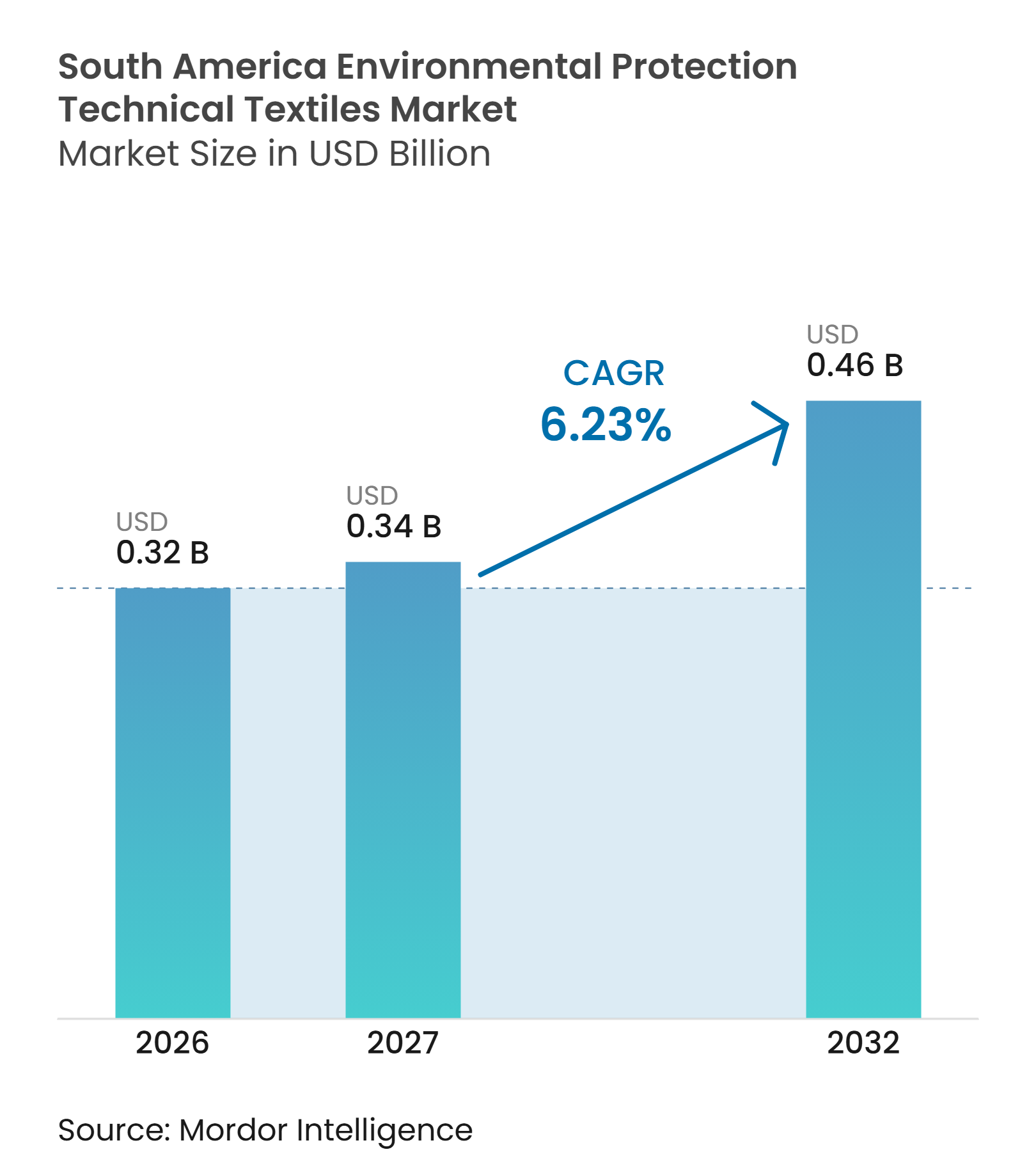
| Base Year Market Size (2026) | USD 0.32 Billion |
| Market Size (2027) | USD 0.34 Billion |
| Market Size (2032) | USD 0.46 Billion |
| Growth Rate (2027 - 2032) | 6.23 % |
| Market Concentration | Medium |
Major Players *Disclaimer: Major Players sorted in no particular order Image © Mordor Intelligence. Reuse requires attribution under CC BY 4.0. | |
South America Environmental Protection Technical Textiles Market Analysis by Mordor Intelligence
The South America Environmental Protection Technical Textiles Market size is expected to increase from USD 0.32 billion in 2026 to USD 0.34 billion in 2027 and reach USD 0.46 billion by 2032, growing at a CAGR of 6.23% over 2027-2032.
Demand is supported by tighter environmental controls in mining and industry, water and sanitation investment, and construction of engineered landfills. Filter fabrics, geomembrane composites, nonwoven filtration media, and sorbent textiles are increasingly treated as operating requirements by resource-intensive businesses rather than optional construction materials. This gives the South America environmental protection technical textiles market some protection from changing construction cycles because buyers must meet permit and operating obligations. Suppliers are responding through products that withstand high heat, corrosive gases, abrasive slurries, and complex water streams. The strongest opportunities are likely to remain where regulatory enforcement, water infrastructure funding, and technical specification needs overlap.
Key Report Takeaways
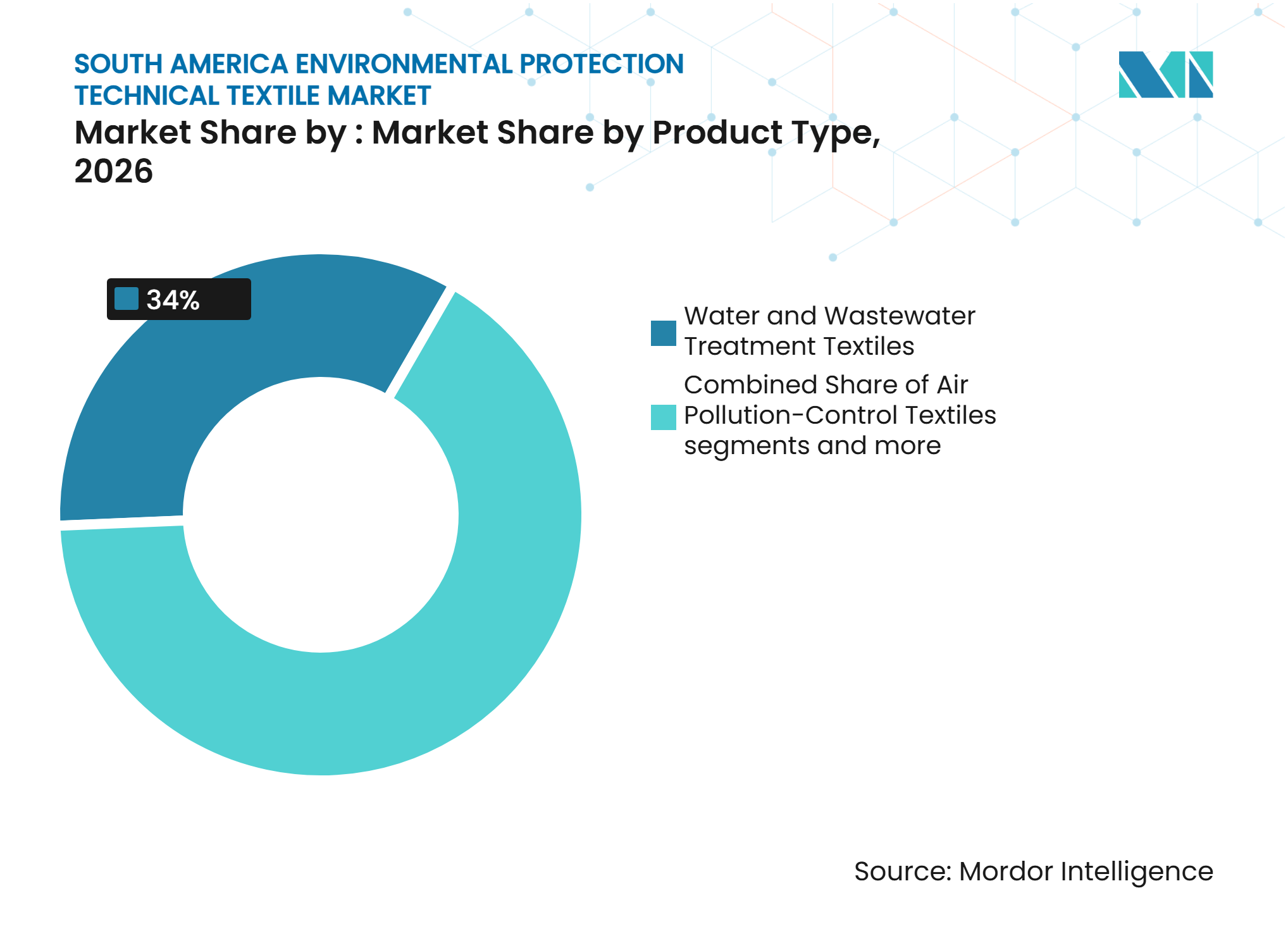
- By product type, water and wastewater treatment textiles held a 34% of South America environmental protection technical textiles market share in 2026, and is forecast to grow at a 7.2% CAGR through 2032.
- By material type, polyester held 30.5% of South America environmental protection technical textiles market size in 2026, while high-performance synthetic fibers are forecast to expand at a 7.4% CAGR through 2032.
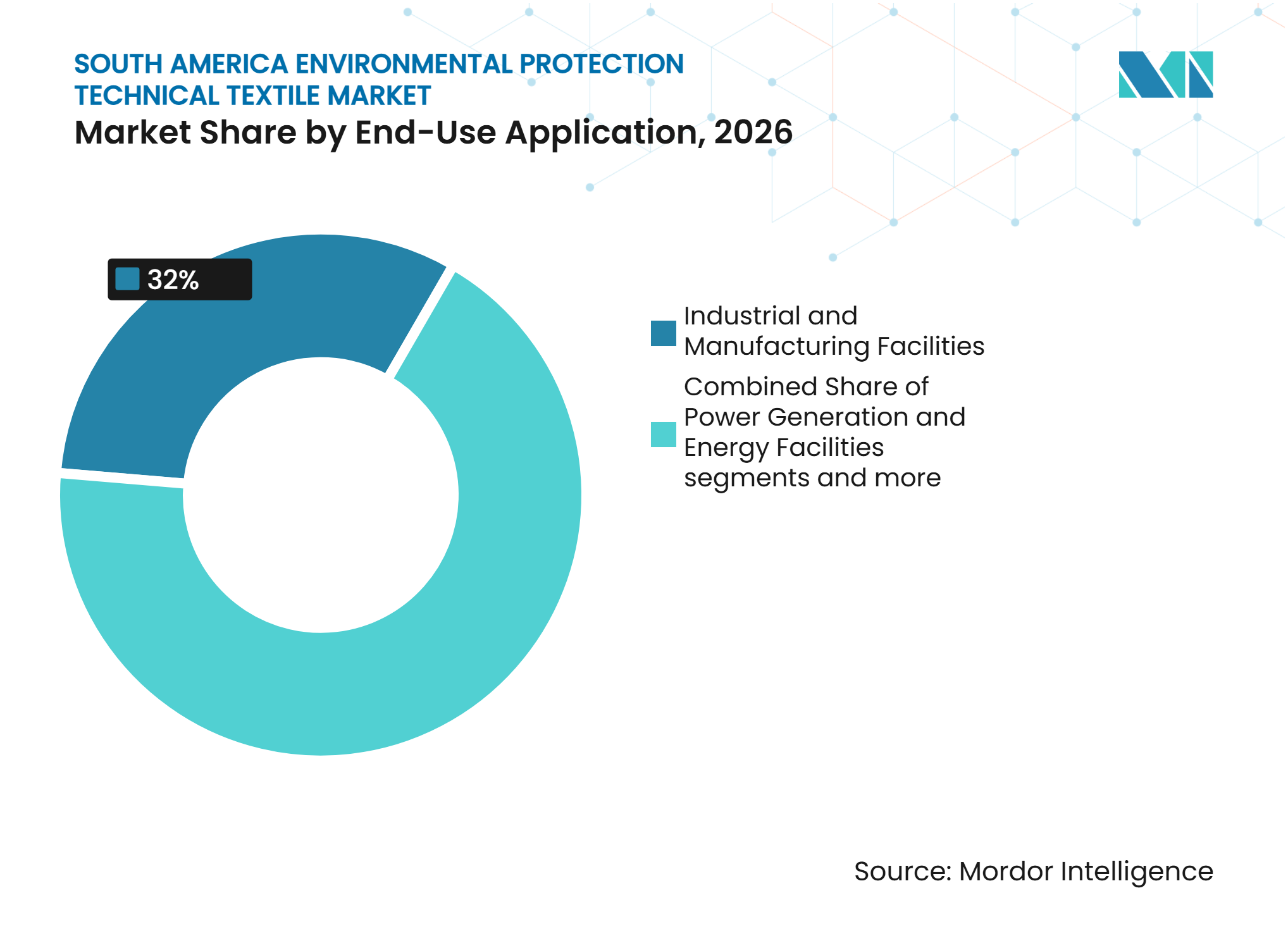
- By end-use application, industrial and manufacturing facilities held 32% market share in 2026, while municipal water and wastewater utilities are forecast to expand at a 7.1% CAGR through 2032.
- By geography, Brazil held a 45.5% market share in 2026, while Argentina is forecast to expand at a 7% CAGR through 2032.
Note: Market numbers in this report are based on Mordor Intelligence's proprietary estimation framework, which combines nine months of actuals with Q4 projections for base year 2026.
Market Trends and Insights
Drivers Impact Analysis of South America Environmental Protection Technical Textiles Market*
| Driver | (~) % Impact on CAGR Forecast | Geographic Relevance | Impact Timeline |
|---|---|---|---|
| Infrastructure Renewal and Climate-Resilient Construction | +1.8% | South America, strongest in Brazil and Chile | Medium term (2-4 years) |
| Mining Wastewater and Tailings Compliance | +1.5% | Chile, Peru, Brazil | Short term (≤ 2 years) |
| Tightening Industrial Air and Effluent Controls | +1.2% | Brazil, Chile, Colombia | Medium term (2-4 years) |
| Landfill Containment and Leachate Management | +0.8% | Brazil, Argentina, Colombia | Medium term (2-4 years) |
| Recycled-Polymer and Lifecycle-Value Procurement | +0.5% | Brazil, Argentina | Long term (≥ 4 years) |
| Localized High-Performance Filtration for Andean Mining | +0.3% | Chile, Peru | Short term (≤ 2 years) |
| Source: Mordor Intelligence | |||
Infrastructure Renewal and Climate-Resilient Construction
South America’s infrastructure gap is a central source of demand for environmental filtration and containment materials. The Inter-American Development Bank estimated that Latin America and the Caribbean would need USD 1.6 trillion of infrastructure investment from 2025 through 2030, equal to 3.5% of annual gross domestic product, with water and sanitation accounting for 25% of the need.[1] In October 2025, ECLAC and the Global Water Partnership launched an initiative intended to mobilize at least USD 20 billion for climate-resilient water investment by 2030.[2] A USD 100 million CAF resilience bond also directed proceeds toward drainage, flood control, waste management, and water and sanitation work in Brazil.[3] These programs can increase specifications for drainage layers, filter media, and composite barriers as project designs move from basic works toward resilient systems. They can also move procurement toward systems that integrate separation, drainage, and long-term water control.
Mining Wastewater and Tailings Compliance
Mining operators in Brazil, Chile, and Peru face stricter rules for tailings containment and water management. IBRAM and ABMS completed a revision to ABNT NBR 13028 in December 2025 that included updated guidance for dewatered tailings disposal in stockpiles. This favors filter-press dewatering, which relies on durable filter cloths, over conventional wet storage. The South America environmental protection technical textiles market benefits when operators redesign tailings facilities around dewatering, containment, and long-term monitoring. This work can create recurring demand because filter media and containment systems require replacement, inspection, and maintenance after initial installation.
Tightening Industrial Air and Effluent Controls
Environmental licensing rules are making filtration equipment more important at industrial facilities. Continuous monitoring requirements can make high-efficiency baghouse fabric an operating requirement rather than a discretionary capital upgrade. Chile approved a copper-smelter emission standard that requires phased sulfur and arsenic capture of at least 95%, rising to 98%, and identifies the Superintendencia del Medio Ambiente as the enforcement body. Chile’s environmental regulator also introduced a 2025 strategy for monitoring facilities that discharge liquid waste, including a digital platform for discharge data. These measures support regular replacement cycles for baghouse fabrics and higher performance requirements for liquid filtration. The South America environmental protection technical textiles market is therefore increasingly connected to operating compliance, not only to one-time equipment investment.
Landfill Containment and Leachate Management
The move from open disposal sites toward engineered sanitary landfills supports use of geomembranes, geotextiles, and leachate drainage systems. A 2026 study found that landfill covers using geomembranes and polymeric materials reduced water infiltration and leachate generation more effectively than traditional covers under Brazilian conditions. These systems also preserve airspace, which can extend the useful operating life of a landfill. Municipal projects increasingly need combined barrier designs rather than a single liner material. This raises the technical textile content of each permitted landfill cell because protective nonwoven layers and drainage components are used with geomembranes. The South America environmental protection technical textiles market can gain from this shift, where environmental licensing and municipal funding advance together.
Restraints Impact Analysis of South America Environmental Protection Technical Textiles Market*
| Restraint | (~) % Impact on CAGR Forecast | Geographic Relevance | Impact Timeline |
|---|---|---|---|
| Polypropylene, Polyester, and Energy Price Volatility | -0.4% | Global, affects all of South America | Short term (≤ 2 years) |
| Import Dependence for Specialty Media and Coatings | -0.3% | Argentina, Chile, Peru, Colombia | Long term (≥ 4 years) |
| Fragmented Specifications and Uneven Enforcement | -0.2% | South America, most acute outside Brazil | Long term (≥ 4 years) |
| Limited End-of-Life Recovery for Contaminated Textiles | -0.1% | South America | Long term (≥ 4 years) |
| Source: Mordor Intelligence | |||
Polypropylene, Polyester, and Energy Price Volatility
Polypropylene and polyester are major inputs for nonwovens and filter fabrics, so changes in petrochemical costs affect converters quickly. Most polymer pricing remains connected to crude-oil-derived intermediates and pressure margins during periods of energy-price disruption. Public tenders and multiyear mining contracts can make it difficult for suppliers to pass higher input costs to customers without delay. Price increases postpone upgrades to higher-grade media, even where environmental needs remain clear. Currency depreciation can add further cost because imported specialty media and raw materials are commonly priced in USD. The effect is more likely to delay procurement schedules than to remove the underlying requirement for pollution-control materials.
Import Dependence for Specialty Media and Coatings
Brazil is the region’s main location for domestic filter-media manufacturing capacity, while other South American countries depend more heavily on imports of specialized products. Chilean mining operations need PTFE-laminated, fluoropolymer, and high-temperature glass-fiber fabrics for demanding gas and slurry conditions. Longer delivery times can complicate maintenance planning and create a preference for stocked alternatives, even when those alternatives do not meet ideal specifications. Certifications such as ABNT, ISO, and EN remain important compliance factors for high-performance products. Domestic capability outside Brazil would take time to build because production equipment, technical know-how, testing, and approval processes must develop together.
*Our forecasts treat driver/restraint impacts as directional, not additive. The impact forecasts reflect baseline growth, mix effects, and variable interactions.
South America Environmental Protection Technical Textiles Market Segment Analysis
By Product Type:
Water Treatment Leads, Air-Control Gains GroundWater and wastewater treatment textiles accounted for 34% of the South America environmental protection technical textiles market share in 2026 and are forecast to expand at a 7.2% CAGR through 2032. Municipal sanitation needs, industrial effluent rules, and water reuse efforts in mining and manufacturing support the segment. Wastewater and effluent filtration products are gaining relevance as discharge requirements become more rigorous. The 2025 regional water and sanitation gap remained substantial, with 145 million people lacking safely managed drinking water and 323 million lacking safely managed sanitation services in Latin America and the Caribbean. This points to sustained requirements for filter beds, sludge dewatering belts, and containment materials where new systems are built or upgraded.
Air pollution-control textiles form the next large product area because cement plants, power facilities, and copper smelters require particulate and gas-control systems. Higher capture requirements at Chilean copper smelters support demand for materials that manage high temperatures and acidic gases across longer operating cycles. The South America environmental protection technical textile industry is also seeing demand for oil and chemical spill-control products as well as stormwater pollution-control materials. These smaller categories serve offshore operations, urban drainage projects, and emergency response work. Other specialized materials, including remediation geotextiles, remain an emerging part of the offering because products suitable for complex contaminant containment are still limited in the region.



By Material Type:
Polyester Leads, High-Performance Synthetics AcceleratePolyester held 30.5% of market value in 2026 because it provides a useful balance of cost, chemical resistance, moderate-temperature stability, and availability. It is widely used in wastewater-treatment nonwovens, leachate drainage geocomposites, and dust-collector filter bags. Polypropylene also remains important for spunbond materials, geotextiles, drainage applications, and sorbent products. A 2026 scientific study reported that filters made from recycled polypropylene and polyester waste could achieve 99.9% filtration efficiency under optimized electro-blowing conditions. This supports the technical case for recycled-content media in applications that require high filtration performance.
High-performance synthetic fibers are forecast to grow at a 7.4% CAGR through 2032, the fastest rate among material categories. Polyphenylene sulfide, aramid, and related materials are used where standard polyester and acrylic products cannot meet heat or acid-gas requirements. The South America environmental protection technical textiles market size for these materials is supported by upgrades at copper and cement facilities that must meet tighter emission requirements. Glass fibers, fluoropolymer media, and polyamide serve more specific conditions, including high-temperature kiln gases, corrosive environments, and abrasive mineral slurries. Natural and regenerated cellulosic materials remain a smaller category.
By End-Use Application:
Industrial Dominates, Municipal Demand AcceleratesIndustrial and manufacturing facilities accounted for 32% of value in 2026, making them the largest end-use category. Mining, metals, cement, chemicals, and petrochemicals use filter cloths, baghouse fabrics, liner composites, and drainage materials across multiple operations. Metals, mining, and mineral processing are especially significant because tailings dewatering and smelter emission control require technically demanding products. Brazil’s updated mining-dam rules and ABNT NBR 13028 revision support wider use of dewatering and monitored containment systems. Mine closure and legacy-tailings remediation can also create demand beyond purchases by active operating sites.
Municipal water and wastewater utilities are projected to grow at a 7.1% CAGR through 2032, the fastest end-use rate. Financing for water resilience and persistent gaps in sanitation access are increasing the need for treatment, sludge management, and drainage infrastructure. The South America environmental protection technical textile industry also serves stable needs in power generation and energy facilities, where baghouse systems require periodic maintenance. Municipal solid-waste facilities require liners, drainage layers, and separation materials as disposal practices become more controlled. Oil and gas response, urban stormwater, environmental remediation, and emergency services complete the application base with distinct demand for sorbents, filtration media, and geotextiles.

Geography Analysis
Brazil: Regulatory Depth and Manufacturing Base Anchor Market Leadership
Brazil held 45.5% of the South America environmental protection technical textiles market share in 2026. The country combines the region’s most diversified industrial base with extensive mining, active environmental licensing, and meaningful domestic filter-media production. ANM Resolution No. 220 of 2025 requires mining-dam safety measures and supports demand for dry-stack-compatible filtration and containment systems. Financing for drainage, flood control, waste management, and water infrastructure is also supported by CAF’s resilience bond, which identified Brazil as its first beneficiary country.
Argentina: Regulatory Activation Underpins Fastest-Paced Growth
Argentina is forecast to grow at a 7% CAGR from 2027 through 2032. Water governance changes and stronger enforcement around industrial discharges support demand for filtration fabrics, geosynthetics, and containment materials. The country changed its water-services regulatory framework through Decree 493 of 2025 for the Buenos Aires metropolitan area. Environmental enforcement in the Matanza-Riachuelo basin also increases the need for functioning effluent-control systems. Water, road, and drainage investment can create a larger construction procurement base, while lithium operations in Salta and Jujuy add demand for chemically resistant containment and brine-management materials.
Andean and Regional Markets: Mining Compliance and Urban Growth Drive Uptake
Chile is a technically demanding market because copper mining drives a high share of filtration and water-management requirements. Copper mining reduced continental water extraction by 7% in 2025 as seawater use increased, which also raises the need for on-site recirculation and filtration. The new copper-smelter standard establishes a clear regulatory influence on high-performance baghouse materials. Peru benefits from similar mining-related needs, including dry-stack tailings systems, while Colombia’s road, water, and urban-drainage projects support separation and stormwater filtration products. Bolivia, Ecuador, and the rest of the region represent smaller, project-led opportunities where mining and municipal water works can create periodic demand for imported products.
Competitive Landscape
Market Concentration
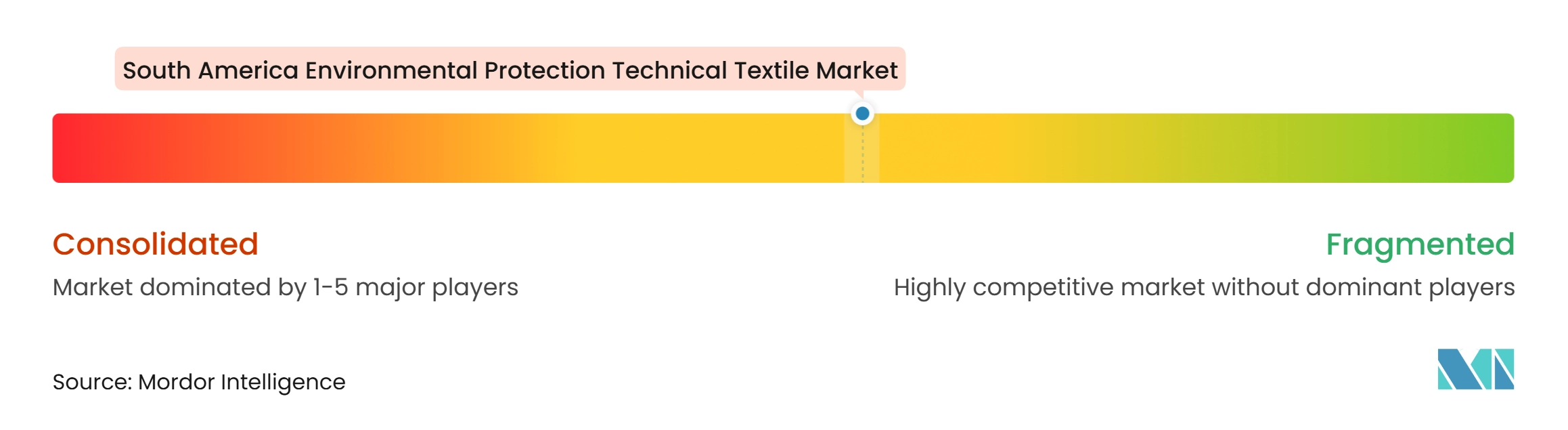
The South America environmental protection technical textiles market exhibits a medium level of market concentration. Freudenberg Performance Materials, Fibertex Nonwovens, HUESKER, NAUE, and Solmax are among the suppliers active in differentiated filter bags, geomembranes, and specialty nonwovens. Their certified products and technical capabilities can make entry difficult in applications that require ABNT, ISO, or EN compliance. Brazilian suppliers, including OBER S/A, TN PLATEX, and BMD Têxteis, and Argentine producers such as Mafissa and S.A. Fabril Scavone compete more directly in polypropylene nonwovens and standard filtration fabrics.
Freudenberg renamed its Slovenian Filc subsidiary under the Freudenberg Performance Materials identity effective January 2026, consolidating its nonwoven filtration capabilities within the group’s global product organization. The company also presented Filtura industrial air-pollution-control media at Filtration & Separation Asia 2026, highlighting PET-based media with ePTFE membrane lamination for difficult filtration uses. These actions show how global suppliers use product integration and higher-performance media to protect specialized positions. Their strategy is relevant to the South America environmental protection technical textiles market because industrial buyers increasingly need verified filtration performance. Local manufacturers retain an advantage where faster delivery, local service, and lower installed cost are more important than advanced media specifications.
Competition is also moving toward PFAS-related containment, recycled feedstocks, and water-recovery applications. PTFE membrane lamination, electrostatic nanofiber media, and high-temperature glass-fiber products increasingly distinguish suppliers serving mining, cement, and chemicals. Valmet has promoted custom filtration solutions for mining operations, focused on production efficiency and solid-liquid separation. Rio2’s 2026 commissioning of the Condestable Tailings Filtration Facility in Peru illustrates a customer-side move toward dry-stack tailings management. The South America environmental protection technical textiles market will remain attractive for suppliers that combine material performance with reliable service, local inventory, and support for compliance documentation.
South America Environmental Protection Technical Textiles Industry Leaders
-
AGRU America, Inc.
-
Solmax
-
HUESKER Synthetic GmbH
-
NAUE GmbH & Co. KG
-
Officine Maccaferri S.p.A.
- *Disclaimer: Major Players sorted in no particular order
South America Environmental Protection Technical Textiles Market Companies Covered in this Report
- AGRU America, Inc.
- Solmax
- HUESKER Synthetic GmbH
- NAUE GmbH & Co. KG
- Officine Maccaferri S.p.A.
- TDM
- Mafissa
- Geomatrix S.A.S.
- OBER S/A
- S.A. Fabril Scavone
- TN PLATEX
- Reicotex
- ADV Tex
- Freudenberg Performance Materials
- Fibertex Nonwovens A/S
- Tensar, a division of CMC
- Geotextil
- EXUNETT
- Zantex
- BMD Têxteis
Recent Industry Developments in South America Environmental Protection Technical Textiles Market
- April 2026: Rio2 Limited commenced commissioning of the Condestable Tailings Filtration Facility in Peru, following an 18-month construction period and USD 27 million capital investment, with an installed design capacity of 8,400 tons per day, transitioning Condestable to dry-stack tailings in compliance with Copper Mark Certification requirements and providing a blueprint for smaller Andean copper operations facing similar environmental compliance timelines.
- January 2026: Freudenberg Performance Materials formally rebranded its Slovenian manufacturing subsidiary Filc under the Freudenberg Performance Materials brand identity, effective January 1, 2026, completing the integration of Filc’s nonwoven filtration competencies into the group’s global technical textile architecture and broadening the product range coordinated across South American markets.
- December 2025: IBRAM’s secretariat, in partnership with ABMS, concluded revision of ABNT NBR 13028, publishing a fifth edition in three parts including new requirements for dewatered tailings in stockpiles, a standard update that pushes Brazilian and regional mining operators toward filter-press-intensive tailings handling systems that require increased technical filter cloth procurement.
South America Environmental Protection Technical Textiles Market Report Scope
The South America Environmental Protection Technical Textiles Market is Segmented by Product Type (Oil and Chemical Spill-Control Textiles, and More), by Material Type (Polypropylene, Polyester, and More), by End-Use Application (Municipal Water and Wastewater Utilities, Industrial and Manufacturing Facilities, and More), and by Geography (Brazil, Argentina, and More). The Market Forecasts are Provided in Terms of Value (USD).
Segmentation Overview
| Air Pollution-Control Textiles | Particulate Emission-Control Filter Textiles |
| Catalytic and Multifunctional Emission-Control Textiles | |
| Other Specialized Air Pollution-Control Textiles | |
| Water and Wastewater Treatment Textiles | Water Purification and Fine-Filtration Textile Media |
| Wastewater and Effluent Filtration Textiles | |
| Wastewater Sludge Dewatering Textiles | |
| Oil and Chemical Spill-Control Textiles | Flat-Form Absorbent Textiles |
| Shaped Absorbent Textile Products | |
| Textile-Based Spill Containment Products | |
| Other Specialized Spill-Control Textiles | |
| Stormwater and Surface Runoff Pollution-Control Textiles | Drain-Inlet and Catch-Basin Textile Filter Bags |
| Stormwater Filter Mats and Textile Inserts | |
| Textile Media for Stormwater Filter Cartridges | |
| Other Dedicated Runoff Pollution-Removal Textiles | |
| Other Specialized Environmental Protection Textiles (Contaminant Remediation Products, etc.) |
| Polypropylene |
| Polyester |
| Polyamide |
| Polyethylene and Other Polyolefins |
| High-Performance Synthetic Fibers (Polyphenylene Sulfide, Aramid, etc.) |
| Fluoropolymer Textile Media |
| Glass and Other Inorganic Fibers |
| Natural and Regenerated Cellulosic Fibers |
| Other Materials |
| Municipal Water and Wastewater Utilities | Drinking Water Treatment |
| Municipal Wastewater Treatment | |
| Industrial and Manufacturing Facilities | Chemicals and Petrochemicals |
| Metals, Mining, and Mineral Processing | |
| Cement and Building Materials Manufacturing | |
| Other Industrial Manufacturing | |
| Power Generation and Energy Facilities | |
| Municipal Solid Waste and Recycling Facilities | |
| Oil and Gas, Marine, and Spill Response Operations | |
| Urban Stormwater and Drainage Infrastructure | |
| Environmental Remediation and Emergency Response Services | |
| Other Environmental Protection End Users |
| Brazil |
| Argentina |
| Chile |
| Peru |
| Colombia |
| Rest of South America |
| By Product Type | Air Pollution-Control Textiles | Particulate Emission-Control Filter Textiles |
| Catalytic and Multifunctional Emission-Control Textiles | ||
| Other Specialized Air Pollution-Control Textiles | ||
| Water and Wastewater Treatment Textiles | Water Purification and Fine-Filtration Textile Media | |
| Wastewater and Effluent Filtration Textiles | ||
| Wastewater Sludge Dewatering Textiles | ||
| Oil and Chemical Spill-Control Textiles | Flat-Form Absorbent Textiles | |
| Shaped Absorbent Textile Products | ||
| Textile-Based Spill Containment Products | ||
| Other Specialized Spill-Control Textiles | ||
| Stormwater and Surface Runoff Pollution-Control Textiles | Drain-Inlet and Catch-Basin Textile Filter Bags | |
| Stormwater Filter Mats and Textile Inserts | ||
| Textile Media for Stormwater Filter Cartridges | ||
| Other Dedicated Runoff Pollution-Removal Textiles | ||
| Other Specialized Environmental Protection Textiles (Contaminant Remediation Products, etc.) | ||
| By Material Type | Polypropylene | |
| Polyester | ||
| Polyamide | ||
| Polyethylene and Other Polyolefins | ||
| High-Performance Synthetic Fibers (Polyphenylene Sulfide, Aramid, etc.) | ||
| Fluoropolymer Textile Media | ||
| Glass and Other Inorganic Fibers | ||
| Natural and Regenerated Cellulosic Fibers | ||
| Other Materials | ||
| By End-Use Application | Municipal Water and Wastewater Utilities | Drinking Water Treatment |
| Municipal Wastewater Treatment | ||
| Industrial and Manufacturing Facilities | Chemicals and Petrochemicals | |
| Metals, Mining, and Mineral Processing | ||
| Cement and Building Materials Manufacturing | ||
| Other Industrial Manufacturing | ||
| Power Generation and Energy Facilities | ||
| Municipal Solid Waste and Recycling Facilities | ||
| Oil and Gas, Marine, and Spill Response Operations | ||
| Urban Stormwater and Drainage Infrastructure | ||
| Environmental Remediation and Emergency Response Services | ||
| Other Environmental Protection End Users | ||
| By Geography | Brazil | |
| Argentina | ||
| Chile | ||
| Peru | ||
| Colombia | ||
| Rest of South America | ||
Key Questions Answered in the Report
What is the expected value of the South America environmental protection technical textiles market by 2032?
The South America environmental protection technical textiles market is projected to reach USD 0.46 billion by 2032, growing at a 6.2% CAGR from 2027 through 2032. Water and sanitation projects, environmental compliance, mining wastewater controls, engineered landfill construction, and a continued need for reliable filtration and containment materials support it.
Which product category leads demand for environmental protection technical textiles in South America?
Water and wastewater treatment textiles led with 34% of value in 2026 and are projected to grow at a 7.2% CAGR through 2032. The category serves municipal sanitation projects, industrial effluent treatment, water reuse, sludge dewatering, and filtration requirements in mining and manufacturing.
Which materials are growing fastest in environmental filtration applications?
High-performance synthetic fibers are forecast to grow at a 7.4% CAGR through 2032 as mining and industrial facilities need stronger heat and chemical resistance. The South America environmental protection technical textiles market uses these materials in demanding filtration applications where standard polyester or acrylic media cannot reliably sustain full operating conditions.
Which end users create the greatest demand for these technical textiles?
Industrial and manufacturing facilities accounted for 32% of value in 2026, led by mining, metals, cement, chemical, and petrochemical operations. These users need filter cloths, baghouse fabrics, liner composites, and drainage materials for tailings handling, emission control, wastewater management, and facility maintenance.
Which South America country has the greatest demand for environmental protection textiles?
Brazil held 45.5% of value in 2026 because of its industrial base, mining activity, environmental licensing rules, and domestic manufacturing capability. The South America environmental protection technical textiles market also benefits in Brazil from investment in drainage, flood control, waste management, water infrastructure, and mining-dam safety measures.
Why are mining rules important for filtration and containment textile demand?
Mining safety and tailings rules favor dewatering, dry-stack handling, and monitored containment, which require filter cloths, liners, and related technical materials. These requirements can generate repeat demand through maintenance and replacement after a facility begins operating, rather than limiting procurement to initial construction.