
Market Overview
| Study Period | 2020 - 2031 |
|---|---|
| Forecast Data Period | 2026 - 2031 |
| Base Year Market Size (2025) | USD 0.67 Billion |
| Market Size (2026) | USD 0.69 Billion |
| Market Size (2031) | USD 0.87 Billion |
| Growth Rate (2026 - 2031) | 4.46 % |
| Market Concentration | Medium |
Major Players *Disclaimer: Major Players sorted in no particular order Image © Mordor Intelligence. Reuse requires attribution under CC BY 4.0. | |
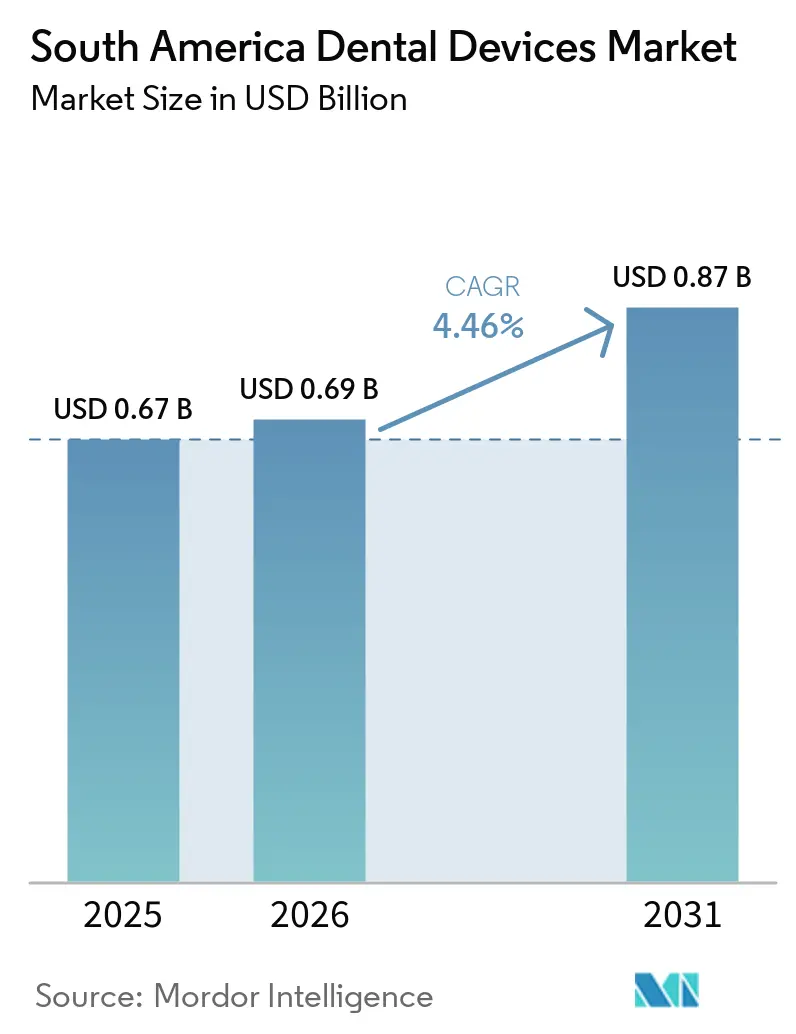
South America Dental Devices Market Analysis by Mordor Intelligence
The South America Dental Devices Market size was valued at USD 0.67 billion in 2025 and is estimated to grow from USD 0.69 billion in 2026 to reach USD 0.87 billion by 2031, at a CAGR of 4.46% during the forecast period (2026-2031).
The South American dental devices market is supported by Brazil’s broad practitioner base, the continued expansion of private clinic networks, and greater use of digital tools in diagnosis and restorative care. Demand is also moving toward implants, prosthetics, and orthodontic treatments as urban patients seek more advanced care. Public oral-health programs in Brazil and Colombia continue to support basic equipment and consumable purchasing, while private networks are placing more orders for higher-value systems. Suppliers increasingly need to combine products with training, clinical support, and dependable service, particularly as larger clinic groups centralize their purchasing.
Key Report Takeaways
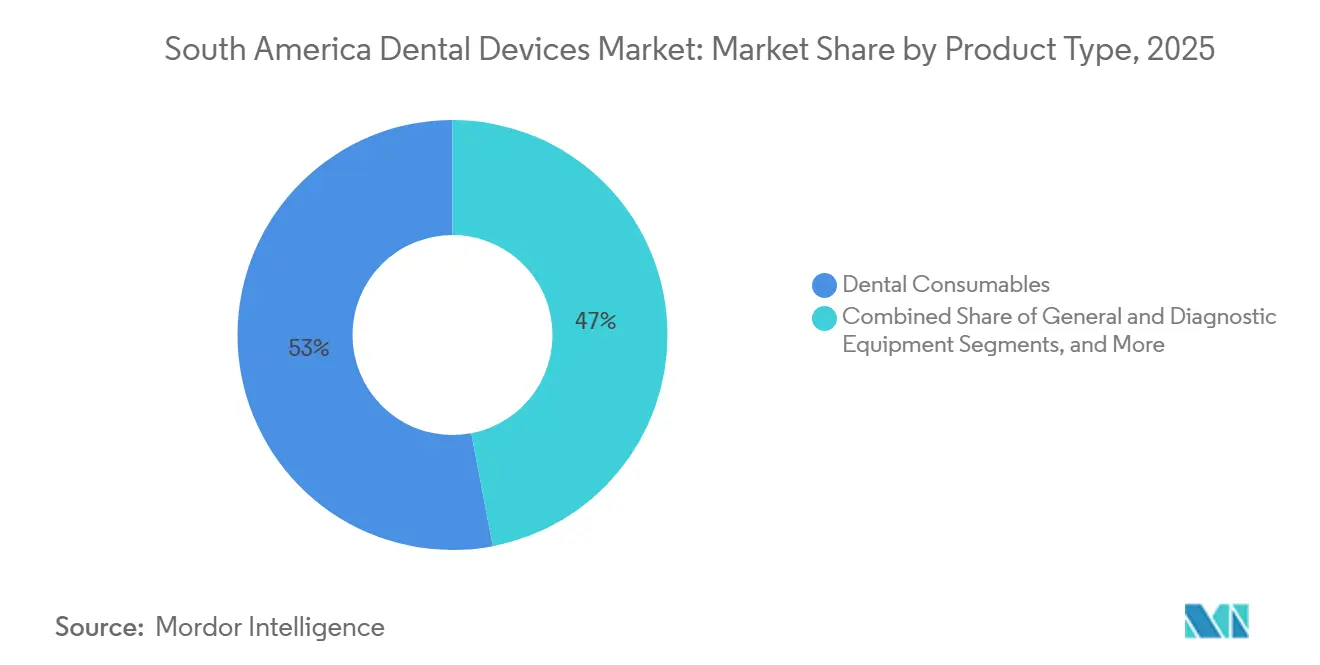
- By product type, consumables held 53.01% of the South American dental devices market share in 2025, while general and diagnostic equipment is projected to grow at a 6.33% CAGR through 2031.
- By treatment type, orthodontics held 33.85% of the South American dental devices market share in 2025, while prosthodontic care is projected to grow at a 5.53% CAGR through 2031.
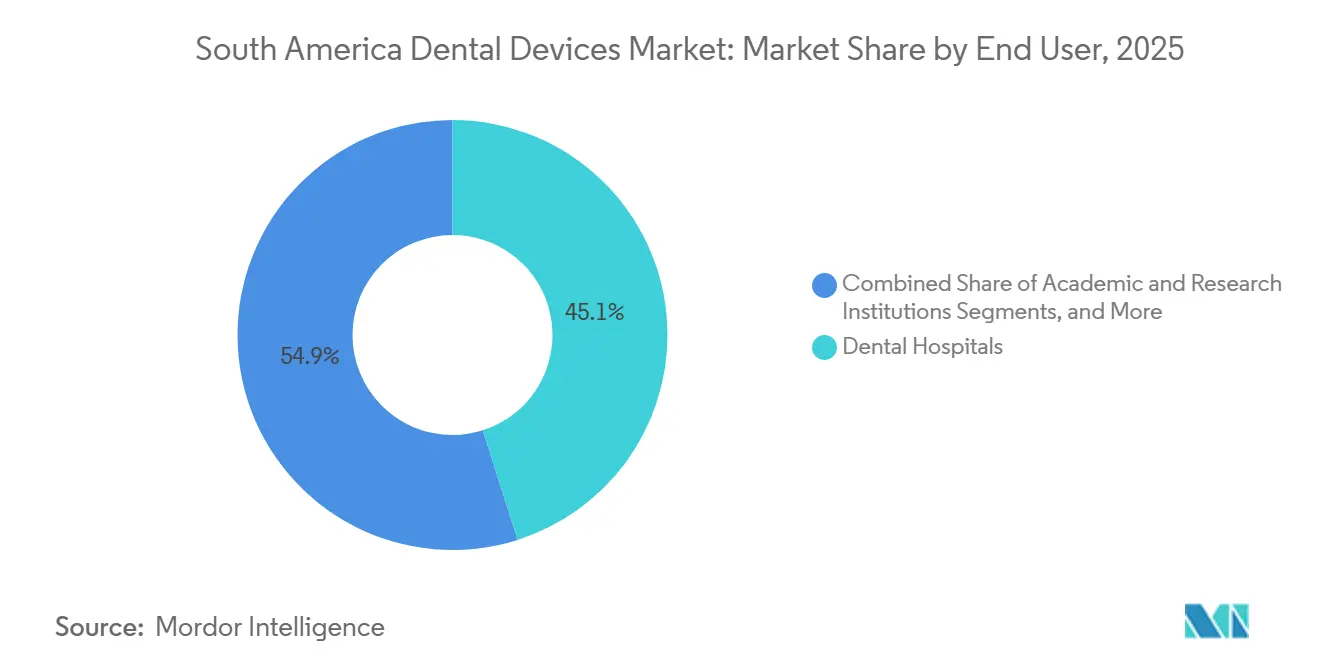
- By end user, dental hospitals held 45.10% of regional end-user revenue in 2025, while dental clinics are projected to grow at a 5.78% CAGR through 2031.
- By geography, Brazil accounted for 45.20% of regional revenue in 2025, while Colombia is projected to grow at a 6.95% CAGR through 2031.
Note: Market size and forecast figures in this report are generated using Mordor Intelligence’s proprietary estimation framework, updated with the latest available data and insights as of January 2026.
Market Trends and Insights
Drivers Impact Analysis of South America Dental Devices Market*
| DRIVER | (~) % IMPACT ON CAGR FORECAST | GEOGRAPHIC RELEVANCE | IMPACT TIMELINE |
|---|---|---|---|
| Private dental clinic network expansion | +1.2% | Brazil, Colombia, Argentina | Short term (≤ 2 years) |
| Digital dentistry workflow adoption | +0.9% | Brazil, Colombia, Chile | Medium term (2-4 years) |
| Implant and restorative procedure growth | +0.8% | Brazil, Argentina, Colombia | Medium term (2-4 years) |
| Public oral-health and primary-care expansion | +0.5% | Brazil, Colombia, Peru | Long term (≥ 4 years) |
| Dental tourism and cross-border treatment demand | +0.4% | Colombia, Brazil | Short term (≤ 2 years) |
| Local manufacturing and service-center expansion | +0.3% | Brazil, Argentina | Medium term (2-4 years) |
| Source: Mordor Intelligence | |||
Expansion of Private Dental Clinic Networks
Private clinic networks are reshaping equipment selection and purchasing across the South American dental devices market. In Brazil, the franchise model has shifted purchasing decisions from individual dentists to centralized dental service organizations, providing suppliers with larger and more predictable orders. However, suppliers must maintain standardized pricing, training, service, and inventory controls across each network. Networks also require device and consumable traceability, supported by Brazil’s ANVISA Unique Device Identification system. Standardized scanners, implant platforms, and dental chairs generate recurring demand for compatible consumables, software, and maintenance services.
Adoption of Digital Dentistry Workflows
Digital dentistry remained a major growth opportunity for the South American dental devices market, as adoption in routine clinical settings was limited. A 2025 study of Brazilian dentists found that 73% performed intraoral radiographs, while only 21% used digital systems. High acquisition and maintenance costs affected 40% of respondents, while 30% cited inadequate equipment infrastructure.[1] In 2026, Dentsply Sirona introduced DS Core Diagnose in Brazil, adding AI-supported analysis of 3D CBCT and 2D X-ray data to connected clinical workflows. Adoption depended on patient volumes, private insurance coverage, financing, technical support, staff capabilities, and regulatory documentation requirements.
Growth of Implant and Restorative Procedures
Implant and restorative procedures generated recurring demand for implants, biomaterials, crowns, bridges, and related instruments across the South American dental devices market. Straumann Group reported 19.5% organic revenue growth in Latin America in the first quarter of 2026, with Brazil, Colombia, and Argentina showing strong momentum in implant products and digital solutions. The company was building a third production facility in Curitiba to expand Neodent capacity for regional and global demand. S.I.N. Implant System introduced implants using Promimic’s HAnano Surface technology at CIOSP 2025, while FGM Dental Group reported exports to more than 100 countries, with exports accounting for 30% of production in 2026. Suppliers benefited by supporting linked clinical needs with compatible products, training, and local availability.
Dental Tourism and Cross-Border Treatment Demand
Cross-border treatment demand increased the commercial importance of specialized clinics in Colombia and Brazil. Patients traveling for implant, restorative, and orthodontic care increased demand for premium imaging systems, implant platforms, and digital prosthetic workflows in established treatment centers. This activity remained concentrated in urban clinics with specialist staff and the capacity to manage complex cases. It encouraged investment in tools that improved diagnosis, treatment planning, and laboratory coordination. For the South American dental devices market, cross-border demand primarily affected the equipment mix at a limited number of specialized private-clinic locations.
Restraints Impact Analysis of South America Dental Devices Market*
| RESTRAINT | (~) % IMPACT ON CAGR FORECAST | GEOGRAPHIC RELEVANCE | IMPACT TIMELINE |
|---|---|---|---|
| Foreign-exchange exposure for imported equipment | -0.6% | Brazil, Argentina | Short term (≤ 2 years) |
| Unequal access to dental care and equipment financing | -0.5% | All regions | Long term (≥ 4 years) |
| Limited specialist digital-dentistry training | -0.3% | Brazil, Colombia, Peru | Medium term (2-4 years) |
| Fragmented after-sales service and consumables supply | -0.2% | Peru, Rest of South America | Medium term (2-4 years) |
| Source: Mordor Intelligence | |||
Foreign-Exchange Exposure for Imported Equipment
Foreign exchange volatility constrains imported system purchases in the South America dental devices market. Brazil’s federal tariffs, state ICMS levies, and COFINS contributions increase the effective cost of foreign equipment by 20-35%. A weaker Brazilian real raises supplier costs or local prices, limiting financing for CBCT and CAD/CAM systems among smaller practices. Peso instability complicates multi-year investment planning in Argentina, while Chile’s managed peso and Ecuador’s dollarized economy provide relatively stable conditions. ANVISA’s device identification requirements and local distribution needs favor companies that effectively manage compliance, inventory, payment terms, and currency exposure.
Unequal Access to Dental Care and Equipment Financing
Unequal financing access creates a clear divide between advanced private clinics and smaller or public providers in the South America dental devices market. A 2025 Brazilian study found a significant association between digital radiography use and the socioeconomic profile of patients served by dentists.[2] Clinics in lower-income communities may recognize the benefits of digital systems but lack sufficient patient volumes or financing capacity to support investment. Public procurement prioritizes durable basic equipment and high-volume consumables, concentrating digital imaging in urban private practices. Broader market growth requires improved financing, training, after-sales support, and consumable availability beyond major metropolitan areas.
*Our forecasts treat driver/restraint impacts as directional, not additive. The impact forecasts reflect baseline growth, mix effects, and variable interactions.
South America Dental Devices Market Segment Analysis
By Product Type:
Consumables Anchor Revenue as Diagnostics AccelerateDental consumables held 53.01% of the South America dental devices market size in 2025, supported by recurring demand for implant components, biomaterials, crowns, bridges, and restorative materials. FGM Dental Group reported exports of 30% of its production to more than 100 countries in 2026. ANVISA’s Unique Device Identification initiatives increased traceability requirements for high-risk consumables and implants, while local manufacturing and standardized clinical platforms supported stable supplier revenue.
General and diagnostic equipment is forecast to grow at a 6.33% CAGR through 2031, making it the fastest-growing product category. CBCT systems, intraoral scanners, digital radiography, and AI-supported diagnostic tools are driving growth. Dentsply Sirona’s 2026 DS Core Diagnose launch in Brazil reflected the shift toward connected imaging and automated clinical visualization. Periodontal instruments and sterilization systems remain essential for public procurement programs and smaller clinics, creating opportunities for bundled offerings, training, and service support.

By Treatment:
Orthodontics Leads as Prosthodontics AcceleratesOrthodontics held 33.85% of the treatment-type mix in 2025, driven by rising adoption of clear aligners and digital scanning among younger urban patients in Brazil, Argentina, and Colombia. Straumann’s Curitiba ClearCorrect facility was the first ClearCorrect production site outside the United States. Align Technology continued clinical engagement through the 2026 Align Evolution Summit LATAM in São Paulo. Orthodontic workflows also supported demand for scanners, imaging systems, treatment-planning software, and related clinical services.
Prosthodontic care is forecast to grow at a 5.53% CAGR through 2031, the fastest rate among treatment categories. Aging populations, edentulism, and demand for fixed restorations support the adoption of implants, crowns, bridges, and denture systems. Endodontics remains the second-largest treatment segment, supported by rotary files, obturation units, apex locators, and digital imaging. Periodontics remains the smallest segment and relies primarily on standard instruments and consumables.
By End User:
Hospitals Hold Volume as Clinics Drive Incremental GrowthDental hospitals held 45.10% of the South American dental devices market size by end user in 2025. They remain key settings for complex prosthodontic, oral surgery, and full-arch rehabilitation procedures. Public procurement programs in Brazil and Colombia direct a meaningful share of device purchases toward accredited hospitals. Their structured replacement cycles and requirements for clinical quality, traceability, and service support stable institutional demand when private capital spending is uneven.
Dental clinics are forecast to grow at a 5.78% CAGR through 2031, making them the fastest-growing end-user channel. Franchise and dental service organization expansion supports coordinated procurement of scanners, implants, chairs, sterilization systems, and consumables. Univali Be Dental School covered CAD/CAM milling units, 3D printers, and digital implant protocols in 2025, supporting technology adoption. Dental laboratories and specialist practices also drive demand for digital impressions, milling systems, prosthetic materials, and focused imaging equipment.
Geography Analysis
Brazil Dental Devices Market
Brazil accounted for 45.20% of regional revenue in 2025, supported by a broad private-clinic base, domestic manufacturing capabilities, and public procurement through the SUS system. Straumann Group reported 20.0% organic growth in Latin America in the fourth quarter of 2025 and 19.5% growth in the first quarter of 2026, with Brazil as a key regional contributor. ANVISA’s 2026 evaluation call for innovative Class III and IV medical devices reflected continued regulatory focus on new device categories. Brazil’s regulatory scale and manufacturing base positioned it as the region’s central commercial market.
Argentina Dental Devices Market
Brazil also served as an export platform for domestic manufacturers. Angelus Dental reported that Prima Dental expanded production capacity by 67% in 2024 and achieved 20% revenue growth. Local production helped suppliers manage currency volatility and logistics challenges affecting imports. Argentina accounted for 10–12% of regional demand, with high-end digital units concentrated in private practices in Buenos Aires and Córdoba. Macroeconomic instability constrained imports and provider financing, creating a divide between high-income private demand and price-sensitive clinics.
South America Dental Devices Market
Colombia is forecast to grow at a CAGR of 6.95% through 2031, the fastest rate in the region. Healthcare reforms, specialized private clinics, and cross-border treatment demand support investments in implants, diagnostics, and digital prosthetic workflows. Straumann Group identified Colombia, Brazil, and Argentina as countries demonstrating strong momentum in the first quarter of 2026. Chile’s stable operating environment supported demand for scanners and CAD/CAM systems, while Peru and the Rest of South America remained focused on mid-tier consumables, refurbished diagnostic equipment, and basic dental chairs.
Competitive Landscape
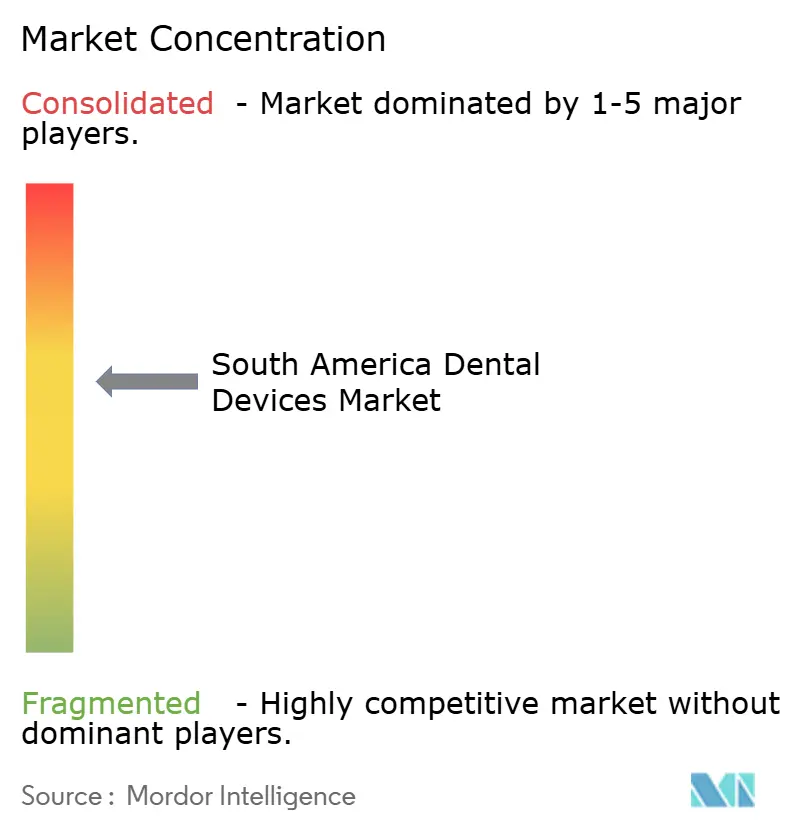
The South America dental devices market is moderately concentrated, with global companies and Brazilian specialists competing across distinct product categories. Straumann Holding, Dentsply Sirona, Envista Holdings, Align Technology, and 3M competed in technology-intensive categories through software, clinical education, and key-account relationships. Neodent, FGM Dental Group, S.I.N. Implant System, Dental Morelli, Angelus Dental, and Alliage S.A. competed through local manufacturing, product availability, and customer proximity. Brazilian specialists remained particularly relevant in implants and consumables, where local supply reduced lead times and simplified service. This balance supported both international and domestic suppliers.
Straumann planned to build a third production facility in Curitiba to expand Neodent product capacity for regional and global markets. Its AXS digital platform recorded user growth exceeding 50% during the six months ending in the first quarter of 2026. FGM Dental Group’s EU-MDR certification strengthened its ability to serve customers using European regulatory standards for supplier assessments. Software adoption, regulatory capabilities, and documentation became increasingly important for suppliers expanding beyond domestic channels. These developments highlighted the importance of long-term support alongside the initial device sale.
Dentsply Sirona presented the MAGNETOM Free.Max Dental Edition with Siemens Healthineers at CIOSP 2026, positioning MRI technology for dental implantology, endodontics, and surgical planning. The move highlighted the advantage global companies held in premium imaging and research-intensive technologies. Local manufacturers found stronger opportunities in mid-tier digital diagnostics, implants, consumables, and services for expanding clinic networks. Each supplier’s competitive position increasingly depended on its ability to support complete clinical workflows rather than individual products.
South America Dental Devices Industry Leaders
-
DENTSPLY SIRONA Inc.
-
Align Technology, Inc.
-
Straumann Holding AG
-
Envista Holdings Corporation
-
Henry Schein, Inc.
- *Disclaimer: Major Players sorted in no particular order
South America Dental Devices Market Companies Covered in this Report
- 3M
- A-dec
- Align Technology
- Alliage S.A.
- Angelus Dental
- BIOLASE
- Bionnovation Biomedical
- Carestream Dental
- Coltene Holding
- Dental Morelli Ltda.
- Dentsply Sirona
- Envista
- FGM Dental Group
- GC Corporation
- Henry Schein
- Ivoclar Vivadent
- Kopp Produtos Odontologicos
- Olsen Industria e Comercio S.A.
- Osstem Implant Co., Ltd.
- Planmeca
- Plenum Bioengenharia
- S.I.N. Implant System
- Straumann Group
- Vatech Co., Ltd.
- ZimVie
Recent Industry Developments in South America Dental Devices Market
- August 2026: ANVISA issued Call No. 5/2026 to assess innovative Class III and IV medical devices with no comparable approved alternatives.
- June 2026: Roland DGA opened a regional dental facility in Bogotá, Colombia, to expand technical support, training, and distribution of DGSHAPE dental milling hardware and digital restoration tools across Latin America.
- February 2026: Dentsply Sirona and Siemens Healthineers presented the MAGNETOM Free.Max Dental Edition at CIOSP 2026 for implant planning, endodontic mapping, and surgical guidance.
- September 2025: ALPINE WHITE launched its at-home dental whitening portfolio in Brazil, featuring peroxide-free peroxy-acid (PAP) Whitening Strips that delivered visible results in as little as three days.
South America Dental Devices Market Report Scope
As per the scope of the report, dental devices are tools, equipment, and custom-made appliances used by health workers to find, fix, and prevent mouth and tooth problems. They range from small hand tools used during checkups to artificial teeth and braces.
The South American dental devices market is segmented by product type, treatment, end user, and geography. By product type, the market includes general and diagnostic equipment, dental consumables, and other dental devices. General and diagnostic equipment comprises dental lasers, radiology equipment, dental chairs, and other general and diagnostic equipment. Dental lasers are further categorized into soft tissue dental lasers and hard tissue dental lasers. Dental consumables include dental biomaterials, dental implants, crowns and bridges, and other dental consumables. By treatment, the market is categorized into orthodontics, endodontics, periodontics, and prosthodontics. By end user, the market is segmented into dental hospitals, dental clinics, academic and research institutions, and other end users. By geography, the market is analyzed across Brazil, Argentina, Colombia, Chile, Peru, and the Rest of South America. The report also covers the estimated market sizes and trends for countries across South America. The report offers market sizes and forecasts in terms of value (USD) for the above segments.
Segmentation Overview
By Product Type
| General and Diagnostic Equipment | Dental Lasers | Soft Tissue Dental Lasers |
| Hard Tissue Dental Lasers | ||
| Radiology Equipment | ||
| Dental Chair and Equipment | ||
| Other General and Diagnostic Equipment | ||
| Dental Consumables | Dental Biomaterial | |
| Dental Implants | ||
| Crowns and Bridges | ||
| Other Dental Consumables | ||
| Other Dental Devices |
By Treatment
| Orthodontic |
| Endodontic |
| Periodontic |
| Prosthodontic |
By End User
| Dental Hospitals |
| Dental Clinics |
| Academic and Research Institutions |
| Other End Users |
By Geography
| Brazil |
| Argentina |
| Colombia |
| Chile |
| Peru |
| Rest of South America |
| By Product Type | General and Diagnostic Equipment | Dental Lasers | Soft Tissue Dental Lasers |
| Hard Tissue Dental Lasers | |||
| Radiology Equipment | |||
| Dental Chair and Equipment | |||
| Other General and Diagnostic Equipment | |||
| Dental Consumables | Dental Biomaterial | ||
| Dental Implants | |||
| Crowns and Bridges | |||
| Other Dental Consumables | |||
| Other Dental Devices | |||
| By Treatment | Orthodontic | ||
| Endodontic | |||
| Periodontic | |||
| Prosthodontic | |||
| By End User | Dental Hospitals | ||
| Dental Clinics | |||
| Academic and Research Institutions | |||
| Other End Users | |||
| By Geography | Brazil | ||
| Argentina | |||
| Colombia | |||
| Chile | |||
| Peru | |||
| Rest of South America | |||
Key Questions Answered in the Report
What is the forecast for the South America dental devices market?
The South America dental devices market is forecast to grow from USD 0.69 billion in 2026 to USD 0.87 billion by 2031 at a 4.46% CAGR. The forecast reflects continuing demand from clinics, hospitals, and dental laboratories.
Which product category leads dental device demand in South America?
Dental consumables led demand with 53.01% share in 2025. Recurring purchases of biomaterials, implant components, crowns, and bridges support this position across outpatient and institutional care.
Which dental device category is expected to grow fastest?
General and diagnostic equipment is forecast to grow at a 6.33% CAGR through 2031. CBCT systems, scanners, digital radiography, and AI-supported diagnostics are the main contributors.
Why is Brazil important for dental device suppliers?
Brazil held 45.20% regional share in 2025 and combines domestic manufacturing, dense private-clinic networks, and large public procurement channels. It is also a key regional base for training and product availability.
Which treatment area has the strongest growth outlook?
Prosthodontic care is forecast to grow at a 5.53% CAGR through 2031. Demand comes from implants, crowns, bridges, dentures, aging populations, and interest in fixed restorative options.
What limits the use of advanced dental systems in South America?
Foreign-exchange exposure, limited equipment financing, uneven training, and fragmented service coverage can delay adoption. These barriers are strongest among smaller clinics and public providers outside major metropolitan areas.