
South America Data Center Risk Engineering and Management Market Size and Share
Market Overview
| Study Period | 2021 - 2032 |
|---|---|
| Forecast Data Period | 2027 - 2032 |
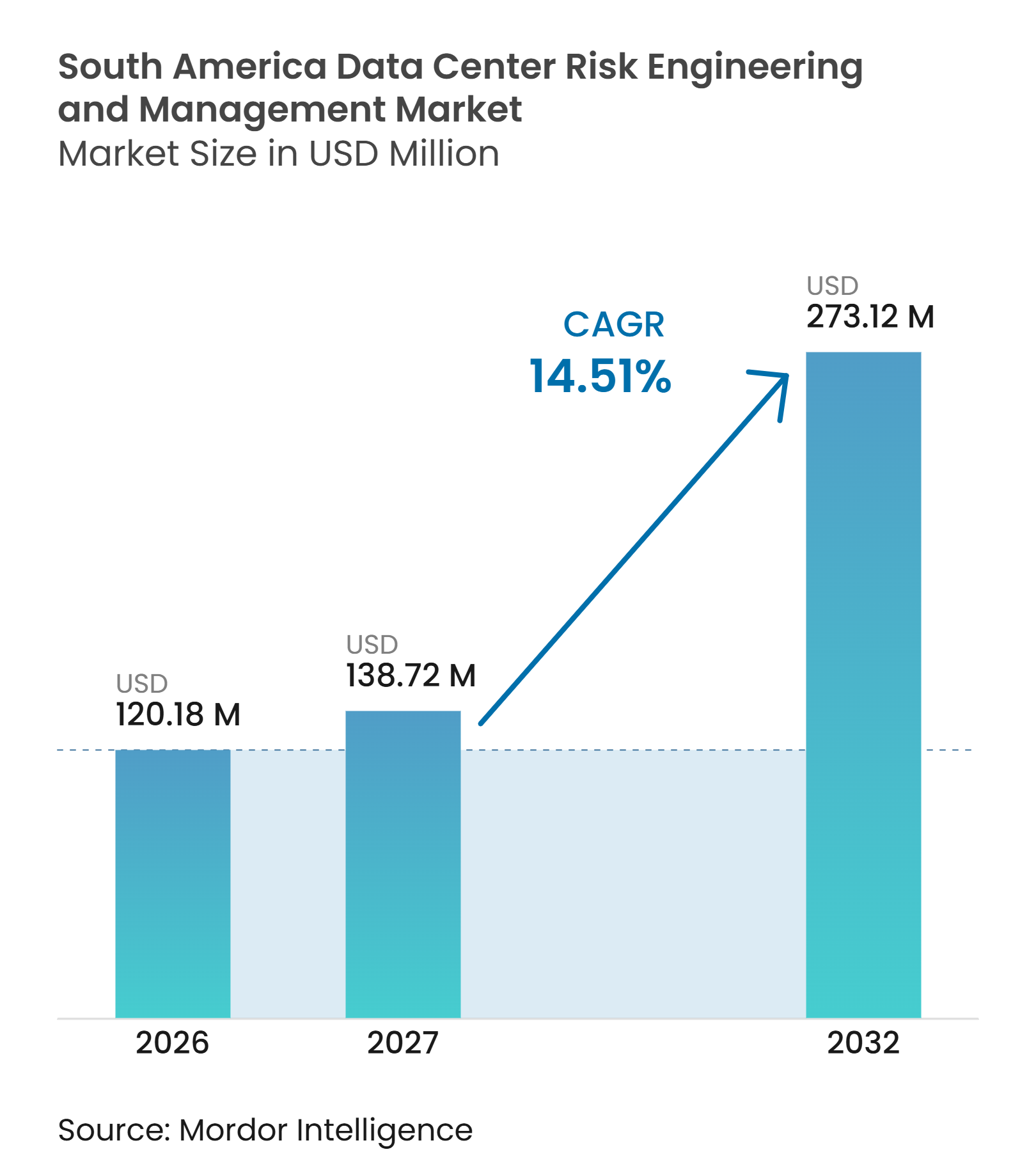
| Base Year Market Size (2026) | USD 120.18 Million |
| Market Size (2027) | USD 138.72 Million |
| Market Size (2032) | USD 273.12 Million |
| Growth Rate (2027 - 2032) | 14.51 % |
| Market Concentration | Low |
Major Players *Disclaimer: Major Players sorted in no particular order Image © Mordor Intelligence. Reuse requires attribution under CC BY 4.0. | |
South America Data Center Risk Engineering and Management Market Analysis by Mordor Intelligence
The South America data center risk engineering and management market size is USD 120.18 million in 2026 and is projected to reach USD 273.12 million by 2032, growing at a CAGR of 14.51% during 2027-2032. The South America data center risk engineering and management market is supported by new hyperscale capacity, which is increasing the need for risk work from site selection through operation. AI deployments add pressure because higher rack densities require more complex power distribution, liquid cooling, fire protection, and monitoring systems. Insurers, lenders, and customers are placing greater weight on documented assessments before projects proceed, making risk engineering part of investment and operating decisions. Providers that combine AI infrastructure knowledge with local regulatory and hazard expertise can serve a wider range of projects across Brazil, Chile, and emerging markets. Grid capacity, water availability, specialist labor, and evolving standards may limit project schedules and raise the need for practical risk planning.
Key Report Takeaways
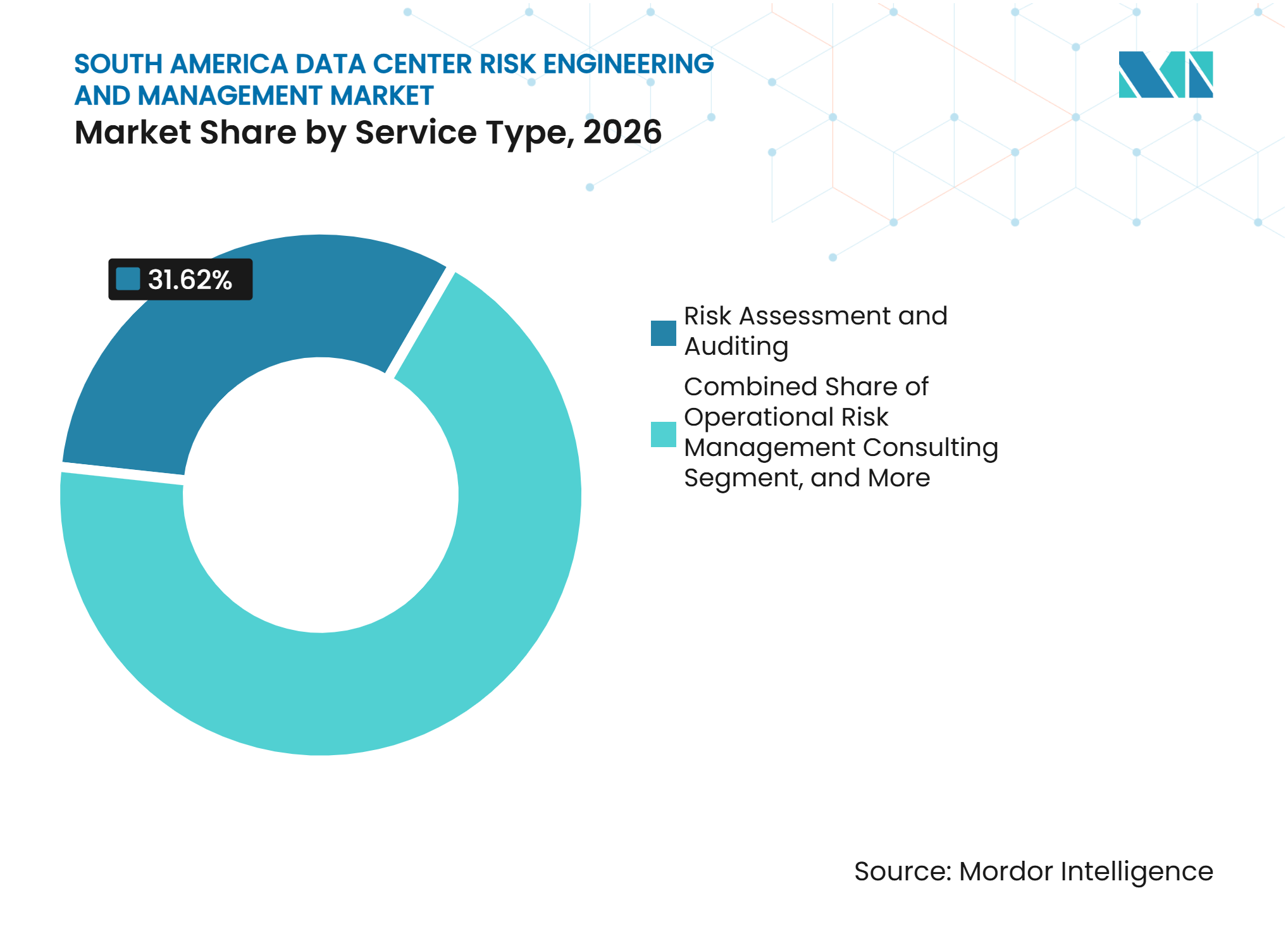
- By service type, Risk Assessment and Auditing held 31.62% of th South America data center risk engineering and management market share in 2026, while Reliability and Availability Engineering is projected to expand at a 14.79% CAGR through 2032.
- By risk category, Electrical and Power Infrastructure Risk held 32.83% share in 2026, while Cooling and Thermal Management Risk is projected to expand at a 14.86% CAGR through 2032.
- By assessment method, Qualitative Risk Assessment held 34.57% share in 2026, while Continuous Risk Assessment and Monitoring is projected to expand at a 14.82% CAGR through 2032.
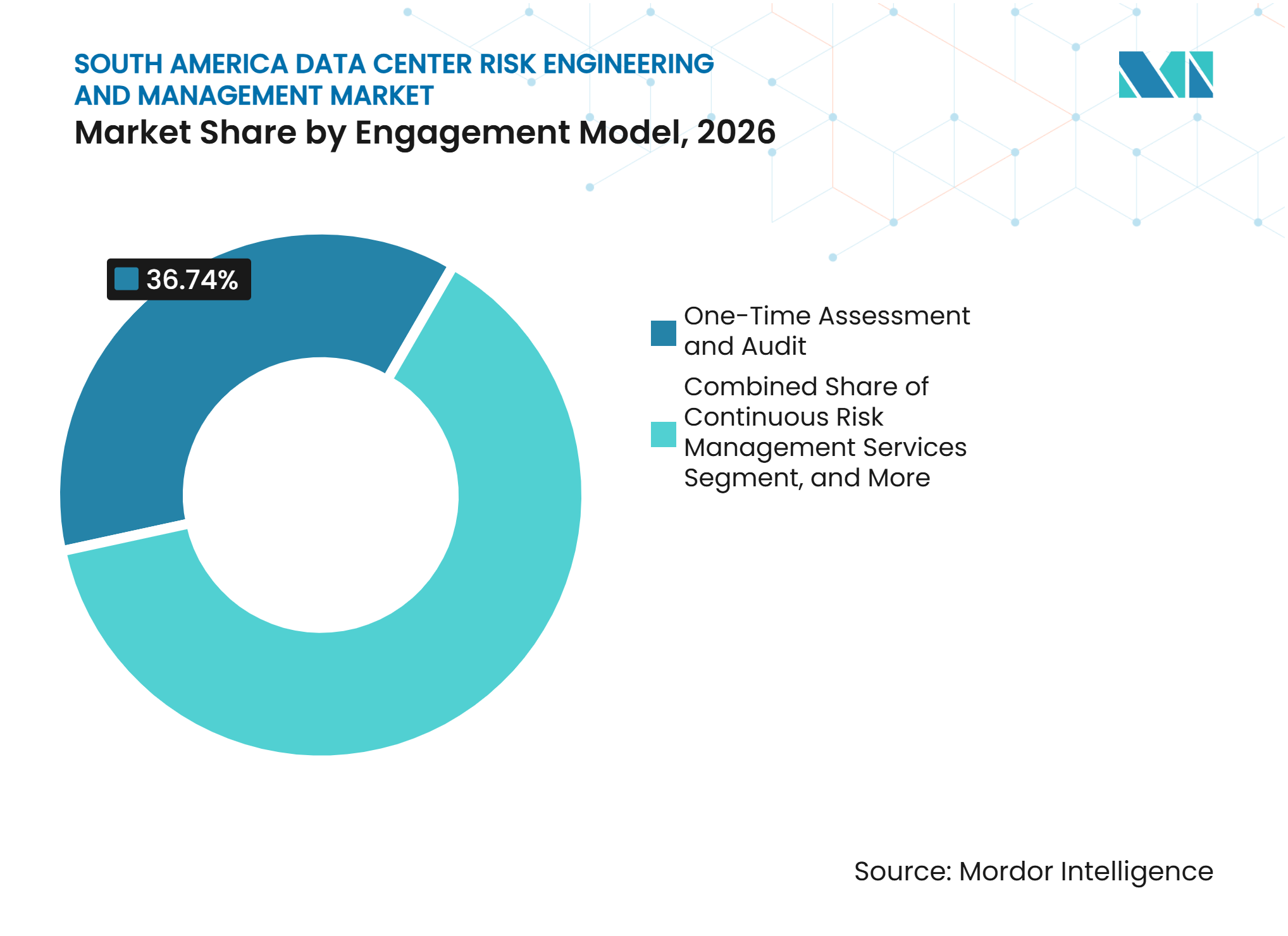
- By engagement model, One-Time Assessment and Audit held 36.74% share in 2026, while Continuous Risk Management Services is projected to expand at a 14.91% CAGR through 2032.
- By project lifecycle stage, Operational Risk Management held 37.49% share in 2026, while Expansion, Retrofit, and Modernization is projected to expand at a 14.84% CAGR through 2032.
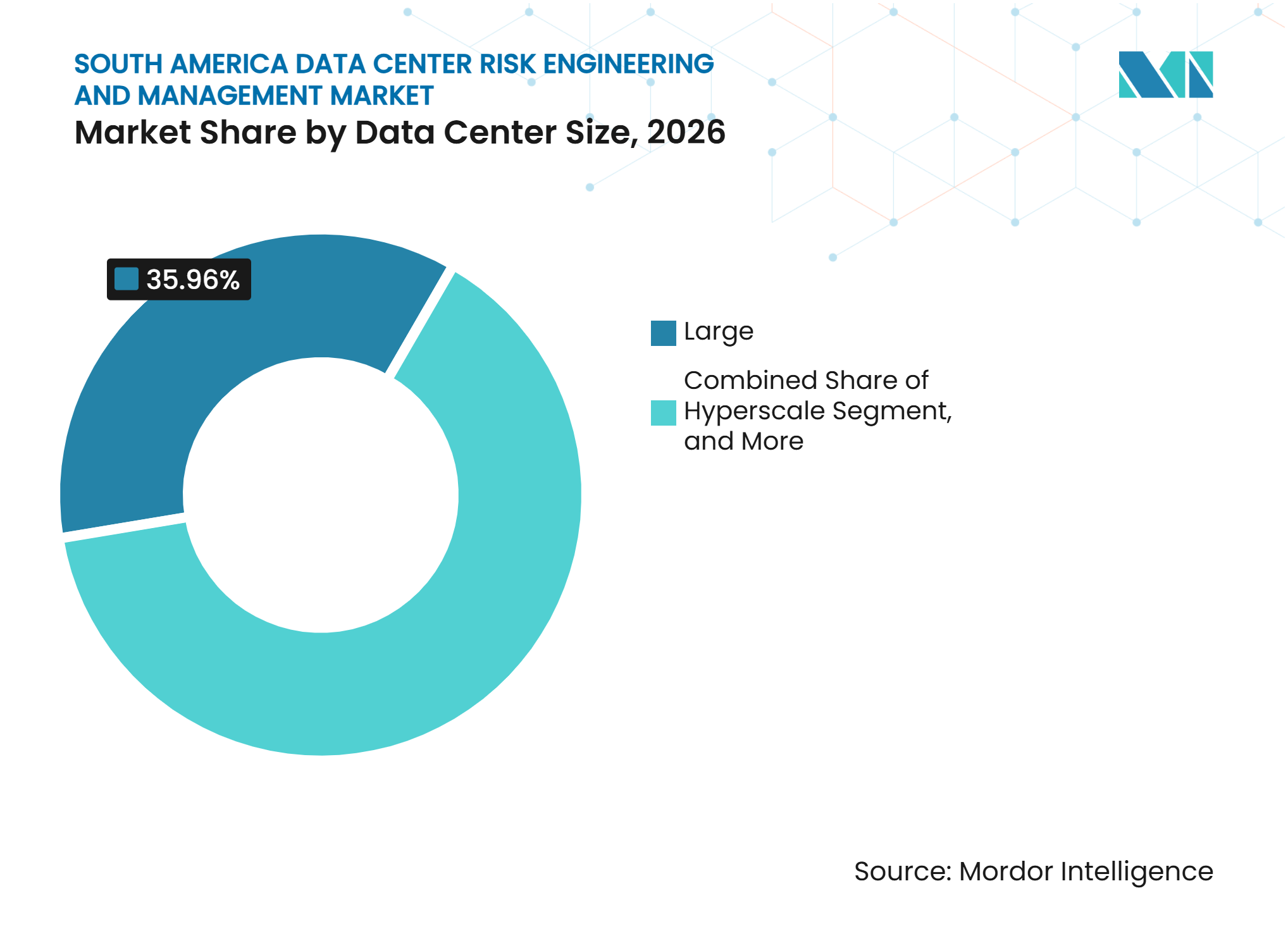
- By data center size, Large data centers held 35.96% share in 2026, while Hyperscale is projected to expand at a 14.94% CAGR through 2032.
- By data center type, Colocation held 43.28% share in 2026, while Cloud Service Providers are projected to expand at a 14.89% CAGR through 2032.
- By geography, Brazil held 52.35% share in 2026, while Chile is projected to expand at a 14.97% CAGR through 2032.
Note: Market numbers in this report are based on Mordor Intelligence's proprietary estimation framework, which combines nine months of actuals with Q4 projections for base year 2026.
Market Trends and Insights
Drivers Impact Analysis of South America Data Center Risk Engineering and Management Market*
| Driver | (~) % Impact on CAGR Forecast | Geographic Relevance | Impact Timeline |
|---|---|---|---|
| Expanding Hyperscale and AI Data Center Capacity | +4.5% | Brazil, Chile, Argentina (emerging) | Short term (≤ 2 years) |
| Increasing Complexity of Power, Cooling, Networking, and Facility Infrastructure | +3.2% | Brazil, Chile, Colombia | Medium term (2-4 years) |
| Rising Risk Exposure From AI Workloads and High-Density Computing Environments | +2.8% | Brazil, Chile | Short term (≤ 2 years) |
| Growing Demand for Reliability Engineering and Critical Infrastructure Assessments | +2.1% | Brazil, Colombia, Peru | Medium term (2-4 years) |
| Insurer, Investor, and Customer Expectations for Documented Risk Mitigation Programs | +1.8% | Brazil, Chile, Global spillover | Short term (≤ 2 years) |
| Data-Residency, Cybersecurity, and Business-Continuity Compliance Requirements | +1.4% | Brazil, Argentina, Colombia | Long term (≥ 4 years) |
| Source: Mordor Intelligence | |||
Expanding Hyperscale and AI Data Center Capacity
South America is seeing concurrent hyperscale projects that require risk support throughout planning, construction, commissioning, and operations. Actis launched the TERRANOVA platform in December 2025 with USD 1.5 billion in committed capital for campuses in Brazil and Chile, creating demand for hazard assessment and reliability work across a multi-campus portfolio. Ascenty planned USD 1 billion of 2026 capital expenditure across Brazil and Chile for 13 active development projects. Several large builds in the same metropolitan area can strain the capacity of specialist firms and increase the value of experienced local teams. FM Global's Intellium program uses a virtual engineering model that can mobilize specialists across site, power, cooling, and battery risks, offering one response to this staffing challenge.[1] The South America data center risk engineering and management market therefore benefits when developers need consistent risk methods across several campuses rather than isolated project reviews.
Increasing Complexity of Power, Cooling, Networking, and Facility Infrastructure
Liquid cooling and denser AI equipment are changing the risks that owners need to assess in new and existing facilities. FM Global updated Data Sheet 5-32 in July 2026 with expanded cooling definitions and liquid-cooling guidance for data centers, reflecting the need for more detailed engineering review. Allianz Commercial reported that fire accounted for 42.3% of loss costs despite accounting for only 10.9% of loss events, while liquid-related failures also remain material for data center claims. These conditions require analysis of links among power, cooling, detection, suppression, and battery systems rather than isolated checks. High-density sites also need clear commissioning procedures because small installation failures can affect multiple systems. This complexity supports demand in the South America data center risk engineering and management market for engineering services that cover both technical design and operating controls.
Rising Risk Exposure From AI Workloads and High-Density Computing Environments
AI facilities concentrate high-value hardware and draw substantially more power within a limited footprint. Swiss Re noted that an AI-class facility can exceed USD 20 billion in construction cost before the value of installed GPU hardware is considered. It also found that 79% of global data center capacity is in areas with elevated natural catastrophe exposure, an issue that matters for Chile's seismic conditions and Brazil's flood exposure. A power interruption at a dense AI installation can quickly become a thermal and service-continuity event. Operators increasingly need scenario analysis that accounts for shared substations, connected cooling plants, and multiple tenants or campuses exposed to the same event. This expands the role of the South America data center risk engineering and management market from basic documentation toward simulations and structured loss modeling.
Growing Demand for Reliability Engineering and Critical Infrastructure Assessments
Reliability work is becoming more frequent as owners upgrade facilities and manage longer equipment delivery periods. The Telecommunications Industry Association launched the Data Center Excellence Quality Standard initiative in February 2026, building on the ISO 9001 high-level structure with early participation from AWS, Oracle, Cummins, and Holder Construction. The initiative highlights the importance of quality management across the supply chain and physical infrastructure lifecycle. The association is also developing ANSI/TIA-942 Addendum 1 for AI applications, targeting mid-2027 publication, with provisions relevant to high-density cabling and liquid cooling. Retrofit projects require new failure-mode assessments when existing power, cooling, and fire protection systems are adapted for AI loads. These shifts provide the South America data center risk engineering and management market with recurring work after the original design review is completed.
Restraints Impact Analysis of South America Data Center Risk Engineering and Management Market*
| Restraint | (~) % Impact on CAGR Forecast | Geographic Relevance | Impact Timeline |
|---|---|---|---|
| High Cost of Specialist Risk Engineering and Assessment Services | -2.3% | South America (regional) | Medium term (2-4 years) |
| Limited Availability of Engineers With Data Center-Specific Expertise | -1.8% | Brazil, Chile, Colombia | Short term (≤ 2 years) |
| Fragmented Risk Data Across Operators, Contractors, and Equipment Suppliers | -1.1% | South America (regional) | Long term (≥ 4 years) |
| Grid, Water, and Permitting Constraints Limiting Risk-Mitigation Options | -0.9% | Brazil, Chile, Argentina | Medium term (2-4 years) |
| Source: Mordor Intelligence | |||
High Cost of Specialist Risk Engineering and Assessment Services
Specialist assessments can be difficult for mid-market colocation operators and enterprise owners to fund on a continuous basis. One-Time Assessment and Audit accounted for 36.74% of the engagement model in 2026, indicating that many buyers still choose defined reviews over ongoing programs. Aon's Data Center Lifecycle Insurance Program combines construction, cyber, cargo, and operating cover with risk engineering, making the service easier to procure as part of a wider facility. This model can broaden access but may also compress the price of a standalone review. Standardized toolkits by facility tier can give smaller operators a practical route to documented controls without the cost of a large bespoke engagement. Cost pressure may keep the South America data center risk engineering and management market weighted toward one-time work until operating risk programs demonstrate clear commercial value.
Limited Availability of Engineers With Data Center-Specific Expertise
Data center risk work requires experience in power systems, thermal management, structural conditions, and operating resilience. The shortage is more pronounced in newer markets, where fewer specialists have completed data center projects at scale. Vertiv Academy Latin America was established to build regional skills and to support localized service hubs in Colombia, Chile, and Peru. FM Global also uses its Intellium virtual engineering unit to deploy subject-matter expertise across geographies. Providers that invest in training and knowledge transfer can improve assessment consistency, but a limited talent pool can slow delivery and raise fees. The South America data center risk engineering and management market remains dependent on building local technical capability alongside project pipelines.
*Our forecasts treat driver/restraint impacts as directional, not additive. The impact forecasts reflect baseline growth, mix effects, and variable interactions.
South America Data Center Risk Engineering and Management Market Segment Analysis
By Service Type:
Risk Assessment Anchors Revenue While Reliability Engineering Leads GrowthRisk Assessment and Auditing captured 31.62% of the South America data center risk engineering and management market share in 2026 because baseline documentation is central to insurer review and colocation due diligence. Aon states that lifecycle risk management spans site selection, design, construction, and operations, thereby connecting formal assessment activities to insurance and financing decisions. Clients use initial assessments to identify hazards and establish evidence for operating controls. These engagements remain necessary even when the owner later adopts a more continuous model.
Reliability and Availability Engineering is projected to expand at a 14.79% CAGR through 2032 as AI service commitments raise the cost of outages. Failure Mode and Effects Analysis, fault-tree analysis, root cause analysis, and hazard identification are more useful when power and cooling systems have many dependencies. Allianz Commercial's data on the cost of fire losses reinforces the need to examine failure paths, not only the presence of individual safeguards.



By Risk Category:
Electrical Risk Dominates, Thermal Risk Moves FastestElectrical and Power Infrastructure Risk accounted for 32.83% of the South America data center risk engineering and management market size by risk category in 2026. Continuous and redundant electricity is fundamental to every facility service, so reviews often extend from the building to substations and transmission connections. Brazil's EPE reported that data center grid connection requests rose from 19.8 GW to 26.2 GW between September and November 2025. This increase creates a need to evaluate connection quality, power availability, and network dependencies before development begins.
Cooling and Thermal Management Risk is projected to expand at a 14.86% CAGR through 2032. Liquid cooling requires controls for fluid selection, leak detection, containment, maintenance, and the interaction of cooling with electrical equipment. FM Global's updated data sheet gives specific attention to these systems in data center properties. Fire, structural, environmental, and supply-chain risks remain interlinked because a cooling failure can affect availability, insurance exposure, and project schedules simultaneously.
By Assessment Method:
Qualitative Methods Lead, Continuous Monitoring AcceleratesQualitative Risk Assessment held 34.57% of the assessment method mix in 2026. It offers a structured starting point for facilities to establish documentation against the Uptime Institute Tier and ANSI/TIA-942 frameworks. The Telecommunications Industry Association reported more than 1,000 ANSI/TIA-942 certifications across more than 800 data centers in over 60 countries, showing the established role of formal infrastructure validation. This approach is especially relevant where operators need a clear initial view of control gaps and compliance requirements.
Continuous Risk Assessment and Monitoring is projected to expand at a 14.82% CAGR through 2032. Sensors and data center infrastructure management tools can provide operational evidence within defined thresholds, rather than relying solely on periodic site visits. This can help detect changes in temperature, power quality, battery condition, and cooling performance before they disrupt service. The method also supports recurring risk services because findings can be reviewed as conditions change. Quantitative assessment, scenario modeling, and digital simulations can then add detail for larger campuses where a single failure may affect several connected systems.
By Engagement Model:
Audits Dominate Today, Continuous Programs Drive Future RevenueOne-Time Assessment and Audit accounted for 36.74% of the engagement model mix in 2026. Many regional facilities are undertaking formal risk work for the first time, often because insurance placement or a customer requirement calls for a completed review. The model gives owners a defined scope and cost, which can be useful for smaller operators. It also allows providers to establish a baseline before recommending corrective actions or a longer service arrangement.
Continuous Risk Management Services is projected to expand at a 14.91% CAGR through 2032. Aon's Data Center Lifecycle Insurance Program was expanded to USD 5 billion in July 2026 and includes lifecycle risk engineering through Aon Global Risk Consulting.[2] Such programs encourage ongoing reviews as facilities move from construction to operation. Managed engineering and integrated advisory work are likely to suit hyperscalers that need consistent controls across a portfolio, while periodic reviews remain relevant for cost-conscious colocation operators.

By Project Lifecycle Stage:
Operations Anchors Revenue, Retrofit AcceleratesOperational Risk Management held 37.49% of the project lifecycle segment in 2026. Brazil's established campuses create recurring work after construction and commissioning are complete. Operational reviews focus on maintenance access, detection systems, emergency procedures, equipment condition, and the evidence needed for certification renewal. They also help owners maintain a consistent control environment while tenant needs change.
Expansion, Retrofit, and Modernization is projected to expand at a 14.84% CAGR through 2032. Older facilities require changes to power distribution, cooling design, and fire protection as rack densities increase. The Chilean government's National Data Centers Plan seeks USD 2.5 billion in inward investment and aims to expand the sector, supporting a pipeline for design and construction oversight. Commissioning work remains important because a retrofit can introduce interfaces between new systems and legacy infrastructure. The South America data center risk engineering and management market can gain recurring work when upgrades require a new review of residual risks.
By Data Center Size:
Large Facilities Anchor Revenue, Hyperscale Drives GrowthLarge data centers held 35.96% of the size segment in 2026. Established campuses in São Paulo, Santiago, and Bogotá require regular assessments to maintain certification, ensure reliability, and ensure compliance. Their scale is sufficient to support dedicated engineering programs, but their systems are usually less concentrated than those of hyperscale campuses. This makes them an important base for recurring operational work.
Hyperscale is projected to expand at a 14.94% CAGR through 2032. AWS committed USD 4 billion to establish its first cloud region in Chile, with 3 availability zones. Hyperscale facilities can combine high equipment values, battery energy storage systems, on-site generation, and liquid cooling within a single campus. Risk assessment must therefore consider common-cause failures across multiple buildings and shared systems. This category broadens the technical scope of the South America data center risk engineering and management market.
By Data Center Type:
Colocation Leads Share, CSPs Command Fastest CAGRColocation held 43.28% of the data center type segment in 2026. Operators such as Equinix, Ascenty, Scala, and ODATA must maintain facility controls that are credible to hyperscale and enterprise tenants. A single infrastructure event can affect multiple customers, so risk assessment must consider tenant aggregation as well as building systems. International certifications can provide a common reference point for customers, insurers, and lenders.
Cloud Service Providers are projected to expand at a 14.89% CAGR through 2032. Proprietary cloud campuses need risk management that follows the project through design, delivery, and long-term operation. Brazil's data protection law and data localization requirements in other regional markets can also support domestic infrastructure needs, depending on the customer and data use case. Compliance and engineering certification services may be beneficial when operators need to demonstrate resilience and data governance.
Geography Analysis
Brazil
Brazil accounted for 52.35% of the South America data center risk engineering and management market share in 2026. The expansion of the São Paulo and Campinas clusters is increasing demand for site, commissioning, and operational assessments. EPE's record of sharply higher grid connection requests shows why risk work increasingly covers transmission and substation dependencies. Brazil's regulatory influence includes Lei Geral de Proteção de Dados, while ANSI/TIA-942 remains relevant to resilience validation. Renewable power procurement also requires review of grid interconnection reliability and contracted energy arrangements.
Chile
Chile is projected to expand at a 14.97% CAGR through 2032. AWS committed USD 4 billion for the first cloud region in Chile, which will comprise 3 availability zones targeted for operation by late 2026. The National Data Centers Plan seeks USD 2.5 billion of inward investment and supports a larger project pipeline. Seismic conditions and water constraints make local engineering expertise important for site selection, structural review, and cooling design.[3] Projects must navigate environmental approvals and infrastructure rules, which adds value to compliance-focused engineering support.
Emerging South American Economies
Argentina, Colombia, Peru, Uruguay, and Paraguay are building earlier-stage project pipelines that broaden the South America data center risk engineering and management market beyond its two largest centers. OpenAI and Sur Energy signed a letter of intent in October 2025 to consider an Argentina project that could require up to USD 25 billion under the RIGI incentive framework. Peru's liquid-cooling-ready capacity and planned local expansion point to future demand for commissioning and Tier III support. Providers that combine international standards with local execution can support early design reviews before higher-value operational services develop.
Competitive Landscape
Market Concentration
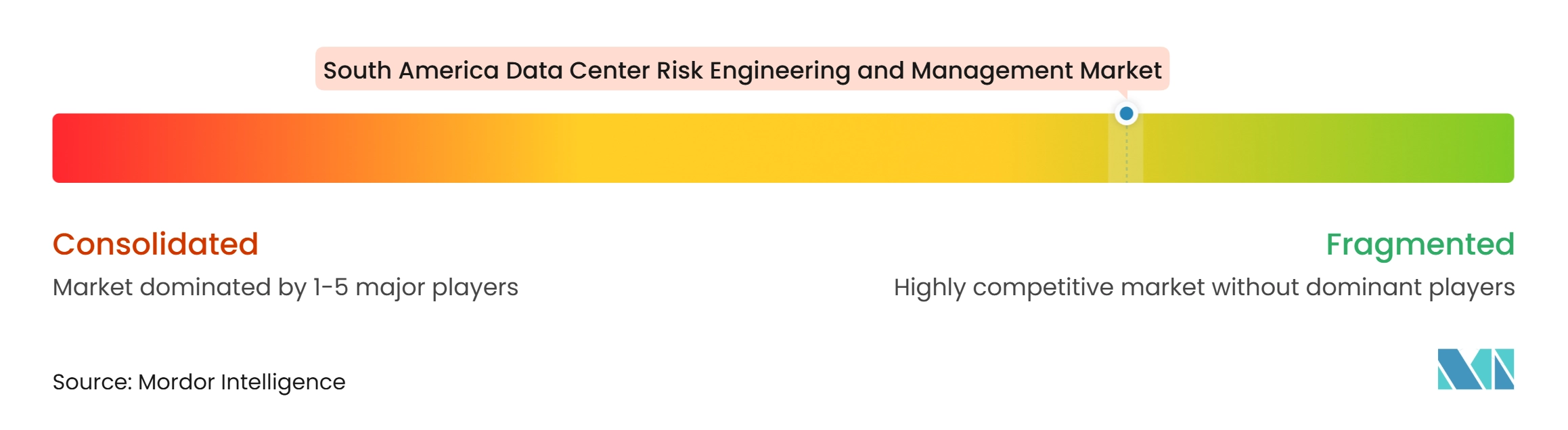
The South America data center risk engineering and management market is moderately fragmented. Global insurance and risk firms, testing and certification bodies, and specialist engineering consultancies compete with different combinations of technical methods, insurance access, and local knowledge. Aon expanded its Data Center Lifecycle Insurance Program from USD 1.5 billion at launch in June 2025 to USD 5 billion by July 2026. Marsh launched Data Centre Insurance and Risk Management Services in May 2025 for owners, developers, operators, and investors.
Competition increasingly centers on AI-specific modeling, commissioning risk, and managed programs for regional operators. FM Global increased capacity for FM Intellium to USD 5 billion in January 2026 and supports clients with a deployable virtual engineering unit. This approach can reduce the need to build a permanent specialist team in every emerging market. SGS introduced a digital commissioning solution in February 2026 using a System Start-up Matrix methodology and an independent verification process. Providers with ANSI/TIA-942 and Uptime Institute capabilities are well-placed to meet buyers' need for independent validation for insurers and project lenders.
Local regulatory knowledge is a meaningful differentiator, especially in markets where infrastructure and environmental approvals vary by location. Vertiv and Grupo Datco formed a distribution partnership in Argentina and Chile in October 2025, extending power, cooling, and monitoring capabilities through the regional network.[4] The South America data center risk engineering and management market has room for firms that can translate high-level standards into practical controls for local construction, operations, and utility conditions. Large international providers have broad methods and specialist reach, while smaller advisers can compete through local relationships and execution.
South America Data Center Risk Engineering and Management Industry Leaders
-
FM Insurance Company Limited
-
Marsh & McLennan Companies, Inc.
-
Chubb Limited
-
Allianz SE
-
Aon plc
- *Disclaimer: Major Players sorted in no particular order
South America Data Center Risk Engineering and Management Market Companies Covered in this Report
- FM Insurance Company Limited
- Marsh & McLennan Companies, Inc.
- Chubb Limited
- Allianz SE
- Aon plc
- JLL Technologies, Inc.
- CBRE Group, Inc.
- Arup Group Limited
- DNV AS
- TÜV Rheinland AG
- SGS Société Générale de Surveillance SA
- Intertek Group plc
- UL LLC
- Uptime Institute, LLC
- ICREA International, Inc.
- Grupo DCC Data Center Consultores
- Schneider Electric SE
- Vertiv Group Corp.
- Eaton Corporation plc
Recent Industry Developments in South America Data Center Risk Engineering and Management Market
- September 2026: Colombia's environmental authority ANLA licensed the Navarra-Bacatá 220 kV transmission project supporting ODATA's BG03 data center in Cundinamarca, a facility targeting up to 120 MW of IT capacity and representing the country's largest data center development. The license covers a 1,037-meter transmission line, 4 towers, and a 230/34.5 kV substation, with 50 MW of assigned connection capacity currently in place, triggering structured demand for electrical infrastructure risk assessment across Colombia's expanding hyperscale pipeline.
- July 2026: FM Global issued an interim revision to Property Loss Prevention Data Sheet DS 5-32 on data centers, introducing expanded cooling system definitions, updated liquid cooling guidance for AI-era infrastructure, and revised UPS battery unit terminology. The revision formalizes new engineering standards drawn from FM Global's 30,000 annual engineer-hours across 1,100 insured data centers representing USD 250 billion of insurable value.
- July 2026: Aon plc expanded its Data Center Lifecycle Insurance Program (DCLP) to USD 5 billion in coverage capacity, adding USD 200 million in third-party liability outside the United States, USD 400 million in cyber and technology errors and omissions coverage, USD 1 billion in terrorism capacity, and expanded lifecycle risk engineering through Aon Global Risk Consulting across climate risk advisory, environmental risk solutions, and operational resilience expertise.
- April 2026: Aon expanded DCLP to USD 3.5 billion, broadening the program to include data centers completing their first year of operations and integrating non-damage cyber delay-in-start-up protection, consolidating previously fragmented construction, operational, and cyber risk lines into a single coordinated engineering and insurance facility.
South America Data Center Risk Engineering and Management Market Report Scope
The South America Data Center Risk Engineering and Management Market refers to the provision of specialized services and solutions that identify, assess, mitigate, and manage operational, environmental, cybersecurity, and infrastructure-related risks in data centers across South America.
The South America Data Center Risk Engineering and Management Market Report is Segmented by Service Type (Risk Assessment and Auditing, Reliability and Availability Engineering, Failure Mode and Effects Analysis (FMEA), Fault Tree and Root Cause Analysis, Hazard Identification and Risk Evaluation, Risk Mitigation Planning, Operational Risk Management Consulting, and Compliance and Engineering Certification Support), Risk Category (Electrical and Power Infrastructure Risk, Cooling and Thermal Management Risk, Fire and Life Safety Risk, Structural and Building Infrastructure Risk, Environmental and Climate Risk, Operational and Human Error Risk, Supply Chain and Equipment Availability Risk, and Physical Security and Access Risk), Assessment Method (Qualitative Risk Assessment, Quantitative Risk Assessment, Reliability-Centered Assessment, Scenario-Based Risk Analysis, Simulation and Digital Modeling, and Continuous Risk Assessment and Monitoring), Engagement Model (One-Time Assessment and Audit, Periodic Risk Review, Continuous Risk Management Services, Managed Risk Engineering, and Integrated Engineering and Advisory Services), Project Lifecycle Stage (Site Selection and Feasibility, Design and Engineering, Construction and Commissioning, Operational Risk Management, and Expansion, Retrofit, and Modernization), Data Center Size (Small, Medium, Large, and Hyperscale), Data Center Type (Colocation, Cloud Service Providers (CSPs), and Enterprise and Edge), and Geography (Brazil, Chile, Argentina, Colombia, Peru, and Rest of South America). The Market Forecasts are Provided in Terms of Value (USD).
Segmentation Overview
| Risk Assessment and Auditing |
| Reliability and Availability Engineering |
| Failure Mode and Effects Analysis (FMEA) |
| Fault Tree and Root Cause Analysis |
| Hazard Identification and Risk Evaluation |
| Risk Mitigation Planning |
| Operational Risk Management Consulting |
| Compliance and Engineering Certification Support |
| Electrical and Power Infrastructure Risk |
| Cooling and Thermal Management Risk |
| Fire and Life Safety Risk |
| Structural and Building Infrastructure Risk |
| Environmental and Climate Risk |
| Operational and Human Error Risk |
| Supply Chain and Equipment Availability Risk |
| Physical Security and Access Risk |
| Qualitative Risk Assessment |
| Quantitative Risk Assessment |
| Reliability-Centered Assessment |
| Scenario-Based Risk Analysis |
| Simulation and Digital Modeling |
| Continuous Risk Assessment and Monitoring |
| One-Time Assessment and Audit |
| Periodic Risk Review |
| Continuous Risk Management Services |
| Managed Risk Engineering |
| Integrated Engineering and Advisory Services |
| Site Selection and Feasibility |
| Design and Engineering |
| Construction and Commissioning |
| Operational Risk Management |
| Expansion, Retrofit, and Modernization |
| Small |
| Medium |
| Large |
| Hyperscale |
| Colocation |
| Cloud Service Providers (CSPs) |
| Enterprise and Edge |
| Brazil |
| Chile |
| Argentina |
| Colombia |
| Peru |
| Rest of South America |
| By Service Type | Risk Assessment and Auditing |
| Reliability and Availability Engineering | |
| Failure Mode and Effects Analysis (FMEA) | |
| Fault Tree and Root Cause Analysis | |
| Hazard Identification and Risk Evaluation | |
| Risk Mitigation Planning | |
| Operational Risk Management Consulting | |
| Compliance and Engineering Certification Support | |
| By Risk Category | Electrical and Power Infrastructure Risk |
| Cooling and Thermal Management Risk | |
| Fire and Life Safety Risk | |
| Structural and Building Infrastructure Risk | |
| Environmental and Climate Risk | |
| Operational and Human Error Risk | |
| Supply Chain and Equipment Availability Risk | |
| Physical Security and Access Risk | |
| By Assessment Method | Qualitative Risk Assessment |
| Quantitative Risk Assessment | |
| Reliability-Centered Assessment | |
| Scenario-Based Risk Analysis | |
| Simulation and Digital Modeling | |
| Continuous Risk Assessment and Monitoring | |
| By Engagement Model | One-Time Assessment and Audit |
| Periodic Risk Review | |
| Continuous Risk Management Services | |
| Managed Risk Engineering | |
| Integrated Engineering and Advisory Services | |
| By Project Lifecycle Stage | Site Selection and Feasibility |
| Design and Engineering | |
| Construction and Commissioning | |
| Operational Risk Management | |
| Expansion, Retrofit, and Modernization | |
| By Data Center Size | Small |
| Medium | |
| Large | |
| Hyperscale | |
| By Data Center Type | Colocation |
| Cloud Service Providers (CSPs) | |
| Enterprise and Edge | |
| By Geography | Brazil |
| Chile | |
| Argentina | |
| Colombia | |
| Peru | |
| Rest of South America |
Key Questions Answered in the Report
What is the South America data center risk engineering and management market size?
The South America data center risk engineering and management market is USD 120.18 million in 2026 and is projected to reach USD 273.12 million by 2032, at a 14.51% CAGR during 2027-2032.
Which service type leads this sector?
Risk Assessment and Auditing lead with 31.62% share in 2026, while Reliability and Availability Engineering is projected to grow at a 14.79% CAGR through 2032.
Why is thermal risk growing in South American data centers?
AI equipment increases rack density and use of liquid cooling, raising the need to manage fluid, power, detection, and fire-protection interfaces.
Which South American country leads demand for risk engineering services?
Brazil leads with 52.35% share in 2026, supported by capacity growth around São Paulo and Campinas and higher demand for grid connection reviews.
Why do data center owners use continuous risk management services?
Continuous services support real-time monitoring and recurring oversight as asset values, rack density, and service-availability requirements increase.
What standards affect AI-ready data center projects?
ANSI/TIA-942, the planned AI-focused Addendum 1, and the DCE 9000 quality initiative shape infrastructure validation and supply-chain quality practices.