
South America Commercial Greenhouse Market Size and Share
Market Overview
| Study Period | 2021 - 2031 |
|---|---|
| Forecast Data Period | 2026 - 2031 |
| Base Year Market Size (2025) | USD 1.18 Billion |
| Market Size (2026) | USD 1.25 Billion |
| Market Size (2031) | USD 1.7 Billion |
| Growth Rate (2026 - 2031) | 6.40 % |
| Market Concentration | Medium |
Major Players *Disclaimer: Major Players sorted in no particular order Image © Mordor Intelligence. Reuse requires attribution under CC BY 4.0. | |
South America Commercial Greenhouse Market Analysis by Mordor Intelligence
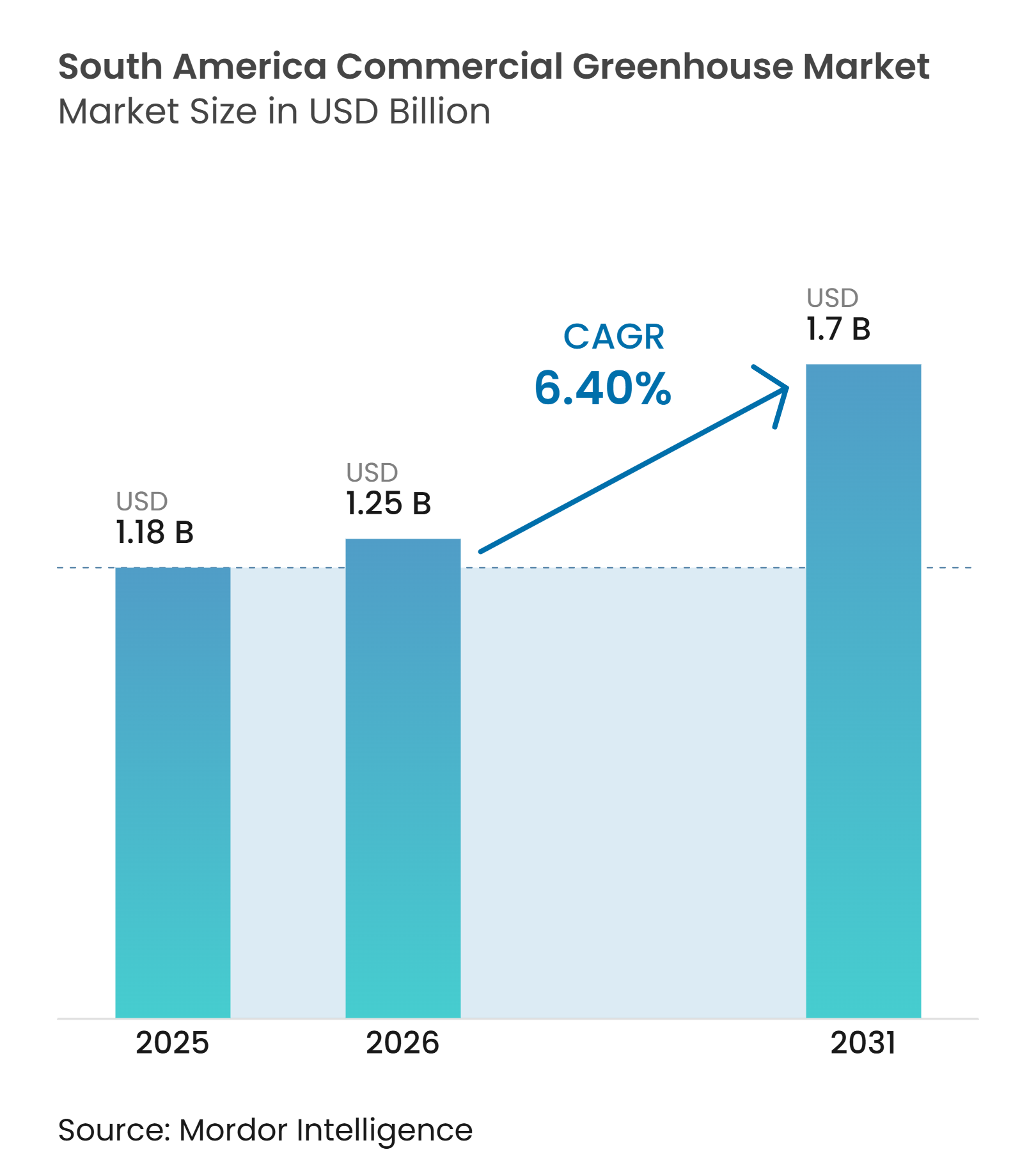
The South America commercial greenhouse market size was valued at USD 1.18 billion in 2025 and is estimated to grow from USD 1.25 billion in 2026 to USD 1.70 billion by 2031. The market is expected to grow at a 6.4% CAGR during 2026–2031. The South America commercial greenhouse market is supported by climate variability, the expansion of commercial horticulture, and fresh-produce export requirements. Brazil and Chile provide distinct sources of demand, scale is important in Brazil, whereas water constraints and export-quality standards shape investment in Chile. Greenhouse buyers are placing greater value on irrigation, climate management, and production records because these systems support more consistent crop output. Competition is extending beyond greenhouse structures, as irrigation and automation suppliers offer integrated solutions, increasing pressure on structure-only suppliers. High installation costs, limited operator capacity, and currency constraints in Argentina continue to favor larger commercial projects over smaller installations.
Key Report Takeaways
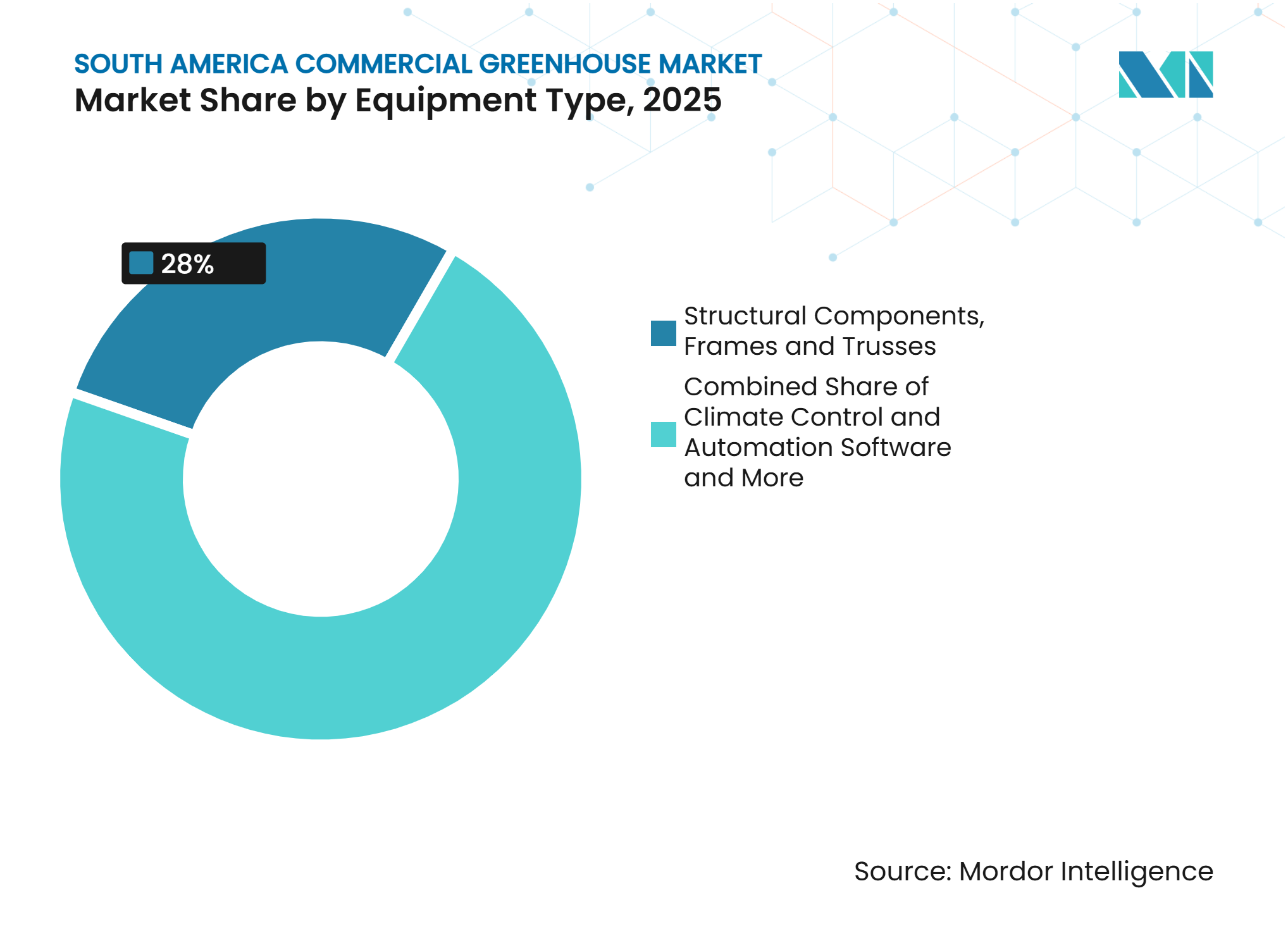
- By equipment type, Structural Components, including Frames and Trusses, were the largest category in 2025. Climate control and automation software is projected to grow at a 10.6% CAGR during 2026–2031.
- By crop type, fruits and vegetables were the largest category with 38% of the South America commercial greenhouse market share in 2025. Herbs and Microgreens are projected to grow at a 9.9% CAGR during 2026–2031.
- By greenhouse type, Plastic-Film Greenhouses held the largest share at 56% in 2025. Hybrid and Semi-Closed Greenhouses are projected to grow at an 11.7% CAGR during 2026–2031.
- By cultivation technology, Drip Hydroponics was the largest category, accounting for 46% of the South America commercial greenhouse market in 2025. Hybrid and Vertical Integration is estimated to grow at a 12.4% CAGR during 2026–2031.
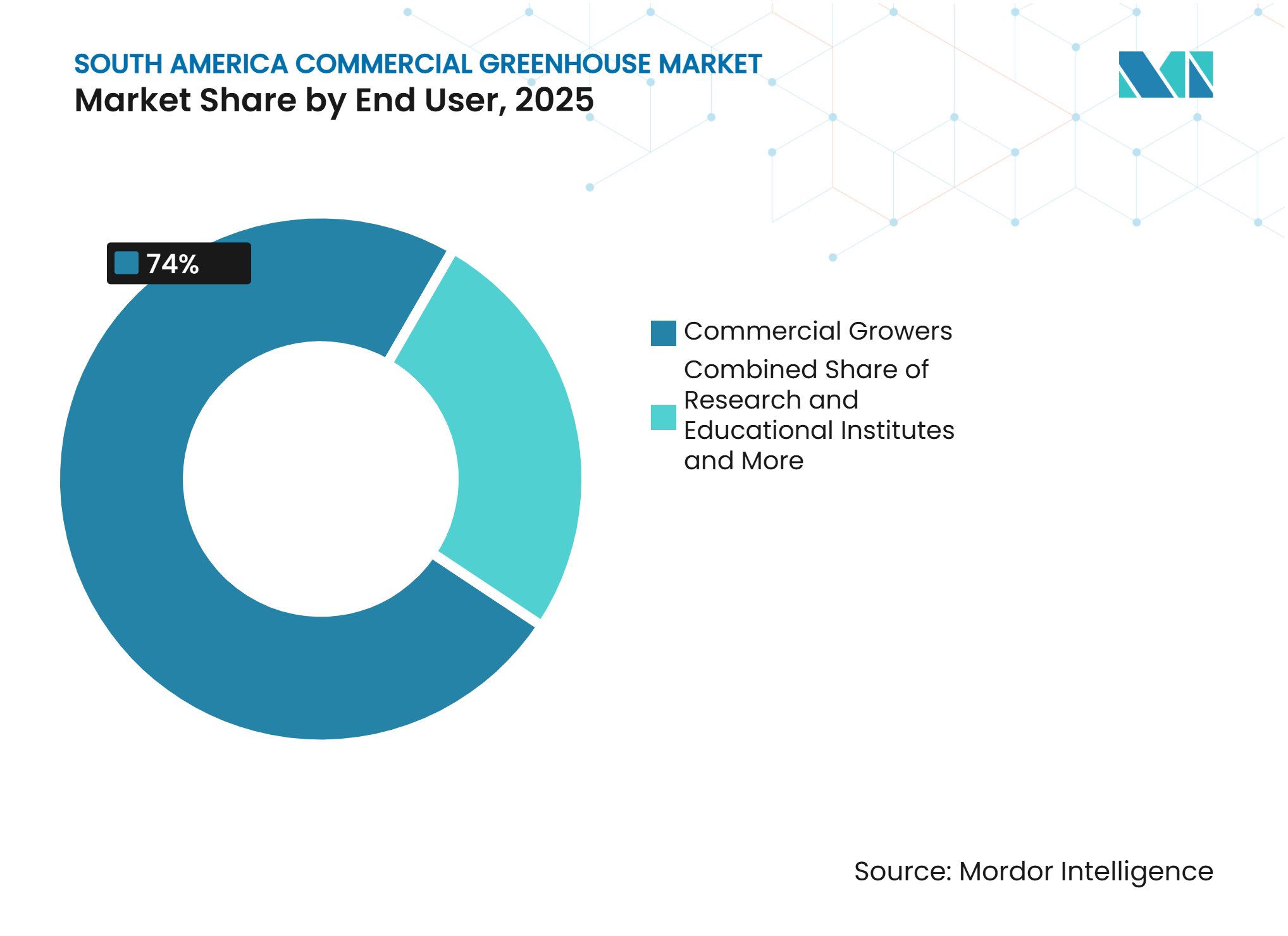
- By end user, Commercial Growers held the largest share at 74% in 2025. Research and Educational Institutes are anticipated to grow at a 9.5% CAGR during 2026–2031.
- By geography, Brazil held the largest share at 54% in 2025. Chile is projected to grow at an 8.8% CAGR during 2026–2031.
Note: Market size and forecast figures in this report are generated using Mordor Intelligence’s proprietary estimation framework, updated with the latest available data and insights as of January 2026.
Market Trends and Insights
Drivers Impact Analysis of South America Commercial Greenhouse Market*
| Driver | (~) % Impact on CAGR Forecast | Geographic Relevance | Impact Timeline |
|---|---|---|---|
| Year-Round and Out-of-Season Fresh Produce Supply | +1.5% | Brazil and Chile | Short term (≤ 2 years) |
| Water-Efficient Production in Water-Stressed Zones | +1.0% | Chile, semi-arid Brazil, and Argentina | Medium term (2-4 years) |
| Demand for Consistent, Traceable, Higher-Quality Produce | +1.0% | Chile and export-oriented Brazil | Short term (≤ 2 years) |
| Modernization Through Automation, Precision Irrigation, and Data Management | +1.2% | Brazil and Chile | Medium term (2-4 years) |
| Climate-Resilient Production Under Weather Volatility | +0.8% | Chile, Argentina, and semi-arid Brazil | Long term (≥ 4 years) |
| Public Programs, Research Partnerships, and Technology Transfer | +0.5% | Brazil and Argentina | Long term (≥ 4 years) |
| Source: Mordor Intelligence | |||
Year-Round and Out-of-Season Fresh Produce Supply
Commercial greenhouse production helps growers meet supply agreements when open-field conditions restrict harvests. Tomatoes, leafy greens, and berries require stable growing conditions to supply supermarkets and food-service buyers year-round. In 2024, the Brazilian Agricultural Research Corporation (Embrapa) documented protected cultivation methods for soil-grown and substrate-grown vegetables under various Brazilian conditions [1]. These methods allow operators to manage temperature, humidity, irrigation, and crop timing more closely than in open fields. The South America commercial greenhouse market benefits when buyers value predictable volume, uniform quality, and a longer commercial season. This demand also supports spending on structures, shading, fertigation, and climate-control equipment.
Water-Efficient Production in Water-Stressed Zones
Water availability has become an important factor in greenhouse investment decisions across Chile and semi-arid parts of Brazil. In 2025, Chile's Office of Agricultural Studies and Policies (ODEPA) published a study on seawater desalination for agriculture in the Limarí basin, where farming accounts for 95.8% of total water demand under extreme scarcity.[2]. Drip irrigation and substrate systems help growers deliver water and nutrients more precisely to the crop root zone. Greenhouses also make it easier to monitor irrigation cycles and to limit losses due to uneven rainfall. The South America commercial greenhouse market, therefore, gains from demand for fertigation equipment, water monitoring, and related technical support. These needs are strongest where drought conditions make crop reliability a commercial priority.
Modernization Through Automation, Precision Irrigation, and Data Management
Automation is becoming a larger part of the investment case for commercial greenhouse projects. Sensors, automated shading, ventilation controls, and remote monitoring enable operators to respond more quickly to changes in temperature, humidity, and irrigation conditions. In 2026, Priva showcased Priva One at GreenTech Amsterdam as a connected platform that integrates climate control, irrigation, crop monitoring, and operational workflows[3]. The South America commercial greenhouse market is moving toward integrated systems because growers can manage multiple production activities within a single operating environment. Suppliers that connect equipment with practical crop data can build stronger relationships with commercial operators.
Climate-Resilient Production Under Weather Volatility
Heat stress in Brazil, frost risk in Chile, and uneven rainfall in Argentina affect crop planning and output. Protected cultivation provides a way to reduce direct exposure to these conditions. In 2026, Argentina's National Institute of Agricultural Technology (INTA), working with the National University of San Luis (UNSL) and local growers, developed an intelligent greenhouse monitoring system that can predict frost and severe wind gusts one to six hours in advance. Structures, screening, ventilation, and irrigation controls work together to create more stable growing environments. The South America commercial greenhouse market benefits when weather risk shifts from a seasonal concern to a driver of capital investment. Demand is likely to focus on systems that are appropriate for local crops, climate zones, and operating budgets.
Restraints Impact Analysis of South America Commercial Greenhouse Market*
| Restraint | (~) % Impact on CAGR Forecast | Geographic Relevance | Impact Timeline |
|---|---|---|---|
| High Upfront Capital Needs and Limited Long-Tenor Financing | -1.50% | Argentina and Rest of South America | Medium term (2-4 years) |
| Shortage of Skilled Operators and Limited Technical Assistance | -0.70% | Argentina and Rest of South America | Long term (≥ 4 years) |
| Water Salinity, Quality Variability, and Pest-Disease Pressure | -1.00% | Chile and semi-arid Brazil | Medium term (2-4 years) |
| Smallholder Fragmentation, Limited Adoption, and Imported-System Cost Exposure | -0.80% | Rest of South America | Long term (≥ 4 years) |
| Source: Mordor Intelligence | |||
High Upfront Capital Needs and Limited Long-Tenor Financing
Modern greenhouse projects require investment in structures, irrigation, climate controls, and installation. The cost increases significantly when growers add automation, fertigation, and advanced ventilation. In September 2025, the São Paulo Agribusiness Expansion Fund (FEAP) increased its Sustainable Rural Development credit line from BRL 20 million (USD 4.0 million) to BRL 50 million (USD 9.9 million), supporting projects that include protected-environment production, although equivalent access is not uniform across the region. The South America commercial greenhouse market is constrained when project payback periods exceed available lending terms. This issue is more difficult for smaller growers and for operations facing unstable access to foreign currency.
Shortage of Skilled Operators and Limited Technical Assistance
Commercial greenhouse performance depends on daily decisions about irrigation, nutrients, ventilation, crop health, and labor. Operators need technical knowledge to maintain stable growing conditions and respond to plant stress. In 2024, the Brazilian Agricultural Research Corporation (Embrapa) published guidance on protected cultivation showing that substrate and fertigation systems require active management of nutrients, drainage, and water conditions, including electrical conductivity monitoring to prevent salinization. The South America commercial greenhouse market can therefore grow more slowly where operator training is limited, even when installation services are available. Suppliers that provide agronomy support and practical training are better placed to address this constraint.
*Our forecasts treat driver/restraint impacts as directional, not additive. The impact forecasts reflect baseline growth, mix effects, and variable interactions.
South America Commercial Greenhouse Market Segment Analysis
By Equipment Type:
Software and Automation Define the Next Investment CycleStructural Components, including Frames and Trusses, represented the largest equipment category in 2025 because every commercial project requires a durable physical structure. These components support new greenhouse construction in Brazil, Chile, Argentina, and the Rest of South America. Irrigation and Fertigation Systems remain important because growers need reliable delivery of water and nutrients inside the structure. Screening and Shading Systems are also relevant for crops that need protection from high temperatures and direct radiation. The segment mix shows that the South America commercial greenhouse market still depends on core construction equipment before operators consider advanced controls.
Climate Control and Automation Software is projected to grow at a 10.6% CAGR during 2026–2031, the fastest among all equipment types. In 2026, Priva showcased Priva One at GreenTech Amsterdam as a connected platform that combines climate control, irrigation, crop monitoring, and operational workflows. LED Grow Lighting remains more relevant for specialty crops and research use because many regional locations receive strong natural sunlight. Heating is more important in southern Chile and higher-altitude Argentine areas, while cooling and ventilation are becoming more relevant in warmer Brazilian production zones.



By Crop Type:
Tomatoes Anchor Market Revenue While Microgreens Emerge at the MarginsFruits and Vegetables accounted for 38% of the South America commercial greenhouse market share in 2025, making it the largest crop category. Tomatoes were the leading crop within this category because commercial growers value their year-round demand and greenhouse suitability. Peppers, cucumbers, leafy greens, and berries also support investment when buyers require stable quality and supply. Protected cultivation allows growers to manage growing conditions more closely for crops that are sensitive to weather changes. This crop group gives the South America commercial greenhouse market a strong link to fresh-produce supply chains.
Herbs and Microgreens are projected to grow at a 9.9% CAGR during 2026–2031, the fastest among all crop types. These crops suit smaller greenhouse footprints and hydroponic systems near urban retail centers. Their short crop cycles can support frequent harvests when operators have reliable water and climate controls. Flowers and Ornamentals remain established greenhouse crops in Brazil, especially where humidity, temperature, and light control support commercial uniformity. Cannabis and Specialty Crops, including medical cannabis and seedling propagation, remain early-stage applications within the reported scope.
By Greenhouse Type:
Plastic Film Dominates as Hybrid Systems Build Commercial MomentumPlastic-Film Greenhouses held 56% of the South America commercial greenhouse market size in 2025, making them the largest greenhouse type. Their position reflects lower entry costs and adaptability across varied regional climates. These structures provide a practical starting point for growers shifting from open-field production to protected cultivation. They can also be paired with irrigation, shading, and basic ventilation systems as commercial needs develop. PROAMCO AGRICOLA SpA supplies tunnel and multi-nave Gothic structures for commercial production in Chile.
Hybrid and Semi-Closed Greenhouses are projected to grow at an 11.7% CAGR during 2026–2031, the fastest among all greenhouse types. These designs combine stronger pest exclusion and environmental management without requiring the full investment of glass construction. In 2024, J. Huete Greenhouses was building a semi-enclosed plastic greenhouse in Colombia, with completion scheduled for the second half of that year. Glass Greenhouses and Rigid Polycarbonate Greenhouses remain premium options for operations that can support larger initial investment. Their use is concentrated in technology-intensive projects and high-value production settings.
By Cultivation Technology:
Hydroponics Anchors Production as Hybrid Methods Define the Growth FrontierDrip Hydroponics held 46% of the cultivation technology segment in 2025, making it the largest approach. The system gives growers direct control over nutrient delivery and irrigation timing. This is valuable in water-constrained areas of Chile and Brazil, where resource efficiency affects project economics. In 2024, the Brazilian Agricultural Research Corporation (Embrapa) documented the need to manage salinity and nutrient accumulation in substrate and fertigation systems. Non-Hydroponic Soil and Substrate systems remain relevant for growers gradually transitioning from open-field practices to protected cultivation.
Hybrid and Vertical Integration is projected to grow at a 12.4% CAGR during 2026–2031, the fastest among all cultivation technologies. Commercial operators can combine hydroponic and substrate methods to meet multiple crop requirements in a single facility. This flexibility supports production planning across changing seasonal demand. Rivulis provides guidance on selecting drip-irrigation systems for greenhouses and soilless systems based on greenhouse dimensions, crop type, and peak water demand. Deep Water Culture and Nutrient Film Technique are used in specialized leafy-green operations that support more intensive management.
By End User:
Commercial Growers Define the Market While Research Institutes AccelerateCommercial Growers accounted for 74% of the end-user segment in 2025, making them the largest buyer group. This group includes integrated horticulture operations, exporters, and domestic fresh-produce businesses. These operators can invest in complete systems that include structures, irrigation, climate controls, and automation. Their purchasing decisions reflect the capital and operating discipline required for profitable protected cultivation. The South America commercial greenhouse market is therefore centered on professional growers rather than occasional or hobby users.
Research and Educational Institutes are anticipated to grow at a 9.5% CAGR during 2026–2031, the fastest among all end-user segments. These institutions support crop improvement, technology validation, and training for commercial greenhouse operations. In May 2024, J. Huete Greenhouses announced a semi-closed plastic greenhouse project for a university in Cali, Colombia, featuring a positive-pressure system for pest exclusion and integrated climate control. Retail Garden Centers and Nurseries remain a secondary user group, especially in floriculture and seedling production.

Geography Analysis
Brazil held 54% of the South America commercial greenhouse market in 2025, making it the largest country segment. Its scale, domestic manufacturing base, and commercial agriculture support demand for greenhouse structures and equipment. São Paulo remains a key center for greenhouse activity, while interest is expanding into the Center-West and Northeast. The São Paulo State Department of Agriculture and Supply provides greenhouse financing through the São Paulo Agribusiness Expansion Fund (FEAP), which supports the construction, modernization, and renovation of greenhouses and other protected production systems. Brazil's demand includes basic structures, as well as irrigation and automation systems, for established operators.
Chile is projected to grow at an 8.8% CAGR during 2026–2031, the fastest among all countries in the region. Water efficiency, export quality requirements, and climate risk guide greenhouse investment decisions in the country. Chile's Office of Agricultural Studies and Policies (ODEPA) coordinates the Ministry of Agriculture's water resources strategy, which directs the sector toward more efficient, equitable, and sustainable water management. Azimut Invernaderos describes greenhouse systems and related equipment designed for agricultural applications in Chile.
Argentina and the Rest of South America represent a smaller but strategically relevant part of the regional landscape. Argentina's agricultural demand supports protected cultivation, although financing, currency access, and imported equipment costs limit adoption. In April 2024, Argentina's National Institute of Agricultural Technology (INTA) worked with a local workers' cooperative in Río Colorado to build eight greenhouses with drip irrigation, designed to extend vegetable production into autumn and start it earlier in spring. The Rest of South America includes markets where commercial projects are developing at different speeds. Growth in these areas is more likely to rely on modular structures, accessible irrigation systems, and local technical support.
Competitive Landscape
Market Concentration
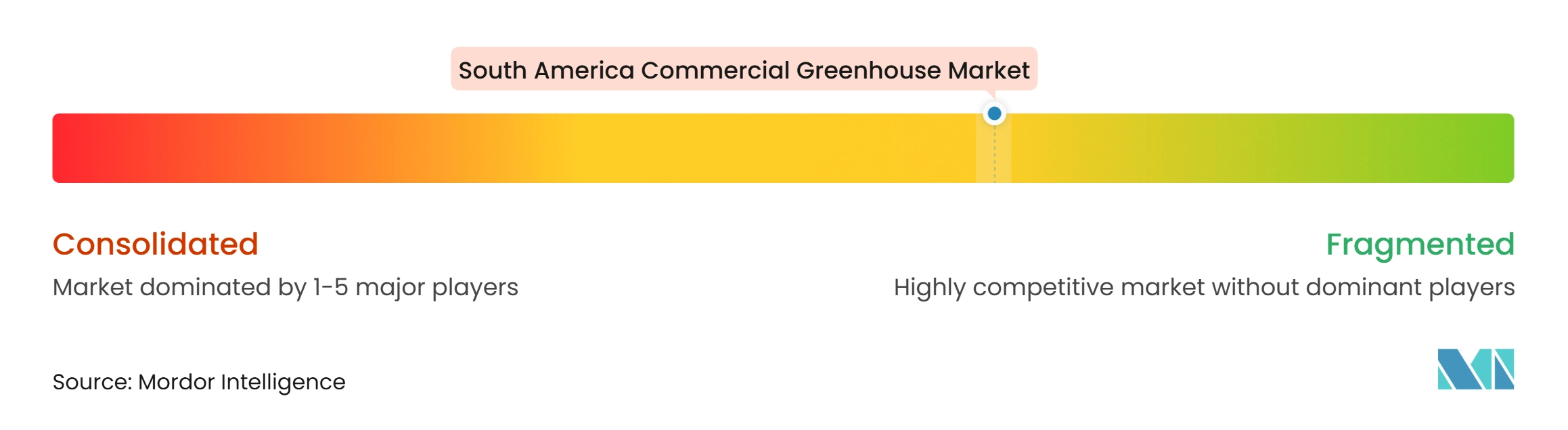
The South America commercial greenhouse market remains moderately fragmented in 2025. Competition includes integrated greenhouse specialists, regional structure manufacturers, irrigation suppliers, and automation providers. Havecon Kassenbouw B.V., RICHEL GROUP SAS, and J. Huete Greenhouses compete for complex turnkey projects through engineering and equipment integration. Agriestufa Industria e Comercio Ltda., J.M. Zanatta e Cia Ltda., PROAMCO AGRICOLA SpA, and Azimut Invernaderos compete through regional presence, localized service, and practical structure offerings. This mix leaves room for suppliers across basic, intermediate, and technically advanced projects.
Irrigation and automation companies are moving toward more integrated commercial offerings. In 2026, Priva showcased Priva One at GreenTech Amsterdam as a connected platform that integrates climate control, irrigation management, crop monitoring, and workflows. Rivulis provides guidance for selecting greenhouse and soilless drip-irrigation systems based on greenhouse dimensions, crop type, and peak water demand. In 2024, J. Huete Greenhouses reported completing seed research greenhouses for Syngenta in South America, equipped with advanced cooling and heating systems. These moves link equipment, agronomy, and management functions more closely in commercial projects.
The mid-market remains important for suppliers serving growers above smallholder scale but below large glass-greenhouse projects. Modular, locally assembled structures can reduce entry barriers while allowing buyers to add automation over time. PROAMCO AGRICOLA SpA positions tunnel and multi-nave greenhouse structures for commercial agricultural use in Chile. The fragmented structure remains consistent because no small group of suppliers is shown to control most regional activity.
South America Commercial Greenhouse Industry Leaders
-
Havecon Kassenbouw B.V.
-
J. Huete Greenhouses
-
RICHEL GROUP SAS
-
Priva Holding B.V. (Priva Horticulture B.V.)
-
Orbia Advance Corporation, S.A.B. de C.V. (Netafim Ltd.)
- *Disclaimer: Major Players sorted in no particular order
South America Commercial Greenhouse Market Companies Covered in this Report
- Priva Holding B.V.
- Agriestufa Industria e Comercio Ltda.
- J. Huete Greenhouses
- RICHEL GROUP SAS
- Havecon Kassenbouw B.V.
- Orbia Advance Corporation, S.A.B. de C.V. (Netafim Ltd.)
- Temasek Holdings (Private) Ltd. (Rivulis Irrigation Ltd.)
- J.M. Zanatta e Cia Ltda.
- Azimut Invernaderos
- PROAMCO AGRICOLA SpA
- Invermed Levante S.L. (Grupo IEP Greenhouses)
- SMARTKAS B.V.
Recent Industry Developments in South America Commercial Greenhouse Market
- June 2026: Orbia Advance Corporation’s Netafim subsidiary inaugurated a new manufacturing plant in Hermosillo, Sonora, Mexico, representing an investment of USD 20 million and expanding the company’s Americas production footprint for South America greenhouse and precision-agriculture irrigation markets.
- June 2025: Rivulis Irrigation Ltd. launched a digital educational platform for selecting greenhouse and row-crop drip-irrigation systems in South America, providing agronomic guidance for soil-based and substrate greenhouse systems.
- 2025: SMARTKAS B.V. completed restructuring under the HIVE Capital group and refocused its commercial operations on digital-twin management systems for greenhouse environments.
South America Commercial Greenhouse Market Report Scope
The South America Commercial Greenhouse Market report is segmented by Equipment Type (Heating Systems, Cooling and Ventilation Systems, LED Grow Lighting, Irrigation and Fertigation Systems, Climate Control and Automation Software, Screening and Shading Systems, and Structural Components), by Crop Type (Fruits and Vegetables, Flowers and Ornamentals, Herbs and Microgreens, and Cannabis and Specialty Crops), by Greenhouse Type (Glass Greenhouses, Plastic-Film Greenhouses, Rigid Polycarbonate Greenhouses, and Hybrid and Semi-Closed Greenhouses), by Cultivation Technology (Hydroponic, Non-Hydroponic Soil and Substrate, and Hybrid and Vertical Integration), and by End User (Commercial Growers, Research and Educational Institutes, and Retail Garden Centers and Nurseries). The market forecasts are provided in terms of value (USD).
Segmentation Overview
| Heating Systems | |
| Cooling and Ventilation Systems | |
| LED Grow Lighting | |
| Irrigation and Fertigation Systems | |
| Climate Control and Automation Software | |
| Screening and Shading Systems | |
| Structural Components | Glazing Systems |
| Frames and Trusses |
| Fruits and Vegetables | Tomatoes |
| Cucumbers | |
| Lettuce and Leafy Greens | |
| Peppers | |
| Strawberries and Berries | |
| Flowers and Ornamentals | Cut Flowers |
| Potted Plants and Bedding Plants | |
| Herbs and Microgreens | |
| Cannabis and Specialty Crops | Medical Cannabis |
| Seedlings and Propagation Crops |
| Glass Greenhouses |
| Plastic-Film Greenhouses |
| Rigid Polycarbonate Greenhouses |
| Hybrid and Semi-Closed Greenhouses |
| Hydroponic | Nutrient Film Technique |
| Deep Water Culture | |
| Drip Hydroponics | |
| Non-Hydroponic Soil and Substrate | Soil-Based |
| Coco Coir and Rockwool Substrate | |
| Hybrid and Vertical Integration |
| Commercial Growers |
| Research and Educational Institutes |
| Retail Garden Centers and Nurseries |
| Brazil |
| Argentina |
| Chile |
| Rest of South America |
| By Equipment Type | Heating Systems | |
| Cooling and Ventilation Systems | ||
| LED Grow Lighting | ||
| Irrigation and Fertigation Systems | ||
| Climate Control and Automation Software | ||
| Screening and Shading Systems | ||
| Structural Components | Glazing Systems | |
| Frames and Trusses | ||
| By Crop Type | Fruits and Vegetables | Tomatoes |
| Cucumbers | ||
| Lettuce and Leafy Greens | ||
| Peppers | ||
| Strawberries and Berries | ||
| Flowers and Ornamentals | Cut Flowers | |
| Potted Plants and Bedding Plants | ||
| Herbs and Microgreens | ||
| Cannabis and Specialty Crops | Medical Cannabis | |
| Seedlings and Propagation Crops | ||
| By Greenhouse Type | Glass Greenhouses | |
| Plastic-Film Greenhouses | ||
| Rigid Polycarbonate Greenhouses | ||
| Hybrid and Semi-Closed Greenhouses | ||
| By Cultivation Technology | Hydroponic | Nutrient Film Technique |
| Deep Water Culture | ||
| Drip Hydroponics | ||
| Non-Hydroponic Soil and Substrate | Soil-Based | |
| Coco Coir and Rockwool Substrate | ||
| Hybrid and Vertical Integration | ||
| By End User | Commercial Growers | |
| Research and Educational Institutes | ||
| Retail Garden Centers and Nurseries | ||
| By Geography | Brazil | |
| Argentina | ||
| Chile | ||
| Rest of South America | ||
Key Questions Answered in the Report
What is the projected value of the South America commercial greenhouse market by 2031?
The South America commercial greenhouse market is projected to reach USD 1.70 billion by 2031.
Which greenhouse type has the largest share in South America?
Plastic-Film Greenhouses held 56% of the South America commercial greenhouse market in 2025.
Which cultivation technology is growing fastest in commercial greenhouses?
Hybrid and Vertical Integration is projected to grow at a 12.4% CAGR during 2026-2031.
Which country leads regional demand for commercial greenhouse systems?
Brazil held 54% of the South America commercial greenhouse market share in 2025.