
Market Overview
| Study Period | 2019 - 2031 |
|---|---|
| Forecast Data Period | 2026 - 2031 |
| Base Year Market Size (2025) | USD 456.97 Million |
| Market Size (2026) | USD 475.30 Million |
| Market Size (2031) | USD 600.91 Million |
| Growth Rate (2026 - 2031) | 4.80 % |
| Market Concentration | Medium |
Major Players *Disclaimer: Major Players sorted in no particular order Image © Mordor Intelligence. Reuse requires attribution under CC BY 4.0. | |
South America Commercial Aircraft Cabin Interior Market Analysis by Mordor Intelligence
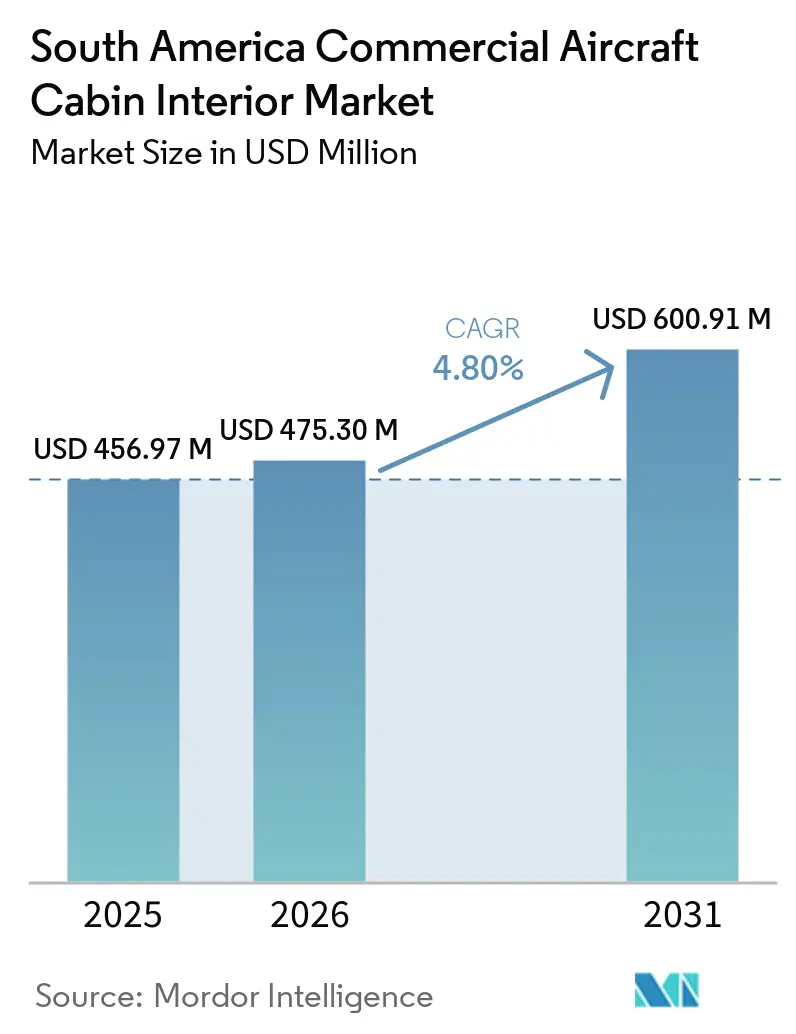
The South America commercial aircraft cabin interior market size was valued at USD 456.97 million in 2025, and is projected to grow from USD 475.30 million in 2026 to USD 600.91 million by 2031, at a 4.80% CAGR during the forecast period (2026-2031). South American air travel expanded across several major markets in 2025. Brazil recorded 129.6 million passengers, up 9.4% year on year, while Argentina reached 33.3 million passengers, up 13.2%. This regional growth is occurring alongside continued investment in cabins by South American airlines. LATAM is retrofitting its B787 fleet with new premium seating, while Azul has selected new Business- and Economy-Class seats for its expanding A330 fleet, supporting demand for aircraft seating, cabin refurbishment, and related interior systems.
Key Report Takeaways
- By product type, seating accounted for 30.45% of the South America commercial aircraft cabin interior market in 2025, while IFEC systems are forecast to grow at a 6.25% CAGR through 2031.
- By cabin class, economy class accounted for 63.20% of the South America commercial aircraft cabin interior market share in 2025, while premium economy is forecast to grow at a 6.10% CAGR through 2031.
- By aircraft type, narrowbody aircraft accounted for 68.50% of the South America commercial aircraft cabin interior market share in 2025, while regional jets are forecast to grow at a 5.65% CAGR through 2031.
- By fit type, OEM installations accounted for 59.25% of the South America commercial aircraft cabin interior market share in 2025, while aftermarket installations are forecast to grow at a 5.90% CAGR through 2031.
- By material, aluminum alloys accounted for 52.90% of the South America commercial aircraft cabin interior market share in 2025, while composites are forecast to grow at a 6.23% CAGR through 2031.
- By geography, Brazil accounted for 57.00% of the South America commercial aircraft cabin interior market in 2025, while Colombia is forecast to grow at a 5.81% CAGR through 2031.
Note: Market size and forecast figures in this report are generated using Mordor Intelligence’s proprietary estimation framework, updated with the latest available data and insights as of January 2026.
Market Trends and Insights
Drivers Impact Analysis of South America Commercial Aircraft Cabin Interior Market*
| Driver | (~) % Impact on CAGR Forecast | Geographic Relevance | Impact Timeline |
|---|---|---|---|
| Post-pandemic passenger traffic recovery | +0.90% | Global, with the highest uplift in Brazil and Colombia | Short term (≤ 2 years) |
| Embraer-led regional fleet renewal | +0.80% | Brazil, Colombia, Chile, and Peru | Medium term (2-4 years) |
| Airline cabin retrofit and premiumization | +0.70% | Brazil, Chile, and Colombia | Medium term (2-4 years) |
| Rising demand for connected passenger experiences | +0.60% | Regional, led by LATAM and Abra Group fleets | Medium term (2-4 years) |
| Brazilian aerospace and MRO capability expansion | +0.50% | Brazil and neighboring South American countries | Long term (≥ 4 years) |
| Cabin localization for dense and thin South American routes | +0.40% | South America | Long term (≥ 4 years) |
| Source: Mordor Intelligence | |||
Post-Pandemic Passenger Traffic Recovery
South America’s commercial aviation sector continued to expand in 2025, supporting opportunities for cabin interior suppliers. Argentina recorded 33.3 million passengers, up 13.2% year on year, with domestic traffic increasing 9.1% and international traffic rising 18.2%. Airlines are also investing in cabin equipment alongside fleet development. In April 2025, Azul selected RECARO CL6710 Business Class and CL3710 Economy Class seats for its new Airbus A330 aircraft, with deliveries scheduled to begin in 2025. These developments expand the installed base of cabin equipment and support ongoing requirements for seating, replacement components, maintenance, and interior upgrades across South America.
Embraer-Led Regional Fleet Renewal
Brazil-based Embraer delivered 78 commercial aircraft in 2025, up approximately 6.8% from 2024, while its commercial aviation backlog reached USD 14.5 billion at year-end.[1] The company continues to target 80–85 commercial aircraft deliveries in 2026. In July 2026, Abra Group, parent of South American carriers Avianca and GOL, agreed to acquire 20 E195-E2 aircraft, with 10 purchase options and 15 purchase rights, bringing the potential total to 45 aircraft.[2] First deliveries are expected in Q4 2027. The E195-E2 platform includes cabin elements such as seating, overhead storage, galleys, and lavatories, with connectivity configurable to airline requirements. This agreement represents a potential source of future demand for cabin interiors in South America.
Airline Cabin Retrofit and Premiumization
South American airlines are investing in premium cabin upgrades to enhance their long-haul passenger offering. In August 2025, LATAM selected RECARO's PL3530 Premium Comfort seat for a 41-shipset retrofit program covering B787-8 and B787-9 aircraft, with initial deliveries scheduled for the first half of 2027. The seats will incorporate Panasonic Astrova in-flight entertainment with 16-inch 4K displays, Bluetooth connectivity, USB-C charging, and AC power. The program generates direct demand for premium seating and integrated passenger experience systems, demonstrating that cabin premiumization is expanding interior equipment opportunities in the South America commercial aircraft cabin interior market.
Rising Demand for Connected Passenger Experiences
LATAM is expanding onboard connectivity as part of its fleet development program. In July 2026, SES was selected to provide multi-orbit inflight connectivity for more than 60 LATAM Airbus A320neo, A321XLR, and Embraer E195-E2 aircraft, with deployment planned over the coming years. LATAM already operates more than 250 SES-connected aircraft, giving it the largest SES-connected fleet in the region. The new aircraft will use SES's electronically steered array antenna and multi-orbit network. This program supports demand for onboard connectivity hardware and associated cabin integration as South American carriers place greater emphasis on connected passenger experiences.
Restraints Impact Analysis of South America Commercial Aircraft Cabin Interior Market*
| Restraint | (~) % Impact on CAGR Forecast | Geographic Relevance | Impact Timeline |
|---|---|---|---|
| High certification and airworthiness compliance costs | -0.60% | Brazil, Chile, Colombia, and Argentina | Medium term (2-4 years) |
| Foreign-exchange exposure in airline procurement | -0.50% | Brazil, Argentina, and Colombia | Short term (≤ 2 years) |
| Import dependence and supply-chain volatility | -0.40% | South America, particularly Brazil and Argentina | Short term (≤ 2 years) |
| Limited regional availability of certified cabin-interior capacity | -0.40% | South America | Long term (≥ 4 years) |
| Source: Mordor Intelligence | |||
High Certification and Airworthiness Compliance Costs
Commercial aircraft cabin modifications in South America must comply with national airworthiness and maintenance requirements. Brazil's ANAC, Chile's DGAC, Colombia's Aerocivil, and Argentina's ANAC oversee certification and maintenance frameworks within their respective markets. Major modifications may require approved design data or supplemental type certification, while appropriately approved organizations must perform maintenance and alterations. These requirements increase the technical documentation, engineering, inspection, and coordination involved in cabin retrofit programs. The need for certified designs, approved components, and qualified maintenance capability can add cost and complexity to interior modifications and affect project schedules across the market.
Import Dependence and Supply-Chain Volatility
South American airlines are exposed to foreign-currency costs because aircraft equipment, spare parts, maintenance contracts, and other aviation inputs are commonly priced or linked to the USD. This creates a cost mismatch for carriers that generate a large share of their revenue in currencies such as the BRL, COP, ARS, and CLP. Currency depreciation can increase the local-currency cost of imported cabin equipment, replacement parts, and maintenance activities. Additionally, reliance on global aerospace supply chains exposes cabin programs to component availability and supplier lead-time pressures. These factors can increase project costs and make it more difficult to manage the timing of cabin upgrades across the market.
*Our forecasts treat driver/restraint impacts as directional, not additive. The impact forecasts reflect baseline growth, mix effects, and variable interactions.
South America Commercial Aircraft Cabin Interior Market Segment Analysis
By Product Type:
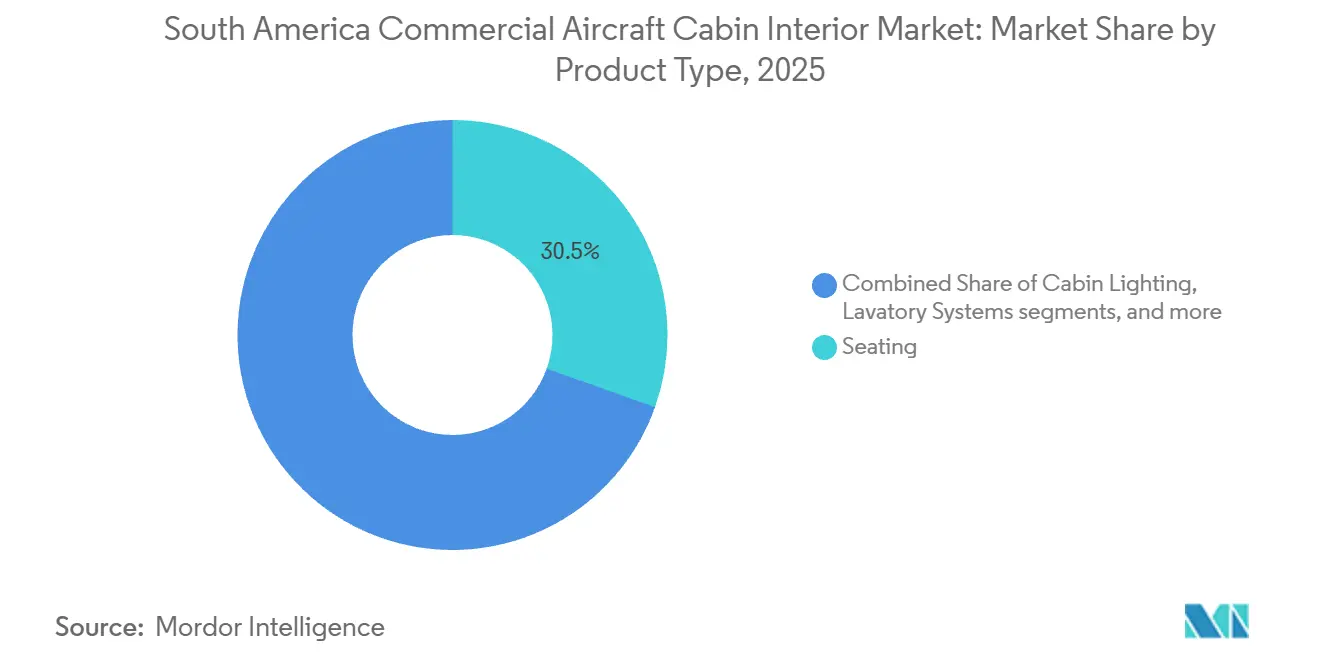
Connectivity Growth Changes the Product MixSeating accounted for an estimated 30.45% of the South America commercial aircraft cabin interior market in 2025. The region’s large narrowbody fleet supports demand and includes both retrofit activity and installations on new aircraft. Premium cabin programs increase interior content on selected long-haul aircraft, while economy-class installations continue to generate higher seat volumes. In August 2025, RECARO announced a 41-shipset PL3530 Premium Comfort retrofit program for LATAM’s B787-8 and B787-9 aircraft, with deliveries beginning in the first half of 2027.[3] The program demonstrates continued investment in differentiated seating alongside standard economy-class requirements.
IFEC is forecast to be the fastest-growing product category, with an estimated CAGR of 6.25% from 2026 to 2031. In July 2026, SES was selected to equip more than 60 LATAM A320neo, A321XLR, and E195-E2 aircraft with multi-orbit connectivity over the coming years. LATAM already operates more than 250 SES-connected aircraft. The program supports demand for electronically steered antennas, in-cabin network integration, software, installation, and maintenance support. Galleys, monuments, overhead bins, lighting, and interior panels remain relevant line-fit and retrofit categories, broadening cabin equipment opportunities as airlines combine conventional interior upgrades with connected passenger-experience systems.

By Aircraft Type:
Narrowbody Volume Supports Regional Jet MomentumNarrowbody aircraft accounted for an estimated 68.50% of the South America commercial aircraft cabin interior market in 2025. This share reflects the large installed base operating across domestic and regional networks. LATAM alone ended 2025 with 291 Airbus narrowbody passenger aircraft, compared with 60 widebody aircraft. Varying operating models drive demand for both higher-density layouts and differentiated premium sections, with LATAM offering Premium Economy on its narrowbody fleet. This generates recurring requirements for seating, overhead storage, cabin monuments, connectivity equipment, and other interior systems across new deliveries and retrofit programs.
Regional jets are forecast to record the fastest growth, at an estimated 5.65% CAGR from 2026 to 2031, based on the market segmentation used in this study. A growing E195-E2 order pipeline in South America supports this outlook. LATAM ordered 24 firm E195-E2 aircraft with 50 purchase options in September 2025, while Abra Group agreed in July 2026 to acquire 20 E195-E2 aircraft with 10 options and 15 purchase rights, bringing its potential requirement to 45 aircraft. Widebody aircraft remain relevant for higher-content long-haul cabin configurations, while turboprops continue to serve secondary and remote regional markets. Demand across aircraft types, therefore, combines the scale of the narrowbody installed base with a growing pipeline of smaller-capacity E2 aircraft.
By Cabin Class:
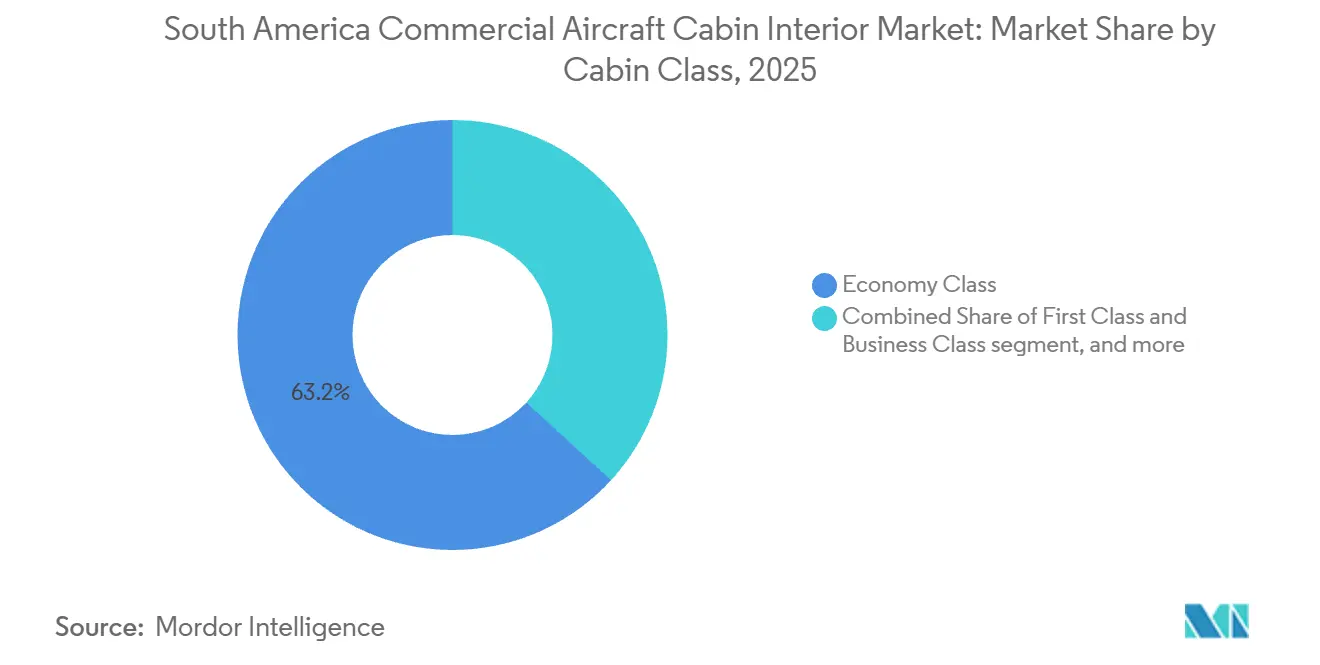
Economy Retains Scale While Premium Economy AdvancesEconomy Class accounted for 63.20% of the South America commercial aircraft cabin interior market in 2025. This reflects the large number of economy seats installed across narrowbody fleets, particularly among LCCs using high-density configurations. JetSMART, for example, operates the A321neo aircraft configured for up to 240 passengers. Airlines are also improving economy products through more ergonomic seating and additional passenger features, creating opportunities for seat replacement and cabin upgrades without materially changing the overall cabin mix. Economy class remains the largest source of installed seat volume across the regional fleet.
Premium Economy is forecast to be the fastest-growing cabin class, at an estimated 6.10% CAGR from 2026 to 2031. LATAM already offers Premium Economy on domestic and regional services and is expanding differentiation on long-haul routes through its new Premium Comfort cabin. In August 2025, LATAM selected RECARO's PL3530 Premium Economy seat for a 41-ship retrofit program for Boeing 787-8 and 787-9 aircraft beginning in 2027. Dedicated premium seating introduces higher-comfort products and integrated passenger features between standard Economy and Business Class, supporting higher-value cabin-interior opportunities in South America.
By Fit Type:
OEM Installation Leads While Aftermarket Demand AccelerateOEM installations accounted for 59.25% of the South America commercial aircraft cabin interior market in 2025. New aircraft production generates demand for seating, cabin monuments, overhead storage, lighting, connectivity equipment, and other interior systems before aircraft enter service. Brazil-based Embraer continues to support regional aircraft production, maintaining guidance for 80–85 commercial aircraft deliveries globally in 2026. South American airline fleet orders provide an additional pipeline for new cabin installations. OEM demand remains an important part of the regional market, although aircraft production and cabin installation schedules are exposed to broader aerospace supply chain conditions.
The aftermarket segment is forecast to grow at an estimated 5.90% CAGR from 2026 to 2031. As aircraft remain in service, airlines undertake cabin upgrades to refresh passenger products, change cabin configurations, and align older aircraft with newer fleet standards. Airbus indicates that initial cabin retrofits on the A350 typically begin after approximately eight years of service, and airlines commonly schedule major interior work alongside C-checks to utilize planned aircraft downtime. Cabin modifications require appropriate engineering, certification, materials, and approved installation capability, making MRO availability an important factor in project scheduling. The aftermarket opportunity grows as airlines combine planned maintenance with seating, connectivity, monument, and other interior upgrades.
By Material:
Aluminum Leads as Composites Gain GroundAluminum alloys accounted for 52.90% of the South America commercial aircraft cabin interior market share in 2025. Aluminum remains widely used in cabin equipment due to its established aerospace applications, durability, repairability, and favorable strength-to-weight characteristics. Aircraft galleys, fittings, frames, and other cabin hardware continue to incorporate aluminum, although suppliers increasingly combine metals with composite structures. The large installed fleet supports recurring demand for repair and replacement components compatible with existing aluminum-based cabin systems.
Composites are forecast to grow at a 6.23% CAGR through 2031. Weight reduction is a key driver, with newer composite overhead bins and cabin panels reducing structural weight while maintaining required performance. Airbus, for example, has introduced composite overhead bin systems designed to reduce cabin weight, while thermoplastics are used in applications such as tray tables, armrests, galley inserts, and interior panels. Metals continue to serve load-bearing fittings and hardware where higher structural strength is required. Adoption of new materials depends on compliance with applicable airworthiness, flammability, structural, and certification requirements, meaning that adoption of composites and thermoplastics will expand alongside the continued use and repair of established metallic cabin systems.
Geography Analysis
Brazil Commercial Aircraft Cabin Interior Market
Brazil accounted for 57.00% of the South America commercial aircraft cabin interior market in 2025. Its position is supported by the scale of its aviation market, domestic aerospace manufacturing, and established MRO capability. Brazil recorded 101.2 million domestic passengers in 2025, up 8.4% year on year. The country also has a significant cabin industry base: Embraer integrated certain Safran Cabin operations in Jacareí in July 2026, covering components such as overhead bins, galleys, lavatories, and floor panels for E-Jets. LATAM's São Carlos MRO facility adds dedicated interiors and composite shops and holds approvals from several regional and international aviation authorities. These capabilities support both new cabin production and ongoing repair and refurbishment activity in Brazil.
Colombia Commercial Aircraft Cabin Interior Market
Colombia is forecast to be the fastest-growing geography, at a CAGR of 5.81% from 2026 to 2031. The outlook is supported by continued passenger activity, LCC expansion, and investment in differentiated airline products. JetSMART carried more than 3.2 million passengers during its first year of domestic operations in Colombia and continued to add routes in 2025. Avianca also reported improved profitability in its domestic Colombian market and continued to expand premium revenue initiatives. These developments support requirements ranging from high-density economy configurations to more differentiated cabin products, although growth will remain sensitive to airline capital spending and imported equipment costs.
South America Commercial Aircraft Cabin Interior Market
Chile supports both premium and low-cost cabin configurations, with LATAM offering Premium Economy while JetSMART operates an extensive domestic and international network. Peru and Ecuador represent smaller aviation markets but continue to benefit from passenger growth and route development; Peru recorded 44.7 million airport passenger movements in 2025, while Ecuador recorded 8.04 million. Smaller South American markets contribute to additional aftermarket demand. Still, the scale and timing of cabin projects vary with fleet size, route development, aircraft age, airline investment capacity, and access to approved maintenance services.
Competitive Landscape
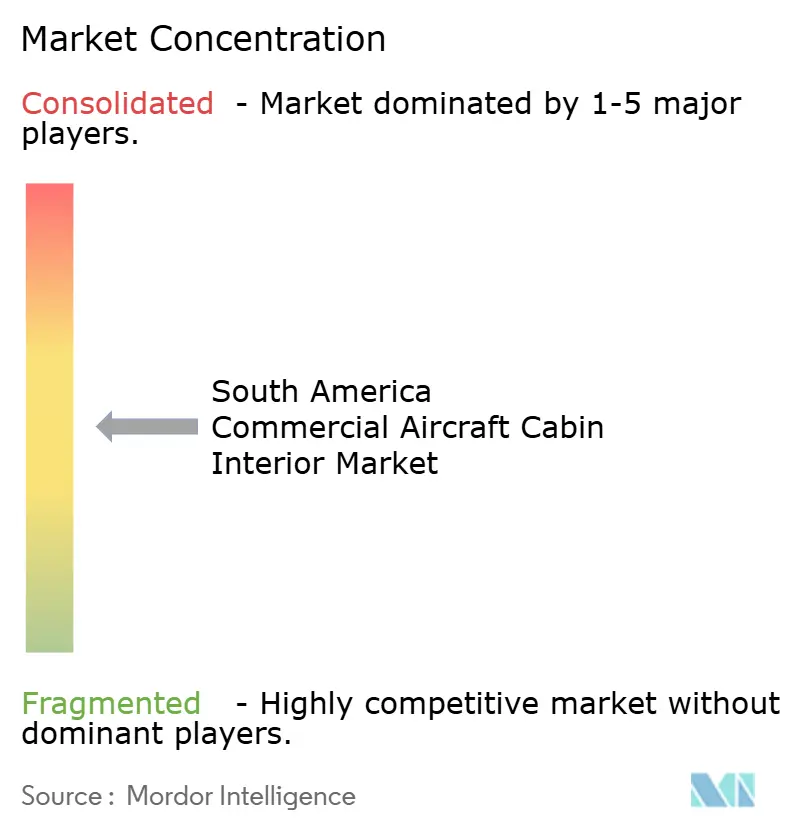
The South America commercial aircraft cabin interior market is moderately consolidated. Safran SA, Collins Aerospace, Diehl Aviation, Thales Group, and Panasonic Avionics Corporation are among the key suppliers across seating, cabin systems, monuments, and IFEC solutions. Certification requirements reinforce supplier relationships, established aircraft platforms, and long support cycles. RECARO's 41-shipset agreement with LATAM demonstrates that a supplier can secure a defined role in a retrofit program. Panasonic Avionics retains an IFE platform role in LATAM's B787 retrofit. Suppliers with existing shipsets are positioned to benefit when airlines seek to limit qualification risk during cabin upgrades.
Connectivity is an increasingly important competitive area, as it combines onboard hardware with ongoing service. In July 2026, SES was selected to provide multi-orbit connectivity across LATAM Airbus and Embraer aircraft. The program covers more than 60 aircraft and supports a LATAM-connected fleet of more than 250 aircraft. Jamco holds recurring galley and lavatory roles on Embraer programs, while Diehl is active in bins and cabin electronics. Astronics is positioned in cabin power and lighting, which can complement connectivity upgrades. Competition in this market, therefore, extends to system integration, technical support, and approved repair coverage.
White-space opportunities remain in lightweight composite bin production and repair of Ku-band and Ka-band connectivity hardware. Available data indicate limited local ANAC-certified capacity in both areas. A local provider would require certified processes, trained technicians, and stable access to imported materials. This barrier protects established international suppliers but also creates conditions for regional partnerships. Embraer's E195-E2 order agreement with Abra Group expands the addressable OEM pipeline. Overall, the South America commercial aircraft cabin interior market continues to be shaped by a small group of global suppliers and a constrained regional service base.
South America Commercial Aircraft Cabin Interior Industry Leaders
-
Safran SA
-
Collins Aerospace (RTX Corporation)
-
Diehl Stiftung & Co. KG
-
Thales Group
-
Panasonic Avionics Corporation
- *Disclaimer: Major Players sorted in no particular order
South America Commercial Aircraft Cabin Interior Market Companies Covered in this Report
- Safran SA
- Panasonic Avionics Corporation
- Collins Aerospace (RTX Corporation)
- Diehl Stiftung & Co. KG
- RECARO Aircraft Seating GmbH & Co. KG (RECARO Holding GmbH)
- Thales Group
- Thompson Aero Seating Limited (Aviation Industry Corporation of China)
- JAMCO Corporation
- Geven S.p.A.
- Singapore Technologies Engineering Ltd.
- FACC AG
- MRO Holdings Inc.
- Astronics Corporation
Recent Industry Developments in South America Commercial Aircraft Cabin Interior Market
- July 2026: SES was selected by LATAM Airlines to provide multi-orbit inflight connectivity across more than 60 A320neo, A321XLR, and E195-E2 aircraft. The deployment strengthens LATAM’s connected fleet strategy and supports higher-speed onboard broadband through electronically steered antennas, reinforcing demand for advanced satellite connectivity across South American commercial aviation.
- August 2025: RECARO Aircraft Seating announced a retrofit collaboration with LATAM Airlines Group to install PL3530 Premium-Class seats across 41 B787-8 and B787-9 shipsets from 2027. The program reflects LATAM’s increasing focus on premium cabin differentiation, combining greater privacy and comfort with advanced inflight entertainment and connectivity features to strengthen its long-haul passenger proposition.
South America Commercial Aircraft Cabin Interior Market Report Scope
Commercial aircraft cabin interiors encompass the systems, components, and materials installed inside commercial aircraft to support passenger comfort, safety, functionality, and the onboard experience. These include seating, cabin lighting, inflight entertainment and connectivity systems, galleys and monuments, lavatory systems, cabin windows and windshields, overhead stowage bins, interior panels and floorboards, and other cabin systems such as water and waste management, air purification, and oxygen systems.
The South America commercial aircraft cabin interior market is segmented by product type, aircraft type, cabin class, fit type, material, and geography. By product type, the market is segmented into seating, cabin lighting, inflight entertainment and connectivity, galley and monument, lavatory systems, cabin windows and windshields, overhead stowage bins, interior panels and floorboards, and other products. By aircraft type, the market is segmented into narrowbody, widebody, regional jets, and turboprop aircraft. By cabin class, the market is segmented into first class and business class, premium economy class, and economy class. By fit type, the market is segmented into OEM and aftermarket. By material, the market is segmented into composites, aluminum alloys, steel and other alloys, and advanced thermoplastics. The report also covers the market sizes and forecasts for the South America commercial aircraft cabin interior market in six countries across the region. For each segment, the market size is provided in terms of value (USD).
Segmentation Overview
By Product Type
| Seating |
| Cabin Lighting |
| In-flight Entertainment and Connectivity (IFEC) |
| Galley and Monument |
| Lavatory Systems |
| Cabin Windows and Windshields |
| Overhead Stowage Bins |
| Interior Panels and Floorboards |
| Others (Water and Waste Management Systems, Air Ionization and Purification System, Oxygen Systems, etc.) |
By Aircraft Type
| Narrowbody Aircraft |
| Widebody Aircraft |
| Regional Jets |
| Turboprop Aircraft |
By Cabin Class
| First Class and Business Class |
| Premium Economy Class |
| Economy Class |
By Fit Type
| Original Equipment Manufacturer (OEM) |
| Aftermarket |
By Material
| Composites |
| Aluminum Alloys |
| Steel and Other Alloys |
| Advanced Thermoplastics |
By Geography
| Brazil |
| Argentina |
| Chile |
| Colombia |
| Peru |
| Ecuador |
| Rest of South America |
| By Product Type | Seating |
| Cabin Lighting | |
| In-flight Entertainment and Connectivity (IFEC) | |
| Galley and Monument | |
| Lavatory Systems | |
| Cabin Windows and Windshields | |
| Overhead Stowage Bins | |
| Interior Panels and Floorboards | |
| Others (Water and Waste Management Systems, Air Ionization and Purification System, Oxygen Systems, etc.) | |
| By Aircraft Type | Narrowbody Aircraft |
| Widebody Aircraft | |
| Regional Jets | |
| Turboprop Aircraft | |
| By Cabin Class | First Class and Business Class |
| Premium Economy Class | |
| Economy Class | |
| By Fit Type | Original Equipment Manufacturer (OEM) |
| Aftermarket | |
| By Material | Composites |
| Aluminum Alloys | |
| Steel and Other Alloys | |
| Advanced Thermoplastics | |
| By Geography | Brazil |
| Argentina | |
| Chile | |
| Colombia | |
| Peru | |
| Ecuador | |
| Rest of South America |
Key Questions Answered in the Report
What is the forecast for South America commercial aircraft cabin interiors?
The South America commercial aircraft cabin interior market is projected to rise from USD 475.30 million in 2026 to USD 600.91 million by 2031 at a 4.80% CAGR.
Which product category has the strongest growth outlook?
IFEC has the highest projected product CAGR at 6.25% through 2031, supported by airline connectivity programs.
Why does narrowbody aircraft demand matter in South America?
Narrowbody aircraft represented 68.50% of 2025 value and serve the region's dense domestic and regional route networks.
What is supporting regional-jet cabin demand?
Regional jets are forecast to grow at 5.65% through 2031, supported by Embraer deliveries and the Abra Group E195-E2 agreement.
What limits cabin retrofit programs in the region?
Certification costs, limited approved capacity, import dependence, and currency exposure can delay planned upgrades.
Which country has the largest role in the regional sector?
Brazil represented 57.00% of 2025 value, supported by its large domestic aviation network and maintenance capabilities.