
South America Building Inspection Services Market Size and Share
Market Overview
| Study Period | 2020 - 2031 |
|---|---|
| Forecast Data Period | 2026 - 2031 |
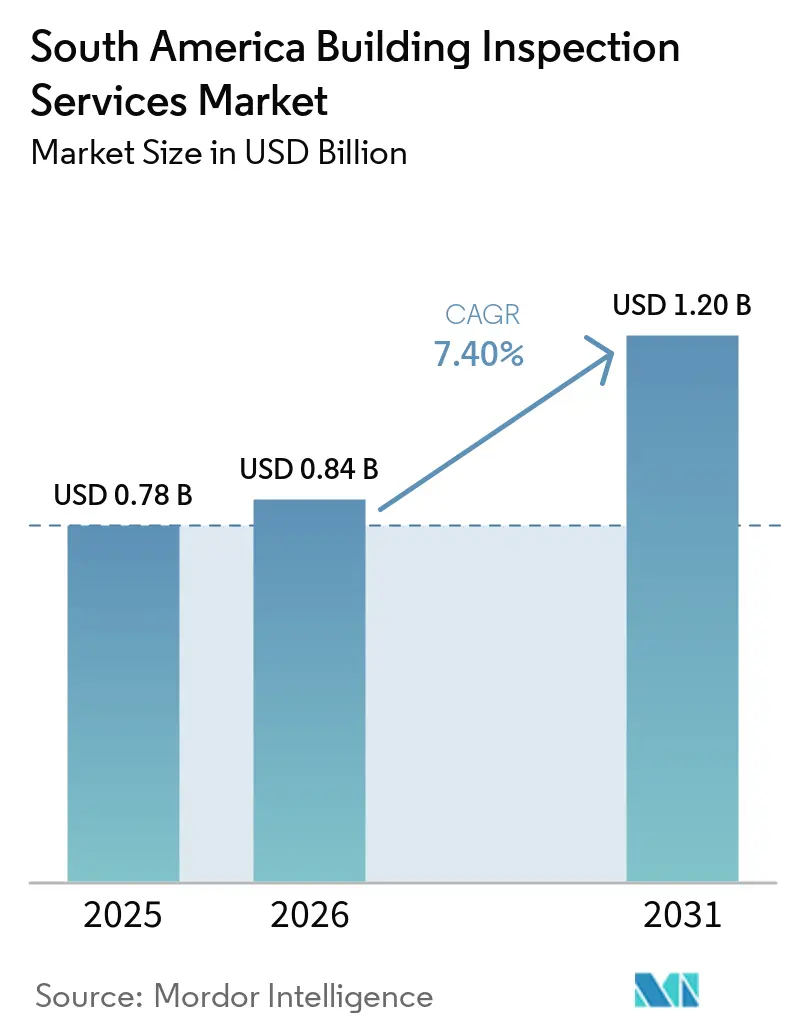
| Base Year Market Size (2025) | USD 0.78 Billion |
| Market Size (2026) | USD 0.84 Billion |
| Market Size (2031) | USD 1.20 Billion |
| Growth Rate (2026 - 2031) | 7.40 % |
| Market Concentration | Low |
Major Players *Disclaimer: Major Players sorted in no particular order Image © Mordor Intelligence. Reuse requires attribution under CC BY 4.0. | |
South America Building Inspection Services Market Analysis by Mordor Intelligence
The South America Building Inspection Services Market size is expected to increase from USD 0.78 billion in 2025 to USD 0.84 billion in 2026 and reach USD 1.20 billion by 2031, growing at a CAGR of 7.40% over 2026-2031. Stronger safety rules are making inspections a recurring requirement for formal construction and existing buildings. Brazil’s proposed national inspection framework and Chile’s updated seismic standard raise the technical requirements for building assessments. Public investment in housing, transport, sanitation, and urban renewal creates inspection work at planning, construction, handover, and maintenance stages. Mortgage lending requirements and institutional property due diligence also tie inspection demand to financing and property transactions. Technology such as drones, thermal imaging, and non-destructive testing, which evaluates a structure without causing damage, is widening the range of assets that can be inspected safely and efficiently.
Key Report Takeaways
- By service, commercial building inspection services held 40.1% of the South America building inspection services market share in 2025, while other specialized services are forecast to grow at a 9.6% CAGR through 2031.
- By sourcing type, outsourced services held 54.7% of the South America building inspection services market share in 2025 and are forecast to grow at an 8.8% CAGR through 2031.
- By application, residential services accounted for 48.8% of the South America building inspection services market size in 2025, while commercial services are forecast to grow at an 8.9% CAGR through 2031.
- By end user, property owners and investors held 31.5% of the South America building inspection services market size in 2025, while government and municipalities are forecast to grow at a 9.2% CAGR through 2031.
- By geography, Brazil held 57.8% of the regional share in 2025, while Colombia is forecast to grow at an 8.6% CAGR through 2031.
Note: Market size and forecast figures in this report are generated using Mordor Intelligence’s proprietary estimation framework, updated with the latest available data and insights as of January 2026.
South America Building Inspection Services Market Trends and Insights
Drivers Impact Analysis*
| Drivers | (~) % Impact on CAGR Forecast | Geographic Relevance | Impact Timeline |
|---|---|---|---|
| Stronger Construction and Safety Enforcement | +2.0% | Brazil, Chile, Peru | Short term (≤ 2 years) |
| Independent Property Due Diligence | +1.8% | Brazil, Colombia, Chile | Medium term (2-4 years) |
| Housing, Transport, and Urban Infrastructure Development | +1.6% | Brazil, Colombia, Peru, Rest of South America | Medium term (2-4 years) |
| Rehabilitation of Aging and Informally Modified Buildings | +1.2% | Brazil, Argentina, Peru | Medium term (2-4 years) |
| Formal Digital Records for Banks and Insurers | +1.0% | Brazil, Colombia, Chile | Long term (≥ 4 years) |
| Drone Inspection for Remote and Difficult-To-Access Assets | +0.9% | Brazil, Colombia, Chile, Argentina, Rest of South America | Medium term (2-4 years) |
| Source: Mordor Intelligence | |||
Stronger Construction and Safety Enforcement Reshapes Inspection as Mandatory Infrastructure
Regulatory requirements are moving building inspection from a discretionary activity toward a formal compliance obligation in the South America building inspection services market. Brazil’s Senate regional development committee approved PL 159/2026 in April 2026, advancing a proposed periodic inspection system and the Laudo de Inspeção Técnica de Edificação, or LITE, credential[1]. The proposal uses the Brazilian Association of Technical Standards NBR 16747 inspection standard and requires professional responsibility records from qualified engineers. Chile’s NCh433:2026 standard now requires deeper soil assessment and revised seismic zoning, which expands the technical work needed before construction and occupancy[2]. Colombia’s Law 1796 requires independent technical supervision for certain multi-unit residential projects, creating a repeat inspection need after delivery. Peru’s 2026 proposal on urban reviewer accreditation similarly aims to strengthen qualifications for structural safety assessments.
Independent Property Due Diligence Creates Recurring Inspection Demand
Independent assessments are becoming more important in property financing and investment decisions across the South America building inspection services market. In Brazil, certified engineering assessments support mortgage collateral valuations under Central Bank Resolution No. 4.676, linking inspection work to the housing finance process. The Minha Casa, Minha Vida housing program has contracted 2 million homes since 2023, supporting a broad base of financed residential transactions. Institutional buyers in São Paulo and Rio de Janeiro increasingly require technical reviews of structural, plumbing, electrical, and facade systems before approving acquisitions. This requirement makes the inspection a standard control within the transaction process rather than a step taken only after an agreement. Chile’s housing-finance reforms and Colombia’s development financing practices also support more formal appraisal and technical documentation requirements.
Housing, Transport, and Urban Infrastructure Development Sustain Inspection Volumes
Public programs are creating a multi-year project pipeline for the South America building inspection services market. Brazil’s Novo PAC committed USD 260 billion through 2026, and USD 140 billion had been executed by the end of 2024, supporting inspection needs across transport, sanitation, housing, and other public assets[3]. Reforma Casa Brazil, launched in November 2025, allocated USD 7.4 billion for repairs to more than 12 million urban households and requires condition assessments before and after supported work. Colombia’s USD 5.3 billion Bogotá metro project creates long-running construction, commissioning, and handover inspection requirements. Peru updated its National Building Regulations in 2025, broadening technical requirements for new construction. Formal digital inspection records also help banks, insurers, and public agencies establish a traceable building condition record that can be used in lending, underwriting, and maintenance planning.
Rehabilitation of Aging and Informally Modified Buildings Broadens the Service Pipeline
Existing buildings provide a demand base that is less dependent on new construction activity in the South America building inspection services market. The Brazilian Institute of Engineering Appraisals and Expertise reported that 66% of building accidents in Brazil were linked to deferred preventive maintenance rather than original construction defects. Peru has 1.6 million informally built homes, and only 16% held construction licenses, according to the Peruvian Economy Institute. Informally modified buildings can require checks of seismic reinforcement, wall layouts, electrical systems, and water systems that go beyond a simple visual review. A 2025 study of self-built homes in Lima documented building-code violations that raise the complexity of these evaluations. Brazil’s NBR 5674:2024 maintenance guidance also supports scheduled facade reviews, while drones allow safer access to roofs, facades, conduits, and other difficult locations.
Restraints Impact Analysis*
| Restraints | (~) % Impact on CAGR Forecast | Geographic Relevance | Impact Timeline |
|---|---|---|---|
| Shortage of Accredited Technical Inspectors | -1.2% | Brazil, Colombia | Short term (≤ 2 years) |
| Currency Volatility and Imported Technology Costs | -1.0% | Argentina, Brazil, Chile | Medium term (2-4 years) |
| Uneven Application of Building Codes Across Municipalities | -0.9% | Colombia, Peru, Rest of South America | Medium term (2-4 years) |
| Informal Construction and Low-Cost Inspection Substitution | -0.8% | Brazil, Peru, Rest of South America | Long term (≥ 4 years) |
| Source: Mordor Intelligence | |||
Shortage of Accredited Technical Inspectors Limits Delivery Capacity
The availability of qualified inspectors may limit the speed at which the South America building inspection services market can meet new compliance demands. Brazil faces pressure from high infrastructure activity and lower engineering school enrollment, which limits the supply of experienced professionals. The Lima chapter of the Peruvian College of Engineers accredited 144 municipal technical inspectors for 2026-2027, including 51 first-time certifications. Professional groups in Peru have also sought the return of mandatory civil-engineer participation in building safety inspections. Chile’s rules on public officials acting as technical works inspectors create different registration requirements from those applied to private specialists. Uneven enforcement across municipalities and the use of lower-cost informal alternatives can also reduce demand for accredited providers and create inspection backlogs.
Currency Volatility and Imported Equipment Costs Restrict Technology Deployment
Imported equipment raises the cost of advanced services in the South America building inspection services market. Thermal imaging tools, ultrasonic testers, LiDAR-equipped drones, and other inspection systems are largely sourced from outside the region. Argentina faces the greatest exposure because import duties, taxes, logistics, and currency depreciation increase local acquisition costs. The Organization for Economic Co-operation and Development identified foreign-exchange constraints and import restrictions as barriers to technology adoption in Argentina during 2025. Smaller Brazilian firms also face elevated capital costs for imported instruments, which can lead them to lease equipment rather than own it. Chile’s updated seismic rules require deeper soil sounding, increasing demand for specialized equipment where local supply remains limited.
*Our forecasts treat driver/restraint impacts as directional, not additive. The impact forecasts reflect baseline growth, mix effects, and variable interactions.
Segment Analysis
By Service: Commercial Assessments Lead While Specialized Formats Grow Faster
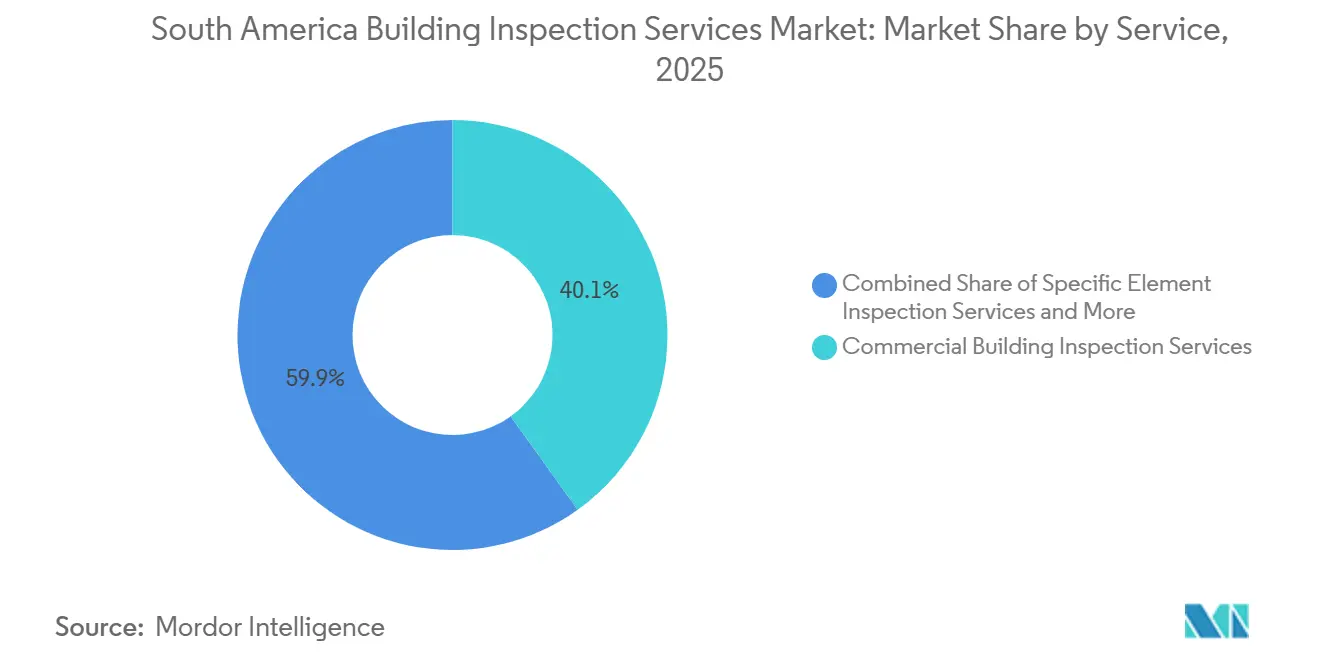
Commercial building inspection services held 40.1% of the South America building inspection services market in 2025, making them the largest service category. Large offices, retail properties, logistics facilities, and multi-story assets need combined checks of structural, mechanical, electrical, plumbing, and fire-suppression systems. These assignments often involve more than 1 discipline and can support longer service engagements. Home inspection and specific-element inspection services remain important for residential properties and targeted building repairs. The Reforma Casa Brazil program supports this work because funded rehabilitation projects require assessments before work begins and after it is completed. The service mix is therefore extending beyond one-time visual inspections toward documented, recurring building-condition reviews.
Other specialized services are forecast to grow at a 9.6% CAGR through 2031, the fastest rate among service types. This category includes drone-based facade checks, thermal imaging, and non-destructive structural testing. ViaMobilidade integrated drone patrols on São Paulo metro Lines 8 and 9 in April 2026, showing how an aerial inspection can cover areas that would take much longer to review from the ground. Brazil’s electricity regulator requires periodic drone inspections of transmission lines, which supports the use of this format for infrastructure assets. Technical standards are also expanding attention to air-conditioning, fire prevention, and other critical building systems. These changes give service providers a reason to offer specialized work alongside conventional commercial inspections.

By Sourcing Type: Outsourcing Holds the Largest Position and Fastest Growth
Outsourced services held 54.7% of the regional share in 2025. Property owners use external providers to access accredited specialists without maintaining internal teams across several jurisdictions. This approach is particularly relevant where a professional must sign inspection records and assume formal responsibility for the assessment. Brazil’s proposed LITE system, Chile’s seismic requirements, and Colombia’s independent technical supervision rules all reinforce the value of third-party expertise. Large agencies and property management organizations still retain in-house teams where they can support the cost of permanent technical staff. In-house delivery remains most common where inspection is part of a public authority’s ongoing building oversight role.
Outsourced services are also forecast to expand at an 8.8% CAGR through 2031, the fastest sourcing format. The technical requirements for drones, thermography, and digital building documentation increase the investment needed to maintain a competitive in-house service. Intertek acquired TESIS, a São Paulo building-products testing company, in May 2025 to extend its building and construction testing, assurance, inspection, and certification services in Brazil. The acquisition demonstrates how larger providers are assembling broader external service platforms. Formal third-party sign-off also creates demand that cannot simply be reassigned to an internal facilities team. This supports continuing use of outsourced services as regulatory scope becomes more complex.
By Application: Residential Work Leads While Commercial Demand Accelerates
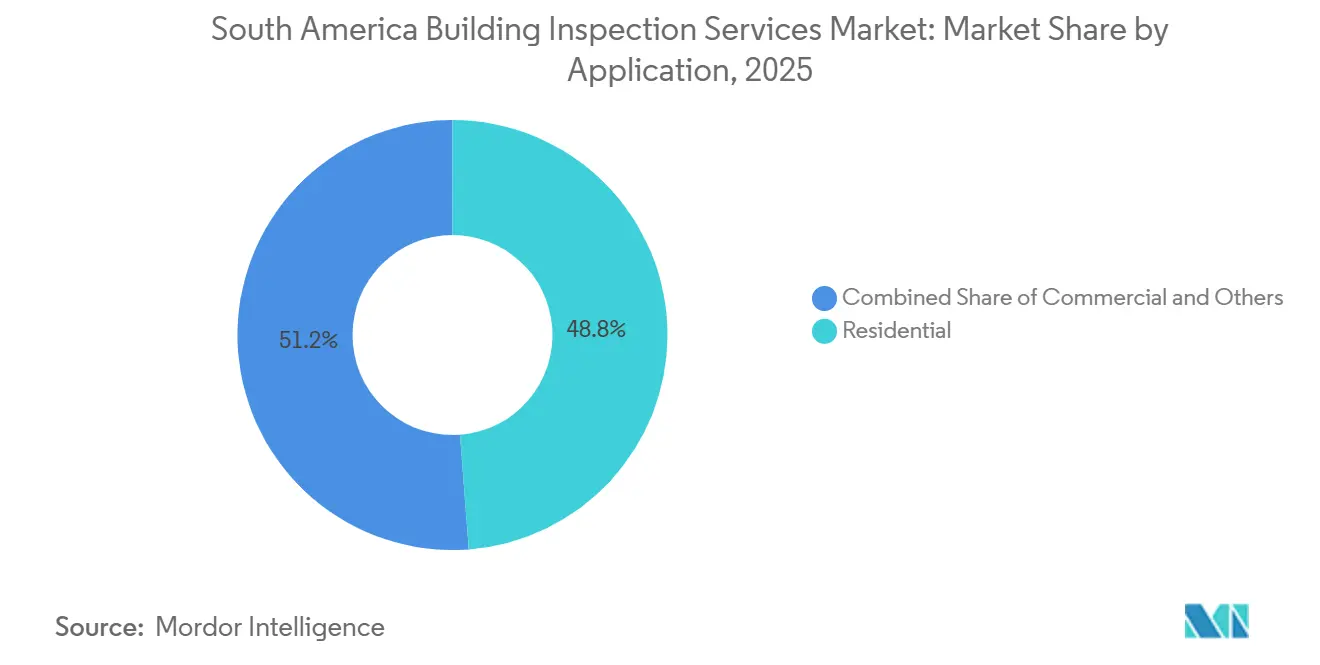
Residential applications accounted for 48.8% of the regional share in 2025. The region’s large housing stock and social housing programs create demand for condition reviews, mortgage assessments, and rehabilitation inspections. Brazil’s housing finance rules require certified engineering assessments for property collateral valuations, connecting residential inspections to loan approval processes. Existing homes also need evaluations before repairs are funded under housing rehabilitation programs. Informal construction in Peru and building maintenance risks in Brazil add another layer of residential assessment demand. These factors keep residential work central to the volume base for inspection providers.
Commercial applications are forecast to grow at an 8.9% CAGR through 2031. Warehouses, cold-storage sites, data centers, and mixed-use urban projects require checks during design, construction, commissioning, and operation. The Bogotá Quora development shows the range of inspections associated with complex projects that combine office, residential, hotel, retail, and cultural uses. Other applications include industrial, infrastructure, and institutional assets that benefit from Brazil’s multi-sector Novo PAC program. Commercial and industrial projects often have higher contract values and longer inspection cycles than individual homes. This makes them important to provider revenue even when their share of inspection events is lower.
By End User: Property Owners Lead While Public Buyers Grow Faster
Property owners and investors held 31.5% of the regional share in 2025. Their demand is supported by mortgage requirements, property transactions, and the need to identify defects before acquisition or renovation. Technical reviews can cover building structure, plumbing, electrical systems, facade conditions, and compliance records. Real estate agencies and brokers also need certificates and related documentation as property transactions become more formal. Insurance and financial institutions use building assessments to evaluate collateral quality and structural risk. Facility-management firms represent a smaller user group but can create recurring work as maintenance reviews become scheduled rather than reactive.
Government and municipalities are forecast to grow at a 9.2% CAGR through 2031. Public infrastructure programs require inspections before construction, during delivery, and through later maintenance cycles. Brazil’s Novo PAC and Reforma Casa Brazil programs widen the number of public projects requiring condition documentation. Peru’s updates to the National Building Regulations also expand the technical scope of assessments for formally developed buildings. Government buyers often require reports that meet public audit and funding documentation needs. This creates opportunities for providers that combine technical inspection with clear records and accredited certification.
Geography Analysis
Brazil held 57.8% of the regional share in 2025, supported by its construction scale, regulatory base, and public investment pipeline. Novo PAC had executed USD 140 billion by the end of 2024 and continues to support work across highways, railways, sanitation, and housing. Reforma Casa Brazil now supports housing upgrades for more than 12 million urban households and requires assessments before and after rehabilitation. NBR 16747 provides the technical methodology for building inspections, while PL 159/2026 is intended to establish a national obligation if enacted. Caixa Econômica Federal requires an in-person engineering inspection before approving a property loan, connecting demand to the national mortgage cycle. Brazil, therefore, combines new-build, rehabilitation, lending, and infrastructure work within a single large inspection base.
Colombia is forecast to grow at an 8.6% CAGR through 2031, the fastest geographic rate in the South America building inspection services market. The National Administrative Department of Statistics recorded an 11.2% year-over-year increase in approved construction area across 302 municipalities during the first 11 months of 2025. The USD 5.3 billion Bogotá metro project was 80% complete by mid-2026 and requires continuing commissioning and handover reviews. Colombia’s planned transport projects also support a longer public inspection pipeline. Chile has a mature regulatory framework for technical works inspectors on public-use and taller residential buildings. The new NCh433:2026 seismic standard strengthens assessment requirements across the country’s seismic zones.
Argentina and Peru contribute a meaningful part of regional demand despite different short-term constraints. Argentina’s construction sector expanded by 6% in real terms during 2025, although suspended federal projects constrain the public inspection pipeline. High costs for imported drones and non-destructive testing equipment limit the availability of advanced services. Peru combines a growing formal construction base with a large stock of informal homes, creating a need for both compliance inspections and rehabilitation assessments. Ecuador, Uruguay, Paraguay, Bolivia, and Venezuela add incremental demand through urban development and building-risk management. Ecuador’s urban densification and seismic exposure provide a particularly relevant need for structural inspection services.
Competitive Landscape
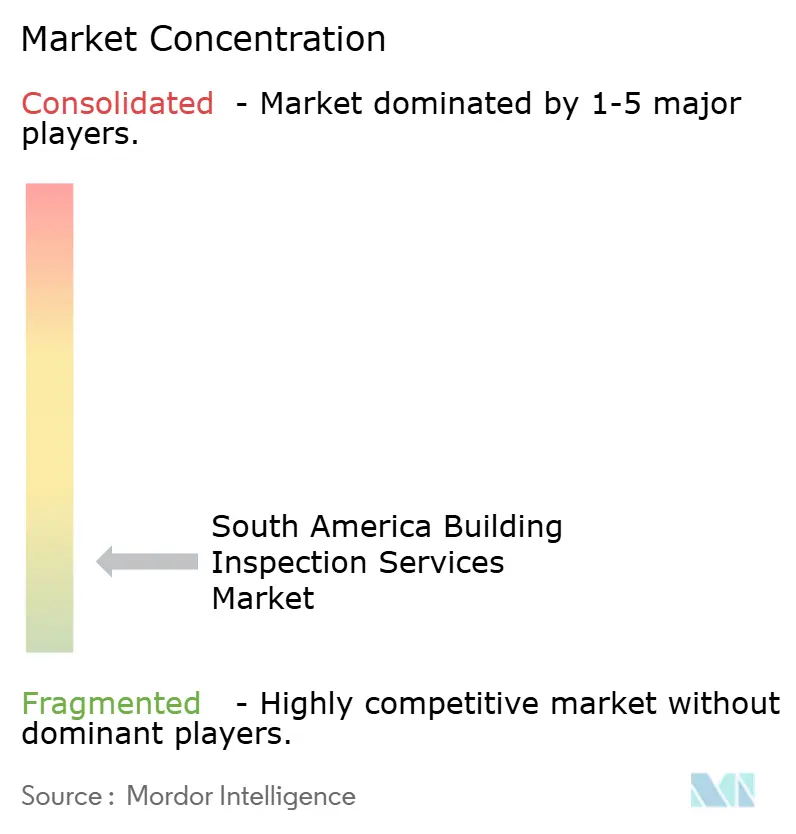
The South America building inspection services market is moderately fragmented. SGS, Bureau Veritas, Intertek, TÜV Rheinland, and DEKRA compete with domestic and regional specialists. Global providers compete through laboratory networks, accreditation, broader service coverage, and digital reporting systems. Domestic firms can compete through local relationships, faster field coverage, and familiarity with municipal rules. Accreditation under International Organization for Standardization and International Electrotechnical Commission standards 17020 for inspection bodies and 17065 for product certification can create an entry barrier for smaller, informal providers. This structure supports competition on technical capability and regulatory acceptance rather than price alone.
Intertek acquired TESIS in Brazil in May 2025, adding a building-products testing company with established local expertise. In February 2026, Intertek agreed to acquire QTEST in Medellín to expand its electrical testing and certification presence in Colombia. SGS received Brazilian CGCRE/Inmetro accreditation in January 2026 for inspection of developments and infrastructure under ISO/IEC 17020. These moves improve the ability of global firms to provide testing, inspection, and certification services across larger projects. SGS and Bureau Veritas ended merger discussions in January 2025, leaving them to pursue separate strategies in the region. Continued independent operations preserve a broader set of large competitors for South American clients.
Opportunities remain in smaller Brazilian cities, peri-urban districts, drone-based facade reviews, roof inspections, and rehabilitation programs that require public-funding documentation. Providers are also adopting photogrammetry, LiDAR scanning, and digital defect identification to produce building information modeling-compatible records for asset managers. Bureau Veritas agreed to acquire Lotusworks in April 2026, strengthening commissioning and quality assurance capability for data centers and similar specialized facilities. TÜV Rheinland has expanded its South American laboratory capacity, while DEKRA holds accreditation in Colombia. The ability to combine field inspection, testing, certification, and digital documentation is becoming more important for complex client requirements. Smaller providers remain relevant where local access and specialized service knowledge are more valuable than a broad regional footprint.
South America Building Inspection Services Industry Leaders
-
SGS Group
-
Bureau Veritas
-
Intertek Group plc
-
Applus+
-
TÜV Rheinland AG
- *Disclaimer: Major Players sorted in no particular order
Recent Industry Developments
- August 2026: Chile's Ministerio de Vivienda y Urbanismo published Decreto Exento N° 28 in the Diario Oficial, officially enacting NCh433:2026 as the national seismic design standard for buildings. The update mandates 30-meter soil sounding and updated seismic zoning classifications for all projects, directly expanding the scope and complexity of structural inspection and certification services across Chile's formal construction sector.
- April 2026: Bureau Veritas signed an agreement to acquire Lotusworks, a mission-critical asset commissioning and quality assurance firm, for USD 412 million. The acquisition strengthens Bureau Veritas' Buildings and Infrastructure division's technical commissioning and quality assurance capabilities, positioning the company for data center construction and semiconductor facility inspection projects entering South America through hyperscaler investment.
- April 2026: ViaMobilidade, operator of São Paulo's metro Lines 8 and 9, formally integrated drone-based aerial inspection into its railway infrastructure monitoring program. The drones can cover inspection stretches in 2 minutes that previously required hours of ground-level patrol and are integrated with analytical cameras, asset sensors, and a real-time control center.
South America Building Inspection Services Market Report Scope
| Home Inspection Services |
| Specific Element Inspection Services |
| Commercial Building Inspection Services |
| Other Specialised Services |
| In-House Services |
| Outsourced Services |
| Residential |
| Commercial |
| Other Applications |
| Real-Estate Agencies and Brokers |
| Property Owners and Investors |
| Government and Municipalities |
| Insurance and Financial Institutions |
| Facility-Management Firms |
| Brazil |
| Argentina |
| Chile |
| Colombia |
| Peru |
| Rest of South America |
| By Service | Home Inspection Services |
| Specific Element Inspection Services | |
| Commercial Building Inspection Services | |
| Other Specialised Services | |
| By Sourcing Type | In-House Services |
| Outsourced Services | |
| By Application | Residential |
| Commercial | |
| Other Applications | |
| By End User | Real-Estate Agencies and Brokers |
| Property Owners and Investors | |
| Government and Municipalities | |
| Insurance and Financial Institutions | |
| Facility-Management Firms | |
| By Countries | Brazil |
| Argentina | |
| Chile | |
| Colombia | |
| Peru | |
| Rest of South America |
Key Questions Answered in the Report
What is the forecast for South America building inspection services through 2031?
The sector is forecast to reach USD 1.2 billion by 2031, growing at a 7.4% CAGR from 2026.
Which service category leads demand in South America?
Commercial building inspection services led with 40.1% share in 2025, reflecting demand from complex office, retail, and logistics assets.
Which service category is growing fastest?
Other specialized services are forecast to grow at a 9.6% CAGR through 2031, supported by drones, thermal imaging, and non-destructive testing.
Why do property owners use outsourced inspection providers?
Outsourced services held 54.7% share in 2025 because owners can access accredited technical expertise and manage compliance responsibilities.
Which country is expected to grow fastest for building inspection services?
Colombia is forecast to grow at an 8.6% CAGR through 2031, supported by construction recovery and large infrastructure projects.
What is driving public-sector demand for building inspections?
Government and municipalities are forecast to grow at a 9.2% CAGR through 2031 as housing, transport, and public-building programs require condition records and technical reviews.