
South America Big Data Analytics Market Size and Share
Market Overview
| Study Period | 2020 - 2031 |
|---|---|
| Forecast Data Period | 2026 - 2031 |
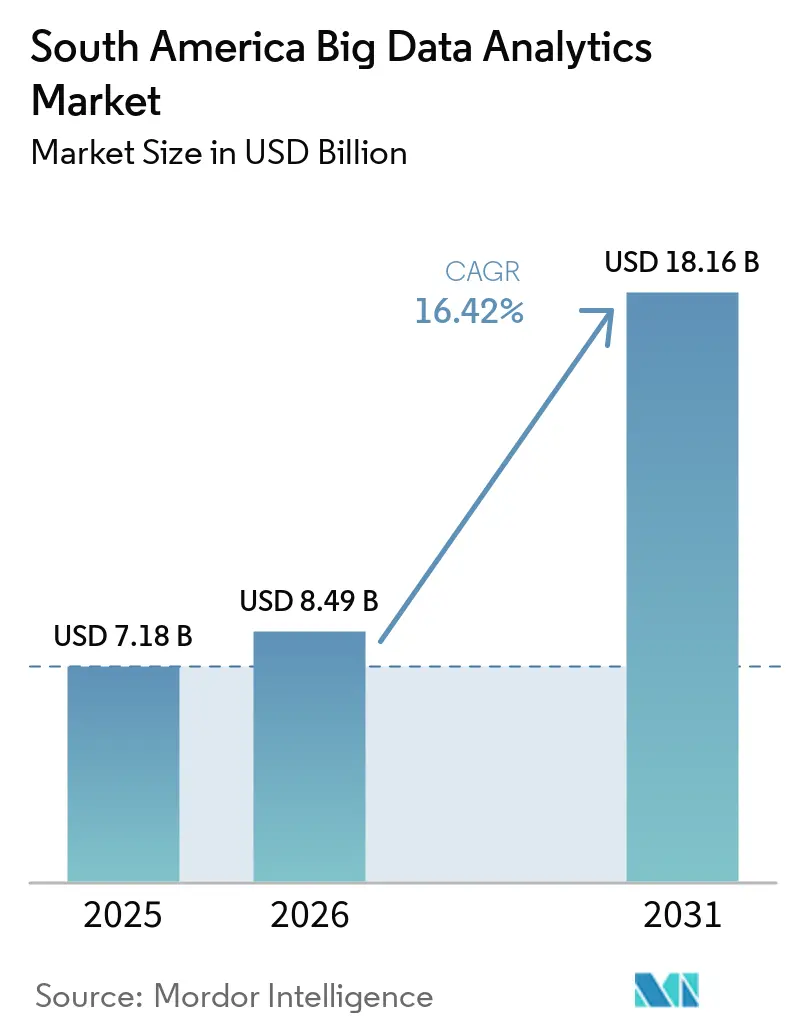
| Base Year Market Size (2025) | USD 7.18 Billion |
| Market Size (2026) | USD 8.49 Billion |
| Market Size (2031) | USD 18.16 Billion |
| Growth Rate (2026 - 2031) | 16.42 % |
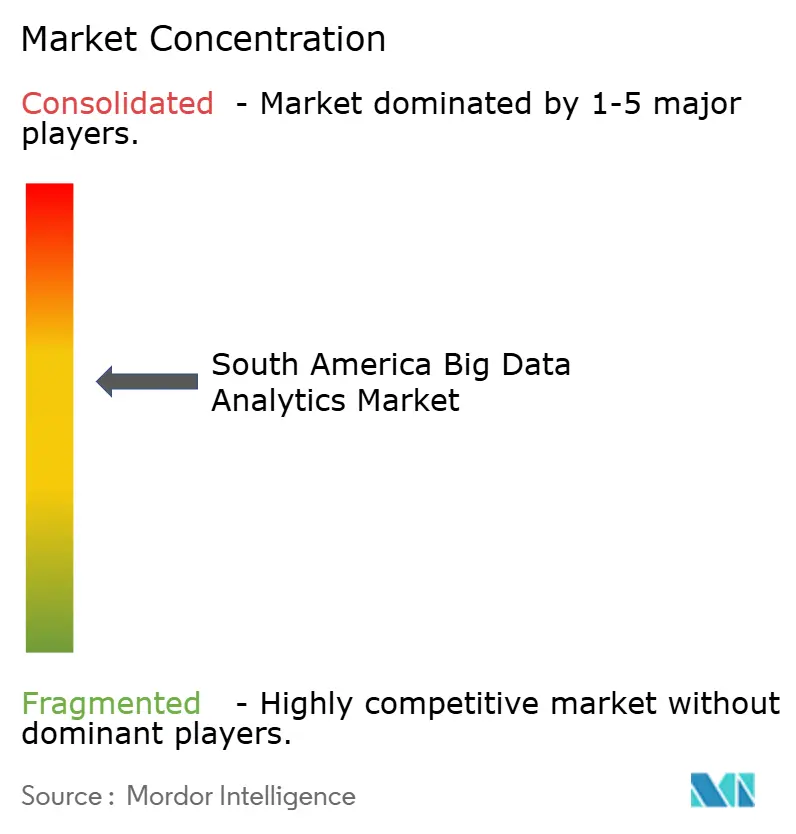
| Market Concentration | Medium |
Major Players *Disclaimer: Major Players sorted in no particular order Image © Mordor Intelligence. Reuse requires attribution under CC BY 4.0. | |
South America Big Data Analytics Market Analysis by Mordor Intelligence
The South America big data analytics market size is expected to increase from USD 7.18 billion in 2025 to USD 8.49 billion in 2026 and reach USD 18.16 billion by 2031, growing at a CAGR of 16.42% over 2026-2031. Cloud capacity is expanding in Brazil and Chile, which is making local processing more practical for workloads that require low latency and local data handling. Enterprise buyers are moving from pilot projects toward tools that can show measurable operational value and support reliable model management. Health data exchange, open finance, digital commerce, and connected devices are adding structured data that can support new uses of the South America big data analytics market. Global platform vendors retain strong positions in large accounts, while regional suppliers are competing through localized products and industry-specific delivery. The main limitation remains the shortage of data engineering and analytics talent, which raises delivery costs and slows adoption among smaller organizations.
Key Report Takeaways
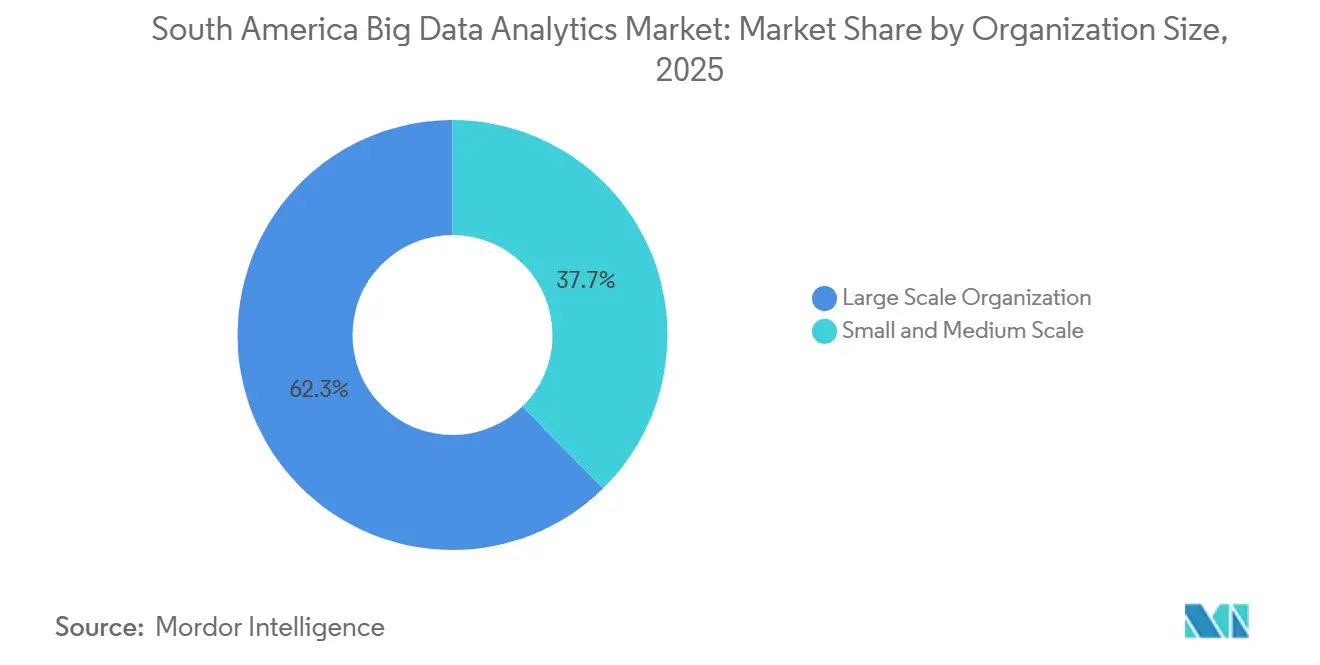
- By organization size, large scale organizations held 62.34% of the South America big data analytics market share in 2025, while small and medium scale organizations are projected to expand at a 16.77% CAGR through 2031.
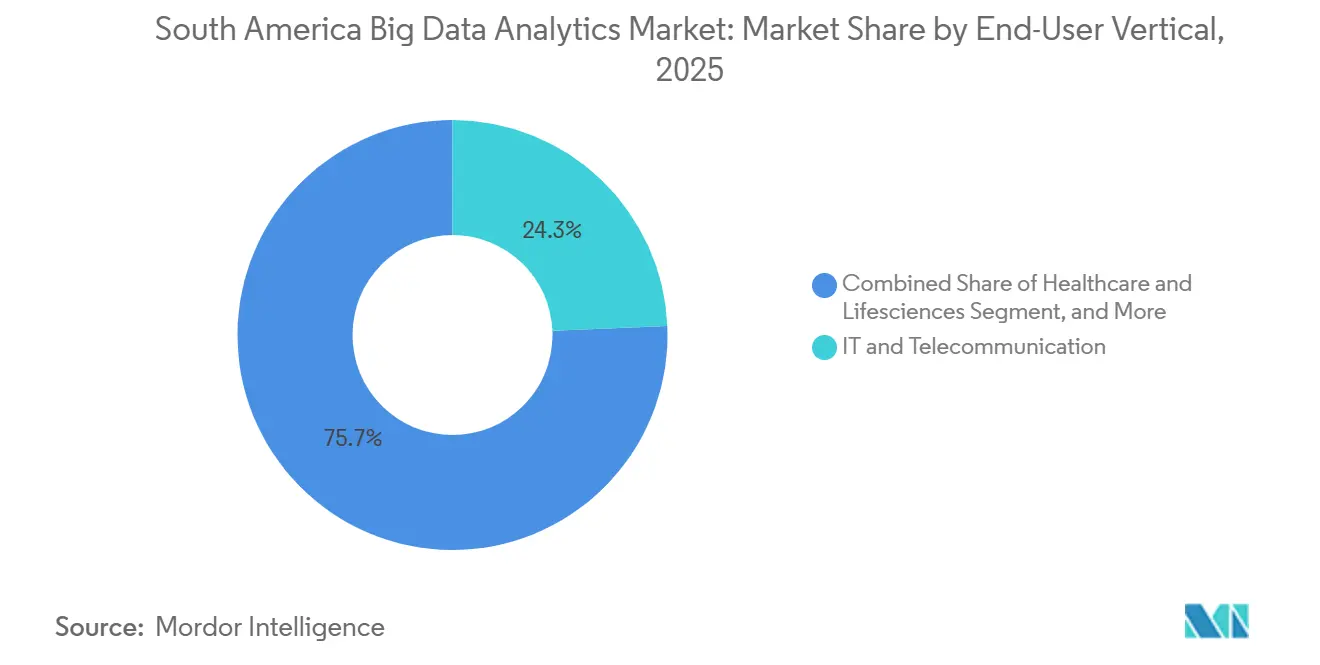
- By end-user vertical, IT and Telecommunication accounted for 24.33% of the South America big data analytics market size in 2025, while Healthcare and Lifesciences is expected to advance at a 16.82% CAGR through 2031.
- By geography, Brazil held 58.22% of the South America big data analytics market share in 2025, while Colombia is projected to expand at a 16.96% CAGR through 2031.
Note: Market size and forecast figures in this report are generated using Mordor Intelligence’s proprietary estimation framework, updated with the latest available data and insights as of January 2026.
South America Big Data Analytics Market Trends and Insights
Drivers Impact Analysis*
| Driver | (~) % Impact on CAGR Forecast | Geographic Relevance | Impact Timeline |
|---|---|---|---|
| Expansion of Cloud and Hyperscale Data-Center Infrastructure | +4.2% | Brazil, Chile, Colombia, Argentina | Short term (≤ 2 years) |
| Growing Enterprise Demand for Data-Driven Decision-Making | +3.8% | Brazil, Argentina, Colombia | Medium term (2-4 years) |
| Increasing AI and Machine Learning Integration | +3.2% | Brazil, Colombia, Chile | Medium term (2-4 years) |
| Rising Digital Commerce and Connected-Device Data Generation | +2.0% | Brazil, Argentina, Colombia | Short term (≤ 2 years) |
| Localization of Spanish and Portuguese Language Analytics | +1.3% | Brazil, Argentina, Colombia, Chile | Medium term (2-4 years) |
| Analytics Adoption Across Brownfield Industrial Assets | +0.9% | Brazil, Chile, Argentina | Long term (≥ 4 years) |
| Source: Mordor Intelligence | |||
Expansion of Cloud and Hyperscale Data-Center Infrastructure
Cloud investment is reducing a core infrastructure constraint for the South America big data analytics market. AWS has committed substantial investments to expand its Brazilian data center operations through the next decade. AWS has also announced significant funding for the AWS South America Chile Region, which is scheduled to begin operating by the end of 2026.[1]Amazon Web Services, “Amazon to Invest More Than USD 4 Billion to Launch Infrastructure Region in Chile,” Amazon Web Services, press.aboutamazon.com Microsoft announced significant investment in Brazilian cloud and AI infrastructure over several years. Ascenty began building a large-scale AI data center campus in Brazil with substantial investment. Greater local capacity can support workloads that are sensitive to latency or subject to data-residency requirements, including banking and public-sector applications. The South America big data analytics market can therefore reach buyers that previously found local hosting capacity inadequate for enterprise service commitments.
Growing Enterprise Demand for Data-Driven Decision-Making
Organizations are placing more emphasis on measurable results from analytics programs. Many large enterprises in the region have at least one AI or analytics project in production, while a smaller share reports measurable impact on business metrics. However, many South American enterprise respondents struggle to translate AI investment into measurable value. This gap supports demand for data governance, model monitoring, and AI operations tools that can improve production performance. Banco de Bogotá migrated several analytical models to Google Cloud BigQuery and substantially reduced processing time, showing how operational priorities can shape technology decisions. The South America big data analytics market is likely to favor platforms and service providers that can connect deployments to visible business outcomes, rather than only adding new models.
Increasing AI and Machine Learning Integration
AI and machine learning are becoming more closely integrated with enterprise analytics platforms across the region. A significant share of regional machine-learning models does not reach production, while deployed models can experience a notable decline in performance over time without systematic monitoring. This pattern is moving buyers toward lakehouse platforms, MLOps tools, and vector databases instead of isolated point products. TOTVS recently launched LYNN, a B2B-focused AI foundation model for agents in its ERP and front-office products.[2]TOTVS, “LYNN, the First B2B AI Foundation Model in Brazil,” TOTVS, totvs.com TOTVS planned substantial software development capital expenditure over several years for the model. The South America big data analytics market benefits when regional vendors create models and data assets that address local business workflows rather than only integrating foreign tools.
Rising Digital Commerce and Connected-Device Data Generation
Digital commerce and connected devices are increasing the volume and speed of operational data. Brazil, Argentina, and Colombia accounted for the majority of regional retail e-commerce sales, according to the supplied material. Centauro used RFID and cloud analytics to track inventory across an extensive store network, significantly improving inventory accuracy and sharply reducing out-of-stock occurrences. Payment activity and device telemetry are creating data streams that require more frequent processing than traditional batch systems. Logistics operators also need timely views of parcels, fulfillment activity, and returns. These changes broaden the set of operational use cases served by the South America big data analytics market.
Restraints Impact Analysis*
| Restraint | (~) % Impact on CAGR Forecast | Geographic Relevance | Impact Timeline |
|---|---|---|---|
| Shortage of Data Engineering and Analytics Talent | -2.8% | Brazil, Colombia, Argentina | Short term (≤ 2 years) |
| Data-Privacy Compliance and Cross-Border Data Governance | -1.9% | Brazil, region-wide | Medium term (2-4 years) |
| Fragmented Data Architectures Across Countries and Industries | -1.4% | Region-wide | Long term (≥ 4 years) |
| High Integration Costs for Legacy Industrial Equipment | -0.8% | Brazil, Argentina, Chile | Long term (≥ 4 years) |
| Source: Mordor Intelligence | |||
Shortage of Data Engineering and Analytics Talent
The supply of data engineering and analytics talent remains a material constraint on the South America big data analytics market. The World Economic Forum reported that a large share of employers in South America planned to upskill their workforces for data and digital roles because external talent availability was not expected to improve over the coming years. The supplied material also stated that many companies in Brazil faced difficulty hiring data engineers. Competition from North American technology contracts can further increase retention pressure for regional employers. Large organizations can address part of the issue through platform-based self-service tools and internal training. Smaller organizations remain more exposed because they have less capacity to fund specialized teams, data governance functions, and extended implementation work.
Data-Privacy Compliance and Cross-Border Data Governance
Privacy rules increase the governance work required for cross-border analytics deployments. Brazil's General Data Protection Law is administered by the Agência Nacional de Proteção de Dados, and the supplied material stated that supervisory proceedings by late 2025 had increased substantially from the previous year. A mutual adequacy decision between Brazil and the European Union took effect in early 2026, simplifying eligible data transfers while increasing the importance of coordinated compliance practices. The ANPD's upcoming priorities include biometric, health, and financial data, which are also high-value categories for analytics use. Argentina's data protection law and Colombia's data protection law add further country-level compliance requirements. The South America big data analytics market faces higher implementation complexity where organizations lack dedicated governance teams and must manage data across several jurisdictions.
*Our forecasts treat driver/restraint impacts as directional, not additive. The impact forecasts reflect baseline growth, mix effects, and variable interactions.
Segment Analysis
By Organization Size: Large Organizations Hold Current Spending While SMEs Expand Faster
Small and medium-scale organizations are expected to expand at a 16.77% CAGR through 2031. This outlook reflects the wider availability of cloud-native and low-code tools that reduce the need for large internal engineering teams. TOTVS processes more than 1 billion new data records each day across an installed base led by small and medium-sized businesses. The company is embedding analytics and AI agents into Protheus and retail intelligence products. LYNN was designed for B2B and SME use cases, which may help users adopt AI-enabled functions within familiar business systems. Regional ERP-linked products can reduce the professional-services burden that previously limited adoption by small manufacturers, retailers, and logistics operators.
Large-scale organizations held 62.34% of the South America big data analytics market size in 2025. Banks, telecommunications groups, and state-owned enterprises have the data infrastructure, governance processes, and budgets needed for full platform deployments. Databricks expanded its Brazil presence across major cloud platforms, giving large buyers a multi-cloud option. The supplied material indicated that its Brazil revenue grew significantly over a recent period and that it substantially expanded its São Paulo office space. SAP uses migration cycles to connect SAP Analytics Cloud and SAP Datasphere to existing ERP environments. Riachuelo's recent deployment significantly reduced analytics extractor development time. The capability gap between large organizations and mid-market users may narrow as cloud pricing and consolidated platforms lower the minimum investment needed for deployment.


By End-User Vertical: IT and Telecommunication Leads While Healthcare Expands Fastest
Healthcare and Lifesciences are projected to advance at a 16.82% CAGR through 2031. Colombia's mandate for HL7 FHIR-based digital health exchange covers a broad network of provider organizations and a large population. The supplied material expects the system to process a substantial volume of FHIR documents annually. Brazil's Ministry of Health is investing in intelligent hospitals and the Rede Nacional de Dados em Saúde platform in the U.S. It also cited a public-private Proadi-SUS allocation for digital health analytics capabilities. These programs turn health data exchange into a direct source of structured records and give providers a stronger reason to use analytics.
IT and Telecommunication accounted for 24.33% of the South America big data analytics market share in 2025. Telecommunications companies already apply analytics to network optimization, churn modeling, and fraud detection across large subscriber bases. BFSI was the second-largest vertical, supported by Colombia's Open Finance Decree 0368, which requires standardized API-based data sharing for supervised institutions. The rule creates use cases in credit scoring, embedded finance, and real-time fraud monitoring. Manufacturing users are adopting digital twins and predictive maintenance in agribusiness, pulp and paper, and mining. Globant's April 2026 work for CMPC cut supply chain compliance processing from 12 days to 3 minutes through machine-learning document extraction. Retail and consumer goods, government, and other verticals continue to adopt analytics, although public procurement cycles and cross-agency data fragmentation can delay implementation.

Geography Analysis
Brazil held 58.22% of the South America big data analytics market size in 2025. Its position reflects the region's deepest enterprise analytics installed base, a large developer community, and established use of analytics in financial services. AWS committed substantial investment to expand Brazilian data center operations. Microsoft also announced significant investment in Brazilian cloud and AI infrastructure, while Ascenty began developing a major AI data center campus. These projects can make locally hosted analytics more practical for regulated data and real-time workloads. Brazil, therefore, remains the main deployment base for global platform providers and a key test market for regional software suppliers.
Argentina held the region's second-largest share, supported by a strong technical talent base and a domestic ecosystem that includes Globant. The supplied material cited more than 115,000 software developers in Argentina during 2025. Macroeconomic pressure encourages uses that can show clear cost savings, including predictive maintenance, supply chain analytics, and financial planning optimization. Agribusiness adds demand through precision farming, commodity logistics, and export traceability. Colombia is projected to expand at a 16.96% CAGR through 2031, the fastest rate among the defined geographic segments. Colombia's national AI policy allocated funding for digital infrastructure and AI capability.[3] Its health interoperability and open-finance requirements also create structured data sources that support the South America big data analytics market.
The Rest of South America includes Chile, Peru, Ecuador, and Paraguay. Chile is becoming an important regional infrastructure location through AWS's significant investment in the AWS South America Chile Region, which is expected to become operational in the near term. The region is expected to provide 3 availability zones and can support enterprise-grade workloads on the Pacific coast. Chile's mining and agribusiness sectors are early users of operational analytics. Peru and Ecuador are at earlier stages of adoption, with deployments concentrated in financial services and mining. Paraguay is building activity in manufacturing and logistics, including Cecon's AWS data lake deployment for production analytics and ISO 27001-aligned data security. These markets offer different entry points for the South America big data analytics market as infrastructure and sector data become more widely available.
Competitive Landscape
The South America big data analytics market is moderately concentrated at the platform layer. IBM, Microsoft, SAP, AWS, and Google are firmly positioned in large enterprise accounts through cloud portfolios, existing software relationships, and integrated analytics offerings. Snowflake and Databricks add competitive pressure by serving customers who seek alternatives to hyperscaler-native analytics products. Databricks recently became available on AWS, Azure, and Google Cloud in Brazil. The supplied material stated that its Brazil revenue increased substantially over recent years. This multi-cloud position gives buyers greater flexibility when they want to avoid reliance on a single cloud environment.
SAP uses ERP migration programs to place SAP Business Data Cloud and SAP Datasphere within existing S/4HANA environments. Riachuelo substantially reduced the time required to develop new analytics extractors after its recent Datasphere deployment. Oxiquim also implemented SAP Analytics Cloud during its S/4HANA migration and significantly reduced budget model execution time. IBM recently introduced IBM Bob as an AI orchestration platform spanning architecture, planning, governance, security, and production operations. These actions show that the South America big data analytics market is competing on integration, governance, and deployment outcomes, not only on standalone data tools.
White space remains in localized SME tools, sector-specific products for agribusiness and mining, and real-time analytics for logistics and financial transactions. TOTVS is addressing the SME opportunity with LYNN and planned significant software development capital expenditure over a multi-year period. Globant, Capgemini, Accenture, and TIVIT compete in implementation work by combining industry delivery experience with global technology partnerships. Globant's CMPC project and its recent SAP Partner Excellence Award for Delivery Quality support its delivery position. NeuralMind, Sonda, and Baufest focus on narrower opportunities in natural language processing, financial reconciliation, and industrial process optimization. The South America big data analytics market is therefore more fragmented in services and specialized applications than in core platform supply.
South America Big Data Analytics Industry Leaders
Microsoft Corporation
IBM Corporation
Amazon Web Services, Inc.
Google LLC
Oracle Corporation
- *Disclaimer: Major Players sorted in no particular order

Recent Industry Developments
- August 2026: IBM presented "IBM Bob," an enterprise AI orchestration platform covering the full software development lifecycle, from architecture and planning through governance, security, and production operations, at Web Summit Rio 2026. The platform reflects IBM's regional strategy of positioning AI governance as a product layer, building on its engagement with Banco do Brasil on the watsonx.governance platform for AI model lifecycle management.
- April 2026: Globant deployed an AI-powered supply chain traceability and compliance solution for CMPC, a global pulp, paper, and packaging company. Built on SAP Business Technology Platform using ML-based document extraction, the solution reduced manual compliance processing from up to 12 days to 3 minutes, enabling real-time adherence to the EU Deforestation Regulation across operations spanning 45+ countries.
- March 2026: Litmus Automation appointed Vertix Technologies as Master Value-Added Reseller for South America, Spanish-speaking markets, expanding deployment of the Litmus Edge and Litmus Unify platform for OT-IT data integration and edge analytics across industrial manufacturers in the region.
- February 2026: TOTVS launched LYNN, the first B2B-focused AI foundation model in Brazil, designed to power Artificial Narrow Intelligence agents across TOTVS's ERP and front-office products. TOTVS plans to invest BRL 75 million (USD 14 million) per year in LYNN, totaling BRL 600 million (USD 109 million) in software development capital expenditure over 4 years.


South America Big Data Analytics Market Report Scope
South America Big Data Analytics Market refers to software, platforms, infrastructure, and professional services used to collect, store, process, and analyze large volumes of structured and unstructured data across the region. It includes data management, data mining, business intelligence, predictive and prescriptive analytics, real-time analytics, visualization, machine learning, and AI-enabled analytics.
The South America Big Data Analytics Market Report is Segmented by Organization Size (Small and Medium Scale, and Large Scale Organization), End-User Vertical (IT and Telecommunication, BFSI, Retail and Consumer Goods, Manufacturing, Healthcare and Lifesciences, Government, and Rest of End-User Verticals), and Geography (Brazil, Argentina, and Colombia, and Rest of South America). The Market Forecasts are Provided in Terms of Value (USD).
| Small and Medium Scale |
| Large Scale Organization |
| IT and Telecommunication |
| BFSI |
| Retail and Consumer Goods |
| Manufacturing |
| Healthcare and Lifesciences |
| Government |
| Rest of End-User Verticals |
| Brazil |
| Argentina |
| Colombia |
| Rest of South America |
| By Organization Size | Small and Medium Scale |
| Large Scale Organization | |
| By End-User Vertical | IT and Telecommunication |
| BFSI | |
| Retail and Consumer Goods | |
| Manufacturing | |
| Healthcare and Lifesciences | |
| Government | |
| Rest of End-User Verticals | |
| By Geography | Brazil |
| Argentina | |
| Colombia | |
| Rest of South America |


Key Questions Answered in the Report
How large is the South America big data analytics sector?
The South America big data analytics market was valued at USD 6.79 billion in 2025, was estimated at USD 7.32 billion in 2026, and is forecast to reach USD 10.97 billion by 2031.
What is driving demand for big data analytics in South America?
New data center capacity, cloud availability, artificial intelligence integration, and the need to connect operational and commercial data are supporting demand.
Which deployment mode held the largest position in 2025?
Cloud deployment held 62.27% in 2025, while edge and fog deployment is projected to expand at an 8.66% CAGR through 2031.
Which application held the leading position in 2025?
Inventory and supply-chain optimization held 22.39% in 2025, supported by the needs of export-oriented food, agricultural, and manufacturing value chains.
Which end-user sector is projected to expand fastest through 2031?
Pharmaceuticals and life sciences is projected to expand at an 8.57% CAGR, supported by clinical trial digitization, pharmacovigilance, and regulatory data management.
Which country is projected to expand fastest through 2031?
Colombia is projected to expand at an 8.63% CAGR through 2031, supported by artificial intelligence policy, delivery capabilities, and growing cloud adoption.
Page last updated on:





