
Market Overview
| Study Period | 2020 - 2031 |
|---|---|
| Forecast Data Period | 2026 - 2031 |
| Base Year Market Size (2025) | USD 246.14 Million |
| Market Size (2026) | USD 265.83 Million |
| Market Size (2031) | USD 376.72 Million |
| Growth Rate (2026 - 2031) | 7.22 % |
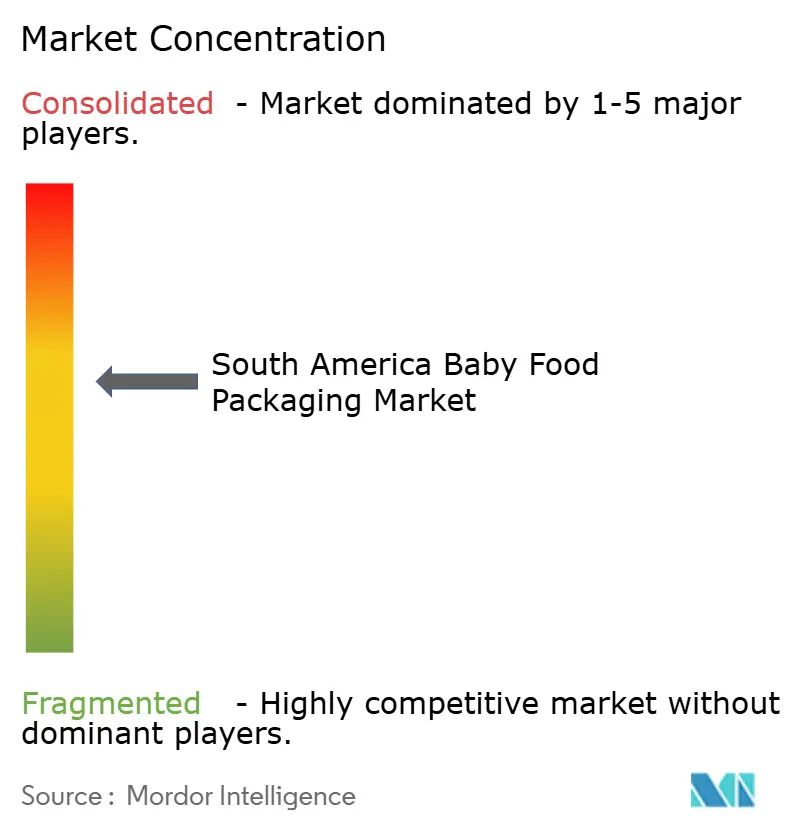
| Market Concentration | Medium |
Major Players *Disclaimer: Major Players sorted in no particular order Image © Mordor Intelligence. Reuse requires attribution under CC BY 4.0. | |
South America Baby Food Packaging Market Analysis by Mordor Intelligence
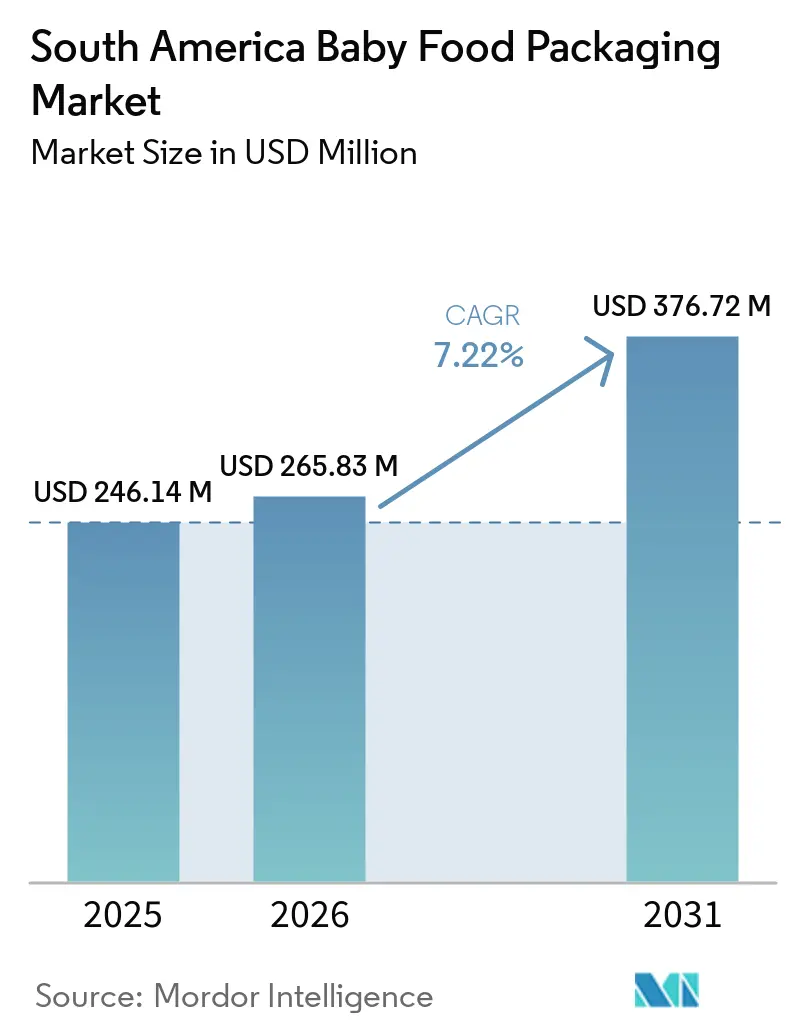
The South America Baby Food Packaging Market size was valued at USD 246.14 million in 2025 and is estimated to grow from USD 263.92 million in 2026 to reach USD 376.72 million by 2031, at a CAGR of 7.22% during the forecast period (2026-2031). The market is shaped by demand for packaging that can protect infant nutrition products through long distribution routes without relying on refrigerated storage. Flexible aseptic formats are becoming more relevant because they support ambient distribution in inland locations where cold-chain capacity remains limited. Food-safety rules, traceability requirements, and recycling expectations are also changing the materials and validation standards that converters must meet. Larger packaging suppliers are better placed to manage resin volatility, testing costs, and investments in recyclable structures, while smaller suppliers face pressure on margins and capacity. The South America Baby Food Packaging Market, therefore, offers opportunities for suppliers with dependable aseptic, tamper-evident, and lower-material packaging solutions.
Key Report Takeaways
- By material, plastic held 42.71% of the South America Baby Food Packaging Market revenue in 2025, while bioplastics are forecast to grow at an 8.14% CAGR through 2031.
- By package type, bottles accounted for 39.42% of revenue in 2025, while pouches are forecast to expand at a 9.11% CAGR through 2031.
- By product, powder milk formula held 34.51% of the South America Baby Food Packaging Market revenue in 2025, while baby snacks are forecast to grow at a 9.01% CAGR through 2031.
- By geography, Brazil held 63.54% of revenue in 2025, while Argentina is forecast to record a 10.11% CAGR through 2031.
Note: Market size and forecast figures in this report are generated using Mordor Intelligence’s proprietary estimation framework, updated with the latest available data and insights as of January 2026.
South America Baby Food Packaging Market Trends and Insights
Drivers Impact Analysis*
| Driver | (~) % Impact on CAGR Forecast | Geographic Relevance | Impact Timeline |
|---|---|---|---|
| Convenience-Led Adoption of Spouted Pouches | +2.1% | South America-wide, with primary demand in Brazil’s Southeast and Argentina’s Buenos Aires corridor | Short term (≤ 2 years) |
| Expansion of Urban Dual-Income Households | +1.6% | Brazil, including São Paulo, Belo Horizonte, and Recife, and Argentina, including Buenos Aires, Córdoba, and Rosario | Medium term (2-4 years) |
| Growth of Shelf-Stable and Aseptic Formats | +1.3% | South America-wide, strongest in Brazil and other ambient-distribution corridors | Medium term (2-4 years) |
| Demand for Safe, Traceable, and Sustainable Packaging | +0.9% | South America-wide, with regulatory influence concentrated in Brazil and Chile | Long term (≥ 4 years) |
| Rural Cold-Chain Avoidance Through Ambient Distribution | +0.6% | Brazil’s interior states and supply chains serving Bolivia, Paraguay, and Peru | Medium term (2-4 years) |
| Localized Pack-Size Adaptation for Uneven Household Purchasing Power | +0.4% | South America-wide, with early gains in Chile, Colombia, and Peru secondary cities | Long term (≥ 4 years) |
| Source: Mordor Intelligence | |||
Spouted Pouch Convenience Reshaping Infant Nutrition Distribution
Spouted pouches are gaining acceptance because they reduce package weight compared with equivalent glass or metal formats. Lower package weight can reduce freight requirements across long inland routes and support broader product availability. These formats also provide resealability and single-serve convenience for caregivers who buy ready-to-feed products. Aseptic spouted pouches combine portion control with product protection for liquid and puréed infant nutrition products. The South America Baby Food Packaging Market can use these formats to support ambient distribution where refrigerated handling is limited. Format decisions are therefore closely linked to channel reach, product protection, and distribution costs.
Urban Dual-Income Households Supporting Premium Packaging Demand
Urban dual-income households place more value on ready-to-feed and single-serve infant nutrition products when time available for food preparation is limited. The International Labor Organization documented continuing changes in employment conditions affecting women through 2025.[1]International Labour Organization, “World Employment and Social Outlook, Trends 2025,” International Labour Organization, ilo.org. Ready-to-feed liquid products require packaging with reliable barriers, visible tamper evidence, and convenient serving portions. These requirements can increase packaging value per unit compared with powder products sold in larger containers. Demand in the South America Baby Food Packaging Market is most relevant in large urban areas, including São Paulo, Belo Horizonte, Recife, Buenos Aires, Córdoba, and Rosario. Suppliers that offer aseptic cartons, bottles, and pouches can address this demand without changing the product’s handling requirements for consumers.
Shelf-Stable and Aseptic Formats Addressing Cold-Chain Constraints
Cold-chain coverage remains uneven outside major urban areas, which limits the commercial reach of perishable liquid infant nutrition products. Aseptic cartons, pouches, and bag-in-box formats can protect products during ambient distribution. This reduces dependence on refrigerated transport and lowers the risk that limited cold storage disrupts product availability. Suppliers are expanding long-life carton capacity in Brazil to serve demand for shelf-stable food and beverage applications. The South America Baby Food Packaging Market benefits from formats that support long shelf life and consistent product safety. Brand owners can then reach inland consumers without making equivalent investments in refrigerated logistics.
Safe, Traceable, and Sustainable Packaging Raising Supplier Requirements
Brand owners are placing greater importance on traceability, food-contact compliance, and packaging designs that reduce material use. Danone Brazil introduced an 8%-lighter biomimetic package in 2025 through work with Graham Packaging, Amazu Biomimicry, and Braskem’s Circular Packaging Design Lab.[2]Braskem S.A., “Danone Leads Sustainable Innovation With Nature-Inspired, Lighter Packaging Featuring Lower Environmental Impact,” Braskem, braskem.com.br. The project shows how brand owners' commitments influence the materials and design work requested of converters. Danone also states a target to reduce virgin fossil-based packaging by 30% by 2030. The South America Baby Food Packaging Market requires suppliers to provide validated materials, reliable documentation, and designs that protect the product. These conditions can favor established converters that can support qualification work and offer certified recyclable or bio-based options.[3]Danone S.A., “Packaging for the Planet,” Danone, danone.com.
Restraints Impact Analysis*
| Restraint | (~) % Impact on CAGR Forecast | Geographic Relevance | Impact Timeline |
|---|---|---|---|
| Raw-Material Price and Currency Volatility | -0.8% | South America-wide, most acute in Argentina and Brazil | Short term (≤ 2 years) |
| Food-Contact Compliance and Chemical-Testing Costs | -0.5% | Brazil, with spillover to Argentina, Uruguay, and Paraguay | Medium term (2-4 years) |
| Limited Collection Infrastructure for Multilayer Pouches | -0.3% | South America-wide, particularly outside major cities in Brazil and Chile | Long term (≥ 4 years) |
| Spoilage and Inventory Risk Outside Major Urban Centers | -0.2% | Brazil’s interior states and smaller inland locations | Medium term (2-4 years) |
| Source: Mordor Intelligence | |||
Raw-Material Price and Currency Volatility Limiting Margin Recovery
Polypropylene and polyethylene prices are commonly linked to USD-denominated commodity markets. Currency weakness can therefore raise the local cost of imported resins before packaged food prices adjust. Flexible pouch producers may be more exposed because multilayer structures require several resin grades and barrier layers. This exposure can reduce converters' ability to recover higher costs in customer contracts. Braskem identifies renewable polyethylene as part of its portfolio, giving suppliers access to a material linked to Brazil’s sugarcane feedstock base. Available domestic bio-based material capacity does not eliminate broader exposure to import parity and resin price movements. The South America Baby Food Packaging Market remains sensitive to these cost movements because infant nutrition packages require consistent material performance and cannot readily compromise on barrier quality.
Food-Contact Compliance and Chemical-Testing Costs Raising Qualification Thresholds
ANVISA updated the positive list of monomers, polymers, and initiating substances used in plastic materials that contact food through Resolution RDC No. 961/2025. The change requires converters to confirm that materials and documentation meet applicable food-contact requirements. Testing, dossier preparation, and approval processes can be difficult for suppliers with limited regulatory and laboratory resources. Brand owners may prefer converters with validated supply chains when packaging infant nutrition products. For the South America Baby Food Packaging Market, ANVISA also published RDC No. 976/2025 and RDC No. 979/2025 in June 2025, covering infant formula requirements and cellulosic food-contact materials. These requirements increase the value of established quality systems, while potentially raising entry barriers for smaller converters.[4]Agência Nacional de Vigilância Sanitária, “Resolução da Diretoria Colegiada RDC Nº 976, de 5 de Junho de 2025,” ANVISA, legisweb.com.br.
*Our forecasts treat driver/restraint impacts as directional, not additive. The impact forecasts reflect baseline growth, mix effects, and variable interactions.
Segment Analysis
By Material: Plastic Remains Established While Bioplastics Gain Use
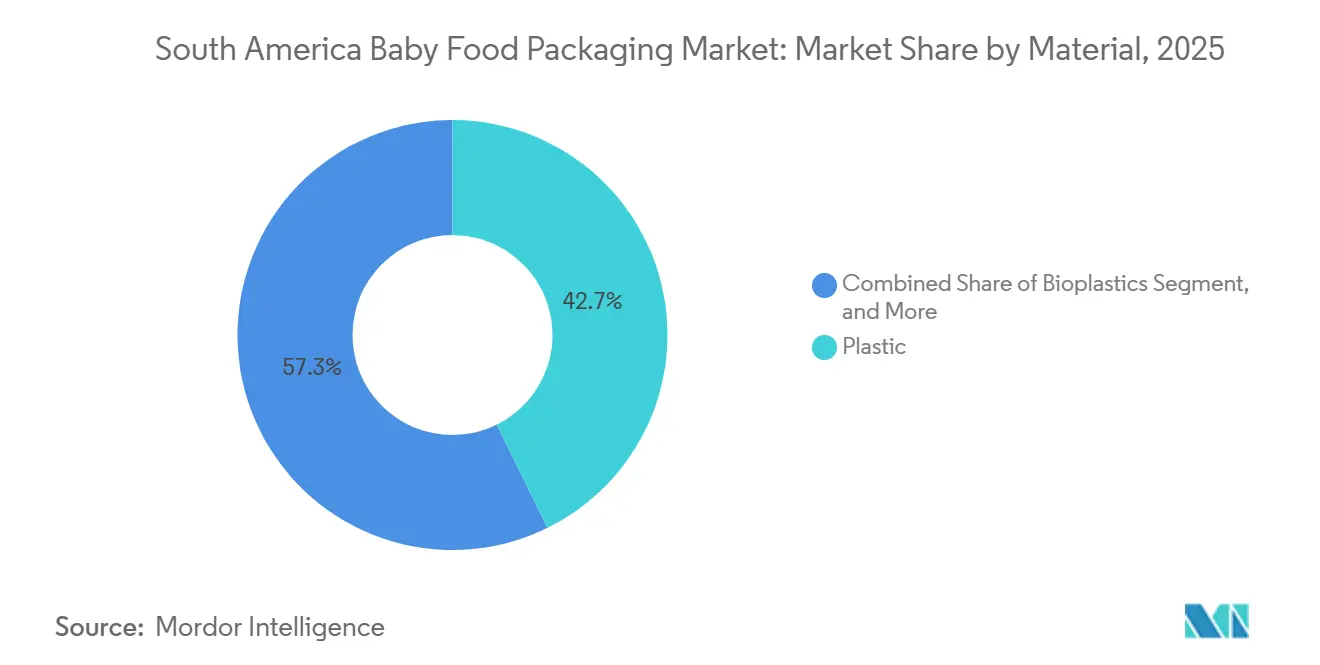
Plastic held 42.71% of the South America Baby Food Packaging Market share in 2025, reflecting its established use in bottles, pouches, closures, and jars. Its range of processing options allows converters to use the material across both rigid and flexible package formats. Brazil’s polymer conversion base supports the local supply of many plastic packaging applications. Plastic also remains important where lightweight and barrier performance are needed for ambient distribution. Bioplastics are forecast to grow at an 8.14% CAGR through 2031, making them the fastest-growing material category. This expansion is linked to brand-owner sustainability programs and growing commercial interest in sugarcane-derived bio-polyethylene.
Danone Brazil’s 2025 packaging project with Braskem demonstrates a commercial application of lower-material and bio-based design in the South America Baby Food Packaging Market. Paperboard is gaining use in secondary packaging for dried baby food and powder formula. ProAmpac expanded its RP-2000 High Barrier Series in 2026 to include a recyclable, fiber-based platform for sensitive dry food applications. Metal remains relevant for premium powder formula tins sold through organized retail. Glass remains a smaller material option because its weight and fragility complicate long-distance distribution. The baby food packaging industry must balance sustainability expectations against the barrier, hygiene, and transport needs of infant nutrition products.



By Package Type: Bottles Lead While Pouches Grow Faster
Bottles accounted for 39.42% of revenue in 2025, supported by their established role in liquid milk formula distribution. Shelf-stable PET and HDPE bottles remain familiar to consumers and offer visible tamper-evidence features. The format is well-suited to modern grocery channels that handle ready-to-feed products. Its installed base also supports continued use by brands with established filling operations. In the South America Baby Food Packaging Market, pouches are forecast to expand at a 9.11% CAGR through 2031, the fastest rate among package types. Spouts, resealability, and low pack weight support their use in portions designed for convenient consumption.
Pouches can help brands distribute liquid and puréed foods to locations where refrigeration is not consistently available. Aseptic cartons remain relevant for foodservice and hospital channels that require safe, single-serve liquid portions. Jars continue to serve selected prepared-food applications, although transport concerns limit the use of glass alternatives. Bag-in-box packages meet the needs of hospitals, public nutrition programs, and crèches that prioritize efficient bulk handling. Continued investment in Brazilian aseptic production supports capacity for ambient-stable carton and pouch formats. The South America Baby Food Packaging Market size for pouches is supported by their ability to pair product protection with distribution flexibility.
By Product: Powder Formula Leads While Baby Snacks Expand
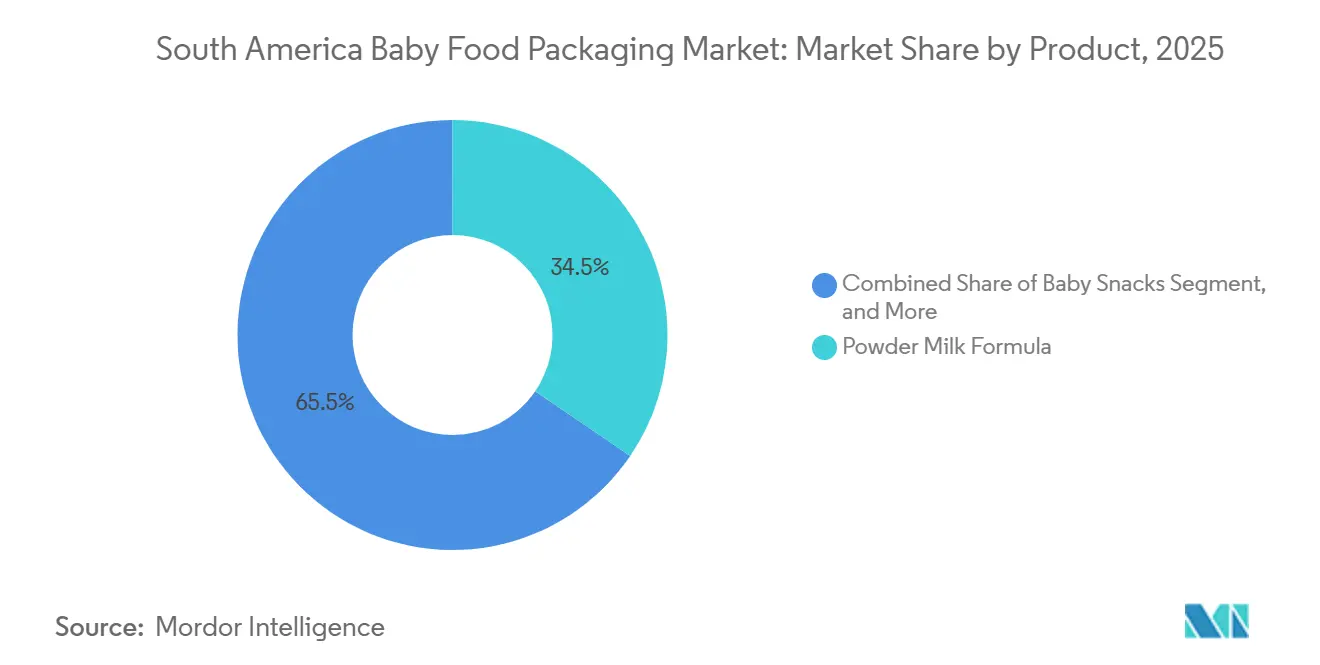
Powdered milk formula accounted for 34.51% of revenue in 2025, reflecting its affordability and long shelf life across household income groups. Tins, flexible packs, and secondary paperboard packaging remain important for this category. Powder products are also less dependent on refrigerated handling than prepared foods. Their established role supports a stable demand for packaging that protects against moisture and contamination. In the South America Baby Food Packaging Market, baby snacks are forecast to grow at a 9.01% CAGR through 2031, the fastest rate among product categories. The category needs resealable stand-up pouches, portion packs, and flow-wrap sachets that maintain product quality and offer convenient portions.
Liquid milk formula is gaining relevance in premium urban channels because caregivers value ready-to-feed formats. These products require high-barrier cartons and bottles that protect them during distribution and handling. Dried baby foods, including cereals and grain-based purées, use packages that protect against moisture while supporting shelf presentation. Prepared baby foods face limits outside large cities when distribution depends on refrigerated logistics. Gualapack launched its MF series of pouch-filling machines in 2026, offering configurations ranging from 50 to 200 pouches per minute. This equipment can support several infant nutrition categories on flexible packaging lines.
Geography Analysis
Brazil accounted for 63.54% of the South America baby food packaging market share in 2025. Its position reflects a large consumer base, integrated polymer and paperboard conversion, modern grocery coverage, and established food-safety oversight. The country provides the largest installed base for suppliers of bottles, cartons, films, pouches, and closures. Brand-owner investment in local infant nutrition production supports demand for dependable packaging supply. Amcor deployed Moda rotary vacuum chamber sealing technology in Sertãozinho, São Paulo, in June 2026. The installation shows continuing capital investment in food-manufacturing packaging operations in Brazil.
Argentina is forecast to grow at a 10.11% CAGR through 2031. The forecast reflects recovering consumer demand after the exchange-control period from 2019 to 2023 and renewed interest from international brand owners. Distribution is concentrated around Greater Buenos Aires, Córdoba, and Rosario, where ambient-stable pouches and aseptic cartons can serve urban retail channels. Increased demand for premium single-serve products favors suppliers with high-barrier and aseptic capabilities. The country’s currency conditions still require packaging suppliers to manage resin costs and contract pricing carefully. The South America Baby Food Packaging Market benefits from Argentina’s potential for faster growth, but operational results remain linked to economic conditions and purchasing power.
Chile, Colombia, Peru, Bolivia, Paraguay, and Ecuador together form a smaller but growing opportunity for ambient-capable packaging suppliers. SIG installed its SIG Small 12 Aseptic filling technology at Celema in Colombia during the fourth quarter of 2024. The installation extended the aseptic carton infrastructure into an additional South American country. Chile’s EPR framework continues to make recycling-compatible packaging structures increasingly important for suppliers active in the country. The South America Baby Food Packaging Market rewards suppliers that combine shelf stability, food safety, and recycling-compatible design.
Competitive Landscape
The South America Baby Food Packaging Market is moderately consolidated among large suppliers of aseptic cartons, flexible films, and spouted pouches, while specialist converters remain active in narrower formats. Amcor, Tetra Laval, SIG Group, and Huhtamäki have meaningful positions in major packaging categories. Their scale supports investment in manufacturing, material development, and food-contact validation. Smaller suppliers can remain competitive by offering specialized filling systems, closures, or flexible structures. Competitive conditions vary by product format because carton, bottle, pouch, and tin suppliers address different technical requirements.
Amcor deployed Brazil’s first Moda rotary vacuum chamber sealing technology at Barra Mansa Alimentos in 2026. The project replaced legacy equipment and sought to improve throughput and vacuum quality. SIG is expanding its long-life packaging capabilities in Brazil to serve ambient-stable applications. This direction supports competition for products that need secure distribution without refrigeration. ProAmpac’s 2026 fiber-based high-barrier platform adds another option for dried food and snack formats where recyclable packaging is requested.
Gualapack differentiates its offering through spouted pouch filling equipment, ure, and related packaging components. Its BabyCap system is designed to address infant food safety needs through an anti-choking closure. The company’s 2025 Mood Cap and WavyLite launches also focused on tethered caps and lower material use. Suppliers are increasingly judged on documentation, food-contact validation, and recycling compatibility. These capabilities can matter as much as price and production speed when brands select packaging partners.
South America Baby Food Packaging Industry Leaders
Amcor plc
Tetra Laval Group
Mondi plc
Berry Global Group, Inc.
Silgan Holdings Inc.
- *Disclaimer: Major Players sorted in no particular order

Recent Industry Developments
- August 2026: Mondi launched an extended corrugated and solid board packaging portfolio for food applications, broadening options for dried and powder infant nutrition products.
- June 2026: Amcor deployed Moda rotary vacuum chamber sealing technology at Barra Mansa Alimentos in Sertãozinho, São Paulo.
- February 2026: ProAmpac expanded its recyclable, fiber-based RP-2000 High Barrier Series for sensitive dry food applications.
- July 2025: Danone Brazil launched an 8%-lighter biomimetic package developed with Graham Packaging, Amazu Biomimicry, and Braskem’s Circular Packaging Design Lab.


South America Baby Food Packaging Market Report Scope
The South America Baby Food Packaging Market refers to the specialized containers and materials used to store, protect, and dispense infant and toddler food products. This includes bottles, pouches, jars, and cartons made from plastics, glass, metal, paperboard, and bioplastics, designed to meet strict safety and hygiene standards. These packaging solutions are essential for preserving the nutritional integrity and extending the shelf life of liquid formulas, dried foods, and prepared baby snacks across the region.
The South America Baby Food Packaging Market Report is Segmented by Material (Plastic, Paperboard, Metal, Glass, and Bioplastics), Package Type (Bottles, Cartons, Jars, Pouches, and Bag-in-Box), Product (Liquid Milk Formula, Dried Baby Food, Powder Milk Formula, Prepared Baby Food, and Baby Snacks), and Geography (Brazil, Argentina, and Rest of South America). The Market Forecasts are Provided in Terms of Value (USD).
By Material
| Plastic |
| Paperboard |
| Metal |
| Glass |
| Bioplastics |
By Package Type
| Bottles |
| Cartons |
| Jars |
| Pouches |
| Bag-in-Box |
By Product
| Liquid Milk Formula |
| Dried Baby Food |
| Powder Milk Formula |
| Prepared Baby Food |
| Baby Snacks |
By Geography
| Brazil |
| Argentina |
| Rest of South America |
| By Material | Plastic |
| Paperboard | |
| Metal | |
| Glass | |
| Bioplastics | |
| By Package Type | Bottles |
| Cartons | |
| Jars | |
| Pouches | |
| Bag-in-Box | |
| By Product | Liquid Milk Formula |
| Dried Baby Food | |
| Powder Milk Formula | |
| Prepared Baby Food | |
| Baby Snacks | |
| By Geography | Brazil |
| Argentina | |
| Rest of South America |


Key Questions Answered in the Report
What is the size of the South America Baby Food Packaging Market?
The market was valued at USD 246.14 million in 2025 and is estimated to reach USD 376.72 million by 2031, growing at a 7.22% CAGR from 2026 to 2031.
Which material leads baby food packaging demand in South America?
Plastic led demand with a 42.71% share in 2025 because it supports bottles, pouches, jars, closures, and flexible packaging applications.
Which package format is growing fastest for baby food products?
Pouches are forecast to grow at a 9.11% CAGR through 2031, supported by low weight, resealability, and suitability for ambient distribution.
Which product category is expanding fastest in baby food packaging?
Baby snacks are forecast to grow at a 9.01% CAGR through 2031 and require resealable pouches, portion packs, and flow-wrap sachets.
Which country has the largest demand for baby food packaging in South America?
Brazil held 63.54% of revenue in 2025, supported by its consumer base, local conversion capacity, modern retail coverage, and food-safety infrastructure.
What is the main challenge facing suppliers of infant nutrition packaging?
Suppliers must manage resin and currency volatility, food-contact testing, and recycling requirements while maintaining high barrier and tamper-evident performance.
Page last updated on:





