
Market Overview
| Study Period | 2020 - 2031 |
|---|---|
| Forecast Data Period | 2026 - 2031 |
| Base Year Market Size (2025) | USD 1.02 Billion |
| Market Size (2026) | USD 1.06 Billion |
| Market Size (2031) | USD 1.27 Billion |
| Growth Rate (2026 - 2031) | 3.69 % |
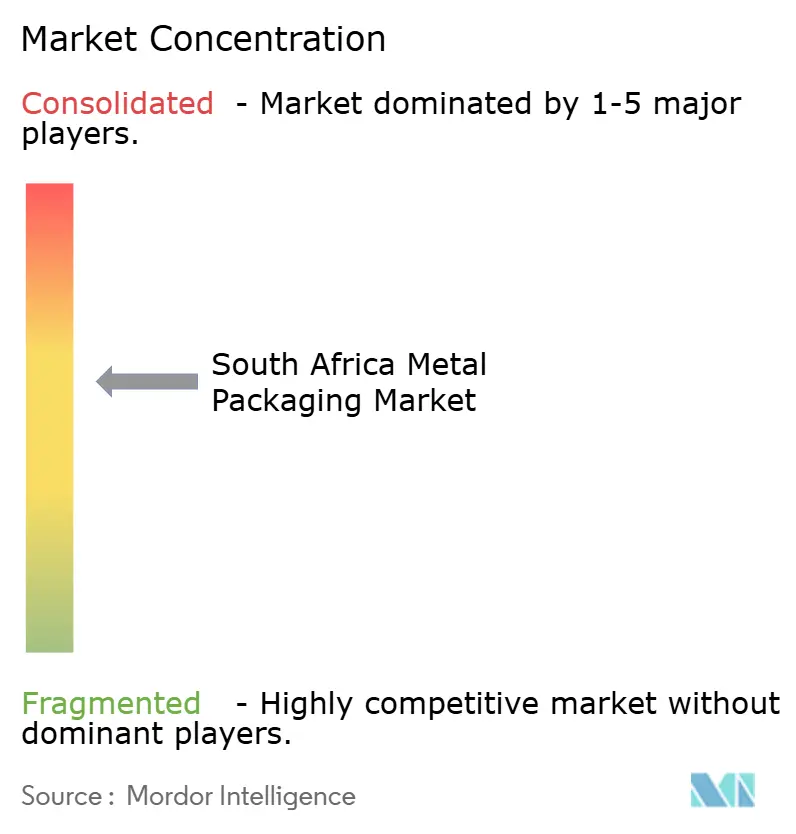
| Market Concentration | Medium |
Major Players *Disclaimer: Major Players sorted in no particular order Image © Mordor Intelligence. Reuse requires attribution under CC BY 4.0. | |
South Africa Metal Packaging Market Analysis by Mordor Intelligence
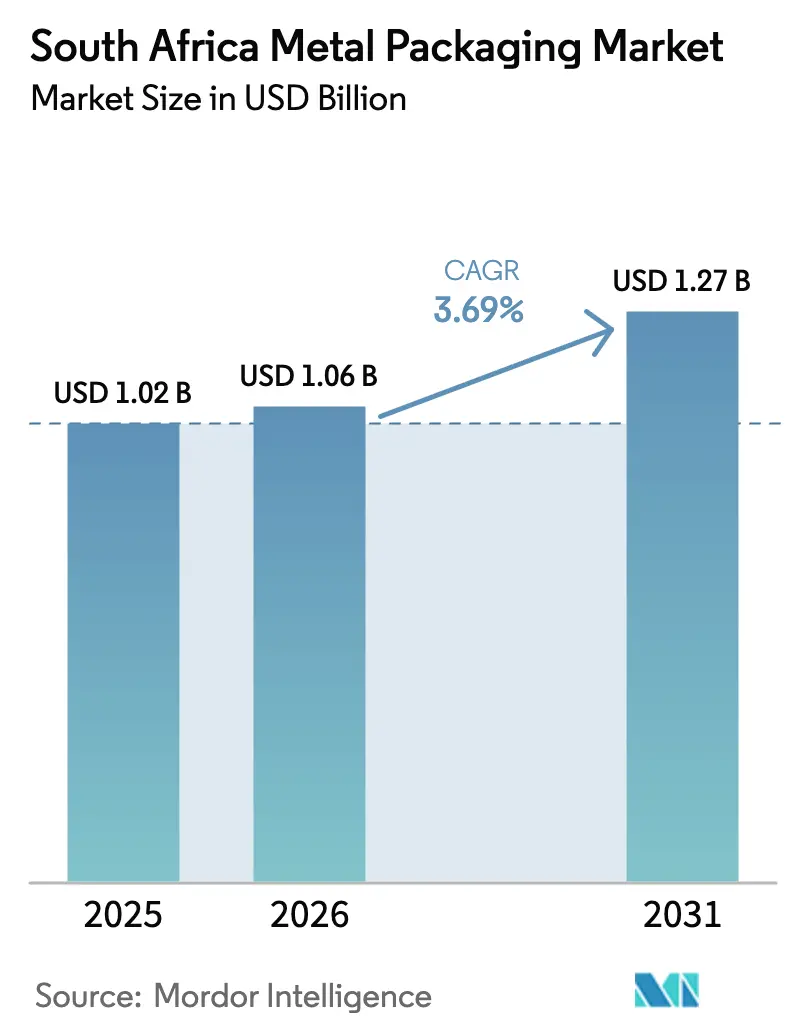
The South Africa metal packaging market size was valued at USD 1.02 billion in 2025 and estimated to grow from USD 1.06 billion in 2026 to reach USD 1.27 billion by 2031, at a CAGR of 3.69% during the forecast period (2026-2031). Moderate expansion accompanies a maturing demand base, tighter Extended Producer Responsibility (EPR) enforcement, and a steady shift in consumer preference toward recyclable formats. Aluminum’s lightweight profile, national recycling infrastructure, and fuel-saving logistics economics sustain its dominance, while steel’s value proposition in heavy-duty industrial uses unlocks incremental gains. Craft breweries, direct-to-consumer (DTC) grocery platforms, and aerosol exports diversify demand nodes, partially cushioning the margin pressure sparked by raw material inflation and port bottlenecks. Consolidation-both domestic and cross-border-accelerates as scale becomes essential for hedging base-metal price swings and financing coating innovations that eliminate BPA, PFAS, and PVC.
Key Report Takeaways
- By material, aluminum captured 62.55% of the South Africa metal packaging market share in 2025; steel is projected to expand at a 4.43% CAGR through 2031.
- By product type, cans contributed 39.15% revenue share in 2025, while bulk containers are forecast to record a 4.88% CAGR to 2031.
- By end-user industry, beverages accounted for 33.72% of the South Africa metal packaging market size in 2025; the industrial segment is advancing at a 4.91% CAGR through 2031.
- By coating type, epoxy phenolic held 45.98% share in 2025, whereas BPA-free alternatives are poised for a 3.92% CAGR during the outlook period.
Note: Market size and forecast figures in this report are generated using Mordor Intelligence’s proprietary estimation framework, updated with the latest available data and insights as of 2026.
South Africa Metal Packaging Market Trends and Insights
Drivers Impact Analysis*
| Driver | (~) % Impact on CAGR Forecast | Geographic Relevance | Impact Timeline |
|---|---|---|---|
| Growing Beverage Can Demand From Craft Brewers | +0.8% | National, concentrated in Western Cape and Gauteng | Medium term (2-4 years) |
| Shift Toward Lightweight Aluminum Substituting Steel | +0.6% | National, led by major beverage producers | Long term (≥ 4 years) |
| Extended Producer Responsibility Legislation Tightening | +0.5% | National, administered through MetPac-SA | Short term (≤ 2 years) |
| Rise of Direct-to-Consumer Food Brands Requiring Premium Metal Packs | +0.4% | National, urban-focused distribution | Medium term (2-4 years) |
| On-Site Solar Power Lowering Operational Energy Costs for Can Makers | +0.3% | National, industrial manufacturing hubs | Medium term (2-4 years) |
| Surging Automotive Aerosol Exports Boosting Aerosol Can Consumption | +0.2% | National, export-oriented manufacturing | Long term (≥ 4 years) |
| Source: Mordor Intelligence | |||
Growing Beverage Can Demand From Craft Brewers
South Africa’s vibrant craft-brew ecosystem is driving a steep trajectory in aluminum can usage as microbrewers seek to differentiate their shelves through colorful, short-run graphics and eco-friendly messaging. Tiny Keg’s ability to service 40% of national craft breweries with 6 million cans in 2023 exemplifies the scalability of these niche players. Premium price tolerance offsets lower batch volumes, ensuring attractive margins for converters. Concentrated cluster activity in the Cape Town and Johannesburg corridors leverages tourism flows and urban retail channels that value locally produced beverages. Regulatory flexibility under the Liquor Products Act simplifies licensing, encouraging further start-ups and line extensions into canned wines and ready-to-drink cocktails. This dynamic positions craft brewers as influential advocates for closed-loop aluminum collection programs tied to EPR targets.
Shift Toward Lightweight Aluminum Substituting Steel
A decisive 2013 shift by Coca-Cola to aluminum cans under a ZAR 5.6 billion (USD 306.0 million) supply contract with Nampak catalyzed a sector-wide move away from tin-plated steel. Aluminum’s 95% energy-saving recycle loop aligns with climate pledges and lowers freight costs amid sustained fuel price volatility. Although the World Bank forecasts a 4% increase in aluminum prices for 2025,[1] the net total cost of ownership remains favorable when factoring in logistics and recycling credits. The switch gains further momentum from aluminum’s superior printability, enabling the creation of limited-edition designs that reinforce brand storytelling. Consequently, material mix forecasts indicate that aluminum is solidifying its front-runner status, while steel is migrating toward bulk bins, drums, and reconditioned industrial containers.
Extended Producer Responsibility Legislation Tightening
Full EPR implementation under MetPac-SA places mandatory recovery and recycling quotas on every packaging producer, sharpening the economic rationale for infinitely recyclable metals. Financial penalties for shortfalls incentivize capital spending on collection nodes and sorting technology, exemplified by the May 2025 MetPac-SA and GeT Metal Group partnership.[2] Clear compliance protocols de-risk investments in domestic smelting and coating facilities, while simultaneously accelerating industry consolidation as smaller firms struggle with administrative overhead. The policy environment thereby enlarges the addressable pool of post-consumer scrap, further strengthening the competitive edge of aluminum and steel substrates in the South Africa metal packaging market.
Rise of Direct-to-Consumer Food Brands Requiring Premium Metal Packs
DTC grocery platforms require robust containers that survive extended shipping legs without compromising product integrity. Hermetic metal cans outperform flexible formats in terms of puncture resistance, oxygen ingress, and tamper-evident visibility-attributes critical for online brands that assume full liability for spoilage and recalls. Superior surface aesthetics enable photorealistic graphics that enhance the unboxing experience, which is crucial to customer retention. Urban millennials in Johannesburg and Cape Town constitute the core DTC demographic, and their preference for sustainable packaging dovetails with metal’s almost limitless recyclability. Converters capable of quick-turn, micro-lot production are securing recurring orders from fast-pivot DTC food entrepreneurs, strengthening premium-price resilience within the South Africa metal packaging market.
Restraints Impact Analysis*
| Restraint | (~) % Impact on CAGR Forecast | Geographic Relevance | Impact Timeline |
|---|---|---|---|
| Volatile Base Metal Prices Pressuring Margins | -0.9% | National, affecting all metal packaging producers | Short term (≤ 2 years) |
| Plastic Pouch Substitution in Paints and Chemicals | -0.6% | National, industrial applications | Medium term (2-4 years) |
| Consumer BPA Concerns Dampening Epoxy-Lined Can Uptake | -0.4% | National, food and beverage applications | Long term (≥ 4 years) |
| Port Congestion and Rail Bottlenecks Disrupting Raw Material Supply | -0.5% | National, concentrated impact on coastal operations | Short term (≤ 2 years) |
| Source: Mordor Intelligence | |||
Volatile Base Metal Prices Pressuring Margins
Aluminum and tin feedstock cost swings erode converter profitability, especially for firms lacking hedging lines or multiyear supply contracts. The rand’s chronic volatility amplifies imported coil costs, while load-shedding injects scheduling inefficiencies that inflate unit energy consumption. Passing through surcharges proves challenging in price-sensitive beverage and staple food categories, prompting tier-two players to exit or consolidate. Working capital stresses elevate borrowing needs precisely when South African interest rates trend higher, compressing spreads and delaying maintenance spending. Larger incumbents leverage procurement scale to secure favorable terms, reinforcing an already concentrated hierarchy within the South Africa metal packaging market.
Plastic Pouch Substitution in Paints and Chemicals
Industrial fillers increasingly specify high-density polyethylene (HDPE) pouches, enticed by weight savings, ergonomic handles, and spout dispensers that cut residue loss. Shipping efficiencies drive down freight budgets in a sector where packaging can eclipse 15% of delivered costs. For commodity chemicals in particular, brand equity exerts limited influence, amplifying price elasticity that works against metal. Yet metal retains an edge where chemical compatibility, vapor-barrier performance, or long-term storage stability is mission-critical. Metal converters, therefore, must articulate total cost-of-ownership narratives-such as reusability cycles or triple-seamed leak security-to reclaim share from flexible rivals.
*Our forecasts treat driver/restraint impacts as directional, not additive. The impact forecasts reflect baseline growth, mix effects, and variable interactions.
Segment Analysis
By Material Type: Aluminum Dominance Drives Sustainability Transition
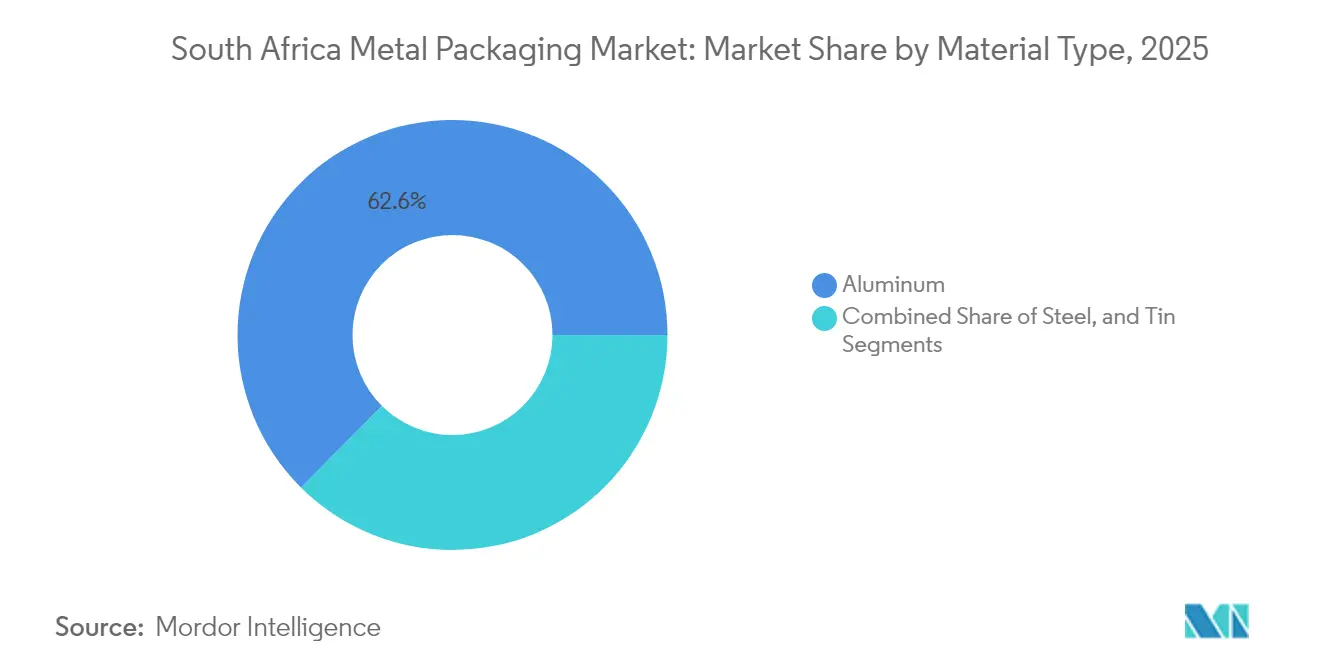
Aluminum accounted for 62.55% of the South African metal packaging market in 2025, as beverage producers adopted the substrate for its recyclability and weight savings. Steel’s 4.43% CAGR between 2026 and 2031 underscores its rising appeal for bulk bins and aerosol shells that prioritize puncture resistance over lightness. Tin, constrained by cost and supply limits, continues to cede niche territories. The South Africa metal packaging market size benefits from Hulamin’s domestic can-body investment, which trims import dependence and shortens lead times. AkzoNobel’s Securshield coating series removes BPA, PFAS, and PVC, thereby future-proofing aluminum’s penetration into high-acid food lines. Collectively, these developments entrench the South Africa metal packaging market share of aluminum while allocating growth white-space to steel in industrial drums and reconditioned chemical barrels.
Aluminum’s circularity aligns seamlessly with EPR quotas that demand verifiable recycling outcomes; each recovered can returns enough valuable metal to offset collection costs, bolstering the substrate’s dominant margin profile. Steel’s magnetic properties simplify separation at materials recovery facilities, giving it a pragmatic sustainability narrative that resonates with bulk lubricant and paint fillers. Tin retains relevance in specialty aerosol valves and niche gourmet lines where corrosion resistance overrides all-in cost. As converter portfolios broaden to encompass multi-substrate options, the South Africa metal packaging market demonstrates adaptive capacity to service both high-velocity consumer categories and heavy-duty industrial sectors.

By Product Type: Industrial Applications Reshape Growth Dynamics
Cans captured 39.15% of total revenue in 2025, driven by entrenched beverage volume. However, bulk containers are projected to post a 4.88% CAGR through 2031. The South Africa metal packaging market size for drums and barrels expands with mining and agrochemical exports that require UN-certified containers capable of withstanding the shocks of sea freight. DPI Recyclers’ model of refurbishing 210-liter drums illustrates the circular economy potential embedded in industrial segments. Decorative cans attract craft beverage and gourmet food brands seeking to make a lasting impression on the shelf.
Advancements in aerosol valve accuracy fuel incremental demand for monobloc and two-piece aerosol cans, targeting automotive polish and personal-care sprayers. Caps and closures, buoyed by Bericap’s acquisition of Coleus Packaging, supply both domestic bottlers and regional exporters with crown corks and roll-on pilfer-proof (ROPP) solutions. The product mix shift necessitates retooling at converter plants to accommodate a variety of diameters and micro-batch print runs. This diversification enhances the overall resilience of the South Africa metal packaging market.
By End-User Industry: Industrial Sector Leads Growth Trajectory
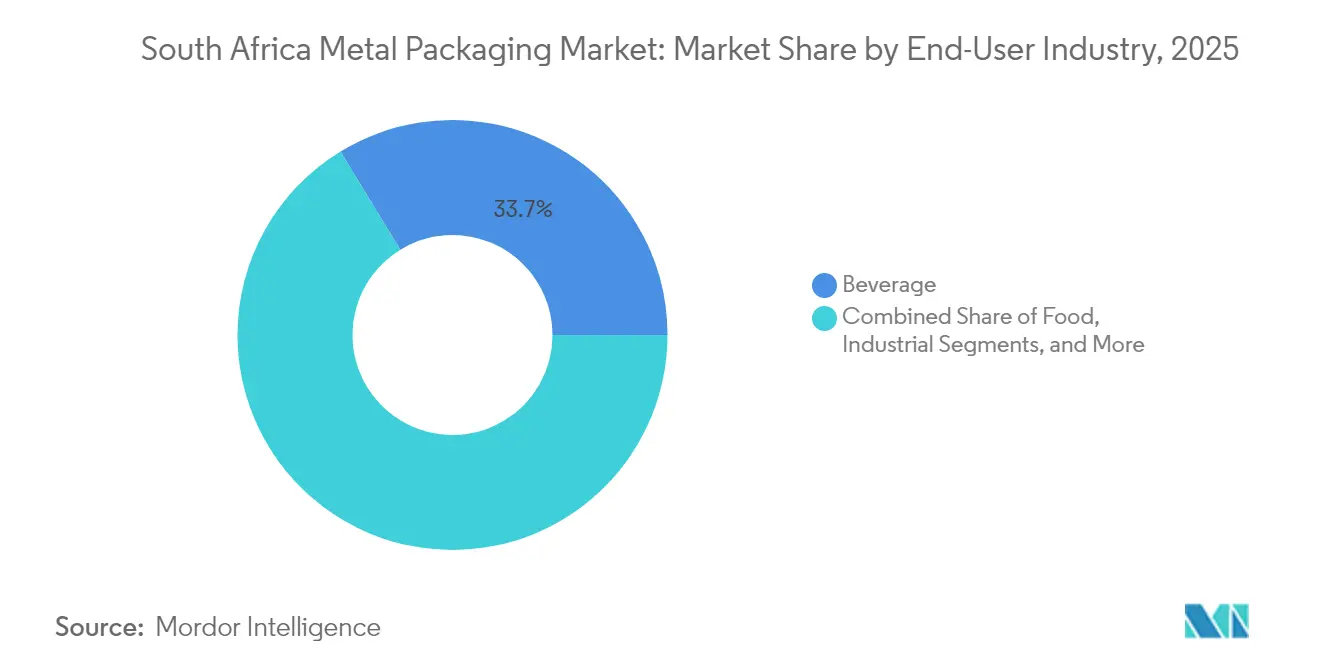
Beverages remained the largest demand node at 33.72% in 2025; however, industrial customers will spearhead future expansion with a 4.91% CAGR, driven by the demand for mining chemicals, lubricants, and construction coatings. The South Africa metal packaging market share devoted to lubricants grows alongside the country’s 17% contribution to Africa’s total lubricant consumption. Aerosolized paints and cleaners, destined for export markets, further increase volume throughput. Meanwhile, food processors embrace premium canisters for shelf-stable ready meals marketed via DTC channels.
Pharmaceutical fillers value metal’s tamper visibility and sterility, and their orders create high-margin niches despite lower absolute tonnage. Paint and coating brands weigh plastic pouches for decorative markets but preserve metal for solvent-resistant industrial grades that demand barrier integrity. This split highlights how the South Africa metal packaging market size evolves by aligning container attributes with end-use performance requirements, rather than pursuing uniform material substitution.
By Coating Type: BPA-Free Innovation Drives Market Evolution
Epoxy phenolic coatings supplied nearly half of the unit volumes in 2025, owing to their balanced cost and chemical resistance profile. However, BPA-free formulations trend upward at a 3.92% CAGR, as retailers and regulators flag endocrine-disruptor risks. Securshield demonstrates that next-generation polymers can meet retort durability requirements without PFAS or PVC, thereby removing compliance uncertainties for exporters targeting European Union markets. Acrylic and polyester chemistries fulfill specialty needs, such as UV-cured graphics or highly acidic contents, by carving out defensible micro-segments.
Converters differentiate through in-house application know-how, line speed, and rapid switchover that support smaller production runs demanded by craft beverages and DTC brands. Coating innovation thus becomes a decisive wedge in competitive bidding, elevating technical capability as a cornerstone of procurement decisions within the South Africa metal packaging market.
Geography Analysis
Gauteng, South Africa’s commercial hub, accounts for the highest packaging consumption, owing to its 26.3% share of national waste generation and a dense beverage bottling footprint. KwaZulu-Natal follows with 17.9%, yet chronic port congestion at Durban-where vessels waited up to 16 days in 2024-has forced converters to increase finished-goods safety stock. Western Cape contributes 14.7% and leads craft beverage innovation, leveraging Cape Town’s tourism economy and robust municipal recycling schemes.
Inland provinces such as Mpumalanga and North West generate steady industrial demand tied to coal and platinum mining, reinforcing the South Africa metal packaging market’s exposure to commodity cycles. EPR mandates apply uniformly nationwide, harmonizing collection targets and enabling economies of scale in back-haul scrap logistics. Cross-border trade with the Southern African Development Community (SADC) is expected to receive incremental tailwinds as the African Continental Free Trade Area progressively reduces tariffs, positioning South African converters to supply Botswana, Namibia, and Zimbabwe.
Infrastructure disparities remain acute: while Gauteng enjoys integrated rail-road links, Limpopo’s limited paved road coverage inflates last-mile costs. Government plans to concession parts of Transnet’s rail freight corridors could unlock throughput gains by 2028, benefiting steel drum producers reliant on manganese and chrome concentrate shipments. Overall, geographic heterogeneity necessitates flexible inventory positioning and multiport export strategies for firms competing in the South Africa metal packaging market.
Regulatory Landscape
South Africa metal packaging regulation is anchored in the National Environmental Management: Waste Act (NEM:WA) No. 59 of 2008 and its Section 18 Extended Producer Responsibility (EPR) framework. EPR regulations were promulgated on 5 November 2020 and became effective from 1 January 2022, requiring packaging producers to belong to an approved EPR scheme/PRO, fund collection and recycling via EPR fees, and report against recovery and recycling obligations, with MetPac-SA acting as the sector PRO/industry body interface for metal packaging compliance.
Beyond EPR, design and recyclability guidance has tightened through the Department of Forestry, Fisheries and the Environment (DFFE), including its Packaging Guideline: Recyclability by Design for packaging and paper (published as a national guideline to reduce waste and promote circular-economy outcomes). Fee determination updates published via government gazettes further formalize cost pass-through considerations for brand owners and converters, reinforcing demand for traceable recycled-content and end-of-life outcomes in aluminum and steel formats.
Value Chain Analysis
The South Africa metal packaging value chain begins with base-metal inputs (aluminum and tinplate/steel), moves through coil and sheet processing, conversion into cans, ends, caps and closures, and industrial packs (drums and bulk containers), and then proceeds to filling by FMCG and industrial brand owners with distribution through retail, on-trade, and export channels. Large converters such as Nampak operate vertically across multiple pack types, including aluminium beverage cans, tinplate food cans, and aluminium monobloc aerosol cans, integrating printing and end manufacture to improve quality control and throughput.
Downstream, EPR obligations bring recycling and recovery organizations into the operating model. MetPac-SA provides coordination across obligated companies, while voluntary industry bodies such as Packaging SA and the Institute of Packaging South Africa (IPSA) support standards awareness and technical capability building. Collection and recycling operators (for example, Collect-a-Can within the broader ecosystem) connect post-consumer scrap flows back to re-melt and re-use, making logistics performance and sortation quality critical pinch points alongside port and inland transport constraints.
Competitive Landscape
Market structure is moderately concentrated. Nampak leverages three-piece and two-piece can lines, plus proprietary ends, to secure multi-year beverage contracts, including the pivotal Coca-Cola aluminum transition. Its vertical integration into printing, sewing, and recycling streamlines cost and quality control. Ball Corporation and Crown Holdings deploy global R&D to introduce lightweight ends and D&I body stock, challenging local incumbents on performance metrics. Ardagh taps its European design studios to co-create limited-edition craft beer wraps, heightening brand appeal.
Sonoco’s USD 3.9 billion acquisition of Eviosys overlays the world’s largest food-can platform onto local distributor relationships, likely intensifying competition in aerosol and retort categories. Hulamin’s upstream expansion shortens coil lead times, enhancing domestic supply reliability. Smaller specialists, such as DPI Recyclers and Tiny Keg, thrive by targeting reconditioned industrial drums and craft-focused micro-print can runs, respectively, niches that large players struggle to serve economically.
Technology leadership centers on coating chemistry, line automation, and scrap recovery yield. Companies investing in on-site solar arrays cut grid exposure and earn ESG credits prized by multinational brand owners. Customer stickiness magnifies for suppliers able to validate cradle-to-cradle metrics, a core procurement criterion for beverage majors and DTC disruptors alike. Such capabilities dictate bargaining power and margin stability in the South Africa metal packaging market.
South Africa Metal Packaging Industry Leaders
-
Nampak Limited
-
Ardagh Metal Packaging S.A.
-
Crown Holdings Inc.
-
Ball Corporation
-
CAN-PACK S.A.
- *Disclaimer: Major Players sorted in no particular order
Market Opportunities and Future Outlook
EPR enforcement and DFFE recyclability-by-design guidance create room for converters and brand owners that can document compliance, recycled-content narratives, and end-of-life outcomes across aluminum and steel packs. Programs routed through MetPac-SA strengthen the business case for investment in collection nodes, sorting partnerships, and traceability systems, with metal formats supported by established recovery economics and verifiable recycling pathways.
On the supply side, local capacity and flexibility initiatives create near-term opportunity in beverage and specialty can formats. Nampak has disclosed progress on increasing South African beverage can capacity through the relocation and installation of a spare Angolan can-manufacturing line (Springs Line 4), alongside operational efficiency improvements at its Springs Line 2 facility to raise output and performance. These steps support faster response to micro-batch demand from craft brewers and DTC food brands, and they increase pressure on competing converters on lead times, print complexity, and coating transitions toward BPA-free alternatives.
Recent Industry Developments
- June 2026: Crown Holdings publishes its 2025 Sustainability Report, mid-point of Twentyby30 program, confirming a 20% reduction in global water withdrawal versus the 2019 baseline. The ESG progress in the packaging supply chain supports transparency and accountability for material sourcing and operations. ESG-driven procurement considerations may influence supplier selection and ESG scoring in the South Africa metal packaging market.
- May 2026: Nampak Limited announces 2026 interim results and progress on the Springs Line 4 can-manufacturing relocation. The capacity expansion strengthens beverage packaging capacity within South Africa and supports local demand fulfillment. The development points to increased SA production capacity and potential shifts in local supply dynamics and capex planning.
- May 2026: Ardagh Glass Packaging-South Africa opens a Science Resource Centre at Masiqhakaze Secondary School in partnership with PROTEC. The corporate social impact activity links to the local STEM ecosystem around SA operations and reinforces community engagement. It also supports the local talent pipeline and education alignment with packaging operations, with potential long-term supply chain resilience benefits.
Research Methodology Framework and Report Scope
Market Definition and Coverage
For this study, the market is defined as the value of metal packaging sold into South Africa across consumer and industrial uses, measured at the converter or packaging supplier level in USD and counted in the year the packaging is supplied.
Scope exclusions: The sizing excludes secondary packaging and outer shipping materials that are not primarily made of metal.
Segmentation Overview
- By Material Type
- Aluminum
- Steel
- Tin
- By Product Type
- Cans
- Food Cans
- Beverage Cans
- Aerosol Cans
- Decorative Cans
- Bulk Containers
- Drums and Barrels
- Caps and Closures
- Other Product Types
- Cans
- By End-User Industry
- Food
- Beverage
- Paints, Coatings and Chemicals
- Pharmaceuticals and Healthcare
- Industrial
- Other End-user Industries
- By Coating Type
- Epoxy Phenolic
- Acrylic
- Polyester
- BPA-Free Alternatives
- Other Coating Types
Data Sources, Market Sizing, and Validation
Desk Research
Desk research was used to build the first cut of market boundaries, demand drivers, and the basic math checks a metal packaging model needs. We relied on public references such as Statistics South Africa releases, South African Revenue Service trade tables, Department of Forestry, Fisheries and the Environment notices on EPR, and South African Bureau of Standards documentation for packaging-related requirements.
To connect demand to packaging consumption, we also reviewed sources such as industry association publications (for example packaging and recycling bodies), peer-reviewed papers on metal recovery rates, and company annual reports and investor presentations from local and regional packaging value-chain participants. Where available, paid subscriptions were used for company financials and intelligence, shipment-level import and export visibility, and patent databases to understand technology shifts in coatings and lightweighting. The desk research sources listed here are illustrative and not exhaustive, and many other references were used for data collection, validation, and clarification.
Primary Interviews and Surveys
Primary work was used to pressure test the desk assumptions and to replace weak public data points with realistic ranges. We spoke with packaging converters, material distributors, brand owners, and procurement teams across food, beverage, chemicals, and healthcare, and then checked responses for consistency across South Africa demand centers.
Inputs that mattered most included typical product mix splits, pricing movement pass-through behavior, lead times, and how substitution between metal and other materials is playing out in specific applications. Those inputs were then used to triangulate the final model.
Distribution of primary research fieldwork respondents
| Company type | Respondent position |
|---|---|
| Top tier: 33% | CXOs: 13% |
| Mid tier: 52% | Functional/Unit leaders: 30% |
| Smaller Players: 15% | Managers: 57% |
Market-Sizing & Forecasting
Market sizing was built using a top-down approach where packaging demand was reconstructed from South Africa consumption indicators and packaged product output signals, and then translated into metal packaging value using observed product mix and pricing ranges. To keep the total realistic, the result was corroborated through selective bottom-up checks, such as sampling supplier revenues, validating typical price per unit for key formats, and cross-checking volumes implied by trade and material availability.
Key inputs used in the model included the split between aluminum and steel use, the balance of cans versus drums and bulk containers, end-use demand patterns in beverages and shelf-stable foods, recycling and recovery targets that influence metal preference, and currency and metal price movements that affect realized pricing. For forecasting, scenario analysis was used so that demand can be flexed based on outlooks shared in interviews for packaged food volumes, beverage can penetration, and industrial activity that drives drums and barrels. When data gaps appeared in smaller niches, the estimates were bridged using proxy indicators like comparable format shares, import reliance signals, and conservative price ranges agreed with multiple respondents.
Data Validation & Update Cycle
Validation was done in steps so the final totals do not depend on any single source. We compare the modeled value outputs against independent signals like trade direction, packaging activity cues, and product category growth, and then investigate any sharp swings that do not match the demand story.
Before sign-off, the model is reviewed by another analyst who checks units, currency timing, and the logic behind each major assumption. If an outlier is spotted, or if a major market event affects volumes or pricing, respondents are re-contacted and the affected inputs are revised. Reports are refreshed annually, and interim updates are completed when material changes occur so clients receive the latest updated view.
Mordor Intelligence's South Africa Metal Packaging Market Sizing Compared With Other Published Estimates
Published estimates for South Africa metal packaging can differ even when they sound similar, mainly because the scope boundary and the pricing basis are not always aligned. Some sources mix metal packaging with broader packaging materials, and others report only selected formats like food cans, which makes the headline number move.
Trade flow direction, packaging share statistics, and recycling and recovery reporting are the checks that keep Mordor Intelligence's 2025 estimate anchored to metal packaging supplied into South Africa, instead of being inflated by wider packaging categories or by double counting across the value chain.
Benchmark comparison
| Source | Market Size | Gaps in Research Methodology |
|---|---|---|
| Mordor Intelligence | USD 1.02 B (2025) | |
| Trade Journal A | USD 0.63 B (2016) | Uses an older packaging market value share reference and does not clearly restate the pricing basis or updates for format mix shifts, which can understate current metal packaging value. |
| Independent Publisher B | USD 3.20 B (2023) | Appears to include broader packaging or adjacent primary packaging materials within the same headline, and the scope is not tightly limited to metal formats supplied in South Africa. |
The comparison shows that timing and scope choices explain most of the spread, not a single different math step. When the market is kept to metal formats only, priced consistently at the supplier level, and checked against demand and trade signals, the resulting number stays easier to trace and repeat year over year.
Key Questions Answered in the Report
What is the projected value of the South Africa metal packaging market by 2031?
The market is forecast to reach USD 1.27 billion by 2031, growing at a 3.69% CAGR.
Which material leads unit demand?
Aluminium held 62.55% share in 2025 thanks to its recyclability and weight advantages.
Which end-user segment will grow fastest through 2031?
Industrial applications, covering mining chemicals and lubricants, are set to advance at a 4.91% CAGR.
How does EPR legislation influence packaging choices?
Mandatory recovery quotas favor infinitely recyclable metals, prompting converters to invest in aluminium and steel capacity.
What geographic areas drive the highest consumption?
Gauteng and KwaZulu-Natal together generate more than 40% of national packaging demand, with Western Cape prominent in craft beverage cans.
Which coating segment is expanding the quickest?
BPA-free alternatives are projected to grow at 3.92% CAGR as health-conscious consumers and regulators push for safer linings.