
Solar PV Module Imaging Inspection Systems Market Size and Share
Market Overview
| Study Period | 2020 - 2031 |
|---|---|
| Market Size (2026) | USD 0.87 Billion |
| Market Size (2031) | USD 1.25 Billion |
| Growth Rate (2026 - 2031) | 7.56 % |
| Fastest Growing Market | Middle East and Africa |
| Largest Market | Asia-Pacific |
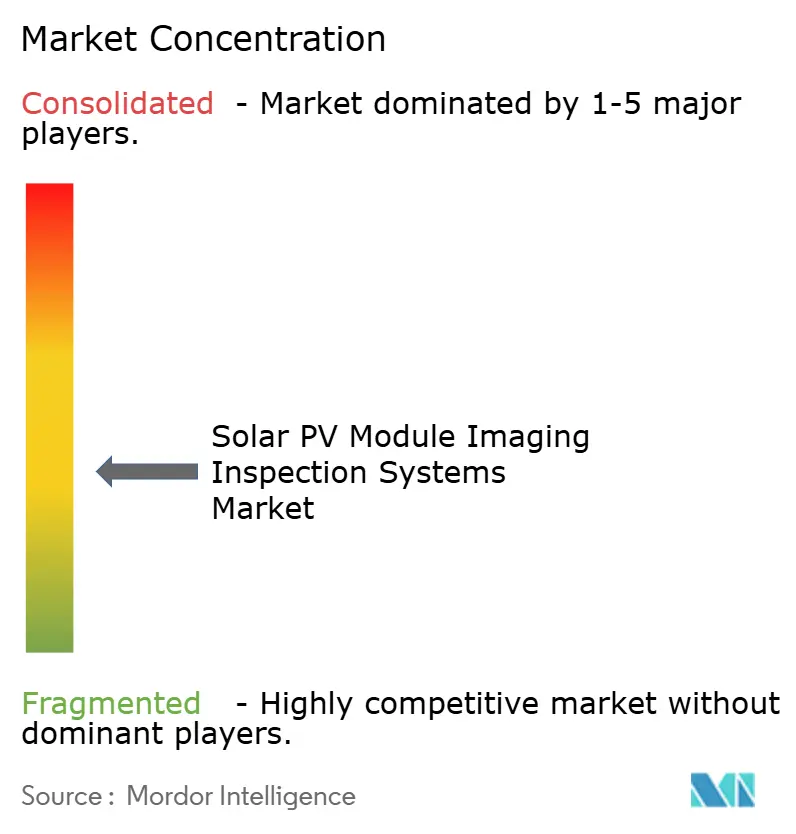
| Market Concentration | Medium |
Major Players *Disclaimer: Major Players sorted in no particular order Image © Mordor Intelligence. Reuse requires attribution under CC BY 4.0. | |
Solar PV Module Imaging Inspection Systems Market Analysis by Mordor Intelligence
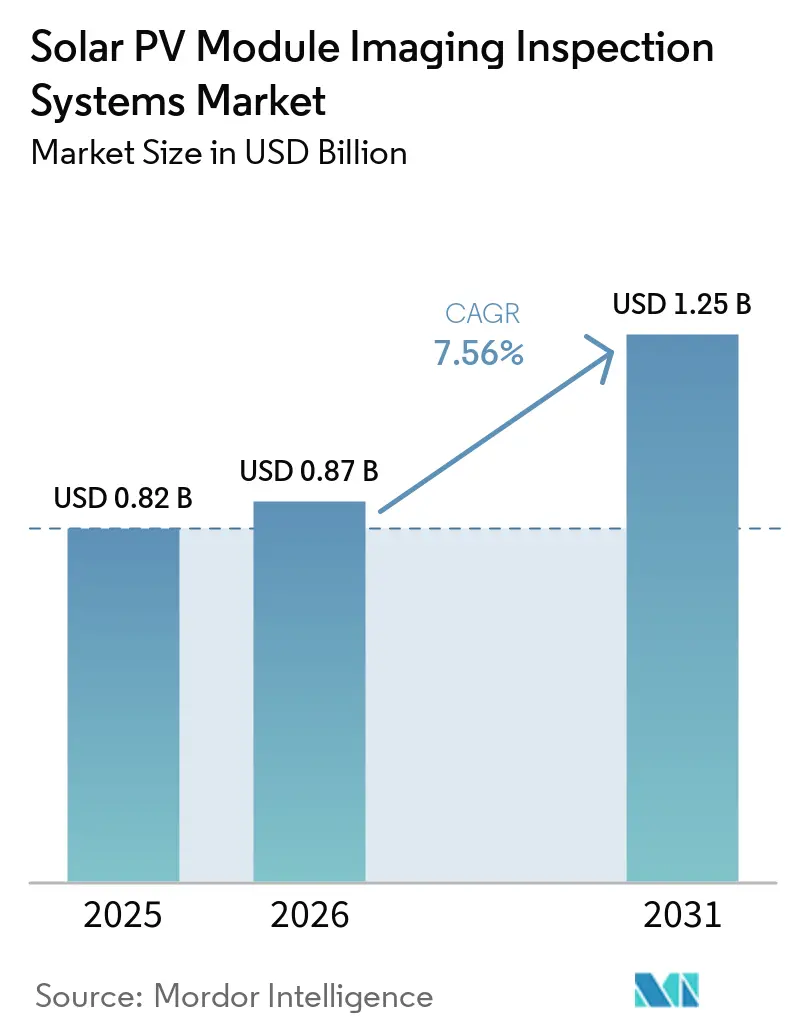
The solar PV module imaging inspection systems market size was valued at USD 0.82 billion in 2025 and is estimated to expand from USD 0.87 billion in 2026 to reach USD 1.25 billion by 2031, at a CAGR of 7.56% during the forecast period (2026-2031). The solar PV module imaging inspection systems market is supported by investment in production-line and field quality assurance as module manufacturing changes rapidly. Higher factory throughput is increasing the need for inspection that can cover every module without slowing production. The move from PERC to TOPCon has also made quality control more demanding because inspection software needs cell-architecture-specific calibration. Kiwa PI Berlin reported a 3.36% pre-shipment non-conformance rate in 2025, its highest level in more than 10 years, with the transition to TOPCon and newly ramped facilities among the contributing factors. The solar PV module imaging inspection systems market therefore has opportunities in both automated factory equipment and portable systems used after installation.
Key Report Takeaways
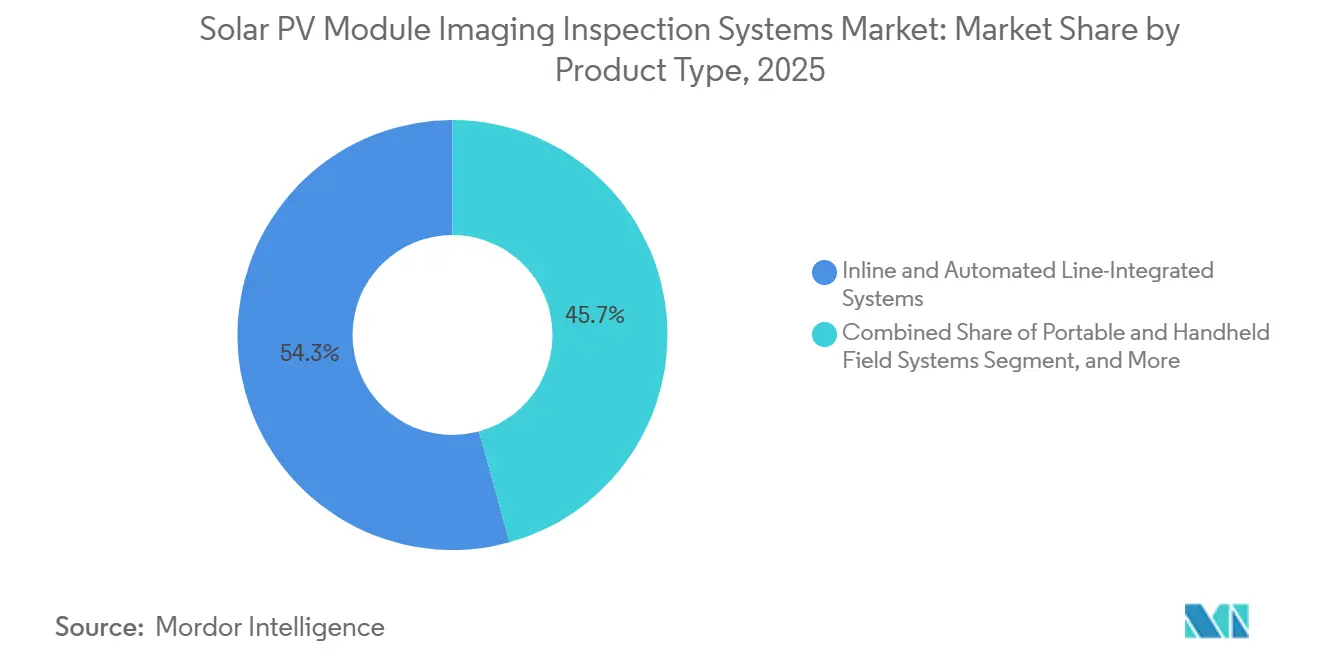
- By product type, inline and automated line-integrated systems held 54.27% of the solar PV module imaging inspection systems market share in 2025, while portable and handheld field systems are projected to expand at a 8.24% CAGR through 2031.
- By imaging technology, automated electroluminescence, non-AI defect detection held 38.72% of market share in 2025, while AI and deep-learning-enabled electroluminescence is projected to expand at a 8.76% CAGR through 2031 in the solar PV module imaging inspection systems market.
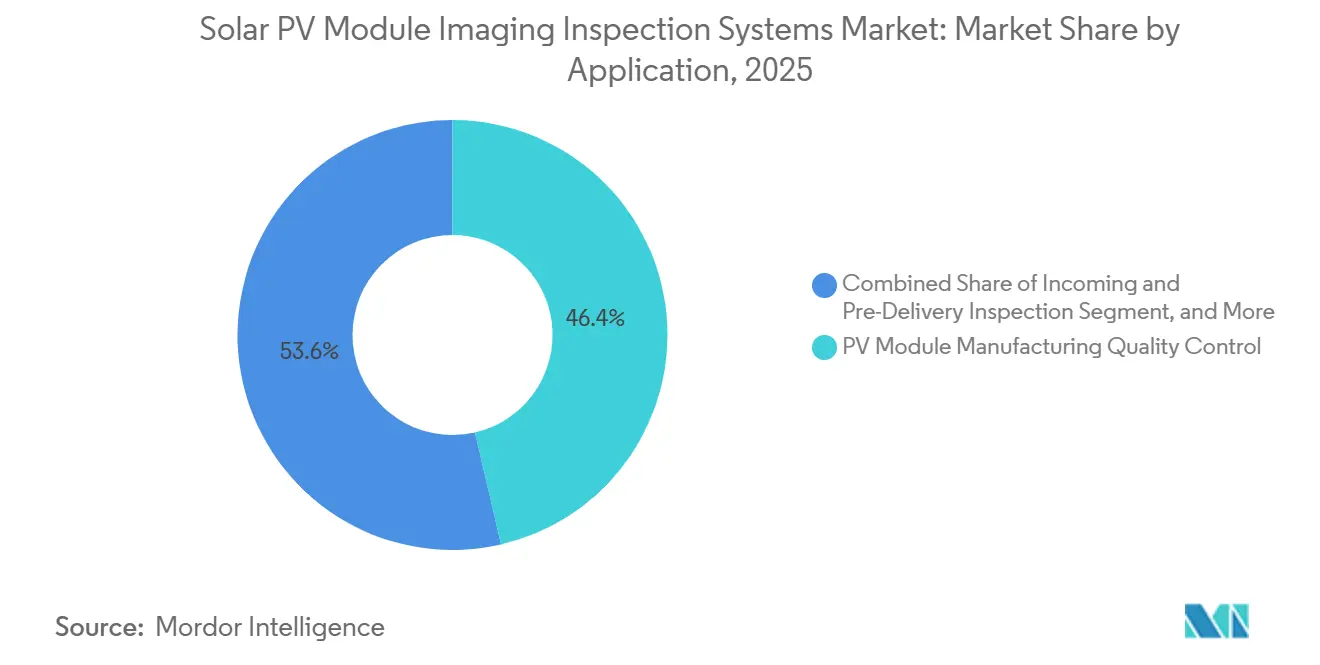
- By application, PV module manufacturing quality control accounted for 46.37% of the solar PV module imaging inspection systems market size in 2025, while end-of-life diagnostics and recycling triage is projected to expand at a 8.64% CAGR through 2031.
- By end-user, solar cell and module manufacturers held 41.23% of demand in 2025, while EPC contractors and O&M service providers are projected to expand at an 9.06% CAGR through 2031 in the solar PV module imaging inspection systems market.
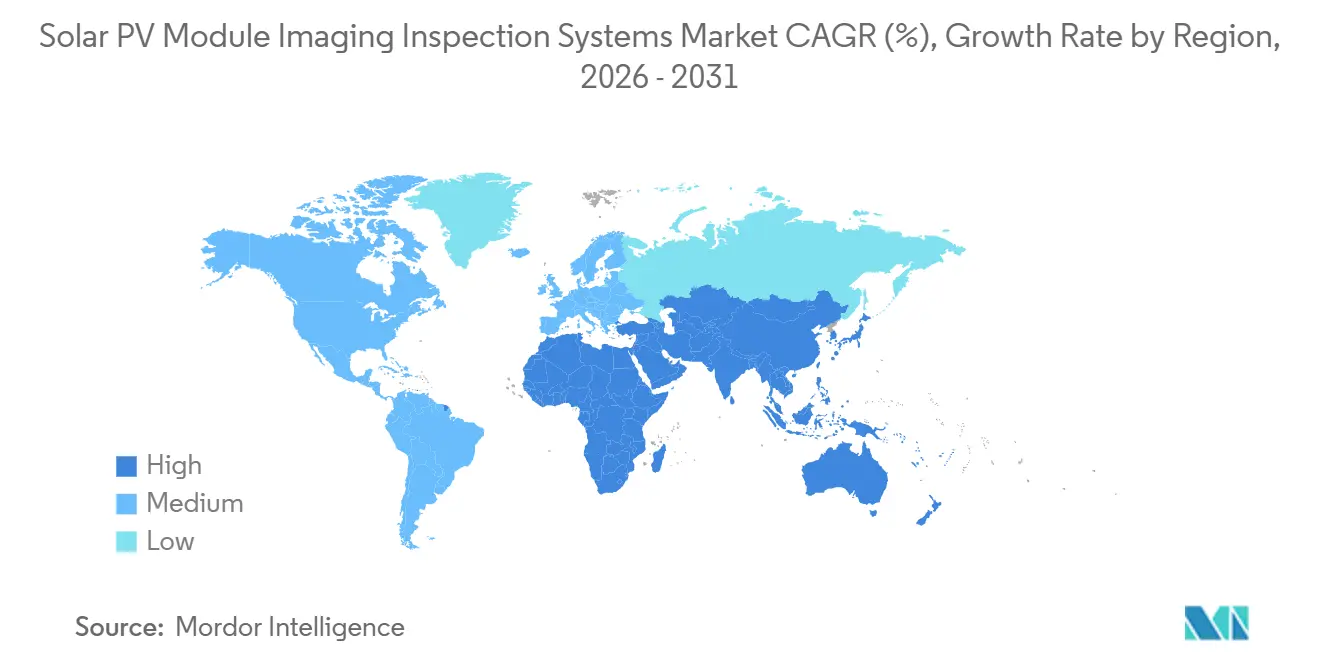
- By geography, Asia-Pacific held 56.94% of market share in 2025, while Middle East and Africa is projected to expand at a 8.68% CAGR through 2031.
Note: Market size and forecast figures in this report are generated using Mordor Intelligence’s proprietary estimation framework, updated with the latest available data and insights as of January 2026.
Global Solar PV Module Imaging Inspection Systems Market Trends and Insights
Drivers Impact Analysis*
| Driver | (~) % Impact on CAGR Forecast | Geographic Relevance | Impact Timeline |
|---|---|---|---|
| Utility-Scale Solar Manufacturing Expansion | +1.8% | Global, concentrated in Asia-Pacific, North America, and India | Short Term (≤ 2 Years) |
| High-Efficiency Module Yield Protection | +1.5% | Global, particularly China, South Korea, and India | Short Term (≤ 2 Years) |
| AI-Enabled Defect Classification and Traceability | +1.3% | Global, with early adoption in Europe and North America | Medium Term (2-4 Years) |
| Insurer and Lender Demand for Bankable Quality Evidence | +0.9% | Global, with regulatory influence concentrated in the EU and North America | Medium Term (2-4 Years) |
| Domestic PV Manufacturing Incentives | +0.7% | North America, through IRA Section 45X, and India, through the PLI scheme | Short Term (≤ 2 Years) |
| Daylight and Drone-Enabled Field Inspection | +0.5% | Global, with concentrated adoption in Asia-Pacific and Middle East and Africa | Long Term (≥ 4 Years) |
| Source: Mordor Intelligence | |||
Utility-Scale Solar Manufacturing Expansion Accelerates Inline Inspection Demand
The solar PV module imaging inspection systems market is benefiting from the scale of new module manufacturing capacity. U.S. module manufacturing capacity reached 69.9 GW by June 2026, compared with 8 GW before the Inflation Reduction Act. India reported INR 73,400 crore in PLI-linked investment as of June 2026, equal to USD 8.69 billion, with 42 GW of module capacity, 12 GW of cell capacity, and 2 GW of ingot-wafer capacity established. Each new line needs inspection equipment that can operate at its planned conveyor speed and support repeatable quality records. This connection between factory construction and inspection purchases gives suppliers a clear route into newly commissioned capacity. It also makes line integration, service access, and compatible software important procurement factors.
High-Efficiency Module Yield Protection Creates a Stronger Case for Inspection
Advanced cell designs increase the cost of defects that are found late in production. ISRA VISION stated that silver paste can account for up to 30% of solar cell manufacturing costs, which raises the value of detecting defects before lamination. A 2025 study by researchers from the University of New South Wales and the University of Newcastle identified sodium, calcium, chlorine, and sulfur contaminants that caused 10-16% power losses in TOPCon and HJT glass-backsheet modules after 1,000 hours of damp-heat testing.[1]University of New South Wales and University of Newcastle, “Hidden Traces: Insights Into How Solar Cell Handling Drives Damp-Heat Failures in HJT and TOPCon Modules,” Solar Energy Materials and Solar Cells, sciencedirect.com Pre-lamination EL and PL imaging can identify relevant defects earlier than inspection methods used only after lamination. Higher cell efficiency also makes an equivalent yield loss more consequential in absolute power-output terms. The solar PV module imaging inspection systems market is thus seeing greater interest in systems that demonstrate yield protection for TOPCon and HJT lines.
AI-Enabled Defect Classification and Traceability Redefine Inspection System Architecture
The solar PV module imaging inspection systems market is shifting from simple pass-fail decisions toward defect classification and traceability. Ebied and colleagues reported 90.13% classification accuracy for a ResNet152-based framework tested on 2,624 EL images from monocrystalline and polycrystalline modules.[2]Ahmed Ebied et al., “Advanced Deep Learning Modeling to Enhance Detection of Photovoltaic Module Defects,” Scientific Reports, nature.com An IEEE 2025 paper reported 96.08% classification accuracy for a CNN-BiLSTM model with contrast correction across 10,000 EL images. A study in Measurement Science and Technology reported that the SAFINet model achieved an mAP@0.5 of 98.8 at 178 frames per second. These capabilities allow manufacturers to retain defect records by module serial number and connect them to later field performance. Suppliers that can retrain models using plant-specific defect libraries can offer a more relevant response to changing cell designs.
Insurer and Lender Demand for Bankable Quality Evidence Extends Inspection Beyond Factories
Project financiers and insurers increasingly require credible quality documentation through the module supply chain. IEC 61215 covers design qualification and type approval for terrestrial photovoltaic modules, while IEC 62941 addresses quality management systems for module manufacturing. TÜV Rheinland provides supply-chain services under ISO/IEC 17025 laboratory accreditation, including factory audits and pre-shipment inspection. This expectation extends the role of imaging from a factory checkpoint to incoming checks, post-lamination assessment, pre-shipment verification, and commissioning. In June 2026, Quantified Energy and Zeitview completed an inverter-fed autonomous drone EL inspection at Acciona Energía’s 458 MWp Red-Tailed Hawk Solar Power Plant in Texas. The stated uses included technical due diligence, warranty claims, and insurance assessments, showing how field inspection can support financial decisions.
Restraints Impact Analysis*
| Restraint | (~) % Impact on CAGR Forecast | Geographic Relevance | Impact Timeline |
|---|---|---|---|
| High Capital Cost and Integration Complexity | -1.2% | Global, most pronounced in South Asia and Southeast Asia | Short Term (≤ 2 Years) |
| Fragmented Inspection Protocols | -0.8% | Global, with compliance frameworks largely absent in Middle East and Africa and South America | Medium Term (2-4 Years) |
| Optical Component Supply and Calibration Constraints | -0.6% | Global, concentrated in markets dependent on imported optics and InGaAs sensors | Medium Term (2-4 Years) |
| False Positives From New Cell Architectures | -0.4% | Asia-Pacific and North America, where TOPCon and HJT adoption is highest | Long Term (≥ 4 Years) |
| Source: Mordor Intelligence | |||
High Capital Cost and Integration Complexity Constrain Mid-Tier Adoption
Advanced inline EL and PL equipment can require several hundred thousand USD in capital spending per station. This cost is difficult for mid-tier manufacturers to justify when module margins are compressed. Integration also requires alignment with manufacturing execution systems, conveyor speeds, and product-format changes. Smaller producers may not have the internal software engineering resources needed for this work. The solar PV module imaging inspection systems market may therefore develop a wider quality gap between manufacturers that can upgrade equipment and those that retain older rule-based systems. Financing options, modular upgrades, and remote calibration can help suppliers reduce this barrier without waiting for margins to improve.
Fragmented Inspection Protocols Create Specification Uncertainty for Buyers
The lack of a universal EL imaging protocol means buyers and suppliers often negotiate their own defect acceptance criteria. IEC 62446-3 provides a framework for fielded photovoltaic systems, but it does not define EL imaging thresholds in enough detail to standardize factory acceptance criteria. This can lengthen procurement and create switching costs when equipment is configured around a proprietary defect-classification scheme. A system trained for one severity matrix may need meaningful retraining before it works at a different site. VDE SPEC 90038-3 addresses production-related quality assurance with references to IEC 62941 and ISO/IEC 17025, but adoption timing outside Europe remains uncertain.
*Our forecasts treat driver/restraint impacts as directional, not additive. The impact forecasts reflect baseline growth, mix effects, and variable interactions.
Segment Analysis
By Product Type: Inline Systems Remain Central as Portable Formats Expand
Inline system decisions are closely tied to production capacity, module format, and the required speed of a given line. Manufacturers use these systems where inspection has to occur without diverting modules for separate handling. The value proposition is strongest where every module must receive imaging coverage before packing and shipment. Automated systems can also create records that allow a quality team to compare defect patterns across shifts and production batches. This makes the equipment relevant to both routine screening and process improvement.
Inline and automated line-integrated systems held 54.27% of the solar PV module imaging inspection systems market share in 2025. Their position reflects the need for full EL coverage within high-throughput module manufacturing lines. MBJ’s EL-Inline system reports cycle times below 20 seconds per module and uses dual 12-megapixel cooled CMOS cameras with neural-network-based defect detection. Inline systems are designed to make inspection part of normal production rather than a separate quality step. This helps manufacturers identify microcracks, inactive areas, and other cell-level defects before modules leave the plant.
Offline and laboratory bench-top systems serve quality teams and research groups that need flexible characterization across EL, PL, and dark lock-in thermography. Their unit volumes are lower, but their flexibility supports the early work needed to calibrate new cell architectures. TOPCon, HJT, and tandem cells require different imaging responses and defect libraries before a technique can be transferred to a production line. Portable and handheld field systems are projected to expand at a 8.24% CAGR from 2026 to 2031. The solar PV module imaging inspection systems market size for portable systems benefits from commissioning and recurring O&M inspection needs. MBJ introduced Quickcheck at Intersolar Europe 2026 for daylight luminescence measurements on operating modules without rewiring or inverter shutdown.



By Imaging Technology: AI-Enabled EL Gains on the Non-AI Installed Base
The technology choice depends on the defect types a manufacturer expects to find and the point at which it needs to find them. EL remains a central method because it can reveal cell-level electrical defects that are not evident in a standard visual review. Rule-based systems retain value where processes and product designs are stable. Their limitation becomes clearer when new luminescence signatures alter how a defect appears in an image. The solar PV module imaging inspection systems market is consequently rewarding suppliers that can update their analysis without replacing an entire inspection workflow.
Automated electroluminescence, non-AI defect detection held 38.72% of the solar PV module imaging inspection systems market share in 2025. This installed base was built around rule-based systems that were suitable for established PERC defect profiles. TOPCon luminescence signatures differ from PERC baselines and can create false positives if software is not retrained. That limitation creates pressure to replace or upgrade older platforms. Conventional manual EL remains relevant in smaller facilities and research settings where automated throughput is not essential.
Photoluminescence and hybrid EL/PL systems serve advanced cell developers and laboratories that need contactless characterization of partly processed cells. AI and deep-learning-enabled EL is projected to expand at a 8.76% CAGR from 2026 to 2031. The solar PV module imaging inspection systems market is moving toward platforms that combine inspection data, process information, and system management. ISRA VISION’s Connected PV platform reflects this approach to linking imaging with production analytics.[3]ISRA VISION, “Solar Cell and Module Inline Inspection and Data Analytics, Connected PV,” ISRA VISION, isra-vision.com A 2026 Solar RRL paper showed that a deep-learning model could extract qualitative PL and series-resistance information from a single EL measurement. This supports the potential for closer integration of EL and PL functions in future systems.
By Application: Manufacturing Quality Control Leads as Recycling Triage Emerges
Application requirements vary by the stage of a module’s life. Factory quality control focuses on speed, repeatability, and the ability to act before shipment. Receiving inspection focuses on verifying the condition of delivered modules before they are deployed. Commissioning inspection establishes a record that can be used later in performance and warranty reviews. Recycling triage uses imaging differently, helping determine whether a removed module may be reused, refurbished, or directed to material recovery. This wider set of applications gives the solar PV module imaging inspection systems market a demand base that is not limited to new factory construction.
PV module manufacturing quality control accounted for 46.37% of the solar PV module imaging inspection systems market size in 2025. Inline EL screening remains central because identifying defects during production protects yield and avoids later rework. Incoming and pre-delivery inspection is also gaining relevance where project-finance due diligence requires independent verification. Solar power plant commissioning and O&M support demand for field systems that document baseline module condition. Research and development and failure analysis continue to support new architectures, including perovskite-silicon tandem cells.
End-of-life diagnostics and recycling triage is projected to expand at a 8.64% CAGR from 2026 to 2031. IEA-PVPS reported global cumulative installed PV capacity of 2.8 TW in 2025. IRENA stated that annual panel waste could require 120,000 heavy-duty truck movements and at least 150 fully operational, medium-sized recycling facilities worldwide by 2035. The EU WEEE Directive establishes collection and recycling obligations for end-of-life PV modules. The SOLMATE framework identifies EL imaging as stage 2 in a 5-stage triage process for decommissioned modules. This moves imaging inspection beyond manufacturing into reuse, refurbishment, and material-recovery decisions.
By End-User: Manufacturers Lead Demand While EPC and O&M Providers Expand Faster
Each end-user group evaluates imaging systems against a different operational requirement. Manufacturers prioritize station speed and yield control. Plant owners need reliable condition evidence across operating fleets. Certification organizations need documented procedures and repeatable evidence suitable for lenders and insurers. Research users need flexible systems that can be adapted to new cell designs. EPC and O&M providers need equipment that reduces disruption at a project site and can be deployed repeatedly across portfolios. These requirements encourage suppliers to offer both equipment and inspection services.
Solar cell and module manufacturers accounted for 41.23% of demand in 2025. Manufacturing-stage inspection offers the highest leverage for yield and cost control because a defect can be identified before a module is shipped. Solar power plant owners and operators are incorporating repeated EL inspection into asset management activities. This supports warranty enforcement and insurance renewals. Testing, inspection, and certification organizations require multi-technology systems that can produce documentation suitable for audits.
Research institutes and universities use scientific-grade imaging cameras and hybrid EL/PL systems to study next-generation cell architectures. EPC contractors and O&M service providers are projected to expand at an 9.06% CAGR from 2026 to 2031. The solar PV module imaging inspection systems market is gaining a service-based route through autonomous field inspection. The June 2026 inspection at Red-Tailed Hawk showed a model for repeated module-level health assessment on a large operating site. India’s ALMM framework requires factory inspection by MNRE-empaneled agencies for government-tender eligibility, which adds compliance work to project timelines.
Geography Analysis
The solar PV module imaging inspection systems market has distinct geographic demand patterns because manufacturing capacity, project deployment, and technical standards are distributed unevenly. Factory-focused demand is strongest where new cell and module lines are being established. Field-focused demand becomes more important where large operating fleets require commissioning, warranty, or periodic asset-condition checks. Regional purchasing decisions also reflect the availability of skilled service labor and access to specialist optical components.
Asia-Pacific held 56.94% of the solar PV module imaging inspection systems market share in 2025. The region’s position follows its concentration of global cell and module manufacturing. China drives most demand for high-throughput inline EL equipment because of its large factory base. India is a growing secondary center for both inline and pre-shipment equipment. Its PLI program reported INR 73,400 crore, equal to USD 8.69 billion, in investment as of June 2026. The program had established 42 GW of module capacity and 12 GW of cell capacity.
Japan and South Korea are smaller but technically demanding markets because manufacturers are developing HJT and tandem architectures. These cell designs require systems that can manage differing geometries and luminescence spectra. Vietnam, Malaysia, Thailand, and Indonesia add demand as module assembly moves to manage tariff exposure. New facilities in this ASEAN corridor have created demand for inspection equipment, although quality investment can vary by plant. North America is moving from import dependence toward domestic manufacturing. U.S. module manufacturing capacity reached 69.9 GW by June 2026, creating demand for a new group of production-line inspection purchases. Europe remains important because Germany is home to suppliers including ISRA VISION, MBJ Solutions, InnoLas Solutions, and greateyes.
Middle East and Africa is projected to expand at a 8.68% CAGR from 2026 to 2031. Saudi Arabia and the UAE are advancing utility-scale projects where international lenders can embed inspection requirements in EPC contracts. The solar PV module imaging inspection systems market size in this region is supported by portable formats that need less permanent local infrastructure. South America also offers an entry point for field-inspection suppliers as utility-scale deployment moves ahead of local inspection capacity. vHive introduced a multi-drone platform in July 2026 with autonomous flight, thermal imaging, RGB mapping, and digital-twin creation for utility-scale solar sites. Such systems are relevant where specialist ground labor is limited.

Competitive Landscape
Competition in the solar PV module imaging inspection systems market reflects the specialized nature of imaging hardware, defect software, and factory integration. Suppliers must demonstrate that a system works with the buyer’s cell architecture and line configuration. They also need to show that the system can retain usable evidence for quality, warranty, and financial review. This creates room for established suppliers with application knowledge, while leaving openings for specialized entrants.
The solar PV module imaging inspection systems market is moderately fragmented. European specialist suppliers include ISRA VISION, MBJ Solutions, greateyes, InnoLas Solutions, and Vitronic. Chinese suppliers such as Wuhan Sinshine Technologies and Wuhan Sunic Photoelectricity Equipment Manufacture compete in the inline EL category. Suppliers differentiate through optical resolution, AI integration, line compatibility, and field-service capability. ISRA VISION’s Connected PV platform combines inspection data, process information, and system management across manufacturing lines. This strategy extends the offer from inspection equipment toward production analytics.
Companies are also expanding into portable and end-of-life formats. MBJ’s Quickcheck was introduced in 2026 for daylight luminescence measurement of individual operating modules without rewiring or inverter shutdown. Quantified Energy and Zeitview used inverter EL functionality for the June 2026 autonomous drone inspection at the Red-Tailed Hawk plant. This model removes the need for external power supplies during field EL work. greateyes has also supplied its ELSEi camera for tandem-cell differential luminescence research. These activities extend supplier presence across manufacturing, research, operating assets, and eventual end-of-life triage.
Smaller providers such as Dark Field Technologies and OnsitePV pursue specialized optical systems and on-site service models. Those approaches allow them to serve needs that larger vendors may not prioritize. Price pressure at module manufacturers makes the total cost of quality an important commercial issue. Suppliers that show measurable yield protection, easier integration, and lower operating disruption may have an advantage in purchasing decisions. The solar PV module imaging inspection systems industry has room for suppliers that link factory records to lifetime field data. The solar PV module imaging inspection systems market also has scope for drone-integrated systems in large solar fleets with limited inspection labor.
Solar PV Module Imaging Inspection Systems Industry Leaders
MBJ Solutions GmbH
ISRA VISION AG
Wuhan Sunshine Technologies Co., Ltd.
InnoLas Solutions GmbH
BrightSpot Automation LLC
- *Disclaimer: Major Players sorted in no particular order

Recent Industry Developments
- September 2026: The International Renewable Energy Agency released its policy brief on end-of-life solar PV panel management, projecting that by 2035, annual panel waste will require approximately 150 fully operational, medium-sized recycling facilities globally. The report directly accelerates regulatory attention toward EL-based module triage inspection as a prerequisite for circular-economy compliance under frameworks such as the EU WEEE Directive.
- June 2026: Quantified Energy and Zeitview completed the first inverter-fed autonomous drone EL inspection on U.S. soil at Acciona Energía's 458 MWp Red-Tailed Hawk Solar Power Plant in El Campo, Texas. Quantified Energy deployed its EL camera system alongside 3 Ingeteam INGECON SUN inverters to autonomously inspect 18,125 modules, producing module-level health profiles including microcrack and hidden cell-level defect detection. The milestone validates inverter-fed autonomous drone EL as a commercially deployable inspection method for large U.S. utility-scale assets.
- June 2026: MBJ Solutions launched MBJ Quickcheck at Intersolar Europe. MBJ Solutions debuted the Quickcheck, a portable handheld luminescence inspection system enabling daylight EL measurements of solar modules in operation without inverter shutdown or rewiring. The tool enables 1-person O&M inspection at 60 seconds per module under operating conditions, removing the requirement for qualified electricians during routine field EL surveys.
- April 2026: IEA-PVPS published the third update to its PV module recycling life cycle inventory report. The report confirmed 2.8 TW of globally installed PV capacity in 2025 and highlighted growing end-of-life management urgency. The publication reinforces the structural demand outlook for EL-based triage inspection tools in the recycling pipeline.


Global Solar PV Module Imaging Inspection Systems Market Report Scope
The Solar PV Module Imaging Inspection Systems Market refers to the industry focused on the development, manufacturing, and deployment of advanced imaging-based inspection solutions used to evaluate the quality, performance, and structural integrity of photovoltaic (PV) modules throughout production and operational life cycles.
The Solar PV Module Imaging Inspection Systems Market Report is Segmented by Product Type (Inline and Automated Line-Integrated Systems, Offline and Laboratory Bench-Top Systems, and Portable and Handheld Field Systems), by Imaging Technology (Conventional Manual Electroluminescence, Automated Electroluminescence Non-AI Defect Detection, AI and Deep-Learning-Enabled Electroluminescence, and Photoluminescence and Hybrid EL/PL Systems), by Application (PV Module Manufacturing Quality Control, Incoming and Pre-Delivery Inspection, Solar Power Plant Commissioning and O&M, Research and Development and Failure Analysis, and End-of-Life Diagnostics and Recycling Triage), by End-User (Solar Cell and Module Manufacturers, Solar Power Plant Owners and Operators, EPC Contractors and O&M Service Providers, Testing Inspection and Certification Organizations, and Research Institutes and Universities), and by Geography (North America, South America, Europe, Asia-Pacific, and Middle East and Africa). The Market Forecasts are Provided in Terms of Value (USD).
| Inline and Automated Line-Integrated Systems |
| Offline and Laboratory Bench-Top Systems |
| Portable and Handheld Field Systems |
| Conventional Manual Electroluminescence |
| Automated Electroluminescence, Non-AI Defect Detection |
| AI and Deep-Learning-Enabled Electroluminescence |
| Photoluminescence and Hybrid EL/PL Systems |
| PV Module Manufacturing Quality Control |
| Incoming and Pre-Delivery Inspection |
| Solar Power Plant Commissioning and O&M |
| Research and Development and Failure Analysis |
| End-of-Life Diagnostics and Recycling Triage |
| Solar Cell and Module Manufacturers |
| Solar Power Plant Owners and Operators |
| EPC Contractors and O&M Service Providers |
| Testing, Inspection, and Certification Organizations |
| Research Institutes and Universities |
| North America | United States | |
| Canada | ||
| Mexico | ||
| South America | Brazil | |
| Argentina | ||
| Rest of South America | ||
| Europe | Germany | |
| United Kingdom | ||
| France | ||
| Italy | ||
| Spain | ||
| Rest of Europe | ||
| Asia-Pacific | China | |
| Japan | ||
| India | ||
| South Korea | ||
| ASEAN | ||
| Rest of Asia-Pacific | ||
| Middle East and Africa | Middle East | Saudi Arabia |
| United Arab Emirates | ||
| Turkey | ||
| Rest of the Middle East | ||
| Africa | South Africa | |
| Nigeria | ||
| Rest of Africa | ||
| By Product Type | Inline and Automated Line-Integrated Systems | ||
| Offline and Laboratory Bench-Top Systems | |||
| Portable and Handheld Field Systems | |||
| By Imaging Technology | Conventional Manual Electroluminescence | ||
| Automated Electroluminescence, Non-AI Defect Detection | |||
| AI and Deep-Learning-Enabled Electroluminescence | |||
| Photoluminescence and Hybrid EL/PL Systems | |||
| By Application | PV Module Manufacturing Quality Control | ||
| Incoming and Pre-Delivery Inspection | |||
| Solar Power Plant Commissioning and O&M | |||
| Research and Development and Failure Analysis | |||
| End-of-Life Diagnostics and Recycling Triage | |||
| By End-User | Solar Cell and Module Manufacturers | ||
| Solar Power Plant Owners and Operators | |||
| EPC Contractors and O&M Service Providers | |||
| Testing, Inspection, and Certification Organizations | |||
| Research Institutes and Universities | |||
| By Geography | North America | United States | |
| Canada | |||
| Mexico | |||
| South America | Brazil | ||
| Argentina | |||
| Rest of South America | |||
| Europe | Germany | ||
| United Kingdom | |||
| France | |||
| Italy | |||
| Spain | |||
| Rest of Europe | |||
| Asia-Pacific | China | ||
| Japan | |||
| India | |||
| South Korea | |||
| ASEAN | |||
| Rest of Asia-Pacific | |||
| Middle East and Africa | Middle East | Saudi Arabia | |
| United Arab Emirates | |||
| Turkey | |||
| Rest of the Middle East | |||
| Africa | South Africa | ||
| Nigeria | |||
| Rest of Africa | |||


Key Questions Answered in the Report
What Is the Solar PV Module Imaging Inspection Systems Market Size?
The market was valued at USD 0.82 Billion in 2025, is estimated at USD 0.87 Billion in 2026, and is forecast to reach USD 1.25 Billion by 2031, growing at a CAGR of 7.56% during the forecast period.
What Is Driving Demand for Solar Module Imaging Inspection Systems?
New module production capacity, adoption of advanced TOPCon and HJT cells, increasing lender quality requirements, and expanding field inspection needs are driving demand for solar module imaging inspection systems.
Which Product Type Held the Largest Share in 2025?
Inline and automated line-integrated systems held the largest share, accounting for 54.27% of revenue in 2025, as high-throughput manufacturing facilities require comprehensive module inspection coverage.
Which Imaging Technology Is Expanding Fastest?
AI and deep-learning-enabled electroluminescence (EL) imaging is projected to expand at a CAGR of 8.76% through 2031, supported by growing demand for improved defect-classification accuracy.
Why Is EL Inspection Important for End-of-Life Solar Modules?
EL imaging supports reuse, refurbishment, and recycling triage by helping operators assess module condition and make informed material-recovery decisions.
Which Region Is Expected to Expand Fastest Through 2031?
Middle East and Africa is projected to be the fastest-growing region, registering a CAGR of 8.68% through 2031, supported by utility-scale solar projects in Saudi Arabia and the UAE.
Page last updated on:





