
Software As A Medical Device (SaMD) For Respiratory Care Market Size and Share
Market Overview
| Study Period | 2020 - 2031 |
|---|---|
| Market Size (2026) | USD 5.86 Billion |
| Market Size (2031) | USD 9.23 Billion |
| Growth Rate (2026 - 2031) | 9.52 % |
| Fastest Growing Market | Asia-Pacific |
| Largest Market | North America |
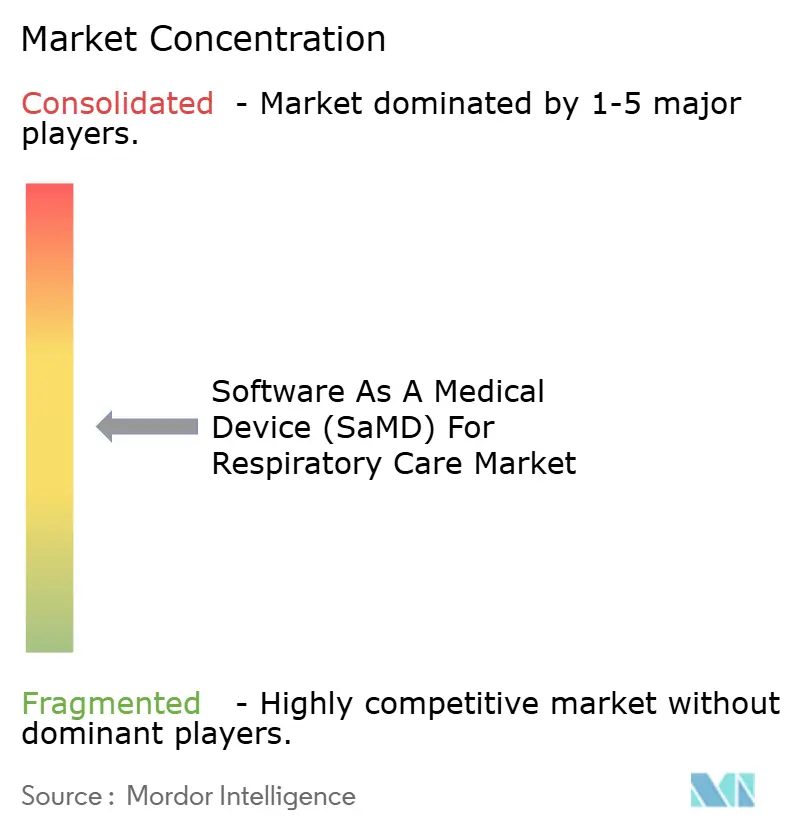
| Market Concentration | Medium |
Major Players *Disclaimer: Major Players sorted in no particular order Image © Mordor Intelligence. Reuse requires attribution under CC BY 4.0. | |
Software As A Medical Device (SaMD) For Respiratory Care Market Analysis by Mordor Intelligence
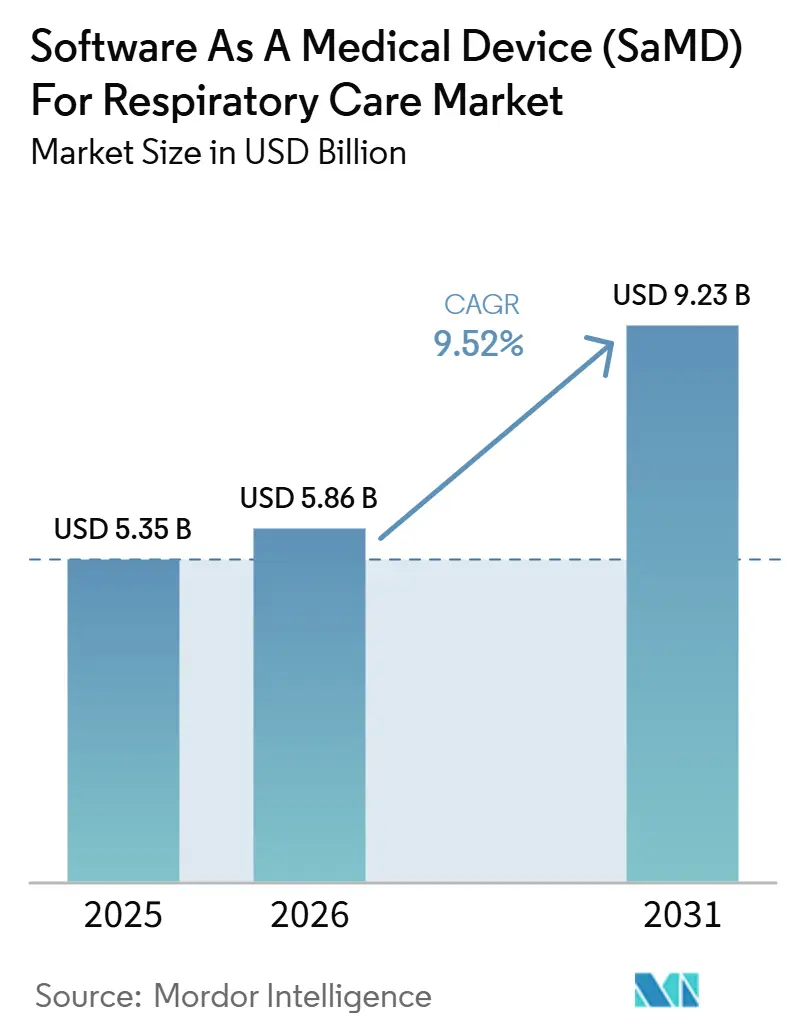
The Software As A Medical Device For Respiratory Care Market size was valued at USD 5.35 billion in 2025 and is estimated to grow from USD 5.86 billion in 2026 to reach USD 9.23 billion by 2031, at a CAGR of 9.52% during the forecast period (2026-2031).
Chronic respiratory diseases continue to place a heavy burden on health systems, increasing demand for software that supports diagnosis, monitoring, and day-to-day disease management outside hospital settings. Clearer regulatory pathways for AI-enabled device software and reimbursement models that support scalable remote respiratory workflows are strengthening the software as a medical device (SaMD) for the respiratory care market. Demand is shifting toward tools that help clinicians identify disease earlier, monitor patients continuously, and guide therapy with broader clinical context. The market is also benefiting from stronger digital health investment across Asia-Pacific and growing adoption of home-based respiratory care models, while competition remains active across platform expansion, waveform analysis, contactless monitoring, and AI-guided therapy support.
Key Report Takeaways
- By component, software led with 69.55% revenue share in 2025, while services are projected to grow at 11.93% CAGR through 2031.
- By deployment mode, cloud-based solutions held 64.22% of revenue in 2025, while on-premises deployment recorded the highest projected growth at 12.67% CAGR through 2031.
- By application, diagnosis and screening accounted for 47.66% of revenue in 2025, while therapy management is projected to expand at 13.35% CAGR through 2031.
- By end user, hospitals and clinics held 52.33% revenue share in 2025, while homecare settings are projected to grow at 12.33% CAGR through 2031.
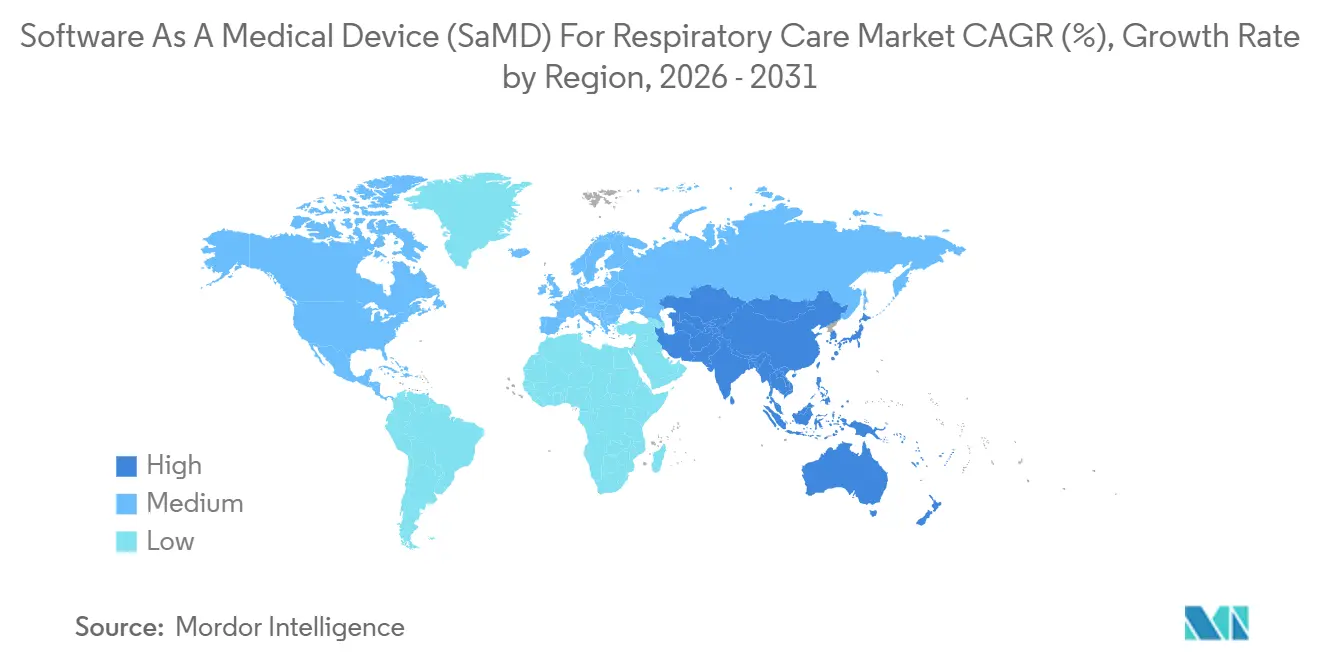
- By geography, North America held 42.25% of global revenue in 2025, while Asia-Pacific is projected to grow at 13.95% CAGR through 2031.
Note: Market size and forecast figures in this report are generated using Mordor Intelligence’s proprietary estimation framework, updated with the latest available data and insights as of January 2026.
Market Trends and Insights
Drivers Impact Analysis of Software As A Medical Device (SaMD) For Respiratory Care Market*
| DRIVER | (~) % IMPACT ON CAGR FORECAST | GEOGRAPHIC RELEVANCE | IMPACT TIMELINE |
|---|---|---|---|
| Rising adoption of AI-enabled respiratory decision support | +2.5% | Global, concentrated in North America and Western Europe | Short term (≤ 2 years) |
| Shift from episodic to continuous home-based respiratory monitoring | +1.9% | North America and Western Europe, with spillover to core APAC markets | Medium term (2-4 years) |
| Expansion of reimbursement-ready remote patient monitoring workflows | +1.5% | North America primary, with early-stage adoption in Europe and Australia | Short term (≤ 2 years) |
| Interoperability with EHR and connected inhaler ecosystems | +1.1% | North America, Europe, and Japan | Medium term (2-4 years) |
| Rising regulatory clarity for device software functions and CDS | +0.8% | Global | Medium term (2-4 years) |
| Higher clinical demand for exacerbation prediction and therapy adherence | +1.3% | Global, led by Asia-Pacific and North America | Long term (≥ 4 years) |
| Source: Mordor Intelligence | |||
Rising Adoption of AI-Enabled Respiratory Decision Support
AI-enabled respiratory decision support is moving beyond pilots and into routine clinical procurement in the software as a medical device (SaMD) for respiratory care market. A randomized controlled trial published in 2024 showed that AI-assisted spirometry interpretation improved COPD diagnosis prediction among primary care clinicians, particularly in cases that clinicians might otherwise have missed. A 2025 blinded diagnostic accuracy study reported an area under the curve of 0.914 for AI spirometry software in a primary care dataset of 1,113 patients. In July 2026, Autonomous Healthcare received FDA De Novo marketing authorization for Syncron-E, creating a new device classification for ventilator waveform analysis software and supporting a clearer regulatory path for focused respiratory algorithms. Clinical validation and clearer review pathways are shortening commercialization timelines and attracting more capital and product development into the software as a medical device (SaMD) for respiratory care market.
Shift From Episodic to Continuous Home-Based Respiratory Monitoring
The shift from clinic-based checks to continuous home-based monitoring is reshaping product design and purchasing priorities across the software as a medical device (SaMD) for respiratory care market. Connected spirometers, inhalers, and wearables generate large patient data streams, while software converts these signals into alerts, trends, and care actions. This shift is one reason homecare settings are growing faster than other end-user categories, with a projected CAGR of 12.33% through 2031. In June 2026, PanopticAI received FDA 510(k) clearance for contactless respiratory rate measurement through a smartphone camera, reinforcing the move toward software subscriptions, monitoring intelligence, and scalable remote care workflows.
Expansion of Reimbursement-Ready Remote Patient Monitoring Workflows
The expansion of reimbursement-ready monitoring workflows is creating a practical route into routine care delivery for the software as a medical device (SaMD) for respiratory care market. The CY 2026 Medicare Physician Fee Schedule finalized new respiratory remote therapeutic monitoring coding changes, including CPT 98984 for 2 to 15 monitoring days in a 30-day period, lowering the billing threshold for respiratory monitoring activity. The policy also recognized software infrastructure, cloud storage, and cybersecurity as cost elements in remote monitoring economics. Existing respiratory RTM code structures continue to support monthly billing for device supply, helping providers invest in programs built on continuous software engagement rather than one-time device use.
Higher Clinical Demand for Exacerbation Prediction and Therapy Adherence
Clinical demand is rising for software that can predict exacerbations earlier and improve therapy adherence within the software as a medical device (SaMD) for respiratory care market. This is critical in chronic respiratory care, where poor inhaler use, missed therapy, and weak follow-up between visits contribute to avoidable deterioration. A 2025 study on an AI-powered smart inhaler showed that software can evaluate inhalation quality against clinical benchmarks instead of only recording actuation events. Therapy management reflects this demand most clearly and is projected to grow at a CAGR of 13.35% through 2031 as the market shifts toward more personalized intervention.
Restraints Impact Analysis of Software As A Medical Device (SaMD) For Respiratory Care Market*
| RESTRAINT | (~) % IMPACT ON CAGR FORECAST | GEOGRAPHIC RELEVANCE | IMPACT TIMELINE |
|---|---|---|---|
| Regulatory reclassification risk for signal-processing software | -1.3% | Global | Short term (≤ 2 years) |
| Weak prospective evidence and reimbursement fragmentation | -0.9% | North America, Europe, and Asia-Pacific | Medium term (2-4 years) |
| Cybersecurity and health data privacy exposure | -0.7% | Global, concentrated in GDPR-regulated European markets | Medium term (2-4 years) |
| Algorithm bias across diverse respiratory phenotypes | -0.8% | Global, with disproportionate relevance in Asia-Pacific and the Middle East and Africa | Long term (≥ 4 years) |
| Source: Mordor Intelligence | |||
Regulatory Reclassification Risk for Signal-Processing Software
Regulatory classification remains a key uncertainty for parts of the software as a medical device (SaMD) for respiratory care market. A tool that starts as low-risk decision support can shift into a regulated device category once its outputs become more treatment-directed or clinically decisive. The FDA's December 2024 guidance on AI-enabled device software clarified that lifecycle controls, update plans, and performance documentation mattered throughout the product life of regulated software, not only at launch. In April 2026, Philips issued a Class I product correction related to Trilogy Evo ventilator software, affecting more than 113,700 devices globally and highlighting how software faults in respiratory care escalated into patient safety and recall issues. Across Europe, the Cyber Resilience Act added another layer of cybersecurity responsibility on top of medical device compliance, increasing cost and complexity for companies operating across multiple jurisdictions.
Weak Prospective Evidence and Reimbursement Fragmentation
Evidence quality remains uneven in the software as a medical device (SaMD) for respiratory care market, particularly when stakeholders assess products for large-scale reimbursement or national rollout. Many validation studies remain retrospective, single-site, or limited in patient mix, making it harder for payers to determine whether results will hold in broader clinical use. A 2025 audit of AI spirometry software found that sensitivity dropped by around 10% in non-White populations compared with all-White training cohorts, raising concerns about generalizability and equitable performance. Broader academic research on pulmonary AI also emphasized the need to improve equity, transparency, and representation across respiratory algorithms before large-scale adoption becomes routine. Reimbursement pathways outside the United States also remain less consistent, limiting global scaling for smaller developers that lack the resources to support multiple country-specific evidence and payment submissions.
*Our forecasts treat driver/restraint impacts as directional, not additive. The impact forecasts reflect baseline growth, mix effects, and variable interactions.
Software As A Medical Device (SaMD) For Respiratory Care Market Segment Analysis
By Component:
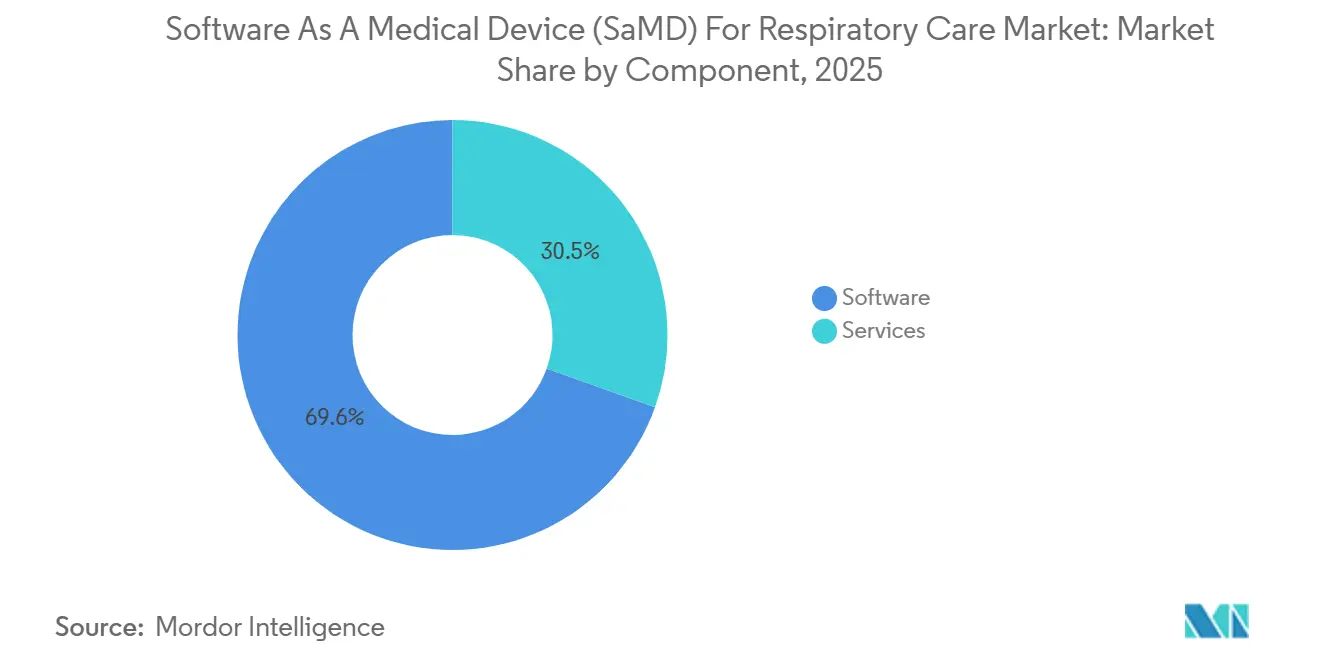
Software Dominates Revenue, Services Command the Growth PremiumSoftware held 69.55% of revenue in 2025, keeping it the core revenue engine in the software as a medical device (SaMD) for respiratory care market. This leadership reflected strong demand for diagnostic software, monitoring platforms, and decision support tools across institutional and home-based respiratory workflows. The software as a medical device (SaMD) for respiratory care market size for services is forecast to expand at a CAGR of 11.93% through 2031, placing services ahead of the broader category growth pace.
This faster growth showed that buyers were moving beyond software licenses and investing in deployment, validation, support, and managed service layers. Health systems increasingly required vendor support for integration, staff onboarding, and post-deployment monitoring. The shift also reflected the need for respiratory software to prove clinical performance over time, not only at the point of initial sale.


By Deployment Mode:
Cloud Holds the Volume, On-Premises Captures the High-Acuity NicheCloud-based deployment held 64.22% of revenue in 2025, making it the largest deployment model in the software as a medical device (SaMD) for respiratory care market. Its lead came from centralized updates, easier storage expansion, cross-site access, and a simpler path to continuous algorithm improvement. The software as a medical device (SaMD) for respiratory care market share for cloud platforms stayed strong due to demand from homecare and ambulatory workflows.
On-premises deployment is projected to grow at a CAGR of 12.67% through 2031, making it the fastest-growing deployment mode despite the broader shift toward cloud architecture. This growth reflected demand from large hospital systems, intensive care settings, and organizations requiring stricter control over sensitive respiratory data. Some use cases required very low latency and uninterrupted processing, making local or tightly controlled private environments more practical for waveform-driven software such as ventilator analysis tools.
By Application:
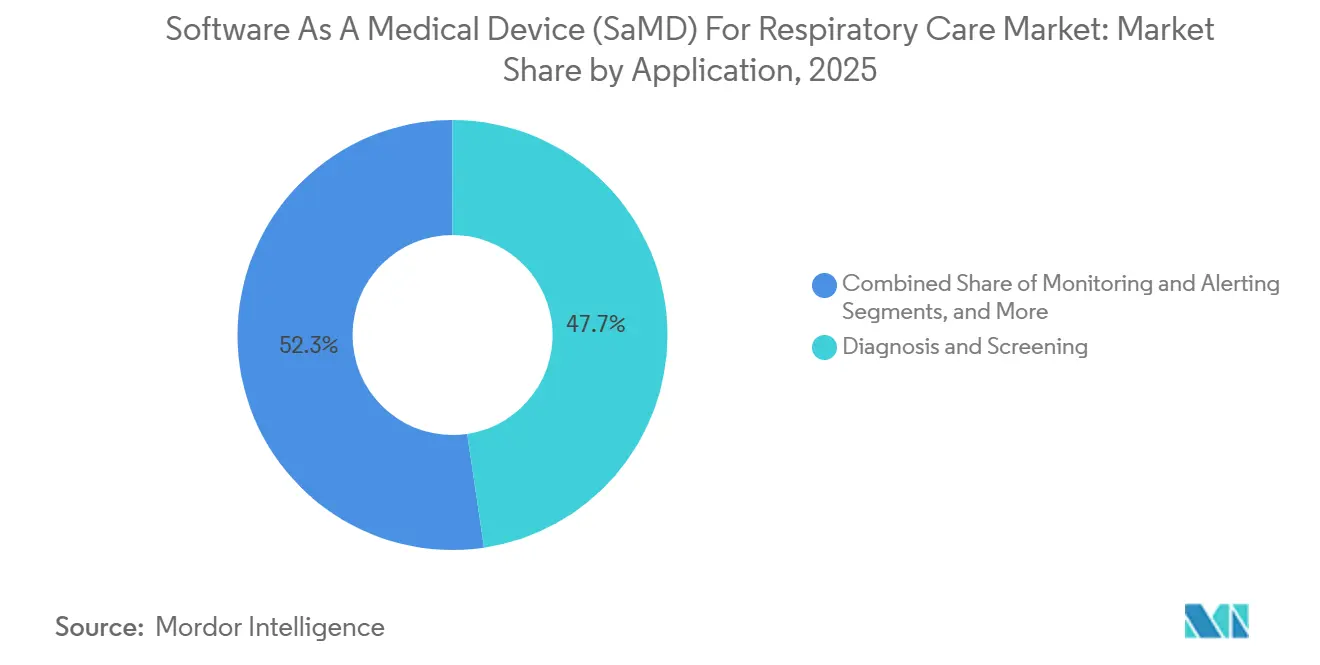
Diagnosis Anchors the Market, Therapy Management Reshapes the Growth CurveDiagnosis and screening accounted for 47.66% of revenue in 2025, keeping it the largest application area in the software as a medical device (SaMD) for respiratory care market. The category grew around tools that helped clinicians identify obstructive airway disease earlier through AI-supported spirometry, acoustic analysis, and waveform interpretation. Evidence continued to support software use in improving diagnostic performance in primary care environments where respiratory expertise was not always available.
Therapy management is forecast to grow at a CAGR of 13.35% through 2031, making it the fastest-moving application in the software as a medical device (SaMD) for respiratory care market. This reflected stronger demand for software that moved beyond observation and guided therapy adjustment, personalization, or reinforcement between visits. ResMed received FDA clearance for Smart Comfort in December 2025, and the product became commercially available in the United States in 2026 as an AI-enabled tool that recommends personalized CPAP comfort settings.

By End User:
Hospitals Anchor Scale, Homecare Defines the Growth FrontierHospitals and clinics held 52.33% revenue share in 2025, keeping them the largest end-user group in the software as a medical device (SaMD) for respiratory care market. These settings continued to control much of the purchasing process for diagnostic software, interoperability requirements, and formal clinical onboarding. They also remained the first point of adoption for tools that affected treatment pathways or required review by respiratory specialists and hospital IT teams.
Homecare settings are forecast to grow at a CAGR of 12.33% through 2031, making them the fastest-growing end-user segment in the software as a medical device (SaMD) for respiratory care market. Growth was driven by connected devices, reimbursement progress, and patient expectations for more support outside formal care episodes. Home-based respiratory software shifted from passive tracking to guided management, with greater focus on adherence coaching, trend review, and escalation support when symptoms worsened.
Geography Analysis
North America Software As a Medical Device (SaMD) for Respiratory Care Market
North America accounted for 42.25% of global revenue in 2025, maintaining its position as the largest regional bloc in the software as a medical device (SaMD) for respiratory care market. The region benefited from mature remote care infrastructure, established respiratory device usage, and a regulatory framework that continued to guide updates and oversight for AI-enabled medical software. Supportive reimbursement policies also improved adoption, especially for respiratory monitoring workflows with clearer coding routes and lower billing barriers.
Europe Software As a Medical Device (SaMD) for Respiratory Care Market
Europe remained a major region in the software as a medical device (SaMD) for respiratory care market, supported by strong public health systems and well-defined digital and regulatory standards. The European Health Data Space advanced interoperability and data exchange, supporting broader adoption of connected health software across member states. This gave respiratory software vendors clearer long-term direction on product integration with clinical systems. Europe’s stricter compliance, cybersecurity, and certification requirements benefited firms with the resources to manage regulatory and product operations across countries.
APAC Software As a Medical Device (SaMD) for Respiratory Care Market
Asia-Pacific was the fastest-growing region, with the software as a medical device (SaMD) for respiratory care market size in the region projected to register a CAGR of 13.95% through 2031. High respiratory disease burden, rising digital health investment, and stronger commercialization of locally developed clinical software supported growth. In June 2026, Nozomi MedAlliance and Yamaguchi University began overseas commercialization work for an AI asthma individualized treatment platform, signaling a more outward-facing phase for Japanese respiratory SaMD development.

Competitive Landscape
The software as a medical device (SaMD) for respiratory care market is moderately consolidated at the platform level and more fragmented at the specialized application level. ResMed, Koninklijke Philips, Medtronic, and AstraZeneca’s digital unit Evinova hold advantages through installed device bases, broad clinical relationships, and integration across respiratory ecosystems. ResMed strengthened its position with Smart Comfort, an FDA-cleared AI-enabled product that recommends personalized CPAP therapy comfort settings and moved into U.S. rollout in 2026. Philips reinforced its monitoring platform strategy through its expanded partnership with Medtronic, adding more patient monitoring capabilities to the IntelliVue environment and increasing switching costs for hospital buyers.
Newer participants continue to grow by targeting clinical specificity, faster validation, and focused use cases within the software as a medical device (SaMD) for respiratory care market. Autonomous Healthcare gained a first-mover advantage when Syncron-E received De Novo authorization and created a new regulatory category in ventilator waveform analysis. PanopticAI differentiated itself with its FDA-cleared contactless respiratory rate measurement product, expanding the market for non-wearable monitoring. Product differentiation increasingly depends on algorithm performance, deployment efficiency, and a clear clinical role, while evidence, compliance, and workflow expectations continue to rise.
The competitive landscape favors companies that combine strong respiratory evidence with reliable execution. Large vendors remain better positioned where hospitals prioritize integration, quality systems, and long-term vendor support. Smaller developers compete effectively in specific clinical needs, less standardized workflows, or areas where incumbent product stacks remain limited. This structure keeps the software as a medical device (SaMD) for respiratory care market open to innovation while giving scaled players an advantage in procurement reach and operational depth.
Software As A Medical Device (SaMD) For Respiratory Care Industry Leaders
Koninklijke Philips N.V.
Medtronic plc
Amiko Digital Health Limited
OMRON Healthcare Co., Ltd.
ResMed Inc.
- *Disclaimer: Major Players sorted in no particular order
Software As A Medical Device (SaMD) For Respiratory Care Market Companies Covered in this Report
- Adherium
- AireHealth, Inc.
- Amiko Digital Health
- AptarGroup, Inc.
- BreatheSuite
- Cognita Labs
- Findair
- Fisher & Paykel Healthcare
- GlaxoSmithKline
- Inogen
- Koninklijke Philips
- Medtronic
- NIOX Group plc
- OMRON Healthcare Co., Ltd.
- Pulmonx Corporation
- Resmed

Recent Industry Developments in Software As A Medical Device (SaMD) For Respiratory Care Market
- July 2026: Autonomous Healthcare received FDA De Novo authorization for Syncron-E, creating a new Class II category for ventilator waveform analysis software that detected patient-ventilator asynchrony in mechanically ventilated adults.
- June 2026: PanopticAI received FDA 510(k) clearance for contactless respiratory rate measurement, enabling smartphone camera-based respiratory monitoring without patient-worn hardware.
- June 2026: Nozomi MedAlliance and Yamaguchi University started an overseas SaMD commercialization collaboration for an AMED-funded AI asthma treatment platform targeting markets with limited spirometry infrastructure.
- June 2026: JMDC, OMRON Healthcare, and Tsukuba University published a validated AI model that predicted sleep apnea cases requiring CPAP treatment using linked claims, health checkup, and personal health record data.


Global Software As A Medical Device (SaMD) For Respiratory Care Market Report Scope
As per the scope of the report, Software as a Medical Device (SaMD) for respiratory diseases refers to standalone software designed to monitor, diagnose, manage, or support treatment for acute and chronic respiratory conditions without being integrated into a medical hardware device. These solutions leverage AI, connected sensors, digital biomarkers, and remote monitoring to assess respiratory function, detect exacerbations, optimize therapy, and improve patient outcomes. Major applications include asthma, chronic obstructive pulmonary disease (COPD), sleep apnea, pulmonary fibrosis, cystic fibrosis, and post-COVID respiratory rehabilitation.
The Software as a Medical Device (SaMD) for respiratory care market is segmented by component, deployment mode, application, end user, and geography. By component, the market includes software and services. The software segment includes diagnostic software, monitoring software, decision support software, disease management software, and digital therapeutics software. The services segment includes implementation and integration services, clinical validation services, training and support services, and managed and subscription services. By deployment mode, the market is segmented into cloud-based and on-premises. By application, the market is categorized into diagnosis and screening, monitoring and alerting, therapy management, exacerbation prediction, and inhaler technique coaching and adherence. By end user, the market is segmented into hospitals and clinics, homecare settings, diagnostic centers, ambulatory care centers, and pulmonary rehabilitation centers. By geography, the market is analyzed across North America, Europe, Asia-Pacific, the Middle East and Africa, and South America. The report also covers the estimated market sizes and trends for 17 countries across major regions globally. The report offers the market sizes and forecasts in terms of value (USD) for the above segments.
| Software | Diagnostic Software |
| Monitoring Software | |
| Decision Support Software | |
| Disease Management Software | |
| Digital Therapeutics Software | |
| Services | Implementation and Integration Services |
| Clinical Validation Services | |
| Training and Support Services | |
| Managed and Subscription Services |
| Cloud-Based |
| On-Premises |
| Diagnosis and Screening |
| Monitoring and Alerting |
| Therapy Management |
| Exacerbation Prediction |
| Inhaler Technique Coaching and Adherence |
| Hospitals and Clinics |
| Homecare Settings |
| Diagnostic Centers |
| Ambulatory Care Centers |
| Pulmonary Rehabilitation Centers |
| North America | United States |
| Canada | |
| Mexico | |
| Europe | Germany |
| United Kingdom | |
| France | |
| Italy | |
| Spain | |
| Rest of Europe | |
| Asia-Pacific | China |
| India | |
| Japan | |
| Australia | |
| South Korea | |
| Rest of Asia-Pacific | |
| Middle East and Africa | GCC |
| South Africa | |
| Rest of Middle East and Africa | |
| South America | Brazil |
| Argentina | |
| Rest of South America |
| By Component | Software | Diagnostic Software |
| Monitoring Software | ||
| Decision Support Software | ||
| Disease Management Software | ||
| Digital Therapeutics Software | ||
| Services | Implementation and Integration Services | |
| Clinical Validation Services | ||
| Training and Support Services | ||
| Managed and Subscription Services | ||
| By Deployment Mode | Cloud-Based | |
| On-Premises | ||
| By Application | Diagnosis and Screening | |
| Monitoring and Alerting | ||
| Therapy Management | ||
| Exacerbation Prediction | ||
| Inhaler Technique Coaching and Adherence | ||
| By End User | Hospitals and Clinics | |
| Homecare Settings | ||
| Diagnostic Centers | ||
| Ambulatory Care Centers | ||
| Pulmonary Rehabilitation Centers | ||
| By Geography | North America | United States |
| Canada | ||
| Mexico | ||
| Europe | Germany | |
| United Kingdom | ||
| France | ||
| Italy | ||
| Spain | ||
| Rest of Europe | ||
| Asia-Pacific | China | |
| India | ||
| Japan | ||
| Australia | ||
| South Korea | ||
| Rest of Asia-Pacific | ||
| Middle East and Africa | GCC | |
| South Africa | ||
| Rest of Middle East and Africa | ||
| South America | Brazil | |
| Argentina | ||
| Rest of South America | ||


Key Questions Answered in the Report
What is the current size of the software as a medical device for respiratory care space?
It stands at USD 5.86 billion in 2026 and is forecast to reach USD 9.23 billion by 2031 at a 9.52% CAGR.
Which application area brings in the most revenue?
Diagnosis and screening led with 47.66% of revenue in 2025, supported by growing use of AI-assisted spirometry and related diagnostic tools.
Which application is growing the fastest through 2031?
Therapy management is projected to grow at 13.35% CAGR, driven by personalized CPAP support, adherence tools, and guided intervention software.
Why are homecare settings becoming more important in respiratory software?
Homecare is projected to grow at 12.33% CAGR because connected devices, remote monitoring workflows, and digital coaching are making home-based respiratory follow-up more practical.
Which region leads revenue and which one is expanding the fastest?
North America held 42.25% of revenue in 2025, while Asia-Pacific is forecast to grow the fastest at 13.95% CAGR through 2031.
What kind of companies are leading competition in this field?
Large respiratory care companies such as ResMed, Philips, Medtronic, and Evinova lead at the platform level, while focused developers are gaining ground in waveform analysis and contactless monitoring.
Page last updated on:





