
Social Login Market Size and Share
Market Overview
| Study Period | 2021 - 2032 |
|---|---|
| Market Size (2027) | USD 2.46 Billion |
| Market Size (2032) | USD 4.62 Billion |
| Growth Rate (2027 - 2032) | 16.59 % |
| Fastest Growing Market | Asia-Pacific |
| Largest Market | Middle East and Africa |
| Market Concentration | Medium |
Major Players *Disclaimer: Major Players sorted in no particular order Image © Mordor Intelligence. Reuse requires attribution under CC BY 4.0. | |
Social Login Market Analysis by Mordor Intelligence
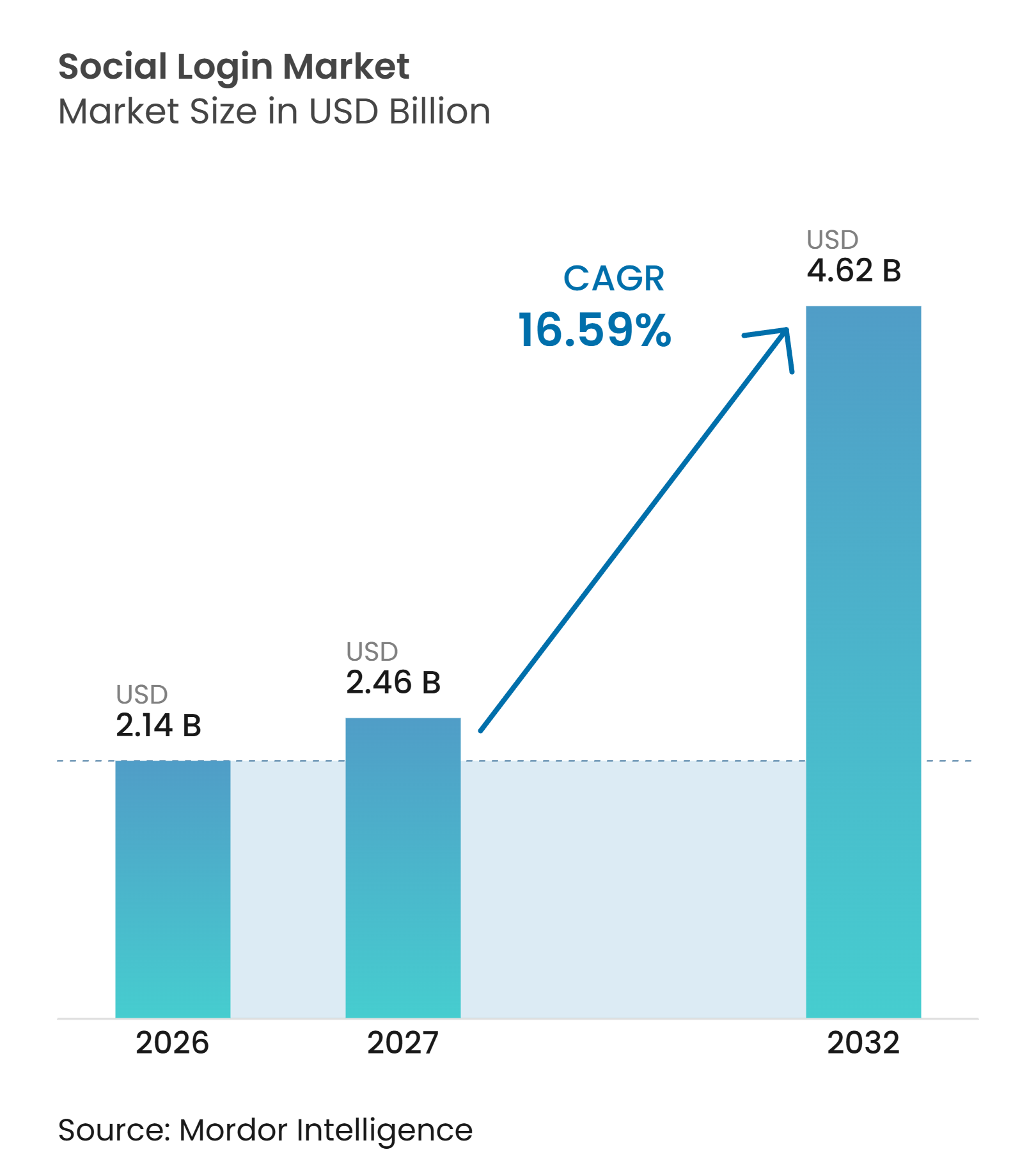
The Social Login Market size is valued at USD 2.14 billion in 2026 and is projected to reach USD 4.62 billion by 2032, expanding at a CAGR of 16.59% from 2027 to 2032. The social login market addresses the gap between password-based access and the quick sign-in experiences that users expect. It lets an application rely on an existing identity with providers such as Google, Apple, Meta, LINE, and WeChat instead of storing a separate password. This model can reduce the time required to register and can limit the credentials that an operator manages directly. The social login market is also moving toward managed customer identity and access management platforms that combine sign-in, consent, and security controls. Provider concentration and differing privacy rules remain important limits because they can increase engineering work for organizations operating across borders and affect provider choices in regulated markets worldwide.
Key Report Takeaways
- By authentication method, Social Media Authentication held 57.91% of the social login market share in 2026, while Passwordless and Passkey-Enabled Authentication is projected to expand at a 17.35% CAGR through 2032.
- By deployment mode, Cloud-Based Deployment accounted for 76.56% market share in 2026 and is projected to expand at a 17.64% CAGR through 2032.
- By industry vertical, E-Commerce and Retail accounted for 25.22% of the Social Login Market size in 2026, while Healthcare and Life Sciences is projected to expand at a 17.28% CAGR through 2032.
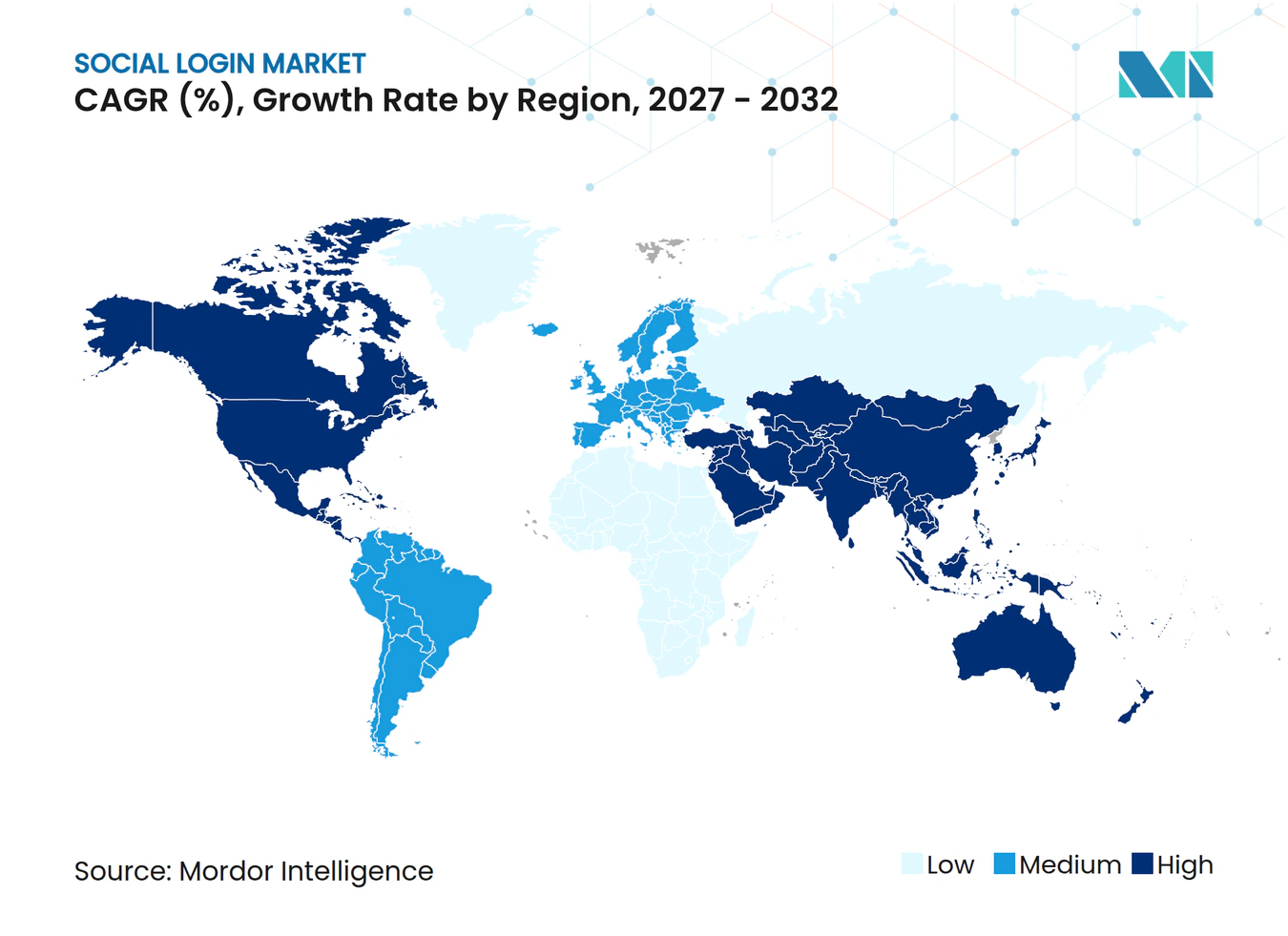
- By geography, North America held 38.48% market share in 2026, while Asia-Pacific is projected to expand at a 17.39% CAGR through 2032.
Note: Market numbers in this report are based on Mordor Intelligence's proprietary estimation framework, which combines nine months of actuals with Q4 projections for base year 2026.
Market Trends and Insights
Drivers Impact Analysis of Social Login Market*
| Driver | (~) % Impact on CAGR Forecast | Geographic Relevance | Impact Timeline |
|---|---|---|---|
| Frictionless Registration and Login Demand | +3.5% | Global, highest in North America and Western Europe | Short term (≤ 2 years) |
| E-Commerce and Mobile-First Journeys | +3.0% | Global, concentrated in Asia-Pacific and North America | Short term (≤ 2 years) |
| Cloud CIAM and API-First Identity Adoption | +2.8% | North America, Europe, Asia-Pacific core | Medium term (2-4 years) |
| Passwordless, MFA, and Adaptive Authentication Integration | +2.5% | North America, Europe, with spillover to Asia-Pacific | Medium term (2-4 years) |
| Regional Digital Platforms and Super-App Ecosystems | +2.0% | Asia-Pacific core, spillover to Middle East and Africa | Long term (≥ 4 years) |
| Consent-Based Identity Data for Conversion and Personalization | +1.5% | Global, early momentum in North America and Europe | Medium term (2-4 years) |
| Source: Mordor Intelligence | |||
Rising Demand for Frictionless Registration and Login
The social login market benefits when password recovery interrupts a purchase or account-access journey. FIDO Alliance research covering 11,000 consumers in 10 countries found that 47% were likely to abandon a purchase or sign-in when they could not remember a password.[1] A social credential can avoid that interruption when the user already has an active session with the identity provider. SocialPLUS reported that smartphones accounted for 97% of social login volume across the Japanese e-commerce platforms in its 2025 survey. This makes short forms and familiar identity choices particularly important on smaller screens. In the European Union, a platform that stores fewer independent credentials may also have a narrower data-handling burden under the GDPR data-minimization principle.
Expansion of E-Commerce and Mobile-First Journeys
The social login market is closely linked to e-commerce journeys where mandatory account creation can interrupt checkout. A faster sign-in can connect registration, account access, and purchase completion in one customer path. It can also provide an identity record that a retailer can use for consent-based personalization, subject to the permissions collected from the user. That capability becomes more relevant as retailers move away from anonymous cookie-based targeting. Mobile commerce and high social-platform use give this driver particular relevance in Asia-Pacific. The opportunity is strongest where a business can offer familiar local providers alongside global options without creating an overly complex sign-in screen.
Cloud-Based CIAM and API-First Identity Adoption
The social login market is supported by cloud customer identity and access management, which turns a provider connection into a managed API integration. Descope found that 37% of organizations had delayed product launches because of identity-related development work in 2025.[2] Pre-built authentication flows can help teams that do not have specialist identity engineers. Managed services can also handle provider changes to scopes, token lifetimes, and returned profile fields across their customer base. LoginRadius introduced Auth Studio in December 2025, describing a tool that creates branded authentication interfaces from a URL or design asset without developer involvement. These functions lower implementation work, but they also make vendor selection and contract controls more significant.
Growing Passwordless, MFA, and Adaptive Authentication Integration
The social login market increasingly serves as the initial layer in an adaptive authentication sequence rather than as a stand-alone control. The FIDO Alliance Passkey Index reported a 93% success rate for passkey sign-ins versus 78% for traditional multifactor authentication. The same research reported that average sign-in time fell from 31.2 seconds to 8.5 seconds and login-related help-desk incidents declined by 81%. Providers can offer a passkey upgrade after a user has entered through an established social identity flow. HYPR reported that 76% of organizations still relied on legacy passwords and 43% had deployed some form of passwordless authentication in 2026.[3] The remaining implementation gap leaves room for managed platforms that package passkeys with existing customer identity functions.
Restraints Impact Analysis of Social Login Market*
| Restraint | (~) % Impact on CAGR Forecast | Geographic Relevance | Impact Timeline |
|---|---|---|---|
| Privacy, Consent, and Cross-Border Data-Transfer Compliance Costs | -2.0% | EU, UK, India, China, Brazil, and California | Medium term (2-4 years) |
| Dependence on Social-Provider APIs and Policy Changes | -1.5% | Global | Short term (≤ 2 years) |
| Account Takeover, Token Theft, and OAuth Misconfiguration Exposure | -1.0% | Global, acute in North America and EU | Medium term (2-4 years) |
| Fragmented Provider Ecosystems and Identity Engineering Scarcity | -0.8% | Global, most severe in Middle East and Africa, South America | Long term (≥ 4 years) |
| Source: Mordor Intelligence | |||
Privacy, Consent, and Cross-Border Data-Transfer Compliance Costs
The social login market faces a persistent constraint where privacy rules require consent before an identity plug-in can load. Germany's TDDDG requires prior consent before social plug-ins may load tracking or authentication cookies. Organizations serving the European Union, India, and China must account for different consent structures and data-residency requirements. The European Commission's May 2025 proposal identified annual administrative cost reductions from simplified GDPR compliance measures. Compliance work also rises with the number of providers because each connection needs its own scope review, data-processing terms, and policy monitoring. This can make a multi-provider deployment more costly to operate than a single-provider configuration.
Dependence on Social-Provider APIs and Policy Changes
The social login market depends on providers that can change their policies, interfaces, and identity data fields without the application operator controlling the timetable. Apple, Google, and Meta can revise OAuth scopes, token lifetimes, and returned data, requiring downstream systems to adapt. Apple's use of masked email addresses in earlier product cycles changed the identity payload available to integrated applications. A provider shutdown or a discontinued configuration tool can also create immediate migration work for customers. Dependency becomes more pronounced when an application relies on only 1 or 2 providers for most of its sign-ins. The risk is amplified where a provider's commerce or advertising interests conflict with third-party operators seeking more identity data for personalization.
*Our forecasts treat driver/restraint impacts as directional, not additive. The impact forecasts reflect baseline growth, mix effects, and variable interactions.
Social Login Market Segment Analysis
By Authentication Method:
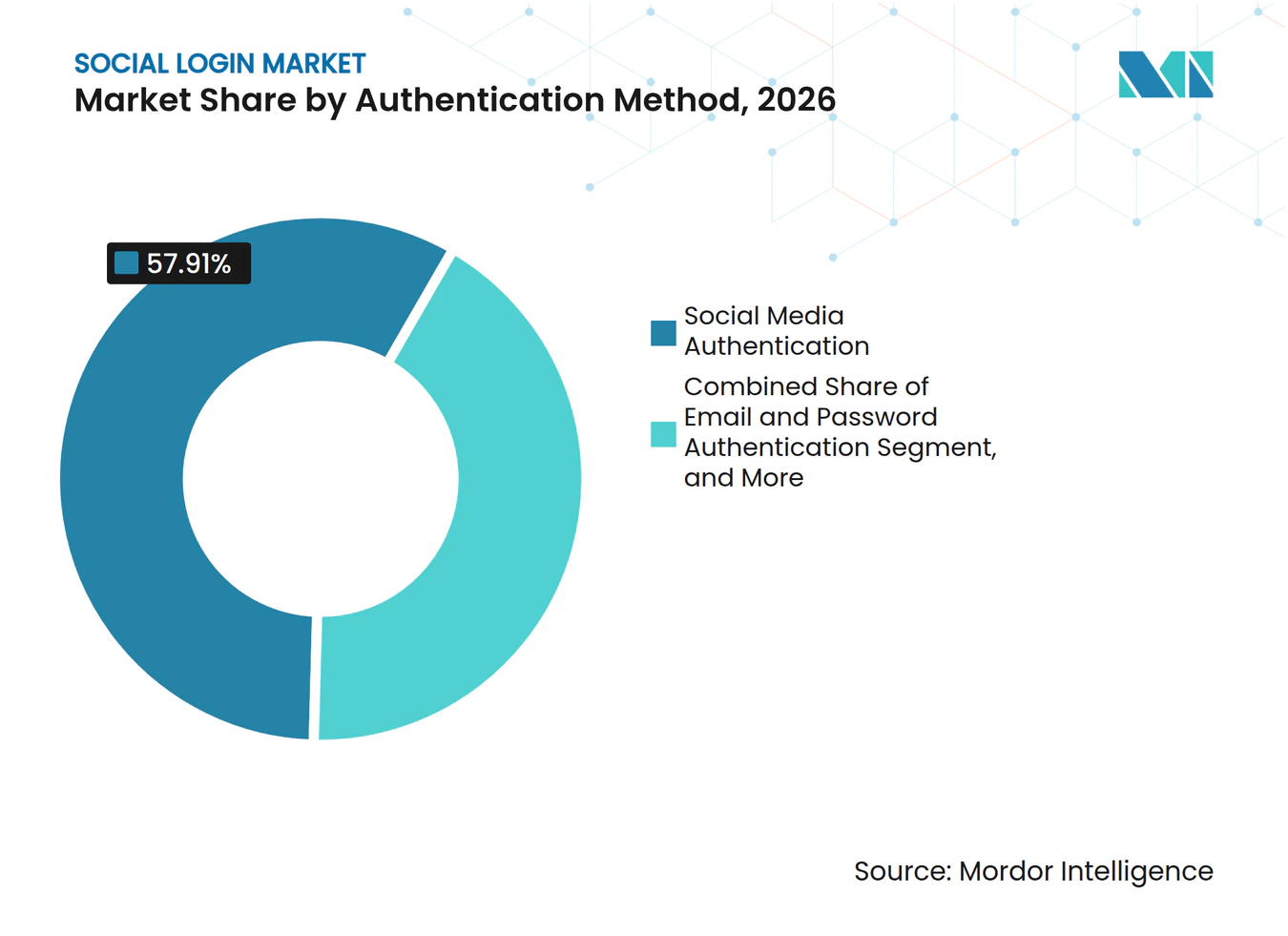
Social Media Authentication Leads While Passkeys AdvanceSocial Media Authentication held 57.91% of the social login market in 2026, reflecting consumer familiarity and the installed base of Google, Apple, Facebook, and LINE integrations. These providers give organizations access to identity choices that users already understand, while single sign-on is the second-largest segment because B2B software platforms often need federated access for external organizations. LoginRadius introduced Partner IAM in June 2025 to support organization-level SAML and OIDC federation for resellers, distributors, and software customers. Email and password authentication remains relevant in regulated settings with stringent data-residency requirements, while multifactor authentication is increasingly incorporated into social identity flows rather than managed separately.
Passwordless and Passkey-Enabled Authentication is projected to expand at a 17.35% CAGR through 2032. The segment is relevant to customer-facing applications because it can reduce the repeated credential entry that interrupts users who switch devices or revisit a service after a long interval. More than 240 organizations signed the FIDO Alliance Passkey Pledge to support passkeys, reduce password reliance, and share adoption practices. IETF RFC 9700 sets best current practice for OAuth 2.0 security, including stronger protection against phishing and token misuse. The social login industry can use managed passkey modules to reduce compatibility, recovery, and deployment barriers within existing identity contracts. FIDO Alliance data also showed a 93% sign-in success rate for passkeys compared with 63% across all other methods, supporting their use where failed sign-ins affect completed transactions. Organizations can retain social sign-in choices while introducing passkeys as a higher-assurance option for returning users.



By Deployment Mode:
Cloud Architecture Changes Identity DeliveryCloud-Based Deployment accounted for 76.56% of the social login market size in 2026 and is projected to expand at a 17.64% CAGR through 2032. Managed CIAM services can provide automatic software development kit updates, provider API maintenance, consent functions, and capacity during authentication peaks. Descope reported that 51% of organizations assigned customer identity work to developers with limited authentication experience in 2025, which helps explain the appeal of pre-built identity flows and API-based configuration. ISO/IEC 27001 certification and GDPR Article 28 processor terms are increasingly important in procurement decisions. Digital-native organizations can adopt these tools without maintaining their own on-premises identity infrastructure.
On-premises deployment retains a role in government, defense, and BFSI environments where data-sovereignty rules limit external credential routing. These organizations may prioritize direct control over infrastructure and user data even when implementation takes longer. Hybrid deployment is developing as a practical alternative for organizations that want cloud-based sign-in orchestration while retaining sensitive profiles on-premises. This approach combines provider connectivity with internal data controls, reflecting a social login market need that cannot be met by a single deployment model. It can also preserve existing internal records while the organization adds new authentication capabilities. Cloud providers that support hybrid controls may compete more effectively for regulated deployments.
By Industry Vertical:
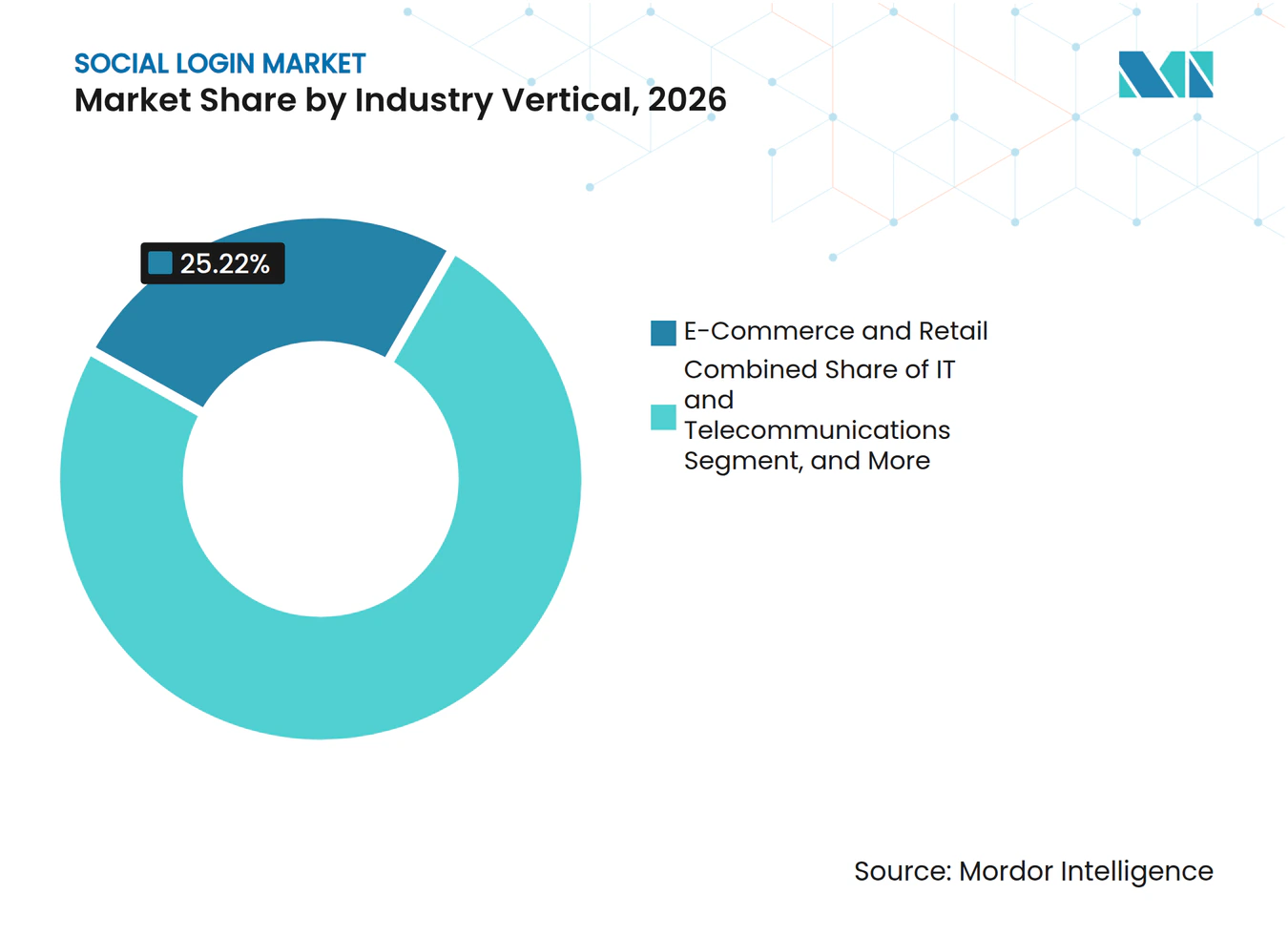
E-Commerce Anchors Demand While Healthcare AdvancesE-Commerce and Retail accounted for 25.22% of the social login market size in 2026. Retailers use familiar sign-in options to reduce interruption between browsing, account creation, and payment, treating authentication as part of checkout conversion rather than as an administrative feature. Media and entertainment platforms use social identity to link subscription access with social sharing and content recommendations. BFSI adoption is increasing, but Know Your Customer requirements often call for an added verification layer for high-value activity. Travel and hospitality providers use social login for loyalty access, where a linked identity can support booking-based personalization.
Healthcare and Life Sciences is projected to expand at a 17.28% CAGR through 2032. The vertical requires a clear record of who accessed a service, what consent was collected, and when stronger verification is required. A May 2026 JAMIA Open study described how federated Google and Facebook credentials could authenticate patients across institutions when used with cryptographic identity tokens and blockchain consent tracking. The proof of concept was validated at Cedars-Sinai Medical Center, the University of Colorado, and the University of California, San Francisco. HIPAA technical safeguards under 45 CFR 164.312 and interoperability requirements favor identity flows that can be audited and standardized. Social login can fit this need in a FHIR API architecture with appropriate consent and verification controls, though patient-facing services need stronger assurance and recovery processes. Its role is therefore likely to be part of a layered patient identity process rather than the only control.

Geography Analysis
North America Social Login Market
North America held 38.48% market share in 2026. The region benefits from enterprise investment in customer identity platforms, large digital commerce activity, and established compliance programs. The United States is the leading national market in the region. ID.me received a December 2025 contract from the Centers for Medicare and Medicaid Services to provide identity verification and federated sign-in for Medicare.gov. The service covers more than 80 million verified beneficiaries and reuses credentials active across federal and state agencies and private-sector organizations.
APAC Social Login Market
Asia-Pacific is projected to expand at a 17.39% CAGR through 2032. The region's super-app ecosystems connect messaging, payments, commerce, and public services through persistent identities. SocialPLUS found that LINE represented 88% of social login activity across 354 Japanese e-commerce and job-search platforms in 2025. That share was 2 percentage points higher than the prior year, and 97% of recorded authentications occurred on smartphones. A 2026 peer-reviewed review described WeChat as a de facto social identity layer for many mini-program applications that authenticate through WeChat login.
Europe and South America Social Login Market
Europe held a significant revenue share in 2026, led by Germany, the United Kingdom, and France. GDPR enforcement creates a need for consent processes that are separate from the user experience benefits of a quick sign-in. Germany's TDDDG has required opt-in consent before social plug-ins load since May 2024. This requirement supports CIAM platforms that integrate consent management with authentication flows, while South America is aligning with GDPR-style consent approaches through Brazil's LGPD. Its mobile-first consumer base and limited legacy banking access support the social login market as an onboarding option. Across these regions, provider selection must reflect both local consumer preferences and the data rules that apply to the service.
Competitive Landscape
Market Concentration
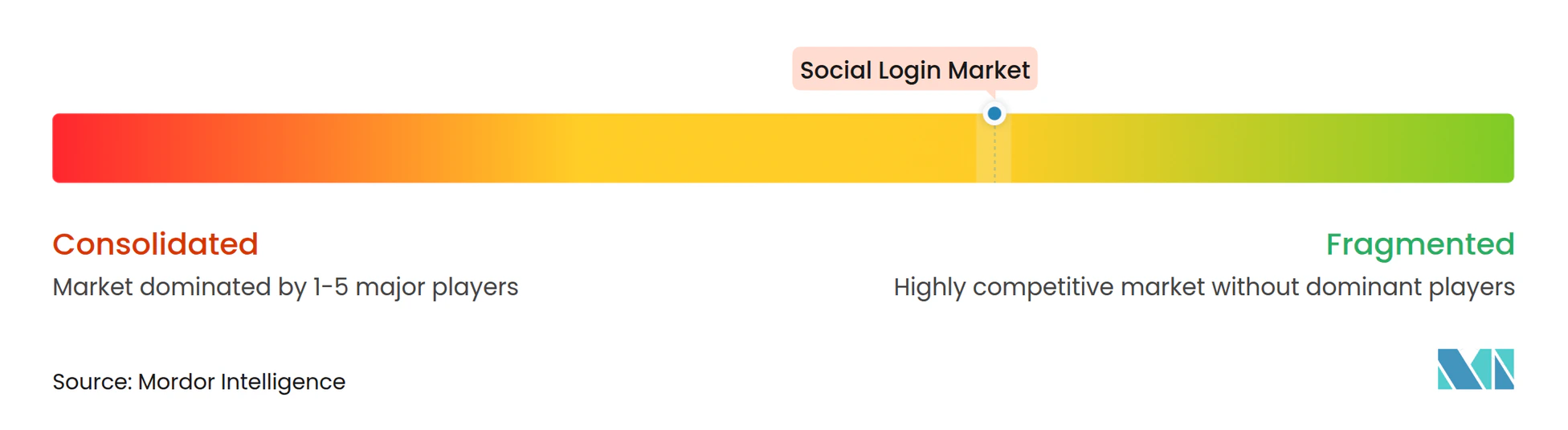
The social login market is moderately fragmented. Okta through Auth0, Ping Identity, and LoginRadius have significant enterprise deployments. Descope, FusionAuth, WSO2, and ZITADEL compete with developer-focused products that emphasize integration speed and ownership cost. The social login market includes cloud-managed and self-hosted options, giving buyers a choice between broad enterprise suites and more modular tools.
Twilio acquired Stytch in October 2025, bringing social login, passwordless, and OAuth functions into its wider communications platform. The transaction can strengthen an offering for startups and mid-market companies that prefer a bundled service. LoginRadius launched Auth Studio in December 2025, using AI-based brand replication to build branded authentication interfaces from a URL or design assets. LoginRadius also launched Partner IAM in June 2025 for external partner, reseller, distributor, and software customer access. These moves broaden the vendor's addressable identity use cases beyond direct consumer sign-in.
Opportunities remain among smaller organizations that need predictable identity costs as their user base expands. Self-hosted platforms such as FusionAuth and SuperTokens appeal to buyers that want more direct control of deployment economics. Healthcare, government, and financial services also present opportunities because they require specialized compliance attestations, including HIPAA Business Associate Agreements and FedRAMP authorization. Descope's visual flow builder and LoginRadius Auth Studio show how vendors are reducing the engineering work needed to change an authentication journey. The social login market will place more weight on adaptive orchestration, compliance automation, and governance as identity requirements become more complex.
Social Login Industry Leaders
-
Okta, Inc.
-
Ping Identity Holding Corp.
-
LoginRadius Inc.
-
One Identity LLC
-
FusionAuth, Inc.
- *Disclaimer: Major Players sorted in no particular order
Social Login Market Companies Covered in this Report
- Okta, Inc.
- Ping Identity Holding Corp.
- LoginRadius Inc.
- One Identity LLC
- ForgeRock, Inc.
- FusionAuth, Inc.
- miniOrange, Inc.
- SecureAuth Corporation
- WSO2 LLC
- Descope, Inc.
- Stytch, Inc.
- Frontegg Ltd.
- Authgear Pte. Ltd.
- SuperTokens, Inc.
- ZITADEL AG
- HYPR Corp.
- Transmit Security, Inc.
- Strivacity, Inc.
- Ubisecure, Inc.
- Nevis Security AG
- Curity AB
Recent Industry Developments in Social Login Market
- September 2026: Descope celebrated one year since the closing of a USD 35 million seed extension, bringing total funding to USD 88 million from Notable Capital, Lightspeed Venture Partners, and Dell Technologies Capital, with capital allocated to agentic identity R&D and regional expansion.
- June 2026: LoginRadius celebrated one year since the launch of Partner IAM, a B2B identity platform purpose-built to manage access for external partners, resellers, distributors, and SaaS customers via organization-level SSO, SAML, and OIDC federation, eliminating the need to adapt workforce IAM to B2B identity use cases.
- January 2026: CLEAR partnered with Ochsner Health to deploy secure identity verification for patient account recovery and creation within MyOchsner. More than 10,000 patients used the service to recover account access within weeks of the January 2026 launch, establishing early enterprise-scale validation of federated identity in hospital-system workflows.
- February 2026: Imprivata announced that Imprivata Patient Access is available in Epic Toolbox within the Identity Verification for MyChart category, streamlining patient identity management and reducing duplicate medical records across Epic-integrated healthcare workflows.
Global Social Login Market Report Scope
The Social Login Market refers to the ecosystem of technologies, platforms, and services that enable users to register for and access websites, mobile applications, digital platforms, and online services using existing credentials from third-party social media and digital identity providers such as Google, Facebook, Apple, LinkedIn, X (formerly Twitter), and other social networks.
The Social Login Market Report is Segmented by Authentication Method (Social Media Authentication, Single Sign-On (SSO), Multi-Factor Authentication (MFA), Email and Password Authentication, and Passwordless and Passkey-Enabled Authentication), Deployment Mode (Cloud-Based Deployment, On-Premises Deployment, and Hybrid Deployment), Industry Vertical (E-Commerce and Retail, Media and Entertainment, IT and Telecommunications, BFSI, Healthcare and Life Sciences, Travel and Hospitality, Education, and Other Industry Verticals), and Geography (North America [United States, Canada, and Mexico], South America [Brazil, Argentina, Chile, and Rest of South America], Europe [Germany, United Kingdom, France, Italy, Spain, Russia, and Rest of Europe], Asia-Pacific [China, Japan, India, South Korea, Australia, Singapore, Malaysia, and Rest of Asia-Pacific], Middle East [Saudi Arabia, United Arab Emirates, Turkey, Israel, and Rest of Middle East], and Africa [South Africa, Nigeria, Kenya, and Rest of Africa]). The Market Forecasts are Provided in Terms of Value (USD).
Segmentation Overview
| Social Media Authentication |
| Single Sign-On (SSO) |
| Multi-Factor Authentication (MFA) |
| Email and Password Authentication |
| Passwordless and Passkey-Enabled Authentication |
| Cloud-Based Deployment |
| On-Premises Deployment |
| Hybrid Deployment |
| E-Commerce and Retail |
| Media and Entertainment |
| IT and Telecommunications |
| BFSI |
| Healthcare and Life Sciences |
| Travel and Hospitality |
| Education |
| Other Industry Verticals |
| North America | United States |
| Canada | |
| Mexico | |
| South America | Brazil |
| Argentina | |
| Chile | |
| Rest of South America | |
| Europe | Germany |
| United Kingdom | |
| France | |
| Italy | |
| Spain | |
| Russia | |
| Rest of Europe | |
| Asia-Pacific | China |
| Japan | |
| India | |
| South Korea | |
| Australia | |
| Singapore | |
| Malaysia | |
| Rest of Asia-Pacific | |
| Middle East | Saudi Arabia |
| United Arab Emirates | |
| Turkey | |
| Israel | |
| Rest of Middle East | |
| Africa | South Africa |
| Nigeria | |
| Kenya | |
| Rest of Africa |
| By Authentication Method | Social Media Authentication | |
| Single Sign-On (SSO) | ||
| Multi-Factor Authentication (MFA) | ||
| Email and Password Authentication | ||
| Passwordless and Passkey-Enabled Authentication | ||
| By Deployment Mode | Cloud-Based Deployment | |
| On-Premises Deployment | ||
| Hybrid Deployment | ||
| By Industry Vertical | E-Commerce and Retail | |
| Media and Entertainment | ||
| IT and Telecommunications | ||
| BFSI | ||
| Healthcare and Life Sciences | ||
| Travel and Hospitality | ||
| Education | ||
| Other Industry Verticals | ||
| By Geography | North America | United States |
| Canada | ||
| Mexico | ||
| South America | Brazil | |
| Argentina | ||
| Chile | ||
| Rest of South America | ||
| Europe | Germany | |
| United Kingdom | ||
| France | ||
| Italy | ||
| Spain | ||
| Russia | ||
| Rest of Europe | ||
| Asia-Pacific | China | |
| Japan | ||
| India | ||
| South Korea | ||
| Australia | ||
| Singapore | ||
| Malaysia | ||
| Rest of Asia-Pacific | ||
| Middle East | Saudi Arabia | |
| United Arab Emirates | ||
| Turkey | ||
| Israel | ||
| Rest of Middle East | ||
| Africa | South Africa | |
| Nigeria | ||
| Kenya | ||
| Rest of Africa | ||
Key Questions Answered in the Report
What is the size of the Social Login Market?
The Social Login Market is valued at USD 2.14 billion in 2026 and is projected to reach USD 4.62 billion by 2032, growing at a CAGR of 16.59% during the forecast period. Growth is driven by rising demand for streamlined user access, managed identity solutions, and secure authentication mechanisms. The market continues to evolve as organizations prioritize seamless and reliable account access experiences.
What is driving adoption of social login?
Adoption is being fueled by increasing demand for frictionless registration experiences, growth in mobile commerce, expanding cloud CIAM deployment, and integration of passwordless authentication technologies. These capabilities help organizations unify authentication, consent management, and customer engagement within a single access journey while reducing integration complexity.
Which authentication method leads social login adoption?
Social Media Authentication dominated the market with a 57.91% share in 2026. Its leadership is supported by widespread integration with leading identity providers and strong user familiarity, enabling fast access to applications and services without requiring separate credentials.
Why are passkeys relevant to customer sign-in?
Passwordless and Passkey-Enabled Authentication is projected to grow at a CAGR of 17.35% through 2032. Passkeys enhance sign-in success rates, improve security, and reduce authentication friction. They work alongside established social identity methods to provide stronger authentication assurance and a better user experience.
Which deployment model is most widely used?
Cloud-Based Deployment held a 76.56% market share in 2026 and is expected to expand at a CAGR of 17.64% through 2032. Cloud deployments simplify identity management by handling API updates, consent management, scalability requirements, and system maintenance, making them the preferred deployment model for most organizations.
Which region is expanding fastest?
Asia-Pacific is projected to be the fastest-growing regional market, registering a CAGR of 17.39% through 2032. Growth is supported by widespread adoption of mobile-first authentication, expanding super-app ecosystems, and strong consumer engagement across digital commerce, payments, messaging, and online services.