
Smart Office Furnitue Market Size and Share
Market Overview
| Study Period | 2021 - 2031 |
|---|---|
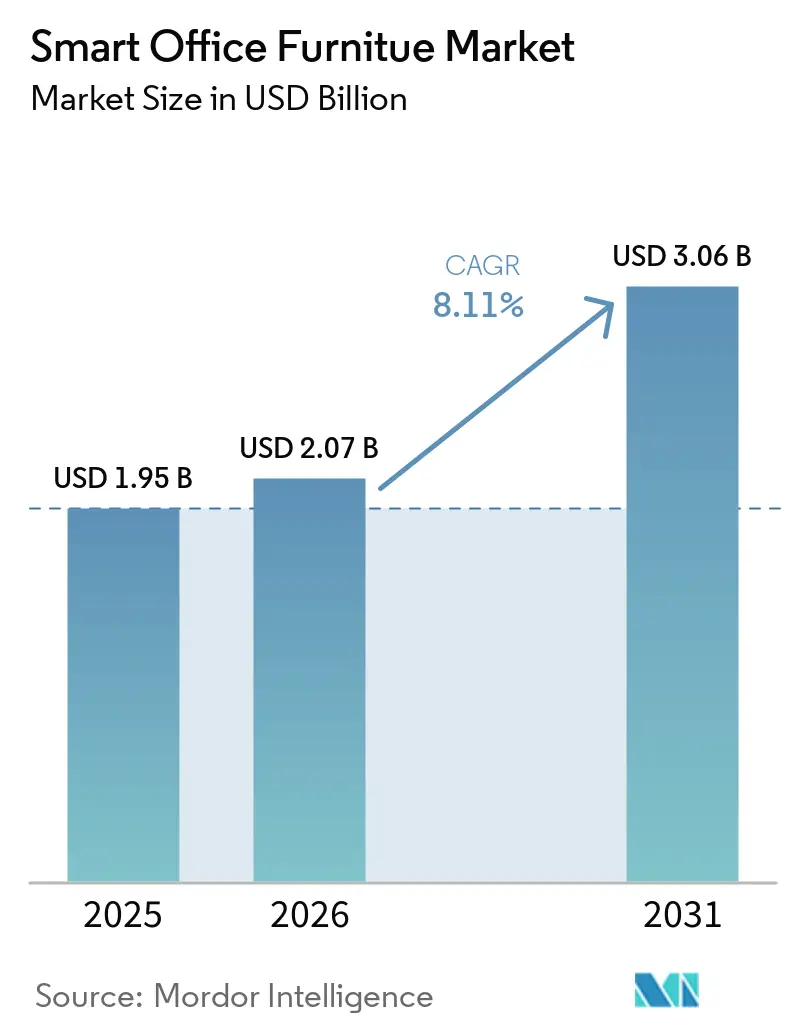
| Market Size (2026) | USD 2.07 Billion |
| Market Size (2031) | USD 3.06 Billion |
| Growth Rate (2026 - 2031) | 8.11 % |
| Fastest Growing Market | Asia-Pacific |
| Largest Market | North America |
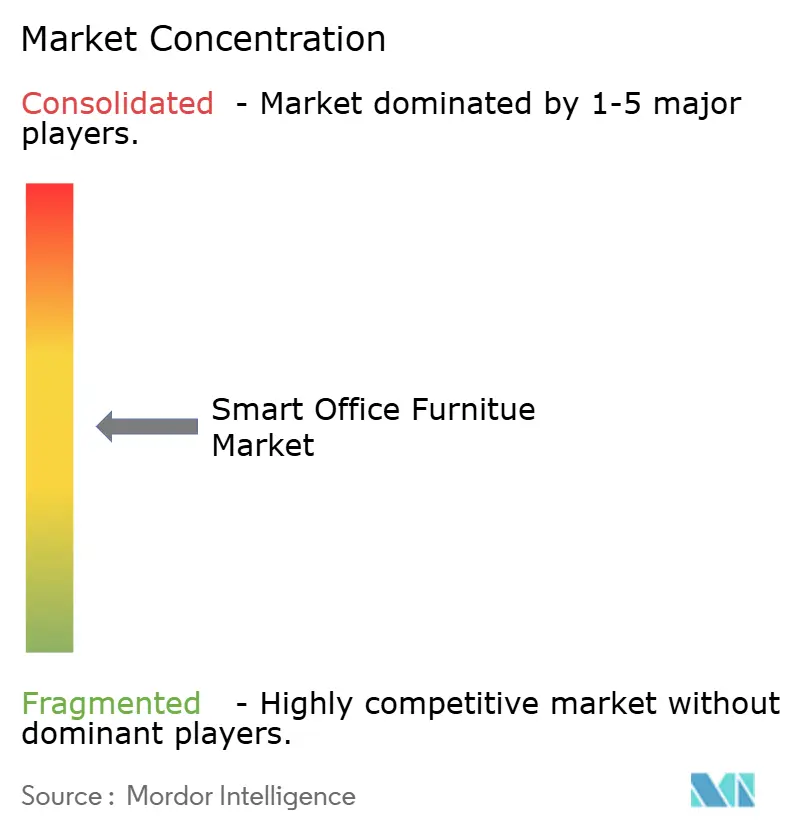
| Market Concentration | Medium |
Major Players *Disclaimer: Major Players sorted in no particular order Image © Mordor Intelligence. Reuse requires attribution under CC BY 4.0. | |
Smart Office Furnitue Market Analysis by Mordor Intelligence
The smart office furniture market size was valued at USD 1.95 billion in 2025 and is estimated to grow from USD 2.07 billion in 2026 to reach USD 3.06 billion by 2031, at a CAGR of 8.1% during the forecast period (2026-2031). Structured hybrid schedules are increasing the need for workstations that can support shared seating, reservation systems, and live occupancy information. Employers are also treating ergonomic design as part of health and safety management, especially where long desk-based shifts increase musculoskeletal risk. Connected furniture is moving closer to enterprise technology procurement because sensors and analytics can support space planning decisions. This shift gives vendors an opportunity to combine desks, software, maintenance, and analytics into a longer-term customer relationship. The smart office furniture market is consequently becoming more relevant to both facilities and technology teams. Cost, privacy rules, cybersecurity obligations, and electronic waste remain important limits on adoption, particularly for smaller organizations and regulated workplaces.
Key Report Takeaways
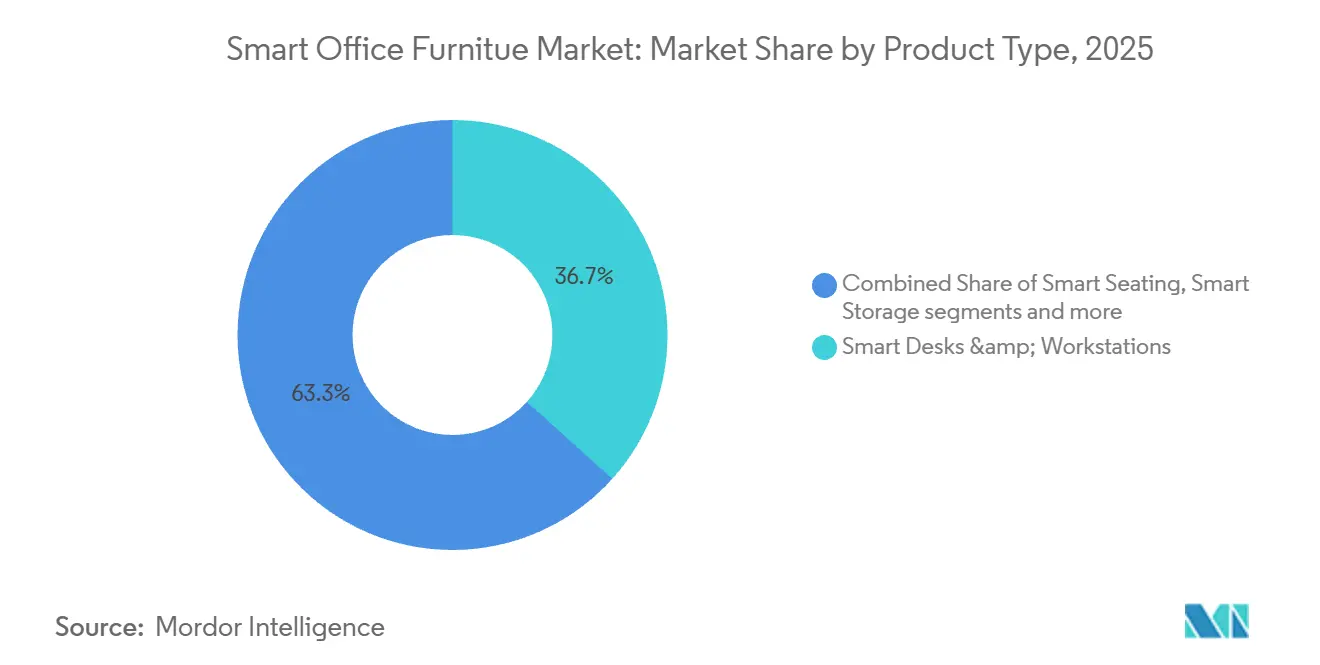
- By product type, smart desks and workstations held 36.7% of the smart office furniture revenue share in 2025 and are forecast to register a 9.1% CAGR through 2031.
- By end user, corporate offices held 61.3% of revenue in 2025, while healthcare offices are forecast to register an 8.9% CAGR through 2031.
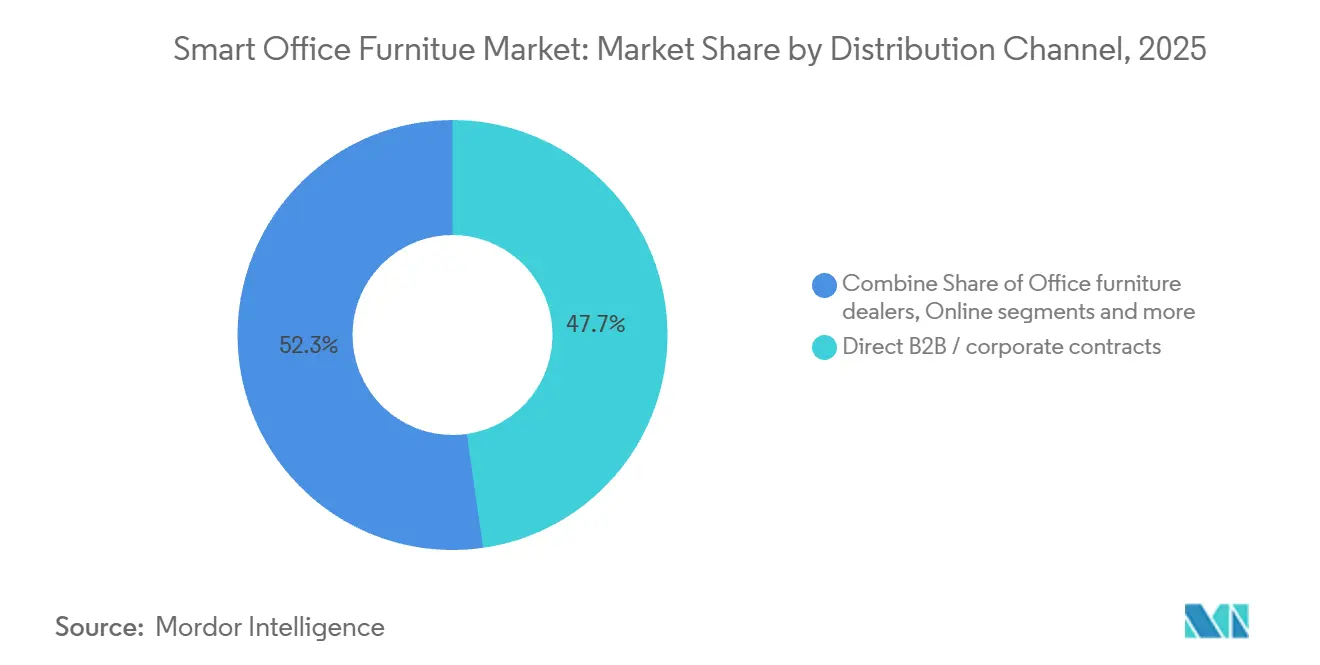
- By distribution channel, direct B2B and corporate contracts accounted for 47.7% of revenue in 2025, while online and e-commerce channels are forecast to register a 9.5% CAGR through 2031.
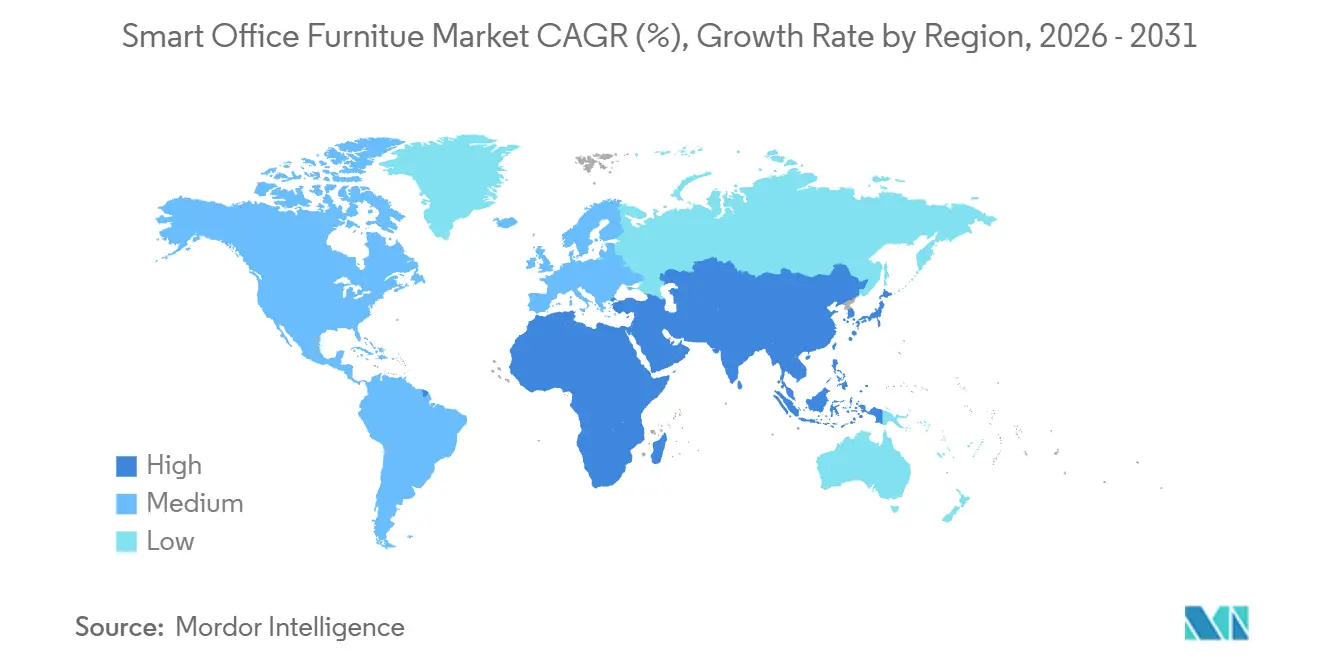
- By geography, North America held 35.8% of the smart office furniture revenue share in 2025, while Asia-Pacific is forecast to register a 9.3% CAGR through 2031.
Note: Market size and forecast figures in this report are generated using Mordor Intelligence’s proprietary estimation framework, updated with the latest available data and insights as of January 2026.
Global Smart Office Furnitue Market Trends and Insights
Drivers Impact Analysis*
| Driver | (~) % Impact on CAGR Forecast | Geographic Relevance | Impact Timeline |
|---|---|---|---|
| Hybrid Work and Activity-Based Workplace Adoption | +2.3% | Global, with concentration in North America, the United Kingdom, and Asia-Pacific gateway cities | Short term (≤ 2 years) |
| Ergonomic Wellness and Musculoskeletal Risk Reduction | +1.6% | Global, with stronger relevance in North America and Northern Europe | Medium term (2-4 years) |
| IoT, AI, and Workplace-Management Integration | +1.8% | Global, with higher deployment intensity in Asia-Pacific and North America | Medium term (2-4 years) |
| Interoperability Standards Reducing Ecosystem Friction | +0.6% | Global, especially North America and the European Union | Medium term (2-4 years) |
| Sensorized Storage and Smart-Locker Expansion | +0.5% | North America and the European Union, with spillover into Asia-Pacific core cities | Short term (≤ 2 years) |
| Furniture-as-a-Platform Revenue Models | +0.5% | North America and the European Union, with early traction in Japan and South Korea | Long term (≥ 4 years) |
| Source: Mordor Intelligence | |||
Hybrid Work and Activity-Based Workplace Adoption Structuring Demand
Structured hybrid work is changing both office utilization and the type of furniture that employers need. JLL reported that 62% of organizations required a fixed number of in-office days in 2026, compared with 49% in 2025, and that 55% of employees attended the office 3 to 4 days a week[1]JLL, “Structured Hybrid Work Becomes the Global Norm as Strategic Focus Shifts to AI-Readiness,” JLL Newsroom, jll.com. Its occupancy benchmark also stated that utilization data informed 90% of global space-planning decisions in 2026, up from 70% in 2025. This makes occupancy sensors, desk reservation links, and dwell-time data more useful to office planning teams. Phone booths, focus rooms, and smaller meeting rooms are appearing more often in corporate layouts, which broadens the need for availability information beyond the main workstation. U.S. Bureau of Labor Statistics data showed that 22.9% of employed people teleworked or worked from home in the first quarter of 2024, indicating that flexible work patterns remained material even as office attendance increased. The smart office furniture market can therefore benefit when employers need to allocate limited seats fairly and use space more efficiently. For suppliers, the commercial value lies in helping clients link a booking decision to the actual availability of a desk or room.
Demand for Ergonomic Wellness and Musculoskeletal Risk Reduction as a Compliance Driver
Ergonomic furniture is increasingly evaluated through workforce health, absence, and employer liability rather than employee comfort alone. The UK Health and Safety Executive recorded 511,000 workers with work-related musculoskeletal disorders in 2024/25, representing 7.1 million working days lost and 27% of all work-related ill health in Great Britain. Back disorders represented 43% of cases, while upper-limb and neck conditions represented 41%[2]Health and Safety Executive, “Work-Related Musculoskeletal Disorders Statistics in Great Britain, 2025,” Health and Safety Executive, hse.gov.uk. A 2025 systematic review of 24 randomized controlled trials involving 4,086 workers found that ergonomic interventions reduced lower-back pain risk, with an odds ratio of 0.53[3]Santos, J., et al., “Efficacy of Ergonomic Interventions on Work-Related Musculoskeletal Pain,” National Library of Medicine, pmc.ncbi.nlm.nih.gov. Height-adjustable desks and seating with posture-related functions can support this risk-management approach when they are correctly deployed. This creates a stronger case for connected desks in organizations that can fund wellness and compliance measures through formal capital budgets. The smart office furniture market is supported when health requirements are included in workplace investment decisions.
IoT, AI, and Workplace-Management Integration Redefining Furniture as an IT Endpoint
Connected furniture is increasingly being treated as a source of workplace data rather than only as a facilities purchase. ITOKI announced its AI management model in February 2026 and positioned office furniture as the data-collection layer within a broader office intelligence architecture. In June 2026, the company introduced ITOKI OFFICE DEVICES, a sensor system installed across a 2,700-square-meter headquarters floor that included 5 meeting rooms and 18 solo desks[4]ITOKI Corporation, “ITOKI Develops ITOKI OFFICE DEVICES to Optimize Office Operations Through Integration with AI Agents,” ITOKI Newsroom, itoki.jp. The system is intended to feed real-time usage information into AI agents and reservation systems. Logitech also expanded its Spot sensor integrations to 10 workplace management platforms in 2026, including Appspace, Extron, Q-SYS, Planon, and Zoom. These developments make furniture-level data part of wider building and workplace systems. Vendors that can work with information technology buyers may have access to larger procurement budgets than vendors that sell furniture alone. This gives the smart office furniture market a path into technology-led workplace projects.
Interoperability Standards Reducing Ecosystem Friction
Proprietary platforms have made it difficult for buyers to combine desks, sensors, and analytics from different suppliers. Adoption of Matter and Thread across connected-building products can reduce this difficulty by supporting more consistent device connectivity. Large offices can also use connectivity options such as LoRaWAN and NB-IoT where floor-wide sensor coverage is required. Better interoperability can allow companies to begin with smaller deployments rather than replacing an entire floor with a single vendor system. This matters for mid-sized buyers that need practical entry points and cannot commit to a large, closed ecosystem. It also moves competition toward data quality, software compatibility, and workplace analytics. The smart office furniture market may therefore see suppliers place more emphasis on platform functions than on the lift mechanism or sensor hardware alone. Buyers can then select physical products based on fit and ergonomics while retaining a consistent data environment.
Restraints Impact Analysis*
| Restraint | (~) % Impact on CAGR Forecast | Geographic Relevance | Impact Timeline |
|---|---|---|---|
| High Upfront Cost and Total Cost of Ownership | -1.4% | Global, with greater pressure on SMEs in South America, Southeast Asia, and Southern Europe | Medium term (2-4 years) |
| Data Privacy, Cybersecurity, and Employee-Surveillance Concerns | -0.7% | The European Union and North America | Medium term (2-4 years) |
| Fragmented Ecosystems and Vendor Lock-In | -0.5% | Global, with a greater impact on large multi-vendor campuses | . Medium term (2-4 years) |
| Short Product Life Cycles and Electronic-Waste Exposure | -0.4% | North America and the European Union | Long term (≥ 4 years) |
| Source: Mordor Intelligence | |||
High Upfront Cost and Total Cost of Ownership Limiting Broad Adoption
IoT-integrated desks can cost 3 to 5 times more than conventional office furniture. The total ownership cost also includes software subscriptions, firmware maintenance, sensor battery replacement, and hardware refreshes as product generations change. Larger enterprises may absorb these costs through real-estate efficiency programs that seek savings from shared desks, smaller footprints, or better seat allocation. Small and medium-sized enterprises often have a less certain payback case and may not have dedicated facilities technology teams. Furniture-as-a-Platform models can address this constraint by bundling hardware, software, and maintenance into monthly per-seat fees. This model changes the purchase from a large capital expense into a recurring operating cost and could open the smart office furniture market to smaller buyers during the forecast period. It also allows a vendor to support maintenance and product updates throughout the customer relationship.
Data Privacy, Cybersecurity, and Employee-Surveillance Concerns Introducing Compliance Complexity
Smart furniture can record when a desk is occupied, how long it is used, which badge holder uses it, and the preferred height setting. The EU Data Act became applicable on September 12, 2025, and includes data generated by connected products and related services. The General Data Protection Regulation and the EU Cyber Resilience Act add further obligations for organizations using connected devices in European workplaces. California privacy rules create related considerations for companies operating in that state. Works councils in unionized workplaces in Germany, France, and Scandinavia can delay deployments where employees view the technology as a surveillance tool. Vendors need clear data controls, restricted access, and aggregated reporting options if they want the smart office furniture market to grow in highly regulated workplaces. Buyers also need a clear explanation of which information is collected and how it will be used.
*Our forecasts treat driver/restraint impacts as directional, not additive. The impact forecasts reflect baseline growth, mix effects, and variable interactions.
Segment Analysis
By Product Type: Smart Desks Lead, While Storage and Seating Gain Strategic Relevance
Smart desks and workstations held 36.7% of the smart office furniture revenue share in 2025 and are projected to grow at a 9.1% CAGR through 2031. Their position reflects the combination of adjustable ergonomics and live workspace information in one product. Height-adjustable desks with occupancy sensors and IoT connectivity are increasingly specified in large corporate refurbishment programs, especially in North America and Northern Europe. A 2025 study projected that years lived with disability linked to occupational ergonomic factors could exceed 15 million person-years by 2037 if workstation design gaps persist. This supports the role of workstation design in employer health strategies. BIFMA guidelines and EN 527 desk specifications are also becoming more relevant in European procurement discussions.
Smart storage, particularly sensorized lockers, is becoming more useful as employees lose permanent desk assignments. Smart seating is also developing through posture sensors and real-time analytics, as reflected in ITOKI’s office-device concept. Smart tables and collaborative furniture serve meeting zones where organizations want more information on room use. Other products include smart reception units, privacy pods, and modular lounge systems that are starting to enter commercial specifications. These categories broaden the connected-furniture offer beyond the primary workstation. The stronger growth outlook for desks shows that the core workstation remains the main point where ergonomic value and occupancy intelligence meet. This focus gives the smart office furniture market a defined starting point even as product boundaries widen.



By End User: Corporate Offices Underpin Volume, While Healthcare Supports the Premium Tier
Corporate offices commanded 61.3% of the smart office furniture market size in 2025. Their lead comes from enterprise purchasing budgets, high desk density, and demand for occupancy information that supports real-estate decisions. Multinational organizations that are consolidating office space can reduce seat counts while increasing the data available for each remaining seat. Educational institutions are adopting connected furniture at a measured pace, mainly in graduate and professional settings with flexible room requirements. Government and public offices are a slower-moving but potentially large opportunity as sustainability requirements and return-to-office policies influence new facilities. Hospitality and retail back-office adoption remains early-stage, although shared workspace hubs are creating some demand.
Healthcare offices are forecast to grow at an 8.9% CAGR through 2031, making them the fastest-growing end-user category. Administrative healthcare teams, medical billing groups, and care-coordination staff often work long shifts in settings where ergonomic injury risk is high. Apollo Hospitals announced INR 1,625 crore in expansion across Mumbai and Lucknow in November 2024, targeting more than 3,500 beds across 11 sites by fiscal year 2026. This expansion represents investment in facilities that will need suitable furnishing for clinical-support functions. UL 962 and ANSI/BIFMA G1 requirements can further shape healthcare purchasing decisions for adjustable desks and seating.
By Distribution Channel: Direct B2B Holds Volume, While E-Commerce Expands Access
Direct B2B and corporate contracts accounted for 47.7% of the smart office furniture market size in 2025. Large projects often involve workplace consultants, architects, and systems integrators, which makes a direct sales model useful for complex specifications. Furniture brands maintain dedicated account teams for enterprise customers that require planning, installation, and post-sale support. Dealers and distributors serve mid-market buyers that may not have internal resources to manage a direct procurement process. Workplace solution providers and systems integrators are gaining relevance as connected furniture becomes part of larger IoT deployments. Their offer can combine furniture, cabling, software, and data infrastructure instead of only supplying physical products.
Online and e-commerce channels are forecast to grow at a 9.5% CAGR through 2031. Amazon Business reported USD 60 billion in annualized gross sales in the second quarter of 2026 and identified office furniture as a category with expanding selection. Guided buying and digital procurement tools can make it easier for smaller companies to purchase components without a dedicated buying team. The channel may place pressure on specialist retailers that depend on traditional sales margins. It also gives the smart office furniture market a wider route to smaller organizations. Those retailers remain relevant where buyers need in-person ergonomic trials or installation support. The shift toward B2B portals indicates that the smart office furniture industry is likely to use both digital and consultative channels rather than move entirely to one model.
Geography Analysis
North America held 35.8% of the smart office furniture revenue share in 2025. The United States is supporting demand through structured return-to-office policies and stronger corporate spending on workplace transformation. One-third of organizations are targeting desk-sharing ratios above 1.5 employees per seat, which increases the need for hot-desking systems and occupancy information. CBRE Canada follows a similar path, with sustainability requirements playing a greater role in buying decisions. Mexico remains at an earlier stage, with activity centered on multinational manufacturing campuses and major commercial districts. Healthcare expansion in the United States provides an additional source of demand for ergonomic furniture used by clinical-support staff. This gives the smart office furniture market a demand base beyond corporate office refurbishment.
Europe is the second-largest region and is shaped more by regulation than by raw volume. Denmark, Sweden, Finland, Norway, and Iceland are advanced adopters because ergonomic standards, circular economy commitments, and energy efficiency concerns have long supported higher-quality office specifications. German works-council consent requirements can slow the use of employee-monitoring tools, but they also create demand for anonymized and aggregate analytics. The EU Data Act and Cyber Resilience Act increase procurement work for connected furniture buyers. They can also help vendors that demonstrate strong compliance practices. In Europe, the smart office furniture market must balance data use with labor and privacy expectations. Brazil leads demand in South America, while Chile, Peru, and Argentina remain at an early stage of adoption.
Asia-Pacific is projected to expand at a 9.3% CAGR through 2031, the highest regional rate in the smart office furniture market. China’s commitments to peak emissions by 2030 and reach carbon neutrality by 2060 are supporting building automation requirements in major commercial projects. ITOKI’s 2026 actions show how Japanese manufacturers are linking furniture sensors to AI agents and reservation systems. India’s Smart Cities Mission Phase 2 and commercial construction in Bengaluru, Hyderabad, and Mumbai are creating new office supply that can include connected infrastructure from the start. The Middle East and Africa are supported by activity in the United Arab Emirates and Saudi Arabia. Government and commercial tower projects in these countries are increasing demand for intelligent workplace fitouts. The smart office furniture market is relevant when these projects include connected workplace requirements. The smart office furniture market can benefit where these projects include monitoring, booking, and energy-management systems from the design stage.

Competitive Landscape
The smart office furniture market is moderately fragmented at the furniture-brand level, while component and platform layers are more concentrated. MillerKnoll is a major scale participant and generated USD 3.7 billion in net sales in fiscal year 2025. It competes across ergonomic seating, desks, and integrated workspace systems. Its 2026 product activity also placed circular design at the center of its commercial message. Humanscale expanded into lounge and collaborative settings with Diffrient Lounge and TexMesh. These moves reflect a wider effort to serve workers across more parts of the office rather than only at their desks. The smart office furniture market is therefore extending into lounge, focus, and collaborative areas.
LINAK, JIECANG Group, and LOGICDATA provide actuators and electronic control systems used by multiple furniture brands. Their role creates a business-to-business-to-business structure in which actuator reliability and software development tools influence how deeply brands can integrate their products into workplace platforms. Smaller suppliers such as ITOKI, Vecos Europe, and Godrej Interio can compete effectively in their home regions by combining local knowledge with connected product designs. ITOKI’s office-device launch is a clear example of a furniture supplier moving toward a workplace intelligence offer. Vecos Europe remains relevant in smart lockers, while Godrej Interio has a local position in India. Companies without open standards compatibility may find it harder to win enterprise requests for proposals that require multi-platform support.
Circular services and analytics for mid-market buyers are important areas of competition. Some customers can afford connected hardware but do not have internal staff who can turn occupancy data into practical decisions. Suppliers that provide easy reporting and ongoing support can address this gap. The smart office furniture market can serve these buyers without requiring internal data specialists. Repair, refurbishment, and resale services can also reduce concerns about devices that reach the end of software support. Humanscale launched its Re-Freshed program in 2024 to collect, refurbish, and resell used products. MillerKnoll’s Knoll brand introduced the Konzert private office system in May 2026 and designed it for modular adaptation over time. The smart office furniture market remains open to suppliers that can combine sound physical design with software compatibility and service support. This is particularly relevant for customers replacing early connected furniture that no longer receives effective software support.
Smart Office Furnitue Industry Leaders
Steelcase Inc.
MillerKnoll, Inc.
Haworth, Inc.
HNI Corporation
Okamura Corporation
- *Disclaimer: Major Players sorted in no particular order

Recent Industry Developments
- June 2026: ITOKI Corporation announced ITOKI Office Devices on June 11, 2026. The furniture-embedded sensor solution captures usage data and connects it with the ITOKI Office AI Agents platform. The prototype covers a 2,700-square-meter headquarters floor with 5 meeting rooms and 18 solo desks, and commercial deployment is planned by the end of 2026.
- June 2026: Herman Miller introduced a redesigned Aeron Chair with generative-design aluminum bases, new color options, and recycled and bio-based nylon content. The company reported a 12% reduction in global average embodied carbon and stated that its material work had diverted more than 660 metric tons of plastic from landfill since 2021.
- May 2026: Knoll debuted the Konzert private office system at Clerkenwell Design Week. The system was designed by Paolo Dell’Elce for modular adaptability and long-term flexibility.
- April 2026: Knoll introduced collaborative and private office furniture programs at Salone del Mobile in Milan, reinforcing MillerKnoll’s design-led positioning in Europe


Global Smart Office Furnitue Market Report Scope
| Smart Desks & Workstations |
| Smart Tables & Collaborative Furniture |
| Smart Seating |
| Smart Storage |
| Smart Tables |
| Other Smart Office Furniture |
| Corporate Offices |
| Healthcare Offices |
| Educational Institutions |
| Government and Public Offices |
| Hospitality and Retail Back-office |
| Other End Users |
| Direct B2B / corporate contracts |
| Office furniture dealers/distributors |
| Workplace solution providers / system integrators |
| Online / e-commerce |
| Specialty smart-furniture retailers |
| Other channels |
| North America | Canada |
| United States | |
| Mexico | |
| South America | Brazil |
| Peru | |
| Chile | |
| Argentina | |
| Rest of South America | |
| Europe | United Kingdom |
| Germany | |
| France | |
| Spain | |
| Italy | |
| BENELUX (Belgium, Netherlands, and Luxembourg) | |
| NORDICS (Denmark, Finland, Iceland, Norway, and Sweden) | |
| Rest of Europe | |
| Asia-Pacific | India |
| China | |
| Japan | |
| Australia | |
| South Korea | |
| South East Asia (Singapore, Malaysia, Thailand, Indonesia, Vietnam, and the Philippines) | |
| Rest of Asia-Pacific | |
| Middle East and Africa | United Arab Emirates |
| Saudi Arabia | |
| South Africa | |
| Nigeria | |
| Rest of the Middle East and Africa |
| By Product Type | Smart Desks & Workstations | |
| Smart Tables & Collaborative Furniture | ||
| Smart Seating | ||
| Smart Storage | ||
| Smart Tables | ||
| Other Smart Office Furniture | ||
| By End User | Corporate Offices | |
| Healthcare Offices | ||
| Educational Institutions | ||
| Government and Public Offices | ||
| Hospitality and Retail Back-office | ||
| Other End Users | ||
| By Distribution Channel | Direct B2B / corporate contracts | |
| Office furniture dealers/distributors | ||
| Workplace solution providers / system integrators | ||
| Online / e-commerce | ||
| Specialty smart-furniture retailers | ||
| Other channels | ||
| By Geography | North America | Canada |
| United States | ||
| Mexico | ||
| South America | Brazil | |
| Peru | ||
| Chile | ||
| Argentina | ||
| Rest of South America | ||
| Europe | United Kingdom | |
| Germany | ||
| France | ||
| Spain | ||
| Italy | ||
| BENELUX (Belgium, Netherlands, and Luxembourg) | ||
| NORDICS (Denmark, Finland, Iceland, Norway, and Sweden) | ||
| Rest of Europe | ||
| Asia-Pacific | India | |
| China | ||
| Japan | ||
| Australia | ||
| South Korea | ||
| South East Asia (Singapore, Malaysia, Thailand, Indonesia, Vietnam, and the Philippines) | ||
| Rest of Asia-Pacific | ||
| Middle East and Africa | United Arab Emirates | |
| Saudi Arabia | ||
| South Africa | ||
| Nigeria | ||
| Rest of the Middle East and Africa | ||


Key Questions Answered in the Report
What is driving demand for smart office furniture?
Structured hybrid work, shared seating, ergonomic requirements, and the need for occupancy data are the main demand factors.
How large is the smart office furniture market?
The smart office furniture market is estimated at USD 2.07 billion in 2026 and is forecast to reach USD 3.06 billion by 2031 at an 8.1% CAGR.
Which product category leads smart office furniture sales?
Smart desks and workstations led with 36.7% revenue share in 2025 and are forecast to grow at a 9.1% CAGR through 2031.
Which end user is expanding fastest?
Healthcare offices are forecast to grow at an 8.9% CAGR through 2031, supported by ergonomic needs among administrative and clinical-support staff.
Page last updated on:


 Your data is secure and never sold or shared.


