
Skimmed Milk Market Size and Share
Market Overview
| Study Period | 2022 - 2032 |
|---|---|
| Market Size (2027) | USD 44.33 Billion |
| Market Size (2032) | USD 50.49 Billion |
| Fastest Growing Market | Middle East and Africa |
| Largest Market | Asia-Pacific |
| Market Concentration | Low |
Major Players *Disclaimer: Major Players sorted in no particular order Image © Mordor Intelligence. Reuse requires attribution under CC BY 4.0. | |
Skimmed Milk Market Analysis by Mordor Intelligence
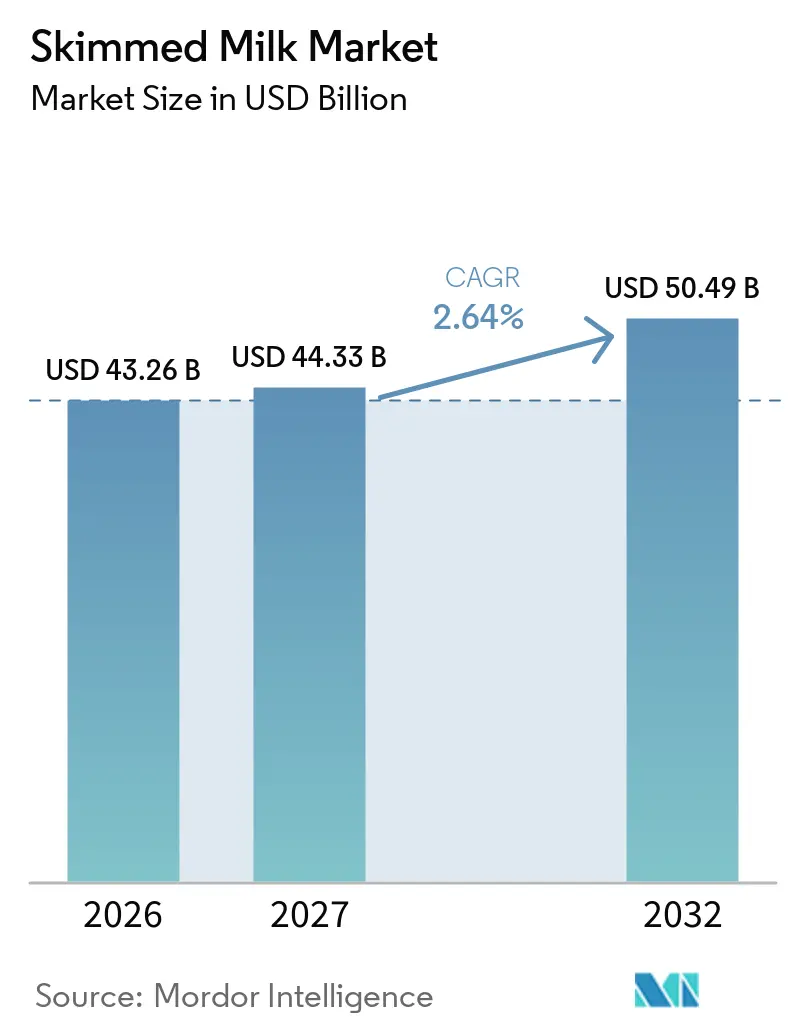
The global skimmed milk market size is expected to grow from USD 43.26 billion in 2026 to USD 44.33 billion in 2027 and is forecast to reach USD 50.49 billion by 2032 at a 2.64% CAGR over 2027-2032. The global skimmed milk market is driven by growing consumer preference for low-fat and high-protein dairy products, supported by increasing awareness of balanced nutrition and dietary fat management. The expanding use of skimmed milk and skimmed milk powder in fortified beverages, functional dairy products, yogurt, bakery items, confectionery, and specialized nutritional formulations is generating additional demand from food manufacturers. The development of lactose-reduced and nutritionally enhanced dairy products is also encouraging product diversification to meet varied dietary requirements. Technological advancements in milk separation, filtration, pasteurization, and drying processes are improving product quality, processing efficiency, and consistency, supporting broader industrial applications. Rising demand from foodservice operators, hotels, restaurants, catering companies, and institutional buyers is further contributing to market growth, as skimmed milk serves as a versatile ingredient in beverages, cooking, and large-scale food preparation.
Key Report Takeaways
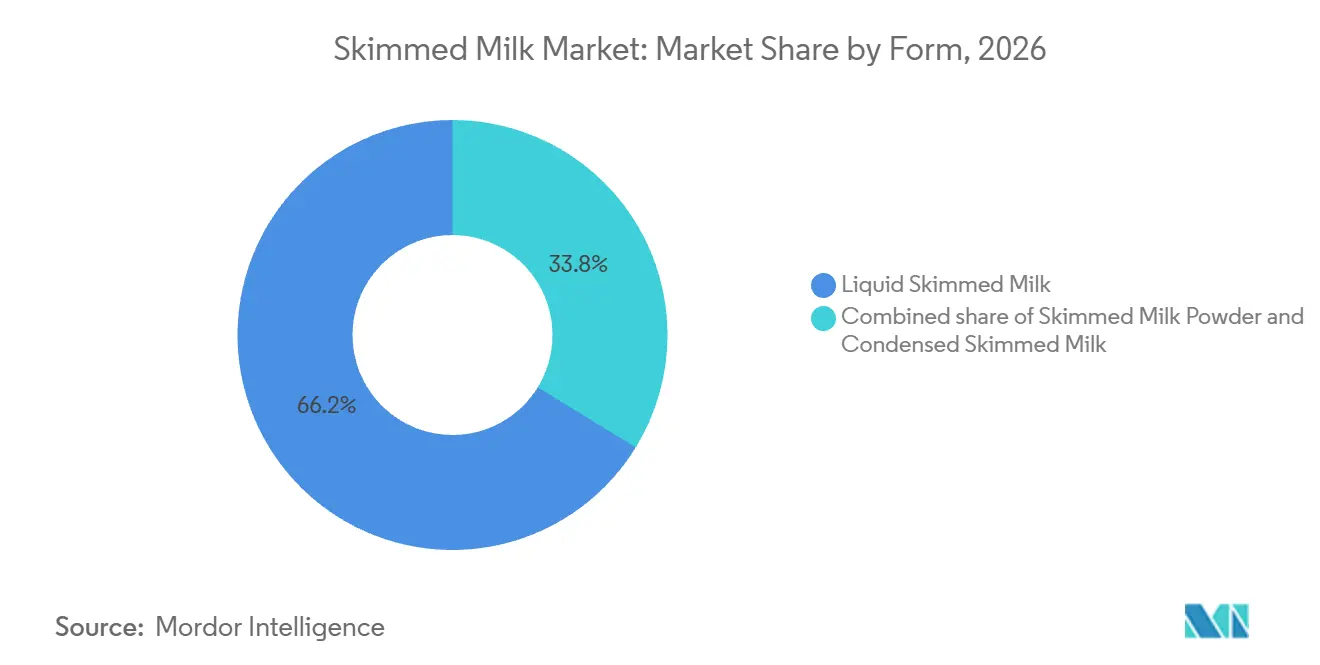
- By form, liquid skimmed milk held 66.24% of the skimmed milk market share in 2026, while condensed skimmed milk is forecast to grow at a 4.23% CAGR from 2027 to 2032.
- By source, cow milk held 81.02% of the skimmed milk market share in 2026, while buffalo milk is forecast to grow at a 3.75% CAGR from 2027 to 2032.
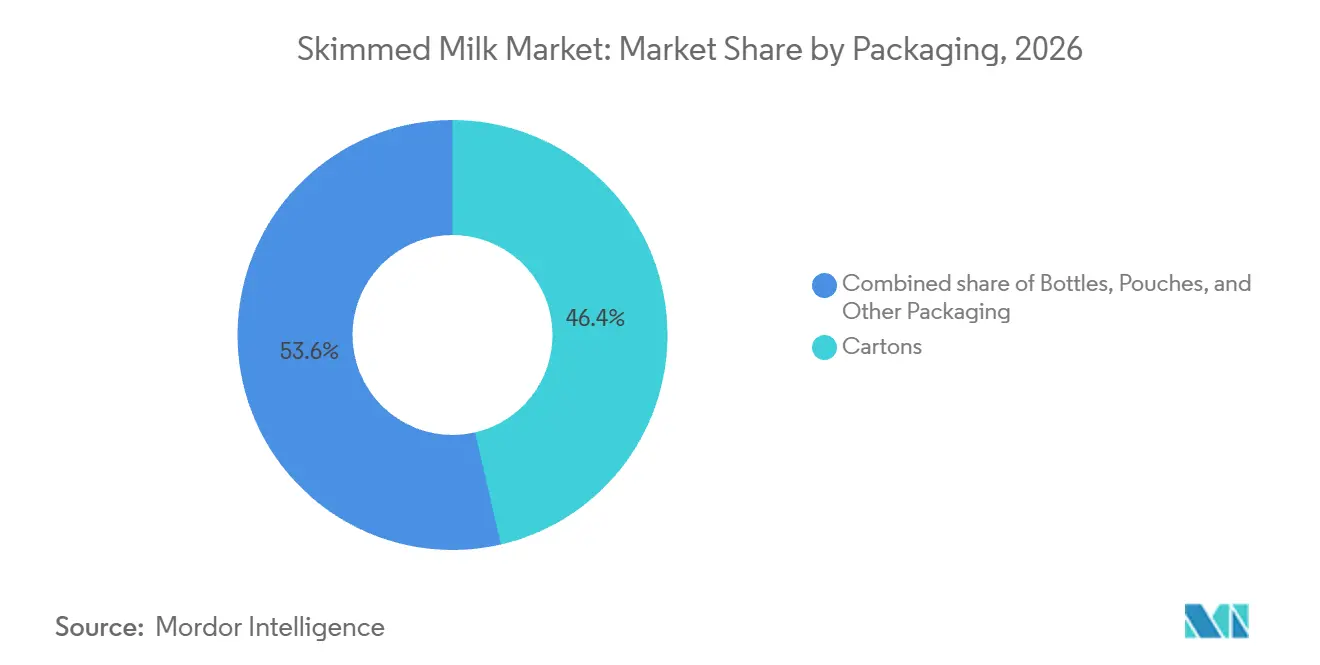
- By packaging, cartons held 46.38% of the market in 2026, while pouches are forecast to grow at a 4.33% CAGR from 2027 to 2032.
- By end use, B2B held 63.13% of the market in 2026, while B2C is forecast to grow at a 4.65% CAGR from 2027 to 2032.
- By geography, Asia-Pacific held 42.44% of the market in 2026, while the Middle East and Africa is forecast to grow at a 3.87% CAGR from 2027 to 2032.
Note: Market numbers in this report are based on Mordor Intelligence's proprietary estimation framework, which combines nine months of actuals with Q4 projections for base year 2026.
Market Trends and Insights
Drivers Impact Analysis of Skimmed Milk Market of Skimmed Milk Market*
| Driver | (~) % Impact on CAGR Forecast | Geographic Relevance | Impact Timeline |
|---|---|---|---|
| Growing consumer preference for low-fat and high-protein dairy products | +0.6% | Global, strongest in North America, Europe, and urban Asia-Pacific | Medium term (2-4 years) |
| Expansion of fortified and functional dairy applications | +0.5% | Global, with high-growth pockets in the Middle East and Africa and South Asia | Medium term (2-4 years) |
| Rising health and nutritional awareness | +0.4% | Global, particularly Asia-Pacific with spillover to the Middle East and Africa | Medium term (2-4 years) |
| Growth in lactose-reduced and fortified dairy product offerings | +0.4% | North America and Europe, with emerging presence in Mexico, India, and Brazil | Long term (≥ 4 years) |
| Technological advancements in dairy processing | +0.3% | Global, concentrated in Europe, New Zealand, and the United States | Long term (≥ 4 years) |
| Growing demand from foodservice and institutional buyers | +0.5% | Global, including the GCC, China, Japan, South Korea, and North America | Short term (≤ 2 years) |
| Source: Mordor Intelligence | |||
Growing Consumer Preference for Low-Fat and High-Protein Dairy Products
Increasing consumer preference for nutritious, protein-rich foods with reduced fat content is supporting the growth of the global skimmed milk market. Consumers are paying closer attention to the nutritional composition of dairy products, particularly protein content and fat levels, as they seek healthier options for their daily diets. According to the 2026 IFIC Food & Health Survey, 28% of Americans reported trying to prioritize protein at every meal [1]. According to the same survey, 33% identified being a good source of protein as a criterion for defining a healthy food [2]. These findings highlight the growing importance of protein content in food selection and create opportunities for skimmed milk, which provides milk protein and essential nutrients while containing substantially less fat than whole milk. Dairy manufacturers are responding to these preferences by expanding their low-fat product portfolios with offerings that cater to health-conscious consumers. For instance, in January 2024, the Gujarat Cooperative Milk Marketing Federation (GCMMF), which markets dairy products under the Amul brand, introduced Sagar Skimmed Milk across India as a fat-free dairy option. Its availability in multiple pack sizes, including larger formats suitable for hotels, restaurants, and caterers, supports consumption beyond household settings. Such product introductions, combined with increasing demand for protein-rich nutrition, are strengthening the relevance of skimmed milk across retail, foodservice, and institutional channels. Health-oriented purchasing preferences, demand for protein-rich foods, and the expansion of low-fat dairy offerings are expected to collectively support the global skimmed milk market.
Expansion of Fortified and Functional Dairy Applications
The growing use of skimmed milk in fortified and functional dairy products is creating new opportunities in the global skimmed milk market. Food manufacturers are increasingly developing dairy products that offer targeted nutritional benefits, such as enhanced protein content, added vitamins and minerals, and improved nutritional composition, to meet evolving consumer preferences. Skimmed milk and skimmed milk powder serve as versatile ingredients for these formulations, supplying milk proteins, calcium, and other essential nutrients while contributing relatively little fat. Their use spans fortified milk beverages, protein-enriched yogurt, fermented dairy products, nutritional powders, meal replacement formulations, and specialized nutrition products, expanding the range of potential applications. Advances in dairy processing and formulation technologies allow manufacturers to adjust nutrient concentrations, improve product consistency, and incorporate additional ingredients while maintaining desirable taste and texture. The growing emphasis on functional nutrition is also encouraging dairy companies to diversify their portfolios beyond conventional milk products and develop offerings designed for specific dietary requirements. As a result, skimmed milk is gaining relevance as both a consumer product and a functional ingredient for industrial dairy processing, supporting demand across retail, foodservice, and specialized nutrition applications.
Technological Advancements in Dairy Processing
Continuous advancements in dairy processing technologies are supporting the growth of the global skimmed milk market by improving production efficiency, product quality, and operational consistency. Modern milk separation systems enable processors to remove cream more precisely, helping achieve the desired fat content while retaining milk proteins, calcium, and other essential nutrients. Developments in membrane filtration, including ultrafiltration and microfiltration, are enabling manufacturers to control milk composition more effectively and develop ingredients suited to specialized food and nutritional applications. Improvements in pasteurization, ultra-high-temperature (UHT) treatment, and aseptic packaging are extending the shelf life of liquid skimmed milk, reducing the risk of microbial contamination, and facilitating distribution across wider geographic areas. For skimmed milk powder, innovations in evaporation, spray drying, and automated process control are helping manufacturers achieve consistent moisture levels, improved solubility, and better functional properties for use in bakery products, confectionery, beverages, and nutritional formulations. The integration of digital monitoring, automated quality inspection, and energy-efficient processing equipment is enabling dairy processors to optimize resource utilization, minimize product losses, and maintain stringent hygiene standards. These technological improvements are strengthening the suitability of skimmed milk for both direct consumption and industrial applications, encouraging manufacturers to expand production capabilities and product portfolios, and supporting the long-term development of the global skimmed milk market.
Growing Demand from Foodservice and Institutional Buyers
Growing demand from foodservice and institutional buyers is supporting the expansion of the global skimmed milk market. Hotels, restaurants, cafés, catering companies, hospitals, and educational institutions use skimmed milk in coffee, tea, smoothies, breakfast menus, sauces, soups, desserts, and various prepared foods to accommodate customers seeking lower-fat dairy options. The growing availability of skimmed milk powder is further strengthening demand among institutional and industrial buyers, as its extended shelf life, ease of storage, and convenient transportation make it suitable for large-scale food preparation and locations with limited refrigeration facilities. Commercial kitchens and food manufacturers also use skimmed milk powder to adjust protein content, improve the consistency of selected formulations, and incorporate milk solids into bakery products, confectionery, dairy desserts, and ready-to-prepare food mixes. As foodservice operators diversify their menus to accommodate different nutritional preferences, skimmed milk serves as a versatile ingredient for developing reduced-fat beverages and meals without eliminating dairy-derived nutrients. Institutional buyers also benefit from bulk packaging and standardized product specifications, which support consistent preparation across multiple outlets and facilities. The expanding use of liquid skimmed milk and skimmed milk powder across hospitality, catering, institutional food preparation, and commercial food manufacturing is creating additional demand channels and contributing to the growth of the global skimmed milk market.
Restraints Impact Analysis of Skimmed Milk Market of Skimmed Milk Market*
| Restraint | (~) % Impact on CAGR Forecast | Geographic Relevance | Impact Timeline |
|---|---|---|---|
| Fluctuations in raw milk availability | -0.4% | Global, most acute in Oceania, Europe, and South Asia | Short term (≤ 2 years) |
| Competition from plant-based milk alternatives | -0.3% | North America and Europe, with early-stage presence in urban Asia-Pacific | Medium term (2-4 years) |
| Milk-price cyclicality and export | -0.2% | Global, especially United States, Europe, and New Zealand export corridors | Medium term (2-4 years) |
| Growing lactose intolerance among consumers | -0.2% | Asia-Pacific and Latin America, including Mexico, India, and Brazil | Long term (≥ 4 years) |
| Source: Mordor Intelligence | |||
Fluctuations in Raw Milk Availability
Variations in raw milk availability pose a significant challenge to the global skimmed milk market, as the production of skimmed milk and skimmed milk powder depends on a consistent supply of suitable-quality milk from dairy farms. Seasonal changes in milk yields, variations in feed quality, animal health issues, water scarcity, and extreme weather conditions can affect dairy productivity and disrupt milk collection schedules. For example, heat stress in dairy cattle can reduce feed intake and milk production, while droughts and inadequate fodder supplies may further constrain raw milk availability in major dairy-producing regions. These supply fluctuations can create difficulties for processors in maintaining production volumes, meeting contractual obligations, and ensuring a steady supply of finished products to retailers, food manufacturers, and institutional customers. Inconsistent milk availability can also affect processing plant utilization, inventory planning, and the continuity of skimmed milk powder production, which requires substantial quantities of raw milk as an input. Manufacturers may face additional challenges in maintaining consistent fat, protein, and total milk solids content when the composition of incoming milk varies. Seasonal supply imbalances and disruptions in dairy farming can therefore create operational uncertainty, constrain production capacity, and affect supply reliability across the global skimmed milk market.
Competition from Plant-Based Milk Alternatives
Competition from plant-based milk alternatives is creating pressure on the global skimmed milk market. Products such as almond, oat, soy, and coconut milk offer options for consumers following dairy-free diets, those with lactose intolerance, and those who prefer plant-derived ingredients. These alternatives are widely available across supermarkets, online retail platforms, cafés, and foodservice establishments, enabling consumers to substitute conventional dairy milk in beverages, breakfast foods, cooking, and other applications. According to the Good Food Institute (GFI), 38% of United States households purchased plant-based milk during the year, reflecting its established presence in the retail dairy alternatives category[3]. The availability of multiple plant-based formulations also encourages manufacturers and retailers to allocate shelf space and product development resources to alternative beverages, which may limit the visibility and expansion opportunities of skimmed milk products. Continued product innovation and wider distribution allow them to compete across selected consumption occasions. As a result, the expansion of plant-based alternatives may constrain skimmed milk demand among certain consumer groups and increase competitive pressure on dairy producers to differentiate their products through nutritional value, taste, functionality, and product quality.
*Our forecasts treat driver/restraint impacts as directional, not additive. The impact forecasts reflect baseline growth, mix effects, and variable interactions.
Skimmed Milk Market Segment Analysis
By Form:
Liquid Supply Remains Central While Concentrates Gain GroundLiquid skimmed milk held 66.24% of the skimmed milk market by form in 2026, driven by growing consumer preference for low-fat dairy products, increasing awareness of balanced nutrition, and demand for convenient everyday dairy options. Its use in coffee, tea, breakfast cereals, smoothies, and home cooking supports regular consumption, while demand from cafés, hotels, restaurants, and institutional kitchens expands commercial applications. Improvements in pasteurization, ultra-high-temperature (UHT) processing, and aseptic packaging enhance product safety and shelf life, enabling wider distribution and supporting market growth.
Condensed skimmed milk is forecast to expand at a 4.23% CAGR from 2027 to 2032, supported by demand for concentrated dairy ingredients with reduced fat content, particularly in bakery products, confectionery, desserts, sauces, and ready-to-prepare foods. The removal of a substantial portion of water during processing reduces product volume and facilitates storage, transportation, and incorporation into industrial formulations. Growing demand from food manufacturers and commercial kitchens, alongside the need for consistent milk solids and convenient ingredient handling, supports adoption. Advances in evaporation, sterilization, and packaging technologies further improve product stability and functionality, creating opportunities across retail and industrial food processing applications.

By Source:
Cow Milk Holds the Base While Buffalo Milk Adds GrowthCow milk accounted for 81.02% of the market by source in 2026, driven by its widespread availability, established dairy processing infrastructure, and growing consumer preference for low-fat dairy products. Its relatively consistent composition and broad suitability for pasteurized milk, UHT beverages, yogurt, and other dairy formulations support demand across household, foodservice, and industrial applications. Established milk collection networks, processing technologies, and distribution channels enable manufacturers to supply skimmed milk to diverse markets, while increasing interest in protein-rich nutrition and reduced-fat diets supports product adoption.
Buffalo milk is forecast to grow at a CAGR of 3.75% from 2027 to 2032, supported by its availability in major dairy-producing countries, particularly India and Pakistan, and its suitability for producing milk-derived ingredients and reduced-fat dairy products. Buffalo milk naturally contains higher levels of fat and total solids than cow milk, creating opportunities to recover cream for other applications while processing the remaining milk into skimmed products. Growing demand for dairy ingredients in traditional food preparation, institutional catering, and commercial food manufacturing further supports this segment. Improvements in cream separation, milk standardization, and processing technologies also help manufacturers produce buffalo skimmed milk with more consistent specifications for different end uses.
By Packaging:
Cartons Support Cold Chains While Pouches Expand AccessCartons accounted for 46.38% of the market by packaging in 2026, driven by demand for convenient, hygienic, and easy-to-store dairy products. Cartons, particularly aseptic and multilayer formats, protect milk from light and external contamination, while suitable processing and packaging combinations can extend shelf life without continuous refrigeration before opening. Their stackable design, ease of transportation, and availability in multiple sizes make them suitable for supermarkets, convenience stores, and institutional buyers. Furthermore, improvements in recyclable carton materials and packaging designs are encouraging dairy manufacturers to adopt cartons for differentiated product offerings and wider distribution.
Pouches are forecast to grow at a 4.33% CAGR from 2027 to 2032, supported by demand for lightweight, space-efficient, and convenient packaging formats for everyday dairy consumption. Pouches generally require less packaging material than rigid containers and can simplify transportation and storage, making them attractive for dairy processors and distribution networks serving high-volume retail markets. Their availability in single-use and family-sized formats supports varied household consumption needs, while their suitability for rapid filling and large-scale production can improve packaging efficiency. In addition, the widespread use of milk pouches in markets with established local dairy distribution systems supports accessibility and helps manufacturers serve price-conscious consumers, provided appropriate hygiene, sealing, and cold-chain requirements are maintained.
By End Use:
B2B Holds Value While B2C Grows FasterB2B accounted for 63.13% of the market in 2026, driven by growing demand from food and beverage manufacturers, bakeries, confectionery producers, dairy processors, and foodservice operators seeking versatile, low-fat dairy ingredients. Skimmed milk and skimmed milk powder provide milk proteins and solids for applications such as yogurt, desserts, bakery products, nutritional beverages, and processed foods. Their ability to support product formulation, maintain consistent ingredient specifications, and accommodate large-scale manufacturing requirements drives industrial adoption. Additionally, the extended shelf life and convenient storage of skimmed milk powder facilitate bulk procurement, inventory management, and distribution across geographically dispersed production facilities.
B2C is forecast to grow at a CAGR of 4.65% from 2027 to 2032, driven by increasing consumer interest in low-fat dairy products, nutritional awareness, and demand for convenient options for everyday consumption. Consumers incorporate skimmed milk into tea, coffee, breakfast cereals, smoothies, and home-cooked meals as an alternative to higher-fat milk. Wider availability through supermarkets, hypermarkets, specialty stores, and online retail platforms improves product accessibility, while varied packaging sizes and pasteurized or UHT formats accommodate different household preferences and storage requirements. Additionally, product positioning around reduced fat content and the retention of essential milk nutrients supports consumer interest in skimmed milk as part of a balanced diet.
Geography Analysis
Asia-Pacific Skimmed Milk Market
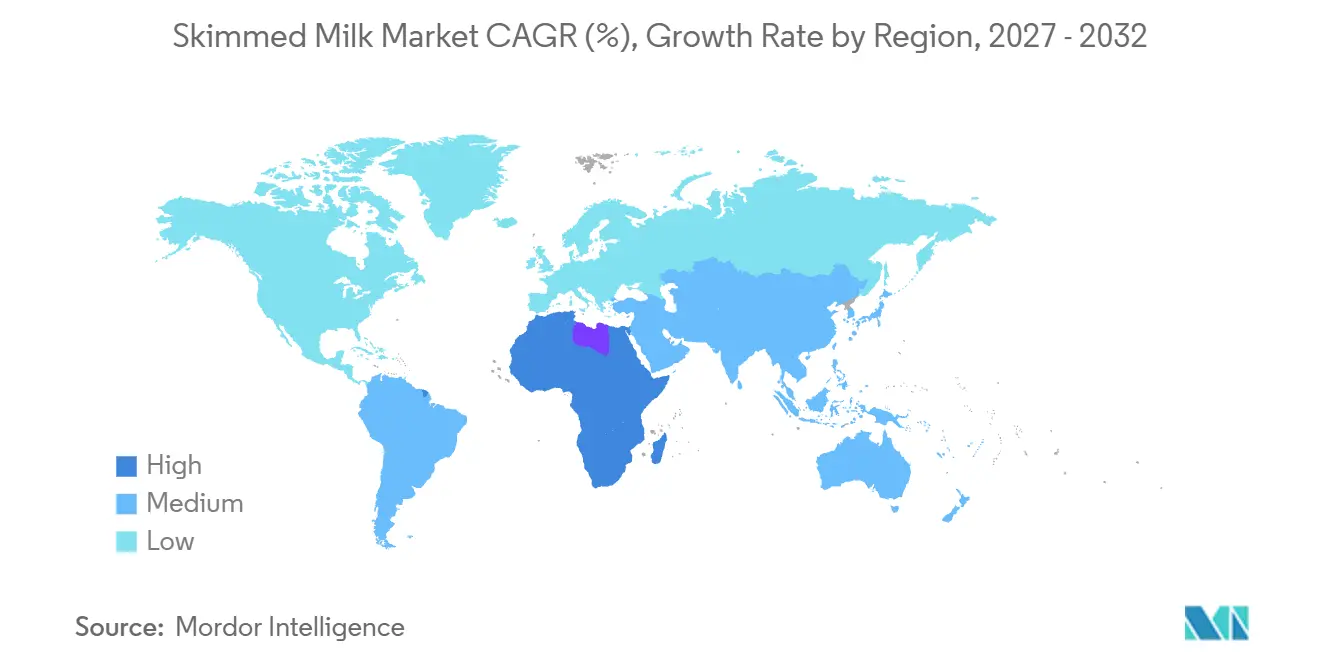
Asia-Pacific accounted for 42.44% of the skimmed milk market in 2026, driven by strong dairy consumption, established milk-processing industries, and growing demand for low-fat dairy products across countries such as India, China, Japan, and Australia. Expanding applications of skimmed milk powder in bakery products, confectionery, yogurt, nutritional beverages, and other processed foods are supporting industrial demand. Additionally, improvements in dairy collection, processing, and cold-chain infrastructure, alongside wider retail distribution and increasing interest in protein-rich nutrition, are creating opportunities for both liquid skimmed milk and powdered products.
Middle East and Africa Skimmed Milk Market
The Middle East and Africa market is forecast to grow at a 3.87% CAGR from 2027 to 2032, supported by demand for convenient dairy products, reliance on imported dairy ingredients in several countries, and growing use of milk powder in food manufacturing and foodservice operations. Skimmed milk powder offers practical storage and transportation advantages in regions where heat and limited cold-chain access can complicate the distribution of liquid milk. Demand from hotels, restaurants, bakeries, catering businesses, and institutional kitchens is also driving the use of skimmed milk ingredients, while the expansion of modern retail and dairy-processing capabilities is improving product availability across the region.
North America, Europe, and South America Skimmed Milk Market
The skimmed milk market across North America, Europe, and South America is driven by established dairy-processing industries, demand for reduced-fat dairy products, and the use of skimmed milk as an ingredient in food manufacturing. In North America, consumer interest in protein-rich nutrition and demand from commercial food processors support market growth. In Europe, established dairy supply chains, product innovation, and the use of skimmed milk in yogurt, cheese-related processing, bakery products, and nutritional formulations sustain demand. In South America, particularly Brazil and Argentina, domestic milk production, expanding dairy-processing activities, and the use of milk powder in confectionery, bakery, and other food applications contribute to market growth. Across these regions, processing improvements and diversified retail and industrial distribution channels further support market growth.
Competitive Landscape
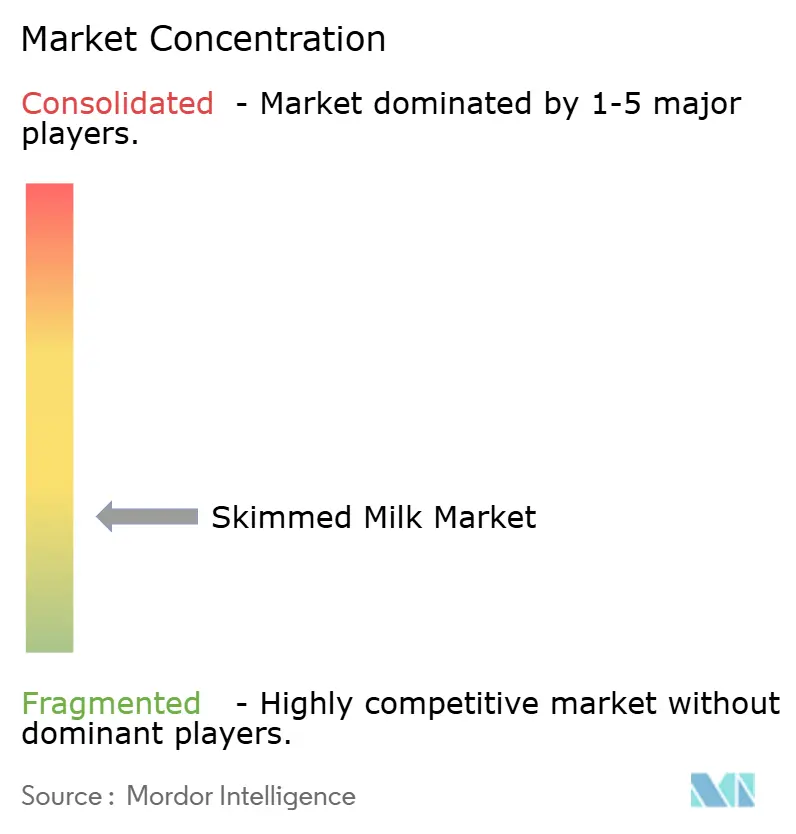
The global skimmed milk market has a fragmented competitive landscape comprising large dairy cooperatives, multinational dairy processors, regional manufacturers, and specialized milk powder producers. Competition is influenced by raw milk procurement capabilities, processing capacity, production efficiency, product quality, and distribution networks. Cooperative business models play an important role in the industry, as access to member-supplied milk supports raw material sourcing and manufacturing continuity. Market participants are increasingly pursuing consolidation, strategic partnerships, and operational restructuring to strengthen their market positions, improve resource utilization, and expand their geographical reach. These developments are contributing to the formation of larger processing networks capable of serving retail customers, food manufacturers, and institutional buyers across multiple markets.
Product diversification and investment in value-added dairy ingredients are becoming important competitive strategies. Manufacturers are increasingly focusing on high-protein dairy ingredients, specialized nutritional formulations, foodservice solutions, and functional milk components to reduce dependence on conventional commodity products. Improvements in processing technologies, including membrane filtration, evaporation, drying, and automated quality control, enable companies to enhance product consistency, optimize resource utilization, and meet the technical requirements of industrial customers. Investments in supply chain integration, digital manufacturing systems, and production infrastructure are also helping market participants improve operational coordination and respond to changing customer requirements. Companies that combine reliable milk sourcing with advanced processing capabilities and diversified product portfolios are better positioned to compete across different skimmed milk applications.
Despite these opportunities, competitive conditions remain challenging, as skimmed milk products are exposed to fluctuations in raw milk availability, commodity prices, energy requirements, and international trade conditions. Smaller and mid-sized processors may face greater pressure to maintain profitability when operating costs increase or market prices weaken, particularly when their portfolios are concentrated in standard milk powders or private-label products. Larger manufacturers generally benefit from established procurement networks, broader customer relationships, and greater capacity to invest in technology and product development. Regional producers and specialized suppliers, however, can remain competitive by serving specific customer requirements, developing differentiated ingredients, and maintaining flexible production capabilities. Overall, the market remains relatively fragmented, with competition driven by operational scale, processing efficiency, product innovation, supply chain management, and the ability to deliver consistent quality across diverse end-use industries.
Skimmed Milk Industry Leaders
-
Dairy Farmers of America, Inc.
-
Royal FrieslandCampina N.V.
-
Gujarat Co-operative Milk Marketing Federation Limited (AMUL)
-
Arla Foods amba
-
Fonterra Co-operative Group Limited
- *Disclaimer: Major Players sorted in no particular order
Skimmed Milk Market Companies Covered in this Report
- Fonterra Co-operative Group Limited
- Arla Foods amba
- Gujarat Co-operative Milk Marketing Federation Limited (AMUL)
- Royal FrieslandCampina N.V.
- Dairy Farmers of America, Inc.
- LACTALIS Ingredients
- Saputo Inc.
- Nestlé S.A.
- Danone S.A.
- Glanbia plc
- DMK Deutsches Milchkontor GmbH
- Vreugdenhil Dairy Foods
- California Dairies, Inc.
- Open Country Dairy Limited
- Synlait Milk Limited
- Groupe Sodiaal
- Meiji Holdings Co., Ltd.
- Inner Mongolia Yili Industrial Group Co., Ltd.
- China Mengniu Dairy Company Limited
- Almarai Company
Recent Industry Developments in Skimmed Milk Market
- April 2025: Arla Foods introduced European-sourced skimmed milk powder on the Global Dairy Trade (GDT) Pulse platform, with its first auction held on May 12, 2025. This initiative expanded the platform's supplier base and provided global buyers with more frequent purchasing opportunities and improved price discovery for skimmed milk powder. The development strengthened Arla Foods' digital sales strategy and broadened access to international dairy ingredient markets.
- January 2024: Gujarat Cooperative Milk Marketing Federation (GCMMF), which markets dairy products under the Amul brand, introduced Sagar Skimmed Milk across India as a fat-free dairy option. Its availability in multiple pack sizes, including larger formats suitable for hotels, restaurants, and caterers, supports consumption beyond household settings.
- April 2023: Finnish dairy company Valio introduced Valio Prime SMP, an infant-grade skimmed milk powder developed for dry-blended infant milk formula production. Manufactured using fresh Finnish milk under stringent microbiological controls, the product is designed to simplify ingredient integration, support consistent quality, and improve manufacturing efficiency for infant formula producers. This launch expanded the availability of specialized skimmed milk powder ingredients for infant nutrition applications and reinforced the role of product innovation in the dairy ingredients market.
Global Skimmed Milk Market Report Scope
This study defines the global skimmed milk market as all commercially produced skimmed milk products with reduced or removed milk fat, derived from cow, buffalo, or other animal milk sources, and sold in liquid, powdered, or condensed form. The market includes products distributed in cartons, bottles, pouches, or other packaging formats to business-to-business (B2B) and business-to-consumer (B2C) end users across North America, Europe, Asia-Pacific, South America, and the Middle East and Africa.
Segmentation Overview
| Liquid Skimmed Milk |
| Skimmed Milk Powder |
| Condensed Skimmed Milk |
| Cow Milk |
| Buffalo Milk |
| Other Animal Milk Sources |
| Cartons |
| Bottles |
| Pouches |
| Other Packaging |
| B2B | |
| B2C | Supermarkets/Hypermarkets |
| Specialty Stores | |
| Online Retail Stores | |
| Other Retail Stores |
| North America | United States |
| Canada | |
| Mexico | |
| Rest of North America | |
| Europe | Germany |
| United Kingdom | |
| Italy | |
| France | |
| Spain | |
| Rest of Europe | |
| Asia-Pacific | China |
| India | |
| Japan | |
| South Korea | |
| Australia | |
| Rest of Asia-Pacific | |
| South America | Brazil |
| Argentina | |
| Rest of South America | |
| Middle East and Africa | South Africa |
| Saudi Arabia | |
| United Arab Emirates | |
| Turkey | |
| Rest of Middle East and Africa |
| By Form | Liquid Skimmed Milk | |
| Skimmed Milk Powder | ||
| Condensed Skimmed Milk | ||
| By Source | Cow Milk | |
| Buffalo Milk | ||
| Other Animal Milk Sources | ||
| By Packaging | Cartons | |
| Bottles | ||
| Pouches | ||
| Other Packaging | ||
| By End Use | B2B | |
| B2C | Supermarkets/Hypermarkets | |
| Specialty Stores | ||
| Online Retail Stores | ||
| Other Retail Stores | ||
| By Geography | North America | United States |
| Canada | ||
| Mexico | ||
| Rest of North America | ||
| Europe | Germany | |
| United Kingdom | ||
| Italy | ||
| France | ||
| Spain | ||
| Rest of Europe | ||
| Asia-Pacific | China | |
| India | ||
| Japan | ||
| South Korea | ||
| Australia | ||
| Rest of Asia-Pacific | ||
| South America | Brazil | |
| Argentina | ||
| Rest of South America | ||
| Middle East and Africa | South Africa | |
| Saudi Arabia | ||
| United Arab Emirates | ||
| Turkey | ||
| Rest of Middle East and Africa | ||
Key Questions Answered in the Report
What is the projected value of the skimmed milk market by 2032?
The skimmed milk market is projected to reach USD 50.49 billion by 2032, from USD 44.33 billion in 2027, at a 2.64% CAGR. Demand is supported by foodservice, infant nutrition, powdered dairy trade, fortified products, and consumer interest in low-fat protein formats.
Which skimmed milk form has the largest share?
Liquid skimmed milk leads by form with a 66.24% share in 2026, reflecting its role in fresh dairy, foodservice, and ingredient processing across the skimmed milk market.
Which skimmed milk form is growing the fastest?
Condensed skimmed milk is forecast to grow at a 4.23% CAGR from 2027 to 2032 as food makers seek shelf-stable dairy ingredients.
Which region leads global demand for skimmed milk?
Asia-Pacific held 42.44% of sales in 2026, supported by dairy consumption growth in India and Pakistan and demand for powder and functional products.