
Singapore Liquid Packaging Cartons Market Size and Share
Market Overview
| Study Period | 2021 - 2032 |
|---|---|
| Forecast Data Period | 2027 - 2032 |
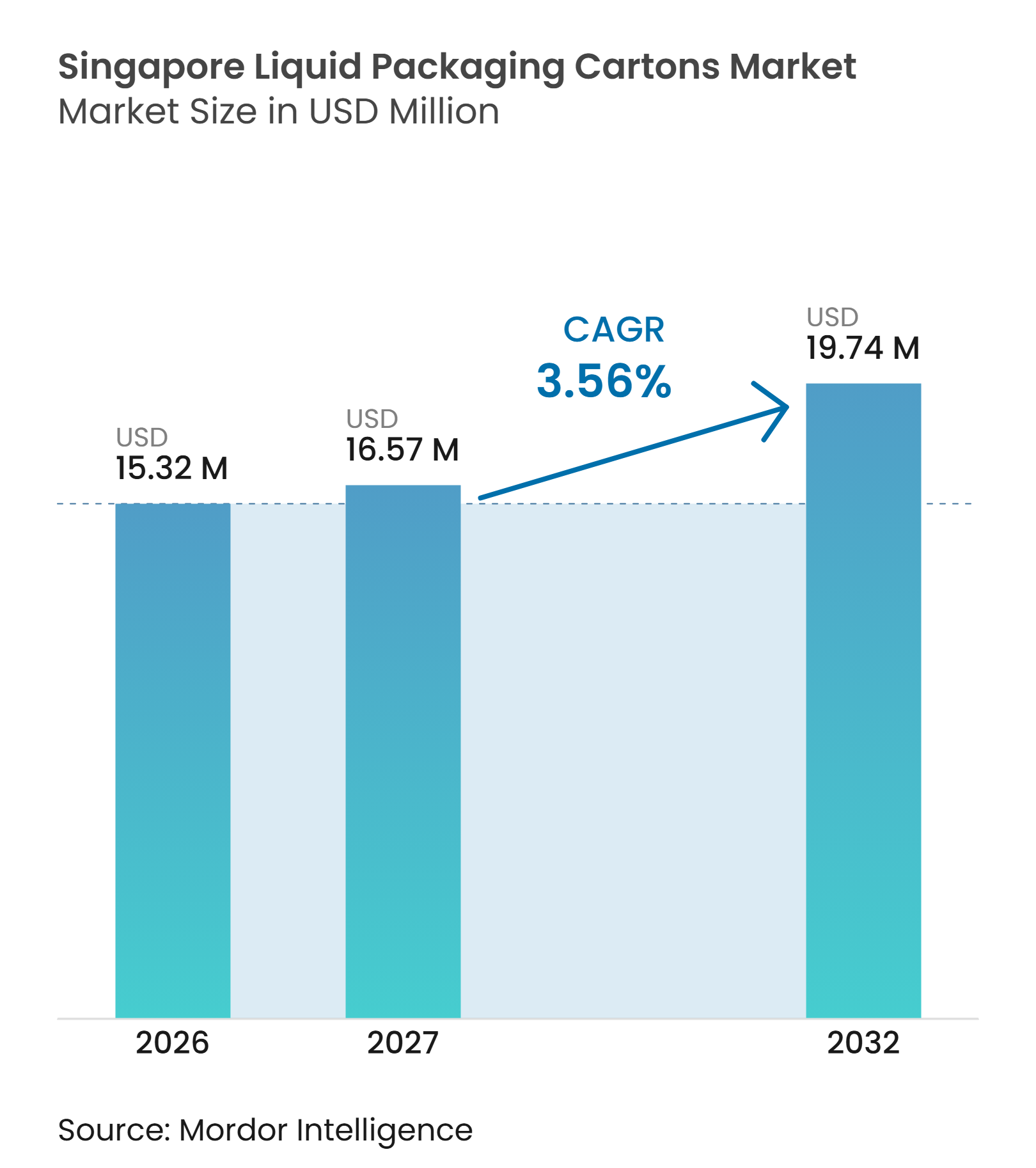
| Base Year Market Size (2026) | USD 15.32 Million |
| Market Size (2027) | USD 16.57 Million |
| Market Size (2032) | USD 19.74 Million |
| Growth Rate (2027 - 2032) | 3.56 % |
| Market Concentration | Medium |
Major Players *Disclaimer: Major Players sorted in no particular order Image © Mordor Intelligence. Reuse requires attribution under CC BY 4.0. | |
Singapore Liquid Packaging Cartons Market Analysis by Mordor Intelligence
The Singapore liquid packaging cartons market size is valued at USD 15.32 million in 2026 and is forecast to reach USD 19.74 million by 2032, growing at a CAGR of 3.56% from 2027 to 2032. The Singapore liquid packaging cartons market benefits from the country’s dependence on imported dairy and juice products, where shelf-stable packs can reduce cold-chain requirements across a dense retail network. Demand is also broadening through plant-based beverages, ready-to-drink coffee, tea, and functional drinks that need long shelf life. Suppliers are responding with new carton formats and paper-based barrier technologies, while brand owners are weighing renewable content, food-contact documentation, and recycling considerations. Competition from PET bottles, aluminum cans, glass, and flexible pouches remains strong, but the exclusion of cartons from Singapore’s beverage deposit scheme supports their position in ambient beverage aisles.
Key Report Takeaways
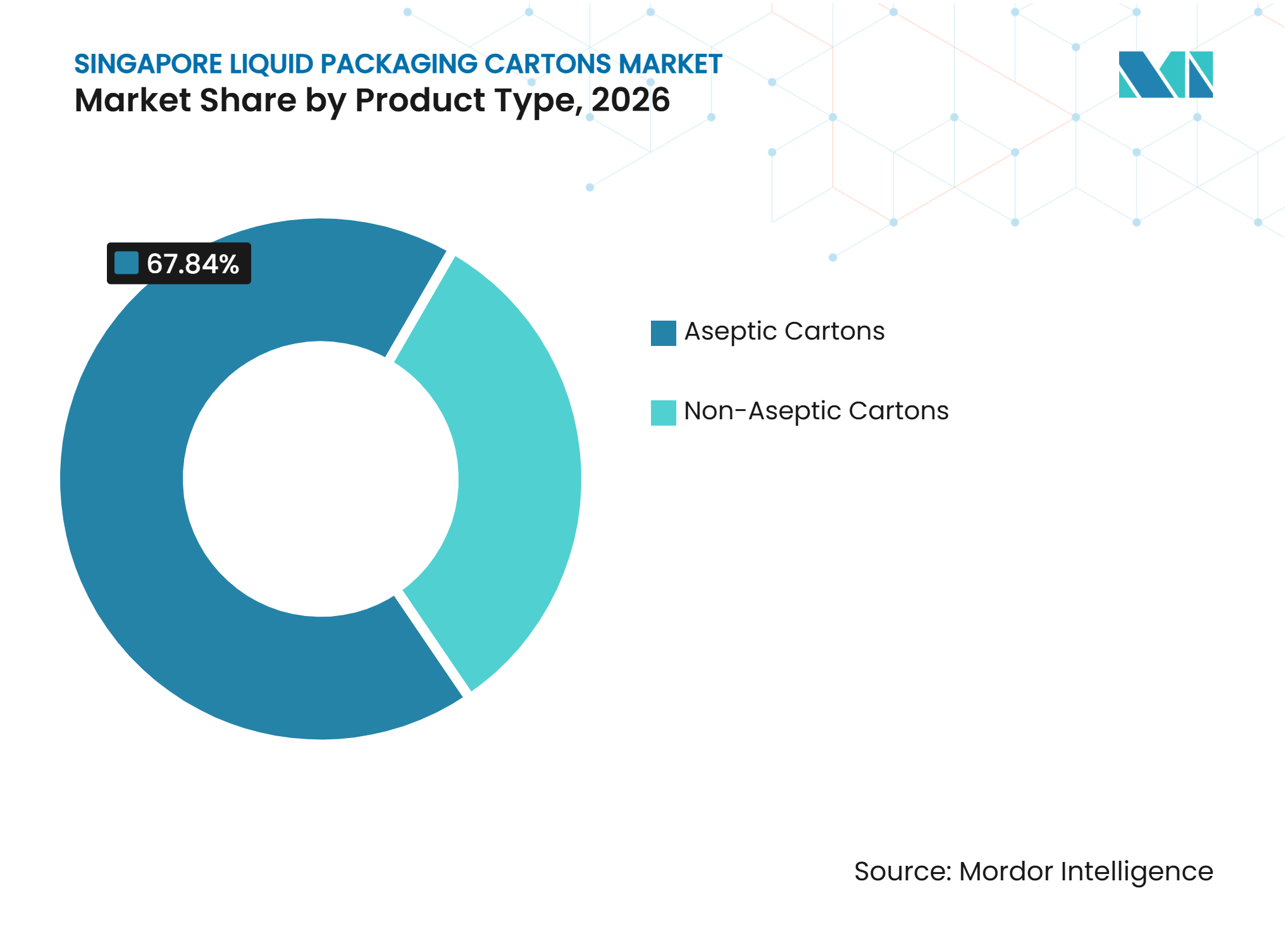
- By product type, aseptic cartons held 67.84% of the Singapore liquid packaging cartons market share in 2026, with a CAGR of 4.34%.
- By application, plant-based beverages are projected to expand at a 4.53% CAGR from 2027 to 2032, making them the fastest-growing application in the Singapore liquid packaging cartons market.
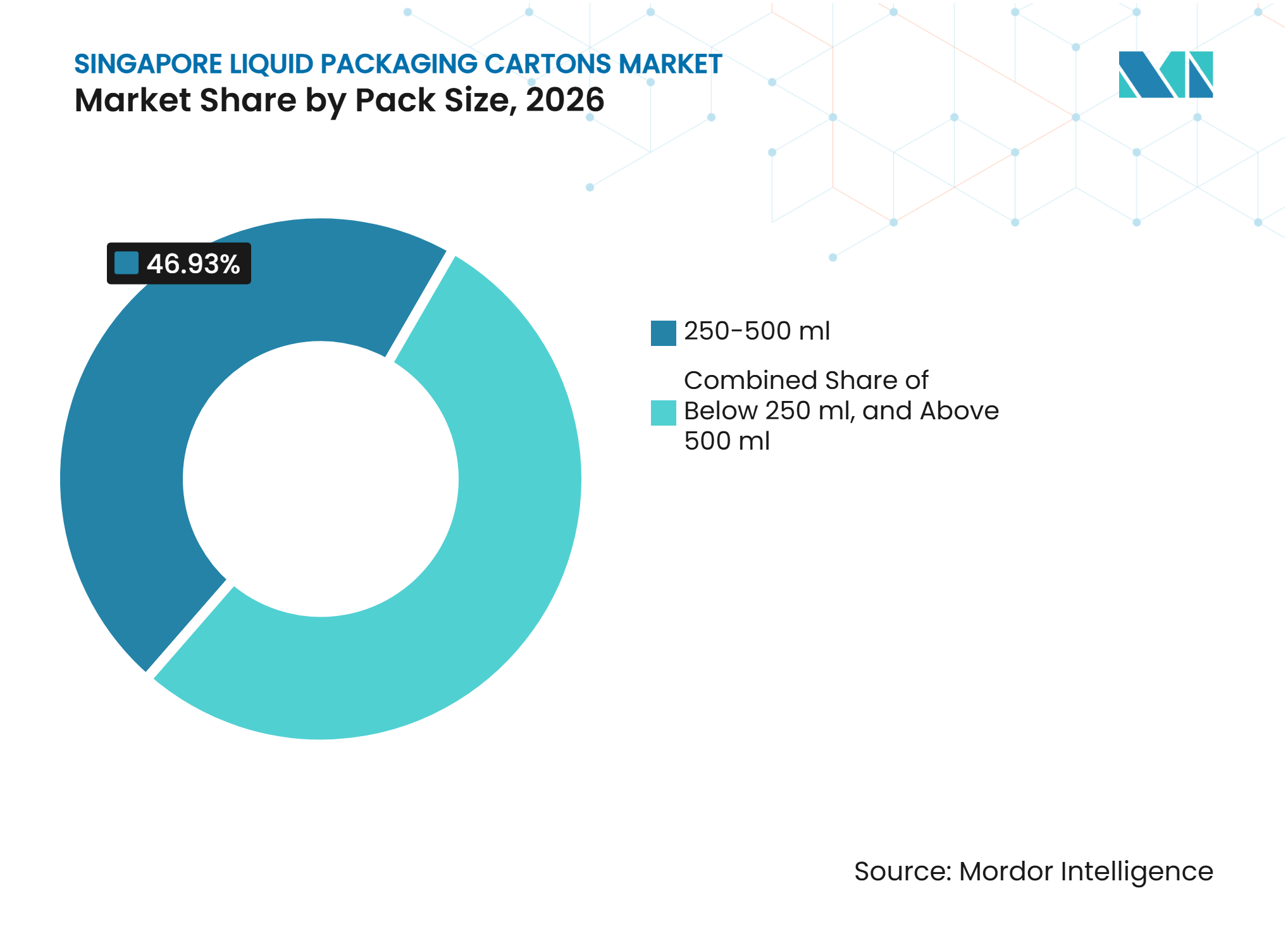
- By pack size, the 250-500 ml format held 46.93% of the Singapore liquid packaging cartons market share in 2026, while below-250 ml cartons are projected to expand at a 4.69% CAGR through 2032.
Note: Market numbers in this report are based on Mordor Intelligence's proprietary estimation framework, which combines nine months of actuals with Q4 projections for base year 2026.
Market Trends and Insights
Drivers Impact Analysis of Singapore Liquid Packaging Cartons Market*
| Driver | (~) % Impact on CAGR Forecast | Geographic Relevance | Impact Timeline |
|---|---|---|---|
| Rising Demand for Shelf-Stable Dairy and Plant-Based Beverages | +1.0% | Singapore-wide, with the highest concentration in modern trade and specialty health retail | Medium term (2-4 years) |
| Expansion of Ready-to-Drink Coffee, Tea, and Functional Beverages | +0.8% | Singapore-wide, strongest in café networks and convenience retail | Medium term (2-4 years) |
| Sustainability-Led Shift Toward Fiber-Based Packaging | +0.5% | National, shaped by Mandatory Packaging Reporting and corporate sustainability requirements | Long term (≥ 4 years) |
| Growth of Ambient Distribution and Omnichannel Retail | +0.3% | Singapore-wide, with higher uptake in e-commerce and hypermarket channels | Short term (≤ 2 years) |
| Relative Format Advantage From Beverage Container Return Scheme Exclusion | +0.2% | Singapore-wide, because the current scheme covers PET and aluminum containers | Short term (≤ 2 years) |
| Regional Supply Resilience and Faster Format Innovation | +0.1% | ASEAN-sourced supply, with a direct effect on product availability in Singapore | Long term (≥ 4 years) |
| Source: Mordor Intelligence | |||
Rising Demand for Shelf-Stable Dairy and Plant-Based Beverages
Plant-based dairy has become an important source of demand for the Singapore liquid packaging cartons market because aseptic packs support long shelf life without refrigeration. Oat, soy, and almond beverages can be distributed through supermarkets, convenience stores, and online grocery platforms with fewer temperature-control demands than chilled products. Oatside expanded its range through the Nobo brand in 2025, adding soy and almond milk products in aseptic cartons for Singapore and other markets.[1] The company’s 250 ml Matcha Oat Milk carton also shows how brands are using smaller packs for individual consumption occasions. UHT milk continues to provide a stable base for carton demand because imported dairy products must travel through a supply chain where long shelf life remains valuable. This mix supports the Singapore liquid packaging cartons market through premium plant-based offerings as well as established dairy consumption.
Expansion of Ready-to-Drink Coffee, Tea, and Functional Beverages
Ready-to-drink coffee, tea, and functional beverages are extending the use of aseptic cartons beyond conventional dairy and juice. Low-sugar formulations, added protein, probiotics, and botanical ingredients are encouraging brands to introduce products that can be stored and delivered at ambient temperatures. Tetra Pak’s Binh Duong plant added the Tetra Prisma Aseptic 500 Edge with DreamCap 26 for ready-to-drink and on-the-go beverage applications in Southeast Asia.[2] MAD Foods introduced a functional oat milk ready-to-drink coffee in Singapore in 2025, which reflects the continued product activity in premium coffee formats. Cartons can support these products because they protect formulations during transport and fit both conventional retail shelves and app-based grocery delivery. The Singapore liquid packaging cartons market therefore has scope to gain from product reformulation even as mainstream beverage categories mature.
Singapore’s packaging reporting rules are increasing the value of documented material information in purchasing decisions. The Mandatory Packaging Reporting framework requires qualifying businesses to report packaging data and prepare plans for reducing, reusing, or recycling packaging.[3] This requirement gives established carton suppliers an advantage when they can provide clear information on renewable content, material composition, and food-contact safety. Tetra Pak and Sterilgarda Alimenti introduced a 1-liter aseptic carton with a paper-based barrier in 2026, with 90% renewable content when paired with plant-based polymers and a stated carbon-footprint reduction of up to 50% against aluminum-barrier equivalents. The Food Safety and Security Bill strengthens the wider regulatory basis for food safety and food-contact controls in Singapore. These factors favor suppliers that can combine lower-impact materials with established validation records.
Sustainability-Led Shift Toward Fiber-Based Packaging
Singapore’s packaging reporting rules are increasing the value of documented material information in purchasing decisions. The Mandatory Packaging Reporting framework requires qualifying businesses to report packaging data and prepare plans for reducing, reusing, or recycling packaging. This requirement gives established carton suppliers an advantage when they can provide clear information on renewable content, material composition, and food-contact safety. Tetra Pak and Sterilgarda Alimenti introduced a 1-liter aseptic carton with a paper-based barrier in 2026, with 90% renewable content when paired with plant-based polymers and a stated carbon-footprint reduction of up to 50% against aluminum-barrier equivalents. The Food Safety and Security Bill also strengthens the wider regulatory basis for food safety and food-contact controls in Singapore. These factors favor suppliers that can combine lower-impact materials with established validation records.
Growth of Ambient Distribution and Omnichannel Retail
Ambient distribution is becoming more important as retailers connect physical stores, loyalty platforms, and delivery services. FairPrice Group launched FPG ADvantage in October 2025 across 570 physical touchpoints, supported by 1.7 million app customers and more than 2 million Link Rewards members. Aseptic cartons are suited to this model because they can move through ambient warehouses and last-mile delivery networks without dedicated refrigeration. Deliveroo’s partnership with Sheng Siong expanded rapid grocery access from more than 21 stores, supporting another route for shelf-stable beverage products. Rectangular cartons also use pallet and shelf space efficiently, which matters when retailers seek to improve fulfillment density. These operating characteristics support the Singapore liquid packaging cartons market across both hypermarkets and smaller convenience-led formats.
Restraints Impact Analysis of Singapore Liquid Packaging Cartons Market*
| Restraint | (~) % Impact on CAGR Forecast | Geographic Relevance | Impact Timeline |
|---|---|---|---|
| Competition From PET Bottles, Metal Cans, Glass, and Flexible Pouches | -0.7% | Singapore-wide, most acute in soft drinks, water, and energy drinks | Short term (≤ 2 years) |
| High Aseptic Line Qualification and Switching Costs | -0.3% | National, with a greater effect on small and medium beverage producers | Medium term (2-4 years) |
| Limited Domestic Carton Collection and Recycling Outlets | -0.2% | Singapore domestic market, where cartons are outside the current deposit scheme | Long term (≥ 4 years) |
| Mature Fresh Milk Demand and Dependence on Imported Supply | -0.1% | Singapore-wide, affecting gable-top and non-aseptic carton demand | Long term (≥ 4 years) |
| Source: Mordor Intelligence | |||
Competition From PET Bottles, Metal Cans, Glass, and Flexible Pouches
PET bottles and aluminum cans have established positions in bottled water, carbonated drinks, and energy beverages, limiting conversion opportunities for cartons. The barrier is not only product price because many beverage companies already operate filling lines designed for these formats. Flexible pouches also compete directly in small portions, particularly in children’s drinks and liquid food packs where cost per unit matters. The beverage deposit scheme currently applies to plastic and metal containers from 150 ml to 3,000 ml, while cartons remain outside its scope. That distinction supports cartons in the short term, although a later extension of the scheme could change packaging decisions. The Singapore liquid packaging cartons market must therefore compete on shelf life, logistics, product protection, and format differentiation rather than rely on a single cost advantage.
High Aseptic Line Qualification and Switching Costs
Aseptic filling requires equipment validation, cleaning-in-place qualification, sterile processing, and compliance with food-safety requirements. These requirements make the format difficult to adopt for smaller producers that do not have the volumes needed to support a dedicated filling line. The Food Safety and Security Bill provides a stronger basis for food-safety oversight and supports more formal controls over products and materials used in the food supply chain. Long-term agreements with carton-system suppliers can also slow format changes because filling, sterilization, sealing, and service systems are closely connected. Singapore’s small population narrows the volume base available for a proprietary aseptic line, particularly for local brands with a limited portfolio. This leaves a large share of carton demand in the hands of multinational food companies and regional beverage groups that can use scale across several markets.
*Our forecasts treat driver/restraint impacts as directional, not additive. The impact forecasts reflect baseline growth, mix effects, and variable interactions.
Singapore Liquid Packaging Cartons Market Segment Analysis
By Product Type:
Aseptic Formats Consolidate Market LeadershipAseptic cartons held 67.84% of the Singapore liquid packaging cartons market share in 2026, making them the leading format in the Singapore liquid packaging cartons market. Their role is supported by demand for UHT dairy, long-life juice, plant-based beverages, and ready-to-drink functional products. The format protects liquids during ambient distribution and helps suppliers avoid the cost and complexity of maintaining refrigeration through every retail channel. Tetra Pak expanded the Binh Duong facility in Vietnam in 2025, raising annual capacity to more than 30 billion packs and adding 15 formats for regional demand. The new range included Tetra Prisma Aseptic 1000 Square and Tetra Brik Aseptic 1000 Slim formats that strengthen supply options for Singapore.
Non-aseptic cartons remain relevant for fresh dairy products and refrigerated juice, where gable-top packs are used by brands such as Marigold. NUTRISOY launched Fresh Soya Milk Matcha Latte in 475 ml and 946 ml gable-top cartons in Singapore in July 2026, showing that producers still use refrigerated cartons for premium beverage launches. These packs serve a different role from aseptic cartons because they support products that depend on refrigerated retailing or a fresh positioning. Packaging reporting requirements apply to both formats, so buyers increasingly compare renewable content, safety documentation, and end-of-life options. The Singapore liquid packaging cartons industry therefore includes a smaller but persistent non-aseptic base alongside the larger aseptic system.


By Applications:
Juices Lead, Plant-Based Beverages AcceleratePlant-based beverages are projected to expand at a 4.53% CAGR from 2027 to 2032, the highest rate among application segments in the Singapore liquid packaging cartons market. The category benefits from product variety across oat, soy, and almond beverages, along with premium retail positioning. Oatside uses aseptic cartons across its range, while the Nobo launch broadened the company’s presence in soy and almond milk. Aseptic processing is useful for plant-based products because it supports distribution without a continuous cold chain. New brands can therefore reach supermarkets, specialist retailers, and online grocery channels with the same basic pack format.
Milk remains a major carton application because imported UHT products require stable distribution and have an established household role. Dairy products excluding milk, such as cooking cream, cream-based drinks, and yogurt beverages, offer smaller but higher-value opportunities. Energy and functional drinks in cartons are also gaining visibility through compact products that can be sold in convenience stores without refrigeration. Liquid food applications, including soups, broths, and cooking sauces, remain less developed in Singapore but offer room for ambient carton formats. Tetra Recart technology demonstrates the potential for carton retorting in food applications that have historically used steel cans. This range of uses reduces the Singapore liquid packaging cartons market’s dependence on any one beverage application.
By Pack Size:
Smaller Formats Gain Structural MomentumThe 250-500 ml segment held 46.93% of market share in 2026, reflecting the popularity of single-serve and dual-serve products. The format works across ambient shelves, convenience-store chillers, and online grocery inventory. It also fits small households that buy more frequently rather than storing large quantities. Below-250 ml cartons are projected to grow at a 4.69% CAGR from 2027 to 2032, the strongest rate across pack-size categories. Their growth is linked to portable drinks, children’s products, and individual servings of plant-based beverages.
Oatside’s 250 ml cartons have helped normalize single-serve oat milk consumption in the city-state. Tetra Pak’s Tetra Prisma Aseptic 500 Edge with DreamCap 26 also targets portable consumption and supports resealable use occasions. Above-500 ml cartons retain a role in UHT milk, long-life juice, cooking cream, and household food preparation. Larger cartons provide a better value proposition per milliliter for multi-serve consumption. However, fast grocery delivery and small-store retailing encourage replenishment in smaller quantities. This behavior should keep the Singapore liquid packaging cartons market focused on formats below 500 ml while preserving demand for multi-serve packs.

Geography Analysis
Modern Trade and Convenience Retail Belt
Singapore’s liquid packaging carton demand is concentrated in modern trade and convenience retail, where FairPrice, Cold Storage, Sheng Siong, Giant, and Don Don Donki provide significant shelf access. FairPrice Group’s FPG ADvantage network connects 570 physical touchpoints with its app and loyalty base, helping consumer brands combine store activity with digital engagement. This retail setting favors shelf-stable formats that can move quickly between central warehousing, neighborhood stores, and delivery orders. High density and extensive convenience retailing allow brands to replenish cartons frequently in smaller volumes. Compliance factors also influence buying decisions because qualifying companies must report packaging data and submit 3R plans under the Mandatory Packaging Reporting framework. The regulatory influence favors suppliers that can clearly document material content and safety information.
Foodservice and Institutional Demand Channels
Foodservice and institutional buyers use multi-serve cartons for UHT milk, cooking cream, and long-life juice. Hotels, hawker centers, quick-service restaurants, corporate cafeterias, and event caterers need products that can be stored safely without relying on large chilled inventories. This makes above-500 ml cartons relevant in commercial kitchens across Marina Bay, Orchard Road, Sentosa, and other hospitality areas. GS Holdings completed its acquisition of Octopus Distribution Networks in 2025, strengthening a distribution platform serving around 200 international brands and more than 1,500 SKUs. The distribution layer connects international packaging innovation with local institutional buyers and helps maintain baseline demand. Food-safety compliance under the Singapore Food Agency’s framework remains important when buyers select liquid food and beverage packs.
Omnichannel Commerce Reshapes Demand
Deliveroo’s grocery partnership with Sheng Siong adds another route for ambient carton beverages, using rapid delivery from more than 21 store locations. Specialty health retailers and grocery platforms also provide space for imported oat milk and functional beverages in cartons. Dark-store models favor packages that can stay at room temperature, stack efficiently, and withstand short fulfillment cycles. The Singapore liquid packaging cartons market size benefits from these channels because aseptic formats reduce the need for dedicated cold-room capacity. Foodpanda’s Pandamart and similar networks reinforce this advantage through high-frequency delivery of room-temperature products. The current beverage return scheme covers specified plastic and metal beverage containers rather than cartons. This policy difference may narrow the comparative cost gap between cartons and some competing formats as deposit-scheme costs move through the supply chain.
Competitive Landscape
Market Concentration
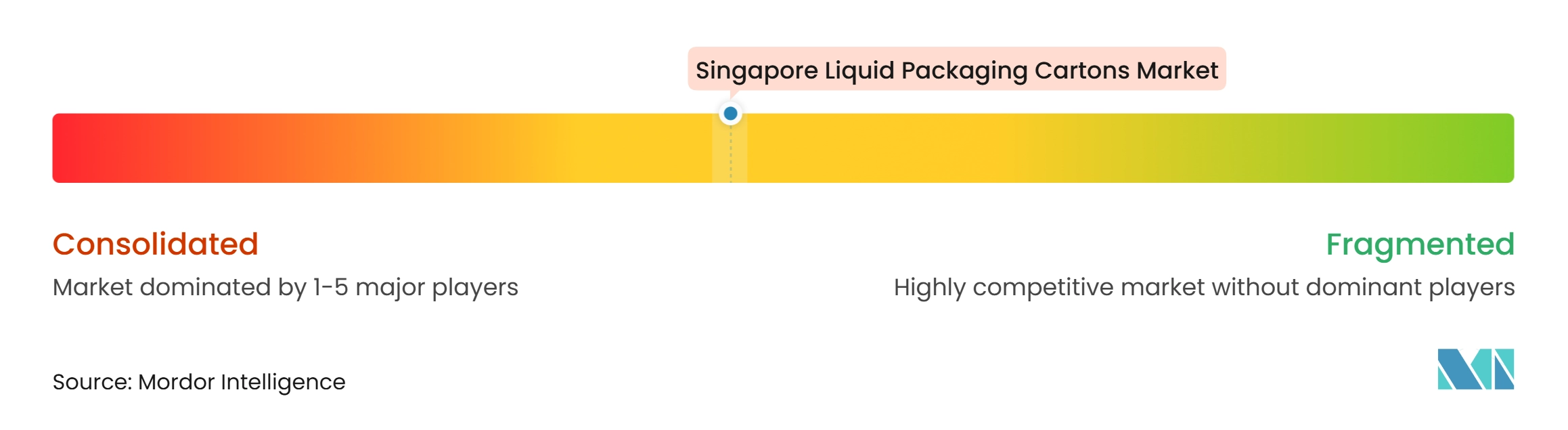
Tetra Pak International S.A. has a dominant presence in the Singapore liquid packaging cartons market because its filling systems, service arrangements, and format range are embedded with leading dairy and juice producers. Its regional Binh Duong expansion added capacity and new formats tailored to ready-to-drink coffee, barista products, and on-the-go consumption. This move gives Singapore customers access to a broader regional supply base. SIG Group AG is a principal challenger, focusing on aseptic carton systems and aluminum-layer-free options. Elopak ASA also competes through carton formats, filling technology, and work on lower-carbon materials. Competition is strongest where brands need shorter runs, smaller packs, or a different balance between cost and sustainability features.
Supplier technology strategies are increasingly centered on paper-based barriers, renewable materials, and alternatives to plastic components. Tetra Pak’s 2026 paper-based barrier launch with Sterilgarda Alimenti is an example of this direction. Elopak invested in Blue Ocean Closures in 2025 to develop fiber-based caps, showing that closures are becoming part of carton differentiation. These developments matter in Singapore because large buyers must evaluate packaging data, material credentials, and food-contact documentation. Newer suppliers such as TidePak Aseptic Packaging Material Co., Ltd. and NewJF Technology Co., Ltd. may compete for price-sensitive business in small packs and liquid food formats. Their opportunity is limited by the importance of established filling ecosystems and qualified supply relationships.
The competitive structure remains concentrated around a small group of system suppliers rather than a wide group of interchangeable carton producers. Long-term filling-line contracts create switching costs and favor companies with technical service capabilities. The Singapore liquid packaging cartons industry also depends on imported cartonboard and regional production, which exposes buyers to logistics and currency movements. Domestic recycling remains a concern because Singapore’s domestic recycling rate was reported at 11% in 2025. This issue can affect how brand owners assess fiber-based packaging claims, even when the carton has favorable renewable-content characteristics. Suppliers that can pair packaging innovation with clear collection, recycling, and compliance support will be better positioned in procurement discussions.
Singapore Liquid Packaging Cartons Industry Leaders
-
Tetra Pak International S.A.
-
SIG Group AG
-
Elopak ASA
-
Pactiv Evergreen Inc.
-
Greatview Aseptic Packaging Co., Ltd.
- *Disclaimer: Major Players sorted in no particular order
Singapore Liquid Packaging Cartons Market Companies Covered in this Report
- Tetra Pak International S.A.
- SIG Group AG
- Elopak ASA
- Novolex Holdings Inc
- Greatview Aseptic Packaging Co., Ltd.
- Nippon Paper Industries Co., Ltd.
- Oji Holdings Corporation
- Stora Enso Oyj
- Billerud Aktiebolag (publ)
- Huhtamäki Oyj
- IPI S.r.l.
- NewJF Technology Co., Ltd.
- Lami Packaging (Kunshan) Co., Ltd.
- TidePak Aseptic Packaging Material Co., Ltd.
Recent Industry Developments in Singapore Liquid Packaging Cartons Market
- November 2026: Kao Industrial (Thailand) Co., Ltd. and SCG Packaging Public Company Limited (SCGP) strengthened their partnership to develop recyclable mono-material, pulp-based, and paper-based packaging, improving circularity and resource efficiency. This development supports Singapore’s sustainability objectives and may increase demand for fiber-based liquid carton packaging and recycling-focused innovations.
- July 2026: NUTRISOY launched its Fresh Soya Milk Matcha Latte in 475 ml and 946 ml gable-top carton formats in Singapore, targeting the premium plant-based ready-to-drink segment with a Nutri-Grade B classification at recommended retail prices of SGD 1.86 and SGD 2.98 respectively. The dual-format strategy reflects a broader market pattern of Singapore carton beverage brands pursuing individual-serve and multi-serve pack sizes for on-the-go and household consumption occasions in the plant-based soy milk category.
- April 2026: Tetra Pak, in collaboration with Sterilgarda Alimenti, launched the first 1-liter aseptic carton with a paper-based barrier, the Tetra Brik Aseptic 1000 Edge, increasing renewable content to 90% when combined with plant-based polymers and reducing the carbon footprint by up to 50% versus aluminum-barrier equivalents, as verified by the Carbon Trust. This format has direct implications for Singapore food and beverage brands subject to packaging reporting requirements.
- October 2025: FairPrice Group launched FPG ADvantage, Singapore’s largest omnichannel retail media network, integrating 570 physical touchpoints and reaching 1.7 million FPG app customers and more than 2 million Link Rewards loyalty members, with AI-enabled smart carts and more than 1,000 digital screens.
Singapore Liquid Packaging Cartons Market Report Scope
The Singapore Liquid Packaging Cartons Market encompasses the manufacturing and supply of paperboard-based packaging solutions designed for the safe storage, transportation, and distribution of liquid beverages and food products. These cartons provide product protection, extended shelf life, and convenient handling while supporting efficient packaging and distribution. The market includes packaging solutions designed to maintain product freshness, prevent contamination, and meet evolving food safety and sustainability requirements. Growing consumption of packaged beverages, increasing demand for convenient and shelf-stable products, and the shift toward recyclable packaging materials drive market growth across India.
The Singapore Liquid Packaging Cartons Market Report is Segmented by Product Type (Aseptic Cartons, and Non-Aseptic Cartons), Applications (Milk, Juices, Plant Based Beverages, Dairy Products Excluding Milk, Energy and Functional Drinks, Liquid Food, and Other Applications), and Pack Size (Below 250 ml, 250-500 ml, and Above 500 ml). The Market Forecasts are Provided in Terms of Value (USD).
Segmentation Overview
| Aseptic Cartons |
| Non-Aseptic Cartons |
| Milk |
| Juices |
| Plant Based Beverages |
| Dairy Products (Excluding Milk) |
| Energy and Functional Drinks |
| Liquid Food |
| Other Applications |
| Below 250 ml |
| 250-500 ml |
| Above 500 ml |
| By Product Type | Aseptic Cartons |
| Non-Aseptic Cartons | |
| By Applications | Milk |
| Juices | |
| Plant Based Beverages | |
| Dairy Products (Excluding Milk) | |
| Energy and Functional Drinks | |
| Liquid Food | |
| Other Applications | |
| By Pack Size | Below 250 ml |
| 250-500 ml | |
| Above 500 ml |
Key Questions Answered in the Report
What is the size of the Singapore liquid packaging cartons market?
The Singapore liquid packaging cartons market is valued at USD 15.32 million in 2026 and is forecast to reach USD 19.74 million by 2032 at a 3.56% CAGR from 2027 to 2032.
Which product type leads Singapore's liquid packaging cartons market?
Aseptic cartons lead with 67.84% share in 2026. Their strength comes from long shelf life and suitability for ambient distribution.
Which application is expected to grow fastest through 2032?
Plant-based beverages are projected to expand at a 4.53% CAGR from 2027 to 2032, supported by oat, soy, and almond beverage launches.
Which carton size is growing fastest in Singapore?
Below-250 ml cartons are projected to grow at a 4.69% CAGR through 2032, while 250-500 ml formats lead the 2026 pack-size mix with 46.93% share.
Why do aseptic cartons fit Singapore's retail system?
Aseptic cartons can be stored and delivered at ambient temperatures, which supports supermarkets, convenience stores, and rapid grocery delivery services.
What is the main constraint on carton adoption in Singapore?
PET bottles, aluminum cans, glass, and flexible pouches compete with cartons, while aseptic filling systems require substantial qualification and investment.