
Side Guard Door Beams Market Size and Share
Market Overview
| Study Period | 2021 - 2031 |
|---|---|
| Market Size (2026) | USD 4.05 Billion |
| Market Size (2031) | USD 5.34 Billion |
| Growth Rate (2026 - 2031) | 5.67 % |
| Fastest Growing Market | Asia-Pacific |
| Largest Market | Asia-Pacific |
| Market Concentration | Low |
Major Players *Disclaimer: Major Players sorted in no particular order Image © Mordor Intelligence. Reuse requires attribution under CC BY 4.0. | |
Side Guard Door Beams Market Analysis by Mordor Intelligence
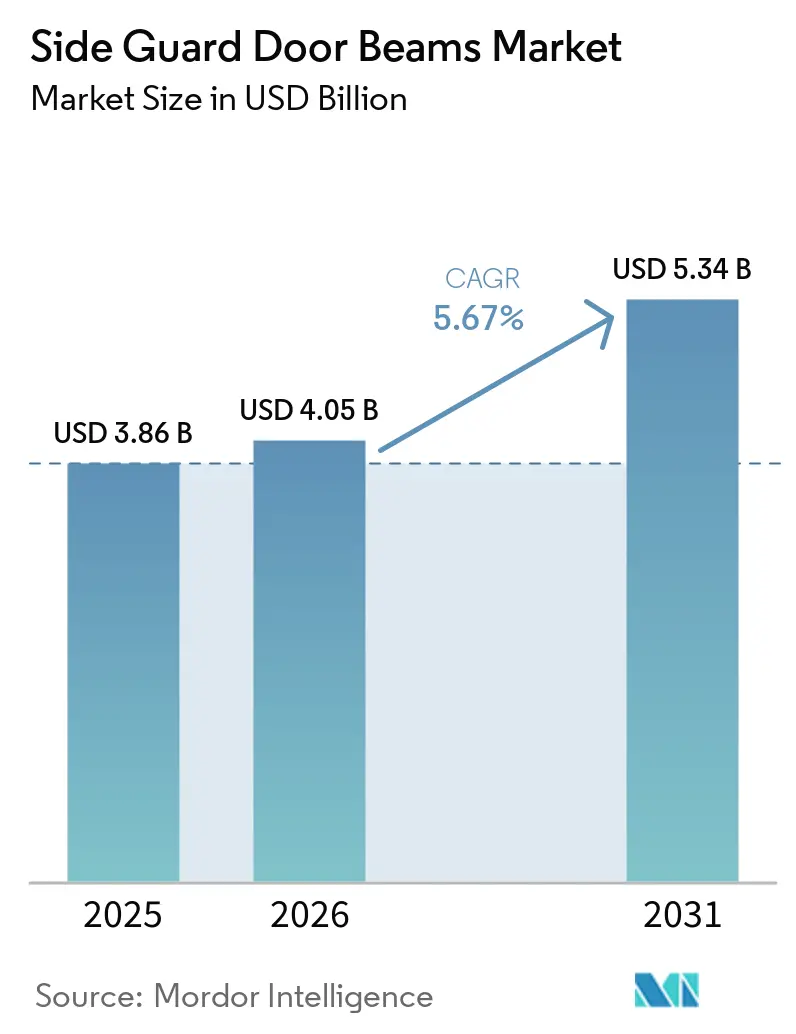
The side guard door beams market size was valued at USD 3.86 billion in 2025 and is estimated to grow from USD 4.05 billion in 2026 to reach USD 5.34 billion by 2031, at a CAGR of 5.67% during the forecast period (2026-2031). The side guard door beams market is being shaped by tighter side-impact requirements, battery-electric vehicle design needs, and efforts to reduce vehicle weight without weakening occupant protection. These factors collectively influence material selection, beam geometry, joining methods, tooling, and validation work for new vehicle programs, as well as the level of engineering support manufacturers expect from component suppliers throughout a platform's lifecycle. Euro NCAP's January 2026 protocol revision raised performance requirements by introducing the Advanced European Mobile Deformable Barrier test at 60 km/h, along with pole and far-side sled assessments, requiring manufacturers to evaluate door structures against a broader set of side-impact conditions than before. The revised Federal Motor Vehicle Safety Standard No. 214, effective July 6, 2026, aligns relevant definitions with electric-vehicle powertrain integrity requirements and simplifies compliance routes for manufacturers designing across conventional and electrified platforms. These changes favor suppliers that can combine material selection, beam geometry, forming expertise, and validation work across multiple vehicle architectures. Manufacturers are also placing greater value on suppliers that can support local production and respond quickly to platform changes. The market also faces pressure from volatile input costs and softer near-term vehicle production, which can limit margin recovery under fixed-price supply agreements and make investment decisions more selective, particularly when suppliers require new hot-forming, extrusion, or trimming capacity.
Key Report Takeaways
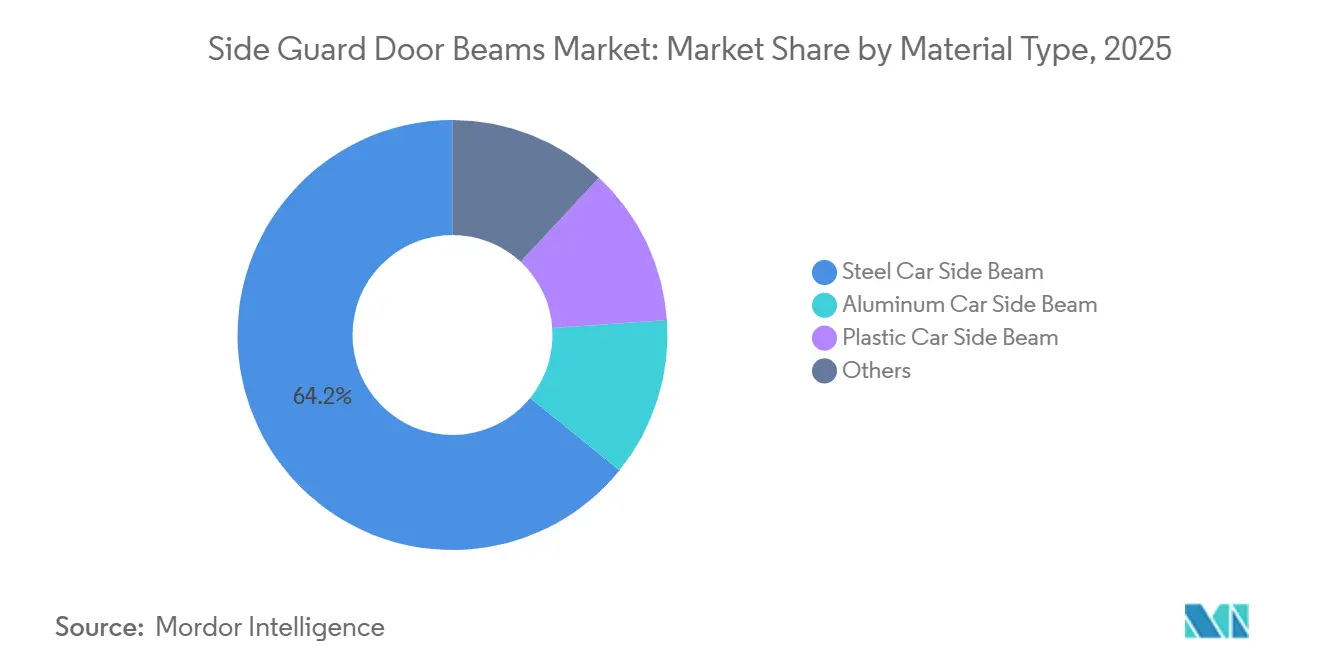
- By material type, steel car side beams held 64.17% of the side guard door beams market share in 2025, while aluminum car side beams are forecast to expand at a 6.34% CAGR through 2031.
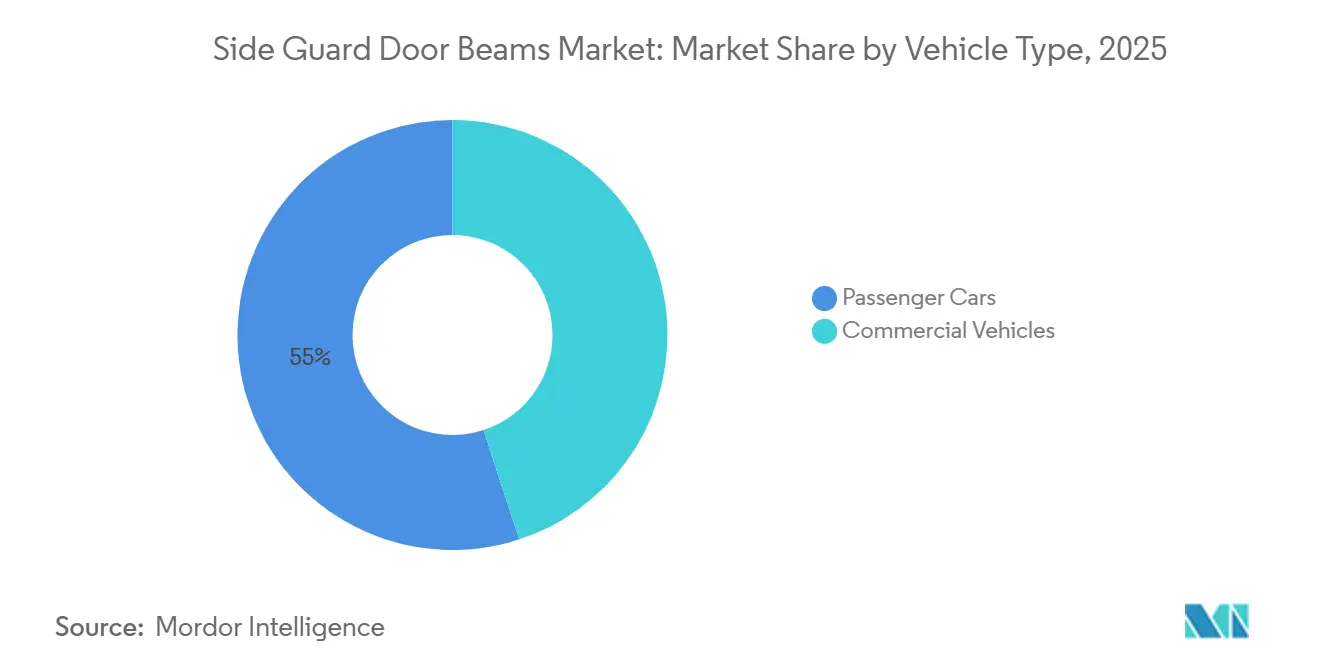
- By vehicle type, passenger cars accounted for 55.03% of the side guard door beams market share in 2025, while commercial vehicles are forecast to expand at a CAGR of 6.81% through 2031.
- By geography, Asia-Pacific accounted for 42.84% of revenue in 2025 and is projected to grow at a 6.72% CAGR through 2031.
Note: Market size and forecast figures in this report are generated using Mordor Intelligence’s proprietary estimation framework, updated with the latest available data and insights as of January 2026.
Market Trends and Insights
Drivers Impact Analysis of Side Guard Door Beams Market*
| Drivers | (~) % Impact on CAGR Forecast | Geographic Relevance | Impact Timeline |
|---|---|---|---|
| Mandatory Side-Impact Safety Requirements | +1.4% | Global, with concentrated compliance activity in North America and Europe | Medium term (2-4 years) |
| Vehicle Lightweighting for Fuel Economy and EV Range | +1.1% | Global, led by Europe, APAC, and North America | Medium term (2-4 years) |
| Growth in Global Vehicle Production and EV Manufacturing | +1.2% | APAC core, spillover to South America and MEA | Medium term (2-4 years) |
| Rising Consumer Attention to Crash-Safety Ratings | +0.8% | North America, Europe, India, ASEAN | Short term (≤ 2 years) |
| EV Battery-Side Protection and New Load-Path Requirements | +0.9% | Global, led by APAC and Europe | Long term (≥ 4 years) |
| Source: Mordor Intelligence | |||
Mandatory Side-Impact Safety Requirements
Overlapping side-impact regulations create a more stable demand base for the side guard door beams market, as door beams are evaluated as part of a vehicle's complete occupant-protection system rather than as standalone components. Euro NCAP's 2026 revision introduced the Aluminum Extended Mobile Deformable Barrier (AE-MDB) assessment at 60 km/h and added far-side evaluation requirements, increasing the importance of controlled intrusion, load distribution, and occupant protection across a wider range of crash conditions. The United States revised Federal Motor Vehicle Safety Standard (FMVSS) No. 214 in 2026 to remove obsolete provisions and align its definitions with FMVSS No. 305a for electric-vehicle powertrain integrity, making cross-platform engineering more relevant for suppliers serving both powertrain types. Platform-sharing manufacturers are likely to apply the strictest applicable requirement when a single architecture serves multiple regions, avoiding separate designs, validation plans, and production approaches for closely related models. This practice extends higher structural specifications into markets where local rules may be less demanding, while supporting more consistent material and geometry choices across a manufacturer's vehicle portfolio. India's Bharat NCAP includes side-impact barrier and pole tests in adult occupant protection scoring, keeping safety performance central to vehicle development decisions and reinforcing the need for suppliers to demonstrate repeatable crash performance.
Vehicle Lightweighting for Fuel Economy and EV Range
Vehicle lightweighting is dividing the side guard door beams market into steel and aluminum technology paths rather than creating a simple replacement cycle, as vehicle makers balance material cost, equipment availability, corrosion performance, and mass reduction differently across programs. Hot-stamped steels, including ArcelorMittal Usibor grades, can reduce mass by up to 50% compared with standard high-yield steel while retaining high strength for crash-critical applications, giving suppliers a viable option where established stamping processes and scale remain important. This approach remains suitable for high-output passenger-vehicle programs where manufacturers can spread tooling costs across large production runs and maintain consistent forming quality across multiple plants. Aluminum remains attractive where weight reduction directly supports electric driving range, where corrosion resistance is a priority, and where the design justifies a higher material cost. The side guard door beams market, therefore, requires both material capabilities, as vehicle segment, price point, regional manufacturing availability, and local operating conditions all influence the final design choice. Suppliers focused on a single material path may lose nominations when original equipment manufacturers select different solutions across a shared platform family or apply separate material mixes for standard and premium models.
Vehicle Production, EV Manufacturing, and Battery-Side Protection
Global electric-car production created a broad demand base for the side guard door beams market in 2025, particularly as electrified platforms combine conventional occupant-protection needs with requirements to protect the battery area during a side impact. Nearly 22 million electric cars were produced during the year, more than 25% above the prior year, with China accounting for nearly 75% of that output, making Asia-Pacific production decisions important for structural component suppliers[1]. Electric vehicles require baseline intrusion protection and structural support to help manage forces near the battery enclosure, so door-beam design must work in conjunction with the sill and underbody structure. Research on comparable side-pole tests found that battery-electric vehicles were, on average, 278 kg heavier than internal-combustion vehicles, with a B-pillar peak acceleration of 69.51 g compared with 55.80 g, underscoring the importance of vehicle mass and structural load paths. SAE work published in 2026 describes battery-pack protection as a coordinated body-in-white task involving door beams, sill reinforcements, and cross members, rather than a sequence of independently optimized parts. This gives module-capable suppliers a stronger role in the side guard door beams market, while also increasing material, joining, testing, and validation requirements for manufacturers that previously treated door reinforcements as a standardized purchase.
Consumer Focus on Crash-Safety Ratings
Crash-safety ratings are increasing the commercial value of side-impact performance in the side guard door beams market, as rating outcomes can make structural features visible in vehicle comparison and purchasing decisions. A visible rating result can influence how consumers compare vehicles with otherwise similar equipment and price levels, particularly when vehicle makers emphasize safety results in product communications. Manufacturers therefore have an incentive to exceed minimum regulatory thresholds, as a stronger score supports product positioning and reduces the risk of a weak result in an independent assessment. Bharat NCAP's side-impact barrier and pole assessments make door intrusion control relevant to a vehicle's adult occupant protection outcome, placing greater focus on beam behavior under different impact conditions. The updated Euro NCAP program also links modern side-impact tests to a more detailed assessment of vehicle protection, including conditions that go beyond the traditional barrier event. This attention encourages earlier collaboration between vehicle engineers and structural suppliers before a program's tooling decisions are finalized, as late changes can affect materials, section shape, joining methods, and validation timing.
Restraints Impact Analysis of Side Guard Door Beams Market*
| Restraints | (~) % Impact on CAGR Forecast | Geographic Relevance | Impact Timeline |
|---|---|---|---|
| High Cost of Advanced Materials and Specialized Processing | -0.8% | Global, concentrated in Europe and North America | Medium term (2-4 years) |
| Volatility in Steel and Aluminum Input Costs | -0.5% | Global | Short term (≤ 2 years) |
| Original Equipment Manufacturer (OEM) Annual Cost-Down Pressure on Tier-1 Suppliers | -0.6% | Global, most acute in Europe and the Asia-Pacific (APAC) | Medium term (2-4 years) |
| Source: Mordor Intelligence | |||
High Cost of Advanced Materials and Specialized Processing
The side guard door beams market requires costly equipment when suppliers move into aluminum extrusion, hot forming, and laser trimming, as each process requires controlled conditions to deliver a repeatable crash response. These investments favor globally capable Tier 1 suppliers and can limit entry for smaller regional manufacturers that lack the capital base or sufficient program output to justify specialized production lines. Suppliers must weigh aluminum's higher per-unit material cost against the fixed investment required for press-hardened steel production, while also considering plant location, tool life, and the expected duration of a vehicle program. SSAB identifies both extruded aluminum and advanced steel solutions as relevant to electric-vehicle battery crash-protection applications, confirming that material selection depends on the vehicle's overall structural design rather than on a single performance measure[2]. This challenge is particularly evident in price-sensitive markets, where original equipment manufacturers have limited room to pass premium material costs to vehicle buyers and may retain lower-cost architectures longer. Annual cost-down expectations add further pressure when a supplier must fund a more complex design, demonstrate its performance, and qualify it within the same contract cycle.
Volatility in Steel and Aluminum Input Costs
Steel and aluminum price fluctuations create margin risk for suppliers in the side guard door beams market that operate under multiyear fixed-price agreements, since component prices often remain set while the cost of specialty inputs changes. Many of these agreements cover the full life of a vehicle platform, which can last 4 to 7 years, leaving suppliers exposed when cost movements are not captured by contract adjustment clauses. Specialty boron-alloyed steel and 7000-series aluminum billet may not allow rapid cost recovery when input prices change, as identifying alternative sources and completing grade qualifications can take considerable time. Cross-border sourcing can add tariff and currency exposure for companies supplying North American vehicle programs, particularly when material and finished-component movements span multiple national borders. This uncertainty can delay new capacity decisions even where electric-vehicle demand supports an expansion case, as adding a production line requires confidence in sustainable returns rather than output alone. It also makes local manufacturing coverage, disciplined sourcing, and stronger material-commercial planning more important to the competitiveness of the side guard door beams market.
*Our forecasts treat driver/restraint impacts as directional, not additive. The impact forecasts reflect baseline growth, mix effects, and variable interactions.
Side Guard Door Beams Market Segment Analysis
By Material Type:
Steel Retains Broad Use While Aluminum Advances in Electric Vehicle (EV) ProgramsSteel car side beams accounted for 64.17% of the side guard door beams market in 2025, reflecting the strength-to-cost balance of advanced high-strength steel across global vehicle programs, including models that must combine crash performance with high production output. Cold-stamped martensitic steel supports thin-wall beam designs while retaining the crash performance required for side-impact protection, allowing suppliers to pursue lighter structures without moving every program to a hot-forming line. SSAB states that its Docol CR1500M-EG is a 1,500 MPa electrogalvanized martensitic steel developed for demanding automotive applications, illustrating the role of coated high-strength grades in crash-critical uses. The material offers corrosion resistance and high strength, helping suppliers meet durability requirements in door areas with long vehicle service lives and varying operating conditions. Steel also benefits from a mature manufacturing base that supports passenger cars, sport utility vehicles, and commercial vehicles, enabling manufacturers to use established supply chains, forming methods, and quality processes. Plastic beams and other material variants remain limited to niche applications, including lower-speed impact zones and non-load-bearing reinforcement uses, where they are not required to perform the primary anti-intrusion role.
Aluminum car side beams are projected to grow at a 6.34% CAGR through 2031, making them the fastest-growing material option in the side guard door beams market, driven by greater emphasis on weight reduction in electrified platforms. Their use is strongest in battery-electric vehicle programs, where weight reduction supports driving range and where the surrounding body structure is designed for a more integrated material package. Higher-strength aluminum solutions are relevant in door applications that require durability in humid operating conditions, as corrosion performance and retained strength affect long-term structural behavior. China published T/ACCEM 870-2026 in February 2026, setting technical requirements for aluminum alloy anti-collision beam assemblies for M1-category passenger vehicles, including new-energy vehicles. The standard took effect on March 4, 2026, and provides manufacturers with a clearer technical reference for component development, supplier discussions, and acceptance criteria. This framework can reduce qualification uncertainty for original equipment manufacturers considering aluminum beam designs, while steel remains relevant where cost, existing equipment, and production scale are decisive factors.

By Vehicle Type:
Passenger Cars Lead While Commercial Vehicles Grow FasterPassenger cars accounted for 55.03% of the side guard door beams market in 2025, as they represent a large share of global light-vehicle production and are subject to comprehensive crash-test requirements across many vehicle classes. Five-star safety programs across North America, Europe, and Asia-Pacific support high structural content value per vehicle, particularly in models sold in regions with more demanding assessment frameworks. Shared vehicle architectures are also pushing specifications upward as passenger-car platforms are adapted into taller crossovers and sport-utility vehicles, which can alter available door space and the side-impact load path. Reduced intrusion space inside the door can require revised beam cross sections and new tooling, while taller bodies may require the beam to work in closer coordination with other body-side reinforcements. Passenger-car production levels help suppliers absorb engineering and validation costs when introducing next-generation beam designs, as similar solutions can be deployed across several related models. These platforms remain the primary revenue base for the side guard door beams market, even as electrification changes the structural package and increases attention to battery protection.
Commercial vehicles are forecast to expand at a 6.81% CAGR through 2031, the highest rate among vehicle-type segments, reflecting the growing importance of structural content in electrified delivery applications. Electric delivery vans and light commercial vehicles require battery-side structural protection, as with passenger electric vehicles, but their packaging and use cycles create a different engineering brief. Higher gross weights and repeated load cycles can require a wider energy-absorption range and better fatigue resistance, increasing the importance of component durability alongside peak crash performance. Urban delivery programs in Asia-Pacific and European zero-emission zones are supporting the shift toward electrified commercial fleets, bringing these platforms into more frequent contact with advanced structural specifications. Original equipment manufacturers are applying more demanding structural specifications to commercial platforms than to conventional internal-combustion models, particularly where battery protection is part of the platform's safety design. The resulting increase in content offers suppliers a revenue opportunity for each door assembly in the side-guard door-beam market, while also requiring closer coordination with vehicle-body and battery-pack engineers.
Geography Analysis
APAC Side Guard Door Beams Market
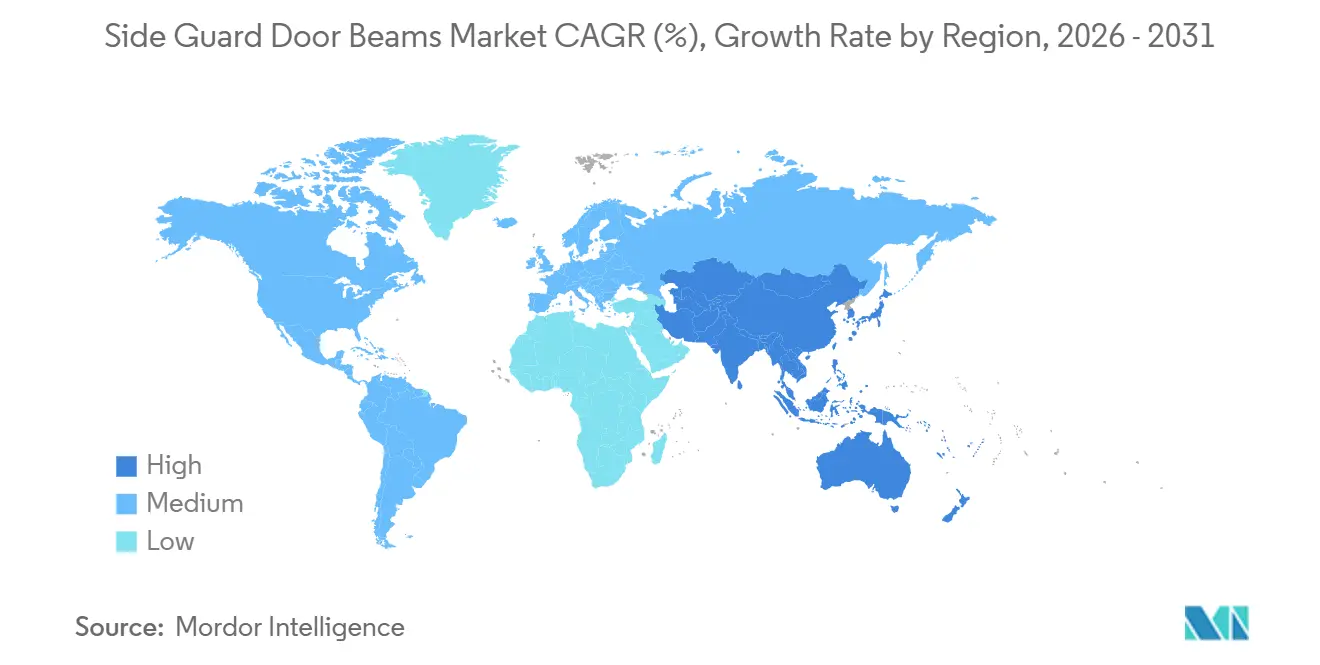
Asia-Pacific accounted for 42.84% of global revenue in 2025 and is forecast to grow at a 6.72% CAGR through 2031, giving the region both the largest current share and the highest growth rate. China produced nearly 16 million electric cars in 2025, accounting for nearly 75% of global electric-car output, and this concentration makes regional production plans highly relevant to structural-component demand. China's electric-vehicle exports more than doubled to 2.5 million vehicles in 2025, requiring export-oriented platforms to meet stricter safety standards and encouraging suppliers to develop solutions that serve both domestic and overseas programs. India adds another layer of demand through growth in vehicle production and the continued use of side-impact tests in the Bharat New Car Assessment Program (NCAP). At the same time, Japan contributes specialized aluminum materials capabilities, and South Korea's integrated manufacturer-supplier base supports regional structural component development.
North America and Europe Side Guard Door Beams Market
North America and Europe form a substantial revenue base for the side guard door beams market, as regulations support high structural content per vehicle and make recurring redesign work more likely when assessment protocols change. Federal Motor Vehicle Safety Standard (FMVSS) No. 214 became effective in the United States on July 6, 2026, while Euro NCAP's 2026 protocol reinforced the need for improved performance in barrier, pole, and far-side assessments. These regulations encourage upgrades across model ranges and increase the value of suppliers that can validate components against multiple conditions. In October 2025, thyssenkrupp Steel presented an integrated door ring solution that combines front- and rear-door-opening structures into a single hot-stamped component, demonstrating the regional shift toward part integration that can reduce body-shop complexity while supporting crash performance.
MEA and South America Side Guard Door Beams Market
South America, the Middle East, and Africa hold smaller positions in the side guard door beams market. However, expanding production capacity gives them growing strategic relevance as vehicle manufacturers broaden their manufacturing and electrification plans. Investment in advanced forming capacity indicates that suppliers are preparing for a wider regional need for stronger body structures and more demanding material processing. South Africa's established assembly base and Saudi Arabia's industrial development programs provide longer-term demand potential in the Middle East and Africa. The absence of a common regional crash-test program comparable to Euro NCAP limits the near-term pace of structural specification upgrades. As a result, structural requirements are likely to remain less uniform than in regions governed by more closely aligned assessment frameworks.
Competitive Landscape
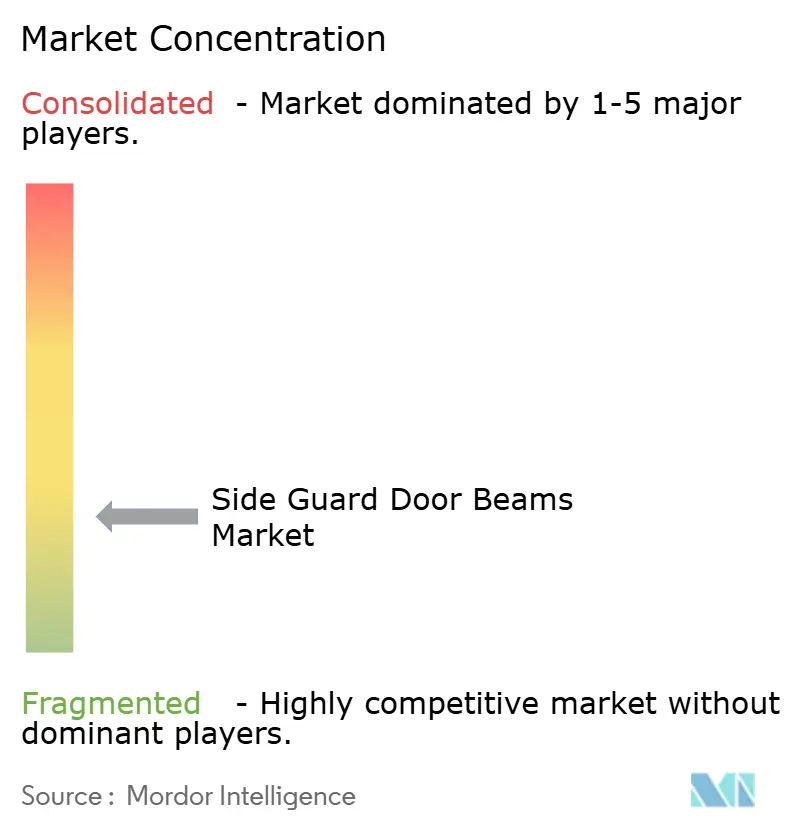
The side guard door beams market is fragmented, with BENTELER, Gestamp, Magna International, and KIRCHHOFF Automotive competing for OEM nominations across major vehicle architectures. Their offerings are differentiated by hot-forming depth, tailored welded blank capability, material options, validation resources, and manufacturing proximity to assembly plants. Suppliers that can serve programs across multiple regions can reduce freight exposure, improve supply continuity, and support manufacturers seeking consistent structural solutions across global platforms. The market also provides opportunities for regional suppliers such as H-ONE, IFB Automotive, and Martinrea International, particularly where rapid tooling, local supply, or platform-specific engineering is required. Competition, therefore, combines scale with the ability to address a manufacturer's specific structural, commercial, and production needs.
Technology investment is central to competition in the side-guard door-beam market. Suppliers are expanding their capability to support both steel and aluminum structures rather than relying on a single material. They want to be involved early in platform engineering, when section design, material selection, joining methods, and supplier roles are still open to influence. In May 2025, KIRCHHOFF Automotive and Volkswagen AG received the Swedish Steel Prize for the SIBORA silicon-boron hot-forming process and its associated steel grade, demonstrating how materials and process engineering can differentiate crash-critical components at manufacturing scale. Our patent activity in aluminum extrusion and multi-material side structures supports our efforts to protect our technical advantages. At the same time, more detailed simulation and validation work can raise the qualification threshold for smaller bidders.
Complete side-module supply represents an important opportunity in the side-guard door-beam market. A supplier that bundles anti-intrusion beams, sill reinforcements, battery-side cross members, and inner-panel structures can help OEMs manage complex assemblies, coordinate part interfaces, and reduce the risk of separate component designs conflicting with the intended crash load path, particularly when a vehicle platform must satisfy different regional safety requirements. This approach can reduce the number of suppliers required for a vehicle side structure and simplify interface management when multiple parts contribute to the same side-impact load path. However, the supplier must demonstrate reliable engineering coordination across materials, forming processes, joining methods, and validation activities, rather than simply providing individual stamped or extruded components. Chinese Tier 1 structural suppliers are becoming stronger competitors as export programs require compliance with European safety specifications. Companies with a historically domestic focus can become relevant on international tender lists by combining cost competitiveness with the capability to meet more stringent technical requirements and deliver the production consistency expected on export-bound vehicles. Larger suppliers can also use simulation and validation capability as a qualification advantage when crash-test requirements become more detailed, as these resources support the assessment of alternative material and section designs before physical testing, facilitate discussions with vehicle engineering teams, and demonstrate that a final component can satisfy multiple crash objectives across different body styles and powertrain configurations.
Side Guard Door Beams Industry Leaders
-
GESTAMP
-
BENTELER International AG
-
Magna International Inc.
-
KIRCHHOFF Automotive
-
AISIN CORPORATION
- *Disclaimer: Major Players sorted in no particular order
Side Guard Door Beams Market Companies Covered in this Report
- AISIN CORPORATION
- Arvin Sango, Inc.
- BENTELER International AG
- GESTAMP
- H-ONE CO., LTD.
- Hyundai Mobis
- IFB Automotive Private Limited
- KIRCHHOFF Automotive
- Magna International Inc.
- Martinrea International Inc.
- Shiloh Industries, Inc.
- SSAB
- Thyssenkrupp AG
- Tower International, Inc.
- Toyoda Gosei Co., Ltd.
Recent Industry Developments in Side Guard Door Beams Market
- July 2026: Martinrea International announced a USD 35 million plant expansion in Ridgetown, Ontario, Canada, adding a 3,000-metric-ton SIMPAC transfer press and 34,000 sq. ft. of manufacturing capacity. The investment targeted next-generation Gen-3 Advanced High-Strength Steel (AHSS) materials for lightweight, high-strength structural body components, including door-beam programs, directly addressing OEM demand for heavier-gauge AHSS processing capability.
- October 2025: Thyssenkrupp Steel presented its integrated door ring solution at Blechexpo 2025, developed in cooperation with Baosteel Tailored Blanks. The InPart Solutions concept merged front- and rear-door ring structures into a single hot-stamped component, reducing weld seams, part count, and production costs while improving structural integrity in side-impact crash scenarios.
Global Side Guard Door Beams Market Report Scope
Side guard door beams are safety bars made of steel or aluminum that are installed inside a vehicle's doors. These components are engineered to absorb and redirect impact energy during side-impact collisions, reducing the risk of injury to occupants.
The side guard door beams market is segmented by material type, vehicle type, and geography. By material type, the market is segmented into steel car side beam, aluminum car side beam, plastic car side beam, and others. By vehicle type, the market is segmented into passenger cars and commercial vehicles. The report also covers market size and forecasts for side guard door beams across 15 countries in major regions. The market sizes and forecasts are provided in terms of value (USD).
Segmentation Overview
| Steel Car Side Beam |
| Aluminum Car Side Beam |
| Plastic Car Side Beam |
| Others |
| Passenger Cars |
| Commercial Vehicles |
| Asia-Pacific | China |
| India | |
| Japan | |
| South Korea | |
| ASEAN Countries | |
| Rest of Asia-Pacific | |
| North America | United States |
| Canada | |
| Mexico | |
| Europe | Germany |
| United Kingdom | |
| France | |
| Italy | |
| NORDIC Countries | |
| Rest of Europe | |
| South America | Brazil |
| Argentina | |
| Rest of South America | |
| Middle East and Africa | Saudi Arabia |
| South Africa | |
| Rest of Middle East and Africa |
| By Material Type | Steel Car Side Beam | |
| Aluminum Car Side Beam | ||
| Plastic Car Side Beam | ||
| Others | ||
| By Vehicle Type | Passenger Cars | |
| Commercial Vehicles | ||
| By Geography | Asia-Pacific | China |
| India | ||
| Japan | ||
| South Korea | ||
| ASEAN Countries | ||
| Rest of Asia-Pacific | ||
| North America | United States | |
| Canada | ||
| Mexico | ||
| Europe | Germany | |
| United Kingdom | ||
| France | ||
| Italy | ||
| NORDIC Countries | ||
| Rest of Europe | ||
| South America | Brazil | |
| Argentina | ||
| Rest of South America | ||
| Middle East and Africa | Saudi Arabia | |
| South Africa | ||
| Rest of Middle East and Africa | ||
Key Questions Answered in the Report
What is current market size of Side Guard Door Beams Market?
The side guard door beams market size was valued at USD 3.86 billion in 2025 and is estimated to grow from USD 4.05 billion in 2026 to reach USD 5.34 billion by 2031, at a CAGR of 5.67% during the forecast period (2026-2031).
Which material is growing fastest for side guard door beam applications?
Aluminum car side beams are projected to grow at a 6.34% CAGR through 2031, supported by electric-vehicle weight-reduction needs.
Which vehicle category is expanding fastest for these components?
Commercial vehicles are forecast to grow at a 6.81% CAGR through 2031 as electric vans and light commercial vehicles need battery-side protection.
Which region leads in demand for side guard door beams?
Asia-Pacific held 42.84% of revenue in 2025 and is forecast to grow at a 6.72% CAGR through 2031.