
Sheet Metal Market Size and Share
Market Overview
| Study Period | 2021 - 2031 |
|---|---|
| Market Size (2026) | USD 204.85 Billion |
| Market Size (2031) | USD 287.55 Billion |
| Growth Rate (2026 - 2031) | 7.02 % |
| Fastest Growing Market | Asia-Pacific |
| Largest Market | Asia-Pacific |
| Market Concentration | Low |
Major Players *Disclaimer: Major Players sorted in no particular order Image © Mordor Intelligence. Reuse requires attribution under CC BY 4.0. | |
Sheet Metal Market Analysis by Mordor Intelligence
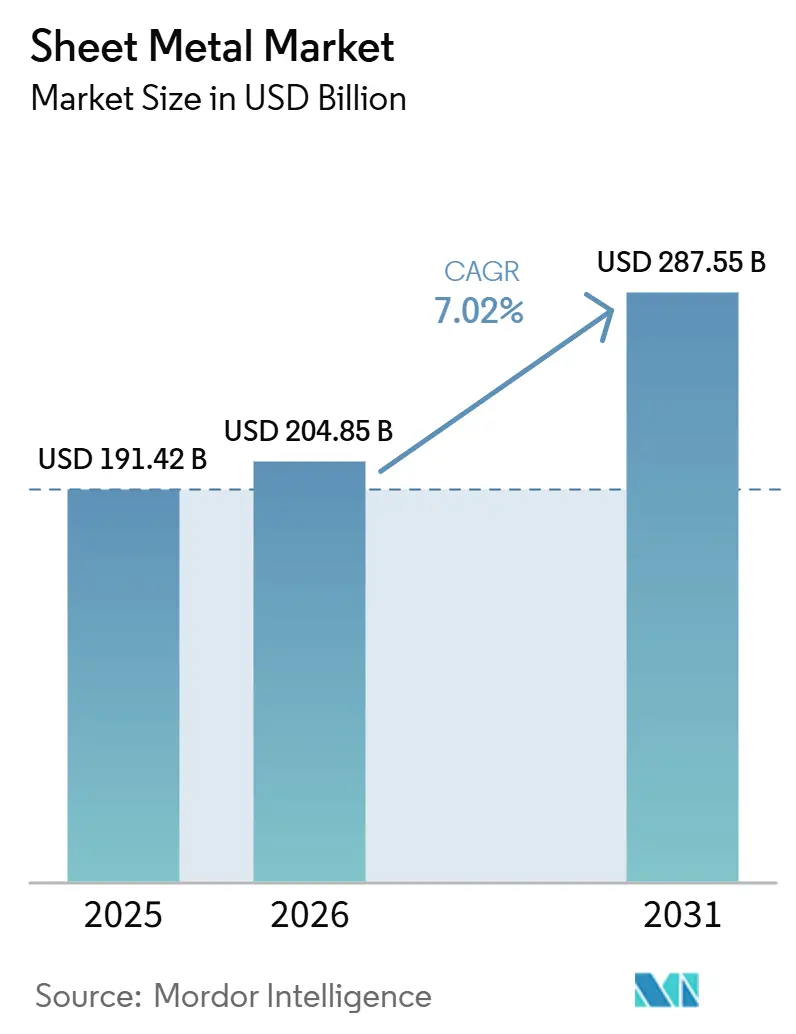
The Sheet Metal Market size is expected to grow from USD 191.42 billion in 2025 to USD 204.85 billion in 2026 and is forecast to reach USD 287.55 billion by 2031 at 7.02% CAGR over 2026-2031. The sheet metal market is growing on the back of steady demand from the automotive, construction, industrial equipment, and electronics sectors, keeping end demand broad rather than dependent on a single cycle. Steel remains the dominant material by volume due to its deep integration in automotive platforms, construction systems, and heavy machinery, while aluminum is gaining ground in applications where weight reduction and energy efficiency are priorities. The market is also being shaped by a shift toward more precise fabrication, as buyers in electronics, defense, and high-specification industrial applications increasingly require tighter tolerances and better surface performance. Capacity additions, joint ventures, and specialty product investments indicate that companies are moving beyond commodity flat products to establish positions in electrical steel, automotive-grade sheets, and low-carbon supply chains. At the same time, pricing volatility in steel and aluminum, along with the cost of modernizing production lines, continues to differentiate efficient operators from smaller players with limited procurement flexibility and capital spending capacity.
Key Report Takeaways
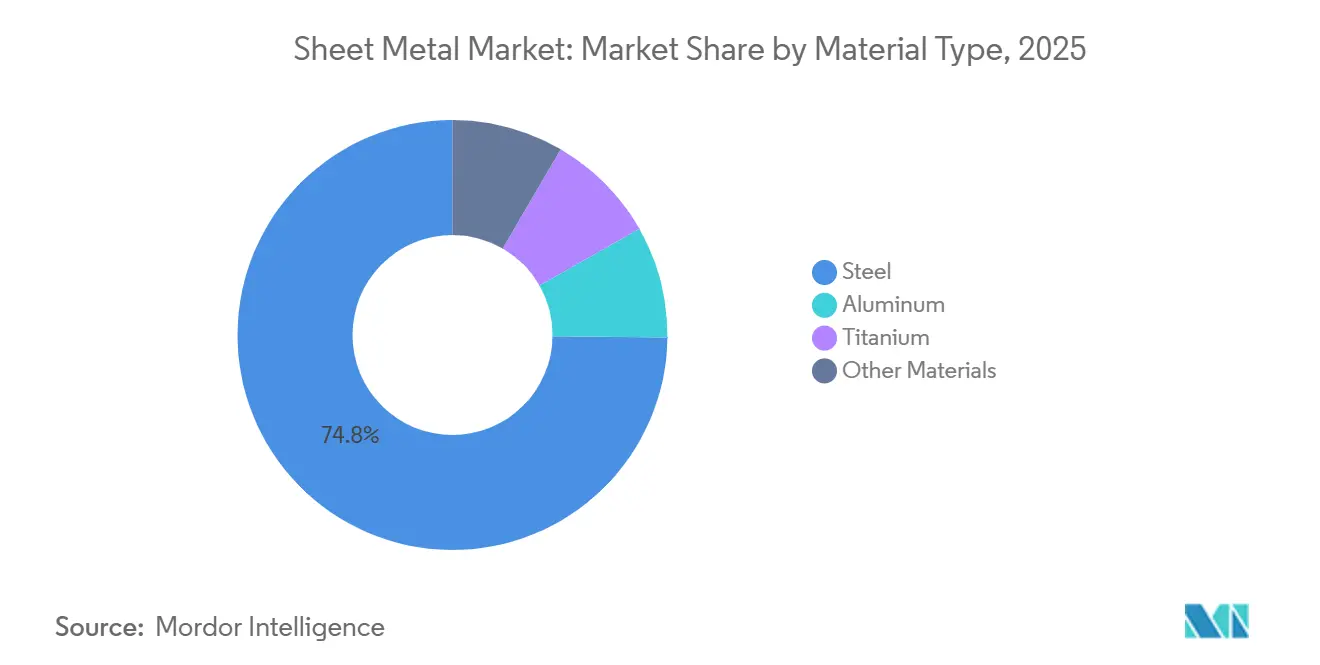
- By material type, steel held 74.82% of the sheet metal market share in 2025, while aluminum is forecast to grow at an 8.33% CAGR through 2031.
- By process, cutting led with 36.44% revenue share in 2025, while roll forming is projected to expand at a 7.93% CAGR through 2031.
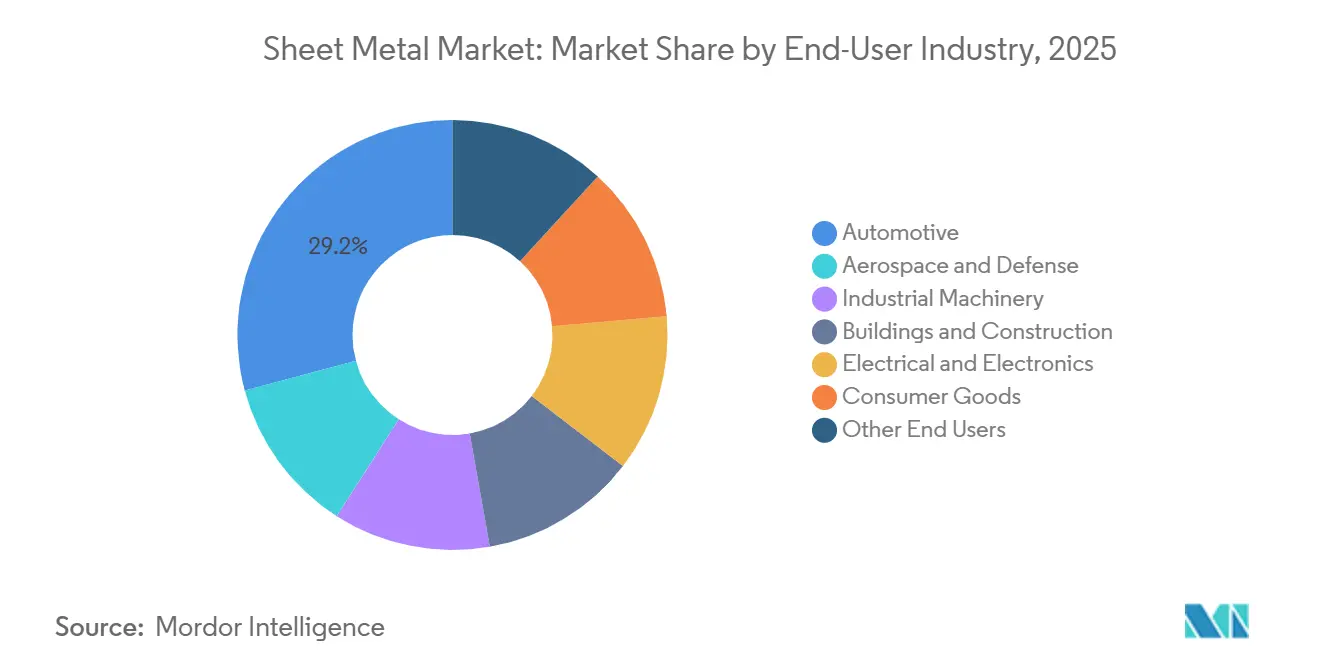
- By end-user industry, automotive accounted for 29.15% of the market share in 2025, while electrical and electronics are forecast to record the highest CAGR of 8.14% through 2031.
- By geography, Asia-Pacific held 48.63% of the sheet metal market share in 2025 and is projected to grow at a 7.84% CAGR through 2031.
Note: Market size and forecast figures in this report are generated using Mordor Intelligence’s proprietary estimation framework, updated with the latest available data and insights as of January 2026.
Global Sheet Metal Market Trends and Insights
Drivers Impact Analysis*
| Drivers | (~) % Impact on CAGR Forecast | Geographic Relevance | Impact Timeline |
|---|---|---|---|
| Rising Demand for Lightweight Materials Across Automotive and EV Platforms | +2.0% | Global, led by North America, Europe, and APAC core including China, South Korea, and Japan | Medium term (2-4 years) |
| Growth in Building and Construction Activity Across Emerging APAC Economies | +1.5% | APAC core, including India, Southeast Asia, and China, with spillover to the Middle East and Africa | Medium term (2-4 years) |
| Expansion of Precision Manufacturing and High-Tolerance Fabrication for Industrial and Defense Applications | +1.1% | North America and Europe, with early gains in India | Long term (≥ 4 years) |
| Increasing Demand from Electric Vehicle and Electronics Manufacturing Supply Chains | +1.3% | Global, concentrated in China, South Korea, and North America | Short term (≤ 2 years) |
| Adoption of Advanced Manufacturing Technologies Including Laser Cutting, Computer Numerical Control (CNC) Bending, and AI-Driven Quality Systems | +0.7% | North America, Europe, and advanced APAC including Japan and South Korea | Long term (≥ 4 years) |
| Source: Mordor Intelligence | |||
Rising Demand for Lightweight Materials Reshaping the Material Mix
The sheet metal market is seeing a clear shift in material choice as vehicle manufacturers and energy equipment suppliers push for lighter structures without sacrificing strength or formability. Aluminum is benefiting from this shift because EV body structures, closures, and battery floor assemblies require lower mass and better corrosion performance. Advanced high-strength steel remains relevant because it offers a cost-to-strength balance that many high-volume vehicle programs continue to need. The change is becoming structural rather than temporary, as Original Equipment Manufacturers (OEMs) are redesigning full-body architectures for EV-native platforms rather than making minor substitutions within older internal combustion designs. This keeps the sheet metal market tied not only to more units sold, but also to higher content requirements in battery enclosures, underbody systems, and protective casings. This trend also supports greater investment in recycling, rolling, and finishing assets that can deliver lighter sheet products at scale.
Growth in Building and Construction Sustaining Steel Sheet Demand
Construction continues to anchor the volume side of the sheet metal market because roofing systems, cladding, ducting, structural frames, and industrial buildings all rely heavily on flat steel products. Demand remains firm in Asia-Pacific, where infrastructure corridors, industrial park expansion, and renewable power installations require large volumes of formed and coated steel sheet. This base is significant because it keeps mills and fabricators exposed to recurring demand even when one manufacturing segment slows. The mix within construction is also changing, as customers increasingly require higher-grade sheets for energy-efficient buildings, modular structures, and refurbishment work rather than basic volume supply. This shift improves the value profile for producers that can meet tighter quality and coating requirements. It also supports resilience in the sheet metal market because construction demand is spreading across logistics facilities, industrial sites, and utility-linked installations, rather than depending on a single property cycle.
Increasing Demand from Electric Vehicle (EV) and Electronics Manufacturing
The sheet metal market is gaining support from electronics and EV supply chains that require precisely fabricated, repeatable, and application-specific parts. Data centers contribute to this demand base because racks, cabinet frames, cable management systems, and thermal enclosures all depend on formed sheet assemblies. EV production adds another layer through battery housings, motor frames, inverter covers, and power electronics enclosures, all of which require dimensional consistency and higher finishing standards. This changes the commercial profile of demand because buyers are no longer purchasing only generic fabricated parts. Instead, they are specifying tighter tolerances, validated quality systems, and production capability that can scale across long programs. This favors fabricators with Computer Numerical Control (CNC), inspection, and finishing capabilities, and it raises the average value of work flowing through the sheet metal market.
Expansion of Precision Manufacturing Creating Differentiated Demand
The sheet metal market is also being driven by precision manufacturing in aerospace, defense, medical equipment, and other high-specification industrial applications. These applications require more than basic cutting and bending, as they often involve exotic alloys, tight tolerances, traceability, and consistent surface quality. This creates a clear split between commodity fabrication and higher-value engineered work. Fabricators that invest in multi-axis forming, laser welding, inspection systems, and certification capability are better positioned to secure longer contracts and protect margins. Buyers in these segments often prioritize consistency and qualification as much as price, making specialized capability a barrier to entry. As a result, the sheet metal market is gradually rewarding technical depth and process control over simple volume throughput.
Restraints Impact Analysis*
| Restraints | (~) % Impact on CAGR Forecast | Geographic Relevance | Impact Timeline |
|---|---|---|---|
| Volatility in Steel and Aluminum Prices Driven by Tariffs, Geopolitical Events, and Supply-Demand Imbalances | -1.3% | Global, most acute in North America and Europe | Short term (≤ 2 years) |
| High Energy Intensity of Sheet Metal Forming Processes, Compounded by Rising Industrial Electricity Costs | -0.8% | Global, most severe in Europe and North America, where the energy transition is underway | Medium term (2-4 years) |
| High Capital Investment Requirements for Advanced Forming, Laser Cutting, and Electric Arc Furnace (EAF)-Based Steelmaking Facilities | -0.6% | Global, with a disproportionate burden on Small and Medium-sized Enterprise (SME) fabricators in emerging markets | Long term (≥ 4 years) |
| Source: Mordor Intelligence | |||
Volatility in Steel and Aluminum Prices Compressing Fabricator Margins
The sheet metal market remains exposed to raw material price swings because many fabricators operate under customer contracts that do not fully pass through rapid changes in steel or aluminum costs. Tariffs, supply disruptions, and regional imbalances can widen the gap between mill pricing and downstream contract economics. This is particularly challenging for smaller fabricators that purchase in shorter cycles and have limited hedging or procurement leverage. Cost management has become a strategic priority as operators turn to supplier diversification, scrap-based routes, and longer-term agreements to reduce exposure. The pressure is most immediate in North America and Europe, where trade measures and energy costs have kept the pricing environment uncertain. This dynamic supports profitability for disciplined operators but raises execution risk for companies that rely heavily on spot purchases.
High Energy Intensity Limiting Cost Competitiveness in Transition Markets
Energy costs present another constraint, as steelmaking and many downstream forming operations rely on heat- and power-intensive processes that are difficult to decouple from industrial electricity prices. Steelmaking energy intensity stood at 21.0 GJ per ton in 2024, while renewable sources accounted for only 1.9% of total energy used by World Steel Association member companies, indicating how far the sector has to go in changing its operating base[1]World Steel Association, “Energy Use in the Steel Industry,” World Steel Association, worldsteel.org. This is relevant to the sheet metal market because laser cutting, induction heating, heat treatment, and other fabrication steps add cost pressure after steel has already been produced. The challenge is more pronounced in Europe, where producers are balancing decarbonization commitments with greater energy exposure and higher regulatory costs. ArcelorMittal, Thyssenkrupp Steel, and voestalpine called for pragmatic reform of the EU Emissions Trading System in 2026, reflecting the severity of the cost burden on the regional steel sector. Until the power mix, grid economics, and policy structure become more favorable, the sheet metal market will continue to carry a cost disadvantage in some transition-heavy regions.
*Our forecasts treat driver/restraint impacts as directional, not additive. The impact forecasts reflect baseline growth, mix effects, and variable interactions.
Segment Analysis
By Material Type: Aluminum’s rise is lifting value growth while steel keeps the volume base
Steel accounted for 74.82% of the sheet metal market in 2025, confirming that the largest share of demand came from applications where strength, price, and established processing routes matter most. Construction systems, industrial machinery, and heavy automotive components continue to rely on steel because its substitution economics remain favorable in high-volume use. This keeps the sheet metal industry anchored to flat steel output, service center networks, and well-established forming practices across most regions. Aluminum is forecast to expand at an 8.33% CAGR through 2031, making it the fastest-growing material type in this market. Its growth is strongest in EV doors, hoods, battery floor structures, and other parts where mass reduction supports energy efficiency and range. The result is not a decline in steel demand, but a shift in the mix toward lighter, more specialized flat products.
This change is significant because the sheet metal market is no longer defined only by tonnage, but also by the technical role each material plays in end use. Aluminum can justify a higher material cost when the finished component requires weight reduction, corrosion resistance, or thermal performance that standard steel cannot meet as readily. Titanium and other specialty materials remain small in volume, but they continue to matter in aerospace and medical fabrication, where certification, precision, and performance outweigh broad cost comparisons. Producers are responding by moving toward specialty flat products rather than remaining in commoditized sheet supply. World crude steel production reached 1,849.4 million tons in 2025, indicating that scale remains substantial even as the product mix shifts toward higher-value flat-rolled applications. Within the sheet metal industry, the strongest positions will likely belong to suppliers that can support both large-volume steel demand and fast-growing lightweight applications.



By Process: Cutting remains the base process while roll forming is gaining strategic weight
Cutting held a 36.44% share in 2025, making it the largest process segment in the sheet metal market and confirming its central role across nearly every fabrication workflow. Laser, plasma, and waterjet operations remain essential because they serve as the initial conversion step for products ranging from HVAC ducts to automotive structures and industrial enclosures. Their broad use keeps cutting tied to the overall health of manufacturing and construction rather than a single niche. Bending and stamping also remain critical as they serve high-volume automotive, appliance, and equipment programs that depend on repeatability and tooling efficiency. This gives the sheet metal market a stable processing base, built on familiar workflows and a strong installed base of equipment. Process leadership is still shaped by scale, uptime, and yield control.
Roll forming is projected to grow at a 7.93% CAGR through 2031, making it the fastest-growing process as it suits long structural profiles used in solar systems, EV platforms, and modular construction. That advantage comes from continuous forming, better material efficiency, and the ability to produce consistent lengths with low scrap. In a market where buyers are focused on both cost and throughput, these operating characteristics are gaining importance. The sheet metal market is rewarding process choices that reduce waste while supporting large program volumes. This is one reason the sheet metal industry is paying more attention to cold-formed profiles for battery trays, racking systems, and lightweight construction frames. As the application mix broadens, roll forming is moving from a niche process toward a more strategic position in the overall conversion chain.
By End-User Industry: Automotive keeps the largest demand pool while electronics sets the pace
Automotive accounted for 29.15% of revenue in 2025, making it the largest end-user segment in the sheet metal market, as body structures, underbody systems, reinforcements, and closures consume large volumes of flat products. The scale of automotive demand provides producers and fabricators with a reliable base load for cutting, stamping, forming, and finishing operations. It also creates deep linkages with both steel and aluminum supply chains, which is why changes in vehicle design quickly affect material strategies across the market. Aerospace and defense, industrial machinery, and buildings and construction add important secondary demand, each with different requirements on tolerance, grade, and delivery profile. Consumer goods and other end users are smaller individually, but they extend the market into appliances, HVAC units, enclosures, and everyday formed products. This broad spread of applications is one reason the sheet metal market remains structurally diversified.
Electrical and electronics is forecast to expand at an 8.14% CAGR through 2031, making it the fastest-growing end-user category and shifting attention toward more precision-oriented fabricated parts. Data center racks, cabinet frames, cable systems, and thermal enclosures are a growing part of that demand base. EV battery management housings, motor casings, and inverter enclosures are increasing the need for tighter dimensional control and improved surface finishes. As a result, the sheet metal market is seeing more value shift toward fabricators that can deliver engineered parts rather than rely solely on standard sheet conversion. This change is also raising the importance of inspection systems, process consistency, and customer-specific fabrication capability. The segment mix still depends on volume sectors, but future gains are increasingly tied to electronics-linked applications that demand greater precision and higher value per unit.
Geography Analysis
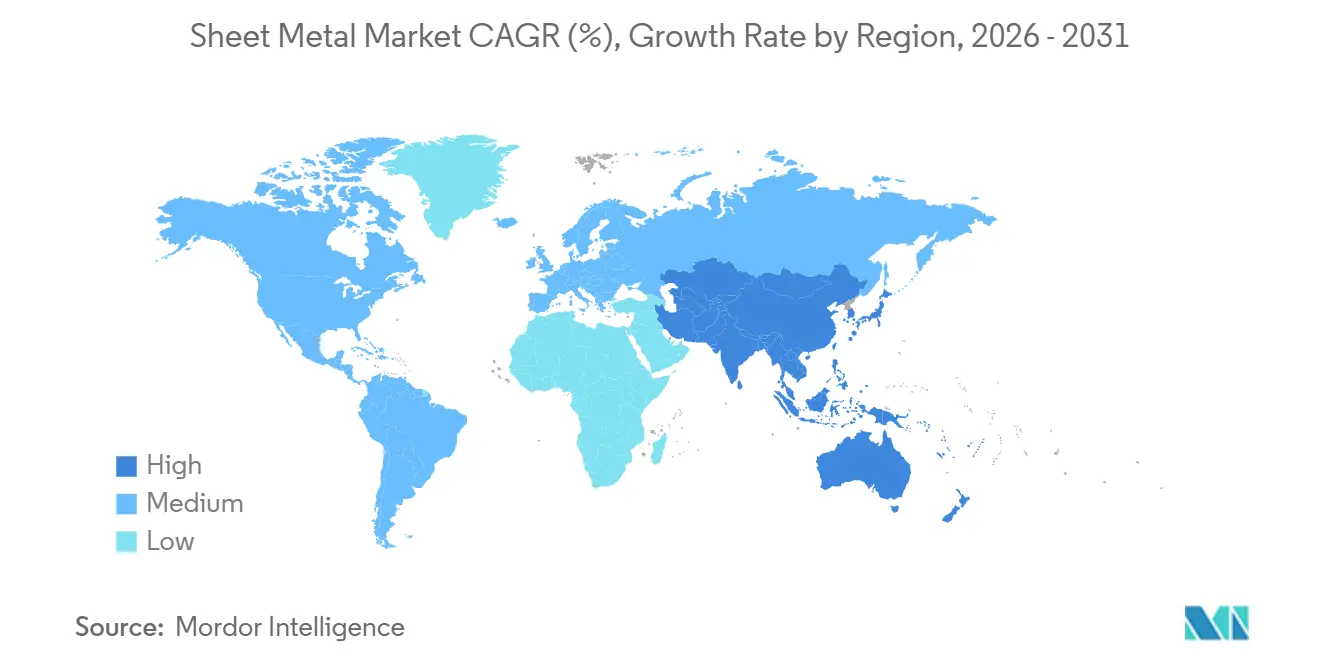
Asia-Pacific accounted for 48.63% of global revenue in 2025 and is projected to grow at a 7.84% CAGR through 2031, making it the largest and fastest-growing region in the sheet metal market. China remains central due to its flat-steel output and breadth of downstream fabrication, even as local competition pushes producers toward higher quality and more specialized grades. India is a key growth market, with new steel capacity, automotive production, electronics manufacturing, and infrastructure investment all expanding simultaneously. This broad-based growth makes the Asia-Pacific sheet metal market less dependent on any single country. South Korea and Japan remain relevant due to their specialization in high-value sheet products such as automotive-grade steel, coated flats, and electrical steel, supporting export-oriented supply for applications that require consistent performance rather than low cost alone.
North America operates under different conditions, where trade protection has supported domestic mills while also keeping input costs challenging for some fabricators. This creates a divide within the sheet metal market, where upstream capacity benefits from price support while downstream companies remain sensitive to contract rigidity and raw material timing. Europe faces structural challenges, as carbon regulations, decarbonization spending, and energy prices are reshaping the economics of steel and fabricated sheet supply. The push for cleaner production coincides with high capital requirements and policy uncertainty. ArcelorMittal, Thyssenkrupp Steel, and voestalpine publicly pressed for Emissions Trading System (ETS) reform in 2026, highlighting how policy design has become a direct competitive factor for the regional steel industry[2]Thyssenkrupp Steel, “ArcelorMittal, thyssenkrupp Steel and voestalpine Call for Pragmatic ETS Reform,” Thyssenkrupp Steel, thyssenkrupp-steel.com. In both regions, the sheet metal market is being shaped as much by regulatory and cost structure issues as by end demand.
South America, the Middle East, and Africa remain smaller in absolute terms but are still relevant to the sheet metal market, providing regional demand tied to vehicles, construction, industrial projects, and export-oriented steel flows. Brazil and Argentina support automotive and construction demand in South America, while Brazil also plays an important role in supplying semi-finished steel. The Middle East is growing in significance as industrial zones and infrastructure programs generate demand for formed and specialty sheet products. While these regions do not yet match Asia-Pacific in scale, they offer diversification opportunities for producers looking beyond mature home markets. Over time, this should support a more balanced geographic structure in the sheet metal market.

Competitive Landscape
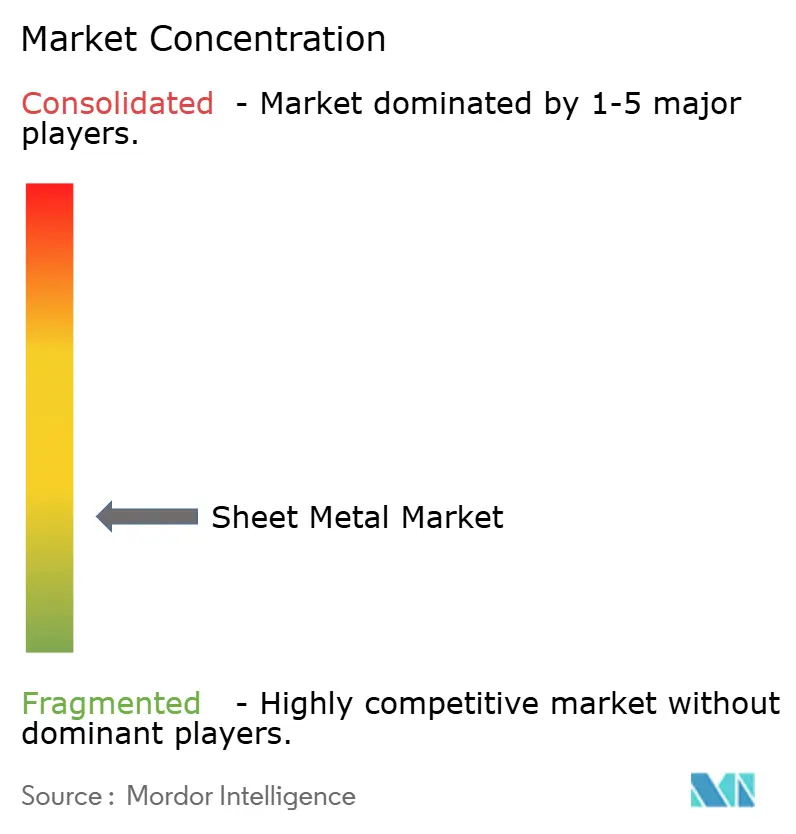
The sheet metal market is fragmented, and competition varies depending on a company's position in the value chain. At the raw material level, large steelmakers such as ArcelorMittal, China Baowu, Nippon Steel, and POSCO hold significant flat-rolled product capacity and shape the supply environment for many downstream players. At the fabrication level, the market is more dispersed, as regional service centers, contract fabricators, and job shops serve local and specialized demand. This creates a market where scale matters upstream, but operational differentiation matters downstream. As a result, strong players are not only large producers, but also companies that can connect material supply with higher-value processing and customer-specific formats.
Strategic deals and capacity partnerships reflect how companies are positioning for this shift. Nippon Steel completed its USD 14.9 billion acquisition of US Steel in June 2025 and committed an additional USD 11 billion in U.S. investments through 2028, strengthening its flat-rolled footprint in a protected domestic market. JFE Steel completed its integrated steelworks joint venture with JSW Steel in March 2026, adding 4.5 metric tons per annum (MTPA) of hot-rolled and cold-rolled sheet and coil capacity in India. POSCO and JSW Steel also signed a 50:50 joint venture to build a 6 MTPA integrated greenfield plant in Odisha, targeting high-value flat products for automotive applications. These moves indicate that the sheet metal market is attracting investment, with long-run demand for automotive-grade and specialty flat products appearing strongest.
Technology has become a significant competitive factor, as customers increasingly require low-carbon supply, better process control, and application-specific performance. Producers investing in electric arc furnaces, advanced rolling capabilities, and digital quality systems are working to secure stronger positions as procurement standards evolve. The same applies downstream, where precision fabricators can win work that basic volume shops cannot easily service. In this environment, the sheet metal market offers opportunities to companies that can combine material availability with tighter tolerances, reliable delivery, and lower embedded carbon exposure. The most visible opportunities are in coated sheets for energy storage systems, precision aluminum sheets for EV structures, and higher-strength structural products for modular construction. Competition is therefore unlikely to be decided by scale alone, even though scale remains a relevant factor.
Sheet Metal Industry Leaders
Nucor Corporation
NIPPON STEEL CORPORATION
ARCELORMITTAL
POSCO
China Baowu Steel Group
- *Disclaimer: Major Players sorted in no particular order

Recent Industry Developments
- July 2026: The EU approved funding for ArcelorMittal and Thyssenkrupp steel decarbonization projects, supporting both companies' transition toward direct reduced iron (DRI) and electric arc furnace-based flat steel production. This positions green flat steel sheet supply in Europe as a funded initiative.
- April 2026: JSW Steel and POSCO signed a joint venture agreement for a 6 MTPA integrated steel plant in Odisha, India, targeting high-value automotive-grade flat steel. The 50:50 venture, expected to be commissioned by 2031, will cover ironmaking, steelmaking, hot rolling, and cold rolling/galvanizing.


Global Sheet Metal Market Report Scope
Sheet metal is metal formed by industrial rolling into thin, flat pieces, generally measuring between 0.5 mm and 6 mm thick. Thinner pieces are classified as foil, and thicker pieces as plate. It is widely used in automotive bodies, appliances, and construction due to its versatility and strength.
The sheet metal market is segmented by material type, process, end-user industry, and geography. By material type, the market is segmented into steel, aluminum, titanium, and other materials. By process, the market is segmented into cutting, bending, stamping, roll forming, and other process. By end-user industry, the market is segmented into automotive, aerospace & defense, industrial machinery, buildings and construction, electrical & electronics, consumer goods, and other end users. The report also covers market size and forecasts for sheet metal across 16 countries in major regions. The market sizes and forecasts are provided in terms of value (USD).
| Steel |
| Aluminum |
| Titanium |
| Other Materials |
| Cutting |
| Bending |
| Stamping |
| Roll Forming |
| Other Process |
| Automotive |
| Aerospace & Defense |
| Industrial Machinery |
| Buildings and Construction |
| Electrical & Electronics |
| Consumer Goods |
| Other End Users |
| Asia-Pacific | China |
| India | |
| Japan | |
| South Korea | |
| Rest of Asia-Pacific | |
| North America | United States |
| Canada | |
| Mexico | |
| Europe | Germany |
| United Kingdom | |
| France | |
| Italy | |
| Russia | |
| Rest of Europe | |
| South America | Brazil |
| Argentina | |
| Rest of South America | |
| Middle-East and Africa | Saudi Arabia |
| South Africa | |
| Rest of Middle-East and Africa |
| By Material Type | Steel | |
| Aluminum | ||
| Titanium | ||
| Other Materials | ||
| By Process | Cutting | |
| Bending | ||
| Stamping | ||
| Roll Forming | ||
| Other Process | ||
| By End-User Industry | Automotive | |
| Aerospace & Defense | ||
| Industrial Machinery | ||
| Buildings and Construction | ||
| Electrical & Electronics | ||
| Consumer Goods | ||
| Other End Users | ||
| By Geography | Asia-Pacific | China |
| India | ||
| Japan | ||
| South Korea | ||
| Rest of Asia-Pacific | ||
| North America | United States | |
| Canada | ||
| Mexico | ||
| Europe | Germany | |
| United Kingdom | ||
| France | ||
| Italy | ||
| Russia | ||
| Rest of Europe | ||
| South America | Brazil | |
| Argentina | ||
| Rest of South America | ||
| Middle-East and Africa | Saudi Arabia | |
| South Africa | ||
| Rest of Middle-East and Africa | ||


Key Questions Answered in the Report
What is current market size of Sheet Metal Market?
The Sheet Metal Market size is expected to grow from USD 191.42 billion in 2025 to USD 204.85 billion in 2026 and is forecast to reach USD 287.55 billion by 2031 at 7.02% CAGR over 2026-2031.
Which region leads in global demand for sheet metal products?
Asia-Pacific led with 48.63% revenue share in 2025 and is also the fastest-growing regional market, with a projected 7.84% CAGR through 2031.
Which material segment is growing the fastest?
Steel remained dominant in 2025 with a 74.82% share, but aluminum is projected to grow the fastest, at an 8.33% CAGR through 2031, driven by lightweight demand.
Why is electronics becoming more important for fabricated sheet demand?
Electrical and electronics are forecast to grow at an 8.14% CAGR through 2031, driven by expanding data center racks, battery enclosures, inverter housing, and other precision applications.
Page last updated on:





