
Senior Care Technologies Market Size and Share
Market Overview
| Study Period | 2021 - 2032 |
|---|---|
| Market Size (2027) | USD 40.14 Billion |
| Market Size (2032) | USD 65.05 Billion |
| Growth Rate (2027 - 2033) | 10.14 % |
| Fastest Growing Market | Asia-Pacific |
| Largest Market | North America |
| Market Concentration | Medium |
Major Players *Disclaimer: Major Players sorted in no particular order Image © Mordor Intelligence. Reuse requires attribution under CC BY 4.0. | |
Senior Care Technologies Market Analysis by Mordor Intelligence
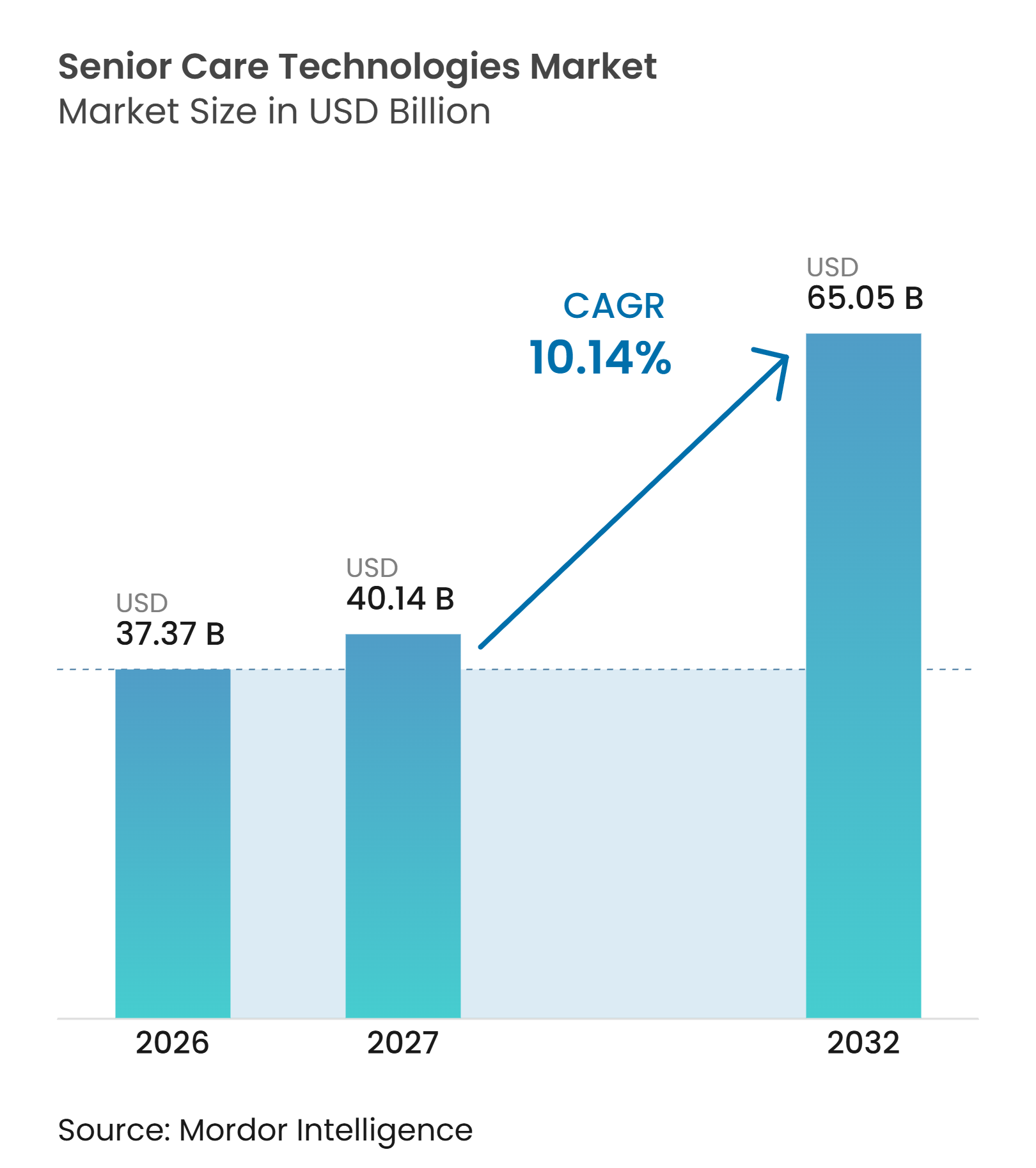
The Senior Care Technologies Market size is expected to grow from USD 37.37 billion in 2026 to USD 40.14 billion in 2027 and is forecast to reach USD 65.05 billion by 2032 at 10.14% CAGR over 2027-2032.
The senior care technologies market is shifting from stand-alone emergency devices toward connected tools that support prevention, observation, and remote clinical decisions. Population aging is widening the need for care support, while caregiver shortages make technology investment more practical for providers and families. AI-enabled analytics, local data processing, and connected sensors are improving the usefulness of monitoring in homes, senior living facilities, and post-acute care settings. Privacy, cybersecurity, interoperability, and component costs remain material constraints, especially where providers must connect new systems with established health records. The senior care technologies market also offers vendors a route to expand beyond facility buyers as families, health systems, and public agencies adopt more integrated approaches to aging at home.
Key Report Takeaways
- By product type, Remote Health Monitoring & Telehealth Systems held a 29.87% revenue share in 2026, while Robotics & Advanced Care Technologies is forecast to expand at an 18.32% CAGR through 2032.
- By component, Hardware held 46.35% revenue share in 2026, while Software & Platforms is forecast to expand at a 13.45% CAGR through 2032.
- By technology, Smart Home Technologies led the technology segment in 2026 with a 38.23% share, while IoT & AI & Machine Learning is forecast to expand at an 18.92% CAGR through 2032.
- By end user, Home Care Settings held 34.36% revenue share in 2026, while Family Caregivers & Independent Seniors is forecast to expand at a 13.36% CAGR through 2032.
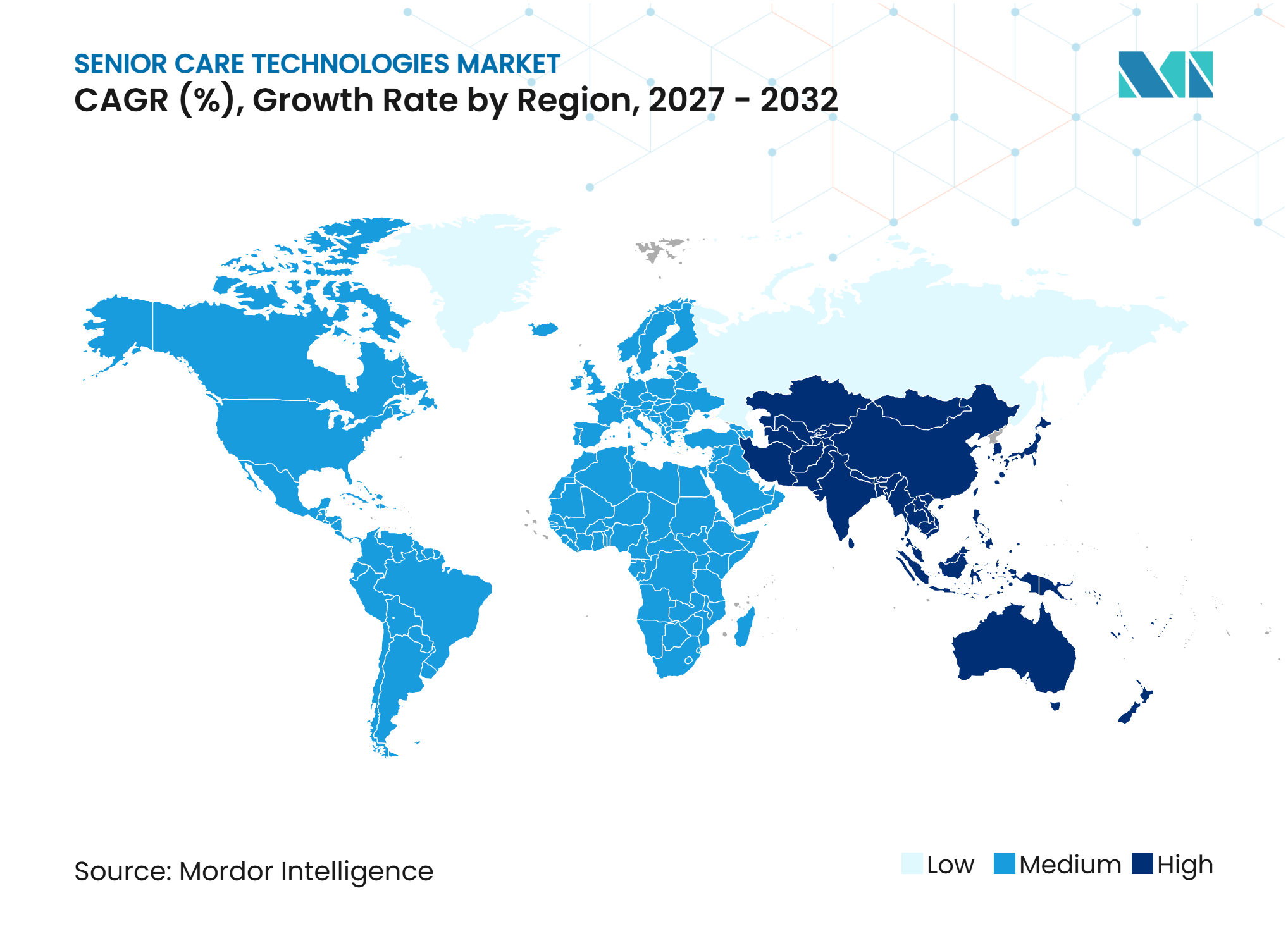
- By geography, North America held 44.36% of the senior care technologies market share in 2026, while Asia-Pacific is forecast to expand at a 16.54% CAGR through 2032.
Note: Market numbers in this report are based on Mordor Intelligence's proprietary estimation framework, which combines nine months of actuals with Q4 projections for base year 2026.
Market Trends and Insights
Drivers Impact Analysis of Senior Care Technologies Market*
| Driver | (~) % Impact on CAGR Forecast | Geographic Relevance | Impact Timeline |
|---|---|---|---|
| Aging Population and Longer Life Expectancy | +2.8% | Global | Long term (≥ 4 years) |
| Aging in Place and Proactive Remote Monitoring Adoption | +2.1% | North America and Europe | Medium term (2-4 years) |
| Caregiver Shortages and Staffing-Rule Pressure | +1.8% | North America, Europe, and core Asia-Pacific markets | Short term (≤ 2 years) |
| Connected-Care Ecosystem Integration | +1.1% | North America and Europe | Medium term (2-4 years) |
| Better AI Accuracy Across Sensing and Predictive Analytics | +1.3% | Global | Medium term (2-4 years) |
| Privacy-Preserving Ambient Sensing Replacing Cameras and Wearables | +0.7% | North America, Europe, and Asia-Pacific | Long term (≥ 4 years) |
| Source: Mordor Intelligence | |||
Aging Population and Longer Life Expectancy
The growing number of older adults is expanding the addressable need for continuous support across the senior care technologies market. The World Health Organization expects 1 in 6 people globally to be aged 60 or older by 2030, which places greater pressure on care systems and informal caregivers.[1]Older people with multiple health conditions often need routine observation for mobility, medication adherence, and changes in daily activity. This creates demand for solutions that combine health monitoring with fall prevention rather than focusing on a single risk. Japan shows how this transition can mature because government support for care technology is helping providers address a rapidly aging population. The senior care technologies market can therefore benefit from products that work across home, community, and facility settings.
Aging in Place and Proactive Remote Monitoring Adoption
Aging in place extends the role of remote monitoring beyond hospital discharge and into routine household care. Connected devices can transfer vital signs and activity information to clinical dashboards, allowing care teams to identify a change before it becomes an emergency. The growing use of virtual care models gives health systems a way to support people at home while maintaining clinical oversight. The senior care technologies market benefits when monitoring devices are simple enough for older adults and useful enough for family caregivers. Privacy-preserving sensors also make it easier to deploy monitoring in private spaces where cameras may face resistance. A 2025 study on lifestyle monitoring identified privacy concerns and notification overload as key barriers, reinforcing the importance of carefully designed workflows.[2]
Caregiver Shortages and Connected-Care Integration
Caregiver shortages are pushing providers to use technology for routine observation, alert screening, and documentation. A 2025 survey found that 78% of senior care leaders saw workforce shortages as a top operational challenge and 70% identified certified nursing assistants as the hardest group to retain.[3]Japan is expected to face a care worker shortfall of 570,000 by 2040, which strengthens the case for tools that help staff cover more residents safely. Integration matters because a care alert gains value when it reaches the resident record, medication workflow, and responsible caregiver without manual re-entry. PointClickCare introduced a senior living platform in 2025 that joins resident records, medication workflows, billing, and analytics in one interface.[4] These connected workflows can make the senior care technologies market more attractive to operators that need to show service quality while managing labor constraints.
Better AI Accuracy and Privacy-Preserving Ambient Sensing
Improved AI performance is making sensing data more useful for identifying falls, changes in mobility, and deviations from a daily routine. A 2025 BMC Geriatrics study found that an intervention using fall sensors and emergency support eliminated fall-related long-lie periods among its monitored participants. Local processing can reduce alert delays and limit the personal information sent outside the home or facility. Ambient radar and acoustic systems can address the common problem of cameras being viewed as intrusive and wearables being removed or left uncharged. Sensi.AI stated that its system analyzes sound patterns to flag care concerns without storing continuous audio, illustrating the commercial focus on privacy-sensitive monitoring. The senior care technologies market has room for vendors that can show both clinical usefulness and responsible data handling.
Restraints Impact Analysis of Senior Care Technologies Market*
| Restraint | (~) % Impact on CAGR Forecast | Geographic Relevance | Impact Timeline |
|---|---|---|---|
| Privacy, Cybersecurity, and Compliance Burden | -1.4% | Global | Short term (≤ 2 years) |
| Integration Cost and Legacy-System Complexity | -1.1% | North America and Europe | Short term (≤ 2 years) |
| Surveillance Trust Gap Among the Oldest-Old | -0.7% | Global | Medium term (2-4 years) |
| Tariff and Component Volatility in Sensors and Robotics | -0.4% | North America and Asia-Pacific | Short term (≤ 2 years) |
| Source: Mordor Intelligence | |||
Privacy, Cybersecurity, and Compliance Burden
Every connected sensor, remote monitoring device, and care platform can increase the number of systems that must be secured. A 2025 peer-reviewed study identified privacy and notification overload as recurring concerns for care managers and frontline caregivers implementing AI-based lifestyle monitoring. Providers must account for HIPAA requirements in the United States and GDPR obligations in Europe when they collect sensitive health and behavioral information. ISO 27001 certification and HIPAA Security Rule compliance are becoming important procurement considerations for enterprise buyers. These requirements can lengthen sales cycles and raise deployment costs for smaller providers. The senior care technologies market must therefore balance richer monitoring with clear consent, data minimization, and secure system design.
Integration Cost, Trust, and Component Volatility
Interoperability remains a difficult issue because health records, post-acute care systems, and home care tools frequently use different data structures. Argentum reported in 2025 that more than 77% of senior living executives ranked interoperability among the top 3 barriers to successful technology implementation, while 63% also cited limited funding. Custom interfaces can cost more than smaller providers can justify, widening the gap between large operators and independent facilities. The surveillance trust gap can also slow uptake when older users do not understand how a device observes them or what information it stores. Hardware vendors face further uncertainty when tariff changes or supply constraints affect sensors, communications components, and robotics equipment. These constraints may limit adoption in the senior care technologies market until vendors provide clearer integration plans, transparent privacy practices, and predictable device pricing.
*Our forecasts treat driver/restraint impacts as directional, not additive. The impact forecasts reflect baseline growth, mix effects, and variable interactions.
Senior Care Technologies Market Segment Analysis
By Product Type:
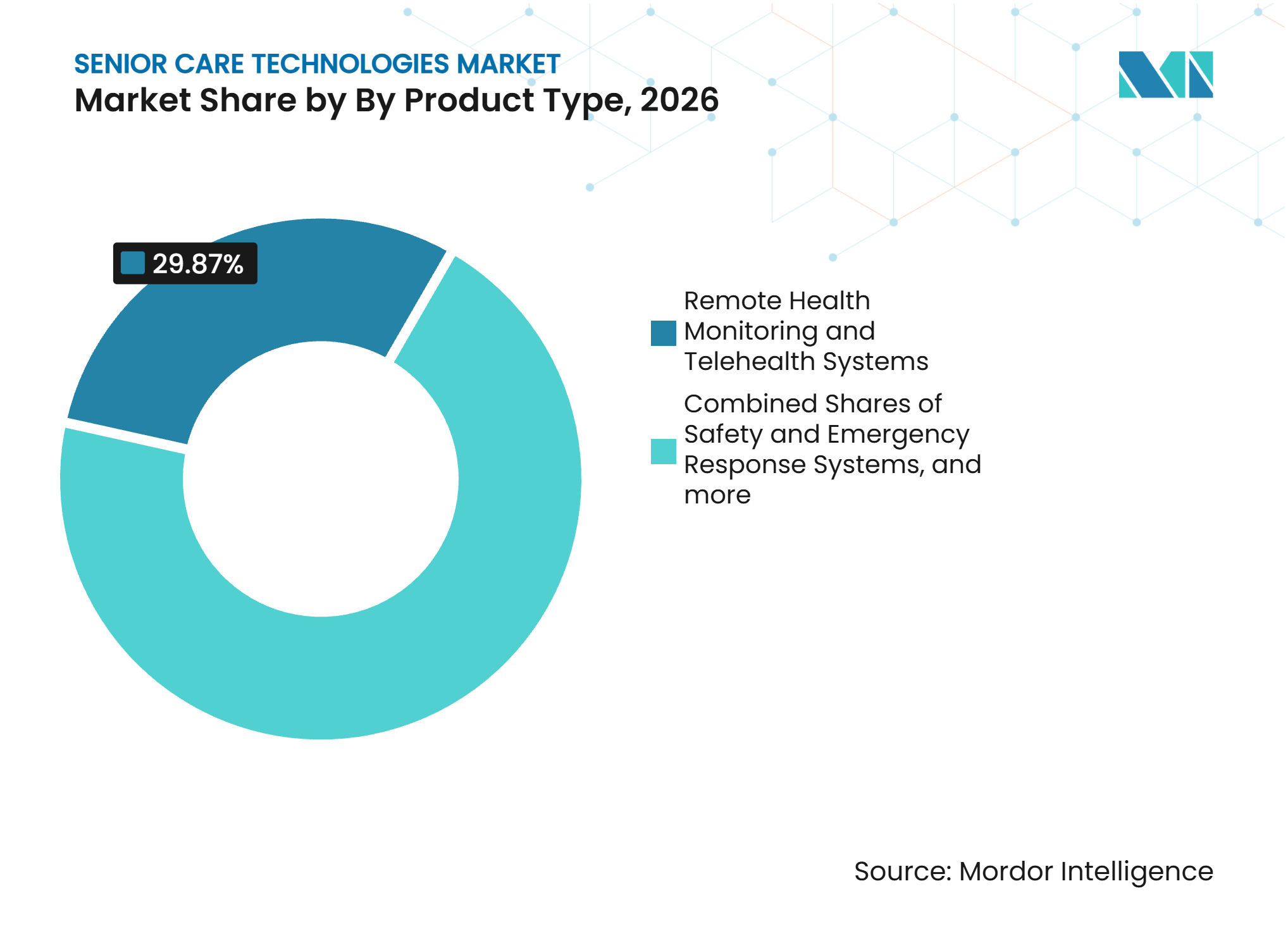
Telehealth Leads Revenue While Robotics Expands FastestRemote Health Monitoring & Telehealth Systems held 29.87% of the senior care technologies market share in 2026. The category benefits from the need to manage cardiovascular, respiratory, and metabolic conditions outside traditional inpatient settings. Connected measurement devices support ongoing review of vital signs and help care teams follow people after discharge.
Robotics & Advanced Care Technologies is forecast to record an 18.32% CAGR through 2032, the fastest rate among product types. The senior care technologies market size for robotics is supported by wider interest in companion functions, mobility support, and care task assistance. Barcelona deployed 600 personalized social companion robots in 2026 through a pilot focused on early cognitive decline, showing that municipal buyers are testing care robotics at scale.



By Component:
Hardware Holds the Largest Position While Software Builds Recurring RevenueHardware held 46.35% of the senior care technologies market share in 2026. Wearables, radar sensors, smart displays, medication dispensers, and communication devices form the physical layer that captures health and activity information. Smaller sensors and lower component costs widen access to individual resident monitoring. Hardware also remains important because even software-led care systems need dependable devices at the point of care.
Software & Platforms is forecast to grow at 13.45% CAGR through 2032. The segment benefits from recurring subscriptions that replace one-time device sales with longer-term operator relationships. The senior care technologies industry is increasingly organized around platforms that connect resident records, medication, billing, monitoring, and analytics. PointClickCare’s 2025 platform launch reflects this effort to consolidate operational and clinical workflows in one system.
By Technology:
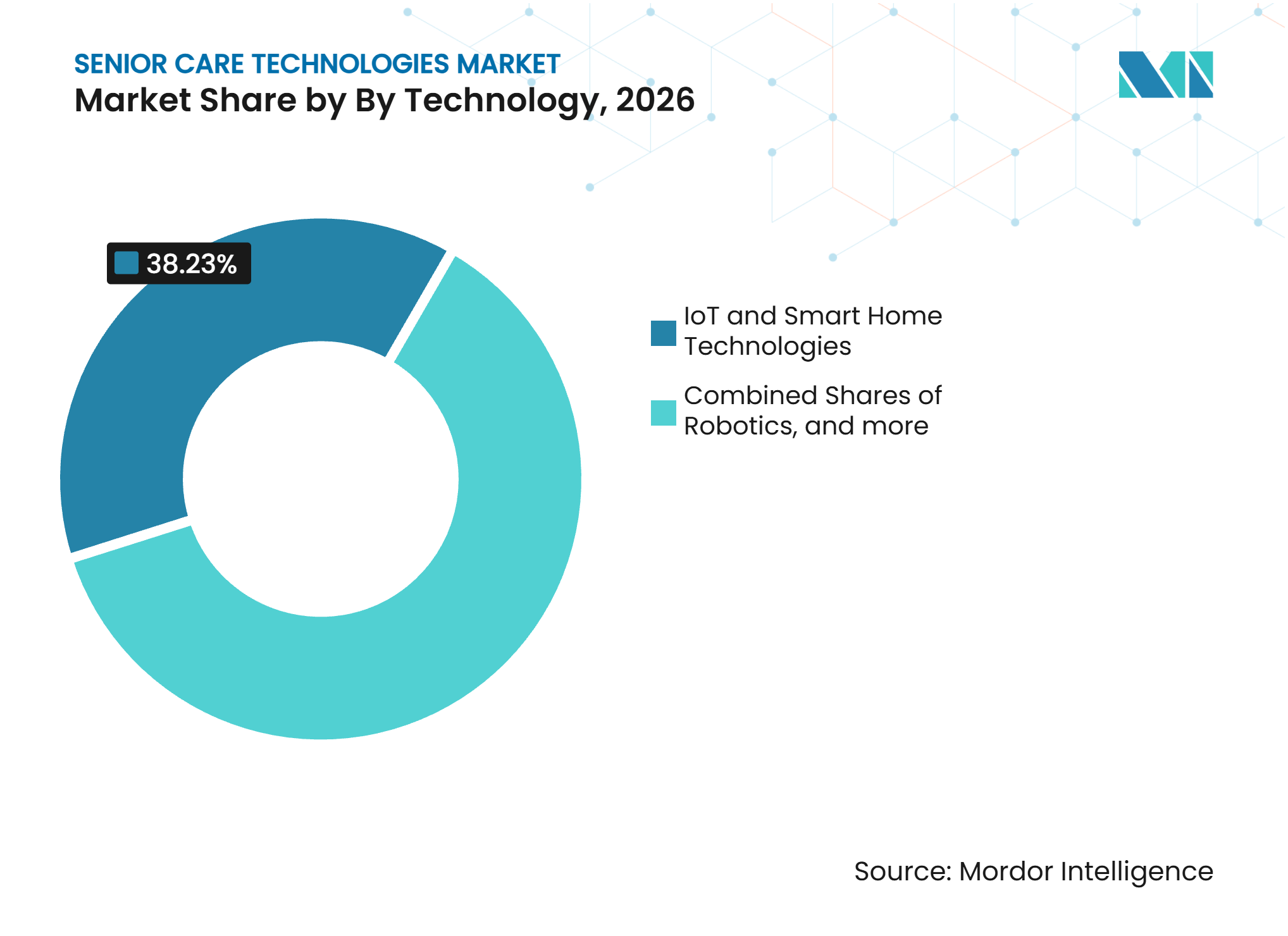
IoT and Smart Home Technologies Drive the Highest GrowthIoT & Smart Home Technologies held 38.23% of the senior care technologies market share in 2026. The senior care technologies market size for this segment is being supported by lower sensor costs, wider connectivity, and public investment in smart aging systems. Japan’s fiscal year 2025 subsidies support the introduction of care technologies, including monitoring and communication devices.
AI & Machine Learning is forecast to advance at a 18.92% CAGR through 2032. Models can review sensor streams and identify potential changes in behavior, gait, sleep, or routine. Robotics is moving from demonstrations to more formal care deployment in Japan, South Korea, and China. SoftBank Robotics registered Pepper in Japan’s welfare equipment information system in 2025, which made it eligible for care technology subsidies.

By End User:
Home Care Holds the Largest Position While Family Caregivers Expand FastestHome Care Settings held 34.36% of the senior care technologies market share in 2026. Older adults often prefer to receive support at home, which encourages use of monitoring, emergency response, medication, and communication tools in residential settings. A 2025 Journal of Medical Internet Research analysis found substantial research and commercial activity around AI, IoT, and edge intelligence in long-term care.
Family Caregivers & Independent Seniors is forecast to grow at a 13.36% CAGR through 2032. This segment is supported by consumer health devices, family alert systems, and services for relatives living in a different city or country. The senior care technologies industry can reach this group when products are practical for nonclinical users and provide clear alerts rather than raw data.
Geography Analysis
North America
North America held 44.4% of the senior care technologies market share in 2026. High healthcare spending developed telehealth infrastructure, and persistent caregiver shortages support adoption across the region. Large senior living operators are integrating monitoring and documentation platforms, while smaller providers are testing AI-supported observation to maintain service levels. SafelyYou stated that its platform operates in 34 U.S. states and is used by 50% of the sector’s largest providers after its January 2025 Series C funding round.
Asia-Pacific
Asia-Pacific is forecast to grow at a 16.5% CAGR through 2032. Japan’s care technology policy and subsidies are supporting monitoring and communication device adoption in facilities. China brings manufacturing capacity to care robotics, as illustrated by Foxconn’s 2025 USD 10 million investment in Robocore Technology to fund production of 30,000 nursing home robots. South Korea is developing home care data capabilities through partnerships that combine AI and health service delivery. Singapore is expanding its Alert Alarm System for seniors in public rental flats through LoRaWAN connectivity.
Europe
Europe combines strong regulatory influence with uneven implementation across countries. DAK-Gesundheit reported in 2025 that 70% of Germany’s 32,000 ambulatory and stationary care facilities remained unconnected to the national Telematikinfrastruktur despite the legal requirement. GDPR compliance shapes provider decisions where monitoring systems collect personal and behavioral data. Rome introduced an EU-funded program in 2026 that used smart bracelets to monitor 700 older residents, demonstrating a public infrastructure approach to remote support.
Competitive Landscape
Market Concentration
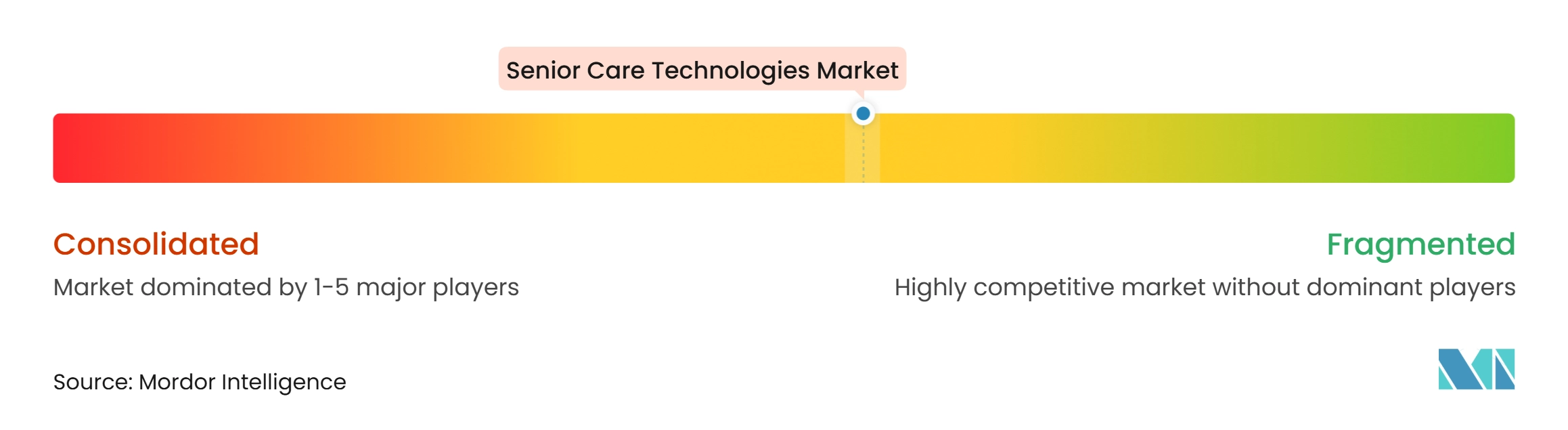
The senior care technologies market is moderately fragmented across global healthcare companies, senior care software specialists, and AI-focused providers. Large companies can build established monitoring portfolios and customer relationships. Specialists often compete through their knowledge of senior living workflows and integration requirements. AI-focused companies seek differentiation through sensing data, predictive models, and intellectual property. Medtronic and Philips formed a multi-year partnership in 2025 to embed Medtronic monitoring technologies into Philips patient monitoring platforms.
Competition is increasingly focused on whether suppliers can provide a connected operating system rather than a single device. Vendors are combining monitoring, resident records, medication workflows, care coordination, and analytics in integrated offerings. PointClickCare’s 2025 platform launch is an example of this strategy within senior living operations. Rural areas, cross-border family care, and non-English language support remain less developed areas of competition. Limited broadband can make continuous remote monitoring less practical in remote communities. Cross-border coordination platforms address the needs of families who support older relatives from another country. Companies are also seeking value-based care arrangements by linking their solutions to fewer falls and reduced hospital use.
Senior Care Technologies Industry Leaders
-
Koninklijke Philips N.V.
-
Medtronic plc
-
Tunstall Healthcare Ltd
-
PointClickCare Technologies Inc.
-
Best Buy Health, Inc.
- *Disclaimer: Major Players sorted in no particular order
Senior Care Technologies Market Companies Covered in this Report
- Best Buy Health, Inc.
- CarePredict Inc.
- Cochlear
- Connect America Holdings LLC
- Demant
- GN Store Nord
- Intuition Robotics Ltd.
- K4Connect, Inc.
- Koninklijke Philips
- Medtronic
- MobileHelp LLC
- Nobi Smart Lights
- OMRON Healthcare Co. Ltd.
- PointClickCare Technologies Inc.
- SafelyYou, Inc.
- Sensi.AI
- Tunstall Healthcare Ltd.
- Vayyar Imaging Ltd.
Recent Industry Developments in Senior Care Technologies Market
- June 2026: Rome's city administration implemented an EU-funded EUR 400 million (USD 439.7 million) scheme covering 700 elderly residents with smart electronic bracelets monitoring heart rate, falls, sleep, and outdoor movement in real time, establishing a city-scale precedent for government-mandated ambient senior care infrastructure.
- November 2025: PointClickCare launched its next-generation senior living platform, integrating resident management, medication workflows, billing, and AI-powered analytics into a unified care network.
Global Senior Care Technologies Market Report Scope
As per the scope of the report, senior care technologies are tools and systems designed to support older adults’ health, safety, independence, and quality of life.
The market encompasses a broad range of product categories, including safety & emergency response systems; fall detection & prevention systems; remote health monitoring & telehealth systems; medication management systems; cognitive & social engagement systems; assistive living & mobility technologies; robotics & advanced care technologies; and other solutions, such as smart nutrition & wellness management solutions and hearing & communication assistance technologies. Based on components, the market is segmented into hardware, software & platforms, and services.
By technology, the market is categorized into artificial intelligence (AI) & machine learning, IoT & smart home technologies, robotics, computer vision & ambient sensing, voice & conversational AI, and other technologies. By end user, the market is segmented into home care settings, senior living facilities, hospitals & clinics, rehabilitation centers, family caregivers & independent seniors, and other end users, including long-term care & skilled nursing facilities and government & community care organizations. Geographically, the market is segmented into North America, Europe, Asia-Pacific, the Middle East & Africa, and South America. For each segment, the report provides market size and forecasts in terms of value (USD).
Segmentation Overview
| Safety & Emergency Response Systems |
| Fall Detection & Prevention Systems |
| Remote Health Monitoring & Telehealth Systems |
| Medication Management Systems |
| Cognitive & Social Engagement Systems |
| Assistive Living & Mobility Technologies |
| Robotics & Advanced Care Technologies |
| Other Product Types (Smart Nutrition & Wellness Management Solutions, Hearing & Communication Assistance Technologies) |
| Hardware |
| Software & Platforms |
| Services |
| AI & Machine Learning |
| IoT & Smart Home Technologies |
| Robotics |
| Computer Vision & Ambient Sensing |
| Voice & Conversational AI |
| Other Technologies |
| Home Care Settings |
| Senior Living Facilities |
| Hospitals & Clinics |
| Rehabilitation Centers |
| Family Caregivers & Independent Seniors |
| Other End Users (Long-Term Care & Skilled Nursing Facilities, Government & Community Care Organizations) |
| North America | United States |
| Canada | |
| Mexico | |
| Europe | Germany |
| United Kingdom | |
| France | |
| Italy | |
| Spain | |
| Rest of Europe | |
| Asia-Pacific | China |
| India | |
| Japan | |
| Australia | |
| South Korea | |
| Rest of Asia-Pacific | |
| Middle East and Africa | GCC |
| South Africa | |
| Rest of Middle East and Africa | |
| South America | Brazil |
| Argentina | |
| Rest of South America |
| By Product Type | Safety & Emergency Response Systems | |
| Fall Detection & Prevention Systems | ||
| Remote Health Monitoring & Telehealth Systems | ||
| Medication Management Systems | ||
| Cognitive & Social Engagement Systems | ||
| Assistive Living & Mobility Technologies | ||
| Robotics & Advanced Care Technologies | ||
| Other Product Types (Smart Nutrition & Wellness Management Solutions, Hearing & Communication Assistance Technologies) | ||
| By Component | Hardware | |
| Software & Platforms | ||
| Services | ||
| By Technology | AI & Machine Learning | |
| IoT & Smart Home Technologies | ||
| Robotics | ||
| Computer Vision & Ambient Sensing | ||
| Voice & Conversational AI | ||
| Other Technologies | ||
| By End User | Home Care Settings | |
| Senior Living Facilities | ||
| Hospitals & Clinics | ||
| Rehabilitation Centers | ||
| Family Caregivers & Independent Seniors | ||
| Other End Users (Long-Term Care & Skilled Nursing Facilities, Government & Community Care Organizations) | ||
| By Geography | North America | United States |
| Canada | ||
| Mexico | ||
| Europe | Germany | |
| United Kingdom | ||
| France | ||
| Italy | ||
| Spain | ||
| Rest of Europe | ||
| Asia-Pacific | China | |
| India | ||
| Japan | ||
| Australia | ||
| South Korea | ||
| Rest of Asia-Pacific | ||
| Middle East and Africa | GCC | |
| South Africa | ||
| Rest of Middle East and Africa | ||
| South America | Brazil | |
| Argentina | ||
| Rest of South America | ||
Key Questions Answered in the Report
What is the projected growth outlook for the Senior Care Technologies Market?
The senior care technologies market is projected to grow from USD 37.37 billion in 2026 to USD 40.14 billion in 2027 and reach USD 65.05 billion by 2032, registering a CAGR of 10.14% during the 2027-2032 forecast period.
What is the largest product category in senior care technologies?
Remote Health Monitoring & Telehealth Systems held 29.87% revenue share in 2026.
Which technology is growing fastest in senior care?
AI & Machine Learning is forecast to grow at a 18.92% CAGR through 2032, supported by connected sensors and smart aging programs.
Why are senior care providers adopting AI monitoring?
AI monitoring can help staff prioritize care alerts, identify changes in daily patterns, and support fall prevention while caregiver shortages persist.
Which end user segment leads senior care technology adoption?
Home Care Settings held 34.36% share in 2026 as older adults and care systems increasingly support aging at home.
Which region is growing fastest for senior care technologies?
Asia-Pacific is forecast to expand at a 16.54% CAGR through 2032, supported by policy initiatives, manufacturing capacity, and urban care infrastructure.