
Secure Email Certificate Market Size and Share
Market Overview
| Study Period | 2021 - 2032 |
|---|---|
| Market Size (2027) | USD 0.68 Billion |
| Market Size (2032) | USD 1.27 Billion |
| Growth Rate (2027 - 2032) | 16.28 % |
| Fastest Growing Market | Asia-Pacific |
| Largest Market | North America |
| Market Concentration | Medium |
Major Players *Disclaimer: Major Players sorted in no particular order Image © Mordor Intelligence. Reuse requires attribution under CC BY 4.0. | |
Secure Email Certificate Market Analysis by Mordor Intelligence
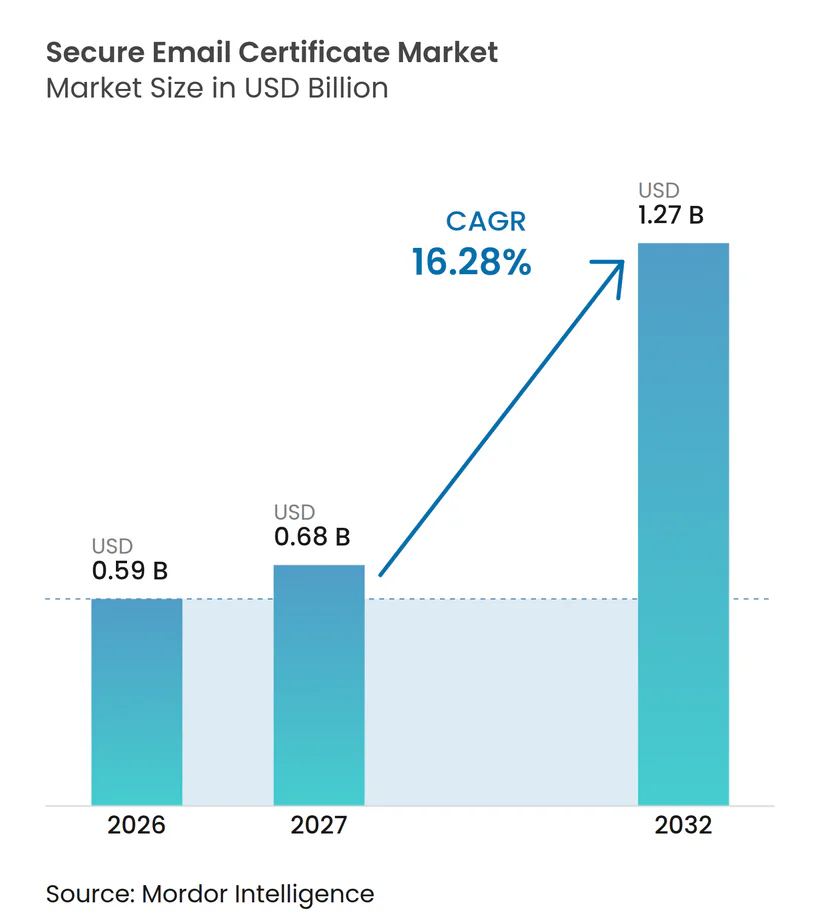
The Secure email certificate market size is projected to expand from USD 0.59 billion in 2026 and USD 0.68 billion in 2027 to USD 1.27 billion by 2032, registering a CAGR of 16.28% between 2027 to 2032. Rising losses from business email compromise are moving authenticated email from an optional control to a more formal security requirement. Enterprises are also facing shorter certificate validity periods and tighter identity rules, which make renewal processes more important. Hybrid work has increased the number of mail clients, cloud services, and endpoints that must exchange trusted messages. Providers are responding by combining certificate issuance, lifecycle management, DMARC enforcement, and brand identity credentials. The Secure email certificate market therefore favors vendors that can simplify deployment while meeting changing public-trust requirements.
Key Report Takeaways
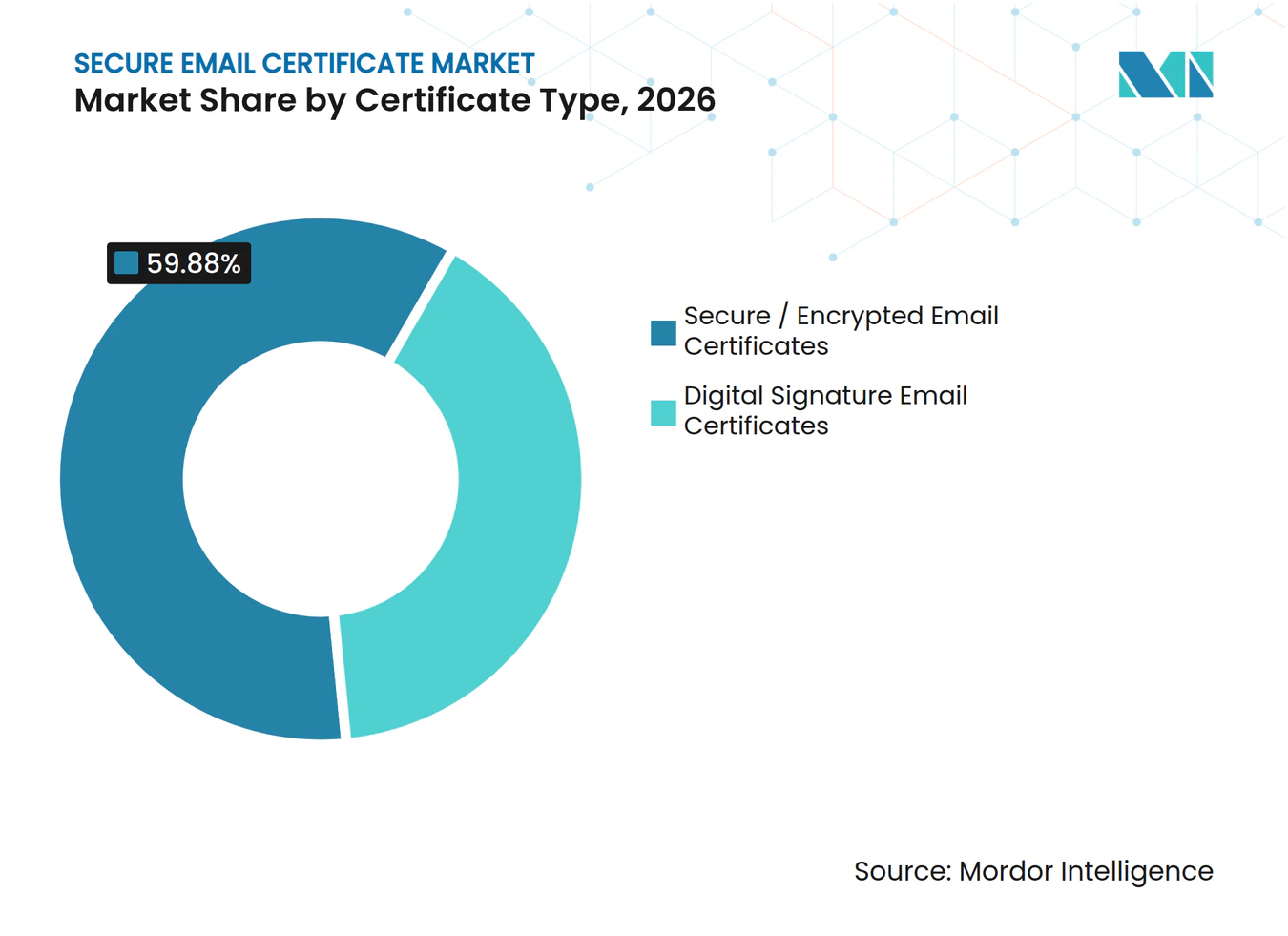
- By certificate type, Secure or Encrypted Email Certificates held 59.88% of the Secure email certificate market share in 2026, while Digital Signature Email Certificates are projected to expand at a 17.71% CAGR through 2032.
- By validation profile, Mailbox-Validated Certificates held 44.32% of revenue in 2026, while Sponsor-Validated Certificates are projected to expand at a 17.14% CAGR through 2032.
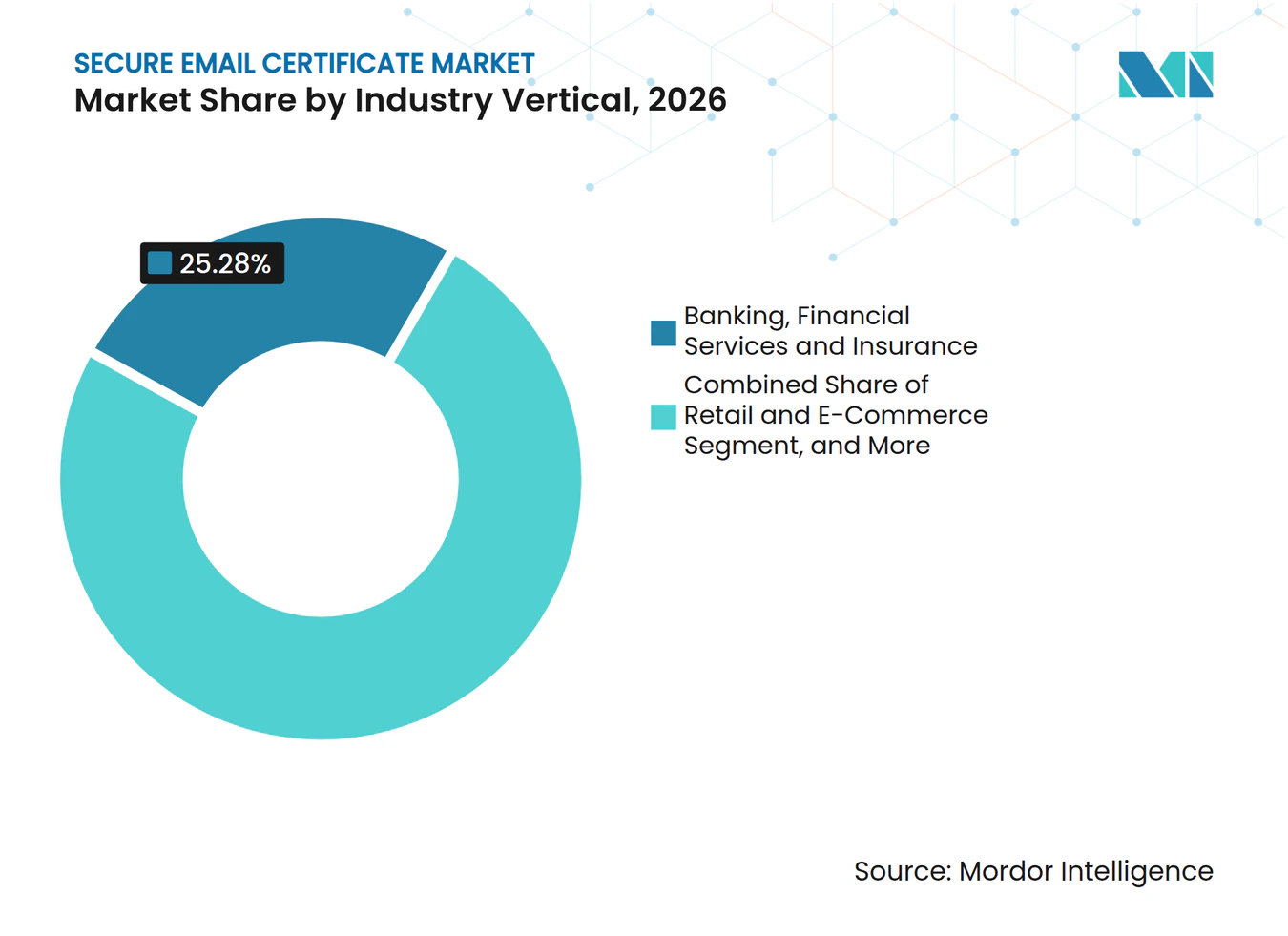
- By industry vertical, BFSI held 25.28% of revenue in 2026, while Information Technology and Telecommunications are projected to expand at a 17.32% CAGR through 2032.
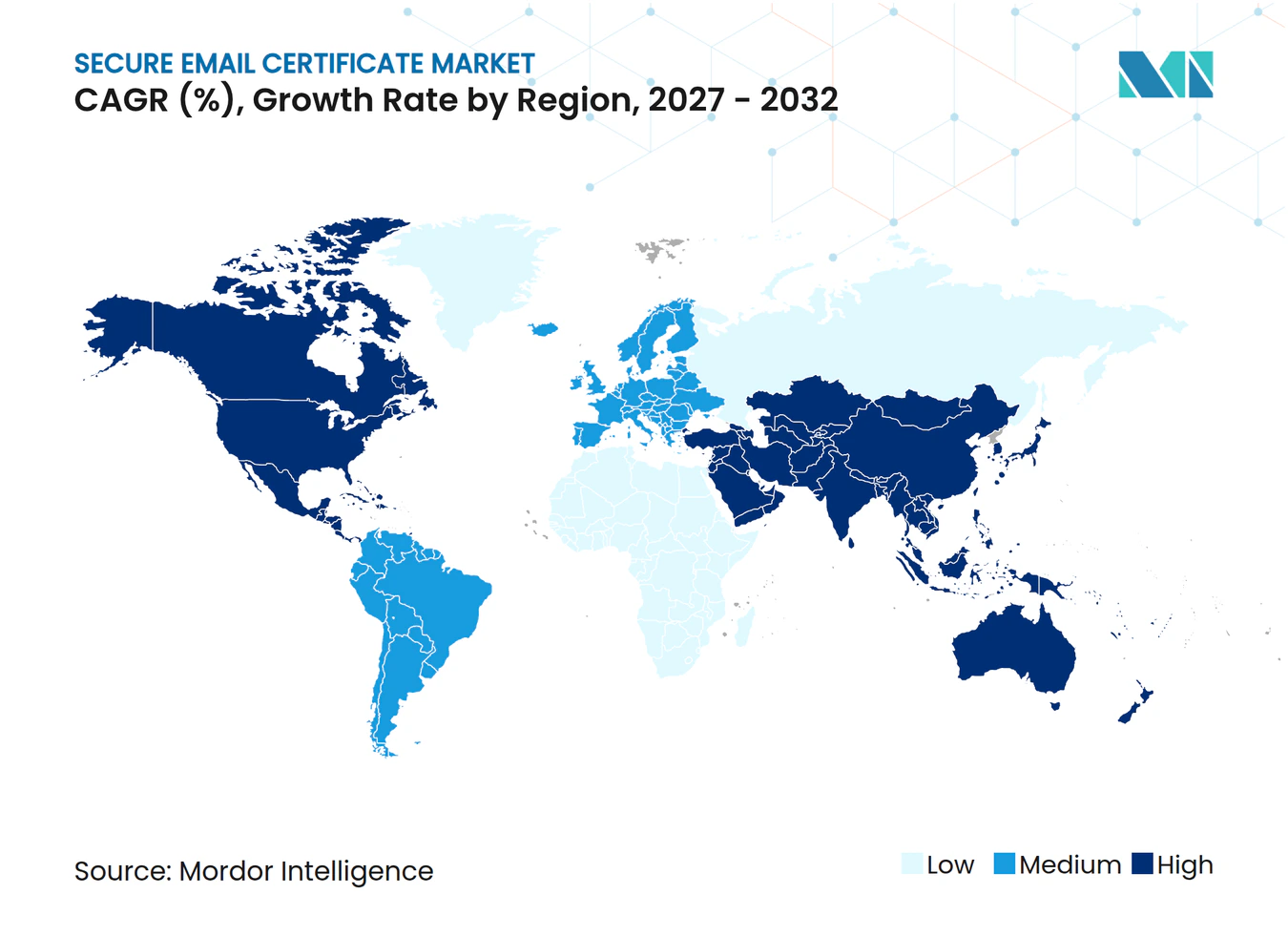
- By geography, North America held 39.77% of revenue in 2026, while Asia-Pacific is projected to expand at a 17.45% CAGR through 2032.
Note: Market numbers in this report are based on Mordor Intelligence's proprietary estimation framework, which combines nine months of actuals with Q4 projections for base year 2026.
Market Trends and Insights
Drivers Impact Analysis of Secure Email Certificate Market*
| Driver | (~) % Impact on CAGR Forecast | Geographic Relevance | Impact Timeline |
|---|---|---|---|
| Escalating Business Email Compromise and Phishing Losses | +3.8% | Global | Short term (≤ 2 years) |
| Mandatory Secure Email Compliance and Auditability | +3.2% | North America and Europe, with spillover to Asia-Pacific | Medium term (2-4 years) |
| Cloud and Hybrid Workforce Expansion | +2.5% | Global | Medium term (2-4 years) |
| Automated S/MIME Lifecycle Management Adoption | +2.0% | North America and Europe, expanding to Asia-Pacific | Medium term (2-4 years) |
| Cross-Platform Email Trust Requirements | +1.5% | Global | Long term (≥ 4 years) |
| BIMI and Verified Brand Identity Adoption | +1.0% | North America and Europe, broadening globally | Medium term (2-4 years) |
| Source: Mordor Intelligence | |||
Escalating Business Email Compromise and Phishing Losses Propel Certificate Adoption
Business email compromise is a major reason organizations are reassessing email identity controls in the Secure email certificate market. The FBI recorded USD 3.05 billion in reported BEC losses across 24,768 complaints in 2025, although the record covers only voluntarily reported United States cases.[1] Signed S/MIME email associates a message with a validated certificate, which helps recipients verify the sender identity. The control is especially relevant when spoofed headers or convincing content can pass basic filtering. Certificate-based authentication also gives security teams an auditable record of issuance and renewal. These conditions are shifting certificate spending toward measurable fraud prevention and governance needs.
Mandatory Secure Email Compliance and Auditability Drive Enterprise Deployment
Compliance requirements are increasing the nonoptional part of demand in the Secure email certificate market. The CA/Browser Forum retired the Legacy S/MIME generation profile in July 2025, requiring new, renewed, and reissued certificates to use Strict or Multipurpose profiles.[2] The newer profiles have a maximum validity period of 825 days, which requires organizations to manage renewals more regularly. Germany's Federal Office for Information Security promoted secure email transport and email authentication through its 2025 national initiative. NHS England also requires organizations using its Secure Email Standard to meet defined security requirements. Such rules make recurring lifecycle management more valuable than one-time certificate purchases.
Cloud and Hybrid Workforce Expansion Intensifies Secure Messaging Demand
Cloud and hybrid work have created more paths for enterprise mail to move between systems. Microsoft states that hybrid Exchange deployments need certificates to secure communication between on-premises and cloud environments.[3] Each endpoint and service connection adds a certificate provisioning and renewal task. Private keys also need controlled access across desktop, mobile, and web clients. This raises the value of centralized identity and key management for organizations with distributed workforces. The Secure email certificate market benefits when buyers replace manual processes with managed issuance. It also exposes weaknesses when a certificate is not available or trusted across every email client used by employees.
Automated S/MIME Lifecycle Management Lowers Deployment Barriers at Scale
Automation reduces the administrative effort that has limited broad S/MIME deployment. The CA/Browser Forum ratified Ballot SMC010 in July 2025, establishing ACME support for S/MIME automation. The protocol supports workflows for issuance, renewal, revocation, and related certificate operations. GMO GlobalSign introduced its LifeCycleX platform in September 2025 for certificate discovery, inventory, and automated provisioning across several environments. Central management can help organizations identify certificates before they expire and reduce manual handling. The Secure email certificate market is consequently moving toward platforms that connect certificate processes to IT and employee lifecycle workflows.
Restraints Impact Analysis of Secure Email Certificate Market*
| Restraint | (~) % Impact on CAGR Forecast | Geographic Relevance | Impact Timeline |
|---|---|---|---|
| Certificate Deployment and Key-Recovery Complexity | -2.2% | Global | Short term (≤ 2 years) |
| Inconsistent Mail-Client and Root-Store Interoperability | -1.6% | Global | Medium term (2-4 years) |
| Limited Recipient-Side S/MIME Adoption | -1.2% | Global, pronounced in Asia-Pacific and emerging markets | Long term (≥ 4 years) |
| Post-Quantum Migration and Profile-Transition Uncertainty | -0.9% | Global, concentrated in North America, Europe, and advanced Asia-Pacific | Long term (≥ 4 years) |
| Source: Mordor Intelligence | |||
Certificate Deployment and Key-Recovery Complexity
Key recovery remains difficult for organizations that must retain access to encrypted records after employees leave. Those organizations need defined escrow and access procedures while protecting private keys from misuse. A January 2025 partnership announcement by Echoworx cited a deployment survey in which 40% of organizations had adopted enhanced email security. The material identified deployment complexity as a central barrier to adoption. ACME can automate certificate issuance, but it does not resolve internal decisions on key ownership, recovery authorization, and retention. The Secure email certificate market therefore depends on providers and internal teams that can make these controls practical for mid-market buyers.
Inconsistent Mail-Client and Root-Store Interoperability Limits Adoption
S/MIME requires compatible behavior across both the sender's and recipient's email clients. JIPDEC reported in 2025 that only 7 of 13 tested mail-client combinations correctly supported S/MIME signing and encryption in both directions. Differences in browser and operating-system root stores can also require organizations to replace certificates when a root relationship changes. Entrust stated that Apple operating systems would no longer trust Entrust-issued S/MIME certificates after November 2024. Microsoft documentation also recorded rendering problems for S/MIME messages in newer Outlook versions. These differences can weaken user confidence and delay planned rollouts in the Secure email certificate market.
*Our forecasts treat driver/restraint impacts as directional, not additive. The impact forecasts reflect baseline growth, mix effects, and variable interactions.
Secure Email Certificate Market Segment Analysis
By Certificate Type:
Encryption Leads as Signature Certificates AccelerateSecure or Encrypted Email Certificates held 59.88% of the Secure email certificate market share in 2026. Their position reflects the need to protect message confidentiality where regulated information is exchanged. Organizations increasingly issue these certificates through centrally managed employee provisioning programs. Sponsor-Validated and Organization-Validated profiles are particularly suited to this administrative model. The July 2025 retirement of the Legacy generation profile shortened the maximum validity period available under older arrangements. That change has increased the importance of scheduled renewal and certificate inventory controls. Organization-Validated encryption certificates are also relevant to European financial services that use qualified trust service frameworks. The Secure email certificate market continues to favor deployments that can maintain confidentiality without interrupting daily communication.
Digital Signature Email Certificates are projected to expand at a 17.71% CAGR through 2032. Signing is useful for organizations that need to authenticate outbound messages without requiring every recipient to hold a matching certificate. This model supports communications from financial institutions, government agencies, and health organizations to broad recipient groups. The Secure email certificate industry is therefore seeing stronger interest in signing certificates for asymmetric communication settings. CA/Browser Forum Ballot SMC011 introduced post-quantum algorithm support into S/MIME requirements in August 2025. Composite hybrid signing schemes can include classical and post-quantum components. NIST's transition planning sets 2035 as the outer federal deadline for migration to post-quantum cryptography. This allows organizations to incorporate future cryptographic needs into certificate planning. The Secure email certificate market can benefit as buyers replace isolated signing tools with managed certificate programs.


By Validation Profile:
Mailbox Validation Dominant, Sponsor Profiles RisingMailbox-Validated Certificates held 44.32% of the validation profile segment in 2026. They are accessible because issuance requires confirmation that the applicant controls the email address. This makes them a common choice for individuals and small businesses. However, the profile does not verify the legal organization behind the mailbox. That limitation can matter when recipients need assurance that a message represents a named entity. Organization-Validated Certificates provide that additional identity connection. The Secure email certificate market size for mailbox validation remains supported by its simple enrollment process. Organizations using higher-assurance profiles increasingly connect issuance to human resources records and corporate identity systems. The Secure email certificate market is supported when enrollment fits existing employee administration processes.
Sponsor-Validated Certificates are projected to expand at a 17.14% CAGR through 2032. Their model lets an organization provision certificates for many employees under a managed process. Ballot SMC009 requires public certificate authorities to include the recipient's given name and surname in the subject name of Sponsor-Validated S/MIME certificates. The rule strengthens the identity link but increases the need for accurate employee data at issuance. Individual-Validated Certificates also serve legal and notarial uses where the identity of a natural person matters. Spain's FNMT-RCM updated its certification practices in March 2025 to add subordinate certificate authorities aligned with S/MIME baseline requirements. The Secure email certificate industry benefits when identity verification methods become easier to use without reducing assurance. The Secure email certificate market also depends on certificate authorities applying the rules consistently across applicant types.
By Industry Vertical:
BFSI Commands Lead While IT and Telecommunications Gain GroundBFSI held a 25.28% revenue share in 2026. Financial organizations handle sensitive communications and face strict requirements for information security, traceability, and customer trust. This makes authenticated and encrypted email a practical control for internal and external exchanges. Healthcare and life sciences also have institutional demand because sensitive data requires protected communication. NHS England's Secure Email Standard provides a defined security framework for health and social care organizations. Government and defense demand is supported by national digital identity and public key infrastructure programs. SECOM Trust Systems supplies S/MIME certificates for Japanese government use cases, including electronic tax filing. The Secure email certificate market has a stable base where institutional communication policies require authenticated exchanges.
Information Technology and Telecommunications are projected to expand at a 17.32% CAGR through 2032. Technology businesses transmit intellectual property and privileged access information through email, increasing the value of sender authentication. Legal and professional services also need evidence that can support nonrepudiation requirements across jurisdictions. Manufacturing, energy, retail, e-commerce, and other sectors add demand as digital workflows mature. The Secure email certificate market size in these sectors will depend on whether organizations can apply security controls without adding excessive administrative work. Automated lifecycle tools make certificate programs more manageable across large employee groups. Broader adoption is also supported when certificate issuers integrate email authentication and brand identity services. These patterns widen the customer base beyond heavily regulated organizations. Buyers can begin with targeted deployments before applying certificate controls across broader employee groups.


Geography Analysis
North America Secure Email Certificate Market
North America held 39.77% of revenue in 2026. The region combines high reported fraud exposure with mature enterprise security programs, and the FBI's 2025 report recorded USD 3.05 billion in BEC losses reported to its Internet Crime Complaint Center. This has reinforced demand for tools that verify message origin and protect content. Canada's cyber center recommends S/MIME as part of its email security best practices for government and critical infrastructure systems. United States organizations have a large installed base of cloud and hybrid email environments, while Mexico contributes through expanding digital financial services despite lower mid-market adoption.
APAC and Middle East Secure Email Certificate Market
Asia-Pacific is projected to expand at a 17.45% CAGR through 2032. JIPDEC reported that 34.2% of Japanese enterprises used S/MIME email signing in March 2025 and 33.2% planned future adoption. These figures point to a substantial group of organizations that have not yet deployed the technology, creating room for the Secure email certificate market to convert planned adoption into implementation. GMO GlobalSign expanded its TLS Connect certificate lifecycle management platform to small and medium enterprises across Asia-Pacific and the Middle East in August 2026, and the Secure email certificate market gains from this shift toward scalable deployment options.
EMEA and South America Secure Email Certificate Market
Europe has material demand under the eIDAS qualified trust service framework and national email security programs, while Germany's BSI TR-03108 and TR-03182 guidelines give organizations a technical route for secure email transport and authentication. The United Kingdom's NHS standard also supports broad institutional deployment in health and social care. The Middle East is at an earlier adoption stage, led by cybersecurity strategies and BFSI requirements in the United Arab Emirates and Saudi Arabia. South America and Africa represent smaller regional contributions, although banking digitalization is creating the organizational conditions for certificate adoption.
Competitive Landscape
Market Concentration
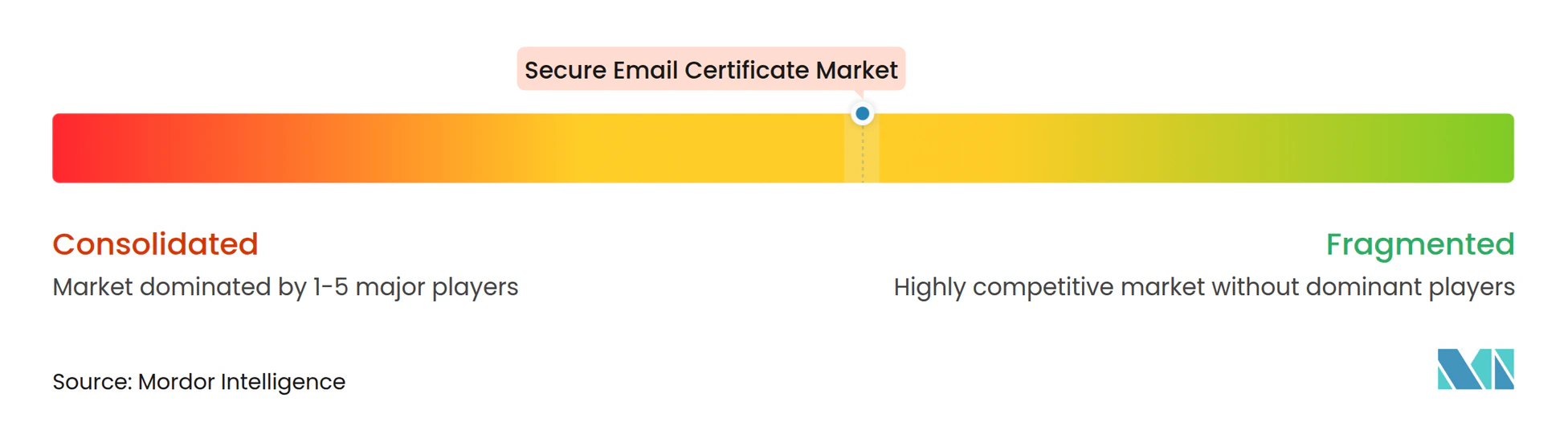
The Secure email certificate market has moderate concentration among global certificate authorities, alongside regional providers that serve local identity and trust requirements, and DigiCert acquired Valimail in September 2025 to add DMARC enforcement and BIMI capability to its digital trust platform. The move expanded its offer from certificate issuance to broader email authentication. Sectigo completed the migration of more than 500,000 certificates from Entrust Certificate Services to its Certificate Manager in September 2025. This consolidation gives large providers more scale in lifecycle management, and the Secure email certificate market becomes more oriented toward platform delivery. Smaller and regional certificate authorities remain important where domestic trust relationships and regulatory familiarity guide buyer decisions.
The Secure email certificate market also has room in the small and medium enterprise segment because ACME-based automation can reduce the manual work needed to issue and renew certificates. This makes S/MIME deployment more accessible for organizations that cannot maintain large internal public key infrastructure teams. Regional providers such as SECOM Trust Systems in Japan, TrustAsia Technologies in China, and Asseco Data Systems in Poland can compete through local market knowledge. Their role remains significant where customers favor domestic support and local regulatory expertise.
Product strategy is moving toward integrated certificate, lifecycle, DMARC, and brand identity services, and Sectigo integrated Verified Mark Certificates and Common Mark Certificates into its Certificate Manager in February 2026. GMO GlobalSign launched LifeCycleX in September 2025 to centralize discovery, inventory, and automated provisioning across certificate environments. CA/Browser Forum support for post-quantum algorithms also makes cryptographic readiness a more relevant vendor capability. The Secure email certificate market is likely to reward providers that make compliance changes easier for customers to absorb.
Secure Email Certificate Industry Leaders
-
DigiCert, Inc.
-
Sectigo Limited
-
GMO GlobalSign, Inc.
-
Entrust Corporation
-
IdenTrust, Inc.
- *Disclaimer: Major Players sorted in no particular order
Secure Email Certificate Market Companies Covered in this Report
- DigiCert, Inc.
- Sectigo Limited
- GMO GlobalSign, Inc.
- Entrust Corporation
- IdenTrust, Inc.
- SSL Corporation
- Asseco Data Systems S.A.
- Actalis S.p.A.
- SwissSign AG
- QuoVadis Limited
- HARICA S.A.
- Buypass AS
- SECOM Trust Systems CO., LTD.
- TrustAsia Technologies, Inc.
- WISeKey International Holding Ltd.
- D-Trust GmbH
- Camerfirma, S.A.
- Hongkong Post Certification Authority
- eMudhra Limited
- Chunghwa Telecom Co., Ltd.
Recent Industry Developments in Secure Email Certificate Market
- October 2026: Google Chrome's Security Team disclosed the compromise of private keys for 8 eMudhra subordinate CA certificates due to cryptographically insufficient entropy in key generation. Chrome deployed an immediate CRLSet update blocking affected certificates and subsequently removed the emSign ECC Root CA - G3 from its root store, requiring all affected subscribers to reissue certificates from an alternate CA hierarchy and materially impacting eMudhra's enterprise client relationships across Asia-Pacific.
- September 2026: The CA/Browser Forum ratified Ballot SMC018, Realignment of Multipurpose Use Cases, effective July 1, 2027, restricting S/MIME Subordinate CA and Subscriber Certificate extended key usage to id-kp-emailProtection, mandatory, and id-kp-clientAuth, optional, only, eliminating dual-purpose certificate profiles and formally confirming the July 15, 2025 deprecation of Legacy Generation profiles.
- August 2026: GMO GlobalSign expanded availability of its TLS Connect CLM automation platform to small and medium enterprises across Asia-Pacific and the Middle East, targeting underpenetrated markets where manual certificate management has historically been the primary adoption barrier.
- March 2026: The CA/Browser Forum published Ballot SMC015, approving mobile driving licenses, mDL, as an accepted identity proofing method for Individual-Validated S/MIME certificate issuance, expanding the range of acceptable verification mechanisms and reducing barriers for individual certificate applicants.
Global Secure Email Certificate Market Report Scope
The Secure Email Certificate Market refers to the industry focused on the development, issuance, management, and deployment of digital certificates used to authenticate email identities, encrypt email communications, and enable secure electronic messaging across individuals, enterprises, and government organizations.
The Secure Email Certificate Market Report is Segmented by Certificate Type (Secure/Encrypted Email Certificates, Digital Signature Email Certificates), Validation Profile (Mailbox-Validated Certificates, Organization-Validated Certificates, Sponsor-Validated Certificates, Individual-Validated Certificates), Industry Vertical (Banking, Financial Services, and Insurance, Healthcare and Life Sciences; Government and Defense, Information Technology and Telecommunications, Manufacturing and Energy, Retail and E-Commerce, Legal, Professional Services, and Education, and Other Industry Verticals), and Geography [North America (United States, Canada, Mexico, Rest of North America), South America (Brazil, Argentina, Rest of South America), Europe (Germany, United Kingdom, France, Italy, Spain, Russia, Rest of Europe), Asia-Pacific (China, Japan, India, Australia, South Korea, Rest of Asia-Pacific), Middle East (United Arab Emirates, Saudi Arabia, Israel, Turkey, Rest of Middle East), and Africa (South Africa, Nigeria, Kenya, Rest of Africa)]. The Market Forecasts are Provided in Terms of Value (USD).
Segmentation Overview
| Secure or Encrypted Email Certificates |
| Digital Signature Email Certificates |
| Mailbox-Validated Certificates |
| Organization-Validated Certificates |
| Sponsor-Validated Certificates |
| Individual-Validated Certificates |
| Banking, Financial Services, and Insurance |
| Healthcare and Life Sciences |
| Government and Defense |
| Information Technology and Telecommunications |
| Manufacturing and Energy |
| Retail and E-Commerce |
| Legal, Professional Services, and Education |
| Other Industry Verticals |
| North America | United States |
| Canada | |
| Mexico | |
| Rest of North America | |
| South America | Brazil |
| Argentina | |
| Rest of South America | |
| Europe | Germany |
| United Kingdom | |
| France | |
| Italy | |
| Spain | |
| Russia | |
| Rest of Europe | |
| Asia-Pacific | China |
| Japan | |
| India | |
| Australia | |
| South Korea | |
| Rest of Asia-Pacific | |
| Middle East | United Arab Emirates |
| Saudi Arabia | |
| Israel | |
| Turkey | |
| Rest of Middle East | |
| Africa | South Africa |
| Nigeria | |
| Kenya | |
| Rest of Africa |
| By Certificate Type | Secure or Encrypted Email Certificates | |
| Digital Signature Email Certificates | ||
| By Validation Profile | Mailbox-Validated Certificates | |
| Organization-Validated Certificates | ||
| Sponsor-Validated Certificates | ||
| Individual-Validated Certificates | ||
| By Industry Vertical | Banking, Financial Services, and Insurance | |
| Healthcare and Life Sciences | ||
| Government and Defense | ||
| Information Technology and Telecommunications | ||
| Manufacturing and Energy | ||
| Retail and E-Commerce | ||
| Legal, Professional Services, and Education | ||
| Other Industry Verticals | ||
| By Geography | North America | United States |
| Canada | ||
| Mexico | ||
| Rest of North America | ||
| South America | Brazil | |
| Argentina | ||
| Rest of South America | ||
| Europe | Germany | |
| United Kingdom | ||
| France | ||
| Italy | ||
| Spain | ||
| Russia | ||
| Rest of Europe | ||
| Asia-Pacific | China | |
| Japan | ||
| India | ||
| Australia | ||
| South Korea | ||
| Rest of Asia-Pacific | ||
| Middle East | United Arab Emirates | |
| Saudi Arabia | ||
| Israel | ||
| Turkey | ||
| Rest of Middle East | ||
| Africa | South Africa | |
| Nigeria | ||
| Kenya | ||
| Rest of Africa | ||
Key Questions Answered in the Report
What is the secure email certificate market size?
The Secure Email Certificate market is projected to reach USD 1.27 billion by 2032 from USD 0.68 billion in 2027, growing at a 16.28% CAGR. The market was valued at USD 0.59 billion in 2026.
What is driving demand for secure email certificates?
Rising business email compromise (BEC) losses, regulatory compliance requirements, hybrid work adoption, and shorter certificate validity periods are driving demand for trusted email authentication and encryption. Automated certificate lifecycle management is also helping organizations streamline issuance, renewal, and revocation processes.
Which certificate type has the largest share?
Secure or Encrypted Email Certificates accounted for 59.88% of the market revenue in 2026, driven by the need among regulated organizations to protect message confidentiality and ensure secure communications through centrally managed certificate programs.
Which validation profile is expanding fastest?
Sponsor-Validated Certificates are projected to grow at a 17.14% CAGR through 2032, supported by enterprise-scale certificate deployment models that leverage centralized employee identity verification and managed provisioning workflows.
Which region leads secure email certificate adoption?
North America held the largest market share at 39.77% in 2026, supported by mature cybersecurity practices and high awareness of email-based threats. Asia-Pacific is expected to register the fastest growth, with a 17.45% CAGR through 2032.
Which end-use sector has the largest presence?
The BFSI sector accounted for 25.28% of market revenue in 2026 due to its strong reliance on secure, auditable, and trusted communications. Information Technology and Telecommunications is expected to be the fastest-growing vertical, expanding at a 17.32% CAGR through 2032.