
Market Overview
| Study Period | 2020 - 2031 |
|---|---|
| Forecast Data Period | 2026 - 2031 |
| Base Year Market Size (2025) | 677.67 Million Liters |
| Market Volume (2026) | 705.86 Million Liters |
| Market Volume (2031) | 865.41 Million Liters |
| Growth Rate (2026 - 2031) | 4.16 % |
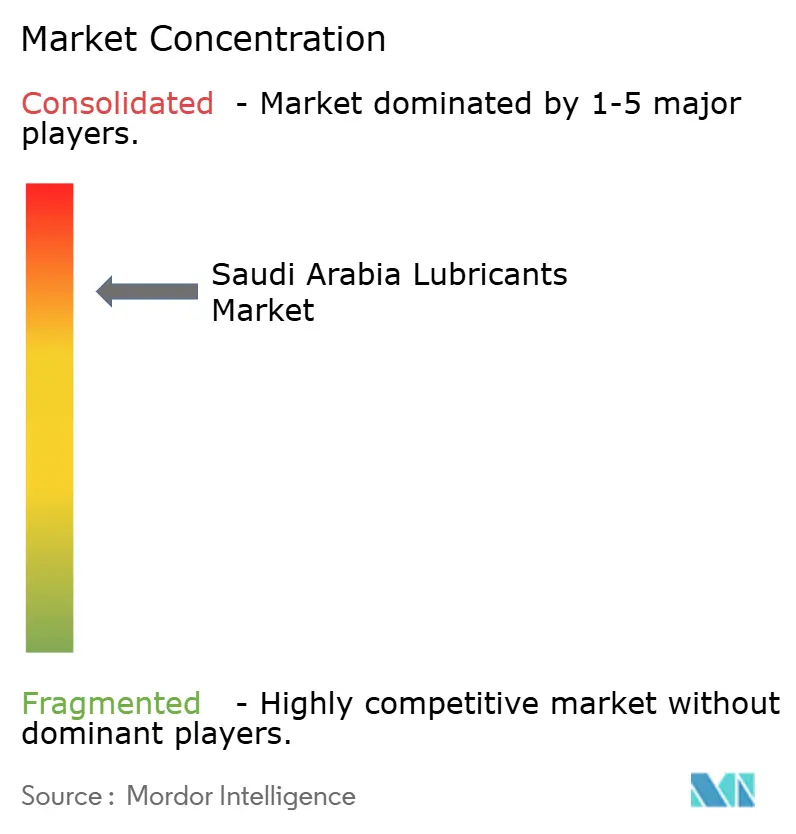
| Market Concentration | High |
Major Players *Disclaimer: Major Players sorted in no particular order Image © Mordor Intelligence. Reuse requires attribution under CC BY 4.0. | |
Saudi Arabia Lubricants Market Analysis by Mordor Intelligence
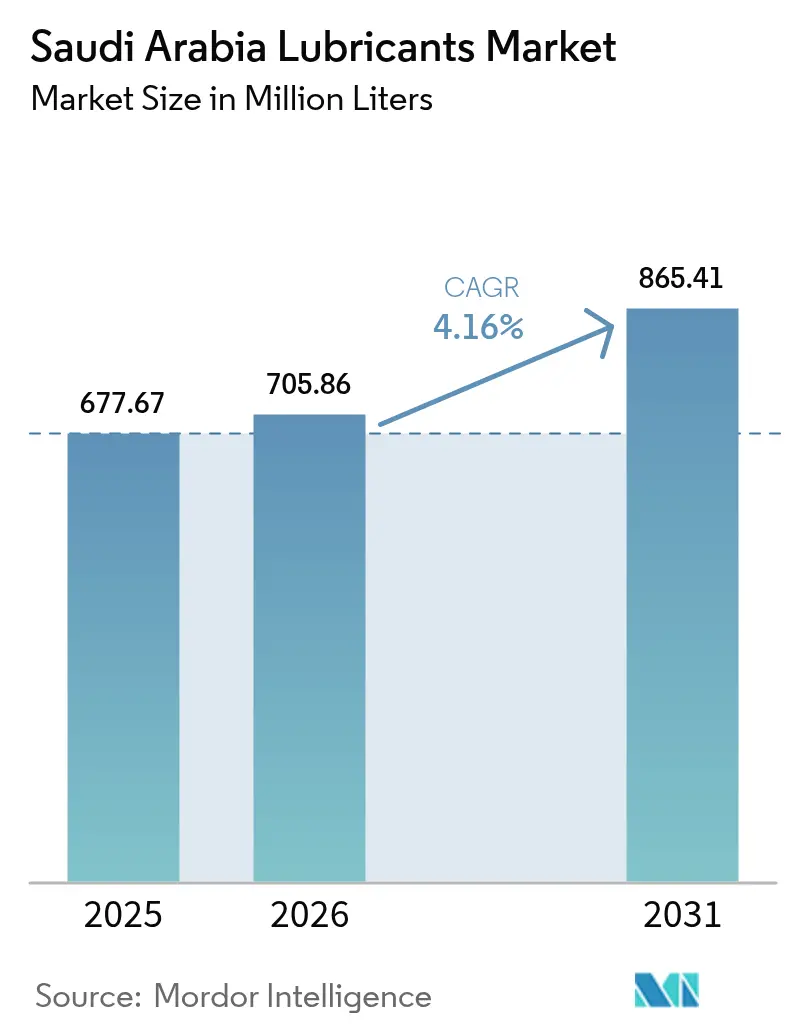
The Saudi Arabia Lubricants Market size was valued at 677.67 Million Liters in 2025 and estimated to grow from 705.86 Million Liters in 2026 to reach 865.41 Million Liters by 2031, at a CAGR of 4.16% during the forecast period (2026-2031). Solid demand stems from Vision 2030-driven industrial projects, steady vehicle-parc expansion, and large-scale power-generation investments. Consolidation moves such as Saudi Aramco’s Valvoline acquisition and a potential Castrol bid add technological depth while deepening domestic value-chain integration. Growth is also enabled by localization initiatives like Luberef’s LubeHUB, which reduces import dependencies for base oils and additives. Meanwhile, the shift toward low-SAPS synthetics, rapid digitalization of distribution, and rising consumption in petrochemical hubs sustain positive volume momentum even as electric-vehicle (EV) adoption begins trimming long-term engine-oil demand.
Key Report Takeaways
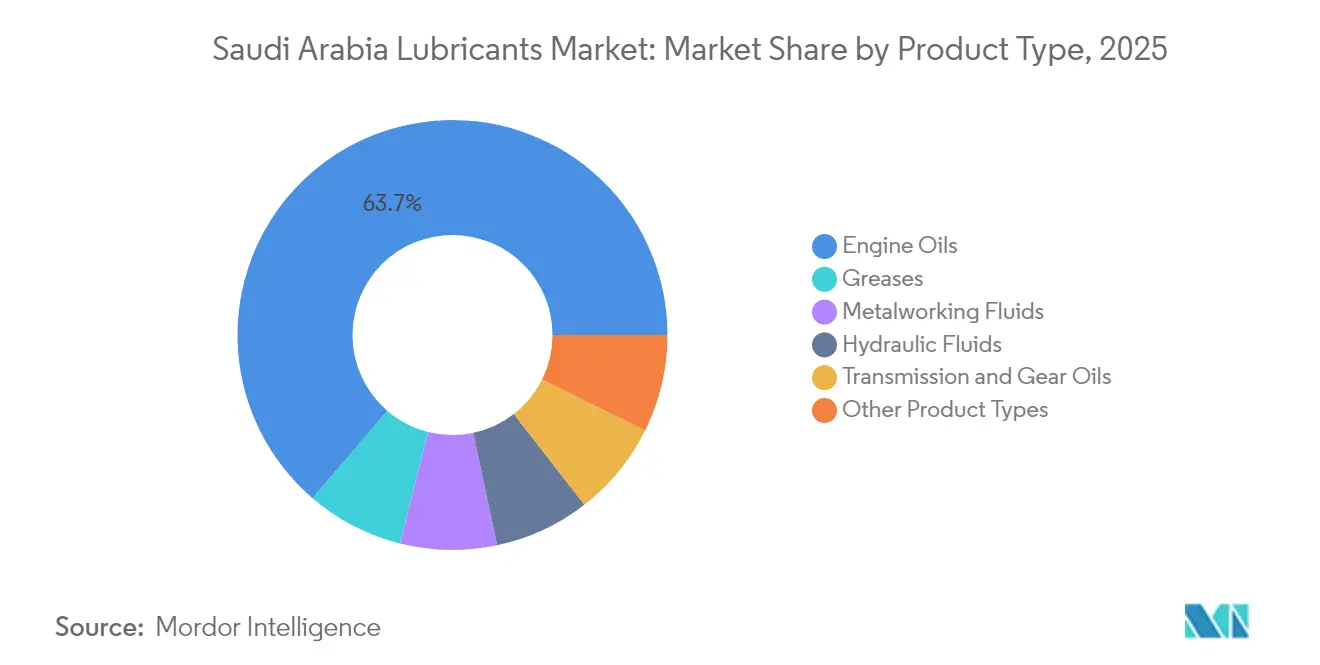
- By product type, engine oil led with 63.72% of Saudi Arabia lubricants market share in 2025; greases are projected to record the fastest 4.55% CAGR through 2031.
- By distribution channel, distributor/retailers held 62.58% of the Saudi Arabia lubricants market size in 2025, whereas direct-channel sales are advancing at a 15.35% CAGR to 2031.
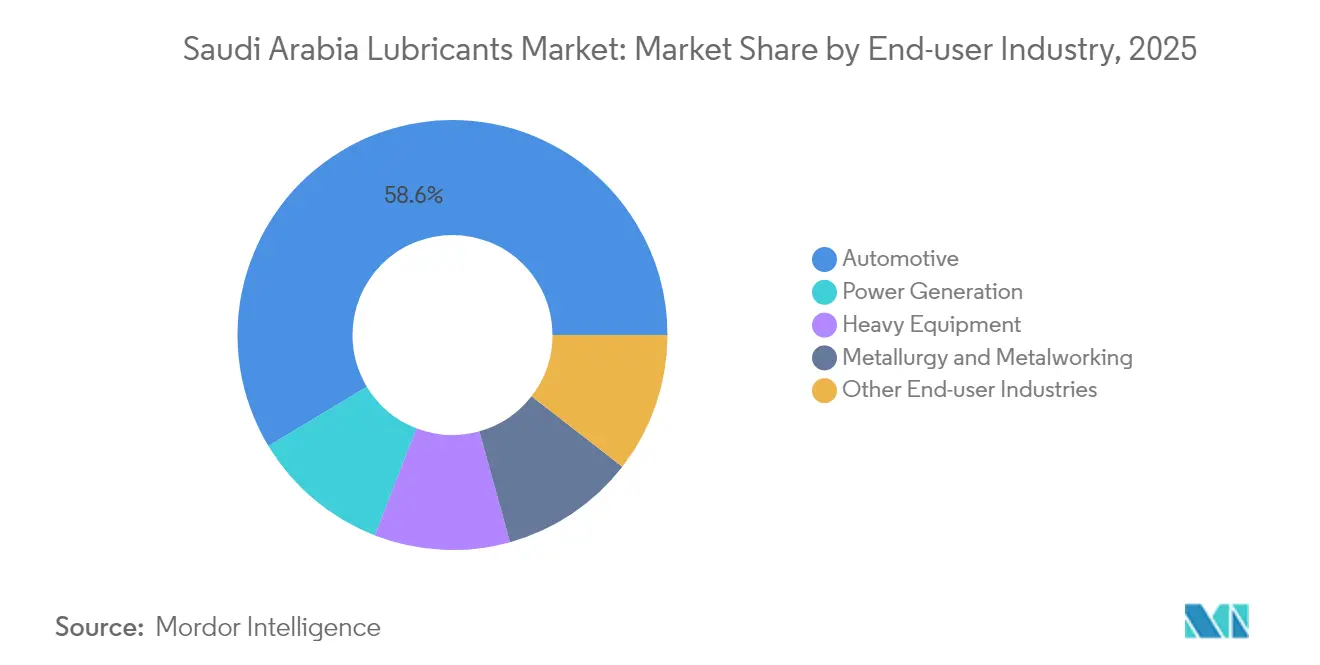
- By end user industry, automotive applications captured 58.64% share of the Saudi Arabia lubricants market size in 2025, while power-generation demand is growing at a 4.52% CAGR over the forecast horizon.
Note: Market size and forecast figures in this report are generated using Mordor Intelligence’s proprietary estimation framework, updated with the latest available data and insights as of 2026.
Saudi Arabia Lubricants Market Trends and Insights
Drivers Impact Analysis*
| Drivers | (~) % Impact on CAGR Forecast | Geographic Relevance | Impact Timeline |
|---|---|---|---|
| Continued growth of Saudi vehicle parc | +1.2% | National, concentrated in Riyadh, Jeddah, Eastern Province | Medium term (2-4 years) |
| Vision-2030 led industrial diversification | +1.5% | National, with Eastern Province and Yanbu leading | Long term (≥ 4 years) |
| Shift to low-SAPS and premium synthetics | +0.8% | National, driven by automotive OEM requirements | Medium term (2-4 years) |
| Luberef LubeHUB supply localization | +0.6% | National, with Yanbu as production hub | Long term (≥ 4 years) |
| Growth of investments in power-generation sector | +0.9% | National, with NEOM and gas-fired projects leading | Long term (≥ 4 years) |
| Source: Mordor Intelligence | |||
Continued Growth of Saudi Vehicle Parc
Saudi Arabia’s expanding vehicle stock keeps lubricant volumes buoyant. Commercial fleets operating in extreme heat and dust require frequent fluid changes, lifting per-vehicle consumption. Telematics-based maintenance programs used by fleet operators are, however, nudging demand toward longer-lasting premium synthetics that lower downtime. Automotive-specific services, including condition-monitoring and OEM-approved formulations, now form a core differentiator for suppliers courting national-fleet contracts.
Vision-2030 Led Industrial Diversification
National Industrial Development and Logistics Programme (NIDLP) incentives are reshaping demand, with over USD 130 billion invested in new factories since 2016. Eastern Province petrochemical complexes such as Amiral and PlasChem Park generate steady orders for hydraulic fluids, metalworking fluids, and specialty greases for precision equipment. SABIC’s NUSANED initiatives promote local catalyst and additive production, pressing suppliers to deliver high-performance formulations aligned with Industry 4.0 manufacturing. These changes deepen the Saudi Arabia lubricants market’s exposure to heavy-industry buyers while encouraging vertical integration of additive chemistry within the Kingdom.
Shift to Low-SAPS and Premium Synthetics
Euro 6 tailpipe norms and OEM warranty rules are accelerating the pivot toward low-SAPS and fully synthetic engine oils. Local marketers highlight performance gains such as extended drain intervals, improved oxidation resistance, and better cold-start protection. APSCO’s Mobil synthetic range, for instance, is positioned as a premium solution for turbocharged gasoline direct-injection engines[1]. Domestic additive capacity slated by Farabi Petrochemicals and Richful will underpin formulation agility and pricing leverage once online. Higher per-liter margins on synthetics also cushion producers against feedstock volatility.
Luberef Lubehub Supply Localization
Luberef’s Yanbu-based LubeHUB delivers Group II base oils via dedicated pipelines, cutting logistics costs for downstream blenders while stimulating inward investment in finished-lube plants. Base-oil capacity now stands at 1.6 million t/y, with Group III feasibility under review. Incentives across 13 specialty-product categories, from transformer oils to white oils, further embed Saudi Arabia as a regional lubricant-manufacturing hub. Localization ensures stable feedstock pricing, faster customization, and export potential to Africa and South Asia where demand is rising sharply.
Restraints Impact Analysis*
| Restraints | (~) % Impact on CAGR Forecast | Geographic Relevance | Impact Timeline |
|---|---|---|---|
| EV penetration trimming engine-oil volumes | -0.8% | National, with urban centers leading adoption | Long term (≥ 4 years) |
| Crude-linked base-oil price volatility | -0.6% | National, affecting all market segments | Short term (≤ 2 years) |
| Counterfeit and grey-import lubricants | -0.4% | National, concentrated in aftermarket channels | Medium term (2-4 years) |
| Source: Mordor Intelligence | |||
EV Penetration Trimming Engine-Oil Volumes
EV registrations tripled to about 800 units in 2024, and policy targets call for 500,000 units of annual domestic output by 2030. Although absolute numbers remain low, every battery-electric vehicle displaces 4-6 liters of engine oil consumption per service interval. Charging-infrastructure build-outs under the state-backed eViq initiative will accelerate adoption in metropolitan corridors. Lubricant suppliers are hedging exposure by developing gearbox fluids for hybrids, dielectric coolants for battery packs, and specialty greases for charging disconnects, positioning for a gradual product-mix shift rather than outright volume collapse.
Counterfeit and Grey-Import Lubricants
SASO conformity rules require SABER certification and Arabic labeling before customs clearance, but non-compliant imports still reach informal channels. Recent enforcement led to 39 fuel-station closures for fraudulent practices[2]. Counterfeits erode brand equity and increase warranty-claim risks. Legitimate marketers respond with tamper-evident packaging, QR-code verification, and dealer-education programs to reassure professional workshops and consumers.
*Our forecasts treat driver/restraint impacts as directional, not additive. The impact forecasts reflect baseline growth, mix effects, and variable interactions.
Segment Analysis
By Product Types: Engine-Oil Dominance Amid Synthetic Transition
Engine oil generated 63.72% of the total 2025 volume, thanks to the Kingdom’s large vehicle parc and harsh climate that necessitates frequent changes. The Saudi Arabia lubricants market size for engine oil is still expected to advance, but at a moderating pace as fleet operators stretch drain intervals through synthetics. Greases, although on a smaller base, will clock the fastest 4.55% CAGR to 2031, supported by industrial machinery, renewable-energy bearings, and construction equipment needs. Hydraulic-fluid demand tracks infrastructure roll-outs, while metalworking fluids benefit from factories added under NIDLP. The forthcoming domestic additive plant enhances formulation flexibility, supporting specialized blends for aerospace and pharmaceutical machining.
Digitization and predictive-maintenance adoption in manufacturing increase the appetite for sensor-friendly lubricants integrated with IoT platforms. Suppliers are therefore bundling fluids with analytics dashboards that flag contamination or viscosity shifts in real time. Overall, premium product tiers capturing higher margins help offset slower growth in conventional mineral-oil categories.

By Distribution Channel: Digital Transformation Accelerating Direct Sales
Distributor/retailers retained 62.58% share in 2025, upheld by nationwide workshop networks and credit facilities. Yet direct orders are growing 15.35% CAGR as fleets link procurement to telematics dashboards that auto-reorder based on consumption thresholds. This evolution embeds technical-service contracts and boosts data transparency. Gasoline stations remain essential for do-it-yourself car owners, though EV charging points planned at major service areas may gradually cannibalize shelf space formerly devoted to engine oil.
Large tenders from logistics operators increasingly specify digital-invoice integration and KPI-based performance guarantees, favoring suppliers with e-commerce portals and API connectivity. Consequently, competition shifts from pure price to total cost-of-ownership metrics validated by data-sharing agreements.
By End User Industry: Automotive Leadership Faces Power-Generation Challenge
Automotive users consumed 58.64% of the 2025 volume, anchored by passenger-car density in Riyadh and Jeddah and heavy-duty trucks hauling construction materials across giga-projects. Fleet upgrades to Euro 6 diesel engines lift demand for low-ash formulations. Nonetheless, the power-generation sector is set for the quickest 4.52% CAGR as more combined-cycle plants, wind farms, and green-hydrogen electrolyzers come online. High-temperature turbine oils with 7,000-hour drain targets and dielectric fluids for battery-storage modules command premium pricing.
Heavy-equipment operators spanning mining to cement enjoy Vision 2030 stimulus, keeping demand stable for extreme-pressure greases. Metallurgy and metalworking volumes grow in tandem with local steel and aluminum capacity additions. Diversifying end-use profiles shields the Saudi Arabia lubricants market from single-sector shocks.
Geography Analysis
Petrochemical giants Aramco, SABIC, and Sadara drive continuous demand for compressors and hydraulic fluids. Yanbu’s LubeHUB further cements the province’s status as a feedstock nucleus. Central Region spearheads automotive lubricant consumption due to Riyadh’s highest vehicle density and government fleets that embed OEM-approved synthetics. Dealer-backed service contracts stimulate repeat purchase cycles and data-driven maintenance scheduling.
Western Region’s Red-Sea port logistics and religious-tourism vehicle traffic sustain multi-grade engine oil demand. Luberef’s Jeddah base-oil plant ensures localized supply resilience. Northern and Southern territories remain smaller but fast-growing as mining concessions and cross-border trade expand heavy-equipment parks requiring specialized greases tolerant of dust and altitude extremes. NEOM’s northwest giga-project introduces renewable-centric lubricant niches, gearbox oils for 80-meter turbines, and biodegradable hydraulic fluids for solar-tracker actuators.
Infrastructure uniformity across regions benefits from SASO standards and SABER digital conformity checks, guaranteeing quality consistency. This regulatory harmonization encourages national roll-outs of differentiated product lines without regional formula tweaks, streamlining inventory and branding strategies.
Value Chain Analysis
Saudi Arabia's lubricants value chain is anchored by integrated upstream-to-downstream participation led by Saudi Aramco, with domestic base oil production centered on Saudi Aramco Base Oil Company (Luberef). Feedstock moves from Aramco's refining system into base oils produced at Luberef's Jeddah and Yanbu facilities, then into finished-lubricant blending and packaging carried out by domestic and JV blenders such as Petromin, Alhamrani-FUCHS Petroleum Saudi Arabia, and Aljomaih and Shell Lubricating Oil Company Limited (JOSLOC). Additives and specialty components remain more import-dependent than base oils, which keeps additive localization initiatives central to formulation agility and lead times.
Distribution covers direct supply into industrial and fleet accounts and a broad aftermarket served by distributors/retailers, workshops, and fuel stations. Large fleets increasingly rely on contract-based technical services and digital ordering. Across the chain, quality and conformity function as gating steps, with SASO-linked conformity assessments and testing infrastructure shaping product approvals and import clearance for lubricating oils. In January 2026, Aramco and Luberef signed an MoU to assess a base oil plant at the Jazan Refinery, reinforcing the focus on deepening domestic feedstock optionality and logistics resilience for downstream lubricant manufacturing.
Competitive Landscape
The Saudi Arabian lubricants market is concentrated in nature. Shell, ExxonMobil, BP-Castrol, and Chevron rely on technology leadership and international brand equity, whereas Aramco leverages feedstock integration via Luberef and newly acquired Valvoline trademarks. Local independents like FUCHS and Petromin cultivate niche trust through localized blending, technical-service labs, and quick-lube chains. Market entry barriers elevate as SASO tightens conformity assessments and demands Arabic safety data sheets. Nonetheless, the planned additive plant promises to democratize advanced chemistry access, possibly lowering formulation costs for home-grown brands and intensifying price competition in mid-tier product categories.
Saudi Arabia Lubricants Industry Leaders
-
BP P.L.C (Castrol)
-
ExxonMobil Corporation (Arabian Petroleum Supply Company (APSCO))
-
Petromin Corporation
-
Saudi Arabian Oil Co. (SAUDI ARAMCO)
-
Shell PLC (Aljomaih and Shell Lubricating oil company Limited (JOSLOC))
- *Disclaimer: Major Players sorted in no particular order
Market Opportunities and Future Outlook
Localization of feedstocks and specialty manufacturing around Yanbu is creating whitespace for finished-lubricant and specialty-oil capacity tied to domestic base oil streams. The LubeHUB Value Park model, built around piped base oil access, is being reinforced by commercial offtake: in June 2026, Luberef signed a strategic base oil supply agreement with APAR Industries Middle East Limited to support specialty oil manufacturing at Yanbu, reflecting demand pull from international specialty manufacturers setting up or scaling local operations. This connects to opportunities across industrial hydraulic fluids, metalworking fluids, turbine oils, and specialty greases, where NIDLP-linked manufacturing growth and large power-generation buildouts are key demand sources.
A second opportunity track is chemistry localization and higher-spec formulations as OEM and industrial reliability requirements tighten. In February 2025, Farabi Downstream Petrochemical Company and Xinxiang Richful Lube Additive Co., Ltd. signed an MoU to establish a JV for an integrated lubricant additive plant in Yanbu, pointing to shorter formulation cycles and broader availability of advanced additive packages inside the Kingdom. Feedstock security actions also support continuity and capacity utilization, including a December 2025 successor feedstock supply agreement notice from Saudi Aramco for Luberef's Jeddah facility. For local blenders, this reduces disruption risk tied to domestic base oil dependence as the market shifts toward premium synthetics and specialty industrial grades.
Recent Industry Developments
- June 2026: APAR Industries Middle East Limited signed a base oil supply agreement with Saudi Aramco Base Oil Company (Luberef) to support specialty oil manufacturing at the LubeHUB lubricants park in Yanbu. The deal reinforces the Yanbu-centric specialty ecosystem by linking a named international manufacturer to local base oil availability. It also supports Saudi Arabia's role as a supply and conversion hub for higher-value lubricant and specialty oil products.
- March 2025: Saudi Aramco confirmed it is evaluating a USD 6-8 billion acquisition bid for BP's Castrol unit. The evaluation points to continued consolidation interest across branded finished lubricants and technology portfolios. It also signals integration ambitions beyond base oils, extending toward formulation, branding, and global channel access.
- March 2024: EV adoption momentum in Saudi Arabia accelerated on a low base, with registrations cited as tripling to about 800 units in 2024 alongside charging-infrastructure build-outs under the state-backed eViq initiative. This shift changes the product-mix conversation for lubricant marketers by lifting demand for thermal management fluids, specialty greases, and hybrid driveline fluids. It also increases the urgency of premiumization in internal-combustion lubricants through longer drain intervals and OEM-approved formulations.
Research Methodology Framework and Report Scope
Market Definition and Coverage
This market covers lubricants consumed within Saudi Arabia, counted as finished lubricating products sold for automotive and industrial use across OEM and aftermarket demand, and measured in volume for a consistent comparison over time.
Scope exclusions: Fuels, base oils traded as feedstock, and non-lubricating specialty chemicals are excluded from this market sizing.
Segmentation Overview
- By Product Types
- Engine Oils
- Greases
- Hydraulic Fluids
- Metalworking Fluids
- Transmission and Gear Oils
- Other Product Types
- By Distribution Channel
- Distributor/Retailers
- Gasoline Stations
- Direct Channel
- By End-user Industry
- Automotive
- Power Generation
- Heavy Equipment
- Metallurgy and Metalworking
- Other End-user Industries
Data Sources, Market Sizing, and Validation
Desk Research
Desk research was used to set the Saudi Arabia demand context and to build the initial volume model that we later stress-tested through interviews. We typically start with public macro and sector indicators, such as Saudi Arabia General Authority for Statistics releases, Saudi Central Bank indicators, and energy and industrial publications from government entities.
To anchor the demand drivers, we also review transport and vehicle-related series from sources such as the World Bank and OPEC country data, followed by trade and customs signals where relevant (for example, UN Comtrade), and technical cues from peer-reviewed lubrication and tribology journals to understand viscosity grade shifts and drain interval behavior. Company annual reports, investor decks, and reputable press are then used to confirm capacity additions, channel structure changes, and major regulatory or standards adoption. Where needed, we also reference paid subscriptions that help with company financials, patent lookups, and shipment-level import and export checks. These examples are illustrative only, and many other public and proprietary sources were also used for collection, cross-checking, and clarification.
Primary Interviews and Surveys
Primary work focused on turning the desk model into a realistic view of actual lubricant consumption in Saudi Arabia, including product mix, channel margins, and end-user substitution trends. We spoke with stakeholders across blenders and distributors, large buyers in transport and industrial operations, and service and workshop ecosystems, so assumptions on volume movement and pricing logic could be checked in plain terms across the country.
Distribution of primary research fieldwork respondents
| Company type | Respondent position |
|---|---|
| Top tier: 26% | CXOs: 16% |
| Mid tier: 53% | Functional/Unit leaders: 38% |
| Smaller Players: 21% | Managers: 46% |
Market-Sizing & Forecasting
The core sizing is built using a top-down demand pool reconstruction, where sector activity is converted into lubricant consumption using country-specific intensity factors and then reconciled to the reported market volume. In practice, we translate signals from the vehicle parc and service patterns, heavy equipment activity tied to construction cycles, industrial output indicators, and power generation utilization into implied lubricant usage by major end users.
Once that demand pool is shaped, it is corroborated through selective bottom-up approximations, such as sampled volume by channel type and a reasoned average selling price range by product family, which helps us spot where the totals might be too high or too low. Some gaps are expected in smaller channels and informal servicing, so those portions are handled using conservative penetration assumptions that were rechecked with interview feedback.
For forecasting, scenario analysis is used because lubricant volumes move with a mix of cyclical drivers and policy-led investment timing. The forward view is built around expected changes in vehicle and equipment growth, industrial project ramp-ups, lubricant upgrade trends toward higher-performance grades, and expected shifts in drain intervals, and then scenario weights are validated through what respondents said they are seeing in purchasing and maintenance routines.
Data Validation & Update Cycle
Validation happens in layers so the final numbers remain traceable to simple checks. We compare the modeled volumes against independent demand signals, and then unusual jumps by end-user type or channel are flagged and reviewed before being accepted into the final dataset.
Where variances persist, we re-contact selected respondents to confirm whether the change is structural (for example, a major industrial ramp-up) or just timing noise, and the assumptions are adjusted only when there is enough support from multiple viewpoints. Each report is refreshed annually, with interim updates triggered by material events that can move lubricant consumption, and a final analyst pass is done close to delivery so clients receive the latest view available.
Mordor Intelligence's Saudi Arabia Lubricants Market Market Sizing Compared With Other Published Estimates
It is normal to see different market sizes for Saudi Arabia lubricants because publishers do not always count the same products, and they may also use different unit systems, base years, and pricing conversions.
Additive packages sold as standalone chemicals sit outside Mordor Intelligence's scope, which is one reason some revenue-based estimates land far away from a volume-led market build that is tied to lubricant consumption signals and end-user activity.
Benchmark comparison
| Source | Market Size | Gaps in Research Methodology |
|---|---|---|
| Mordor Intelligence | USD 677.67 M (2025) | |
| Trade Journal A | USD 470.00 M (2024) | Uses kilotonne-style consumption snapshots and converts to USD with a single price assumption, which can undercount premium synthetics and channel markups, and it may not align to a consistent base year. |
| Regional Consultancy B | USD 1.32 B (2024) | Reported as a revenue number that likely blends lubricants with adjacent chemical and service elements, and the total can inflate if prices, exchange rates, and distribution margins are applied unevenly across segments. |
The spread in published values is mainly explained by what is counted as a lubricant product, whether the market is framed in volume or in revenue, and how pricing and currency timing are applied. By keeping the market tied to observable consumption drivers and then checking the result against channel and end-user feedback, the estimate stays easier to replicate and easier to audit when assumptions change.
Key Questions Answered in the Report
How large is the Saudi Arabia lubricants market in 2026?
It totals 705.86 million liters in 2026 and is expected to grow at a 4.16% CAGR to reach 865.41 million liters by 2031.
Which product dominates lubricant demand in the Kingdom?
Engine oil commands 63.72% of 2025 volume, reflecting the sizeable on-road vehicle parc and harsh desert operating conditions.
What channel is expanding fastest for lubricant sales?
Direct-channel purchases linked to digital fleet-management platforms are increasing at a 15.35% CAGR through 2031.
Which end-use sector shows the quickest growth?
Power-generation applications are projected to rise at a 4.52% CAGR, driven by gas-fired IPPs and renewable-energy projects.
How is Vision 2030 influencing lubricant demand?
Vision 2030-led industrial diversification fuels consumption of hydraulic fluids, metalworking fluids, and specialty greases in new manufacturing hubs.