
Saudi Arabia Air Freight Transport Market Size and Share
Market Overview
| Study Period | 2021 - 2032 |
|---|---|
| Forecast Data Period | 2027 - 2032 |
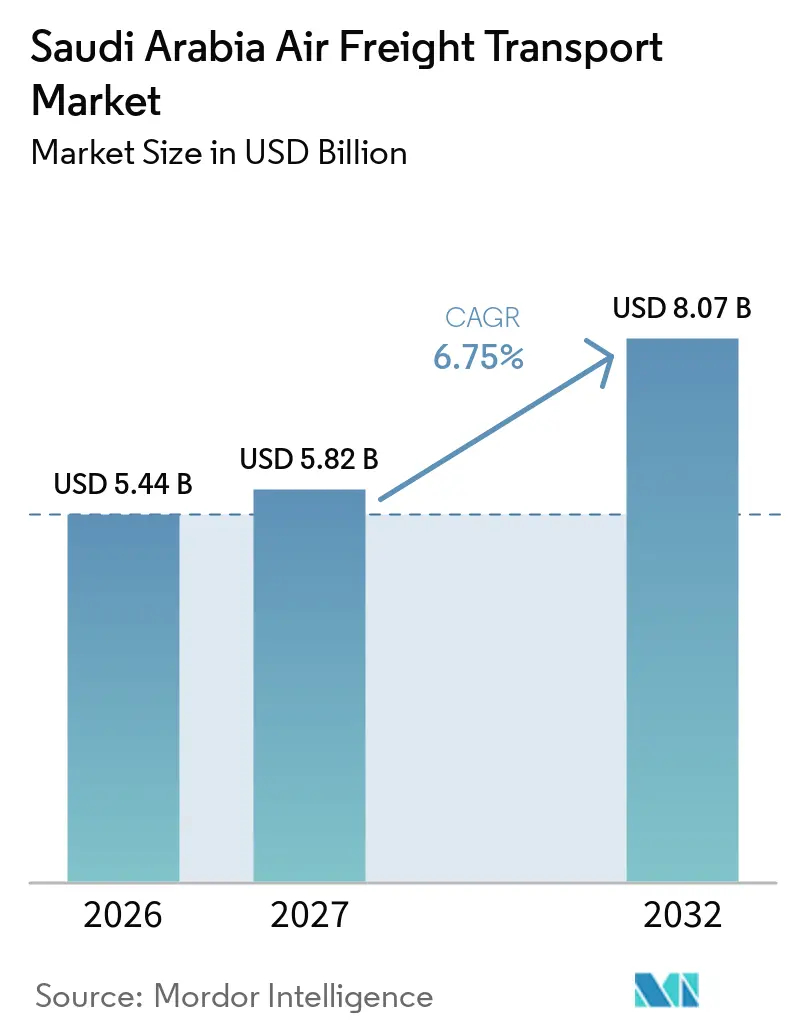
| Base Year Market Size (2026) | USD 5.44 Billion |
| Market Size (2027) | USD 5.82 Billion |
| Market Size (2032) | USD 8.07 Billion |
| Growth Rate (2027 - 2032) | 6.75 % |
| Market Concentration | Medium |
Major Players *Disclaimer: Major Players sorted in no particular order Image © Mordor Intelligence. Reuse requires attribution under CC BY 4.0. | |
Saudi Arabia Air Freight Transport Market Analysis by Mordor Intelligence
The Saudi Arabia air freight transport market size is valued at USD 5.44 billion in 2026. It is estimated to grow from USD 5.82 billion in 2027 to reach USD 8.07 billion by 2032, at a CAGR of 6.75% during the forecast period (2027-2032).
Airport infrastructure investment, international trade, e-commerce shipments, and the movement of high-value, time-sensitive goods drive market demand. Riyadh and Jeddah function as key cargo gateways, while logistics zones and digital cargo systems strengthen connections among air transport, warehousing, customs clearance, and road distribution. Pharmaceutical shipments and specialized industrial cargo further support demand for controlled handling and reliable delivery schedules. Market growth depends on the availability of appropriate aircraft capacity, efficient cargo processing, and dependable connectivity between international gateways and domestic destinations.
Key Report Takeaways
- By service, freight transport (Cargo/CEP) accounts for 49.26% of the Saudi Arabia air freight transport market size in 2026, while other value-added services are projected to record the fastest growth at a CAGR of 8.28% through 2032.
- By destination, international freight accounts for 78.92% of the Saudi Arabia air freight transport market share in 2026, while domestic freight is projected to register at a CAGR of 9.89% through 2032.
- By carrier type, belly cargo accounts for 67.43% of the Saudi Arabia air freight transport market size in 2026, while freighter services are projected to register at a CAGR of 8.36% through 2032.
- By cargo type, general cargo accounts for 64.58% of the Saudi Arabia air freight transport market share in 2026, while special cargo is projected to register at a CAGR of 9.98% through 2032.
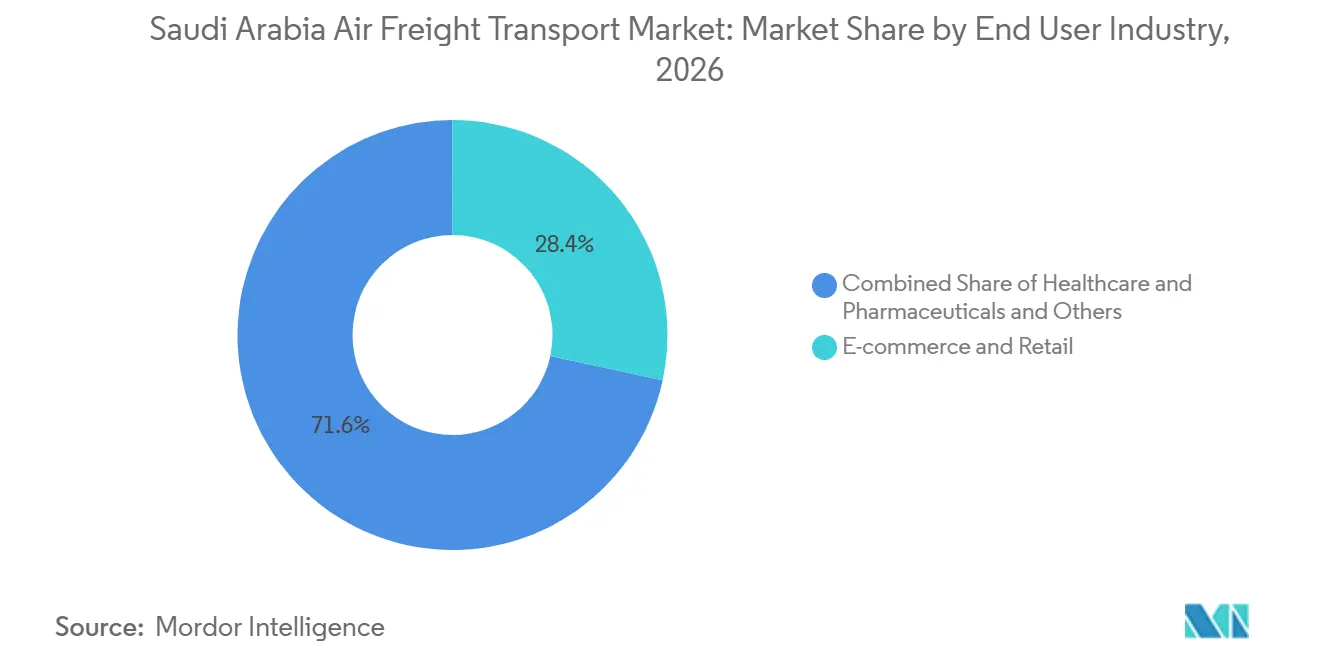
- By end-user industry, e-commerce and retail accounts for 28.37% of the Saudi Arabia air freight transport market size in 2026, while healthcare and pharmaceuticals are projected to register a CAGR of 8.79% through 2032.
- By geography, the Central Region accounts for 50.37% of the Saudi Arabia air freight transport market size in 2026, while the Western Region is projected to register a CAGR of 9.12% through 2032.
Note: Market numbers in this report are based on Mordor Intelligence's proprietary estimation framework, which combines nine months of actuals with Q4 projections for base year 2026.
Saudi Arabia Air Freight Transport Market Trends and Insights
Drivers Impact Analysis*
| Driver | (~) % Impact on CAGR Forecast | Geographic Relevance | Impact Timeline |
|---|---|---|---|
| Vision 2030 Investment Expanding Air Cargo Infrastructure | +2.2% | National, with early gains in Riyadh, Jeddah, and Dammam | Long term (4 years or more) |
| E-Commerce Growth Increasing Time-Definite Air Freight Demand | +1.5% | National, concentrated in Central and Western regions | Short term (2 years or less) |
| Pharmaceutical Logistics Expanding Temperature-Controlled Air Cargo Demand | +1.0% | National, concentrated in Riyadh and Jeddah hubs | Medium term (2–4 years) |
| Industrial Projects Increasing Specialized Air Freight Volumes | +0.7% | Western and Eastern regions | Long term (4 years or more) |
| Charter Liberalization Improving Flexible Air Cargo Capacity | +0.5% | National, with potential in Riyadh, Al-Jouf, and Tabuk | Short term (2 years or less) |
| Airport Logistics Zones Strengthening Sea-Air Connectivity Networks | +0.8% | Western, Central, and Eastern regions | Medium term (2–4 years) |
| Source: Mordor Intelligence | |||
Vision 2030 Investment Expanding Air Cargo Infrastructure
Saudi Arabia's Vision 2030 agenda is driving investment in airports, logistics zones, and integrated transport infrastructure. In March 2025, SAL formalized plans for a logistics zone in Falcon City, north of Riyadh, with planned investment of approximately SAR 4.1 billion (USD 1.0925 billion)[1]. The project will integrate warehousing, storage, and multimodal connectivity. Its infrastructure will strengthen cargo distribution and enhance connectivity between air freight, road transport, and other logistics services. The project's commercial impact will be driven by development progress, tenant demand, and the availability of complementary cargo-handling and customs services.
E-Commerce Growth Increasing Time-Definite Air Freight Demand
E-commerce drives air freight demand by generating shipments that require predictable transit times, international network access, and efficient domestic delivery. In August 2025, DHL eCommerce completed its strategic investment in AJEX Logistics Services, a Saudi regional parcel provider with more than 60 facilities, 1,200 vehicles, and 2,000 employees. The partnership integrates AJEX's regional and domestic delivery network with DHL's international parcel capabilities. This integration strengthens support for cross-border e-commerce shipments and improves coordination between international transportation and last-mile distribution. The partnership is positioned to increase air freight demand as parcel volumes grow and customers prioritize faster delivery services.
Pharmaceutical Logistics Expanding Temperature-Controlled Air Cargo Demand
Pharmaceutical distribution depends on robust temperature control, documented handling, and seamless coordination between air cargo terminals and onward transport. In April 2026, Saudia Cargo and the Saudi Food and Drug Authority launched a joint initiative offering shipping-cost reductions of up to 50% for pharmaceutical shipments. Supported by Saudia Cargo's IATA CEIV Pharma and CEIV Fresh certifications, the initiative strengthens the movement of medicines and medical supplies. In October 2025, AJEX also opened a 3,000 m² GMP-GxP-compliant facility in Riyadh, featuring 2 °C to 8 °C refrigerated storage, a -20 °C chamber, and real-time monitoring[2]. Together, these initiatives strengthen Saudi Arabia’s pharmaceutical logistics infrastructure by improving temperature control, regulatory compliance, and shipment reliability. This supports the safe distribution of temperature-sensitive medicines and medical supplies across the Kingdom.
Industrial Projects Increasing Specialized Air Freight Volumes
Industrial, energy, manufacturing, and infrastructure projects drive demand for urgent shipments of components, replacement parts, high-value equipment, and oversized cargo. Air freight plays a critical role when delivery delays could disrupt project schedules or production operations. In September 2025, FedEx launched a dedicated freighter service connecting Saudi Arabia with the United States and Europe, with onward connections to Asian markets. The service uses a Boeing 777 freighter to transport bulky, palletized, temperature-controlled, and dangerous goods. This capacity strengthens support for specialized freight requirements. Demand will vary based on project schedules, shipment size, and the cost competitiveness of air transport relative to ocean or road alternatives.
Restraints Impact Analysis*
| Restraint | (~) % Impact on CAGR Forecast | Geographic Relevance | Impact Timeline |
|---|---|---|---|
| High Air Freight Costs Limiting Modal Competitiveness | -1.2% | Global, amplified on intra-GCC and Asia–Saudi routes | Short term (2 years or less) |
| Limited Freighter Capacity Increasing Belly-Space Dependence | -0.9% | National, concentrated at Riyadh and Jeddah hubs | Medium term (2–4 years) |
| Extreme Heat Increasing Equipment and Operating Complexity | -0.5% | National, particularly Central and Western regions during summer | Long term (4 years or more) |
| Data Interoperability Gaps Limiting Cargo Handling Efficiency | -0.6% | National, particularly at multi-handler interfaces in Riyadh, Jeddah, and Dammam | Medium term (2–4 years) |
| Source: Mordor Intelligence | |||
High Air Freight Costs Limiting Modal Competitiveness
Air freight commands a premium over ocean freight for comparable shipments, limiting its suitability for bulk goods and products with flexible delivery schedules. Fuel costs, capacity constraints, and changes in international routing also affect freight rates. Shippers primarily use air transport for urgent, high-value, perishable, and time-sensitive goods. Freight forwarders with limited purchasing scale face additional pressure when securing carrier capacity. These factors constrain air freight adoption among price-sensitive customers and underscore the importance of service reliability, transit time, and shipment value.
Limited Freighter Capacity Increasing Belly-Space Dependence
Air cargo capacity is determined by dedicated freighter services and cargo space available on passenger aircraft. Belly cargo provides consistent capacity on established international routes, although availability depends on passenger schedules, aircraft configuration, and route demand. Dedicated freighters deliver greater flexibility on cargo-intensive routes and for shipments requiring specific handling or loading arrangements. In September 2025, FedEx introduced a dedicated freighter service into Saudi Arabia, demonstrating the expansion of scheduled cargo connectivity. However, market-wide capacity expansion depends on aircraft availability, route economics, airport infrastructure, and sufficient contracted demand.
*Our forecasts treat driver/restraint impacts as directional, not additive. The impact forecasts reflect baseline growth, mix effects, and variable interactions.
Segment Analysis
By Service: Freight Transport Leads While Value-Added Services Expand
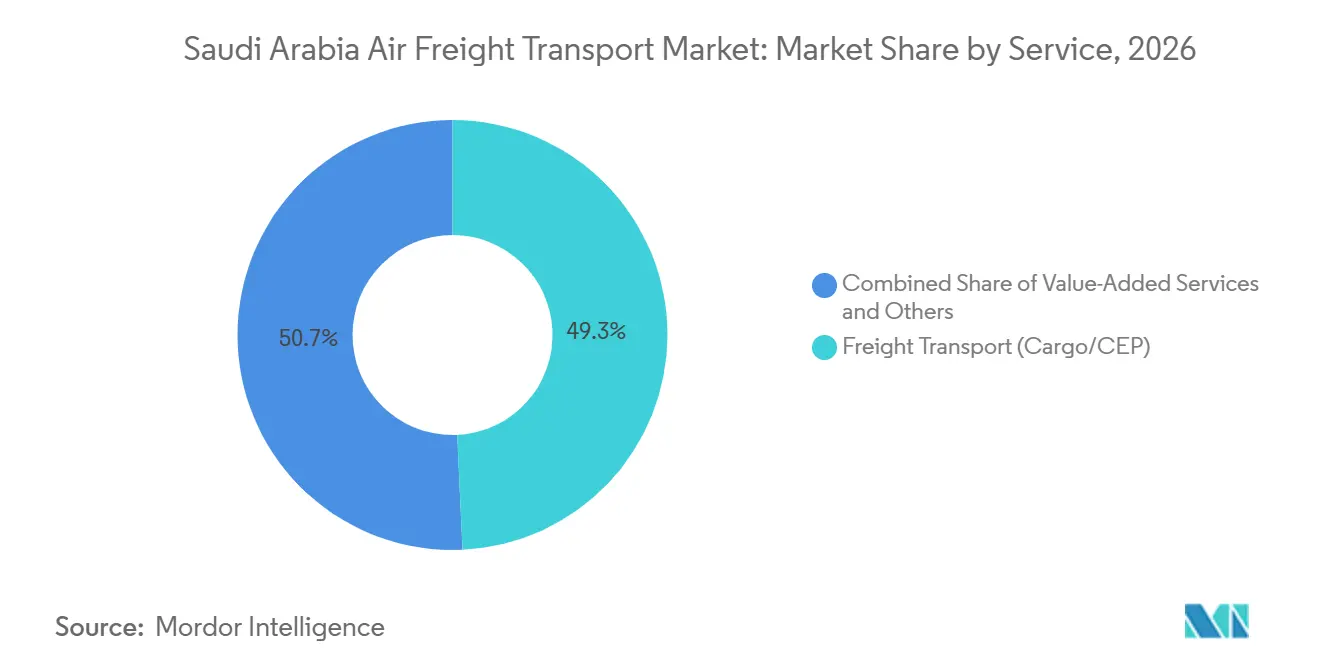
Freight transport (Cargo/CEP) accounts for 49.26% of the Saudi Arabia air freight transport market share in 2026. The category encompasses the movement of cargo and express shipments across domestic and international networks. Its operations rely on aircraft capacity, airport handling, customs clearance, and integrated road distribution links. Freight forwarders manage bookings, documentation, routing, and connections between carriers and shippers.
Other value-added services are projected to register at a CAGR of 8.28% through 2032. This category includes customs brokerage, cargo insurance, shipment documentation, and supply chain support. In September 2025, FedEx announced the expansion of FedEx Logistics freight forwarding services in Saudi Arabia as part of its transition to direct operations in the Kingdom[3]. The offering includes air, road, and ocean freight, as well as transit cargo support and customs brokerage. These services enable customers to manage multiple logistics activities through a single provider. Growth in value-added services will be supported by rising customer demand and providers’ ability to deliver these services efficiently.

By Destination: International Freight Leads While Domestic Growth Accelerates
International freight accounts for 78.92% of the Saudi Arabia air freight transport market size in 2026. The segment supports import and export flows across trade routes connecting Saudi Arabia with Asia, Europe, Africa, and the Americas. Demand spans consumer products, industrial components, pharmaceuticals, electronics, and other high-value goods. Major gateway airports, international airline networks, and efficient customs processes underpin the movement of these shipments. Competitive performance depends on route availability, transit times, handling quality, and onward distribution capabilities.
Domestic freight is projected to register a CAGR of 9.89% through 2032. Connections among major airports, regional distribution centers, businesses, and consumers drive growth. The expansion of local express networks and ground-handling services strengthens domestic cargo connectivity. In June 2025, Swissport launched coordinated ground-handling operations for Air Arabia across 13 Saudi airports, including 7 newly added locations. This expansion of ground-handling services improves domestic cargo connectivity and supports more efficient movement of goods between regional airports and distribution networks. Wider airport coverage can help airlines and logistics providers strengthen shipment coordination and meet growing demand for domestic freight services.
By Carrier Type: Belly Cargo Dominates While Freighters Add Capacity
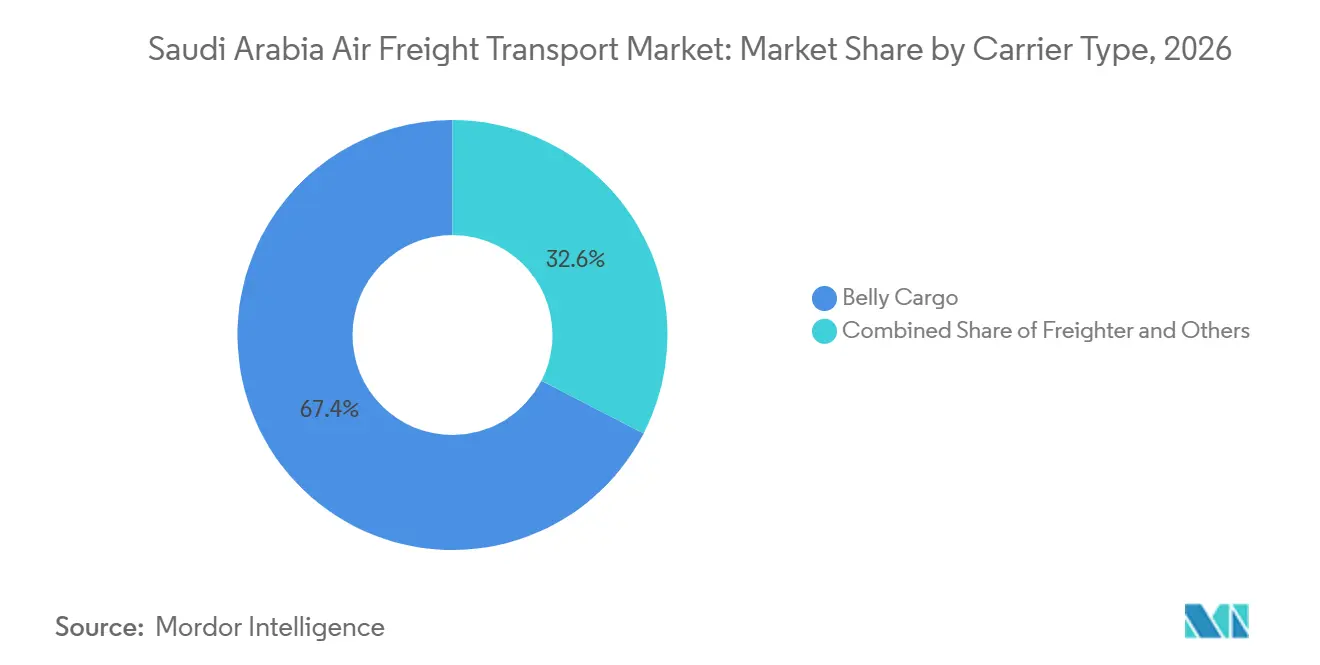
Belly cargo accounts for 67.43% of the Saudi Arabia air freight transport market in 2026. Passenger aircraft provide substantial cargo capacity on routes supported by passenger demand, enabling airlines to maximize available aircraft space for freight. This model strengthens international shipment flows on established routes and delivers regular cargo connectivity without requiring dedicated freighter operations. Available capacity depends on passenger schedules, aircraft type, payload restrictions, and route frequency. Consequently, changes in passenger operations directly influence cargo availability.
Freighter services are projected to register at a CAGR of 8.36% through 2032. Dedicated cargo aircraft provide the capacity and scheduling flexibility required for shipments that need cargo-focused operations, specialized loading, or larger volumes. These services support the transport of industrial equipment, high-value shipments, temperature-sensitive goods, and other cargo that exceeds the constraints of passenger aircraft. FedEx's September 2025 dedicated freighter launch into Saudi Arabia demonstrates the expansion of cargo connectivity. Continued growth will depend on route economics, aircraft availability, and shipment volumes sufficient to sustain operations.
By Cargo Type: General Cargo Leads While Special Cargo Grows Faster
General cargo accounts for 64.58% of the Saudi Arabia air freight transport market in 2026. It includes a broad range of commercial merchandise, consumer goods, and standard industrial shipments that do not require specialized handling. The segment benefits from diversified demand across retail, manufacturing, and international trade. Its performance is driven by freight rates, trade flows, airline capacity, and the competitiveness of air transport relative to other modes. Efficient cargo handling and customs clearance are critical to minimizing delays.
Special cargo is projected to register at a CAGR of 9.98% through 2032. The category includes dangerous goods, high-value shipments, oversized cargo, and other consignments requiring specialized handling or documentation. Pharmaceutical products and industrial components require controlled environments, specialized equipment, and additional regulatory checks. In April 2026, Saudia Cargo and the Saudi Food and Drug Authority announced a pharmaceutical freight initiative offering shipping-cost reductions of up to 50%. The initiative strengthens the movement of medicines and medical supplies under the specified program.
By End-User Industry: E-Commerce Leads While Healthcare Grows Faster
E-commerce and retail accounts for 28.37% of the Saudi Arabia air freight transport market in 2026. Online retailers rely on air freight for selected cross-border orders, inventory replenishment, and time-sensitive merchandise. International parcel networks depend on seamless coordination among airport handling, customs clearance, sorting facilities, and domestic delivery providers. DHL eCommerce’s investment in AJEX in August 2025 strengthens the link between regional parcel networks and international delivery capabilities. This investment supports air freight volumes, with the extent of growth determined by the share of shipments transported by air and the delivery services customers select.
Healthcare and pharmaceuticals are projected to register a CAGR of 8.79% through 2032. The segment demands specialized handling, end-to-end shipment traceability, and strict compliance with product-specific storage and transportation requirements. Saudi Cargo’s April 2026 initiative with the Saudi Food and Drug Authority and AJEX’s GMP-GxP-compliant facility in Riyadh, established in October 2025, demonstrate continued investment in specialized healthcare logistics. Other end-user industries, including manufacturing, automotive, electronics, and energy, generate sustained demand for urgent components and high-value shipments. Diversification across these industries enables the air freight sector to address distinct customer requirements, although each industry varies in its reliance on air transport.
Geography Analysis
The Central Region accounts for 50.37% of Saudi Arabia’s air freight transport market in 2026, supported by Riyadh’s strong commercial base, airport connectivity, and logistics infrastructure investment. The planned SAL Logistics Zone in Falcon City is expected to expand warehousing and distribution capacity north of Riyadh. DHL Supply Chain’s EUR 130 million (USD 152.92 million) logistics hub at the Special Integrated Logistics Zone, announced in November 2025 and scheduled for completion in the second quarter of 2027, further strengthens the region’s investment pipeline. Meanwhile, FedEx’s transition to direct operations and launch of dedicated flights in September 2025 have enhanced international connectivity, complemented by plans for a regional hub at King Salman International Airport. Together, these developments reinforce Riyadh’s position as a key gateway for international cargo and domestic distribution.
The Western Region is projected to register a CAGR of 9.12% through 2032. Jeddah serves as a key gateway for international trade, while coordination among seaports, airports, logistics zones, and road networks supports the efficient movement of cargo across transport modes. In March 2026, Saudi Arabia’s logistics authorities announced a logistics corridor initiative involving western-coast ports to improve cargo connectivity[4]. These initiatives created additional routing options for eligible shipments, although their impact on air cargo will depend on cargo type, transit times, customs procedures, and available capacity. Medina also supports the region’s distribution requirements through its commercial activity and connections with surrounding markets.
The Eastern Region benefits from industrial activity and access to Gulf trade routes, supporting demand for industrial components, equipment, and other commercial shipments. In June 2025, Swissport launched ground-handling operations for Air Arabia across 13 Saudi airports, including Hail, Al-Jouf, Tabuk, Yanbu, Taif, Abha, and Jizan. This expansion increased Swissport’s airport operating footprint. Regional air freight growth will depend on local demand, flight schedules, handling capabilities, and onward transport connections.
Competitive Landscape
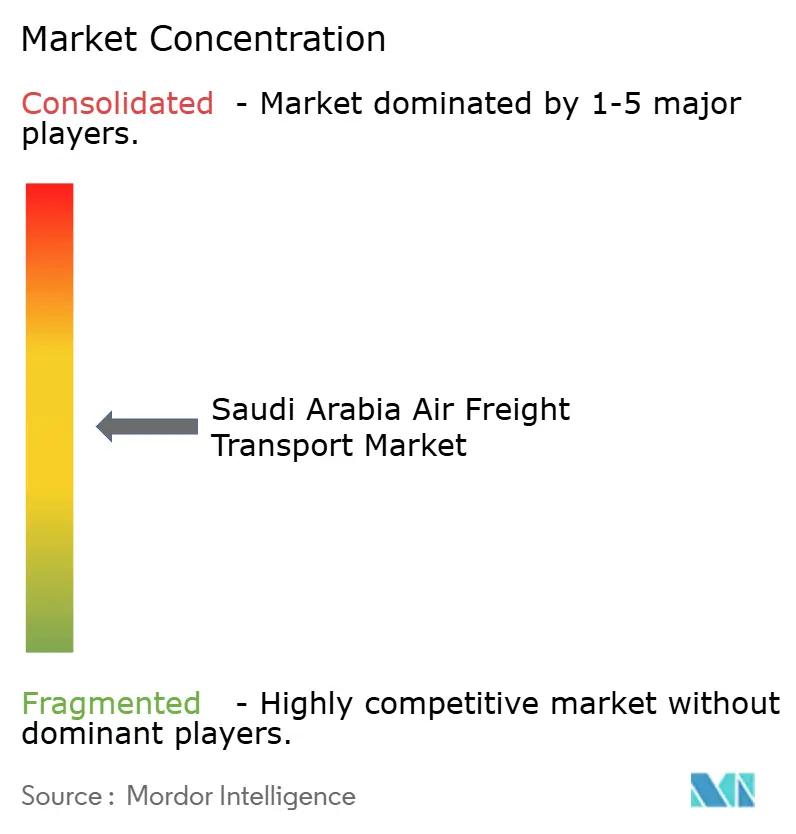
The Saudi Arabia air freight transport market is consolidated and includes airport cargo handlers, national cargo operators, international airlines, express integrators, and freight forwarders. SAL Saudi Logistics Services operates a broad cargo-handling network, while Saudia Cargo provides dedicated air cargo services and specialized handling capabilities. International integrators such as FedEx and DHL compete through international network access, express services, forwarding, and domestic distribution. Competition also involves Emirates SkyCargo, Qatar Airways Cargo, Etihad Cargo, Turkish Cargo, and Lufthansa Cargo, whose Saudi operations depend on route coverage, available capacity, service frequency, and local ground-handling arrangements.
Infrastructure investment and network integration are important competitive factors. In September 2025, FedEx announced that it had completed its transition to direct operations in Saudi Arabia, introduced a dedicated freighter connection, expanded freight forwarding services, and planned a regional hub at King Salman International Airport. In August 2025, DHL eCommerce completed its strategic investment in AJEX, strengthening the connection between regional parcel operations and DHL's international network. These developments broaden service options across international transportation, forwarding, and domestic distribution.
Operational capability and service specialization also influence competition. In October 2025, SAL renewed its partnership with Emirates SkyCargo to provide ground handling, air cargo, and logistics support for the airline's flights across Saudi airports. In April 2026, Saudia Cargo and the Saudi Food and Drug Authority introduced a pharmaceutical freight initiative, while AJEX opened its GMP-GxP-compliant Riyadh facility in October 2025. These developments demonstrate investment in airport services and specialized healthcare logistics. Operators seeking to differentiate their offerings need appropriate handling facilities, reliable capacity, efficient customs processes, and coordination between air and road transport.
Saudi Arabia Air Freight Transport Industry Leaders
-
Saudia Cargo
-
SAL Saudi Logistics Services Company
-
Riyadh Cargo (Riyadh Air)
-
Emirates SkyCargo
-
Qatar Airways Cargo
- *Disclaimer: Major Players sorted in no particular order
Recent Industry Developments
- September 2026: SAL and Elm launched CargoGate, a digital operational solution for coordinating shipment pickup and delivery appointments, managing vehicle movements, and streamlining procedures at SAL stations.
- April 2026: Saudia Cargo and the Saudi Food and Drug Authority launched an initiative offering shipping-cost reductions of up to 50% for pharmaceutical shipments and medical supplies. The initiative draws on Saudia Cargo's IATA CEIV Pharma and CEIV Fresh certifications.
- November 2025: DHL Supply Chain signed a land lease agreement to develop a regional logistics and distribution hub at Saudi Arabia's Special Integrated Logistics Zone in Riyadh. The EUR 130 million (USD 152.92 million) investment covers a 78,000 m² site, including 53,000 m² of warehouse space, with completion planned for the second quarter of 2027.
- October 2025: SAL renewed its strategic partnership with Emirates SkyCargo to provide integrated ground handling, air cargo, and logistics services for the airline's flights across Saudi airports.
Saudi Arabia Air Freight Transport Market Report Scope
| Freight Transport (Cargo/CEP) |
| Freight Forwarding |
| Other Value-Added Services (Customs Brokerage, Insurance, etc.) |
| Domestic |
| International |
| Belly Cargo |
| Freighter |
| General Cargo |
| Refeer Cargo |
| Special Cargo (Dangerous, High Value, Oversized, etc.) |
| E-commerce and Retail |
| Manufacturing and Automotive |
| Healthcare and Pharmaceuticals |
| Perishables and Fresh Produce |
| High-Tech and Electronics |
| Others |
| Central (Riyadh, Al-Qassim, and Hail) |
| Eastern (Ash-Sharqiyah) |
| Western (Al-Bahah, Makkah, Medina, and Tabuk) |
| Northern (Al-Jouf and Arar) |
| Southern (Asir, Jazan, and Najran) |
| By Service | Freight Transport (Cargo/CEP) |
| Freight Forwarding | |
| Other Value-Added Services (Customs Brokerage, Insurance, etc.) | |
| By Destination | Domestic |
| International | |
| By Carrier Type | Belly Cargo |
| Freighter | |
| By Cargo Type | General Cargo |
| Refeer Cargo | |
| Special Cargo (Dangerous, High Value, Oversized, etc.) | |
| By End-User Industry | E-commerce and Retail |
| Manufacturing and Automotive | |
| Healthcare and Pharmaceuticals | |
| Perishables and Fresh Produce | |
| High-Tech and Electronics | |
| Others | |
| By Region | Central (Riyadh, Al-Qassim, and Hail) |
| Eastern (Ash-Sharqiyah) | |
| Western (Al-Bahah, Makkah, Medina, and Tabuk) | |
| Northern (Al-Jouf and Arar) | |
| Southern (Asir, Jazan, and Najran) |
Key Questions Answered in the Report
What is the Saudi Arabia air freight transport market forecast through 2032?
The market is projected to reach USD 8.07 billion by 2032, increasing from USD 5.82 billion in 2027 at a CAGR of 6.75% during 2027–2032.
Which service category leads the Saudi Arabia air freight transport market?
Freight transport (Cargo/CEP) accounts for 49.26% of the market in 2026, while other value-added services are projected to register a CAGR of 8.28% through 2032.
Why does international air cargo dominate Saudi Arabia?
International freight accounts for 78.92% of the market in 2026, reflecting the Kingdom's role in trade routes connecting Asia, Europe, Africa, and other markets.
Which cargo category is projected to grow fastest?
Special cargo is projected to register a CAGR of 9.98% through 2032, supported by demand for specialized handling of dangerous goods, high-value shipments, oversized cargo, and other sensitive consignments.
Which region leads Saudi air freight activity?
The Central Region accounts for 50.37% of the market in 2026, supported by Riyadh's commercial activity, airport connectivity, and logistics investment.
What are the main constraints on Saudi air cargo growth?
High transportation costs can limit air freight adoption for price-sensitive goods. Dependence on passenger aircraft capacity, extreme temperatures, and gaps in coordination between cargo-handling systems can also increase operational complexity.