
Remote Monitoring and Management (RMM) Software Market Size and Share
Market Overview
| Study Period | 2021 - 2032 |
|---|---|
| Market Size (2027) | USD 3.48 Billion |
| Market Size (2032) | USD 5.82 Billion |
| Growth Rate (2027 - 2032) | 10.83 % |
| Fastest Growing Market | Asia-Pacific |
| Largest Market | North America |
| Market Concentration | Medium |
Major Players *Disclaimer: Major Players sorted in no particular order Image © Mordor Intelligence. Reuse requires attribution under CC BY 4.0. | |
Remote Monitoring and Management (RMM) Software Market Analysis by Mordor Intelligence
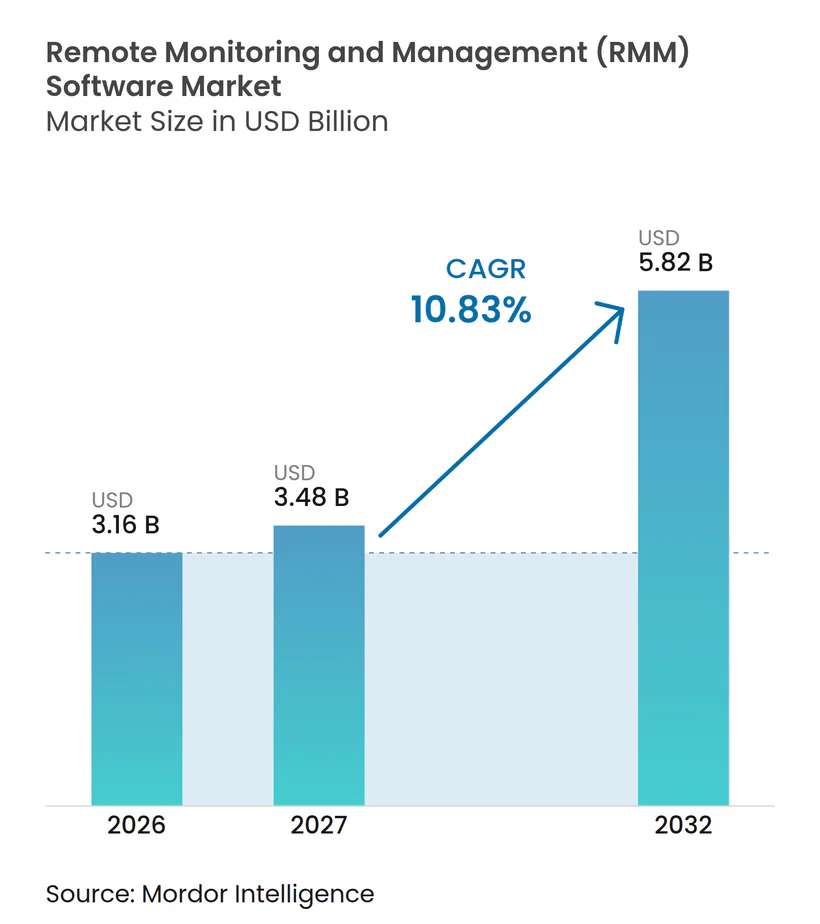
The remote monitoring and management (RMM) software market size is projected to expand from USD 3.16 billion in 2026 to USD 3.48 billion in 2027, and to USD 5.82 billion by 2032, registering a CAGR of 10.83% from 2027 to 2032. The remote monitoring and management software market is growing as IT teams manage systems across offices, cloud environments, and employee endpoints. Automated monitoring is becoming central to service delivery because technicians cannot manually oversee a rising number of connected assets. Managed service providers are moving from reactive repair work toward ongoing monitoring, patching, and remediation. Security functions are becoming part of the core platform as buyers seek stronger visibility and compliance support. Vendors are responding by combining remote management, security, backup, and workflow automation in integrated platforms.
Key Report Takeaways
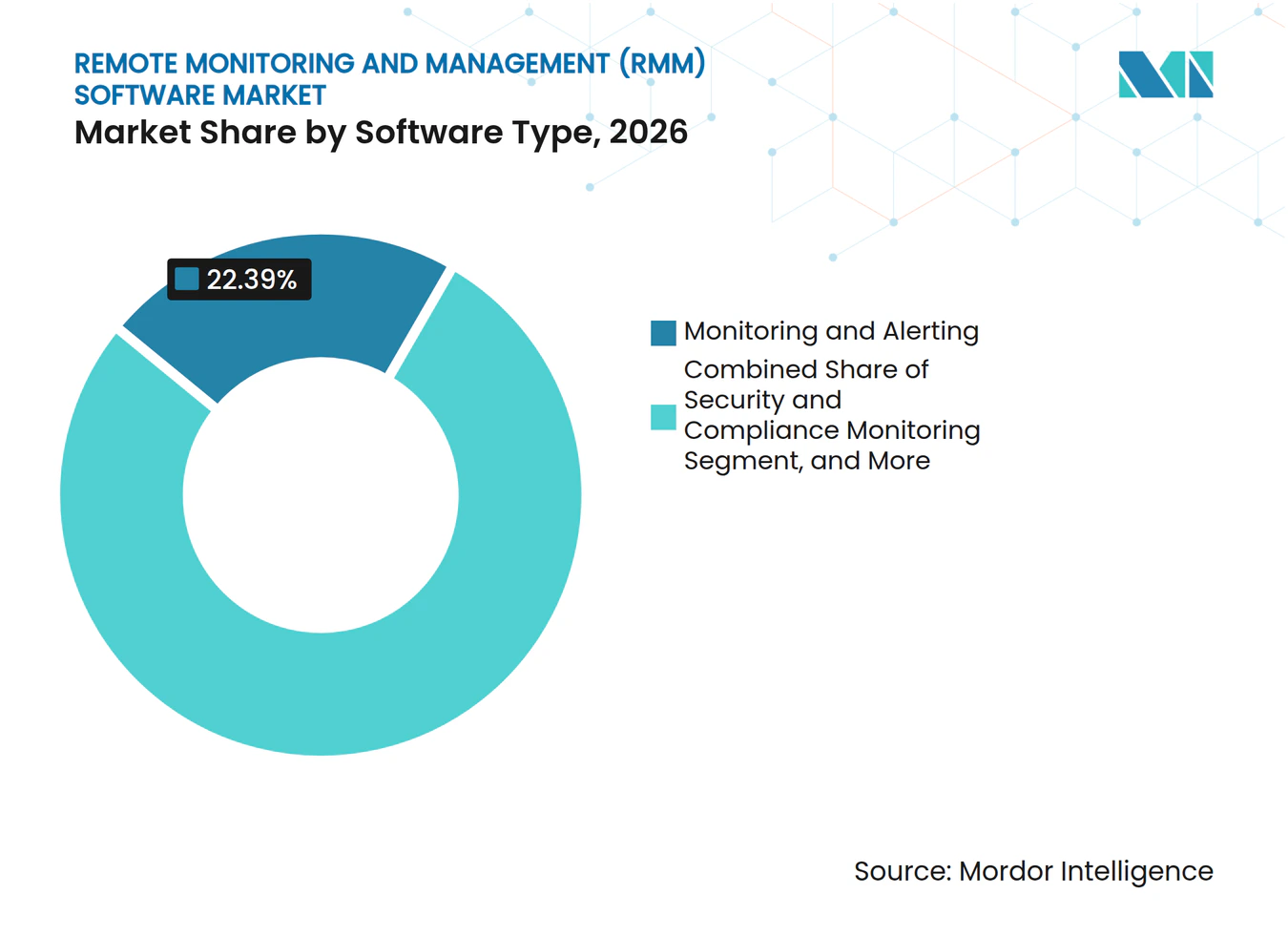
- By software type, Monitoring and Alerting held 22.39% of the remote monitoring and management (RMM) software market share in 2026, while Security and Compliance Monitoring is projected to expand at a 11.52% CAGR through 2032.
- By deployment model, cloud-based solutions accounted for 68.84% of the remote monitoring and management (RMM) software market share in 2026 and are expected to grow at a 11.48% CAGR through 2032.
- By organization size, small and medium enterprises held 57.37% share in 2026 and are projected to expand at a 11.29% CAGR through 2032.
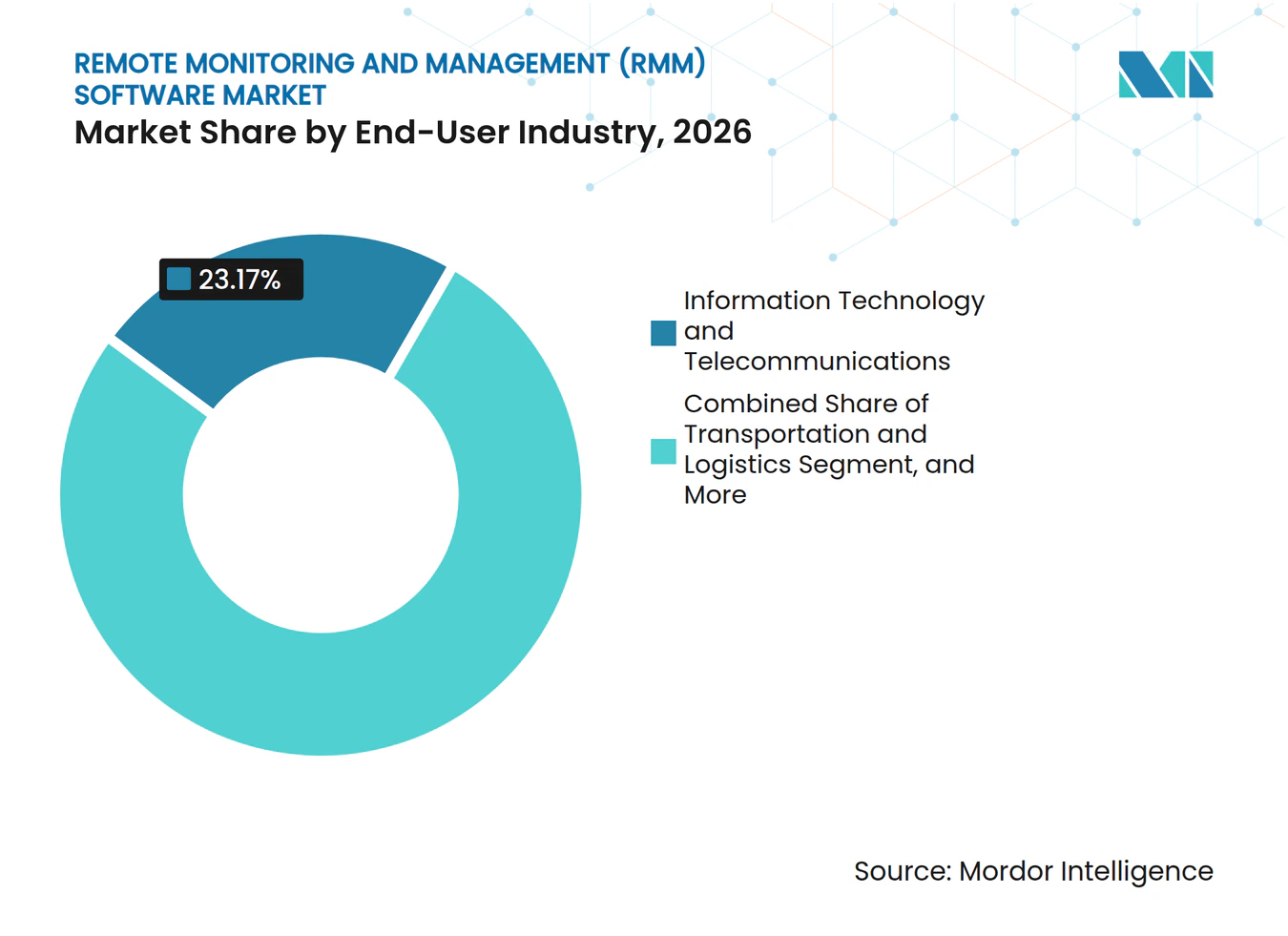
- By end-user industry, Information Technology and Telecommunications accounted for 23.17% share in 2026, while healthcare is projected to grow at a 11.03% CAGR through 2032.
- By device type, desktops and laptops held 48.28% share in 2026, while mobile devices are projected to expand at a 12.08% CAGR through 2032.
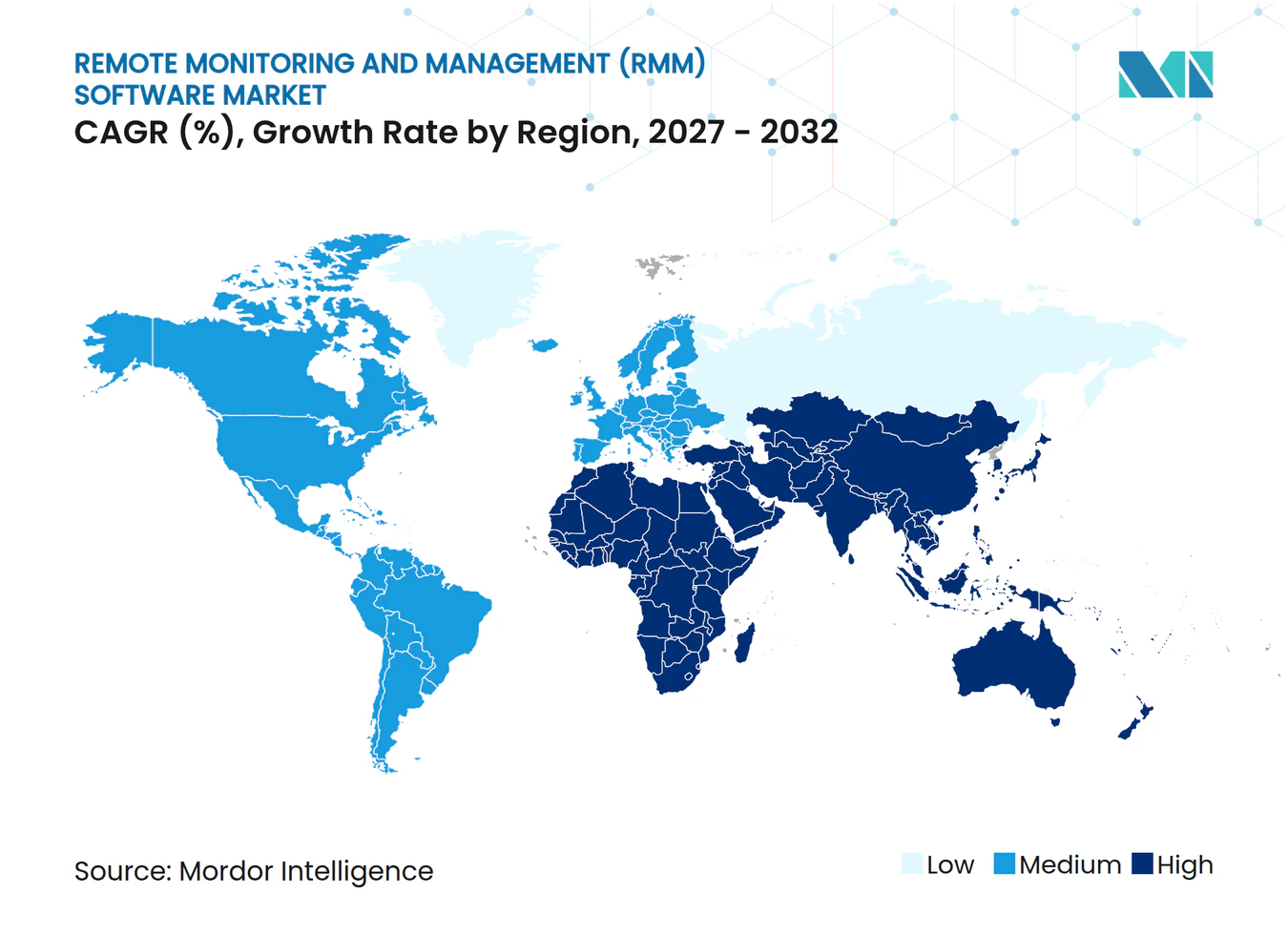
- By geography, North America accounted for 44.13% share in 2026, while Asia-Pacific is projected to grow at a 11.91% CAGR through 2032.
Note: Market numbers in this report are based on Mordor Intelligence's proprietary estimation framework, which combines nine months of actuals with Q4 projections for base year 2026.
Market Trends and Insights
Drivers Impact Analysis of Remote Monitoring and Management (RMM) Software Market*
| Driver | (~) % Impact on CAGR Forecast | Geographic Relevance | Impact Timeline |
|---|---|---|---|
| Expansion of Distributed and Hybrid IT Environments | +2.8% | Global, with highest intensity in North America and Western Europe | Medium term (2-4 years) |
| Growth of Managed Service Provider Adoption | +2.3% | Global, early gains in North America and Asia-Pacific core | Medium term (2-4 years) |
| Rising Cybersecurity, Patch, and Compliance Requirements | +1.9% | North America and EU, with spillover to Asia-Pacific and Middle East | Short term (≤ 2 years) |
| Proliferation of Endpoints, Cloud Resources, and IoT Devices | +1.4% | Global, led by Asia-Pacific manufacturing and North American enterprises | Long term (≥ 4 years) |
| Agentic AI and Predictive Remediation for Technician Productivity | +0.9% | North America and EU, with Asia-Pacific catching up | Short term (≤ 2 years) |
| Consolidation of RMM, PSA, Security, Backup, and Remote Access Tools | +0.6% | North America and Western Europe | Medium term (2-4 years) |
| Source: Mordor Intelligence | |||
Expansion of Distributed and Hybrid IT Environments
Distributed work has changed what IT teams need to monitor. Organizations now manage data centers, public cloud tenants, branch locations, and remote employee devices simultaneously. This makes centralized oversight a basic operational need for the remote monitoring and management (RMM) software market. Broader technology investment has expanded the systems that IT teams must support. Hybrid environments also reduce the value of tools designed only for local networks. Providers now need cloud resource discovery, identity monitoring, and visibility across multiple cloud environments to remain relevant.
Growth of Managed Service Provider Adoption
The expansion of managed service providers is a durable source of demand for remote monitoring and management software. Small and medium enterprises often lack the resources to maintain internal teams capable of providing 24-hour IT coverage. Security-focused providers are also using RMM as an access layer for endpoint security rather than only as an operations tool. That use broadens the platform role beyond patching and break-fix support. Consolidation among providers is shifting purchasing decisions from individual technicians to larger operators managing many client environments.
Rising Cybersecurity, Patch, and Compliance Requirements
Security requirements are becoming a direct purchasing factor in the remote monitoring and management (RMM) software market. The NIST Cybersecurity Framework 2.0 and the EU Network and Information Security Directive 2 require stronger controls over patching, asset visibility, and reporting in affected organizations.[1] These requirements support demand for automated patch deployment, compliance reporting, and auditable records. In 2025, ConnectWise expanded third-party patch coverage from more than 350 applications to more than 7,000 applications. Compliance-oriented purchasing is often deliberate, as buyers review certifications and reporting capabilities before selecting a platform. Vendors with established documentation can therefore have an advantage in regulated accounts.
Proliferation of Endpoints, Cloud Resources, and IoT Devices
Each new device class increases the monitoring workload for IT teams. Bring-your-own-device policies, cloud virtual desktops, and industrial sensors have broadened the meaning of an endpoint. Mobile devices are projected to grow at a 12.08% CAGR through 2032, reflecting wider use of smartphones and tablets in healthcare, logistics, retail, and field services. The remote monitoring and management (RMM) software market, therefore, needs agents that support varied operating systems and constrained devices. Providers also need cloud APIs that can connect management workflows to virtual and mobile assets. A cross-platform approach can help managed service providers operate from a single console rather than maintaining separate tools.
Restraints Impact Analysis of Remote Monitoring and Management (RMM) Software Market*
| Restraint | (~) % Impact on CAGR Forecast | Geographic Relevance | Impact Timeline |
|---|---|---|---|
| Security Exposure from Privileged Remote Access | -1.8% | Global, with highest sensitivity in North America and EU | Short term (≤ 2 years) |
| Competition from Bundled Cloud and Endpoint Platforms | -1.2% | North America and Western Europe | Medium term (2-4 years) |
| Alert Fatigue and Agent Sprawl in Multivendor Environments | -0.8% | Global, most acute in mid-market managed service providers | Medium term (2-4 years) |
| Pricing Friction and Uncertain Pass-Through of AI Costs | -0.5% | North America and EU, with spillover to Asia-Pacific | Long term (≥ 4 years) |
| Source: Mordor Intelligence | |||
Security Exposure from Privileged Remote Access
Privileged access creates a material security risk for the remote monitoring and management (RMM) software market. The same access that lets a provider manage many endpoints can also attract attackers seeking a route into client systems. In August 2026, N-able disclosed active exploitation of CVE-2026-18577 in its N-central platform and released a hotfix. Sophos documented related activity that involved the deployment of secondary remote management tools and techniques intended to evade endpoint detection. In September 2026, Microsoft described phishing campaigns that used legitimate RMM installers for persistent access. These incidents can lengthen sales cycles as enterprise buyers assess the security practices of both providers and their RMM suppliers.
Competition from Bundled Cloud and Endpoint Platforms
Bundled cloud and endpoint tools constrain some demand for standalone RMM software. Microsoft Intune offers device compliance, application deployment, and patching functions that overlap with entry-level RMM capabilities. This is attractive to providers that already manage Microsoft 365 licensing for small and medium business customers. In June 2025, ConnectWise, Microsoft, and Pax8 introduced an endpoint management and security offering for Microsoft 365 customers. The offering consolidated RMM, managed detection and response, security, and backup dashboards into a single purchasing route. Standalone providers need deeper ecosystem integration and differentiated automation to retain mid-market accounts.
*Our forecasts treat driver/restraint impacts as directional, not additive. The impact forecasts reflect baseline growth, mix effects, and variable interactions.
Remote Monitoring and Management (RMM) Software Market Segment Analysis
By Software Type:
Security and Compliance Tools Are Reshaping Monitoring PrioritiesMonitoring and Alerting held 22.39% of the remote monitoring and management (RMM) software market share in 2026. It remains the foundation of the platform because providers need timely visibility into device condition, service availability, and potential failures. Security and Compliance Monitoring is projected to grow at an 11.52% CAGR through 2032. Buyers increasingly expect a unified view of security posture, patch status, and operational health. This shifts security modules from an optional add-on toward a basic platform requirement.
Remote Access and Control enables real-time intervention when a user or device needs assistance. Patch and Software Management supports preventive maintenance and helps teams reduce known weaknesses. Automation and scripting are gaining importance as providers seek to manage more endpoints without adding technicians. Kaseya introduced its Intelligence platform in April 2026 and said it was trained on more than 1 billion help desk tickets and 17 million managed endpoints.[2] Asset Discovery and Inventory, together with Reporting and Analytics, help providers maintain current records and produce evidence for compliance reviews.



By Deployment Model:
Cloud-Native Deployments Anchor Provider ScalabilityCloud-based solutions accounted for 68.84% of the remote monitoring and management (RMM) software market size in 2026. The model reduces the need for on-site infrastructure and lets providers onboard clients without major capital spending. Cloud deployment is projected to grow at an 11.48% CAGR through 2032. Multi-tenant architecture allows a single instance to manage endpoints for multiple client organizations. This supports the scale needed by providers with large small-business customer bases.
Cloud delivery also lets suppliers release agent updates, security patches, and product enhancements across their customer base more quickly. On-premises deployment remains relevant for government, defense, and critical infrastructure users with strict data residency or air-gap needs. Hybrid deployment gives some large enterprises a middle path between cloud-scale management and selective local data retention. It can support organizations that need shared control while retaining certain workloads on-site. The remote monitoring and management (RMM) software market is therefore likely to maintain several deployment options even as cloud delivery leads overall adoption.
By Organization Size:
Small and Medium Enterprises Drive Platform AdoptionSmall and medium enterprises held 57.37% of revenue in 2026 and are projected to grow at an 11.29% CAGR through 2032. These organizations can use managed services to gain capabilities that would be difficult to staff internally. Automated patching, monitoring, and alerting help smaller IT teams manage more devices. This produces a clear operational benefit where IT staff must support a broad set of users and locations. The remote monitoring and management (RMM) software market is closely tied to the need for practical technology support at lower operating costs.
Pricing based on endpoints rather than technicians can make RMM more accessible for provider practices serving smaller organizations. NinjaOne reported pricing from USD 1.50 per month for large endpoint fleets. The company also reported more than 35,000 customer organizations across more than 140 countries. Large enterprises remain important because they require multi-tenant governance, detailed analytics, and integration with IT service management systems. Their procurement processes are often more complex, but they can enable larger, more strategic deployments.
By End-User Industry:
Healthcare Expands Through Connected CareInformation Technology and Telecommunications held 23.17% share of the remote monitoring and management (RMM) software market in 2026. The sector aligns naturally with a platform designed to monitor systems, handle remote support, and automate routine tasks. Healthcare is projected to grow at an 11.03% CAGR through 2032. Connected medical devices, distributed clinics, and home care systems are raising the need for consistent device oversight. Health Insurance Portability and Accountability Act security requirements also reinforce demand for reporting and controlled access.
NinjaOne stated in March 2026 that nearly 1,000 healthcare organizations had become customers during the preceding year, while healthcare-related annual recurring revenue grew nearly 70% year over year. Financial services, government and defense, and professional services also have strong needs for automated patch compliance and continuous monitoring. Retail and e-commerce, manufacturing, and energy and utilities are adopting remote oversight for distributed facilities and operational equipment. Education, transportation and logistics, and hospitality and travel remain e in adoption. Providers with sector-specific onboarding materials can improve their position in these groups.

By Device Type:
Mobile Management Gains Urgency as Endpoint Use ChangesDesktops and laptops held 48.28% of the remote monitoring and management (RMM) software market share in 2026. They remain central because many monitoring workflows were first built around traditional employee computers. Mobile devices are projected to grow at a 12.08% CAGR through 2032. Smartphones and tablets are now essential work devices in healthcare, retail, logistics, and field service. This creates demand for management capabilities that work beyond desktop operating systems.
Managed iPad fleets used for clinical applications illustrate why mobile management is becoming more important. Providers are adding or developing mobile device management functions so that these assets can be monitored alongside other endpoints. Syncro released a Linux Agent in open beta in February 2026 for Ubuntu, RHEL, and Debian-based systems. Servers and virtual machines remain the second-largest device category in many managed settings because they support essential workloads. Printers and peripheral devices are smaller but remain relevant in office-focused managed service engagements.
Geography Analysis
North America Remote Monitoring and Management (RMM) Software Market
North America held 44.13% of the remote monitoring and management (RMM) software market share in 2026. The region benefits from a dense provider base, substantial enterprise IT budgets, and mature compliance-led procurement. The United States supports recurring subscriptions through providers serving small and medium enterprises in financial services, healthcare, and professional services. Canada adds a growing group of cloud-first providers focused on mid-market customers. Mexico is earlier in adoption, but is expanding as manufacturing organizations use outsourced technology support for industrial automation.
North America (NIST) Remote Monitoring and Management (RMM) Software Market
Compliance frameworks have a strong effect on purchasing in North America. NIST Cybersecurity Framework 2.0 supports stronger risk management practices and clearer cybersecurity governance. Providers that offer ready-made reporting and audit records can meet requirements for government-adjacent and regulated accounts. Large enterprises often use many cybersecurity tools, which can increase interest in integrated platforms that reduce product sprawl. The remote monitoring and management (RMM) software market benefits when security, backup, and remote access functions can be managed through fewer systems.
EMEA, APAC and South America Remote Monitoring and Management (RMM) Software Market
Asia-Pacific is projected to expand at an 11.91% CAGR through 2032. Australia, India, South Korea, and Southeast Asia are expanding their managed service ecosystems alongside cloud investment, while India and Southeast Asia have large bases of small and medium enterprises that can benefit from high endpoint-to-technician ratios supported by automation. NinjaOne completed its acquisition of Melbourne-based Dropsuite for USD 270 million in June 2025.[3] Europe has distinct demand for compliance documentation and European data processing options, while South America, the Middle East, and Africa remain smaller but are expanding as technology services and digital transformation programs develop.
Competitive Landscape
Market Concentration
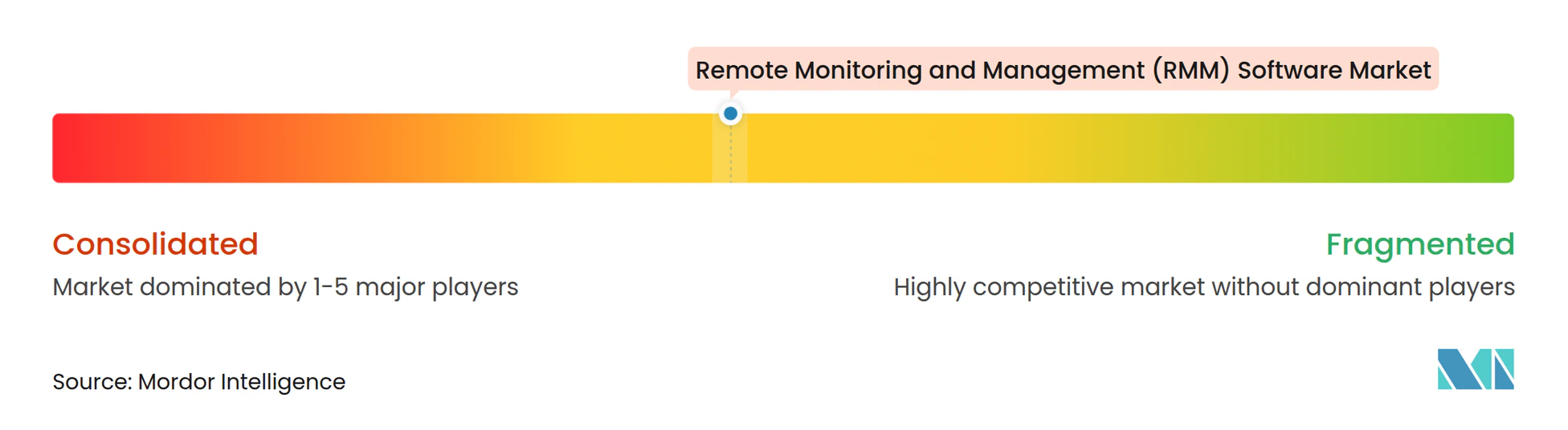
The remote monitoring and management (RMM) software market is moderately concentrated among leading platform providers. A small group of vendors has significant provider spending because their products link RMM with professional services automation, security, backup, and remote access. Switching can be difficult when customers use several products from the same supplier. The wider field remains fragmented, with many vendors serving particular verticals, geographies, or price points. No supplier has unchallenged strength across every segment.
Platform breadth is a central competitive factor in the remote monitoring and management (RMM) software market. In 2025, ConnectWise expanded patching coverage to more than 7,000 third-party applications and added robotic process automation capabilities.[4] This approach combines patching, workflow support, and professional services functions. Kaseya launched an agentic IT management platform in April 2026 that it said can support ticket triage, threat containment, backup verification, and workflow optimization. The growing use of operational data in automation can favor firms with large installed bases and established workflow data.
Newer providers compete by offering simpler adoption and tools that may improve technician productivity. Strong compliance practices and alignment with the NIST Secure Software Development Framework can provide more credible evidence during security reviews for healthcare, financial services, and government customers. ConnectWise, Microsoft, and Pax8 used their 2025 collaboration to combine endpoint management and security through the Pax8 marketplace. The remote monitoring and management (RMM) software market remains open to providers that can combine security, automation, and manageable deployment without adding operational complexity.
Remote Monitoring and Management (RMM) Software Industry Leaders
-
ConnectWise, LLC
-
Kaseya US, LLC
-
NinjaOne, Inc.
-
N-able Technologies Ltd.
-
Atera Networks Ltd.
- *Disclaimer: Major Players sorted in no particular order
Remote Monitoring and Management (RMM) Software Market Companies Covered in this Report
- ConnectWise, LLC
- Kaseya US, LLC
- NinjaOne, Inc.
- N-able Technologies Ltd.
- Atera Networks Ltd.
- Halo Service Solutions Ltd.
- Zoho Corporation Pvt. Ltd.
- GoTo Group, Inc.
- TeamViewer SE
- Auvik Networks Inc.
- Syncro, Inc.
- Barracuda Networks, Inc.
- JumpCloud, Inc.
- Fortra, LLC
- Addigy, Inc.
- SuperOps.ai
- Domotz Inc.
- Splashtop Inc.
- Microsoft Corporation
- Cisco Systems, Inc.
Recent Industry Developments in Remote Monitoring and Management (RMM) Software Market
- April 2026: Kaseya launched what it describes as the first agentic IT management platform at Kaseya Connect Global, powered by Kaseya Intelligence, an AI engine trained on more than 1 billion help desk tickets, 3 exabytes of backup data, and 17 million managed endpoints. The platform executes actions autonomously, including ticket triage, threat containment, backup verification, and workflow optimization, and represents a shift from AI as a recommendation layer to AI as an operational system.
- March 2026: NinjaOne reported at HIMSS 2026 that nearly 1,000 healthcare organizations became customers in the preceding year and that healthcare-related annual recurring revenue grew nearly 70% year over year. The company attributed growth to the demand for unified IT operations that support HIPAA compliance readiness while reducing IT complexity in distributed clinical environments.
- February 2026: Syncro released a Linux Agent in open beta, extending RMM functionality to Ubuntu, RHEL, and Debian-based systems and enabling partners to standardize monitoring and scripting workflows across Windows, macOS, and Linux assets from a single console.
- November 2025: ConnectWise advanced its Asio platform at IT Nation Connect with RMM third-party patching now covering over 7,000 applications, up from more than 350, alongside new RPA capabilities and an Auvik network monitoring integration. Early adopters of the RPA automation module reported savings of more than 165 technician hours per month, 75% faster client onboarding, and 90% faster offboarding.
Global Remote Monitoring and Management (RMM) Software Market Report Scope
Remote Monitoring and Management (RMM) software enables managed service providers (MSPs), IT teams, and enterprises to remotely monitor, manage, maintain, and secure IT infrastructure, including endpoints, servers, networks, applications, and devices. The software provides capabilities such as real-time system monitoring, automated patch management, remote access and support, asset management, performance reporting, alerting, and issue remediation.
The Remote Monitoring and Management (RMM) Software Market Report is Segmented by Software Type (Monitoring and Alerting, Remote Access and Control, Patch and Software Management, Automation and Scripting, Asset Discovery and Inventory, Reporting and Analytics, and Security and Compliance Monitoring), Deployment Model (Cloud-Based, On-Premises, and Hybrid Deployment), Organization Size (Small and Medium Enterprises and Large Enterprises), End-User Industry (Information Technology and Telecommunications, BFSI, Healthcare, Retail and E-Commerce, Manufacturing, Government and Defense, Education, Professional Services, Energy and Utilities, Transportation and Logistics, Hospitality and Travel, and Other End-User Industries), Device Type (Desktops and Laptops, Servers and Virtual Machines, Mobile Devices, and Printers and Peripheral Devices), and Geography (North America, South America, Europe, Asia-Pacific, Middle East, and Africa). The Market Forecasts are Provided in Terms of Value (USD).
Segmentation Overview
| Monitoring and Alerting |
| Remote Access and Control |
| Patch and Software Management |
| Automation and Scripting |
| Asset Discovery and Inventory |
| Reporting and Analytics |
| Security and Compliance Monitoring |
| Cloud-Based |
| On-Premises |
| Hybrid Deployment |
| Small and Medium Enterprises |
| Large Enterprises |
| Information Technology and Telecommunications |
| BFSI |
| Healthcare |
| Retail and E-Commerce |
| Manufacturing |
| Government and Defense |
| Education |
| Professional Services |
| Energy and Utilities |
| Transportation and Logistics |
| Hospitality and Travel |
| Other End-User Industries |
| Desktops and Laptops |
| Servers and Virtual Machines |
| Mobile Devices |
| Printers and Peripheral Devices |
| North America | United States |
| Canada | |
| Mexico | |
| South America | Brazil |
| Argentina | |
| Rest of South America | |
| Europe | Germany |
| United Kingdom | |
| France | |
| Italy | |
| Spain | |
| Russia | |
| Rest of Europe | |
| Asia-Pacific | China |
| India | |
| Japan | |
| South Korea | |
| Australia | |
| Rest of Asia-Pacific | |
| Middle East | Saudi Arabia |
| United Arab Emirates | |
| Turkey | |
| Rest of Middle East | |
| Africa | South Africa |
| Egypt | |
| Nigeria | |
| Rest of Africa |
| By Software Type | Monitoring and Alerting | |
| Remote Access and Control | ||
| Patch and Software Management | ||
| Automation and Scripting | ||
| Asset Discovery and Inventory | ||
| Reporting and Analytics | ||
| Security and Compliance Monitoring | ||
| By Deployment Model | Cloud-Based | |
| On-Premises | ||
| Hybrid Deployment | ||
| By Organization Size | Small and Medium Enterprises | |
| Large Enterprises | ||
| By End-User Industry | Information Technology and Telecommunications | |
| BFSI | ||
| Healthcare | ||
| Retail and E-Commerce | ||
| Manufacturing | ||
| Government and Defense | ||
| Education | ||
| Professional Services | ||
| Energy and Utilities | ||
| Transportation and Logistics | ||
| Hospitality and Travel | ||
| Other End-User Industries | ||
| By Device Type | Desktops and Laptops | |
| Servers and Virtual Machines | ||
| Mobile Devices | ||
| Printers and Peripheral Devices | ||
| By Geography | North America | United States |
| Canada | ||
| Mexico | ||
| South America | Brazil | |
| Argentina | ||
| Rest of South America | ||
| Europe | Germany | |
| United Kingdom | ||
| France | ||
| Italy | ||
| Spain | ||
| Russia | ||
| Rest of Europe | ||
| Asia-Pacific | China | |
| India | ||
| Japan | ||
| South Korea | ||
| Australia | ||
| Rest of Asia-Pacific | ||
| Middle East | Saudi Arabia | |
| United Arab Emirates | ||
| Turkey | ||
| Rest of Middle East | ||
| Africa | South Africa | |
| Egypt | ||
| Nigeria | ||
| Rest of Africa | ||
Key Questions Answered in the Report
What is the remote monitoring and management (RMM) software market size?
The remote monitoring and management (RMM) software market is projected to grow from USD 3.16 billion in 2026 and USD 3.48 billion in 2027 to USD 5.82 billion by 2032, at a 10.83% CAGR.
What is driving demand for remote monitoring and management (RMM) software market?
Distributed IT environments, broader managed service provider use, compliance requirements, and rising endpoint counts are supporting adoption. The remote monitoring and management software market benefits when automated monitoring, patch management, and remote support help technicians work across many devices and customer settings.
Which deployment model leads RMM software adoption?
Cloud-based platforms held 68.84% share in 2026 and are projected to grow at an 11.48% CAGR through 2032.
Which organizations are adopting RMM software fastest?
Small and medium enterprises held 57.37% share in 2026 and are projected to expand at an 11.29% CAGR through 2032. These organizations can use provider-led automation to manage patches, alerts, and support without building large internal IT teams.
Which end-user sector is growing fastest for RMM platforms?
Healthcare is projected to grow at an 11.03% CAGR through 2032 as connected care settings and compliance needs expand. Clinical workstations, mobile carts, and remote care devices increase the value of centralized visibility and policy-based controls.
Which region is growing fastest for RMM software?
Asia-Pacific is projected to grow at an 11.91% CAGR through 2032, supported by provider growth and expanding cloud infrastructure.