
Remote Browser Isolation Market Size and Share
Market Overview
| Study Period | 2021 - 2032 |
|---|---|
| Market Size (2027) | USD 1.29 Billion |
| Market Size (2032) | USD 4.19 Billion |
| Growth Rate (2027 - 2032) | 26.57 % |
| Fastest Growing Market | Asia-Pacific |
| Largest Market | North America |
| Market Concentration | Medium |
Major Players *Disclaimer: Major Players sorted in no particular order Image © Mordor Intelligence. Reuse requires attribution under CC BY 4.0. | |
Remote Browser Isolation Market Analysis by Mordor Intelligence
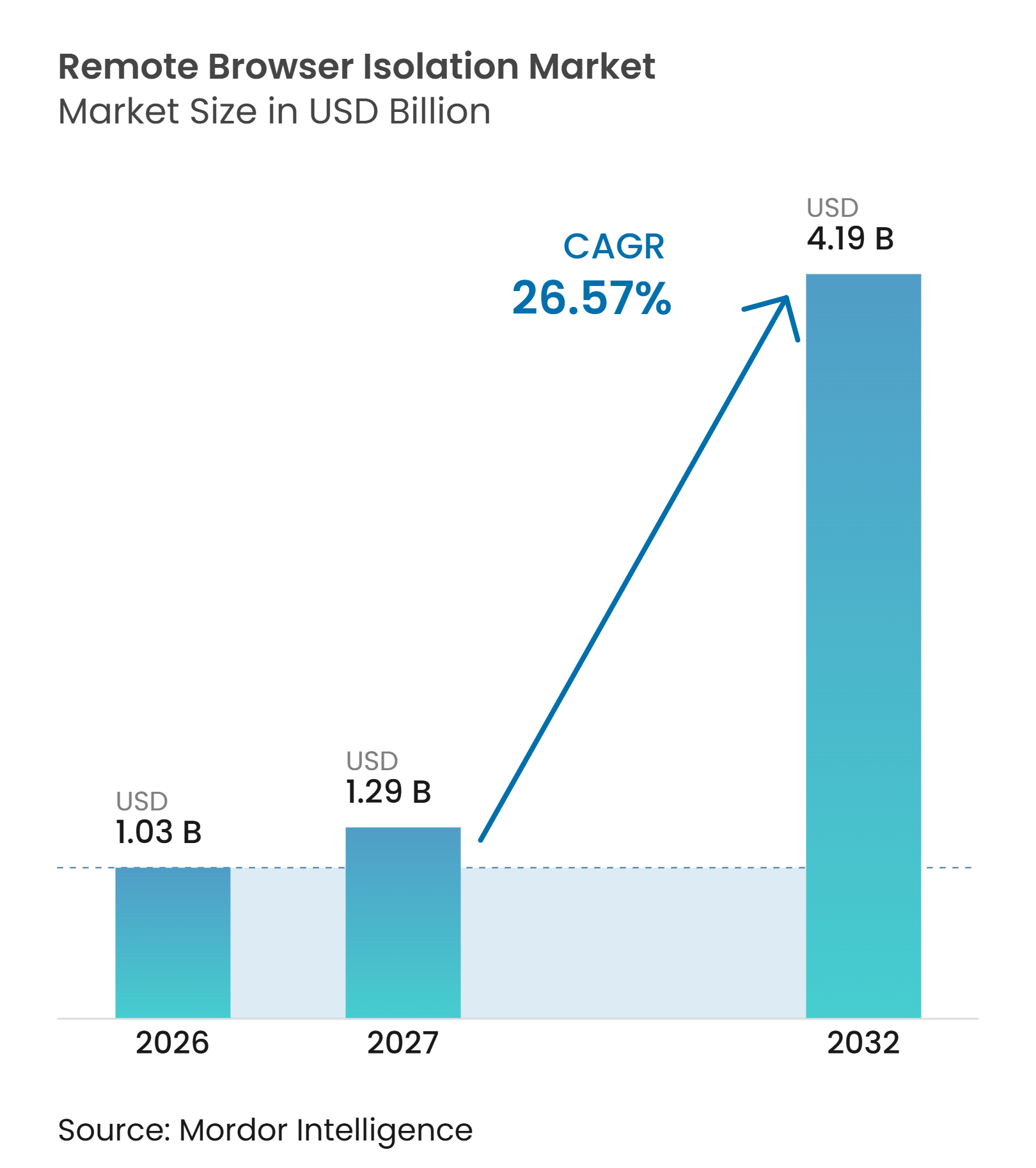
The remote browser isolation market size is expected to grow from USD 1.03 billion in 2026 to USD 1.29 billion in 2027 and is forecast to reach USD 4.19 billion by 2032 at 26.57% CAGR over 2027-2032. The remote browser isolation market is becoming part of zero-trust security programs rather than a separate optional control. Browsers remain a major work environment for knowledge workers, including those who access cloud applications on contractor and personal devices. Web-based threats, zero-trust requirements, and durable hybrid work practices drive demand across deployment models. Vendors are combining dedicated isolation functions with broader secure service edge platforms, changing how buyers evaluate the remote browser isolation market. Data-localization rules also create an opening for rendering capacity that remains within a country or region, while bundled features and more advanced browser-native attacks increase pressure on standalone providers. These conditions make product depth, local service coverage, and compatibility with broader security controls more important in vendor selection, especially when buyers need protection for employees, contractors, and temporary workers, as well as personal devices, under a single access policy, without requiring each group to use identical endpoint software or hardware for every user.
Key Report Takeaways
- By deployment mode, cloud-based delivery held 69.84% of the remote browser isolation market share in 2026, while it is projected to expand at a 28.61% CAGR through 2032.
- By enterprise size, large enterprises held 68.71% of the remote browser isolation market share in 2026, while small and medium-sized enterprises are projected to expand at a 29.93% CAGR through 2032.
- By application, web threat and malware isolation accounted for 46.21% of the remote browser isolation market size in 2026, while browser data loss prevention is projected to expand at a 28.93% CAGR through 2032.
- By end-user industry, BFSI held 31.27% of the remote browser isolation market share in 2026, while healthcare and life sciences are projected to expand at a 27.51% CAGR through 2032.
- By geography, North America held 35.86% of the remote browser isolation market share in 2026, while Asia-Pacific is projected to expand at a 29.72% CAGR through 2032.
Note: Market numbers in this report are based on Mordor Intelligence's proprietary estimation framework, which combines nine months of actuals with Q4 projections for base year 2026.
Global Remote Browser Isolation Market Trends and Insights
Drivers Impact Analysis*
| Driver | (~) % Impact on CAGR Forecast | Geographic Relevance | Impact Timeline |
|---|---|---|---|
| Zero Trust Security Adoption | +6.2% | Global, strongest mandate in North America and Europe | Medium term (2-4 years) |
| Rising Web-Based Phishing and Ransomware Attacks | +5.4% | Global, with acute pressure in North America, Europe, and Asia-Pacific | Short term (≤ 2 years) |
| Permanent Hybrid and Remote Workforces | +4.8% | Global, with the highest density in North America and Western Europe | Medium term (2-4 years) |
| Integration of RBI Into Secure Access Service Edge Platforms | +3.9% | Global, with spillover concentrated in Asia-Pacific and the Middle East | Long term (≥ 4 years) |
| Browser-Native Attack Automation and AI-Generated Web Threats | +3.2% | Global, emerging faster in North America and East Asia | Short term (≤ 2 years) |
| Sovereign Browser Rendering for Sensitive Workloads | +2.1% | Europe, the Middle East, and national security agencies in Asia-Pacific | Long term (≥ 4 years) |
| Source: Mordor Intelligence | |||
Zero Trust Security Adoption
The move from perimeter security toward continuous verification supports the remote browser isolation market. A 2026 survey of 851 IT and security professionals found that 82% viewed universal zero trust network access as essential, but only 17% had fully implemented it.[1] This gap leaves organizations with a continuing need to secure browser activity at the edge of identity and device controls. Browsers do not natively apply device posture checks in the same way as managed endpoint agents. A cloud-rendered browsing session can therefore limit exposure when a user reaches an untrusted website from a device outside corporate management. The same survey found that 63% of organizations favored a single-vendor SASE or hybrid platform model, placing many remote browser isolation market purchases within larger platform contracts.
Rising Web-Based Phishing and Ransomware Attacks
Web-based attacks remain a direct reason for organizations to deploy isolation controls. The Anti-Phishing Working Group recorded 1,069,681 phishing attacks in Q2 2026, up 10.1% from Q1 2026, and June recorded 425,808 incidents. Its report also showed that wire-transfer business email compromise attacks increased 88% between Q1 and Q2 2026. Sophos reported that malicious email and phishing represented 26% and 24% of ransomware entry points in its 2026 survey. These attack paths often begin when users open links or login pages in a browser. Isolation keeps the content away from the local device when the user reaches a phishing site or a page carrying malicious code. This direct containment use case remains central to the remote browser isolation market.
Permanent Hybrid and Remote Workforces
Hybrid work extends web access beyond the company-managed endpoint. Verizon reported that 52% of security incidents in 2025 involved a remote worker device or connection.[2] IBM reported an average remote-work-related breach cost of USD 4.75 million in 2025, USD 173,774 higher than the cost reported for non-remote breaches. Contractor machines, personal laptops, and BYOD sessions can sit outside a company’s usual endpoint controls. Remote rendering offers a way to protect those sessions without installing a client on every device. This makes deployment more practical where organizations need to protect users who cannot receive managed hardware.
Integration of RBI Into Secure Access Service Edge Platforms
RBI integration into secure access service edge platforms changes the buying path for many organizations. Zscaler, Palo Alto Networks, Netskope, Cloudflare, Cato Networks, and Versa Networks embed isolation in their secure service edge stacks. A policy can then use identity, device posture, cloud access security broker signals, data loss prevention classification, and risk information to determine when to isolate a session. The isolation function can be available as a configuration within an existing subscription rather than a separate purchase. This model is particularly relevant for smaller organizations that had previously viewed dedicated browser isolation as complex or costly. It also supports wider use of the remote browser isolation market, where security teams are consolidating vendors.
Restraints Impact Analysis*
| Restraint | (~) % Impact on CAGR Forecast | Geographic Relevance | Impact Timeline |
|---|---|---|---|
| Latency and User-Experience Trade-Offs | -3.2% | Global, most acute in Asia-Pacific and regions with lower average bandwidth | Short term (≤ 2 years) |
| Budget Pressure From Bundled SSE Functionality | -2.8% | Global, most pronounced among North American and European mid-market buyers | Medium term (2-4 years) |
| Data Residency and Cross-Border Rendering Constraints | -2.0% | Europe, China, the Middle East, and Southeast Asia | Long term (≥ 4 years) |
| Browser Compatibility and Application Exception Management | -1.6% | Global, concentrated in enterprises with large legacy-application portfolios | Medium term (2-4 years) |
| Source: Mordor Intelligence | |||
Latency and User Experience Trade-Offs
Performance concerns can limit broad deployment of isolation, especially for video conferencing, web trading, and real-time software-as-a-service collaboration. Nomura Research Institute noted in April 2025 that web-content compatibility problems can lead organizations to keep exception lists. These lists can weaken a security policy when exceptions accumulate over time. Cloudflare, Menlo Security, and Island implemented GPU acceleration in their cloud isolation platforms during 2025 and 2026 to reduce the gap with local browser rendering. Long network paths remain a concern for organizations that support users across several regions. The restraint remains most visible where local bandwidth and nearby rendering capacity are limited.
Budget Pressure From Bundled SSE Functionality
Bundled platform functionality broadens the use of isolation but puts pressure on dedicated providers. When major vendors include RBI in higher-tier subscriptions, buyers may question the value of a separate product. The 2026 zero trust survey found that 63% of organizations favored single-vendor SASE or hybrid platform consolidation. This procurement pattern can extend sales cycles and increase price sensitivity for specialist vendors. Providers must show greater depth in isolation, control, and auditability to justify a separate purchase. Demand for dedicated offerings is therefore strongest in regulated settings where bundled functions do not meet required levels of assurance.
*Our forecasts treat driver/restraint impacts as directional, not additive. The impact forecasts reflect baseline growth, mix effects, and variable interactions.
Segment Analysis
By Deployment Mode: Cloud Delivery Supports Agentless Scale
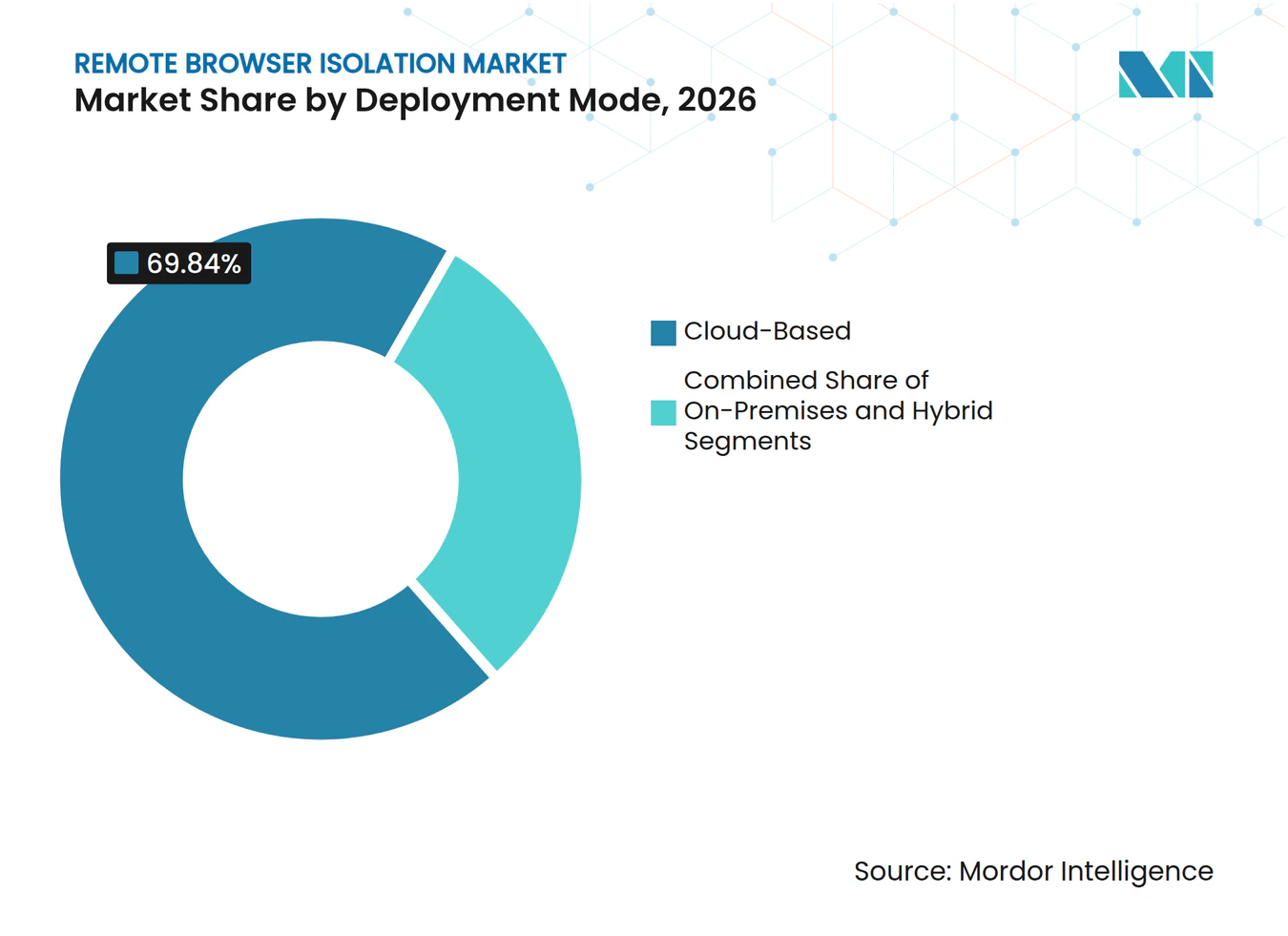
Cloud-based delivery held 69.84% of the remote browser isolation market share in 2026. It protects unmanaged BYOD devices and contractor machines without requiring a software agent on the device. That capability supports zero-trust programs that must extend beyond the endpoint management perimeter. On-premises deployment remains relevant when classified or air-gapped workloads cannot move through a public cloud path. These deployments primarily support defense and intelligence settings with strict operational restrictions.
Cloud-based delivery is projected to expand at a 28.61% CAGR through 2032, the fastest rate among deployment modes. Menlo Security, Cloudflare, Netskope, and Zscaler have built cloud rendering environments that can add session capacity without direct customer intervention. GPU acceleration at edge locations has reduced the latency difference between cloud-rendered and locally rendered sessions. Hybrid models remain relevant for organizations that require sovereign rendering for regulated data while using cloud delivery for general browsing. On-premises and hybrid configurations are expected to represent a smaller portion of the remote browser isolation market as cloud delivery becomes more common.



By Enterprise Size: Large Enterprises Lead While SMEs Expand Faster
Large enterprises accounted for 68.71% of the remote browser isolation market size in 2026. Their scale, contractor populations, third-party access, and remote work arrangements create exposure that browser isolation is designed to address. Menlo Security reported in March 2026 that its customer base included more than 1,000 enterprises and 8 of the 10 largest global financial institutions.[3] These customers often need browser controls that work across a broad mix of managed and unmanaged endpoints. Their budgets and mature security operations also support the adoption of dedicated controls. Complex internal access patterns make it valuable to apply a consistent browsing policy across employees, contractors, and external service providers.
Small and medium-sized enterprises are projected to expand at a 29.93% CAGR through 2032. Secure service edge bundling can make isolation available as a policy setting rather than a separate procurement effort. Netskope expanded its Enterprise Browser in February 2025 to support additional use cases for unmanaged devices and temporary workers within Netskope One. Managed security service providers can include browser isolation in standard security packages for smaller organizations. These channels can reduce implementation barriers before customers formalize their requirements at renewal. The approach also lets smaller teams use browser controls without operating a separate rendering environment or creating a specialized internal security workflow.
By Application: Threat Containment Leads While Browser Data Protection Advances
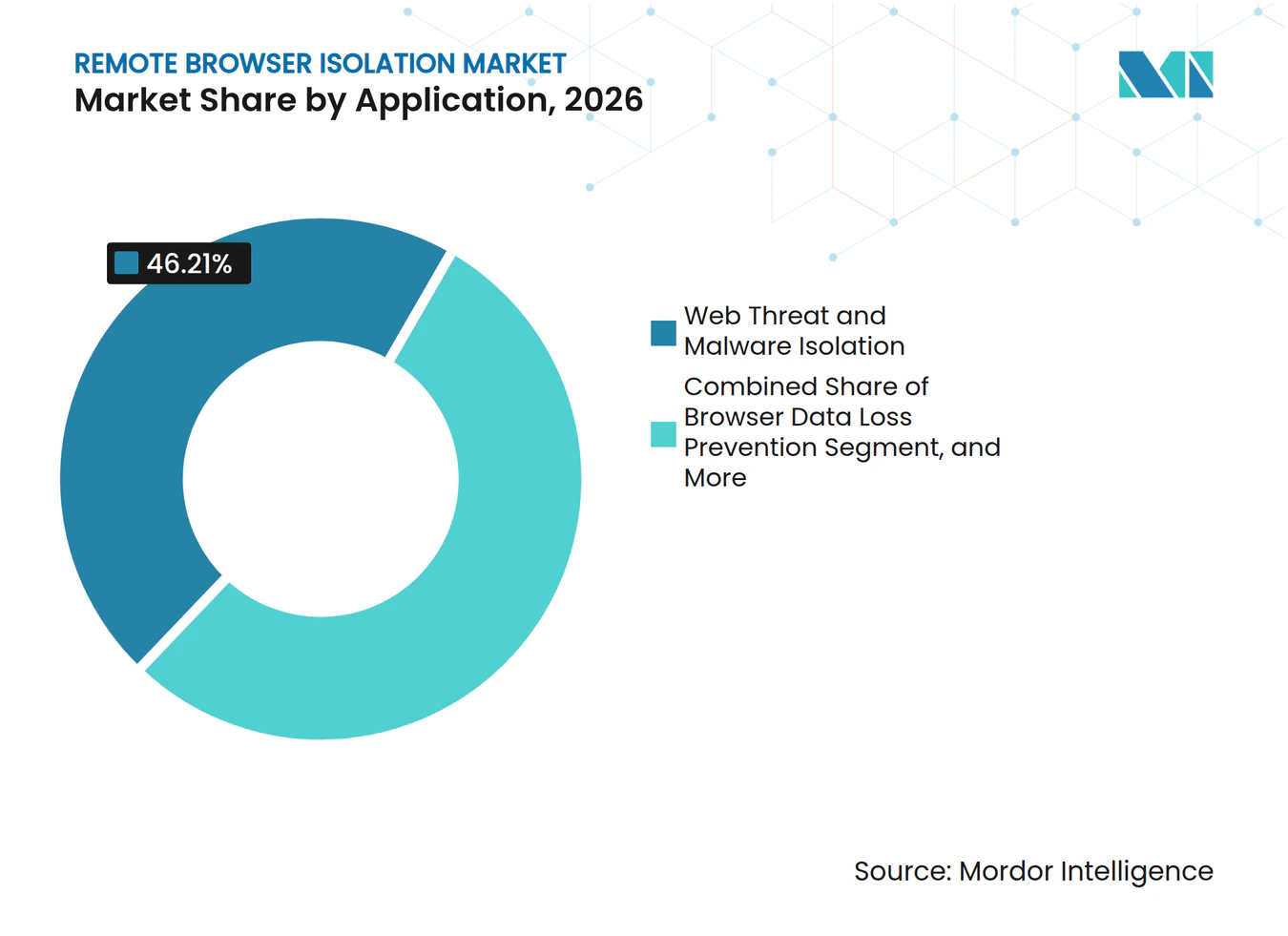
Web threat and malware isolation accounted for 46.21% of the remote browser isolation market in 2026. This application prevents malware payloads, zero-day browser exploits, and drive-by downloads from executing on the user device. It offers clear control for organizations that need to contain untrusted web content. Phishing and credential theft protection also benefit from sessions rendered outside the endpoint. Secure access for remote users, contractors, and third parties is increasingly important as companies manage larger external workforces. Isolation can apply the same protection to a temporary session that organizations use for a regular employee session, even when the device is not company-owned.
Browser data loss prevention is projected to expand at a 28.93% CAGR through 2032. The segment addresses concerns about sensitive information sent via enterprise AI tools and software-as-a-service applications. PCI DSS version 4.0 became fully enforceable in March 2025 and requires payment-page scripts to be inventoried, authorized, and validated.[4] Browser isolation can support that control by governing the browser document object model environment. Regulated web access also serves public agencies, financial organizations, and critical infrastructure operators that require tight control over permitted destinations and session actions.

By End-User Industry: BFSI Leads While Healthcare and Life Sciences Accelerate
BFSI held 31.27% market share in the remote browser isolation market in 2026. Financial organizations face credential theft, payment fraud, and regulatory scrutiny over web access security. Menlo Security reported that 8 of the 10 largest global financial institutions were among its customers as of March 2026. The APWG reported an 88% quarter-on-quarter increase in wire-transfer business email compromise attacks in Q2 2026. Information technology and telecommunications organizations form an important secondary customer group, while public-sector use broadens with zero-trust programs.
Healthcare and life sciences are projected to expand at a 27.51% CAGR through 2032. Telemedicine and protected health information create a need for stronger access controls around browser-based workflows. Menlo Security cited Wellstar Health System in its March 2026 browser security platform announcement as a deployment supporting AI agent governance in clinical workflows. Retail and e-commerce organizations use browser protections around payment processes and PCI DSS 4.0 controls. Their adoption pace is lower because browser-specific requirements are less explicit than in some highly regulated sectors. These organizations still need controls that reduce the risk of malicious scripts or untrusted web sessions affecting payment-related browsing activity.
Geography Analysis
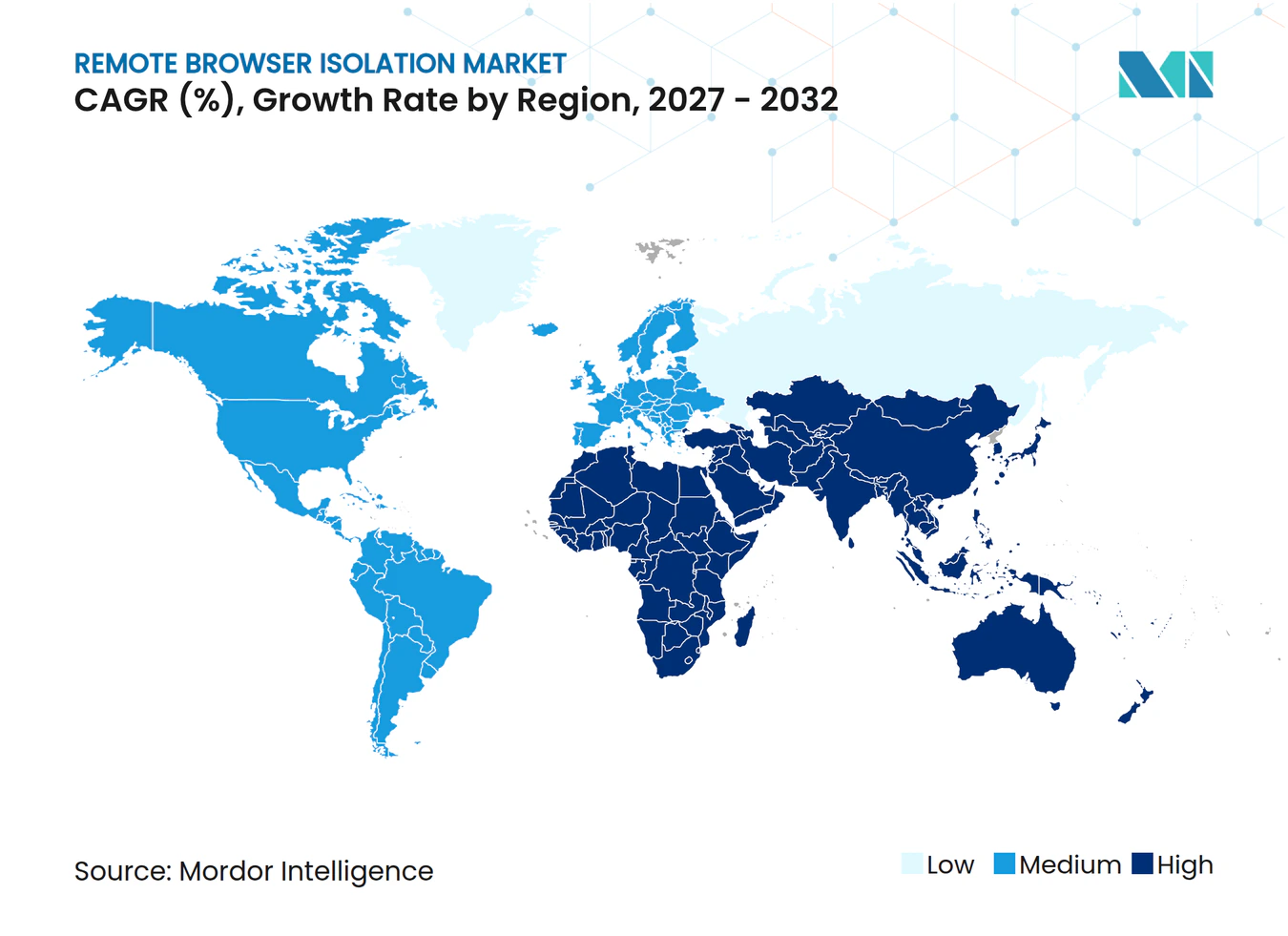
North America held 35.86% of the remote browser isolation market share in 2026. The region benefits from high enterprise security spending, early zero trust mandates, and a concentration of product vendors. Palo Alto Networks stated that its Remote Browser Isolation reached FedRAMP Moderate general availability and was listed in the FedRAMP Marketplace on April 21, 2026. The listing enables federal agencies handling controlled unclassified information to use the service within an authorized compliance boundary. Canada’s financial services and healthcare organizations follow related zero-trust adoption patterns.
Europe has demand shaped by data residency and cross-border rendering requirements. Rules governing international access to EU-stored personal data make the location of browser rendering operationally important. The European Data Protection Board states that remote operational access from outside the European Union can constitute an international data transfer, even without a data download. This supports demand for rendering infrastructure located within Europe. VirtualBrowser received CSPN first-level security certification from France’s ANSSI in January 2026, and the certification was recognized by Germany’s BSI under a bilateral agreement. The United Kingdom, Germany, and France are the strongest individual markets in the region.
Asia-Pacific is projected to expand at a 29.72% CAGR through 2032, the fastest geographic rate in the remote browser isolation market. China’s revised Cybersecurity Law took effect on January 1, 2026, strengthening network security and incident-reporting obligations.[5] China also published the YD/T 6848-2026 SASE Technical Guidelines in April 2026, with effect from August 2026. In Japan, Internet Initiative Japan and Soliton launched the IIJ Secure Terminal Isolation Solution in March 2025 for enterprise desktop and web browser isolation. South America, the Middle East, and Africa remain smaller markets, with financial services in Brazil and Saudi Arabia among the earlier regional adopters.
Competitive Landscape
Market Concentration
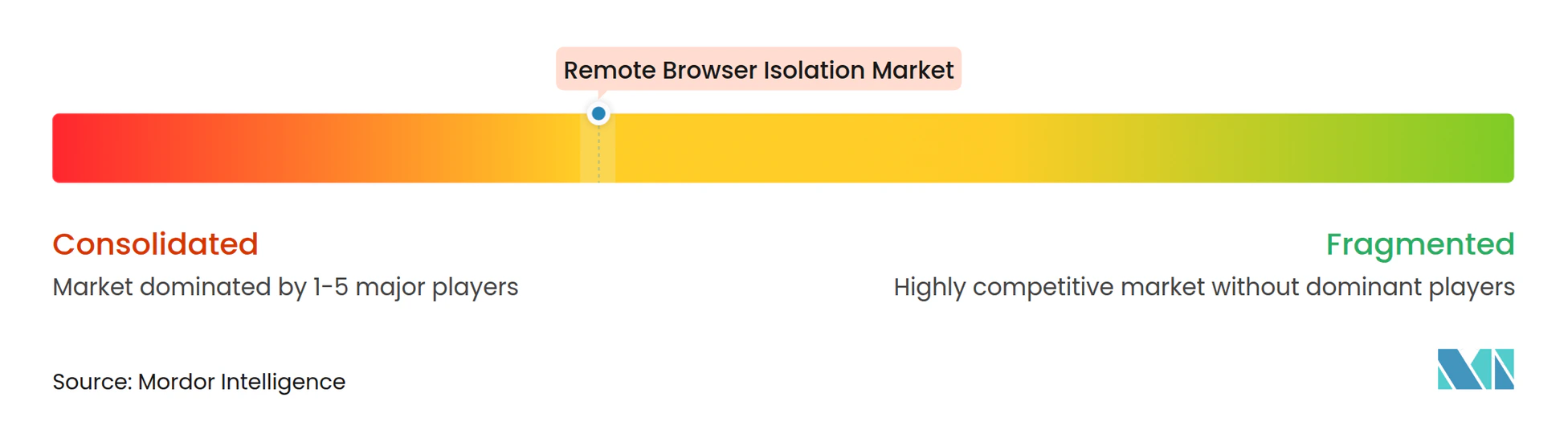
The remote browser isolation market is moderately consolidated at the top and includes a wider group of specialist providers. Menlo Security remains a notable pure-play provider, reporting more than USD 140 million in annual recurring revenue and net revenue retention above 120% in its March 2026 announcement. Zscaler, Palo Alto Networks, Cloudflare, Netskope, Cato Networks, and Versa Networks compete through their broader SASE and secure service edge platforms. These vendors can combine browser isolation with web gateways, zero-trust network access, data controls, and identity-aware policies. This gives buyers one policy environment for managing web access, data handling, user identity, and device context.
Zscaler completed its acquisition of SquareX on February 5, 2026, adding lightweight browser-extension security for unmanaged and BYOD devices to its Zero Trust Exchange platform.[6] It had also acquired SPLX in November 2025 to add AI asset discovery, automated red teaming, prompt hardening, and governance. Palo Alto Networks announced Prisma SASE 4.0 and Prisma Browser in September 2025, extending its browser-related controls for BYOD and contractor access. Its FedRAMP Moderate listing for RBI strengthened its position in federal opportunities.
AI agents that use browsers raise security concerns about hidden-page prompt injection, credential theft, and data exfiltration via agent-controlled functions. Cato Networks disclosed the HashJack technique in 2026, showing that malicious instructions in URL fragments could target AI browser assistants. Menlo Security launched a browser security platform in March 2026 for human users and autonomous AI agents, including instruction-data separation controls. Authentic8, Kasm Technologies, and Garrison Technology remain relevant for high-assurance customers that require deeper isolation, session recording, and air-gapped controls.
Remote Browser Isolation Industry Leaders
-
Menlo Security, Inc.
-
Zscaler, Inc.
-
Broadcom Inc.
-
Cloudflare, Inc.
-
Palo Alto Networks, Inc.
- *Disclaimer: Major Players sorted in no particular order
Recent Industry Developments
- May 2026: Netskope and Deloitte expanded their strategic partnership on May 27, 2026, to deliver Managed SASE services globally, combining Deloitte's cyber operations advisory framework with Netskope One's SSE capabilities, including SWG, ZTNA, CASB, FWaaS, and RBI, to serve enterprise customers modernizing their security and networking infrastructure.
- April 2026: Palo Alto Networks' Remote Browser Isolation reached FedRAMP Moderate General Availability on April 21, 2026, and was listed on the FedRAMP Marketplace. The listing allows US federal agencies handling Controlled Unclassified Information to deploy RBI as an authorized control within their compliance boundary, aligned with Executive Order 14028, OMB Memorandum M-22-09, and CISA's Zero Trust Maturity Model.
- March 2026: Menlo Security launched the industry's first Browser Security Platform purpose-built to govern both human users and autonomous AI agents through a unified cloud-delivered control plane on March 18, 2026. The platform introduced AI agent security including instruction-data separation to counter prompt injection and goal hijacking. Menlo reported surpassing USD 140 million ARR with net revenue retention exceeding 120%.
- February 2026: Zscaler completed the acquisition of SquareX on February 5, 2026, extending its Zero Trust Exchange platform with lightweight browser-extension-based security for unmanaged and BYOD devices through standard browsers including Google Chrome and Microsoft Edge, without requiring a third-party browser or full agent.
Global Remote Browser Isolation Market Report Scope
The remote browser isolation market comprises cybersecurity solutions and services that execute web browsing sessions in a remote, virtualized, or cloud-based environment rather than on the end user’s endpoint. By separating web content and active code from the local device, these solutions reduce exposure to browser-borne malware, malicious websites, zero-day exploits, and data-security risks.
The Remote Browser Isolation Market Report is Segmented by Deployment Mode (Cloud-Based, On-Premises, and Hybrid), Organization Size (Large Enterprises, and Small and Medium-Sized Enterprises), Application (Web Threat and Malware Isolation, Phishing and Credential-Theft Protection, Browser Data Loss Prevention, Secure Remote and Third-Party Access, Unmanaged Device and BYOD Security, Regulated and Controlled Web Access, and Other Applications), End-User Industry (Banking, Financial Services, and Insurance (BFSI), IT and Telecommunications, Government and Public Administration, Healthcare and Lifesciences, Retail and E-Commerce, and Other End Users), and Geography (North America, South America, Europe, Asia-Pacific, Middle East, and Africa). The Market Forecasts are Provided in Terms of Value (USD).
| Cloud-Based |
| On-Premises |
| Hybrid |
| Large Enterprises |
| Small and Medium Enterprises |
| Web Threat and Malware Isolation |
| Phishing and Credential-Theft Protection |
| Browser Data Loss Prevention |
| Secure Remote and Third-Party Access |
| Unmanaged Device and BYOD Security |
| Regulated and Controlled Web Access |
| Other Applications |
| Banking, Financial Services and Insurance (BFSI) |
| IT and Telecommunications |
| Government and Public Administration |
| Healthcare and Life Sciences |
| Retail and E-Commerce |
| Other End-User Industries |
| North America | United States |
| Canada | |
| Mexico | |
| South America | Brazil |
| Rest of South America | |
| Europe | United Kingdom |
| Germany | |
| France | |
| Italy | |
| Rest of Europe | |
| Asia-Pacific | China |
| Japan | |
| India | |
| South Korea | |
| Rest of Asia-Pacific | |
| Middle East | Saudi Arabia |
| United Arab Emirates | |
| Rest of Middle East | |
| Africa | South Africa |
| Nigeria | |
| Rest of Africa |
| By Deployment Mode | Cloud-Based | |
| On-Premises | ||
| Hybrid | ||
| By Organization Size | Large Enterprises | |
| Small and Medium Enterprises | ||
| By Application | Web Threat and Malware Isolation | |
| Phishing and Credential-Theft Protection | ||
| Browser Data Loss Prevention | ||
| Secure Remote and Third-Party Access | ||
| Unmanaged Device and BYOD Security | ||
| Regulated and Controlled Web Access | ||
| Other Applications | ||
| By End-User Industry | Banking, Financial Services and Insurance (BFSI) | |
| IT and Telecommunications | ||
| Government and Public Administration | ||
| Healthcare and Life Sciences | ||
| Retail and E-Commerce | ||
| Other End-User Industries | ||
| By Geography | North America | United States |
| Canada | ||
| Mexico | ||
| South America | Brazil | |
| Rest of South America | ||
| Europe | United Kingdom | |
| Germany | ||
| France | ||
| Italy | ||
| Rest of Europe | ||
| Asia-Pacific | China | |
| Japan | ||
| India | ||
| South Korea | ||
| Rest of Asia-Pacific | ||
| Middle East | Saudi Arabia | |
| United Arab Emirates | ||
| Rest of Middle East | ||
| Africa | South Africa | |
| Nigeria | ||
| Rest of Africa | ||
Key Questions Answered in the Report
What is the remote browser isolation market size?
The remote browser isolation market size is expected to grow from USD 1.03 billion in 2026 to USD 1.29 billion in 2027 and is forecast to reach USD 4.19 billion by 2032 at 26.57% CAGR over 2027-2032.
Why are organizations adopting remote browser isolation?
Organizations use it to contain web-based threats, protect unmanaged devices, and support zero trust security models.
Which deployment model leads remote browser isolation adoption?
Cloud-based delivery led with 69.84% share in 2026 and is projected to expand at a 28.61% CAGR through 2032.
Which end-user sector has the largest adoption of remote browser isolation?
BFSI held 31.27% share in 2026 because financial organizations face high exposure to credential theft and payment fraud.
What is the fastest-expanding application for browser isolation?
Browser data loss prevention is projected to expand at a 28.93% CAGR through 2032, supported by concern over enterprise AI and SaaS data exposure.
Which region is expanding fastest in remote browser isolation?
Asia-Pacific is projected to expand at a 29.72% CAGR through 2032 as security budgets and compliance requirements increase.