
Managed Browser Security Services Market Size and Share
Market Overview
| Study Period | 2021 - 2032 |
|---|---|
| Market Size (2027) | USD 2.39 Billion |
| Market Size (2032) | USD 5.58 Billion |
| Growth Rate (2027 - 2032) | 18.48 % |
| Fastest Growing Market | Asia-Pacific |
| Largest Market | North America |
| Market Concentration | Medium |
Major Players *Disclaimer: Major Players sorted in no particular order Image © Mordor Intelligence. Reuse requires attribution under CC BY 4.0. | |
Managed Browser Security Services Market Analysis by Mordor Intelligence
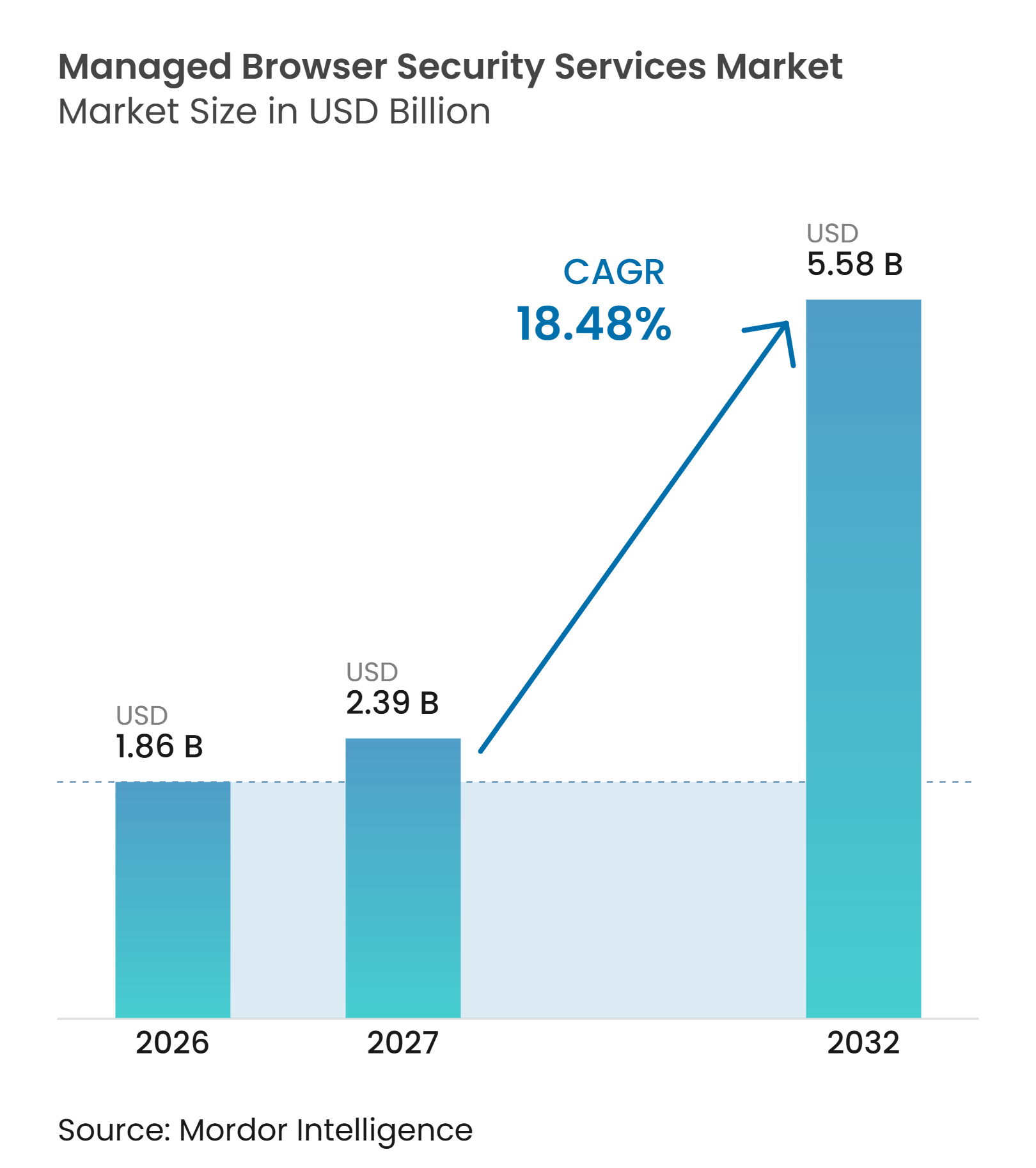
The managed browser security services market size is projected to expand from USD 1.86 billion in 2026 and USD 2.39 billion in 2027 to USD 5.58 billion by 2032, registering a CAGR of 18.48% between 2027 to 2032. The managed browser security services market is gaining importance because browsers now support a large share of enterprise work, including access to cloud applications, contractor portals, and collaboration tools. Demand is moving toward services that apply controls during a browser session instead of relying only on network or endpoint protections. Platform providers are also incorporating browser controls into wider SSE and SASE offerings, which can simplify procurement for existing customers. At the same time, specialist providers continue to compete on detailed session controls, investigation tools, and governance for AI-related activity. The managed browser security services market faces implementation constraints where applications, extensions, or data-processing rules do not fit a provider's deployment model.
Key Report Takeaways
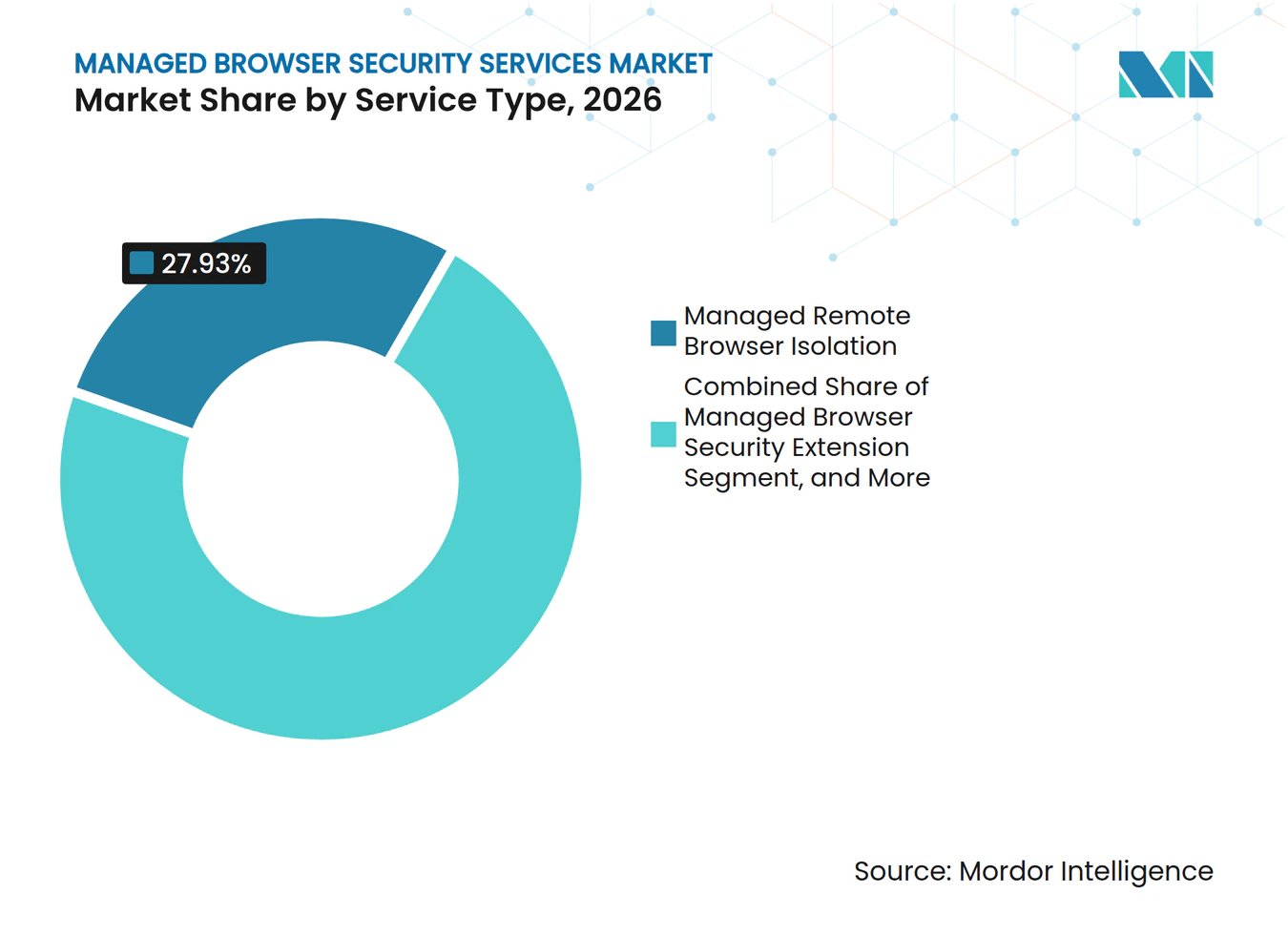
- By service type, Managed Remote Browser Isolation held 27.93% of the managed browser security services market share in 2026, while Managed Enterprise Browser is projected to expand at a 19.11% CAGR through 2032.
- By security architecture, Remote Browser Isolation accounted for 32.22% of the managed browser security services market share in 2026, while Dedicated Enterprise Browser is expected to grow at a 19.46% CAGR through 2032.
- By deployment mode, cloud-based delivery held 80.77% of the managed browser security services market share in 2026 and is projected to expand at an 18.87% CAGR through 2032.
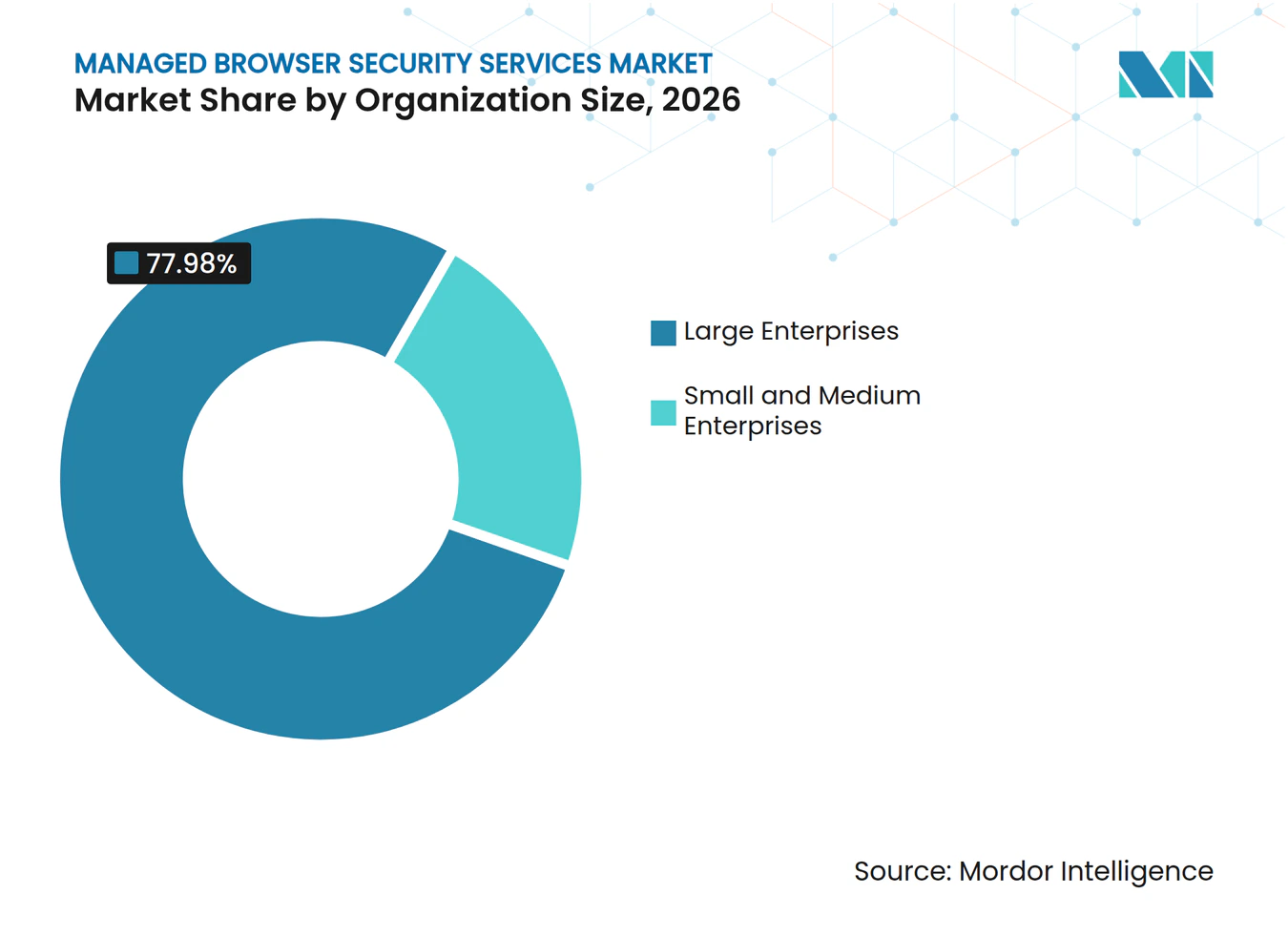
- By organization size, large enterprises held 77.98% of the managed browser security services market share in 2026, while small and medium enterprises are projected to grow at a 19.82% CAGR through 2032.
- By end-user industry, BFSI accounted for 22.02% of the managed browser security services market size in 2026, while energy and utilities is expected to expand at a 19.43% CAGR through 2032.
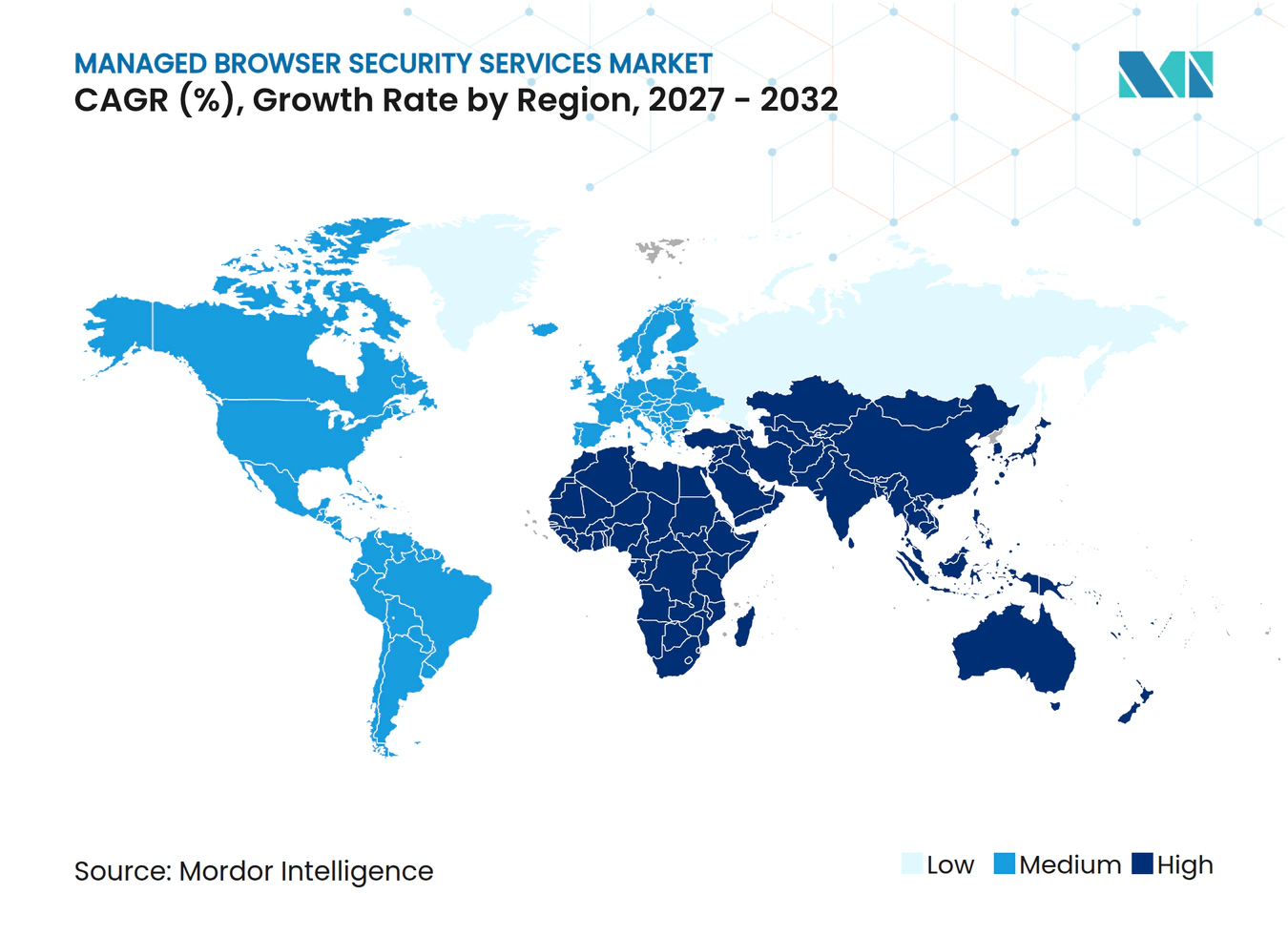
- By geography, North America held 47.21% of the managed browser security services market share in 2026, while Asia-Pacific is projected to grow at a 19.37% CAGR through 2032.
Note: Market numbers in this report are based on Mordor Intelligence's proprietary estimation framework, which combines nine months of actuals with Q4 projections for base year 2026.
Market Trends and Insights
Drivers Impact Analysis of Managed Browser Security Services Market*
| Driver | (~) % Impact on CAGR Forecast | Geographic Relevance | Impact Timeline |
|---|---|---|---|
| Escalating Browser-Borne Threats and Phishing-as-a-Service | +3.5% | Global | Short term (≤ 2 years) |
| Permanent Hybrid Work and Unmanaged-Device Exposure | +3.0% | Global | Medium term (2-4 years) |
| Zero Trust, NIS2, DORA, and Sector-Specific Compliance | +2.5% | North America and EU, spill-over to Asia-Pacific | Medium term (2-4 years) |
| Browser Security Bundling Into SSE and SASE Platforms | +2.0% | Global, early concentration in North America and Asia-Pacific | Medium term (2-4 years) |
| Managed-Service Demand From Cybersecurity Talent Shortages | +1.5% | Global | Medium term (2-4 years) |
| AI-Agent and GenAI Browser Governance Requirements | +1.2% | Global | Medium term (2-4 years) |
| Source: Mordor Intelligence | |||
Escalating Browser-Borne Threats and Phishing-as-a-Service
The managed browser security services market is responding to phishing campaigns designed to avoid conventional detection methods. Menlo Security reported 115,842 evasive phishing campaigns in its first-quarter 2026 enterprise telemetry and found that 1 in 5 phishing links clicked by users went undetected by legacy URL filtering.[1] Group-IB reported that Tycoon 2FA represented 44.5% of global credential-theft attacks in 2025 and 89% of the adversary-in-the-middle phishing-as-a-service category. Remote rendering and file disarm approaches can prevent untrusted web content from running on a user's device. This execution-level protection matters because session attacks may leave few file or process indicators for endpoint tools to inspect.
Permanent Hybrid Work and Unmanaged-Device Exposure
The managed browser security services market benefits from work models that extend access beyond corporate-managed endpoints. Session-layer controls can apply data-loss prevention and access policies without requiring the organization to own the device. This makes the model relevant for contractors, temporary staff, mergers, and bring-your-own-device use cases. The finding indicates that some Asia-Pacific demand is also linked to changes in access infrastructure, not only to higher threat exposure.
Zero Trust, NIS2, DORA, and Sector-Specific Compliance
The managed browser security services market is supported by rules that impose stricter expectations for identity, access, and third-party risk controls. DORA became applicable to financial entities on January 17, 2025, and requires ICT risk-management arrangements that address third-party access and operational resilience. ENISA published technical implementation guidance for NIS2 in June 2025, covering cybersecurity risk-management measures for entities and managed service providers. These requirements make browser configuration, access verification, and audit records more relevant to regulated buyers. Financial services organizations need controls that extend to outsourced access and unmanaged browser sessions. The managed service model can help organizations apply those controls consistently when internal security teams have limited capacity.
Browser Security Bundling Into SSE and SASE Platforms
The managed browser security services market is increasingly shaped by browser capabilities embedded in broader security platforms. Netskope enhanced One Enterprise Browser in February 2025 with SSE integration for data protection, Zero Trust access, and adaptive policy controls across managed and unmanaged devices. A unified console can reduce the operational burden of using separate tools for browser, network, and data controls. Bundling can also make browser security easier to adopt for customers who already use an SSE or SASE provider. This approach may increase switching costs when policy, reporting, and identity information are managed in a single environment. It also places pressure on specialist vendors to demonstrate greater control depth, simpler implementation, or service capabilities that platform bundles do not provide.
Restraints Impact Analysis of Managed Browser Security Services Market*
| Restraint | (~) % Impact on CAGR Forecast | Geographic Relevance | Impact Timeline |
|---|---|---|---|
| Application Compatibility and User-Experience Friction | -1.8% | Global | Medium term (2-4 years) |
| Data Residency and Cross-Border Processing Constraints | -1.2% | EU and Asia-Pacific primarily, spill-over to Middle East and Africa | Medium term (2-4 years) |
| Budget Pressure and Unclear Standalone ROI | -0.9% | Global, with higher pressure in small and medium enterprises | Medium term (2-4 years) |
| Browser Ecosystem Dependence and Platform Substitution | -0.6% | Global | Long term (≥ 4 years) |
| Source: Mordor Intelligence | |||
Application Compatibility and User Experience Friction
Application compatibility remains an immediate limit on broader deployment in the managed browser security services market. Remote rendering can add latency and may affect web applications that rely on WebSockets, WebRTC, or productivity extensions. Palo Alto Networks noted that extension-based controls cannot validate device posture and may inherit the operating system's trust from a compromised endpoint. These constraints make architecture selection important for organizations with complex workflows. Security teams must show that policy controls do not interfere with critical applications or create workarounds. Google’s Manifest V3 changes also limit how browser extensions intercept traffic, which can reduce the scope of some extension-led controls.
Data Residency and Cross-Border Processing Constraints
Data residency rules can complicate cloud delivery in the managed browser security services market. Remote browser isolation processes content in the cloud infrastructure before sending a sanitized rendering to the user. That route can raise questions under GDPR transfer provisions, China’s Personal Information Protection Law, and India’s Digital Personal Data Protection Act when processing occurs outside the required jurisdiction. Providers need regional infrastructure and transparent data-processing practices to support regulated customers. This requirement favors platforms with established international cloud presence and raises the cost of entry for smaller specialists. It can also lead multinational buyers to adopt hybrid designs in which specific users or data flows remain within a defined region.
*Our forecasts treat driver/restraint impacts as directional, not additive. The impact forecasts reflect baseline growth, mix effects, and variable interactions.
Managed Browser Security Services Market Segment Analysis
By Service Type:
RBI Leads While Enterprise Browsers AccelerateManaged Remote Browser Isolation held 27.93% of the managed browser security services market share in 2026. Its position reflects a long record of deployment in regulated industries, where isolating untrusted content is considered a necessary control. In this model, web content runs in a remote container rather than on the endpoint. That separation reduces the risk that active code reaches a corporate device. Financial services and public-sector users can value the clear control boundary during audits. The service also supports access from devices that the organization does not directly manage.
Managed Enterprise Browser is projected to grow at a 19.11% CAGR through 2032. The category embeds controls into the browser runtime rather than placing them only around the browser. This design can apply policy to content, downloads, identity activity, and data movement during the session. Zscaler introduced Browser Detection and Response in October 2026, describing coverage for more than 90 client-side attack types across websites, files, extensions, identity, and clipboard activity. Managed Browser Security Extension and Managed Browser DLP and Data Protection services remain lighter options for organizations that do not require full isolation. Managed Browser Threat Detection and Response addresses activity that network controls may not identify once it occurs inside a browser session.



By Security Architecture:
Dedicated Enterprise Browser Drives Architecture ShiftRemote Browser Isolation accounted for 32.22% of the managed browser security services market share in 2026. Its core advantage is that active web code does not run on the enterprise endpoint. This is useful in environments where device trust cannot be assumed. The architecture provides direct control for high-risk browsing, unknown sites, and unmanaged device access. Organizations can apply it broadly or reserve it for higher-risk destinations and users. Browser-native extension or agent models and hybrid designs support buyers who require a lower-overhead approach.
Dedicated Enterprise Browser is expected to grow at a 19.46% CAGR through 2032. The architecture shifts policy enforcement from an added layer to a control plane that is built into the browser experience. Hybrid browser security can isolate selected content while allowing trusted software-as-a-service traffic to continue through a standard workflow. This adoption indicates sustained interest in financial services with detailed browser controls. It also shows why providers are investing in reporting and controls that fit regulated access workflows.
By Deployment Mode:
Cloud Delivery Establishes a Dominant PositionCloud-based delivery held 80.77% of the managed browser security services market share in 2026 and is projected to expand at an 18.87% CAGR through 2032. The large share reflects the ability to update policies and threat intelligence across distributed users from a central service. Cloud delivery can provide quick access for users, contractors, and acquired businesses without a lengthy endpoint rollout. Menlo Security reported that zero-day exposure could leave locally executing browsers unprotected for at least 6 days. Centralized services can shorten the time needed to apply new protections. On-premises deployment retains importance for government and defense users with air-gap requirements.
Hybrid deployment is gaining use among organizations with different processing requirements across locations. It can keep specified users or data flows within a local environment while using cloud-managed services elsewhere. Netskope stated that its NewEdge network operates across more than 75 regions and 220 countries. Such infrastructure helps providers meet multinational performance and residency needs. The required investment can limit smaller providers' ability to serve large global accounts. This creates a practical advantage for established providers that combine regional presence with policy management across a common platform.
By Organization Size:
Large Enterprises Lead as SMEs Close the GapLarge enterprises accounted for 77.98% of the managed browser security services market size in 2026. These organizations manage broad application portfolios, large contractor populations, and substantial regulatory duties. Their scale also makes unmanaged access a repeated operational issue rather than an occasional exception. Punjab National Bank allocated USD 47.6 million.[2] Large institutions can use managed browser services to apply controls across complex access paths. They also have the resources to integrate browser tools with identity, data protection, and incident-response processes.
Small and medium enterprises are projected to expand at a 19.82% CAGR through 2032. Consumption-based pricing can reduce the staffing and infrastructure threshold that previously limited adoption. Smaller organizations are more affected when a limited team must operate many security products. A managed service can place policy administration and monitoring behind a service-level agreement. This allows smaller teams to obtain controls that would otherwise require specialized browser-security expertise.

By End-User Industry:
BFSI Anchors Demand as Energy and Utilities EmergeBFSI accounted for 22.02% of the managed browser security services market in 2026. Financial institutions face high levels of phishing, identity abuse, and third-party access risk. DORA has also increased attention on ICT risk management and resilience across financial entities. This illustrates the demand for browsers that can secure work conducted by employees, vendors, and contractors. IT and telecommunications, healthcare, government and defense, and professional services constitute an additional demand base because each handles sensitive information via browser-based applications.
Energy and utilities are projected to grow at a 19.43% CAGR through 2032. IT and OT convergence is extending browser-based access into functions that were previously separated from web-facing networks. Operators increasingly use connected systems for predictive maintenance, remote management, and operational monitoring. Browser sessions can therefore become a path to operational data and supervisory tools. NERC CIP-003-9 requirements are increasing attention on controls for low-impact assets and web-based access points. This gives utilities a compliance-related reason to strengthen browser controls as their operational environments become more connected.
Geography Analysis
North America Managed Browser Security Services Market
North America held 47.21% of the managed browser security services market share in 2026. The region benefits from the presence of SSE and enterprise browser providers and from early adoption among large enterprises. The US federal Zero Trust Architecture direction under Executive Order 14028 supports stronger access-control practices. SecurityWeek reported that US cybersecurity job postings declined 26.4% in the first 3 quarters of 2026 compared with the same period in 2025. This labor change can encourage buyers to use managed services for specialized capabilities. Canadian financial services and government users also support regional demand through privacy and security obligations.
Europe Managed Browser Security Services Market
Europe is the second-largest region in the managed browser security services market. NIS2 and DORA create structured requirements across Germany, the UK, France, and Italy. ENISA’s 2025 technical guidance sets out cybersecurity risk management measures relevant to entities operating under NIS2. SANS reported in 2026 that 95% of surveyed organizations saw regulatory directives affecting hiring, up from 40% in 2025.[3] The same report found that 27% had experienced breaches linked to workforce skills gaps. VirtualBrowser raised USD 6.5 million, in May 2026 to support research, development, and European expansion.
APAC Managed Browser Security Services Market
Asia-Pacific is projected to grow at a 19.37% CAGR through 2032. Cloud adoption, changing access infrastructure, and growing threat exposure support demand across China, India, South Korea, and Australia. Regional demand also benefits from enterprise digitalization efforts that increase browser use for core operations. It shows that demand can arise from changes to legacy access systems as well as from new security concerns. Cyber-insurance requirements may further encourage organizations to apply stronger controls over browser-based access.
Competitive Landscape
Market Concentration
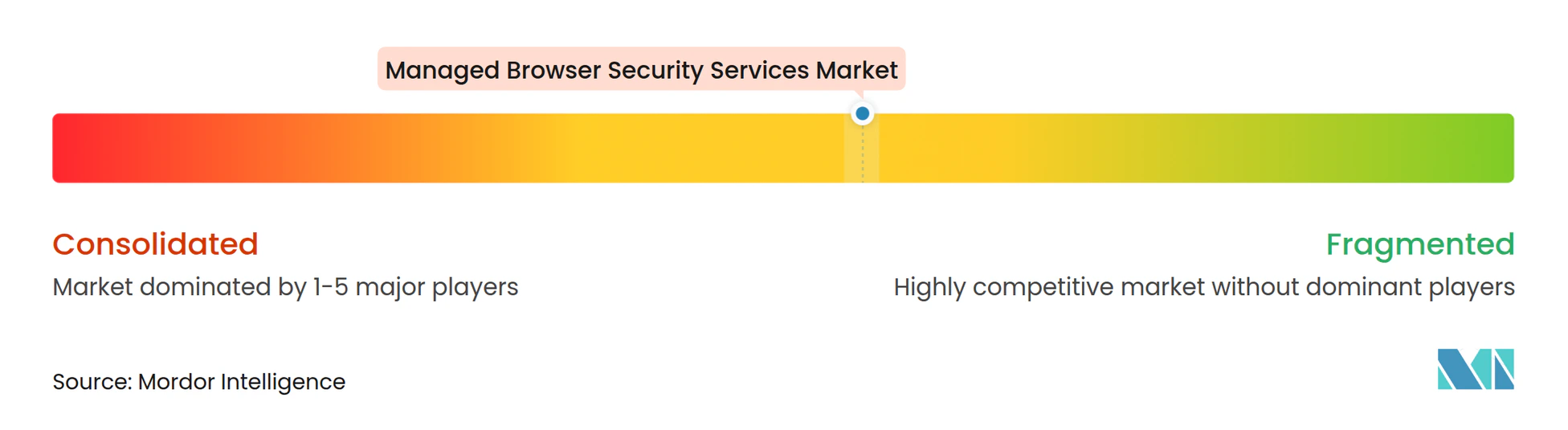
The managed browser security services market includes SSE and SASE vendors that bundle browser functions into larger security platforms. It also includes dedicated enterprise browser companies that focus on detailed session control, audit logging, and browser-specific governance. This creates different buying paths for enterprises. Existing platform customers may prefer integrated controls that use their current identity and data policies. Specialist providers can compete where browser activity requires more specific visibility or control. The competitive environment, therefore, includes both broad platform consolidation and focused product development.
AI-related governance and browser-session forensics are important areas of differentiation in the managed browser security services market. Menlo Security expanded its relationship with Google Cloud in September 2025 to use Vertex AI and Gemini models within HEAT Shield AI for phishing prevention. Microsoft announced shadow AI protection for Edge for Business in March 2026, using inline data loss prevention via Microsoft Purview to block sensitive submissions to unsanctioned generative AI tools. Netskope’s February 2025 browser enhancement added integrated data protection and Zero Trust controls for unmanaged-device and contractor use cases. These actions show that providers are connecting browser security with AI governance, data protection, and identity-aware access.
Providers are also positioning their services for regulatory traceability and cross-border deployment. ETSI published browser-security requirements under EN 304-617 in October 2025 as work connected with the EU Cyber Resilience Act. Buyers in regulated sectors may favor suppliers that document how policies and controls support these obligations. Island completed a USD 400 million Series F round in September 2026 at a USD 6.4 billion valuation, with funds directed to research and development and international expansion.[4] The category still has room for providers that simplify deployment for smaller organizations and manage AI-agent activity. Competition is likely to remain strongest where providers can combine clear security outcomes with practical application support and regional processing options.
Managed Browser Security Services Industry Leaders
-
Zscaler, Inc.
-
Palo Alto Networks, Inc.
-
Netskope, Inc.
-
Menlo Security, Inc.
-
Broadcom Inc.
- *Disclaimer: Major Players sorted in no particular order
Managed Browser Security Services Market Companies Covered in this Report
- Zscaler, Inc.
- Palo Alto Networks, Inc.
- Netskope, Inc.
- Menlo Security, Inc.
- Broadcom Inc.
- Cloudflare, Inc.
- Forcepoint LLC
- iboss, Inc.
- Check Point Software Technologies Ltd.
- Proofpoint, Inc.
- Citrix Systems, Inc.
- Fortinet, Inc.
- Island Technology, Inc.
- Authentic8, Inc.
- Seraphic Security, Inc.
- Akamai Technologies, Inc.
- Google LLC
- Microsoft Corporation
- Kasm Technologies, Inc.
Recent Industry Developments in Managed Browser Security Services Market
- October 2026: Zscaler launched Browser Detection and Response on October 5, 2026, an industry-first capability to monitor, detect, and mitigate client-side web attacks from inside the browser, covering more than 90 unique attack types across sites, files, extensions, identity, and clipboard activity, deployable via a lightweight extension or as part of the Zscaler Zero Trust Browser.
- September 2026: Island Technology closed a USD 400 million Series F round led by Evolution Equity Partners at a USD 6.4 billion valuation, more than doubling since 2024. Proceeds are directed toward R&D and international expansion across Europe, Asia, and the Middle East, and the company plans to scale its 1,000-person workforce to 1,500 employees.
- March 2026: Menlo Security launched the first Browser Security Platform purpose-built for agentic enterprises, applying machine-speed governance and threat prevention to both human users and autonomous AI agents through a unified control plane, including the Menlo AI Agent Security module enforcing instruction-data separation to prevent goal hijacking and lateral movement.
- March 2026: Microsoft announced shadow AI protection for Edge for Business at RSAC 2026, blocking sensitive data submissions to unsanctioned consumer GenAI tools using inline DLP powered by Microsoft Purview, applicable across managed and unmanaged devices through Entra ID sign-in.
Global Managed Browser Security Services Market Report Scope
Managed Browser Security Services Market refers to the market for cloud-based and managed cybersecurity solutions that protect enterprise web browser environments from cyber threats, including phishing, malware, ransomware, data leakage, malicious downloads, and unauthorized access. These services enable organizations to monitor, manage, and secure browser activity across managed and unmanaged devices through capabilities such as browser isolation, secure web gateways, policy enforcement, threat detection, data loss prevention, and real-time security monitoring.
The Managed Browser Security Services Market Report is Segmented by Service Type (Managed Remote Browser Isolation, Managed Enterprise Browser, Managed Browser Security Extension, Managed Browser DLP and Data Protection, and Managed Browser Threat Detection and Response), Security Architecture (Remote Browser Isolation, Browser-Native Extension or Agent, Dedicated Enterprise Browser, and Hybrid Browser Security), Deployment Mode (Cloud-Based, On-Premises, and Hybrid), Organization Size (Small and Medium Enterprises and Large Enterprises), End-User Industry (Information Technology and Telecommunications, BFSI, Healthcare, Retail and E-Commerce, Manufacturing, Government and Defense, Education, Energy and Utilities, and Other End-User Industries), and Geography (North America, South America, Europe, Asia-Pacific, Middle East, and Africa). The Market Forecasts are Provided in Terms of Value (USD).
Segmentation Overview
| Managed Remote Browser Isolation |
| Managed Enterprise Browser |
| Managed Browser Security Extension |
| Managed Browser DLP and Data Protection |
| Managed Browser Threat Detection and Response |
| Remote Browser Isolation |
| Browser-Native Extension or Agent |
| Dedicated Enterprise Browser |
| Hybrid Browser Security |
| Cloud-Based |
| On-Premises |
| Hybrid |
| Small and Medium Enterprises |
| Large Enterprises |
| Information Technology and Telecommunications |
| BFSI |
| Healthcare |
| Retail and E-Commerce |
| Manufacturing |
| Government and Defense |
| Education |
| Energy and Utilities |
| Other End-User Industries |
| North America | United States |
| Canada | |
| Mexico | |
| South America | Brazil |
| Argentina | |
| Rest of South America | |
| Europe | Germany |
| United Kingdom | |
| France | |
| Italy | |
| Spain | |
| Russia | |
| Rest of Europe | |
| Asia-Pacific | China |
| India | |
| Japan | |
| South Korea | |
| Australia | |
| Rest of Asia-Pacific | |
| Middle East | Saudi Arabia |
| United Arab Emirates | |
| Turkey | |
| Rest of Middle East | |
| Africa | South Africa |
| Egypt | |
| Nigeria | |
| Rest of Africa |
| By Service Type | Managed Remote Browser Isolation | |
| Managed Enterprise Browser | ||
| Managed Browser Security Extension | ||
| Managed Browser DLP and Data Protection | ||
| Managed Browser Threat Detection and Response | ||
| By Security Architecture | Remote Browser Isolation | |
| Browser-Native Extension or Agent | ||
| Dedicated Enterprise Browser | ||
| Hybrid Browser Security | ||
| By Deployment Mode | Cloud-Based | |
| On-Premises | ||
| Hybrid | ||
| By Organization Size | Small and Medium Enterprises | |
| Large Enterprises | ||
| By End-User Industry | Information Technology and Telecommunications | |
| BFSI | ||
| Healthcare | ||
| Retail and E-Commerce | ||
| Manufacturing | ||
| Government and Defense | ||
| Education | ||
| Energy and Utilities | ||
| Other End-User Industries | ||
| By Geography | North America | United States |
| Canada | ||
| Mexico | ||
| South America | Brazil | |
| Argentina | ||
| Rest of South America | ||
| Europe | Germany | |
| United Kingdom | ||
| France | ||
| Italy | ||
| Spain | ||
| Russia | ||
| Rest of Europe | ||
| Asia-Pacific | China | |
| India | ||
| Japan | ||
| South Korea | ||
| Australia | ||
| Rest of Asia-Pacific | ||
| Middle East | Saudi Arabia | |
| United Arab Emirates | ||
| Turkey | ||
| Rest of Middle East | ||
| Africa | South Africa | |
| Egypt | ||
| Nigeria | ||
| Rest of Africa | ||
Key Questions Answered in the Report
What is the managed browser security services market size?
The managed browser security services market is projected to increase from USD 1.86 billion in 2026 and USD 2.39 billion in 2027 to USD 5.58 billion by 2032, at an 18.48% CAGR.
What is driving adoption of managed browser security services?
Evasive phishing, unmanaged-device access, hybrid work, and regulatory requirements are increasing demand for session-level browser controls.
Which service type leads browser security services?
Managed Remote Browser Isolation led with a 27.93% share in 2026 because it separates active web content from the endpoint.
Which deployment approach is most widely used?
Cloud-based delivery held 80.77% in 2026 and is projected to grow at an 18.87% CAGR through 2032.
Which customer group is growing fastest?
Small and medium enterprises are projected to grow at a 19.82% CAGR as managed services reduce the need for specialized internal security staff.
Which region is growing fastest for browser security services?
Asia-Pacific is projected to expand at a 19.37% CAGR through 2032, supported by cloud adoption and changing enterprise-access requirements.