
Browser Extension Security Market Size and Share
Market Overview
| Study Period | 2021 - 2032 |
|---|---|
| Market Size (2027) | USD 2.63 Billion |
| Market Size (2032) | USD 4.71 Billion |
| Growth Rate (2027 - 2032) | 12.36 % |
| Fastest Growing Market | Asia-Pacific |
| Largest Market | North America |
| Market Concentration | Medium |
Major Players *Disclaimer: Major Players sorted in no particular order Image © Mordor Intelligence. Reuse requires attribution under CC BY 4.0. | |
Browser Extension Security Market Analysis by Mordor Intelligence
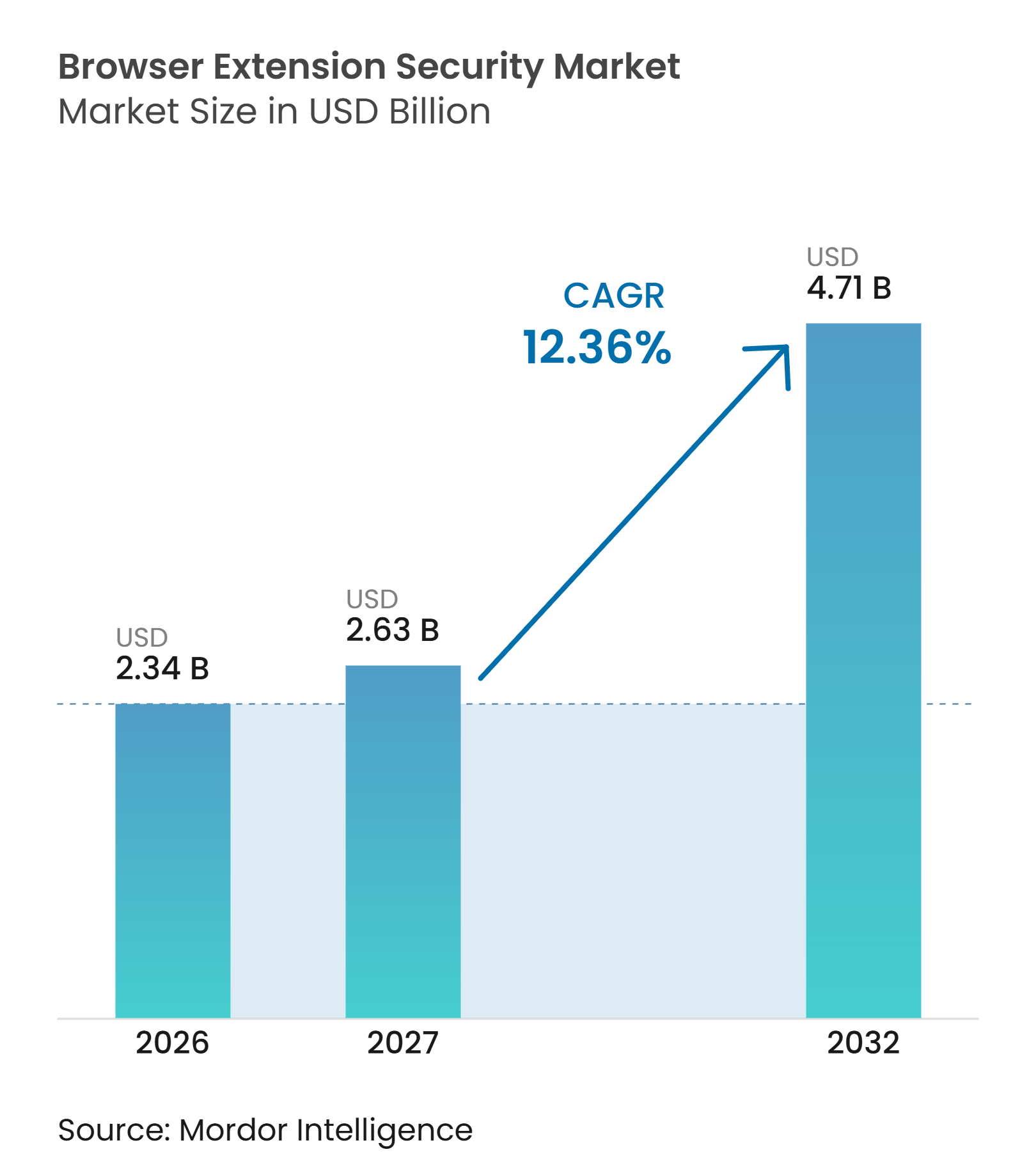
The browser extension security market size was valued at USD 2.34 billion in 2026 and estimated to expand from USD 2.63 billion in 2027 to reach USD 4.71 billion by 2032, at a CAGR of 12.36% during the forecast period 2027-2032. The browser extension security market is shaped by the browser becoming the main point of access for software, cloud data, and AI tools in many workplaces, across daily operational, administrative, customer service, and research activities. That change exposes security gaps because browser traffic can bypass controls designed for networks, email, or managed endpoints, and because access decisions made at login do not necessarily govern the extension behavior, web content, or data transfer that occurs later in a browser session. Extension permissions, session tokens, and browser-based credential theft have made runtime visibility more important than store approval alone, particularly when a trusted extension changes after deployment or an employee uses a legitimate application from a device outside normal corporate control. Vendors are responding by combining browser controls with SASE, security service edge, and extended detection and response platforms, giving customers a way to apply browser protections alongside the systems they already use for access control, endpoint investigation, threat detection, and cloud security administration. The opportunity is strongest for offerings that apply policy across managed and unmanaged devices without forcing users to replace their preferred browser, because practical deployment and limited user disruption remain central to adoption in environments that depend on contractors, personal devices, hybrid work, and cloud-delivered business applications.
Key Report Takeaways
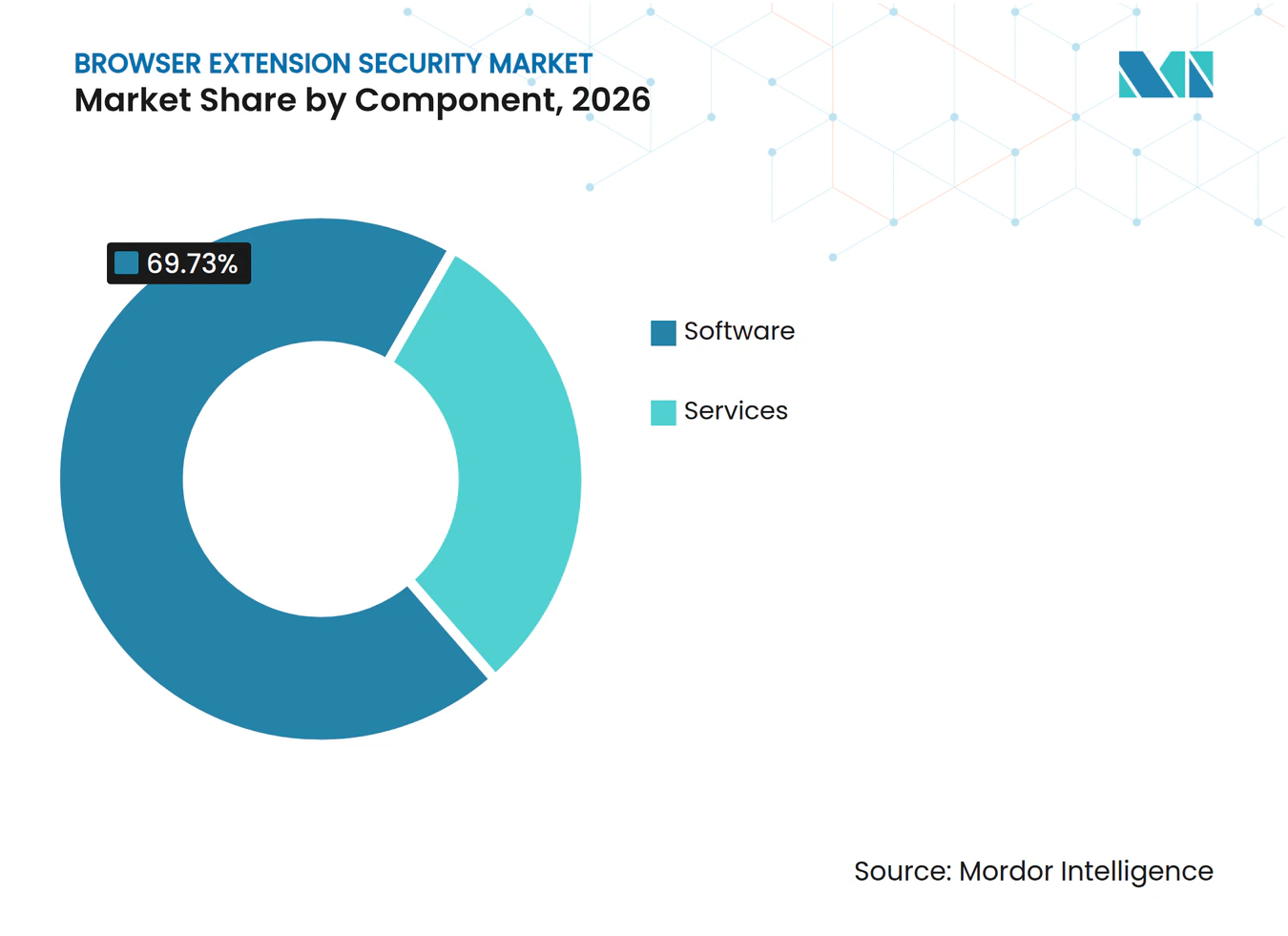
- By component, software held 69.73% of the browser extension security market share in 2026, while services are projected to expand at a 14.86% CAGR through 2032.
- By application, security and compliance accounted for 38.54% of revenue in 2026, while risk assessment is projected to expand at a 16.22% CAGR through 2032.
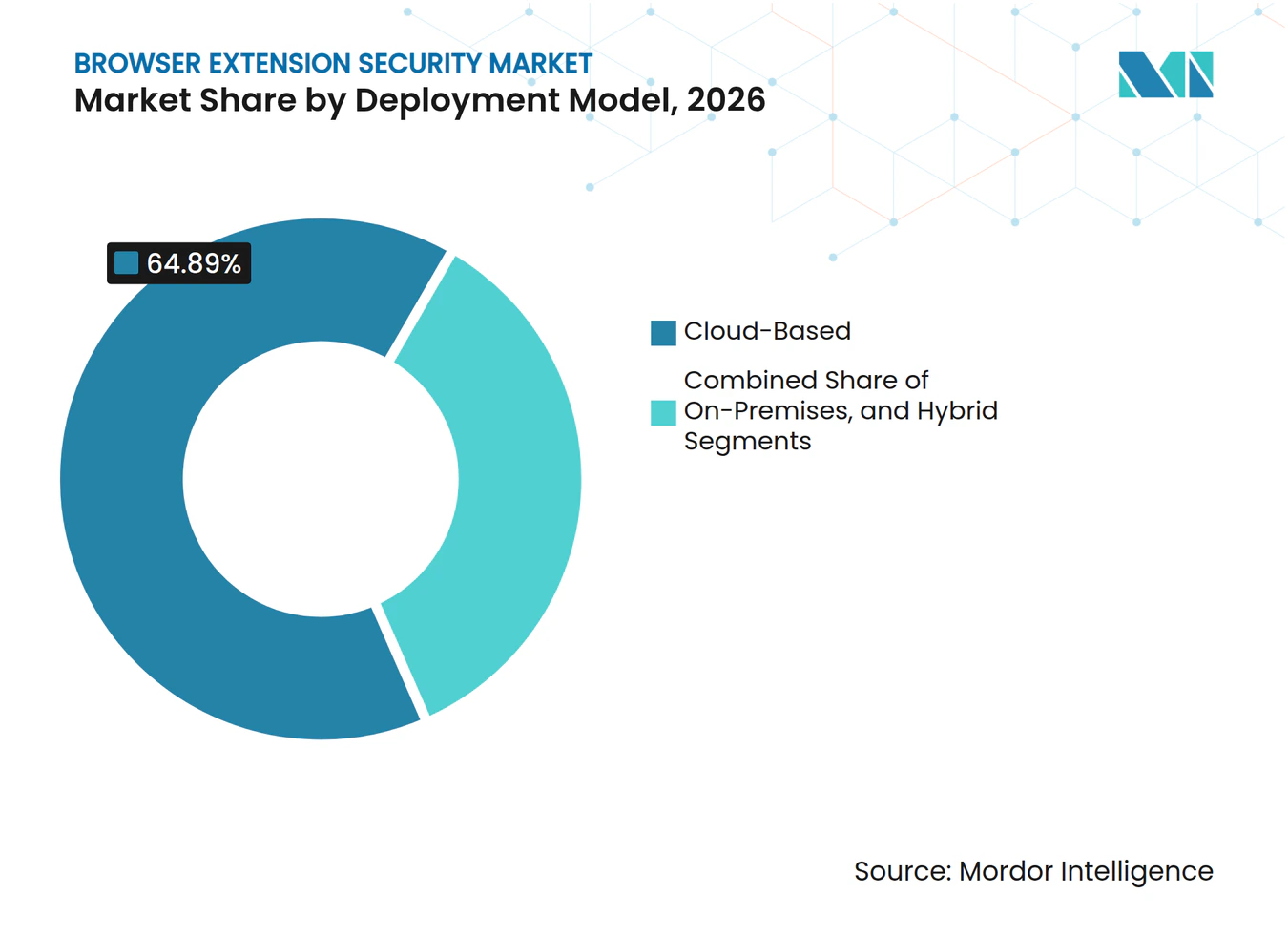
- By deployment model, cloud-based delivery accounted for 64.89% of revenue in 2026 and is projected to grow at a 19.31% CAGR through 2032.
- By organization size, large enterprises accounted for 67.51% of revenue in the browser extension security market in 2026, while small and medium-sized enterprises are projected to expand at a 16.43% CAGR through 2032.
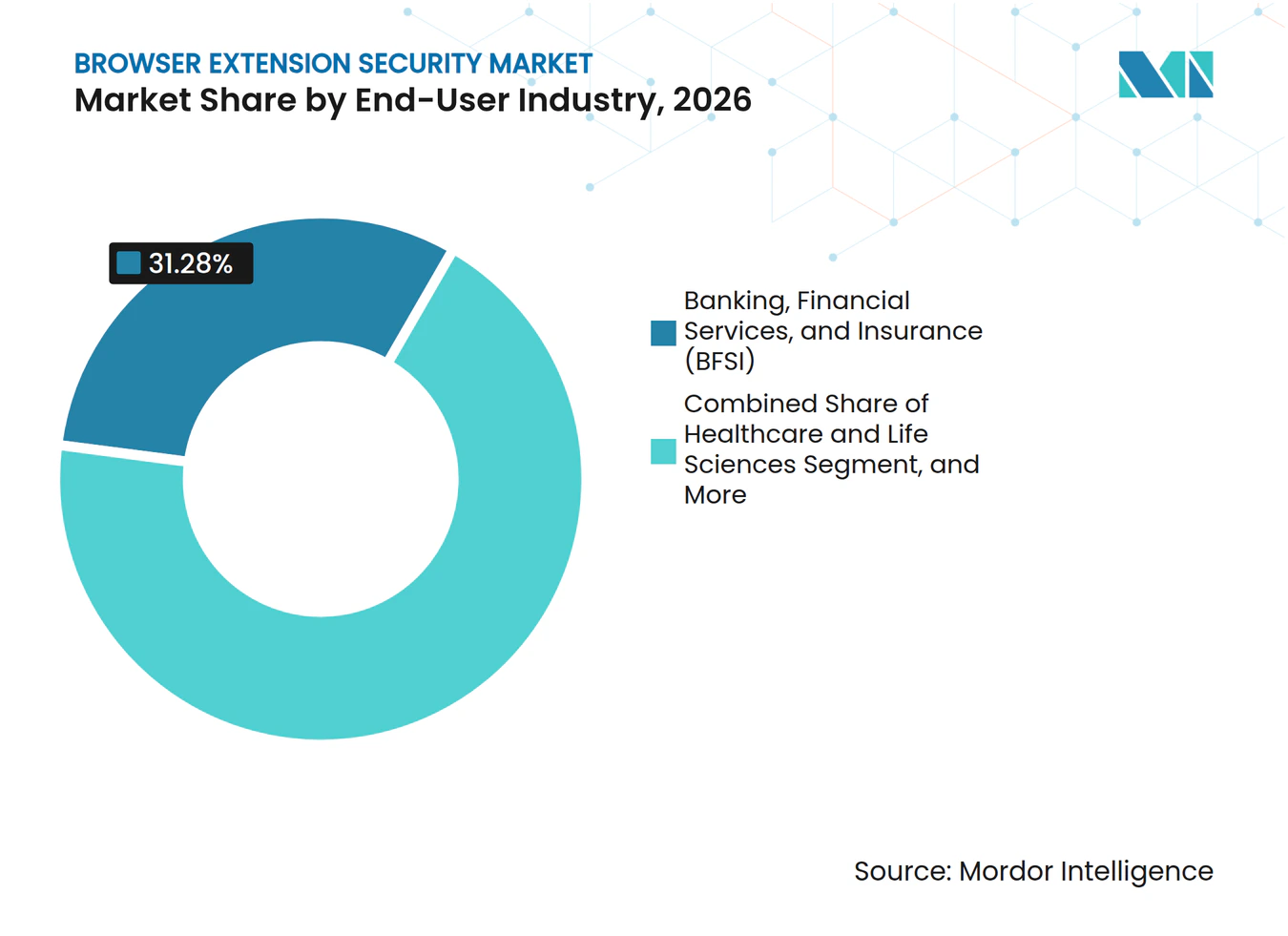
- By end-user industry, BFSI held 31.28% of revenue in 2026, while healthcare and life sciences are projected to expand at a 14.61% CAGR through 2032.
- By browser, Google Chrome held 54.91% of revenue in 2026, while Apple Safari is projected to expand at a 15.73% CAGR through 2032.
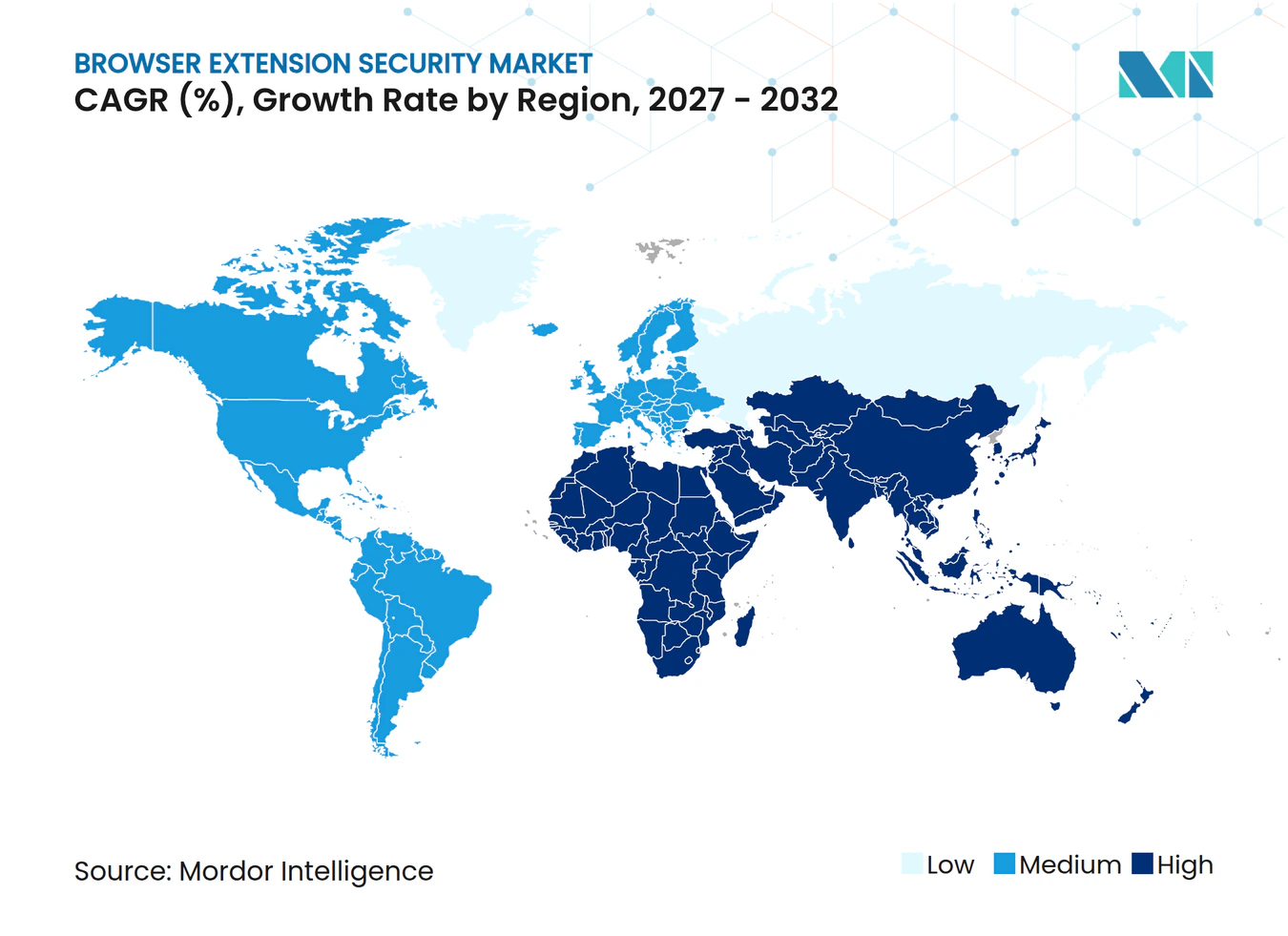
- By geography, North America accounted for 34.66% of revenue in the browser extension security market in 2026, while Asia-Pacific is projected to expand at a 17.92% CAGR through 2032.
Note: Market numbers in this report are based on Mordor Intelligence's proprietary estimation framework, which combines nine months of actuals with Q4 projections for base year 2026.
Global Browser Extension Security Market Trends and Insights
Drivers Impact Analysis*
| Driver | (~) % Impact on CAGR Forecast | Geographic Relevance | Impact Timeline |
|---|---|---|---|
| Expansion of Browser-Based SaaS and Cloud Workloads | +3.8% | Global | Short term (≤ 2 years) |
| Escalation of Browser-Native Threats and Extension Supply-Chain Attacks | +3.2% | Global | Short term (≤ 2 years) |
| Zero-Trust Access and Data Protection for Hybrid, BYOD, and Unmanaged Users | +2.5% | North America and Europe | Medium term (2-4 years) |
| Generative AI Usage and Browser-Level Interaction Governance | +2.1% | Global | Medium term (2-4 years) |
| Trusted-Store Verification Failures and Compromised Extension Updates | +1.4% | Global | Short term (≤ 2 years) |
| Multi-Profile Browser Usage Across Corporate and Personal Contexts | +0.8% | North America and Asia-Pacific | Medium term (2-4 years) |
| Source: Mordor Intelligence | |||
Expansion of Browser-Based SaaS and Cloud Workloads
Enterprise software migration has narrowed the opportunity for perimeter controls to inspect activity because many applications now run directly through the browser. The Cloud Security Alliance found that 76% of surveyed organizations increased SaaS security budgets in 2025, while 56% reported concern about overprivileged API access.[1] These concerns point to an access layer where users, browser extensions, and cloud services exchange sensitive data during routine work. Public cloud adoption by smaller organizations also extends this exposure to companies that do not operate large security teams. The browser extension security market therefore benefits when software inventories, identity controls, and data protection programs need a common view of browser activity. Demand is likely to favor tools that identify unmanaged applications and apply policy without changing the underlying network architecture.
Escalation of Browser-Native Threats and Extension Supply-Chain Attacks
Browser extensions can retain permissions after installation and may access credentials, cookies, downloads, and web content during later sessions. LayerX reported that nearly 75% of extensions observed on enterprise devices requested high or critical permissions, and 72% of enterprise users had at least 1 extension with a known CVE.[2] Verizon identified credential abuse in 39% of breaches in its 2026 breach investigation report. These findings explain why static allowlists do not fully address a risk that can change after an extension has been approved. Spin.AI documented malicious extensions that reached users via browser marketplaces, showing that marketplace verification does not eliminate supply chain exposure. The browser extension security market gains from continuous permission monitoring, behavioral analysis, and rapid response to changes in extension behavior.
Zero-Trust Access and Data Protection for Hybrid, BYOD, and Unmanaged Users
Contractors, partners, and remote workers often enter business applications from personal devices with valid credentials but without a company endpoint agent. This creates a gap between identity authentication and the ability to control the subsequent browser session. Cato Networks introduced a browser extension for universal zero-trust network access in September 2025, extending policy enforcement to unmanaged devices without client installation. The approach illustrates why lightweight controls are gaining attention, where a full enterprise browser would create adoption friction. Requirements under NIS2 and DORA have also raised the value of controls that can document access policies and evidence their operation. The browser extension security market is supported by buyers who need practical protection for third-party access while preserving normal browser workflows.
Generative AI Usage and Browser-Level Interaction Governance
Generative AI services are commonly accessed through a browser, which makes browser controls relevant to prompts, uploads, copied data, and downloaded content. LayerX found that AI-related extensions were more likely than average extensions to have known vulnerabilities or to access cookies, and that permissions could change after installation. Google documents browser management controls that can limit selected AI features and apply data protection policies in managed Chrome environments. Organizations face a practical choice between restricting useful tools and allowing ungoverned data movement. Selective inspection offers a more workable option than a broad ban for many employers. This need supports browser security products that combine AI governance with data loss prevention and user-aware policy enforcement.
Restraints Impact Analysis*
| Restraint | (~) % Impact on CAGR Forecast | Geographic Relevance | Impact Timeline |
|---|---|---|---|
| Browser API and Manifest Policy Limitations | -2.1% | Global | Short term (≤ 2 years) |
| Integration Complexity, User Friction, and Unclear Security ROI | -1.8% | Global | Medium term (2-4 years) |
| Contested Endpoint Risk in Extension-Based Architectures | -1.2% | North America and Europe | Medium term (2-4 years) |
| Browser-Vendor Policy Volatility and Version-Specific Enforcement | -0.7% | Global | Short term (≤ 2 years) |
| Source: Mordor Intelligence | |||
Browser API and Manifest Policy Limitations
Google’s move to Manifest V3 has limited some dynamic request-inspection methods previously used by security extensions. A peer-reviewed study of developers' views on Manifest V3 reported that key APIs for authentication tools, proxy managers, and behavioral monitoring could become unavailable or unstable.[3] Vendors may need separate technical approaches for browsers that expose different APIs and policy rules. This increases product development work and can delay feature parity across customer environments. Organizations also may need to reassess controls that relied on earlier extension frameworks for auditable monitoring. The browser extension security market faces a short-term constraint in which vendors must preserve their security capabilities while adapting to browser policy changes.
Integration Complexity, User Friction, and Unclear Security ROI
Deployment can require browser management, group policy changes, identity integration, and coordination with endpoint or network teams. The Cloud Security Alliance reported that organizations still struggle to monitor non-human identities and manage SaaS access risks. These issues can fragment ownership among web security, endpoint security, and SASE budgets. Preventive tools also have a reporting challenge because their value is often measured by incidents that did not occur. Buyers may prioritize solutions that show fewer risky permissions, fewer vulnerable extensions, or fewer policy violations for executives to review. Vendors that simplify deployment and produce clear risk reporting are more likely to overcome this restraint.
*Our forecasts treat driver/restraint impacts as directional, not additive. The impact forecasts reflect baseline growth, mix effects, and variable interactions.
Segment Analysis
By Component: Software Provides the Core While Services Address Execution Needs
Software held 69.73% of the browser extension security market in 2026. The category includes extension management platforms, browser-native data loss prevention, threat detection tools, and secure enterprise browser products. These products provide the policy and visibility layer needed to identify installed extensions, evaluate permissions, and observe risky browser actions. They also create the audit records sought by organizations subject to cybersecurity and privacy obligations. Platform providers are integrating these capabilities into broader SASE and XDR contracts, which can make procurement easier for existing customers. The software base remains important because customers need technical controls that work across common browsers and user devices, while still allowing security teams to set consistent rules for extension installation, permission changes, sensitive data handling, and access to important cloud applications.
Services are projected to expand at a 14.86% CAGR through 2032. Many security teams need external support to configure policies, prioritize extension risks, and investigate browser events. Managed service providers can translate regulatory requirements into operating procedures and evidence collection. Their role becomes more important when an organization uses multiple browsers, device types, and identity systems. The browser extension security industry also benefits from services that help customers migrate controls as browser platforms revise APIs and extension requirements. This combination allows software vendors to extend their reach beyond customers with mature in-house browser security teams, because an external service can translate product capability into daily policy operations, evidence collection, and response procedures that internal teams can maintain over time.


By Application: Security and Compliance Remain the Main Use Case While Risk Assessment Accelerates
Security and compliance accounted for 38.54% of segment revenue in 2026. Organizations use these products to meet obligations under frameworks such as HIPAA, DORA, NIS2, and cybersecurity disclosure requirements. Browser-layer controls can support evidence of policy enforcement when workers access sensitive systems through web applications. They can also help teams restrict risky extension permissions and create an inventory of browser add-ons. This is especially relevant in regulated environments where credentials, session tokens, and records move through browser sessions. The segment’s leadership reflects the need to connect technical safeguards with auditable controls, particularly where security leaders must explain how employee browser use, extension permissions, and browser session risks are governed within an established compliance program.
Risk assessment is projected to expand at a 16.22% CAGR through 2032. Buyers are moving beyond a simple approved-or-blocked model toward continuous scoring based on permission changes, known vulnerabilities, reputation, and behavior. That approach is important when a legitimate extension becomes risky after an update. Monitoring and analytics provide the data needed to support this assessment and generate evidence for reviews. Other applications include AI interaction governance, agentic workflow supervision, and identity session monitoring. These uses broaden the browser extension security market as security teams treat the browser as an active part of the enterprise attack surface, rather than as a passive display layer outside the scope of identity, data protection, and threat response programs.
By Deployment Model: Cloud-Based Delivery Combines Scale With Faster Adoption
Cloud-based delivery accounted for 64.89% of the browser extension security market in 2026. It is also projected to expand at a 19.31% CAGR through 2032. Cloud delivery can be included in SASE or security service edge platforms, avoiding a separate network redesign for the customer. It helps vendors update policies, threat intelligence, and detection logic without deploying software across each location. This model also supports distributed workforces that access business applications from many networks. Its position reflects a preference for controls that operate at the browser-cloud application boundary, often the point where users authenticate, copy data, upload documents, install extensions, and begin a session with a business service.
On-premises deployment remains important for government, defense, and critical infrastructure users with strict handling rules or isolated networks. Hybrid models address situations in which cloud controls and local data requirements must coexist. European data residency rules can create these dual operating needs, particularly in regulated services. The browser extension security market will continue to include hybrid configurations because not every browser session can be routed through a single cloud service. Cloud offerings remain the primary route for smaller organizations because deployment is simpler and does not require a large-scale infrastructure project. Palo Alto Networks positioned Prisma Browser for Business for smaller businesses through AWS Marketplace in March 2026, reinforcing this route to adoption and illustrating how cloud marketplaces can reduce procurement steps for organizations that lack the resources for a broad security transformation project.[4]


By Organization Size: Large Enterprises Lead Revenue While Smaller Firms Gain Access
Large enterprises accounted for 67.51% of the browser extension security market in 2026. These organizations manage extensive fleets of devices, complex browser policies, and broader regulatory obligations. They are also more likely to maintain security operations teams that can act on browser telemetry. A large enterprise may need to set different policies for employees, contractors, partners, and high-risk business functions. This operational scale supports spending on enterprise browser controls and integrations with existing security platforms. It also increases the value of consolidated reporting across browser, endpoint, identity, and network activity, allowing security leaders to relate browser events to the wider context of access decisions, user behavior, device posture, and incident management.
Small and medium-sized enterprises are projected to expand at a 16.43% CAGR through 2032. Their need is shaped by growing SaaS usage and by their role as suppliers to larger enterprises that require stronger cyber controls. Cloud-delivered offerings reduce the need for dedicated infrastructure and make policy deployment more accessible. Smaller firms can begin with extension visibility and risk scoring before adopting broader browser protections. The Cloud Security Alliance has identified continued concern around overprivileged SaaS access, which is relevant when growing firms expand their application portfolios without matching security resources. The browser extension security market can address this group when vendors offer clear configuration, practical reporting, and manageable pricing, since smaller firms are more likely to adopt a focused control when its security value is easy to explain to a limited technology and finance leadership team.
By End-User Industry: BFSI Leads Demand While Healthcare and Life Sciences Advance Fastest
BFSI held 31.28% of the browser extension security market share in 2026. Financial institutions manage valuable credentials, payment information, and transaction data that employees access through browser-based applications. They also operate under intensive cybersecurity, resilience, and disclosure requirements. DORA, which became applicable in January 2025, raises the importance of ICT risk management and operational resilience for EU financial entities.[5] Browser-layer controls help these organizations document how they manage extensions, sessions, and data transfers. This makes financial services a consistent source of demand for governance and threat protection, because the sector needs to address both deliberate attacks and routine policy failures that could expose accounts, customer information, transaction data, or other sensitive records.
Healthcare and life sciences are projected to expand at a 14.61% CAGR through 2032. The U.S. Department of Health and Human Services proposed updates to the HIPAA Security Rule in January 2025 that would strengthen safeguards for electronic protected health information. Clinicians and staff often access electronic health record systems through web browsers, including from personal or mobile devices. That pattern makes unmanaged browser sessions a material concern where sensitive information is displayed, copied, or uploaded. Government and defense, IT and telecommunications, retail and e-commerce, and education and research also have distinct browser risks. Their needs range from protection against phishing and data theft to control of AI tool use in research and customer-facing operations, creating a broad set of use cases for extension oversight, session protection, browser policy management, and data movement controls.
By Browser: Chrome Leads Current Coverage While Safari Gains From BYOD Use
Google Chrome held 54.91% of the browser extension security market in 2026. Chrome’s enterprise controls, centralized extension management, and policy tools make it a major environment for browser security deployment. Statcounter recorded Chrome as the leading browser worldwide in August 2026. Its scale concentrates a large share of browser activity and related exposure in one ecosystem. Menlo Security reported more than 80 high- and critical-severity Chromium vulnerabilities confirmed during 2025, including actively exploited zero-days. This reinforces the need for regular patching, extension review, and browser monitoring, especially for organizations that rely on a common browser standard and need to manage exposure across many users without disrupting routine web application use.
Apple Safari is projected to expand at a 15.73% CAGR through 2032. Growth is linked to BYOD patterns in which employees use iOS devices and Safari for work access. Safari’s enterprise enrollment and extension management conditions differ from those of Chromium-based browsers, which creates a governance gap for security teams. Microsoft Edge retains a meaningful role due to its integration with Microsoft 365 and Windows device management. Mozilla Firefox and other Chromium-based browsers serve narrower privacy, compliance, and user preference needs. The browser extension security market must therefore support more than a single browser engine if it is to provide consistent protection across employee and contractor populations, because a policy that only covers one browser can leave gaps wherever personal devices, specialized applications, or user preference leads to a different browser choice.
Geography Analysis
North America held 34.66% of regional revenue in 2026. The region has a high concentration of regulated financial institutions, technology vendors, and enterprises with mature security spending. The Securities and Exchange Commission’s cybersecurity disclosure rules have increased the importance of incident governance and reporting for public companies.[6] Major transactions in 2026 also show how established platform providers are adding browser controls to their portfolios. CrowdStrike announced its agreement to acquire Seraphic Security in January, Zscaler completed its SquareX acquisition in February, and Akamai completed its LayerX acquisition in July. Island’s September 2026 funding round also demonstrates continuing investor interest in the specialist enterprise browser model, while the sequence of platform acquisitions indicates that established security providers see browser protection as a capability that should be connected to endpoint, identity, network, and cloud security workflows.
Europe is a compliance-led demand center for the browser extension security market. NIS2 requires covered entities to take cybersecurity risk-management measures and has increased scrutiny of third-party and supply-chain risks. DORA has added a related operational resilience focus for financial organizations. These rules make auditable browser controls more relevant where employees access cloud systems and sensitive data through web applications. France’s SecNumCloud framework and other national data sovereignty expectations can support hybrid deployment models. VirtualBrowser reported CSPN certification from France’s ANSSI and recognition involving Germany’s BSI, indicating an approval path for high-assurance browser security use cases. Financial services, healthcare, energy, transport, and public administration are likely to remain priority customer groups across the region, because these sectors combine sensitive data, operational continuity obligations, and large populations of employees or third parties who rely on browser-based services to perform daily work.
Asia-Pacific is projected to expand at a 17.92% CAGR through 2032. Demand is supported by cloud adoption, data sovereignty requirements, and concern over state-linked cyber threats across major economies. Japan has begun to show commercial adoption through browser extension security services. Internet Initiative Japan introduced its Browsing Protection, SecureLayer feature in October 2025, and Asgent followed with a managed SecureLayer Browser Extension service in November 2025. Island named Asia-Pacific and Europe expansion as uses for its September 2026 capital raise. South America, the Middle East, and Africa remain earlier-stage demand areas, with banking and government organizations offering the clearest entry points, as these buyers often have a direct need to protect digital services, manage web-based employee access, and improve cybersecurity governance alongside increasing cloud adoption.
Competitive Landscape
Market Concentration
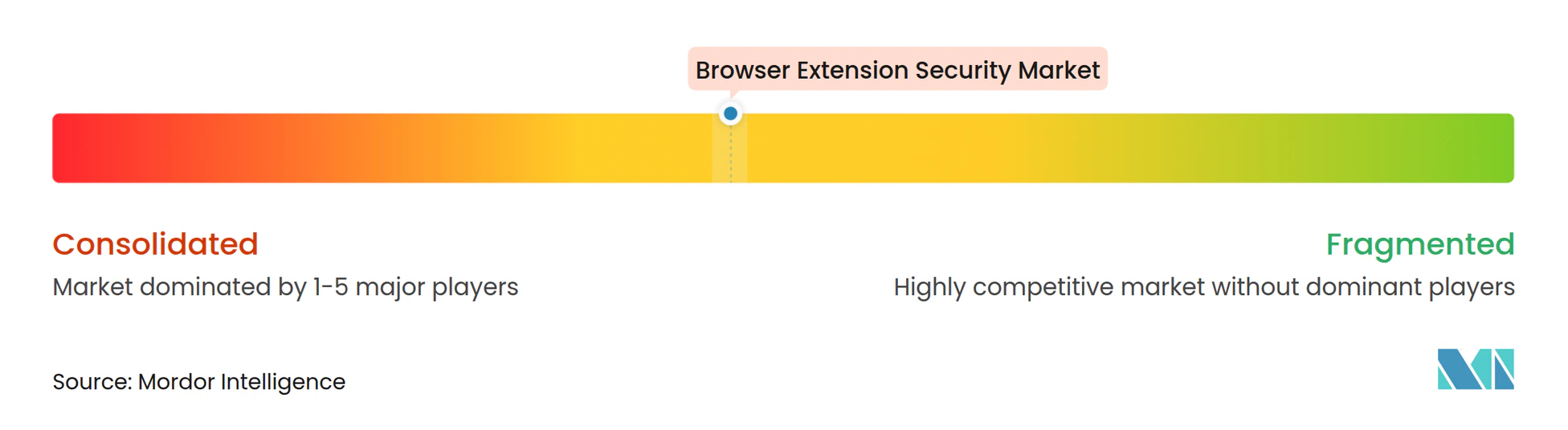
The browser extension security market is consolidating around platform integration. CrowdStrike’s proposed acquisition of Seraphic brings browser runtime protection closer to endpoint telemetry and identity authorization. Zscaler acquired SquareX to add browser detection and response technology to its Zero Trust Exchange platform. Akamai completed its acquisition of LayerX and positioned the offering as Akamai Workforce Protector. These actions reflect a preference for browser controls that work with standard browsers rather than requiring a complete browser replacement. Platform vendors can sell such controls through their current SASE, SSE, and XDR relationships, which may shorten buying cycles for existing customers and make browser protection easier to evaluate as part of a unified security program rather than as a separate product category with a different purchasing process.
Palo Alto Networks shows the scale that can result from this cross-selling model. The company said Prisma Browser had nearly 10 million deployments when it introduced an expanded offering in March 2026. The earlier Prisma SASE 4.0 release also added browser capabilities focused on evasive browser-based threats. Check Point, Netskope, and Cato Networks follow a similar logic by extending browser controls through broader security platforms. Netskope enhanced enterprise browser capabilities for unmanaged and BYOD use cases in February 2025. This structure increases competition among buyers seeking a single-vendor relationship and unified policy administration, and it keeps the browser extension security market in active transition, although customers still need to assess how well each platform supports their mix of browsers, unmanaged devices, regulatory evidence requirements, and existing security operations processes.
Independent specialists retain a role where customers want deeper browser-specific control. Island raised USD 400 million in September 2026 at a USD 6.4 billion valuation and reported that annual recurring revenue had doubled in each fiscal year since its 2022 launch. The mid-market provides room for vendors that offer more depth than a platform bundle without the cost or operational scope of a full enterprise browser program. Browser detection and response is another competitive direction because it treats browser activity as a live detection-and-response problem rather than only a policy enforcement issue. Manifest V3 migration remains a competitive test for vendors that relied on older extension approaches, since the ability to preserve useful inspection, policy enforcement, and management features under new browser limitations can affect customer confidence at contract renewal and during product evaluations. The browser extension security market remains shaped by active platform and specialist competition, and is evolving through platform integration, although the supplied evidence does not provide combined market-share data for the leading players.
Browser Extension Security Industry Leaders
-
Akamai Technologies, Inc.
-
Cisco Systems, Inc.
-
Conceal Security, Inc.
-
CrowdStrike Holdings, Inc.
-
Fortinet, Inc.
- *Disclaimer: Major Players sorted in no particular order
Recent Industry Developments
- July 2026: Akamai Technologies completed its acquisition of LayerX Security for USD 205 million in cash, rebranding the product as Akamai Workforce Protector. The deal extends Akamai's Zero Trust portfolio into browser-layer AI interaction governance, providing real-time visibility into prompts, file uploads, and SaaS application activity across Chrome, Edge, Firefox, and Safari.
- May 2026: Akamai Technologies announced a definitive agreement to acquire LayerX Security for USD 205 million, citing AI usage control and browser-level enterprise visibility as the primary strategic rationale, complementing existing ZTNA and network segmentation capabilities.
- February 2026: Zscaler completed its acquisition of SquareX, closed February 5, 2026, integrating SquareX's browser detection and response technology into the Zscaler Zero Trust Exchange Platform to extend lightweight browser security to standard browsers on unmanaged and BYOD devices.
- January 2026: CrowdStrike signed a definitive agreement to acquire Seraphic Security for USD 420 million in a predominantly cash transaction. The acquisition integrates Seraphic's browser runtime protection with the Falcon platform's endpoint telemetry and SGNL's continuous identity authorization.
Global Browser Extension Security Market Report Scope
The browser extension security market includes software and services that discover, inventory, assess, monitor, govern, and remediate security risks associated with browser extensions, plug-ins, and add-ons used across enterprise browsers. These solutions help organizations prevent data exfiltration, unauthorized access, excessive permissions, malicious code, and other risks created by extensions’ access to browser data, web applications, and system resources.
The Browser Extension Security Market Report is Segmented by Component (Software, and Services), Application (Security and Compliance, Extension Policy Management, Risk Assessment, Monitoring and Analytics, and Other Applications), Deployment Mode (Cloud-Based, On-Premises, and Hybrid), Organization Size (Large Enterprises, and Small and Medium-Sized Enterprises), End-User Industry (Banking, Financial Services, and Insurance (BFSI), Healthcare and Life Sciences, Government and Defense, IT and Telecommunications, Retail and E-Commerce, Education and Research, and Other End User Industries), Browser (Google Chrome, Microsoft Edge, Mozilla Firefox, Apple Safari, and Other Chromium-Based Browsers), and Geography (North America, South America, Europe, Asia-Pacific, Middle East, and Africa). The Market Forecasts are Provided in Terms of Value (USD).
| Software |
| Services |
| Security and Compliance |
| Extension Policy Management |
| Risk Assessment |
| Monitoring and Analytics |
| Other Applications |
| Cloud-Based |
| On-Premises |
| Hybrid |
| Large Enterprises |
| Small and Medium-Sized Businesses |
| Banking, Financial Services, and Insurance (BFSI) |
| Healthcare and Life Sciences |
| Government and Defense |
| IT and Telecommunications |
| Retail and E-Commerce |
| Education and Research |
| Other End User Industries |
| Google Chrome |
| Microsoft Edge |
| Mozilla Firefox |
| Apple Safari |
| Other Chromium-Based Browsers |
| North America | United States |
| Canada | |
| Mexico | |
| South America | Brazil |
| Argentina | |
| Rest of South America | |
| Europe | Germany |
| United Kingdom | |
| France | |
| Italy | |
| Spain | |
| Rest of Europe | |
| Asia-Pacific | China |
| Japan | |
| India | |
| South Korea | |
| Australia | |
| Rest of Asia-Pacific | |
| Middle East | United Arab Emirates |
| Saudi Arabia | |
| Israel | |
| Rest of Middle East | |
| Africa | South Africa |
| Nigeria | |
| Rest of Africa |
| By Component | Software | |
| Services | ||
| By Application | Security and Compliance | |
| Extension Policy Management | ||
| Risk Assessment | ||
| Monitoring and Analytics | ||
| Other Applications | ||
| By Deployment Model | Cloud-Based | |
| On-Premises | ||
| Hybrid | ||
| By Organization Size | Large Enterprises | |
| Small and Medium-Sized Businesses | ||
| By End User Industry | Banking, Financial Services, and Insurance (BFSI) | |
| Healthcare and Life Sciences | ||
| Government and Defense | ||
| IT and Telecommunications | ||
| Retail and E-Commerce | ||
| Education and Research | ||
| Other End User Industries | ||
| By Browser | Google Chrome | |
| Microsoft Edge | ||
| Mozilla Firefox | ||
| Apple Safari | ||
| Other Chromium-Based Browsers | ||
| By Geography | North America | United States |
| Canada | ||
| Mexico | ||
| South America | Brazil | |
| Argentina | ||
| Rest of South America | ||
| Europe | Germany | |
| United Kingdom | ||
| France | ||
| Italy | ||
| Spain | ||
| Rest of Europe | ||
| Asia-Pacific | China | |
| Japan | ||
| India | ||
| South Korea | ||
| Australia | ||
| Rest of Asia-Pacific | ||
| Middle East | United Arab Emirates | |
| Saudi Arabia | ||
| Israel | ||
| Rest of Middle East | ||
| Africa | South Africa | |
| Nigeria | ||
| Rest of Africa | ||
Key Questions Answered in the Report
What is the 2027 size of the browser extension security market?
The browser extension security market size was valued at USD 2.34 billion in 2026 and estimated to expand from USD 2.63 billion in 2027 to reach USD 4.71 billion by 2032, at a CAGR of 12.36% during the forecast period 2027-2032.
What is driving demand for browser extension security?
SaaS use, browser-native threats, unmanaged-device access, and AI governance are increasing demand for controls at the browser layer.
Which deployment model is expanding the fastest?
Cloud-based delivery is projected to expand at a 19.31% CAGR through 2032, supported by SASE and SSE delivery models.
Which customer group has the largest share?
Large enterprises accounted for 67.51% of revenue in 2026 because of their larger security budgets, complex environments, and regulatory exposure.
Which end-user sector leads demand?
BFSI held 31.28% of revenue in 2026, supported by strict operational resilience and cybersecurity obligations.
Which region is projected to advance the fastest?
Asia-Pacific is projected to expand at a 17.92% CAGR through 2032, supported by cloud adoption and regional cybersecurity requirements.