
Enterprise Browser Security Market Size and Share
Market Overview
| Study Period | 2021 - 2032 |
|---|---|
| Market Size (2027) | USD 2.98 Billion |
| Market Size (2032) | USD 9.11 Billion |
| Growth Rate (2027 - 2032) | 25.04 % |
| Fastest Growing Market | Asia-Pacific |
| Largest Market | North America |
| Market Concentration | Medium |
Major Players *Disclaimer: Major Players sorted in no particular order Image © Mordor Intelligence. Reuse requires attribution under CC BY 4.0. | |
Enterprise Browser Security Market Analysis by Mordor Intelligence
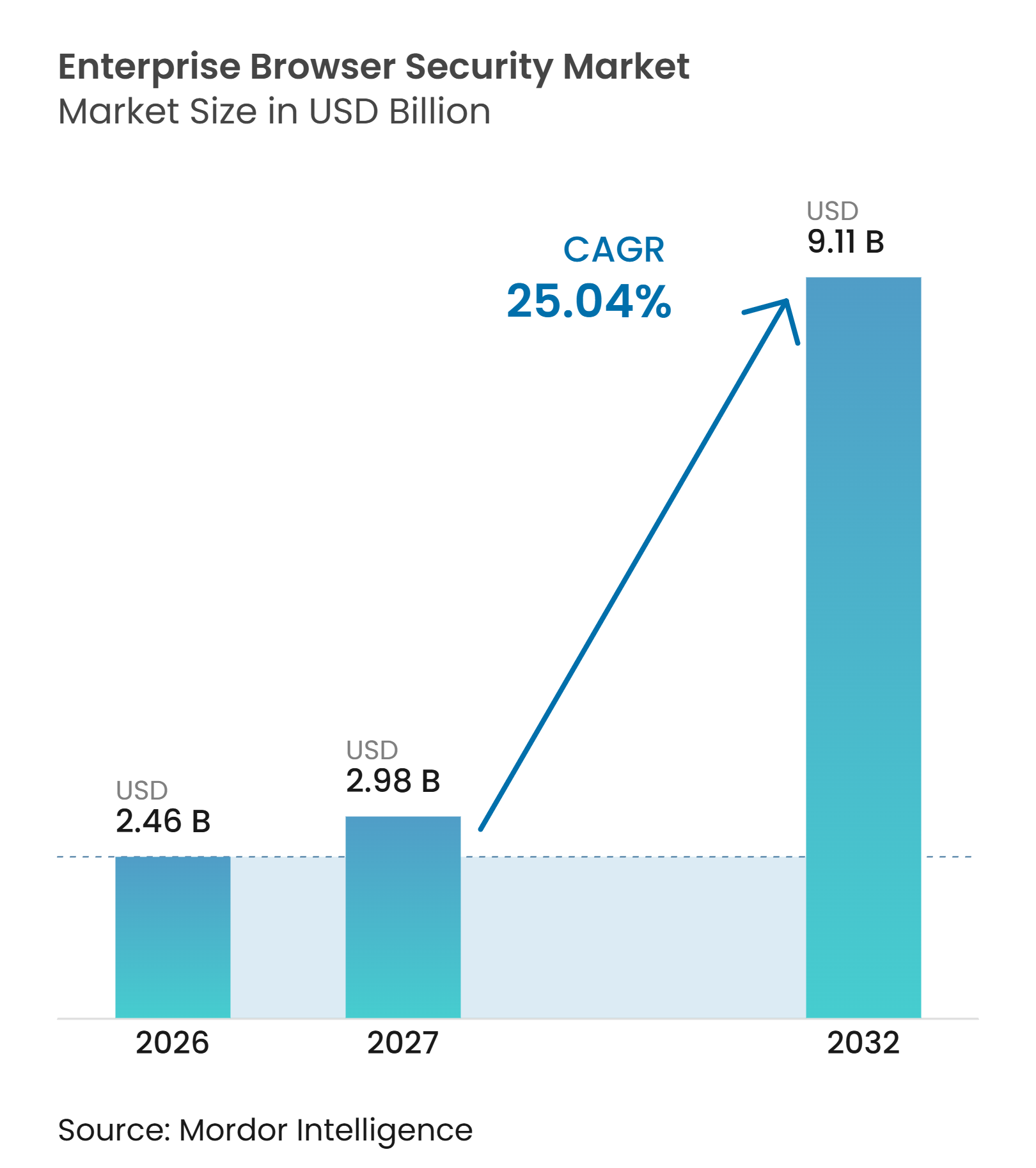
The enterprise browser security market size is projected to expand from USD 2.46 billion in 2026 to USD 9.11 billion by 2032, registering a CAGR of 25.04% between 2027 and 2032. The enterprise browser security market is growing as work increasingly takes place in browsers, where conventional network controls have limited visibility into actions within authenticated sessions. Purpose-built platforms are gaining attention because they can apply data loss prevention, session recording, extension controls, and access policies in the browser. Cloud delivery is reinforcing this shift by enabling organizations to update policies and threat intelligence across distributed workforces without lengthy local deployment cycles. Competition is separating vendors that offer deep browser controls from platform providers that include browser functions within broader secure service edge and secure access service edge contracts. The enterprise browser security market also faces an adoption challenge, since unmanaged consumer browser sessions can create security gaps when employees do not consistently use the approved environment, making rollout, employee support, workflow compatibility, and policy enforcement central parts of the value proposition rather than secondary implementation concerns.
Key Report Takeaways
- By offering, Enterprise Browser Security Solutions led with 71.23% of the enterprise browser security market share in 2026, while Services are projected to expand at a 26.84% CAGR through 2032.
- By deployment mode, Cloud held 69.84% of the enterprise browser security market share in 2026 and is projected to expand at a 27.61% CAGR through 2032.
- By enterprise size, Large Enterprises accounted for 68.71% of the enterprise browser security market size in 2026, while SMEs are projected to expand at a 28.93% CAGR through 2032.
- By end-user industry, BFSI accounted for 31.24% of the enterprise browser security market in 2026, while Healthcare and Life Sciences are projected to expand at a 27.51% CAGR through 2032.
- By geography, North America held 34.66% of the enterprise browser security market share in 2026, while Asia-Pacific is projected to expand at a 28.72% CAGR through 2032.
Note: Market numbers in this report are based on Mordor Intelligence's proprietary estimation framework, which combines nine months of actuals with Q4 projections for base year 2026.
Global Enterprise Browser Security Market Trends and Insights
Drivers Impact Analysis*
| Driver | (~) % Impact on CAGR Forecast | Geographic Relevance | Impact Timeline |
|---|---|---|---|
| Browser-Native Phishing, Malware, and Session Attacks | +5.5% | Global, highest intensity in North America and Asia-Pacific | Short term (≤ 2 years) |
| Zero Trust, SASE, and Secure Access Modernization | +5.0% | North America and EU, spillover to Asia-Pacific | Medium term (2-4 years) |
| Generative AI and Agentic Browser Governance | +4.5% | Global, early adopters in North America and UK | Medium term (2-4 years) |
| Browser-Centric Enterprise Workflows and SaaS Exposure | +4.0% | Global, acute in SaaS-heavy North America and Western Europe | Short term (≤ 2 years) |
| Hybrid Work, BYOD, and Contractor Access | +3.5% | Global, Asia-Pacific and South America accelerating structurally | Medium term (2-4 years) |
| Regulatory and Data-Residency Pressure | +2.5% | EU, United States, and Asia-Pacific national frameworks | Long term (≥ 4 years) |
| Source: Mordor Intelligence | |||
Browser-Native Phishing, Malware, and Session Attacks
The enterprise browser security market is being shaped by the browser’s role as a primary delivery point for phishing, malware, and credential theft. Zscaler reported that 87% of the 31.1 billion transactions it blocked in 2025 were delivered through encrypted channels.[1] It also reported that 95.2% of blocked phishing attempts, equal to 1.2 billion hits, used encrypted channels. The Anti-Phishing Working Group recorded 3.8 million phishing attacks in 2025, including 295,691 unique phishing websites in December 2025. These figures increase the value of controls that can inspect and restrict activity inside the browser session. Browser isolation can limit the execution environment that malicious content needs, moving protection closer to the point where an attack is opened, rendered, and used, while providing administrators with a more direct place to apply restrictions before credentials, files, or sensitive application functions can be misused.
Zero Trust, SASE, and Secure Access Modernization
The enterprise browser security market is also benefiting from zero-trust programs that need controls at the point where content is rendered. Browser-level enforcement can apply data loss prevention, session-token governance, download rules, and clipboard restrictions after identity-based access has been granted. This gives organizations a way to extend access policies into the actual session, rather than stopping at the network boundary. Palo Alto Networks introduced Prisma SASE 4.0 in September 2025 and described Prisma Browser as a tool designed to intercept encrypted and evasive attacks that assemble inside the browser. The company reported 35% year-over-year SASE revenue growth when it made that announcement. The shift supports enterprise buyers who want fewer disconnected access and data-protection tools, especially where different teams currently manage identity, web filtering, endpoint controls, and cloud application security through separate operational processes.
Generative AI and Agentic Browser Governance
The enterprise browser security market is gaining a new use case as AI agents perform tasks inside authenticated browser sessions. An agent may operate under the same credentials as an employee, enabling malicious prompt injection that can initiate unauthorized actions or expose sensitive data. Google identified prompt injection from untrusted web content, cross-origin data exfiltration, and unauthorized action execution as key risks in Chrome’s agentic capabilities.[2] Google also introduced a User Alignment Critic to assess planned actions against task-specific origin sets. Menlo Security launched a browser security platform for human users and autonomous AI agents in March 2026, and disclosed USD 140 million in annual recurring revenue with net retention above 120%. These developments make a unified policy layer for human and nonhuman actors more relevant to enterprise security procurement, because organizations need to define which actions agents may take, what data they may access, and when human confirmation is required.
Browser-Centric Enterprise Workflows and SaaS Exposure
Browser-centered workplaces, financial records, personal data, and intellectual property in the same session environment across many cloud applications. This concentration increases the value of having a consistent way to control downloads, copy-and-paste actions, extensions, and access to unmanaged devices. The enterprise browser security industry is therefore tied to the continued growth of software-as-a-service use, remote access, and third-party collaboration. The gap between browser use and browser-specific controls leaves organizations dependent on combinations of virtual desktop infrastructure, virtual private networks, secure web gateways, and endpoint products. A managed browser can consolidate some of these functions when the organization can apply policies consistently. This creates an opportunity for vendors that can demonstrate security gains without imposing disruptive workflow changes, particularly where employees have established browser habits and business teams depend on specialized web applications that cannot tolerate avoidable access delays.
Restraints Impact Analysis*
| Restraint | (~) % Impact on CAGR Forecast | Geographic Relevance | Impact Timeline |
|---|---|---|---|
| User Resistance to Replacing Familiar Browsers | -2.5% | Global, most acute where Chrome and Edge are entrenched | Short term (≤ 2 years) |
| Latency and User-Experience Penalties in Isolated Sessions | -2.0% | Global, highest friction in Asia-Pacific and South America | Medium term (2-4 years) |
| Deployment Cost and Security-Team Skills Constraints | -1.5% | SME segment globally, emerging markets specifically | Medium term (2-4 years) |
| Privacy, Employee-Monitoring, and Data-Residency Complexity | -1.0% | EU, Asia-Pacific data-residency mandates, and multinationals | Long term (≥ 4 years) |
| Source: Mordor Intelligence | |||
User Resistance to Replacing Familiar Browsers
User behavior remains a significant constraint for the enterprise browser security market. Employees may return to familiar consumer browsers when the managed browser creates friction for a task or does not support a preferred workflow. This behavior can leave parallel unmanaged sessions outside the protections that the organization has purchased. Island Technology advises customers to track managed-browser retention 90 days after deployment, indicating that sustained use is a key measure of deployment success.[3] Extension-based security models address this concern by applying controls inside Chrome or Edge without requiring a full browser replacement. These models can widen adoption but may not provide the same depth of control as a purpose-built enterprise browser, leaving buyers to weigh a smoother deployment path against the additional controls they may need for sensitive sessions and privileged tasks.
Latency and User-Experience Penalties in Isolated Sessions
Remote browser isolation can create user-experience issues when rendering is delivered from remote cloud environments. Rich web applications and real-time collaboration tools can be affected when sessions are transmitted as pixel streams. Users may create workarounds when performance issues delay routine tasks, potentially weakening the security perimeter. Menlo Security describes Adaptive Clientless Rendering as an approach that sends DOM-mirroring instructions rather than video streams, while keeping content execution in the cloud. The issue may be more pronounced in Asia-Pacific, South America, and the Middle East, where a greater distance from cloud infrastructure increases round-trip times. Providers that improve performance across these regions can reduce a barrier to adoption in the enterprise browser security industry by ensuring consistent application responsiveness, which is important for business users whose work depends on browser-based collaboration, administration, and customer service.
*Our forecasts treat driver/restraint impacts as directional, not additive. The impact forecasts reflect baseline growth, mix effects, and variable interactions.
Segment Analysis
By Offering: Solutions Lead While Services Support Integration
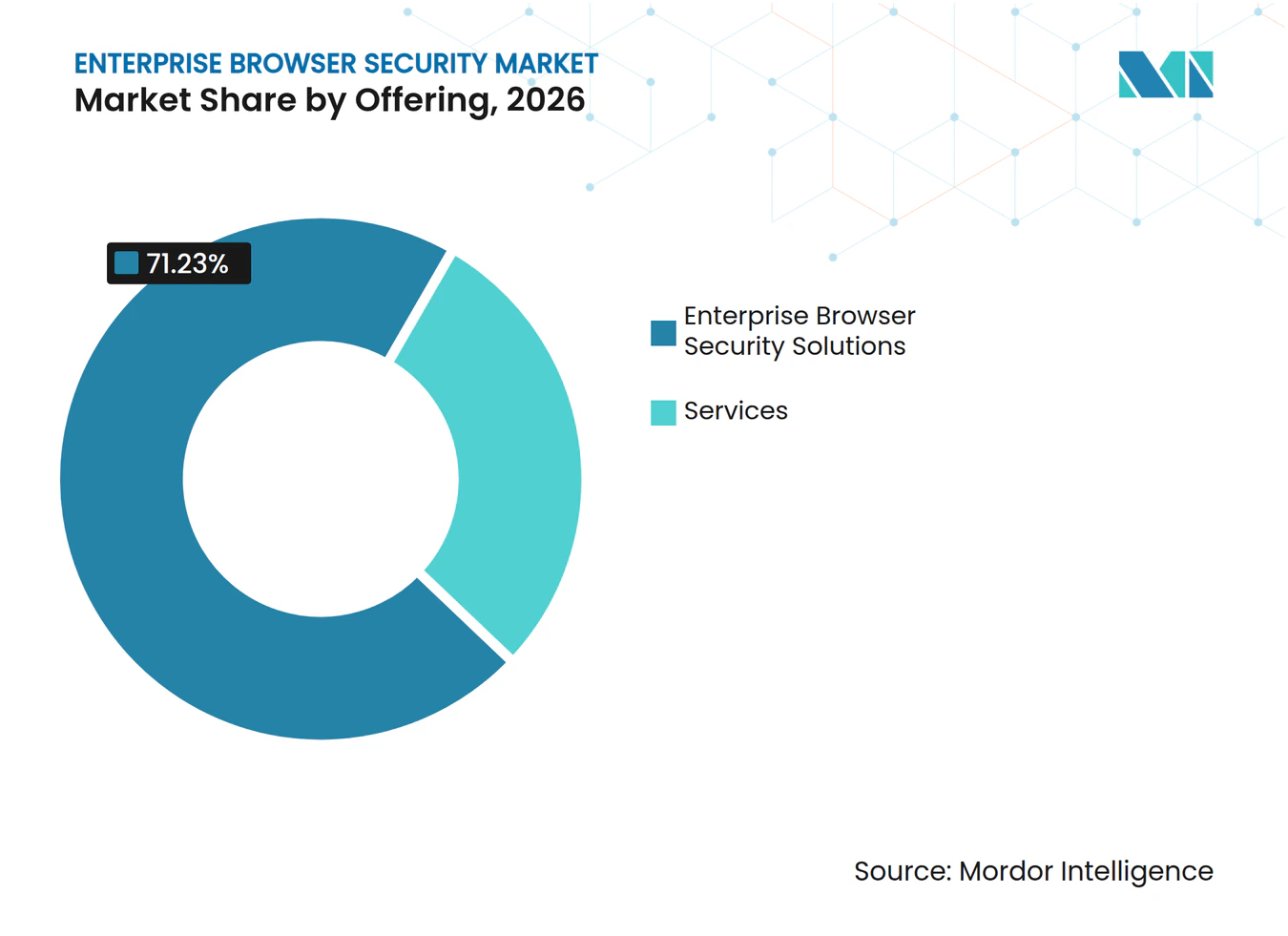
Enterprise Browser Security Solutions commanded 71.23% of the enterprise browser security market share in 2026. These platforms bring data loss prevention, session recording, extension controls, controlled browsing, and AI-agent safeguards into a single policy environment that security teams can manage centrally. Buyers favor this structure when they want consistent controls across browser activity rather than a collection of separate tools that require complex integration and policy reconciliation. The enterprise browser security market size for Services is projected to expand at a 26.84% CAGR through 2032. Services are needed because browser controls must work with identity providers, security information and event management platforms, secure access service edge environments, and established incident-response processes.
Managed Browser Security Services are gaining relevance among mid-market organizations that need service-level commitments but lack internal policy configuration expertise or dedicated browser security administrators. Professional and integration services can align browser rules with conditional access, identity-based segmentation programs, and existing processes for reviewing security alerts. This work is important when an organization uses several existing endpoint, access, and data-security products that have separate administrative consoles. Vendor-specific integration knowledge can create switching costs once a deployment is established and operational teams depend on the provider’s implementation expertise. The enterprise browser security industry, therefore, has a recurring services opportunity even when platform vendors offer browser controls as part of larger subscriptions, since customers still need help mapping policies to applications, testing user workflows, preparing support teams, and maintaining integrations after deployment.


By Deployment Mode: Cloud Leads While Local Models Remain Relevant
Cloud deployment held 69.84% of the enterprise browser security market share in 2026 and is projected to grow at a 27.61% CAGR through 2032. Cloud-native systems can update threat intelligence, access rules, and data-protection policies across distributed workforces without waiting for local patch cycles or device-by-device configuration. This supports buyers who manage users across many locations, applications, operating systems, and device types. The cloud model also supports faster rollout of browser controls to contractors and remote employees, including users who need temporary access to private applications. It remains the leading deployment approach because it aligns with how most enterprise applications are now accessed.
Hybrid deployments remain important for financial services and government users who must process certain workloads within defined geographic boundaries. These organizations can keep sensitive work local while managing policies through a central cloud console, preserving oversight across users and applications. Germany’s BSI certified m-privacy’s TightGate-Pro 2.0 in 2026 under Common Criteria EAL 3+, showing continued demand for locally certified isolation products.[4] France’s ANSSI-certified VirtualBrowser is used by Matignon, Thales, and Dassault Aviation, illustrating the role of local certification in sensitive environments. On-premises and hybrid systems will remain relevant where sovereignty, formal certification, and workload-location requirements carry more weight than cloud cost advantages, particularly for organizations whose procurement rules require approved products, local processing, or locally controlled access to sensitive systems.
By Enterprise Size: Large Organizations Lead While SMEs Gain Access
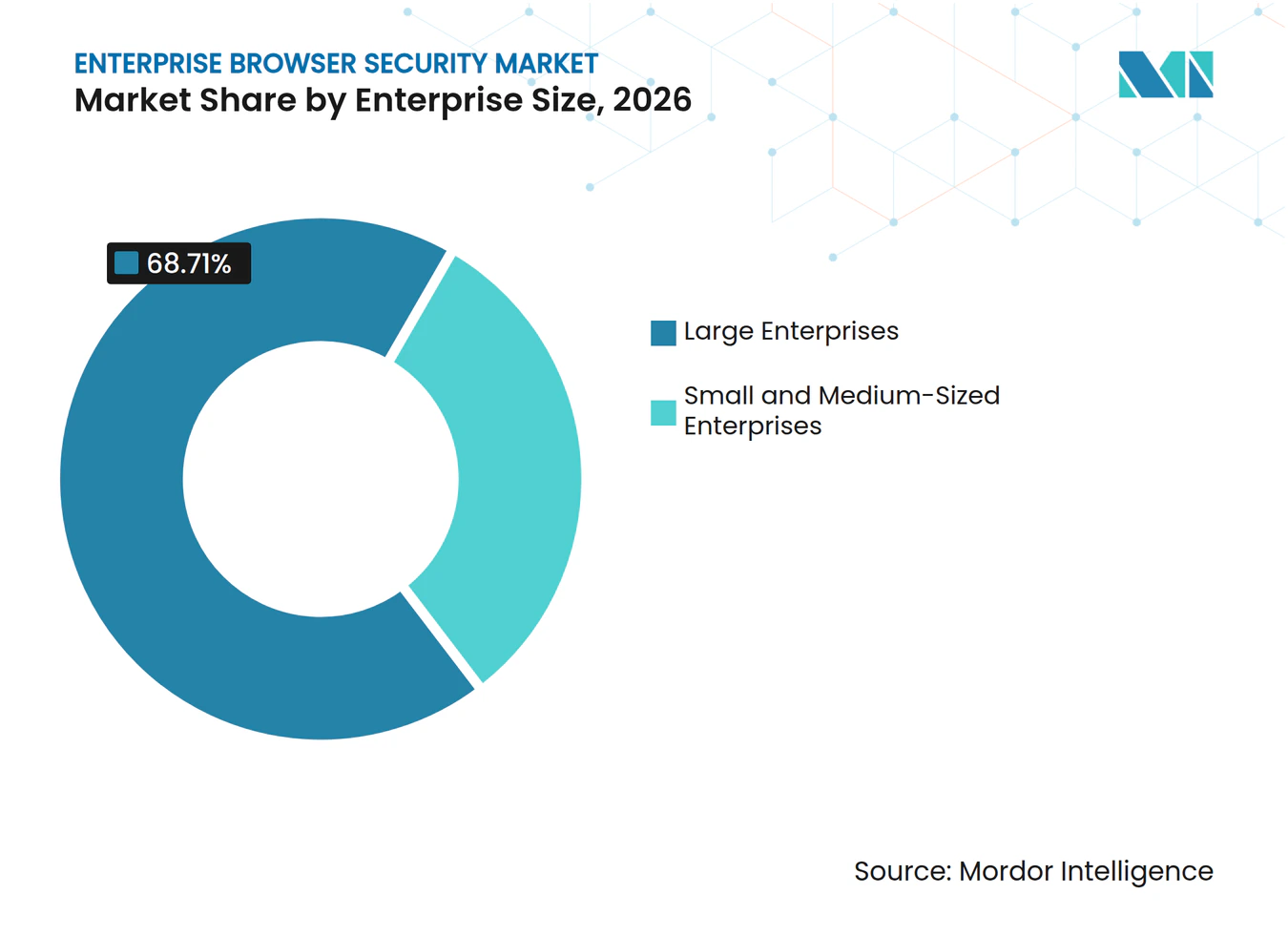
Large enterprises held 68.71% of the enterprise browser security market share in 2026. These buyers adopted early because they have complex identity, security information and event management, endpoint detection, and compliance environments that require integrated controls. They also face substantial exposure to phishing, credential theft, and sensitive data loss across large user populations, diverse business units, and numerous cloud applications. Menlo Security states that 8 of the 10 largest global financial institutions are platform customers.[5] Dedicated security teams and established governance practices make it easier for large organizations to deploy, monitor, update, and manage browser policies by enabling coordination among technical controls and legal, compliance, incident response, identity, and business application stakeholders.
SMEs are projected to grow at a 28.93% CAGR through 2032, the fastest rate by enterprise size. Extension-based deployment can reduce the need for dedicated IT resources and can fit managed service provider operating models that support smaller internal teams. ESET reported that phishing campaigns were the leading cause of SME security incidents in France, accounting for 31% of incidents covered by its 2026 panorama. Verizon reported that the enterprise-to-SMB zero-trust adoption gap is narrowing as automation reduces the skilled-personnel requirement for ongoing management. Simpler licensing, lower operational requirements, and external management support can make browser-based security more practical for smaller organizations, allowing them to improve web-session protection without building the same internal security operations capacity that larger enterprises maintain.

By End-User Industry: BFSI Leads While Healthcare and Life Sciences Accelerate
BFSI accounted for 31.24% of the enterprise browser security market in 2026. Financial institutions manage high-value transactions, privileged access, and sensitive customer information through browser-based applications used by employees, advisors, and operations teams. The Office of the Comptroller of the Currency identified browser-based credential theft and phishing as leading systemic threats to the USD 16 trillion federal banking system in 2025. Payment Card Industry Data Security Standard version 4.0 took effect in March 2025, adding compliance pressure for controls around payment data. Browser-level session protection can support financial institutions that need to reduce credential theft, fraud, and data exfiltration risks while meeting their control obligations, particularly when staff, partners, and temporary users access high-value applications through standard web interfaces.
The healthcare and life sciences industry is projected to expand at a 27.51% CAGR through 2032. The sector faces growing ransomware exposure and ongoing obligations to protect electronic health records, clinical systems, and personal health information. The U.S. Department of Health and Human Services Office for Civil Rights has stated that tracking technologies used in clinical browsers without suitable safeguards can create HIPAA compliance risks. Government and public administration require certified browser isolation for sensitive workflows, while retail and e-commerce face risks related to payment credentials, customer accounts, and web-based fraud. IT and telecommunications also require controls governing access to cloud applications across large, distributed workforces, where contractors, support teams, and technical users may require varying levels of access to shared operational systems.
Geography Analysis
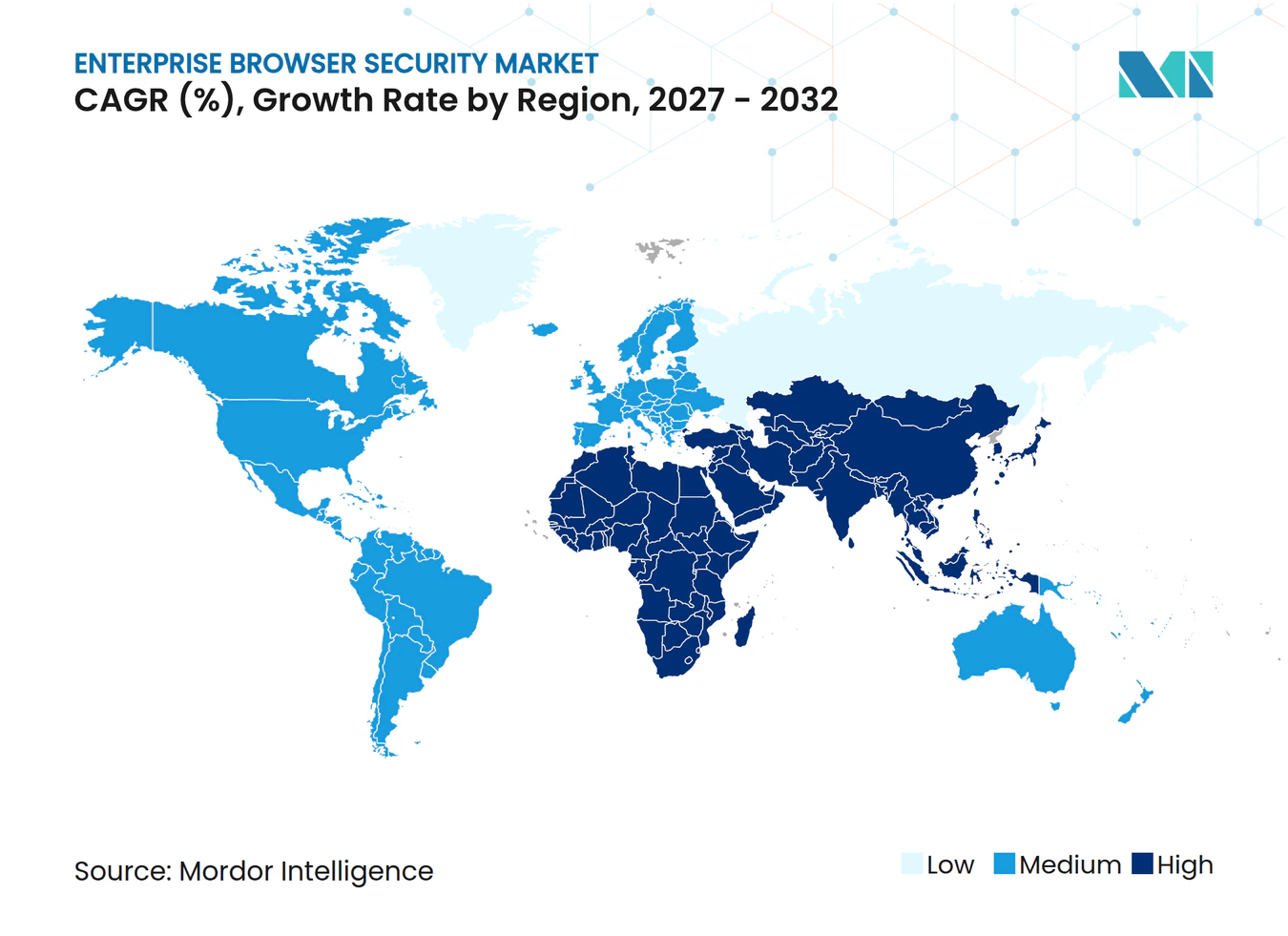
North America held 34.66% of the enterprise browser security market share in 2026. The region benefits from a large software-as-a-service ecosystem, early zero-trust programs, and high security spending by financial institutions and government contractors. The area also has a mature group of security buyers who can test browser controls alongside existing access, endpoint, and cloud security investments. The OCC identified browser-based credential theft and phishing as systemic threats to the U.S. financial system in 2025. This concern directs spending toward browser-level controls for financial applications, privileged access, and other workflows where a stolen session could create broader exposure. Canada’s alignment with U.S. cybersecurity approaches extends the regional opportunity, while Brazil and Mexico support early-stage demand in South America through software-as-a-service adoption and hybrid work, where growing reliance on web applications raises the need for consistent access controls across corporate and personal devices.
Europe is driven by a dense regulatory environment that links browser activity to access, identity, and supply chain security. The NIS2 Directive applies cybersecurity risk-management requirements to entities in critical sectors across the European Union.[6] The directive permits fines of up to EUR 10 million (USD 11.19 million) or 2% of global annual turnover for essential entities. The January 2026 proposed changes to the framework broadened attention to European Digital Identity Wallet providers. These requirements make browser controls relevant where organizations must document access governance, multifactor authentication, and security practices across suppliers and employees. Local certifications in Germany and France also create a distinct procurement path for providers that meet country-specific requirements, giving an advantage to companies that can provide evidence of technical assurance and support deployment models aligned with local sovereignty expectations.
Asia-Pacific is projected to grow at a 28.72% CAGR through 2032, making it the fastest-growing geographic segment in the enterprise browser security market. Adoption is supported by software-as-a-service adoption in India, South Korea, Australia, and Southeast Asia, along with national localization requirements and expanding digital office infrastructure. China’s Guangdong Enterprise Security Browser Technical Specification became effective in January 2025 and set requirements for enterprise browser client management and web application security. Qianxin reported that its trusted browser platform had more than 10 million installed units among government, finance, energy, and telecommunications customers in China, while Saudi Arabia and the UAE support demand in the Middle East through digital-economy programs, and adoption in Africa is emerging with mobile-first enterprise infrastructure.
Competitive Landscape
Market Concentration
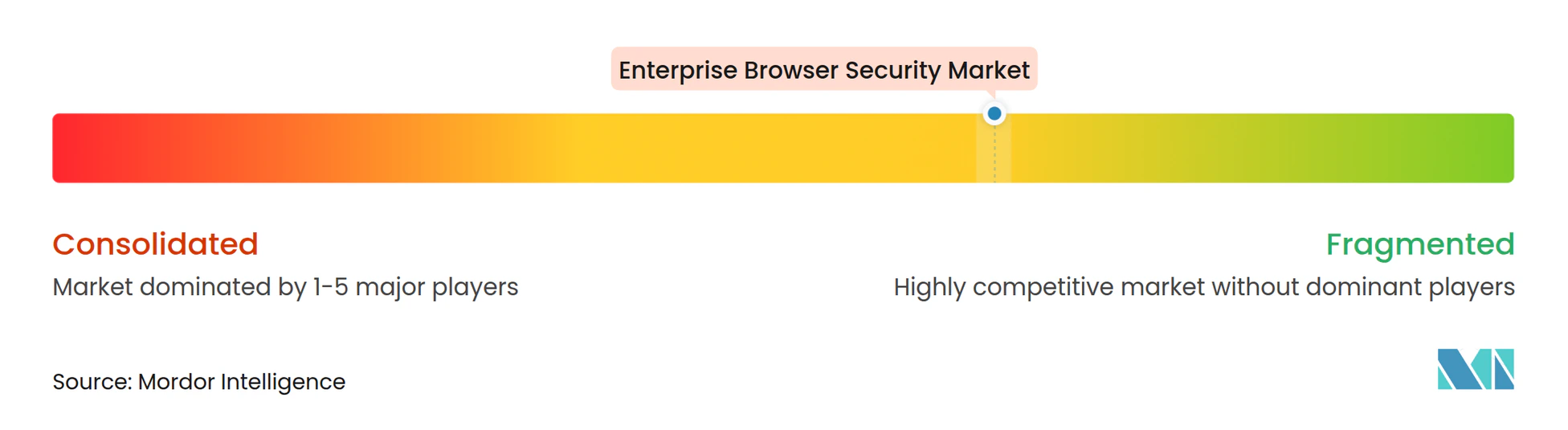
The enterprise browser security market is fragmented across pure-play browser vendors, secure service edge and secure access service edge providers, and endpoint-security companies. Pure-play vendors such as Island and Menlo Security emphasize granular controls within the browser session, including policies for sensitive actions that conventional controls may not see. Platform vendors such as Palo Alto Networks, Zscaler, Netskope, and Cato Networks can add browser functions to larger security contracts, which can simplify procurement for existing customers. Island raised USD 400 million in a Series F round in September 2026, reaching a USD 6.4 billion valuation. The transaction supported Island’s strategy to position the enterprise browser as an alternative to virtual desktop infrastructure, virtual private networks, and legacy secure web gateways, reflecting a broader effort to reduce reliance on multiple tools that were designed for earlier patterns of remote access and web use.
The competition between standalone depth and platform breadth influences purchasing decisions. Standalone providers can offer detailed session policies and specialized agentic AI protections, while bundled providers compete on the convenience and cost of a consolidated security contract. Palo Alto Networks unveiled updated Prisma Browser capabilities for agentic AI in March 2026, addressing shadow AI agents, prompt injection, and agent hijacking inside Prisma SASE. Menlo Security launched a platform in March 2026 that applies one control plane to human users and autonomous AI agents. Zscaler announced the ZAgent Framework and Zero Trust Browser Extension in June 2026 to extend zero-trust controls to AI agent-to-infrastructure communications, showing that large platform providers are treating agentic workflows as an extension of their access-security strategy rather than a separate category.
Extension-based providers such as SquareX and LayerX address organizations that want browser controls without forcing employees to leave Chrome or Edge. This approach can reduce the adoption friction that limits managed-browser migration and can give providers a path into companies that are not ready for a full replacement. Cato Networks introduced Cato Enterprise Browser in April 2026 within its existing Universal Zero Trust Network Access license. Check Point expanded Harmony SASE with an Enterprise Browser in June 2025 for unmanaged devices, contractors, and bring-your-own-device users, addressing a common deployment case where organizations must protect access without controlling the device itself.
Enterprise Browser Security Industry Leaders
-
Island Technology, Inc.
-
Menlo Security, Inc.
-
Palo Alto Networks, Inc.
-
Netskope, Inc.
-
LayerX Security Ltd.
- *Disclaimer: Major Players sorted in no particular order
Recent Industry Developments
- June 2026: Zscaler announced the ZAgent Framework and Zero Trust Browser Extension and Enterprise Browser at Zenith Live 2026, extending Zero Trust SASE to secure AI agent-to-infrastructure communications and replace VDI and VPN setups for unmanaged and BYOD devices.
- April 2026: Cato Networks launched the Cato Enterprise Browser integrated natively into its SASE platform under the existing Universal Zero Trust Network Access license, delivering zero-trust access, data protection, and AI governance for managed and unmanaged devices without additional licensing.
- March 2026: Palo Alto Networks unveiled an updated Prisma Browser for the Agentic AI era on March 23, 2026, addressing shadow AI agents, prompt injection, and agent hijacking natively within its Prisma SASE framework.
- March 2026: Netskope launched Netskope One AI Security, unifying AI security capabilities across agents, applications, large language models, and data within the Netskope One platform, following the company’s NASDAQ listing under ticker NTSK.
- February 2026: Forescout Technologies and Netskope announced a Zero Trust security integration combining Forescout’s real-time device intelligence with Netskope’s cloud security to enforce continuously adaptive access decisions across managed and unmanaged IT, OT, IoT, and IoMT devices.
Global Enterprise Browser Security Market Report Scope
The enterprise browser security market comprises software platforms and related services that secure enterprise web browsing by applying centrally managed policies, access controls, data-loss prevention, threat protection, and monitoring within or around the browser. It includes hardened enterprise browsers, browser security layers, and extensions used to protect web-based applications, user sessions, and sensitive corporate data; it generally excludes consumer browsers and conventional network-layer secure web gateways.
The Enterprise Browser Security Market Report is Segmented by Offering (Enterprise Browser Security Solutions, and Services [Managed Browser Security Services, and Professional and Integration Services]), Deployment Mode (Cloud, On-Premises, and Hybrid), Enterprise Size (Large Enterprises, and Small and Medium-Sized Enterprises), End-User Industry (Banking, Financial Services, and Insurance (BFSI), IT and Telecommunications, Healthcare and Life Sciences, Government and Public Administration, Retail and E-Commerce, and Other End-User Industries), and Geography (North America, South America, Europe, Asia-Pacific, Middle East, and Africa). The Market Forecasts are Provided in Terms of Value (USD).
| Enterprise Browser Security Solutions | |
| Services | Managed Browser Security Services |
| Professional and Integration Services |
| Cloud |
| On-Premises |
| Hybrid |
| Large Enterprises |
| Small and Medium-Sized Enterprises |
| Banking, Financial Services, and Insurance (BFSI) |
| IT and Telecommunications |
| Healthcare and Life Sciences |
| Government and Public Administration |
| Retail and E-Commerce |
| Other End-User Industries |
| North America | United States |
| Canada | |
| Mexico | |
| South America | Brazil |
| Argentina | |
| Rest of South America | |
| Europe | United Kingdom |
| Germany | |
| France | |
| Italy | |
| Rest of Europe | |
| Asia-Pacific | China |
| Japan | |
| India | |
| South Korea | |
| Australia and New Zealand | |
| Rest of Asia-Pacific | |
| Middle East | Saudi Arabia |
| United Arab Emirates | |
| Rest of Middle East | |
| Africa | South Africa |
| Nigeria | |
| Rest of Africa |
| By Offering | Enterprise Browser Security Solutions | |
| Services | Managed Browser Security Services | |
| Professional and Integration Services | ||
| By Deployment Mode | Cloud | |
| On-Premises | ||
| Hybrid | ||
| By Enterprise Size | Large Enterprises | |
| Small and Medium-Sized Enterprises | ||
| By End-User Industry | Banking, Financial Services, and Insurance (BFSI) | |
| IT and Telecommunications | ||
| Healthcare and Life Sciences | ||
| Government and Public Administration | ||
| Retail and E-Commerce | ||
| Other End-User Industries | ||
| By Geography | North America | United States |
| Canada | ||
| Mexico | ||
| South America | Brazil | |
| Argentina | ||
| Rest of South America | ||
| Europe | United Kingdom | |
| Germany | ||
| France | ||
| Italy | ||
| Rest of Europe | ||
| Asia-Pacific | China | |
| Japan | ||
| India | ||
| South Korea | ||
| Australia and New Zealand | ||
| Rest of Asia-Pacific | ||
| Middle East | Saudi Arabia | |
| United Arab Emirates | ||
| Rest of Middle East | ||
| Africa | South Africa | |
| Nigeria | ||
| Rest of Africa | ||
Key Questions Answered in the Report
What is the enterprise browser security market size?
The enterprise browser security market size is projected to expand from USD 2.46 billion in 2026 and USD 2.98 billion in 2027 to USD 9.11 billion by 2032, registering a CAGR of 25.04% between 2027 and 2032.
What is driving demand for enterprise browser security?
Phishing delivered through encrypted channels, browser-based SaaS work, and the need to govern AI agents are increasing demand for browser-level controls that can govern user actions, data movement, and access to sensitive web applications after users authenticate.
Which deployment model has the largest share?
Cloud held 69.84% in 2026 and is also projected to grow at the fastest deployment-mode CAGR of 27.61% through 2032, as organizations value faster policy updates and centralized management for distributed employees, contractors, and devices.
Which organizations are adopting these platforms fastest?
SMEs are projected to expand at a 28.93% CAGR through 2032 as extension-based delivery and managed services reduce deployment complexity, helping smaller teams protect browser sessions without maintaining extensive in-house management capabilities.
Which end-user sector has the largest share?
BFSI held 31.24% in 2026 because financial institutions require stronger controls for credentials, transactions, and sensitive customer data accessed through browser-based customer, payment, and operations systems.
Which region is growing fastest?
Asia-Pacific is projected to grow at a 28.72% CAGR through 2032, supported by SaaS adoption, national browser-security requirements, and expanding digital-work infrastructure across major economies.