
Real Estate Marketing Services Market Size and Share
Market Overview
| Study Period | 2020 - 2031 |
|---|---|
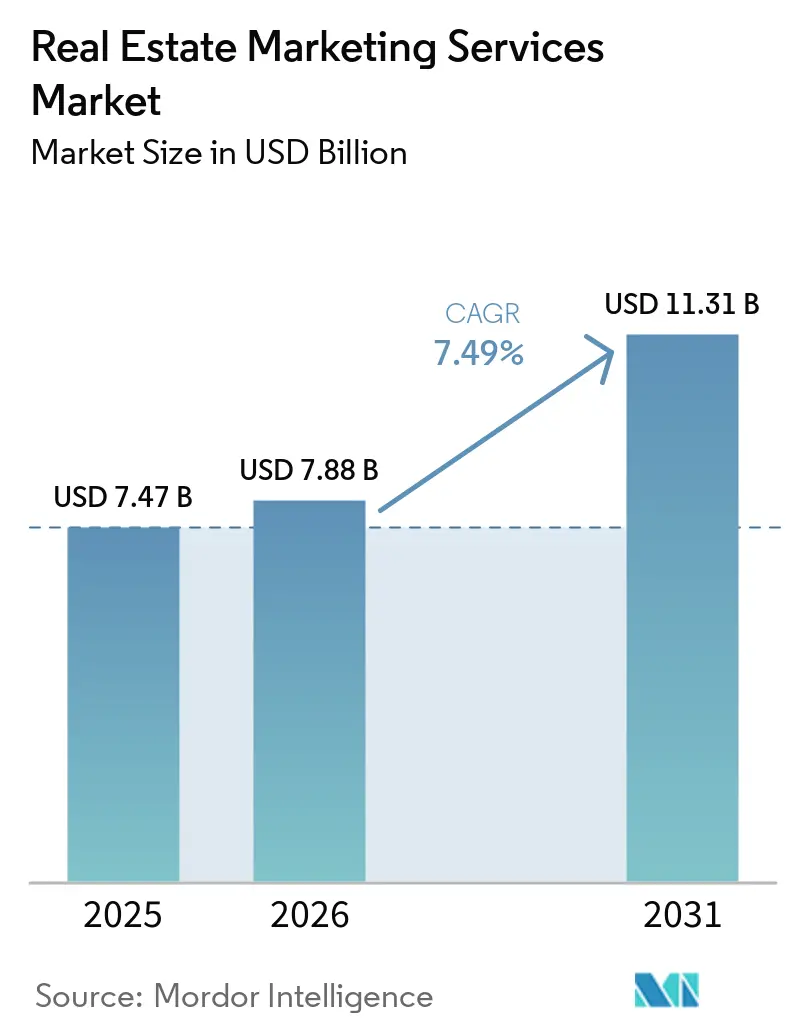
| Market Size (2026) | USD 7.88 Billion |
| Market Size (2031) | USD 11.31 Billion |
| Growth Rate (2026 - 2031) | 7.49 % |
| Fastest Growing Market | Asia-Pacific |
| Largest Market | North America |
| Market Concentration | Low |
Major Players *Disclaimer: Major Players sorted in no particular order Image © Mordor Intelligence. Reuse requires attribution under CC BY 4.0. | |
Real Estate Marketing Services Market Analysis by Mordor Intelligence
The Real estate marketing services market size is projected to expand from USD 7.47 billion in 2025 and USD 7.88 billion in 2026 to USD 11.31 billion by 2031, registering a CAGR of 7.49% between 2026 and 2031. The Real estate marketing services market is supported by the shift of property discovery toward websites, applications, search engines, and other digital channels. Professional marketing has become a recurring operating need for agents, developers, and institutional landlords because online visibility affects buyer discovery and seller acquisition. Buyers now compare agents before making contact, which makes a continued digital presence important even when transaction activity slows. The Real estate marketing services market is also moving toward analytics-led campaign design, as providers connect marketing activity with qualified leads and completed transactions. Platform vendors are extending automation, CRM, and content tools, while full-service providers remain relevant where campaign planning, local execution, and compliance management require sector knowledge.
Key Report Takeaways
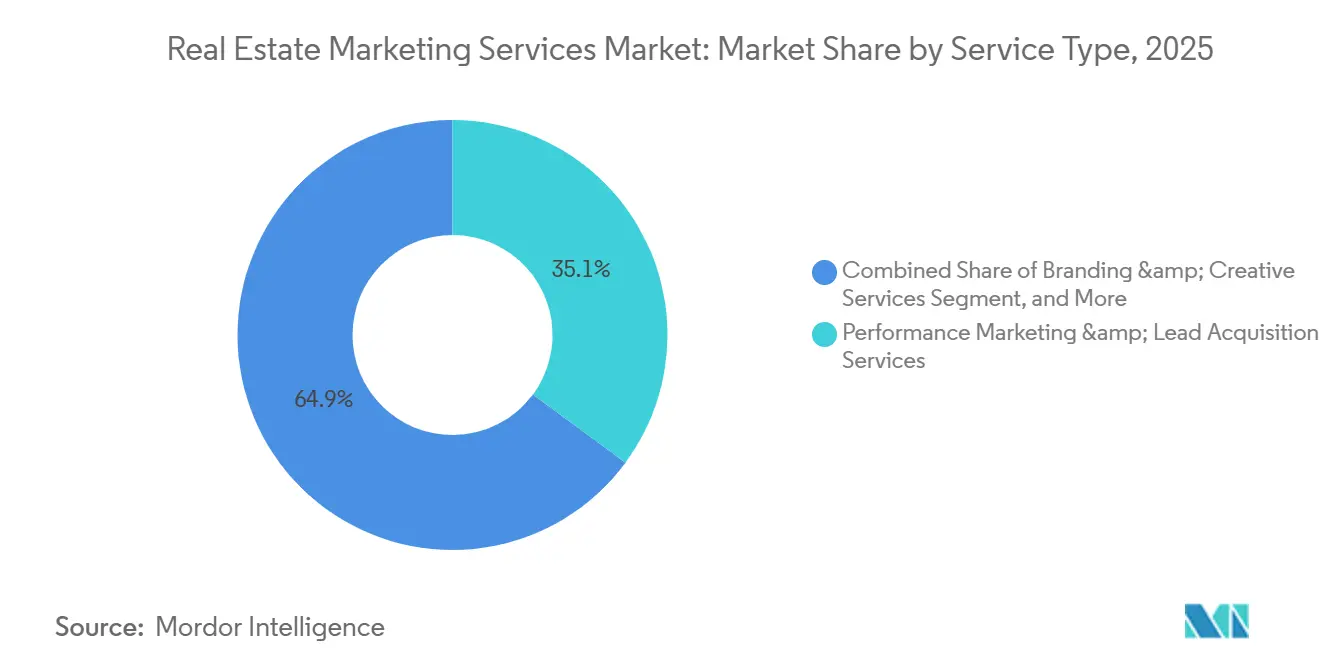
- By service type, Performance Marketing and Lead Acquisition Services held 35.12% of the Real estate marketing services market share in 2025, while Marketing Strategy, Research, and Analytics Services is projected to expand at an 8.55% CAGR through 2031.
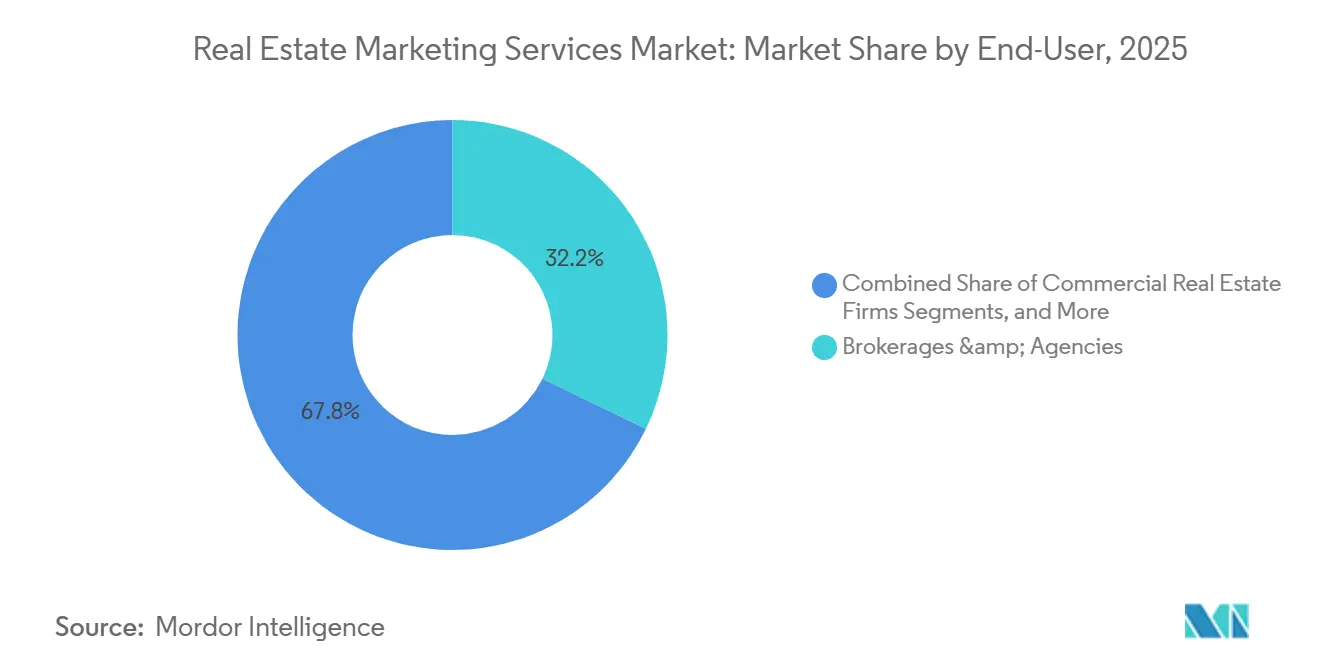
- By end-user, Brokerages and Agencies held 32.19% share in 2025, while Residential Developers are projected to expand at an 8.32% CAGR through 2031.
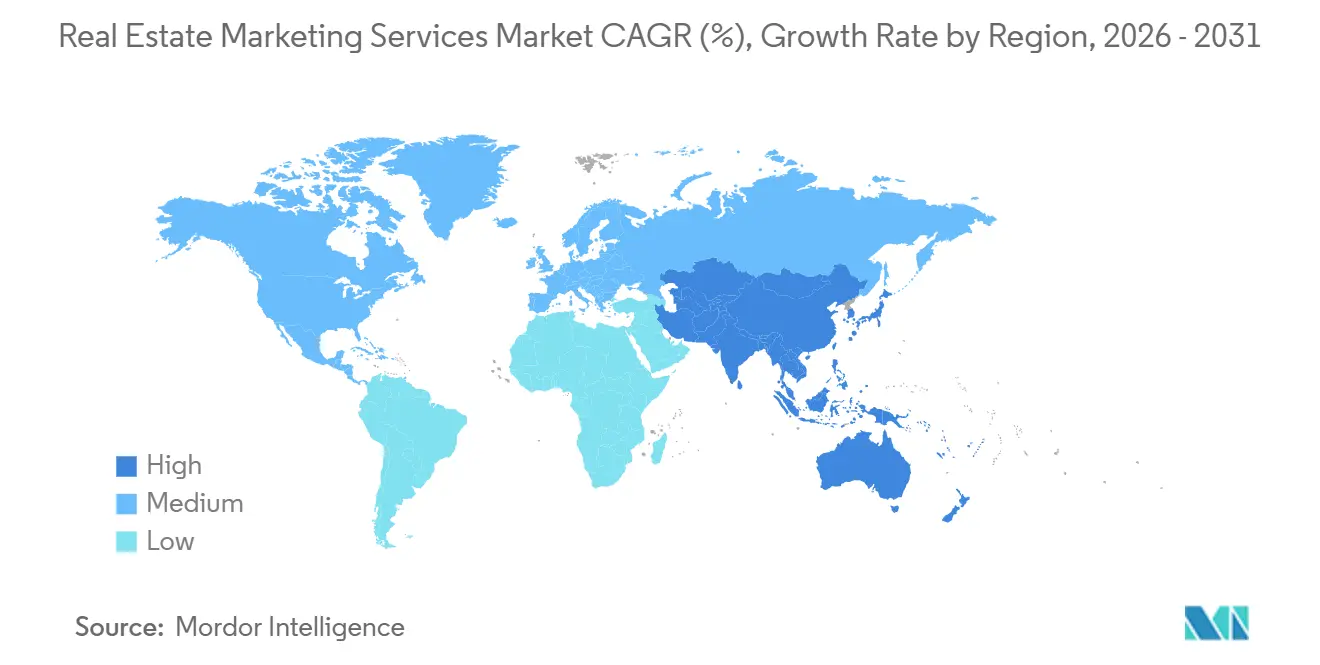
- By geography, North America accounted for 38.34% share in 2025, while Asia-Pacific is projected to expand at an 8.38% CAGR through 2031.
Note: Market size and forecast figures in this report are generated using Mordor Intelligence’s proprietary estimation framework, updated with the latest available data and insights as of January 2026.
Market Trends and Insights
Drivers Impact Analysis of Real Estate Marketing Services Market*
| Driver | (~) % Impact on CAGR Forecast | Geographic Relevance | Impact Timeline |
|---|---|---|---|
| Digital-First Home Search and Online Agent Discovery | +2.1% | Global | Short term (≤ 2 years) |
| Social Media and CRM-Led Quality Lead Generation | +1.5% | Global | Short term (≤ 2 years) |
| Performance Marketing Adoption by Developers and Brokerages | +1.2% | North America and Asia-Pacific | Medium term (2-4 years) |
| Rich-Media Listing Expectations From Sellers and Buyers | +0.9% | North America and Europe | Medium term (2-4 years) |
| AI Search Optimization and Answer-Engine Discovery | +0.8% | North America | Medium term (2-4 years) |
| Pre-Listing Seller Acquisition and Phased Listing Promotion | +0.6% | North America | Short term (≤ 2 years) |
| Source: Mordor Intelligence | |||
Digital-First Home Search and Online Agent Discovery
The Real estate marketing services market benefits from the nearly universal use of online research by homebuyers and sellers before they enter into a conversation with an agent. The National Association of REALTORS reported that online channels became the primary way consumers found an agent in 2025, ahead of personal referrals. This change makes persistent digital visibility a necessary operating expense for property professionals, rather than a promotional activity that can be paused when conditions become difficult. Reducing visibility during a slow period can leave agents less visible when customer activity improves, because buyers will still compare profiles, listings, and local expertise online. Bank of America reported that prospective buyers increasingly used AI tools for homebuying research, with adoption especially notable among younger buyer groups, including Gen Z respondents and Millennials.[1]Bank of America, “2026 Homebuyer Insights Report,” Bank of America, bankofamerica.com. The broader discovery process now includes conventional search, property portals, and AI-generated responses, which increases the range of planning, content, and optimization work required from the Real estate marketing services market.
Social Media and CRM-Led Quality Lead Generation
Social media and CRM systems have become central to lead generation in the Real estate marketing services market, as they combine initial customer reach with structured follow-up. The National Association of REALTORS found that REALTORS identified social media as their top lead-generating technology, followed by CRM platforms. Social platforms can generate high inquiry volumes at a lower cost per lead, but these leads often require longer and more carefully organized follow-up than portal or referral contacts. That requirement creates demand for CRM configuration, audience segmentation, message sequencing, and customer journeys that keep potential buyers engaged before they are ready to transact. CallRail reported that surveyed U.S. real estate businesses planned to use AI for lead scoring and attribution measurement.[2]CallRail, “2026 Real Estate Marketing Outlook Report,” CallRail, callrail.com. Providers in the Real estate marketing services market that help clients improve lead quality and follow-up processes can serve needs that extend beyond the placement and management of individual campaigns.
Performance Marketing Adoption by Developers and Brokerages
Developers and brokerages are shifting advertising budgets toward programs that link spending with qualified inquiries and pipeline outcomes that can be reviewed by sales teams. CallRail found that paid search and paid social were the 2 tactics most often identified as effective for new real estate businesses, while 82% of respondents prioritized pay-per-click for 2026. This shift moves spending away from broad campaigns that cannot be tied easily to a customer outcome or evaluated against qualified inquiry and pipeline measures. Campaign management, landing page design, and CRM integration become more important when clients need to track activity from first click to contract signing across several channels. Mobile-first audiences and stronger programmatic advertising infrastructure are widening this approach across South and Southeast Asian markets, where developers are replacing showroom-led activity with digital customer acquisition. The Real estate marketing services market, therefore, has opportunities for specialists who can connect performance activity, reliable attribution, lead handling, and clear budget decisions.
Rich-Media Listing Expectations From Sellers and Buyers
Seller expectations for photography, video, and virtual property experiences continue to support demand for professional media services across listing launches and ongoing promotional activities. The National Association of REALTORS® reported that a significant share of sellers preferred agents who offered professional photography, while many were more likely to hire agents who provided virtual tours.[3]National Association of REALTORS®, “NAR Existing-Home Sales Report Shows 2.4% Decrease in June,” National Association of REALTORS®, nar.realtor. The association also found that many REALTORS used drone photography and video, while others offered virtual tours. These services provide agents with reusable content for portals, websites, social platforms, direct outreach, and the various stages of a property’s marketing cycle. AI-assisted production can reduce the cost of creating assets, but it also increases attention to the authenticity, documentation, and appropriate use of listing media. The Real estate marketing services market can therefore support work that combines content production with disclosure management and review processes for AI-enhanced materials.
Restraints Impact Analysis of Real Estate Marketing Services Market*
| Restraint | (~) % Impact on CAGR Forecast | Geographic Relevance | Impact Timeline |
|---|---|---|---|
| Transaction-Volume Volatility and Thin Listing Inventories | -2.6% | Global | Short term (≤ 2 years) |
| Rising Customer-Acquisition Costs Across Portals and Paid Media | -1.5% | North America and Europe | Medium term (2-4 years) |
| AI Visibility Concentrating Demand Around a Small Share of Agents | -0.7% | North America | Medium term (2-4 years) |
| Disclosure and Authenticity Risks in AI-Enhanced Listing Media | -0.5% | North America | Short term (≤ 2 years) |
| Source: Mordor Intelligence | |||
Transaction-Volume Volatility and Thin Listing Inventories
Marketing spending is directly linked to listing supply and transaction activity, making service demand sensitive to housing cycles and the number of properties actively marketed. Existing-home sales in the United States improved slightly from the prior year, while inventory and supply remained constrained. The National Association of REALTORS described the recent sales level as historically low, and the latest reading remained below pre-pandemic norms. Bank of America found that many prospective buyers were waiting for prices and rates to improve, while home prices remained elevated. Lower listing availability can reduce active campaigns, limit agent budgets, and shorten the period available for performance marketing teams to test, refine, and optimize campaign activity. This pressure is particularly strong for portal-dependent agents that buy advertising or leads more frequently when transaction activity is higher, which can constrain spending across the Real estate marketing services market.
Rising Customer-Acquisition Costs Across Portals and Paid Media
Rising portal and paid-media costs can reduce marketing returns for agents and smaller brokerages that have less flexibility in their acquisition budgets. News Corp reported that Realtor.com lead volume declined 17% year over year in fiscal Q4 2025, while revenue per lead improved as the platform focused on higher-quality acquisition. This result reflected a market where fewer leads can be more expensive for customers purchasing them, even when the platform places greater emphasis on lead quality. CoStar raised subscription fees for new Homes.com members from May 1, 2026, adding to the cost of formal portal participation.[4]CoStar Group, “CoStar Group Reports First Quarter 2026 Results,” CoStar Group, costargroup.com. Well-capitalized clients can absorb these costs more easily than smaller operators, which can widen differences between enterprise accounts and independent agents. The resulting shift toward owned media and CRM-led programs can raise demand for analytics, CRM strategy, content work, and data management in the Real estate marketing services market, but it can also require greater upfront investment from clients.
*Our forecasts treat driver/restraint impacts as directional, not additive. The impact forecasts reflect baseline growth, mix effects, and variable interactions.
Real Estate Marketing Services Market Segment Analysis
By Service Type:
Analytics Spending Rises as Lead Quality MaturesPerformance Marketing and Lead Acquisition Services accounted for 35.12% of the Real estate marketing services market size in 2025. Its leading position reflected the importance of pay-per-click, paid social, and portal advertising for agents and developers seeking measurable near-term pipeline results. Branding and Creative Services supplied a steady revenue base because professionals need to maintain recognizable identities across changing listings and campaigns. Digital Asset and Listing Management Services also generated recurring demand through photography, video, listing updates, and content distribution. Events and Experiential Marketing Services represented a smaller but durable part of spending, particularly for luxury residential programs and developer pre-sales activity.
Marketing Strategy, Research and Analytics Services is projected to expand at an 8.55% CAGR through 2031, making it the fastest service type in the Real estate marketing services market. The segment reflects a move from optimizing inquiry volumes toward designing campaigns around lead quality and transaction outcomes. Firms are building multi-touch attribution models that follow activity from the first impression to the closing stage. Salesforce introduced autonomous marketing agents in June 2026, including Hunter for identifying leads from behavioral signals and a Marketing Goals Agent for building and optimizing campaigns around defined objectives. Full-service agencies can apply these tools to property-specific strategy, channel selection, performance review, and the interpretation of campaign results.



By End-User:
Brokerages Anchor Spending as Developers Drive GrowthBrokerages and Agencies held 32.19% share in 2025. They market active listings for sellers while maintaining visibility to attract buyers and recruit agents, which gives their spending a more consistent pattern than categories that depend on a single campaign type. Cutting visibility during a downturn can make it harder to retain client attention when market conditions improve. Commercial Real Estate Firms, Property Management Companies, and REITs and Institutional Investors form a distinct customer group with needs focused on capital-markets audiences, institutional tenants, and asset positioning rather than residential buyer lead generation.
Residential Developers are projected to expand at an 8.32% CAGR from 2026 to 2031. New project launches and off-plan sales require sustained promotion before units are delivered, especially in Asia-Pacific and the Middle East. The Real estate marketing services industry serves these clients through combinations of analytics, branding, performance activity, and CRM configuration. Developer requirements can be broader than the needs of individual agents because campaigns must support both project awareness and lead conversion. This increases the value of providers that can coordinate multiple service types within one program. The Real estate marketing services market can support longer service relationships where one provider coordinates planning, launch activity, customer follow-up, and performance reporting.
Geography Analysis
North America Real Estate Marketing Services Market
North America accounted for 38.34% share in 2025. The region benefits from a developed digital advertising infrastructure and mature portal and CRM ecosystems in the United States and Canada. High agent-to-listing ratios sustain competition for buyer and seller attention across paid media, listing distribution, CRM management, and content production. The United States is particularly important because changes in transactions can quickly affect brokerage and agent marketing budgets.
APAC Real Estate Marketing Services Market
Asia-Pacific is projected to expand at an 8.38% CAGR through 2031. Mobile-first buyer groups in India and rapid urbanization in Southeast Asian cities support demand for performance campaigns and developer launch services. Developers are shifting from showroom walk-ins to measurable digital channels, including search, social media, and programmatic advertising, for promoting residential projects. The Real estate marketing services market offers opportunities for campaign teams to adapt messaging, lead handling, and channel allocation to differing national buyer preferences.
EMEA and South America Real Estate Marketing Services Market
Europe has different digital maturity profiles across Germany, the United Kingdom, and France, while the United Kingdom is more advanced in measuring paid, organic, and conversion activity. Middle Eastern markets are becoming more formalized, creating demand for professional services as advertising activity receives greater oversight. The UAE remains the region’s most digitally developed property marketing environment, with international buyer campaigns using search, social media, and WhatsApp follow-up. South America is at an earlier stage of adoption, with Brazil offering the largest addressable opportunity because of urbanization and digital advertising infrastructure. African markets led by South Africa, Egypt, and Nigeria are moving from traditional outdoor media toward digital-first property promotion.

Competitive Landscape
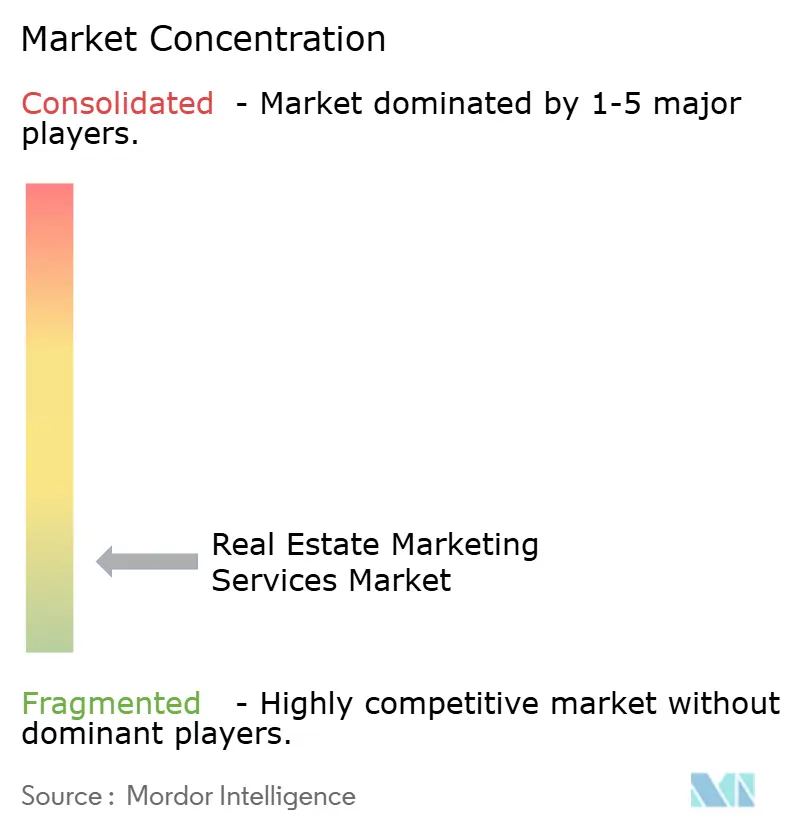
The Real estate marketing services market has a fragmented agency layer and a more concentrated technology platform layer. Independent agencies compete through local knowledge and focused execution for particular property types or territories. Their local relevance can remain strong even when enterprise vendors offer broader technology suites. Platform vendors integrate CRM, automation, analytics, and content tools into unified products that can create switching costs and expand spending by brokerage and developer clients.
Salesforce expanded its marketing capabilities in June 2026 with Piper for inbound qualification, Hunter for prospecting, and Agentforce Content Agent for multichannel content creation. The tools extend automation from campaign management into lead qualification, prospecting, and content generation. Adobe announced Adobe CX Enterprise Coworker in April 2026 as an agentic AI orchestration layer for autonomous marketing workflow execution. These developments increase the importance of services that address strategy, property context, and coordination across channels.
Compass found that pre-marketed listings achieved an average close price 4.6% higher than direct-to-MLS listings in its analysis of 70,809 residential transactions from April 2025 through March 2026. This company research supports phased listing promotion as a defined advertising category. CoStar reduced its planned Homes.com net investment for 2026 to USD 550 million from USD 850 million in 2025, changing the competitive setting for agencies that built programs around that portal. The Real estate marketing services market has room for providers that combine AI-enabled operations with compliance-oriented campaign oversight. However, answer-engine discovery could place more visibility with top-performing agents and reduce the serviceable base among smaller independent practitioners.
Real Estate Marketing Services Industry Leaders
CoStar Group, Inc.
Luxury Presence, Inc.
BoomTown ROI LLC
Placester, Inc.
Curaytor, Inc.
- *Disclaimer: Major Players sorted in no particular order
Real Estate Marketing Services Market Companies Covered in this Report
- Luxury Presence, Inc.
- BoomTown ROI LLC
- Placester, Inc.
- Curaytor, Inc.
- Real Geeks, LLC
- Agent Image, Inc.
- Chime Technologies, Inc.
- Sierra Interactive, LLC
- MoxiWorks, LLC
- SharpLaunch, Inc.
- Zillow Group, Inc.
- CoStar Group, Inc.
- Move, Inc.
- REA Group Ltd
- Rightmove plc

Recent Industry Developments in Real Estate Marketing Services Market
- July 2026: Zillow filed suit against Midwest Real Estate Data (MRED) and Compass, alleging conspiracy related to its Listing Access Standards policy after MRED suspended Zillow's Chicago-area data feed, leaving Zillow with fewer listings than competitors Redfin and Realtor.com. CoStar simultaneously filed an amicus brief challenging Zillow's listing policy, intensifying competitive and legal dynamics across the residential portal advertising market.
- July 2026: Compass published an analysis of approximately 296,000 residential transactions showing that homes listed on Zillow sold for an average 1.3% less than those excluded from the portal. The company framed this as a “Zillow tax” estimated at USD 5,590 per transaction at the median home price of USD 430,000, a finding that directly challenges the return on investment case for portal-based marketing.
- June 2026: Salesforce unveiled agentic marketing tools at its Connections event in Chicago, including Piper, an AI SDR for inbound qualification, Hunter, a prospecting agent, and Agentforce Content Agent, which creates multichannel content from a single brief. The tools are generally available or in pilot and target real estate marketing automation at an enterprise scale.
- May 2026: Saudi Arabia's REGA published comprehensive Real Estate Marketing and Advertising Regulations effective May 1, 2026. The regulations mandate a separate advertising license for every real estate advertisement on websites, social media, or any media channel, replacing prior guidance and formally regulating a market previously underserved by licensed marketing services firms.


Global Real Estate Marketing Services Market Report Scope
Real Estate Marketing Services Market refers to agencies, consultancies, and technology providers that promote properties, real estate brands, developments, and related services. It serves developers, brokers, agents, property managers, investors, and proptech companies seeking to attract buyers, sellers, tenants, or investors.
The Real Estate Marketing Services Market Report is Segmented by Service Type (Performance Marketing, Branding and Creative, Digital Asset Management, Events and Experiential Marketing, and Marketing Strategy and Analytics), End-User (Brokerages, Residential Developers, CRE Firms, Property Management, and REITs), and Geography (North America, South America, Europe, Asia-Pacific, Middle East, and Africa). The Market Forecasts are Provided in Terms of Value (USD).
| Performance Marketing and Lead Acquisition Services |
| Branding and Creative Services |
| Digital Asset and Listing Management Services |
| Events and Experiential Marketing Services |
| Marketing Strategy, Research and Analytics Services |
| Brokerages and Agencies |
| Residential Developers |
| Commercial Real Estate Firms |
| Property Management Companies |
| REITs and Institutional Investors |
| North America | United States |
| Canada | |
| Mexico | |
| South America | Brazil |
| Argentina | |
| Chile | |
| Colombia | |
| Peru | |
| Rest of South America | |
| Europe | United Kingdom |
| Germany | |
| France | |
| Italy | |
| Spain | |
| Russia | |
| Netherlands | |
| Poland | |
| Rest of Europe | |
| Asia-Pacific | India |
| Japan | |
| Australia | |
| South Korea | |
| Indonesia | |
| Philippines | |
| Thailand | |
| Rest of Asia-Pacific | |
| Middle East | Turkey |
| Israel | |
| Saudi Arabia | |
| United Arab Emirates | |
| Rest of Middle East | |
| Africa | South Africa |
| Nigeria | |
| Kenya | |
| Egypt | |
| Rest of Africa |
| By Service Type | Performance Marketing and Lead Acquisition Services | |
| Branding and Creative Services | ||
| Digital Asset and Listing Management Services | ||
| Events and Experiential Marketing Services | ||
| Marketing Strategy, Research and Analytics Services | ||
| By End-User | Brokerages and Agencies | |
| Residential Developers | ||
| Commercial Real Estate Firms | ||
| Property Management Companies | ||
| REITs and Institutional Investors | ||
| By Geography | North America | United States |
| Canada | ||
| Mexico | ||
| South America | Brazil | |
| Argentina | ||
| Chile | ||
| Colombia | ||
| Peru | ||
| Rest of South America | ||
| Europe | United Kingdom | |
| Germany | ||
| France | ||
| Italy | ||
| Spain | ||
| Russia | ||
| Netherlands | ||
| Poland | ||
| Rest of Europe | ||
| Asia-Pacific | India | |
| Japan | ||
| Australia | ||
| South Korea | ||
| Indonesia | ||
| Philippines | ||
| Thailand | ||
| Rest of Asia-Pacific | ||
| Middle East | Turkey | |
| Israel | ||
| Saudi Arabia | ||
| United Arab Emirates | ||
| Rest of Middle East | ||
| Africa | South Africa | |
| Nigeria | ||
| Kenya | ||
| Egypt | ||
| Rest of Africa | ||


Key Questions Answered in the Report
What is the size of the real estate marketing services market?
The Real estate marketing services market size is USD 7.88 billion in 2026 and is forecast to reach USD 11.31 billion by 2031, at a 7.49% CAGR.
Which service type led real estate marketing services spending?
Performance Marketing and Lead Acquisition Services led with 35.12% share in 2025.
Which service type is expected to expand fastest through 2031?
Marketing Strategy, Research and Analytics Services is projected to expand at an 8.55% CAGR through 2031.
Which end user accounted for the largest share in 2025?
Brokerages and Agencies held 32.19% share in 2025 because they market listings while maintaining buyer, seller, and agent visibility.
Which region is expected to expand fastest through 2031?
Asia-Pacific is projected to expand at an 8.38% CAGR, supported by mobile-first buyers and digital promotion for new residential projects.
How are AI tools changing property marketing services?
AI tools are being used for lead scoring, attribution, content creation, campaign optimization, and conversational engagement, increasing the need for strategy and campaign oversight.
Page last updated on:





