
Rare Earth Metals Leaching Chemicals Market Size and Share
Market Overview
| Study Period | 2022 - 2032 |
|---|---|
| Market Size (2027) | USD 0.74 Billion |
| Market Size (2032) | USD 1.07 Billion |
| Growth Rate (2027 - 2032) | 7.48 % |
| Fastest Growing Market | North America |
| Largest Market | Asia-Pacific |
| Market Concentration | Medium |
Major Players *Disclaimer: Major Players sorted in no particular order Image © Mordor Intelligence. Reuse requires attribution under CC BY 4.0. | |
Rare Earth Metals Leaching Chemicals Market Analysis by Mordor Intelligence
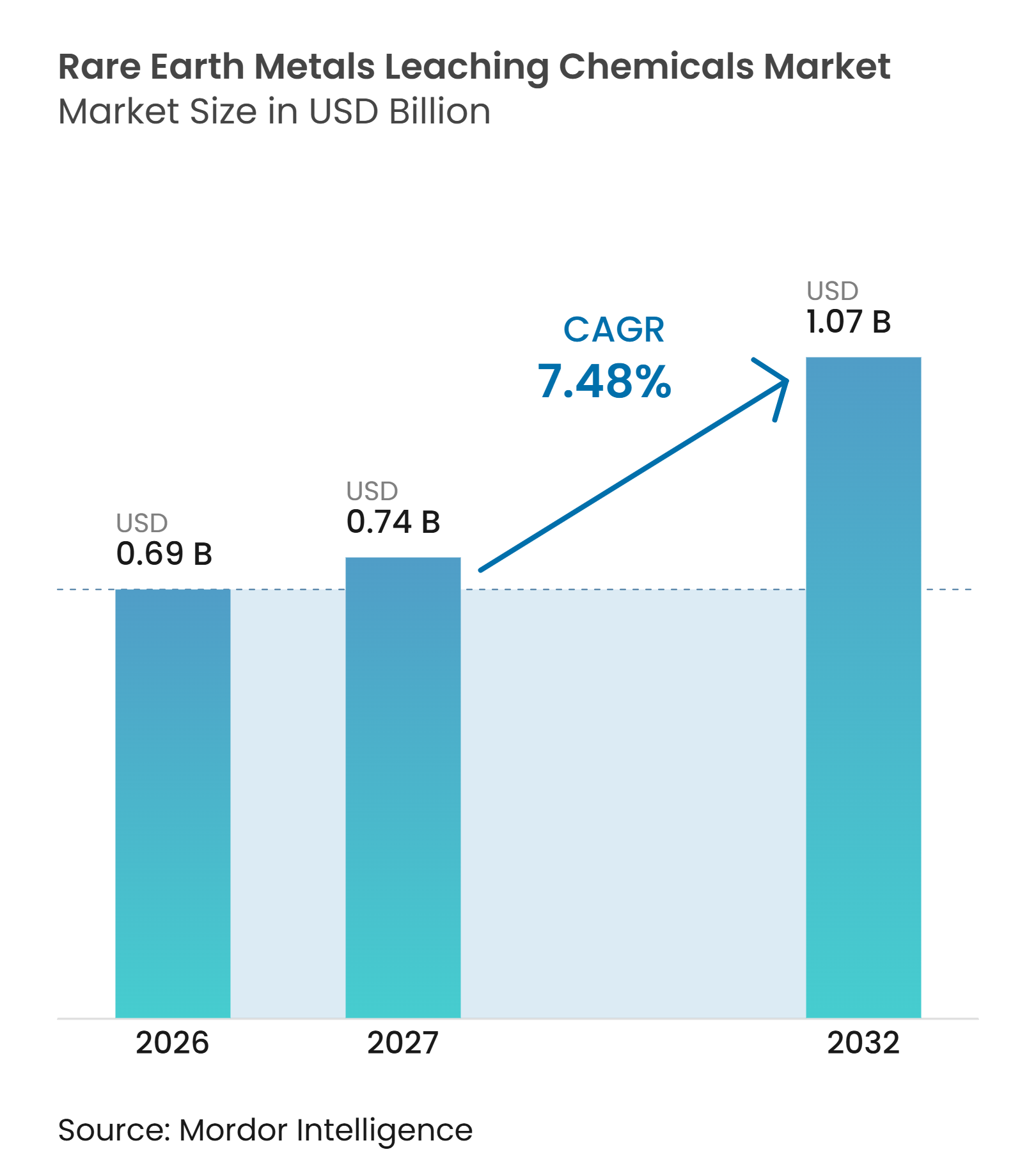
The Rare Earth Metals Leaching Chemicals market size was valued at USD 0.69 billion in 2026 and is estimated to grow from USD 0.74 billion in 2027 to USD 1.07 billion by 2032, at a CAGR of 7.48% during the forecast period (2027-2032). Growing demand for permanent magnets in electric vehicles and wind turbines is driving rare earth extraction, which in turn supports consumption of acids, ammonium salts, and organic leaching agents. The International Energy Agency expects demand for rare earth elements in clean energy technologies to reach 38 kilotons by 2030, largely driven by electric-vehicle motors and wind-turbine magnets. Processing capacity outside China is gaining policy support, creating opportunities for reagent suppliers with reliable local delivery. Producers are responding through long-term supply arrangements, on-site chemical generation, and specialized formulations that reduce acid use. Environmental controls on tailings and ammonia runoff, along with volatile input costs, continue to shape project economics and chemical selection.
Key Report Takeaways
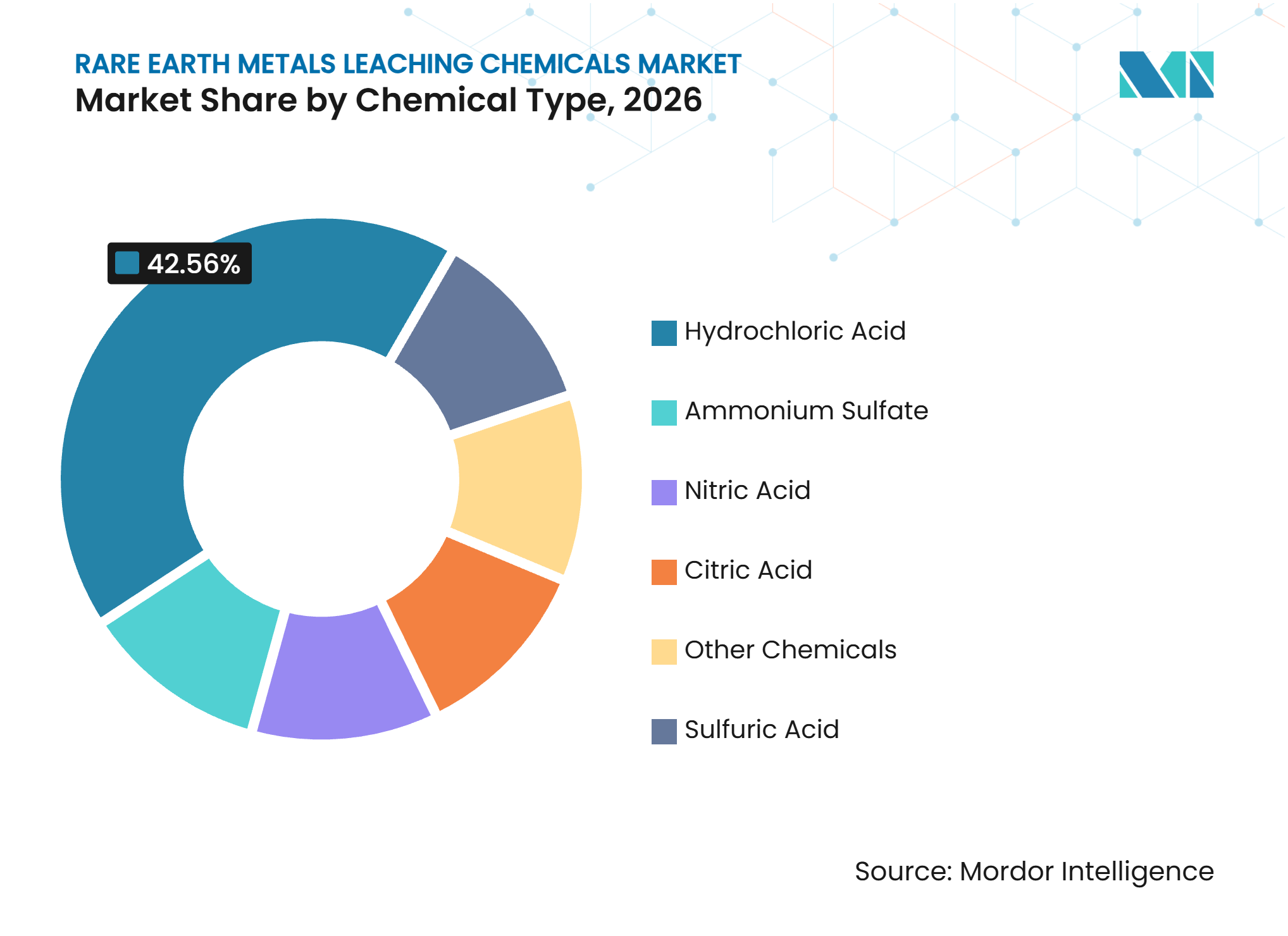
- By chemical type, hydrochloric acid held 42.56% of the Rare Earth Metals Leaching Chemicals market share in 2026, while sulfuric acid is forecast to expand at an 8.42% CAGR through 2032.
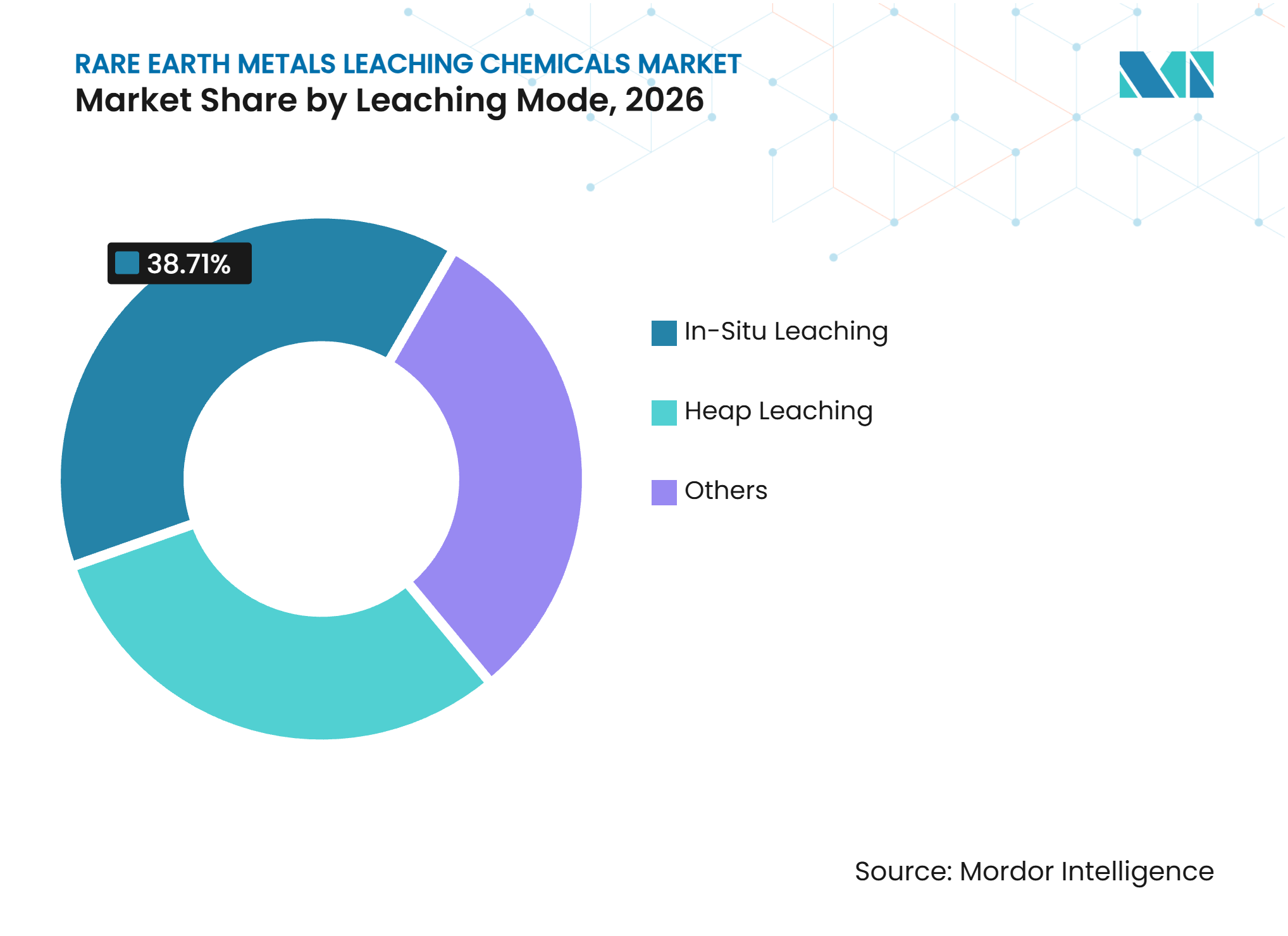
- By leaching mode, in-situ leaching held 38.71% of the Rare Earth Metals Leaching Chemicals market share in 2026, while heap leaching is forecast to expand at an 8.91% CAGR through 2032.
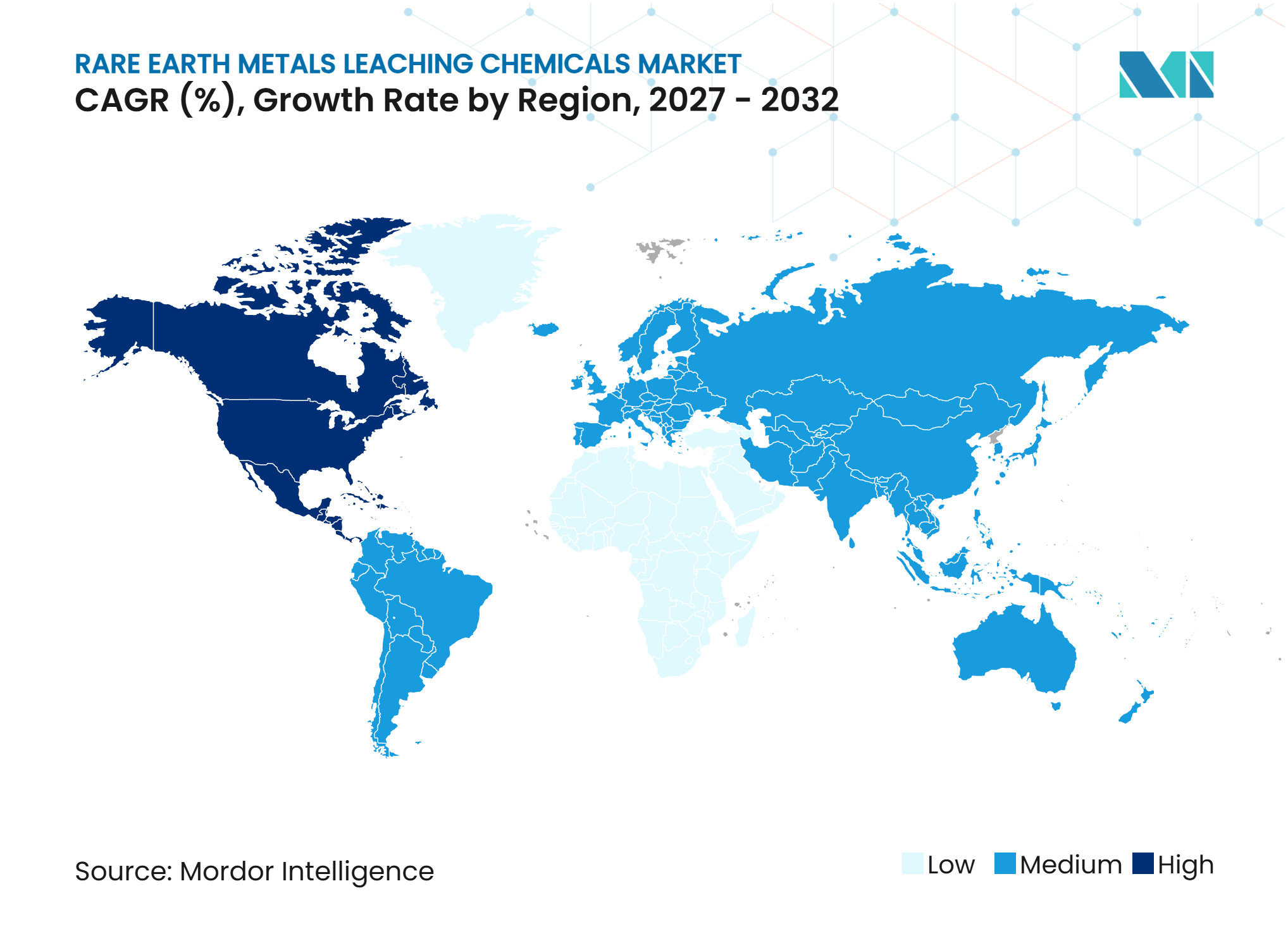
- By geography, Asia-Pacific held 51.65% of the Rare Earth Metals Leaching Chemicals market share in 2026, while North America is forecast to expand at an 8.66% CAGR through 2032.
Note: Market numbers in this report are based on Mordor Intelligence's proprietary estimation framework, which combines nine months of actuals with Q4 projections for base year 2026.
Market Trends and Insights
Drivers Impact Analysis of Rare Earth Metals Leaching Chemicals Market*
| Drivers | (~) % Impact on CAGR Forecast | Geographic Relevance | Impact Timeline |
|---|---|---|---|
| Electric Vehicle and Wind Turbine Magnet Demand | +2.3% | Global, with concentrated upstream effects in Asia-Pacific and spillover to North America and EU processing corridors | Long term (≥ 4 years) |
| Critical-Mineral Supply-Chain Localization | +1.8% | North America and EU core, with growing importance in Australia and India | Medium term (2-4 years) |
| Expansion of Domestic Rare Earth Refining Capacity | +1.4% | EU, North America, and Australia | Medium term (2-4 years) |
| Growth in Hydrometallurgical Recovery from Secondary Feedstocks | +1.2% | Global, with early adoption in the United States, EU, and Japan | Long term (≥ 4 years) |
| Ore-Mineralogy Matching for Higher Leach Selectivity | +0.8% | Global, especially Asia-Pacific, North America, and South America | Medium term (2-4 years) |
| Source: Mordor Intelligence | |||
Electric Vehicle and Wind Turbine Magnet Demand
Demand for permanent magnets used in electric vehicles and wind turbines supports a larger rare earth extraction base. The International Energy Agency (IEA) projects demand for rare earth elements in clean energy technology at 38 kilotons by 2030, with electric vehicle motors and wind turbines as the main drivers of growth. Each additional unit of magnet-grade material requires extraction from ore or recycled feedstock prior to separation, thereby increasing the use of mineral acids, ammonium salts, and other reagents in leaching circuits. Tighter composition requirements for magnets favor more selective leaching systems that separate rare earths earlier in the process. Research published in 2025 found that organic acid ligands can produce different extraction efficiencies for individual lanthanides under near-neutral conditions, supporting the use of citric acid and related agents in specialized processing.
Critical-Mineral Supply-Chain Localization
China imposed export controls on medium- and heavy-rare-earth-related items in April 2025, prompting increased supply chain planning among manufacturers and governments. The United States Department of Energy announced up to USD 134 million in 2025 for demonstrations covering rare earth extraction and separation facilities[1]. These projects include recovery from coal fly ash and mine tailings, which requires process-specific leaching reagents. The European Union also designated strategic projects under the Critical Raw Materials Act, creating a broader construction pipeline for rare earth processing. Even if trade restrictions change, the experience of constrained access gives buyers a reason to build supply alternatives. This supports demand for rare earth metal leaching chemicals in facilities outside China.
Expansion of Domestic Rare Earth Refining Capacity
New refining investments are increasing demand for process chemicals that would not be required in a concentrated supply structure. Solvay began producing neodymium-praseodymium alloy for permanent magnets at La Rochelle in April 2025 and later developed samarium production at the site. The company also expanded its plans for heavy rare earth production and signed a letter of intent with Viridis for upstream feedstock. European strategic project selections include rare-earth separation and recycling activities that require a secure supply of reagents prior to commissioning. These developments make the availability of delivered chemicals a planning consideration for processors and favor suppliers that can support testing, transport, and compliance requirements at new sites.
Growth in Hydrometallurgical Recovery from Secondary Feedstocks
Electronic waste, magnet manufacturing scrap, and coal combustion residues are additional feedstocks for rare earth recovery. These materials often favor milder acid systems than those used in primary ore processing, which broadens demand beyond conventional mining applications. The U.S. National Energy Technology Laboratory has described processes that use mild inorganic acids to recover rare earth elements from coal fly ash. Recycling also creates a supply route that does not require a new mine. The European Commission has proposed measures to retain rare-earth magnet waste within the EU, directing more secondary feedstock to domestic recycling facilities. As recycling circuits expand, reagent suppliers require formulations suited to mixed and variable feedstocks.
Restraints Impact Analysis of Rare Earth Metals Leaching Chemicals Market*
| Restraints | (~) % Impact on CAGR Forecast | Geographic Relevance | Impact Timeline |
|---|---|---|---|
| Mineral-Acid and Ammonium-Salt Price Volatility | -1.5% | Global, most acute at small-to-medium operations in North America and South America with limited long-term supply contracts | Short term (≤ 2 years) |
| Environmental Permitting and Tailings-Liability Burden | -1.2% | Asia-Pacific, EU, and North America | Long term (≥ 4 years) |
| Corrosion, Impurity Loading, and Reagent-Consumption Risk | -0.7% | Global, especially clay-hosted ion-adsorption deposits in South China | Medium term (2-4 years) |
| Source: Mordor Intelligence | |||
Mineral-Acid and Ammonium-Salt Price Volatility
Hydrochloric acid and sulfuric acid production is energy-intensive, linking reagent costs to electricity, natural gas, and other inputs. Olin Corporation identifies electricity as the largest raw material component in its chlor-alkali production[2]. This exposure can move independently from rare earth pricing. Reagent costs in dilute-acid heap leaching can exceed 30% of operating expenditures, making cost changes significant for smaller projects. Some producers are evaluating on-site chlor-alkali generation using local salt and renewable power to reduce exposure to spot markets. This approach lowers transport dependence but requires capital investment and is most viable where ore throughput supports the cost.
Environmental Permitting and Tailings-Liability Burden
Leaching carries operating and long-term environmental obligations that can delay or discourage project development. In-situ leaching at ion-adsorption deposits can leave residual ammonium in tailings, and published research has documented higher ammonia-nitrogen concentrations following this activity. Chinese research is examining ammonia-free coordination leaching systems, though these methods introduce different ligand costs and process requirements. European operators must also manage chemical registration and environmental permitting under the Registration, Evaluation, Authorization and Restriction of Chemicals (REACH) regulation and national rules. The Critical Raw Materials Act supports domestic projects, but permitting remains a material factor in their progress. Suppliers of low-ammonia or ammonia-free formulations stand to benefit as operators work to meet stricter water and tailings controls.
*Our forecasts treat driver/restraint impacts as directional, not additive. The impact forecasts reflect baseline growth, mix effects, and variable interactions.
Rare Earth Metals Leaching Chemicals Market Segment Analysis
By Chemical Type:
Acid Portfolio Shaped by Feedstock MineralogyHydrochloric acid held 42.56% of the Rare Earth Metals Leaching Chemicals market share in 2026, as it can dissolve a broad range of rare earth minerals at commercially viable reaction rates. It is used across in-situ and heap-leach circuits, particularly where chloride complexes facilitate dissolution. The market has also seen interest in on-site hydrochloric acid production at remote operations. OD6 Metals reported that a compact chlor-alkali facility at Splinter Rock could produce 62 kilotons of hydrochloric acid annually from local solar salt. Eliminating long transport routes can improve delivery cost certainty, making hydrochloric acid attractive when logistics account for a large share of the final reagent cost.
Sulfuric acid is the fastest-growing chemical type, with its market size projected to grow at an 8.42% CAGR between 2027 and 2032. Heap leaching commonly uses diluted sulfuric acid and can require less capital than agitated-tank leaching, making it well-suited to emerging clay-hosted projects in Australia and South America. Ammonium sulfate remains widely used in Chinese in-situ leaching, although ammonia-nitrogen controls present a compliance challenge. Nitric acid remains relevant for niche high-purity circuits and specialized recycling streams. Citric acid and other organic acids are gaining attention in secondary recovery as lower-impact options in selected applications.



By Leaching Mode:
Heap Leaching Gains Ground as Scale Economics ImproveIn-situ leaching accounted for 38.71% of the Rare Earth Metals Leaching Chemicals market share in 2026, supported by its long-standing use at ion-adsorption deposits in southern China. The technique has a relatively low capital requirement and can preserve surface vegetation where deposits have shallow, permeable clay horizons. Its established base makes it an important source of demand for ammonium sulfate and hydrochloric acid. However, controls on groundwater and ammonia-nitrogen are placing pressure on conventional ammonium sulfate methods. Ammonia-free coordination leaching systems are being studied as an alternative, and these methods could increase the specialty chemical content used per ton of treated ore.
Heap leaching is projected to expand at an 8.91% CAGR through 2032 and is the fastest-growing leaching mode in the Rare Earth Metals Leaching Chemicals market. The method is gaining attention at Australian and South American clay-hosted projects due to its lower capital intensity. OD6 Metals reported that its optioneering study supported heap leaching over conventional agitated tank leaching at Splinter Rock, with the reported flowsheet achieving 75% neodymium-praseodymium recovery through several downstream stages. Agitated-tank leaching and bioleaching remain relevant for hard primary ores such as bastnaesite and monazite. The range of leaching modes gives chemical suppliers multiple routes to serve different ore types and operating requirements.

Geography Analysis
Asia-Pacific: The Dominant Processing Hub Under Regulatory Flux
Asia-Pacific held 51.65% of the Rare Earth Metals Leaching Chemicals market share in 2026, reflecting the concentration of ion-adsorption deposits and refining activity in China. Research published in 2025 describes major ion-adsorption rare earth deposits in southern China and the technical role of leaching in their development. China imposed export controls on medium- and heavy-rare-earth-related items in 2025, increasing focus on supply security. This regulatory shift may encourage domestic processing efficiency while prompting overseas buyers to diversify their sources. India is building associated chemical capacity, with Gujarat Alkalies and Chemicals approving a hydrochloric acid (HCl) synthesis unit at Dahej in 2025. Japan, South Korea, and ASEAN economies contribute to demand through electronics recycling and secondary recovery, where mild-acid systems are relevant.
North America: Federal Capital Drives Fastest-Growing Demand
North America is projected to grow at an 8.66% CAGR from 2027 to 2032, the fastest rate among geographic segments in the Rare Earth Metals Leaching Chemicals market. The U.S. Department of Energy announced up to USD 134 million for integrated rare earth extraction and separation demonstrations in 2025. These projects support processing of unconventional feedstocks, including coal byproducts and mine wastes. The United States and Japan signed a framework in October 2025 covering grants, loans, guarantees, and offtake arrangements for critical-mineral and rare earth projects. This creates an opportunity for North American processors to secure supply and develop reagent strategies. Canada remains relevant in the chlor-alkali sector, although ERCO Worldwide permanently closed its Hargrave sodium chlorate operation in December 2025. Mexico can support regional logistics for downstream electric-vehicle and renewable-energy supply chains.
Regional Dynamics Across Europe, South America, and the Middle East and Africa
Europe is building demand around the Critical Raw Materials Act, which sets 2030 targets for domestic extraction, processing, and recycling. The region's Rare Earth Metals Leaching Chemicals market can benefit from recycling initiatives, as policymakers seek to retain rare earth magnet waste within Europe. Solvay's La Rochelle operations provide a regional example of investment in rare earth processing. REACH registration is a compliance requirement for suppliers introducing formulations into the European market. South America has clay mineral prospects in Brazil and Argentina, where heap leach projects could use dilute sulfuric acid at scale. Renewable power availability and project development conditions can support this approach, though outcomes depend on site-specific permitting and infrastructure. In the Middle East and Africa, industrial diversification in Saudi Arabia and established base-metal processing in South Africa create selective opportunities where phosphate and titanium streams contain recoverable rare earth values.
Competitive Landscape
Market Concentration
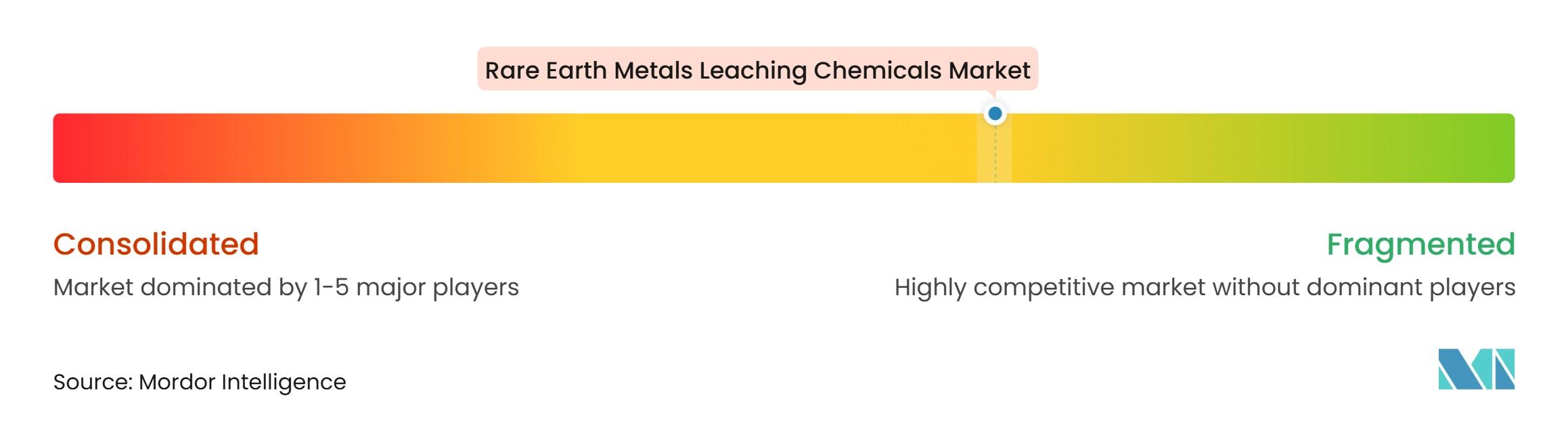
The Rare Earth Metals Leaching Chemicals market is moderately fragmented at the chemical-supply level, as leaching applications account for a small share of the output of large commodity chemical producers. Olin supplies hydrochloric acid for ore and mineral processing and is a major chlor-alkali and derivatives producer in North America. Westlake also holds substantial capacity for chlorine and caustic soda, supporting reagent availability across North America. These companies compete primarily on delivered price, supply reliability, and transport capability. Remote mine locations can shift the balance toward contracted or on-site supply, creating opportunities for chemical suppliers that can integrate logistics with mine-site operations.
BASF has expanded its mining solutions research and development activity in Houston, including leaching and flotation research for hydrometallurgy. Its LixTRA leaching aids and LIX solvent extraction products give it a specialty position in the Rare Earth Metals Leaching Chemicals market. OD6 Metals offers another example through its Splinter Rock flowsheet, which reported more than 80% hydrochloric acid recovery and reduced net acid consumption from 37.2 kilograms to 7.5 kilograms per ton of ore. Such process improvements can create value beyond basic acid pricing. Suppliers that offer lower-ammonia systems and technical support may gain an advantage as environmental requirements tighten. Established registration portfolios under REACH and U.S. chemical and mine safety requirements also raise practical entry barriers.
Berkshire Hathaway completed the acquisition of OxyChem from Occidental Petroleum in January 2026, following the USD 9.7 billion agreement announced in 2025. OxyChem is a major chlor-alkali producer and supplies hydrochloric acid to customers in the ore and mineral processing industries. The change in ownership may alter the company's capacity investment time horizon. Solvay holds a distinct position by combining rare earth separation activity in La Rochelle with its chemicals portfolio. Its planned heavy rare earth expansion is expected to deepen its process knowledge of selective separation. We welcome suppliers who combine bulk chemical availability with ore-specific formulation and compliance support.
Rare Earth Metals Leaching Chemicals Industry Leaders
-
BASF
-
Occidental Chemical Corporation
-
Olin Corporation
-
Solvay
-
LANXESS
- *Disclaimer: Major Players sorted in no particular order
Rare Earth Metals Leaching Chemicals Market Companies Covered in this Report
- Arkema
- Aurubis AG
- BASF
- ERCO Worldwide
- Grupa Azoty S.A.
- Gujarat Alkalies and Chemicals Limited
- Gujarat State Fertilizers & Chemicals Limited (GSFC)
- LANXESS
- Occidental Chemical Corporation
- Olin Corporation
- Sasol
- Solvay
- Tronox Holdings plc
- UBE Corporation
- Westlake Corporation
Recent Industry Developments in Rare Earth Metals Leaching Chemicals Market
- January 2026: Berkshire Hathaway completed the acquisition of OxyChem (Occidental Chemical Corporation) from Occidental Petroleum for USD 9.7 billion in cash. OxyChem is the fourth-largest global chlor-alkali producer, supplying hydrochloric acid for rare-earth metal leaching and mineral-processing applications. The transfer of ownership to Berkshire Hathaway's long-duration capital framework may influence OxyChem's capacity investment decisions, which had previously been constrained by its former parent's debt-reduction priorities.
- October 2025: The United States and Japan signed the Framework for Securing the Supply of Critical Minerals and Rare Earths through Mining and Processing. The framework commits both governments to mobilize grants, loans, guarantees, and offtake arrangements for jointly selected projects, and to establish a bilateral Mining, Minerals and Metals Investment Ministerial within 180 days.
Global Rare Earth Metals Leaching Chemicals Market Report Scope
Rare earth metals leaching chemicals are chemical agents and solvents used in extractive metallurgy to selectively dissolve, separate, and recover rare earth elements (REEs) from ores, mining tailings, industrial residues, or recycled materials.
The rare earth metals leaching chemicals market is segmented by chemical type, leaching mode, and geography. By chemical type, the market is segmented into hydrochloric acid, sulfuric acid, ammonium sulfate, nitric acid, citric acid, and other chemicals. By leaching mode, the market is segmented into in-situ leaching, heap leaching, and others. The report also covers market sizes and forecasts for rare earth metals leaching chemicals across 15 countries in major regions. The market sizes and forecasts are provided in terms of value (USD).
Segmentation Overview
| Hydrochloric Acid |
| Sulfuric Acid |
| Ammonium Sulfate |
| Nitric Acid |
| Citric Acid |
| Other Chemicals |
| In-Situ Leaching |
| Heap Leaching |
| Others |
| Asia-Pacific | China |
| India | |
| Japan | |
| South Korea | |
| ASEAN Countries | |
| Rest of Asia-Pacific | |
| North America | United States |
| Canada | |
| Mexico | |
| Europe | Germany |
| United Kingdom | |
| France | |
| Italy | |
| NORDIC Countries | |
| Rest of Europe | |
| South America | Brazil |
| Argentina | |
| Rest of South America | |
| Middle East and Africa | Saudi Arabia |
| South Africa | |
| Rest of Middle East and Africa |
| By Chemical Type | Hydrochloric Acid | |
| Sulfuric Acid | ||
| Ammonium Sulfate | ||
| Nitric Acid | ||
| Citric Acid | ||
| Other Chemicals | ||
| By Leaching Mode | In-Situ Leaching | |
| Heap Leaching | ||
| Others | ||
| By Geography | Asia-Pacific | China |
| India | ||
| Japan | ||
| South Korea | ||
| ASEAN Countries | ||
| Rest of Asia-Pacific | ||
| North America | United States | |
| Canada | ||
| Mexico | ||
| Europe | Germany | |
| United Kingdom | ||
| France | ||
| Italy | ||
| NORDIC Countries | ||
| Rest of Europe | ||
| South America | Brazil | |
| Argentina | ||
| Rest of South America | ||
| Middle East and Africa | Saudi Arabia | |
| South Africa | ||
| Rest of Middle East and Africa | ||
Key Questions Answered in the Report
What is current market size of Rare Earth Metals Leaching Chemicals Market?
The Rare Earth Metals Leaching Chemicals market size was valued at USD 0.69 billion in 2026 and is estimated to grow from USD 0.74 billion in 2027 to USD 1.07 billion by 2032, at a CAGR of 7.48% during the forecast period (2027-2032).
Which chemical type leads rare earth metals leaching?
Hydrochloric acid leads with a 42.56% share in 2026 because it can treat a broad range of rare earth minerals.
Which leaching method is growing fastest for rare earth processing?
Heap leaching is projected to grow at an 8.91% CAGR through 2032 as projects seek lower-capital processing routes.
Why is North America expanding quickly in rare earth processing?
North America is forecast to grow at an 8.66% CAGR, supported by U.S. funding for extraction and separation demonstrations.