
Quantum-as-a-Service (QaaS) Software Platform Market Size and Share
Market Overview
| Study Period | 2020 - 2031 |
|---|---|
| Market Size (2026) | USD 0.93 Billion |
| Market Size (2031) | USD 2.31 Billion |
| Growth Rate (2026 - 2031) | 19.96 % |
| Fastest Growing Market | Asia-Pacific |
| Largest Market | North America |
| Market Concentration | Medium |
Major Players *Disclaimer: Major Players sorted in no particular order Image © Mordor Intelligence. Reuse requires attribution under CC BY 4.0. | |
Quantum-as-a-Service (QaaS) Software Platform Market Analysis by Mordor Intelligence
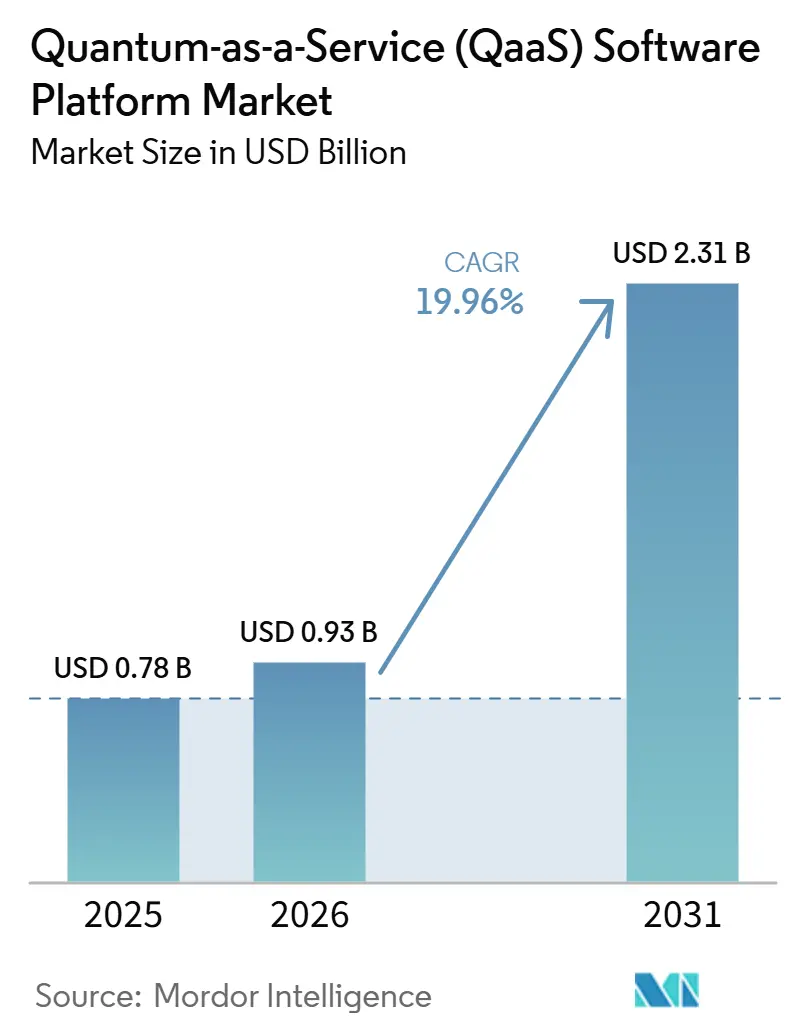
The quantum-as-a-service (QaaS) software platform market size is projected to expand from USD 0.78 billion in 2025 and USD 0.93 billion in 2026 to USD 2.31 billion by 2031, registering a CAGR of 19.96% between 2026-2031. The quantum-as-a-service (QaaS) software platform market is growing because enterprises can now access quantum computing through subscription models instead of owning specialized hardware and cryogenic systems. Government-backed commercialization programs and public procurement are helping the quantum-as-a-service (QaaS) software platform market move from research activity into structured pilot deployments. Cloud-native development tools are also making the quantum as a service market easier to use for simulation, optimization, machine learning, and cryptography workloads across regulated sectors. Competition in the quantum as a service market is increasingly centered on platform integration, workflow orchestration, and the ability to fit quantum tools into existing enterprise cloud environments. Hardware noise and the shortage of specialized talent still limit scaled deployment, but those same limits also keep demand pointed toward managed service models across the quantum-as-a-service (QaaS) software platform market.
Key Report Takeaways
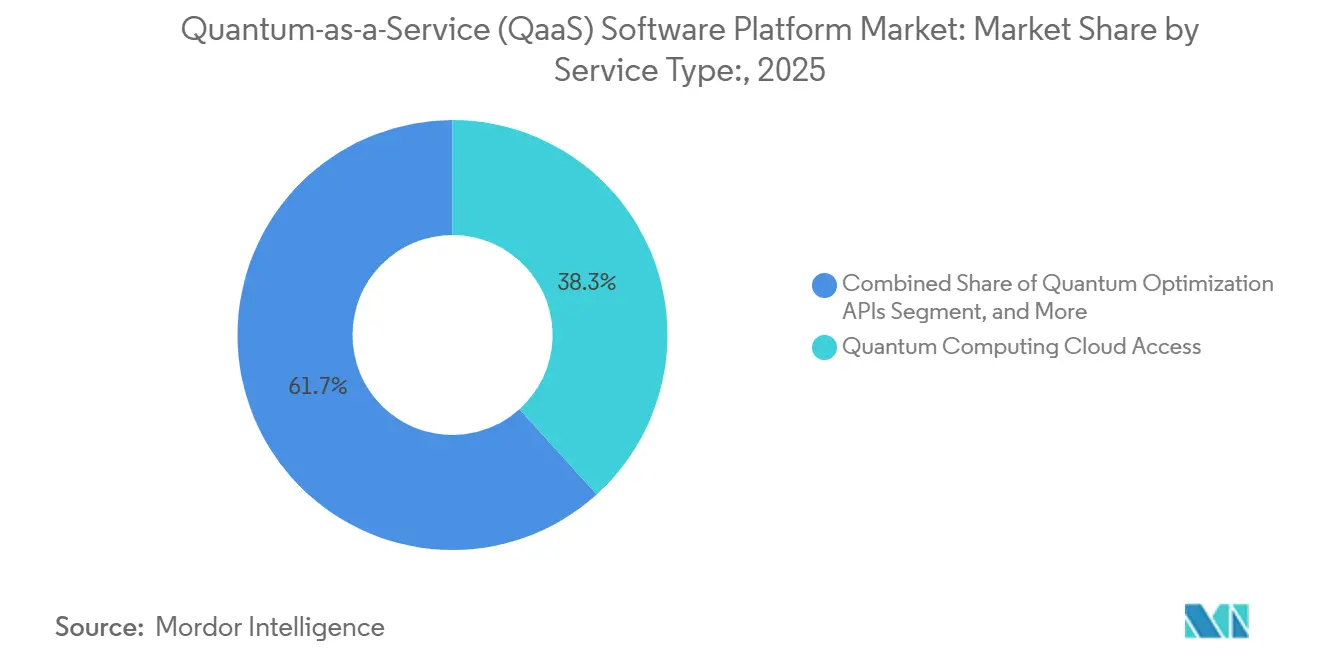
- By service type, quantum computing cloud Access held 38.29% of revenue in 2025, while quantum machine learning services is projected to expand at a 21.63% CAGR through 2031.
- By deployment mode, public cloud QaaS accounted for 62.91% of revenue in 2025, while hybrid quantum-classical workflow is expected to record the highest CAGR of 23.22% through 2031 in the quantum as a service market.
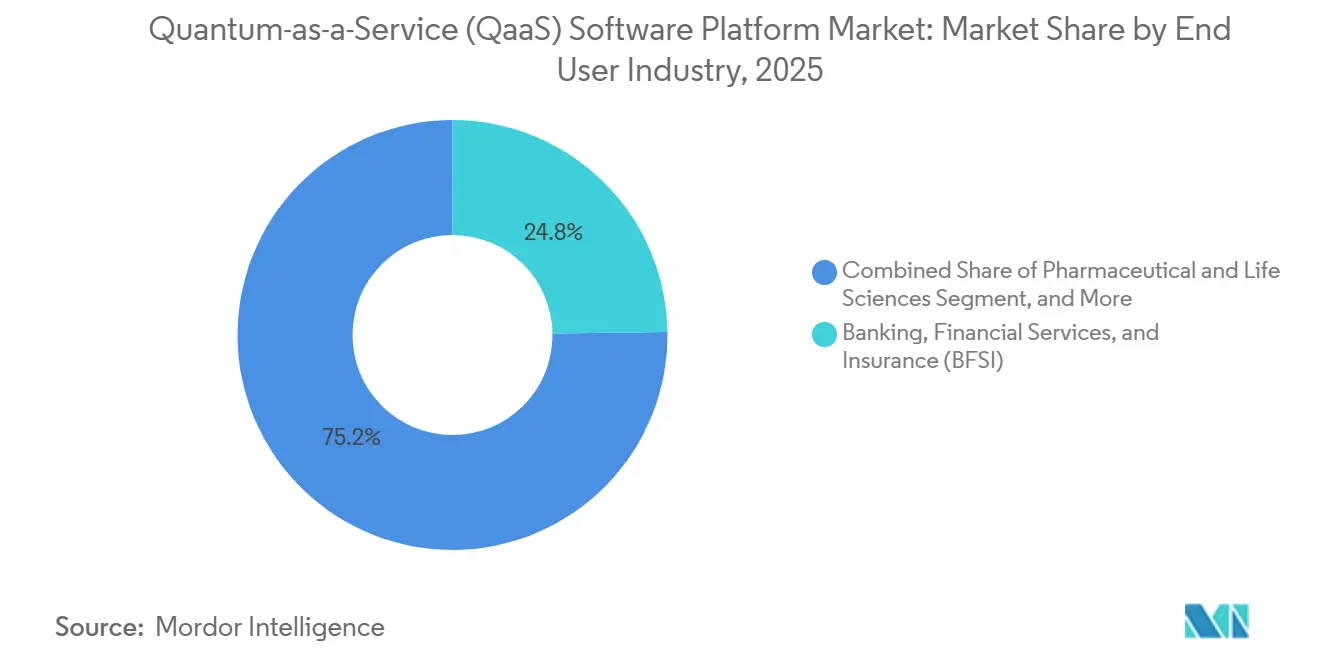
- By end user industry, BFSI held 24.78% of revenue in 2025, while pharmaceutical and life sciences is projected to grow at a 24.81% CAGR through 2031.
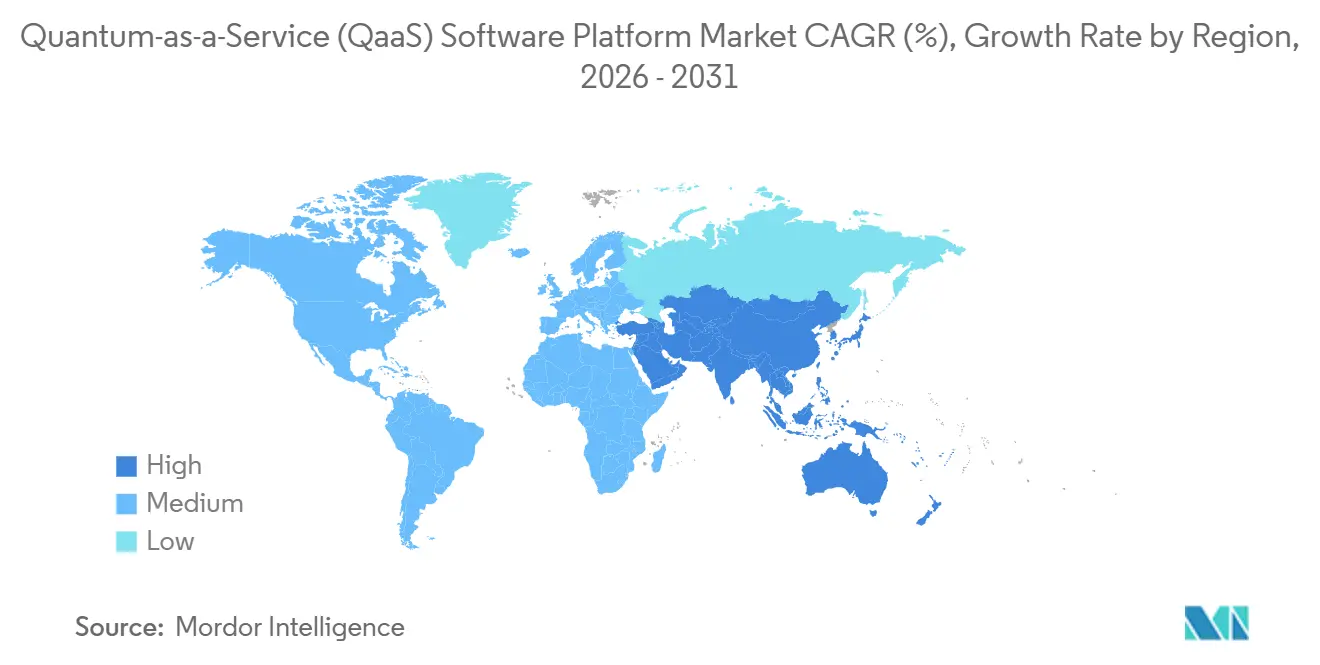
- By geography, North America captured 37.19% of revenue in 2025, while the Asia-Pacific is forecast to expand at a 26.11% CAGR through 2031.
Note: Market size and forecast figures in this report are generated using Mordor Intelligence’s proprietary estimation framework, updated with the latest available data and insights as of January 2026.
Market Trends and Insights
Drivers Impact Analysis of Quantum-as-a-Service (QaaS) Software Platform Market*
| DRIVER | (~) % IMPACT ON CAGR FORECAST | GEOGRAPHIC RELEVANCE | IMPACT TIMELINE |
|---|---|---|---|
| Rising Enterprise Demand for Quantum Access Without Hardware Ownership | +4.8% | Global, with strongest concentration in North America and Europe | Short term (≤ 2 years) |
| Expansion of Cloud-Native Quantum Development Ecosystems | +4.1% | Global, early maturity in North America, rapidly scaling in APAC | Short term (≤ 2 years) |
| Government-Funded Quantum Programs Accelerating Commercial Pilot Activity | +3.3% | North America, Europe, APAC core including China, Japan, and India | Medium term (2-4 years) |
| Growing Need for Hybrid Quantum-Classical Workflow Orchestration | +2.9% | North America and Europe, with early adoption in APAC | Medium term (2-4 years) |
| Increased Demand for Quantum Simulation and Optimization APIs in Regulated Industries | +2.2% | North America, Europe, with spillover to the Middle East | Medium term (2-4 years) |
| Emerging PQC Readiness and Quantum Risk Testing Use Cases | +1.6% | Global, with highest compliance pressure in the United States, the European Union, and Canada | Long term (≥ 4 years) |
| Source: Mordor Intelligence | |||
Rising Enterprise Demand for Quantum Access Without Hardware Ownership
The quantum-as-a-service (QaaS) software platform market is benefiting from a simple economic shift, as few enterprises want to own and maintain expensive quantum systems for early-stage workloads. Buyers are increasingly using the quantum-as-a-service (QaaS) software platform market to test portfolio optimization, molecular simulation, and security use cases without incurring cryogenic maintenance, calibration, or specialist staffing costs. The State of the Global Quantum Industry 2026 found that 89% of enterprises were already hands-on with quantum technologies, but only 3% had reached scaled deployment, leaving a significant conversion path from trial activity to production use. The same study also pointed to sovereignty requirements and local control expectations, meaning enterprises are not only asking for access; they are asking for controlled, auditable access models.[1]Quantum Economic Development Consortium, “2026 State of the Global Quantum Industry Report,” QED-C, quantumconsortium.org That is why the quantum-as-a-service market is expanding across public, private, and hybrid formats rather than through a single delivery model.
Expansion of Cloud-Native Quantum Development Ecosystems
The quantum-as-a-service (QaaS) software platform market is also moving forward because developers can reach quantum resources through cloud environments that already sit inside enterprise workflows. This lowers the learning barrier and lets teams test quantum routines alongside classical tools, data pipelines, and familiar access controls. In May 2026, Scaleway and QbitSoft launched Europe’s first cloud-native quantum adoption program, giving enterprises access to multiple hardware modalities through one sovereign cloud interface.[2]Scaleway, “Scaleway and QbitSoft Launch Europe’s First Cloud-Native Quantum Adoption Program,” Scaleway, scaleway.com That kind of structure matters in the quantum-as-a-service (QaaS) software platform market because software providers that sit above the hardware layer can become the long-term control point for enterprise workflow design. As more backends become available through cloud access, the quantum-as-a-service (QaaS) software platform market is likely to reward vendors that simplify developer adoption rather than vendors that only promote raw hardware characteristics.
Government-Funded Quantum Programs Accelerating Commercial Pilot Activity
Public policy is playing a direct role in the quantum-as-a-service (QaaS) software platform market, because government funding is now tied more clearly to commercialization, domestic supply chains, and practical deployment. In June 2026, the White House issued Executive Order 14413 to coordinate quantum commercialization efforts and update national strategy, which strengthens procurement visibility for the quantum-as-a-service (QaaS) software platform market. In the same period, the US Department of Energy launched the Quantum Genesis initiative with a goal of creating a scientifically relevant fault-tolerant quantum computer by 2028, which links quantum access more closely with large-scale research infrastructure. In May 2026, the US Department of Commerce also announced USD 2.013 billion in CHIPS Act incentives for 9 quantum companies, including support for IBM and GlobalFoundries, which can improve fabrication capacity and lower delivery bottlenecks over time. These programs matter to the quantum-as-a-service (QaaS) software platform market because they reduce supply risk, encourage pilot demand, and bring hardware, software, and foundry decisions into one policy-backed framework.
Growing Need for Hybrid Quantum-Classical Workflow Orchestration
The quantum-as-a-service (QaaS) software platform market is increasingly being shaped by hybrid workflows rather than stand-alone quantum execution. Enterprises are learning that most usable workloads still depend on classical preprocessing, orchestration, and post-processing wrapped around the quantum step. In March 2026, IBM released the first published reference architecture for quantum-centric supercomputing, showing how QPUs can be integrated with CPUs and GPUs across on-premises, research, and cloud settings. That matters because the quantum-as-a-service (QaaS) software platform market is no longer only about renting compute time; it is also about embedding quantum routines into larger operational systems. As a result, vendors that control workflow software, orchestration layers, and enterprise integration points are building stronger long-term positions in the quantum-as-a-service (QaaS) software platform market.
Restraints Impact Analysis of Quantum-as-a-Service (QaaS) Software Platform Market*
| RESTRAINT | (~) % IMPACT ON CAGR FORECAST | GEOGRAPHIC RELEVANCE | IMPACT TIMELINE |
|---|---|---|---|
| NISQ Hardware Limitations and Low Production Reliability | -3.0% | Global, most acute in markets with advanced enterprise pilots including North America and Europe | Medium term (2-4 years) |
| Shortage of Quantum Software Engineers and Algorithm Specialists | -2.3% | Global, most severe in North America, Europe, and APAC outside China | Long term (≥ 4 years) |
| Interoperability Fragmentation Across SDKs and Cloud Platforms | -1.7% | Global, with strongest effect in multi-cloud enterprise environments | Medium term (2-4 years) |
| Data Sovereignty, Security, and Export Control Constraints | -1.2% | Cross-border markets, with pressure in the Middle East and Africa, APAC, and the European Union | Long term (≥ 4 years) |
| Source: Mordor Intelligence | |||
NISQ Hardware Limitations and Low Production Reliability
The quantum-as-a-service (QaaS) software platform market still faces the basic limits of noisy intermediate-scale quantum hardware. Current systems have finite coherence times, limited connectivity, and error rates that reduce the depth and consistency of commercially useful circuits. Research published in the New Journal of Physics in 2026 showed that NISQ-era quantum machine learning systems still face a tradeoff among expressivity, trainability, and noise resilience, which keeps many hybrid workflows from scaling cleanly.[3]A. Mejibi et al., “NISQ in Practice: Navigating Noise, Scale, and Hardware Constraints of Near-Term Devices in Quantum Machine Learning Workflows,” New Journal of Physics, doi.org The State of the Global Quantum Industry 2026 also reported that algorithm design has overtaken hardware maturity as the leading barrier to production deployment, which shows that the quantum-as-a-service (QaaS) software platform market is being held back by both engineering and application limits. Even as throughput improves, the quantum-as-a-service (QaaS) software platform market still needs more reliable production conditions before enterprises shift larger workloads into routine use.
Shortage of Quantum Software Engineers and Algorithm Specialists
The quantum-as-a-service (QaaS) software platform market also faces a workforce issue unlikely to be resolved quickly. A University of Houston projection released in April 2026 indicated that the global quantum sector could need 850,000 workers within the next decade, while universities may produce only 250,000 qualified graduates, leaving a 600,000-worker gap. This shortage slows the quantum-as-a-service (QaaS) software platform market because enterprises need people who understand both quantum theory and software implementation, and that talent remains scarce. In January 2026, the US National Science Foundation launched a USD 100 million National Quantum and Nanotechnology Infrastructure program to support open-access facilities and training, which shows that public institutions recognize the scale of the workforce challenge. At the same time, the shortage also reinforces the managed-service model, because the quantum-as-a-service (QaaS) software platform market lets enterprises access capabilities through APIs and supported workflows rather than building full internal teams from scratch.
*Our forecasts treat driver/restraint impacts as directional, not additive. The impact forecasts reflect baseline growth, mix effects, and variable interactions.
Quantum-as-a-Service (QaaS) Software Platform Market Segment Analysis
By Service Type:
Cloud Access Holds the Revenue Base While QML Services Extend Future Use CasesQuantum Computing Cloud Access held 38.29% of the quantum-as-a-service (QaaS) software platform market share in 2025, which made it the main commercial doorway for enterprises entering this space. The segment leads because buyers usually start with subscription-based access to hardware before moving toward more specialized simulation, optimization, or security contracts. This pattern keeps the quantum-as-a-service (QaaS) software platform market grounded in access-first purchasing behavior, especially among enterprises that are still qualifying use cases and internal teams. It also gives platform operators a strong position in the quantum-as-a-service (QaaS) software platform market because early access decisions often shape later toolchain and workflow choices.
The quantum-as-a-service (QaaS) software platform market size for Quantum Machine Learning Services is projected to expand at a 21.63% CAGR through 2031, which makes it the fastest-growing service category. That growth reflects rising interest in production-oriented machine learning workflows rather than only academic experiments. The quantum-as-a-service (QaaS) software platform market is also seeing a stronger pull for simulation and optimization services in materials, logistics, and financial modeling, where buyers want measurable improvements over classical baselines. Quantum cryptography and security services are gaining weight as well, because some regulated enterprises are using the quantum-as-a-service (QaaS) software platform market to test resilience, risk exposure, and future security-readiness requirements within controlled environments.



By Deployment Mode:
Public Cloud Leads Current Spend While Hybrid Workflows Build Staying PowerPublic Cloud QaaS accounted for 62.91% of revenue in 2025, which kept it as the largest deployment mode across the quantum-as-a-service (QaaS) software platform market. The segment benefits from standard enterprise procurement, familiar billing, and easier identity management inside existing cloud relationships. This gives hyperscaler-linked offerings a broad distribution advantage in the quantum-as-a-service (QaaS) software platform market, especially for first-stage pilots and shared access models. It also lowers the friction for enterprises that want to experiment without redesigning security, governance, or data workflows at the start.
The Hybrid Quantum-Classical Workflow segment is projected to grow at a 23.22% CAGR through 2031, which makes it the fastest-moving deployment model in the quantum-as-a-service (QaaS) software platform market. In March 2026, IBM published a reference architecture for quantum-centric supercomputing that showed how QPUs can work alongside CPUs and GPUs across mixed infrastructure settings.[4]IBM Research, “Unveiling the First Reference Architecture for Quantum-Centric Supercomputing,” IBM Research, research.ibm.com The State of the Global Quantum Industry 2026 also found that 46% of buyers expected on-premises infrastructure to form part of their access model within 3 years, which supports the move toward hybrid and controlled delivery models. In the quantum-as-a-service (QaaS) software platform market, that means hybrid deployment is becoming a way to build long-term switching costs through proprietary workflows, tuned parameters, and domain-specific libraries.
By End User Industry:
BFSI Sets the Revenue Pace While Life Sciences Expands FastestBFSI accounted for 24.78% of end-user revenue in 2025, which gave it the largest industry position in the quantum-as-a-service (QaaS) software platform market. Financial institutions are among the earliest buyers because portfolio optimization, risk modeling, and quantum security preparation already fit established decision processes and high-value data environments. In June 2026, Crédit Agricole CIB and Pasqal advanced their strategic partnership to move quantum computing in finance from research toward operational capital markets workflows.[5]Pasqal, “Crédit Agricole CIB and Pasqal Advance Their Strategic Partnership to Deploy Quantum Computing Applied to Finance,” Pasqal, pasqal.com That kind of move shows why the quantum-as-a-service (QaaS) software platform market is finding near-term revenue support in financial services, where the path from pilot to operational testing is clearer than in many other sectors.
The quantum-as-a-service (QaaS) software platform market size for Pharmaceutical and Life Sciences is projected to expand at a 24.81% CAGR through 2031, which makes it the fastest-growing end-user segment. In May 2026, the Cleveland Clinic, RIKEN, and IBM modeled a 12,635-atom protein on quantum hardware, which marked the largest biologically meaningful molecular system simulated this way in the input draft. In April 2026, Singapore’s Center for Quantum Technologies and Qubit Pharmaceuticals also announced a 2-year collaboration to develop quantum-chemistry algorithms for drug-candidate screening. These actions support the quantum-as-a-service (QaaS) software platform market because life sciences buyers are using current access models to build workflows and internal capability before fault-tolerant systems become widely available.
Geography Analysis
North America and Europe Quantum-as-a-Service (QaaS) Software Platform Market
North America held 37.19% of global revenue in 2025, which gave it the largest regional position in the quantum-as-a-service (QaaS) software platform market share. The United States is strengthening that lead through direct policy coordination, because the White House issued Executive Order 14413 in June 2026 to accelerate commercialization and update the national quantum strategy.[6]White House, “Ushering in the Next Frontier of Quantum Innovation,” White House, whitehouse.gov The US Department of Energy is also pushing the quantum-as-a-service (QaaS) software platform market through the Quantum Genesis initiative, which is tied to fault-tolerant system development and national-scale computing infrastructure. In May 2026, the US Department of Commerce announced USD 2.013 billion in CHIPS Act incentives for 9 quantum companies, which adds fabrication and engineering support to the region’s commercial pipeline. Europe remains a meaningful part of the quantum-as-a-service (QaaS) software platform market because sovereign cloud positioning, domestic providers, and regulated-sector demand are supporting local adoption, as shown by Qilimanjaro’s multimodal QaaS data center launch and the Scaleway and QbitSoft cloud-native adoption program.
APAC Quantum-as-a-Service (QaaS) Software Platform Market
Asia-Pacific is projected to grow at a 26.11% CAGR from 2026 to 2031, which makes it the fastest-growing regional part of the quantum-as-a-service (QaaS) software platform market size. The region is benefiting from strong alignment among public funding, research institutions, and enterprise pilot activity, which is helping local ecosystems move from laboratory focus to commercial access models. This structure is supporting the quantum-as-a-service (QaaS) software platform market through domestic capability building rather than only through imported cloud access. China, Japan, India, and South Korea are shaping that shift through national programs, local partnerships, and early buyer engagement across computing, communications, and commercial product development.
MEA and South America Quantum-as-a-Service (QaaS) Software Platform Market
South America, the Middle East, and Africa remain earlier-stage parts of the quantum-as-a-service (QaaS) software platform market, but they are strategically important because buyers there can move directly into managed-service formats without a long hardware ownership phase. In 2025, Aramco and Pasqal launched Saudi Arabia’s first quantum computer and the Middle East’s first commercial quantum computing as a service platform at Aramco’s Dhahran data center. That move shows that the quantum-as-a-service (QaaS) software platform market in the Middle East is forming around institutional use cases in energy, materials, and industrial optimization. South America remains closer to awareness and pilot activity, with Brazil showing the strongest potential in the quantum-as-a-service (QaaS) software platform market because of its financial services depth and broader digital transformation push.

Competitive Landscape
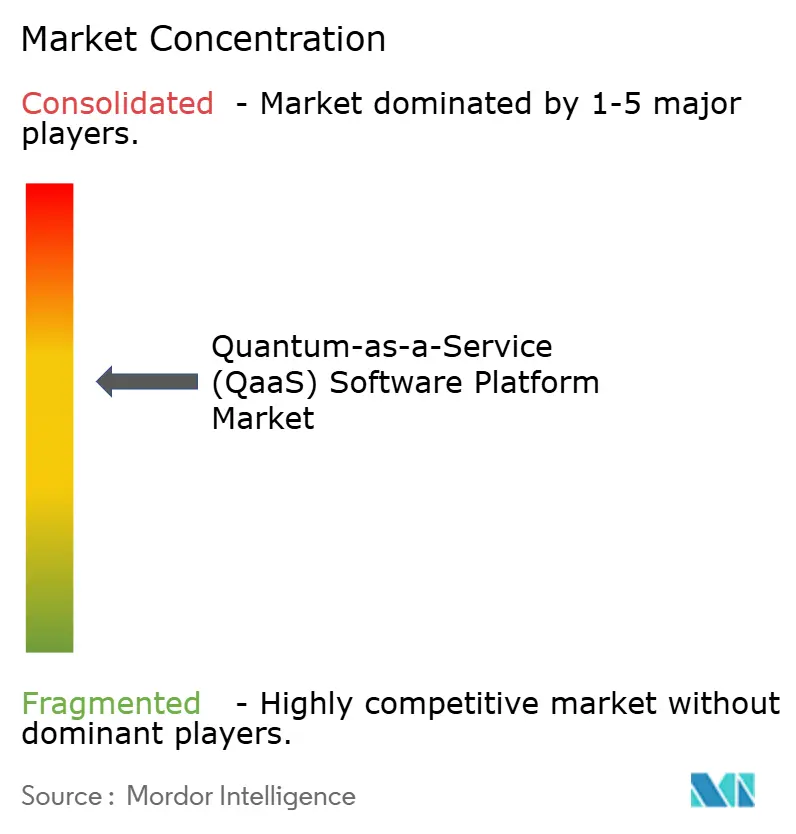
The competitive structure of the quantum-as-a-service (QaaS) software platform market has a concentrated platform layer and a broader, fragmented execution layer. IBM, Microsoft Azure Quantum, and Amazon Web Services anchor the platform side of the quantum-as-a-service (QaaS) software platform market because they can embed quantum access inside existing enterprise cloud relationships. Pure-play vendors such as D-Wave, Rigetti Computing, Pasqal, Quantinuum, Xanadu, and IonQ compete more directly on hardware modality, specialized workloads, and differentiated access models. This means the quantum-as-a-service (QaaS) software platform market still rewards vendors that can lower procurement friction while also showing credible technical relevance for real business problems. IBM’s Anderon foundry plan and the related USD 1 billion federal incentive support show how leading providers are tying product roadmaps to domestic manufacturing and supply-chain scale within the quantum-as-a-service (QaaS) software platform market.
White space remains strongest in middleware, workflow orchestration, and vertical-specific algorithm libraries across the quantum-as-a-service (QaaS) software platform market. Pasqal is moving deeper into finance through its expanded work with Crédit Agricole CIB, which shows how providers are trying to convert long-running research collaborations into operational deployment paths. Scaleway and QbitSoft are using sovereign cloud positioning to differentiate their role in the quantum-as-a-service (QaaS) software platform market for European enterprises that want simplified access and domestic control. Qilimanjaro is also differentiating with a multimodal QaaS data center, which gives it a distinct positioning around unified access to analog, digital, and classical HPC resources.
The quantum-as-a-service (QaaS) software platform market is likely to favor vendors that can show measurable gains on production-oriented workloads instead of relying only on benchmark claims. That standard increases the value of software abstraction, integration support, and domain workflows because enterprise buyers want repeatable results more than isolated hardware milestones. It also supports regional providers in the quantum-as-a-service (QaaS) software platform market where sovereignty, data control, or sector-specific compliance matters as much as raw performance, a pattern reinforced by rising buyer interest in controlled and auditable access models. As a result, the quantum-as-a-service (QaaS) software platform market remains concentrated at the top platform layer but still open across applications, delivery formats, and industry-specific solution design.
Quantum-as-a-Service (QaaS) Software Platform Industry Leaders
IBM Corporation
Microsoft Corporation
Amazon Web Services, Inc.
IonQ, Inc.
Quantinuum Ltd.
- *Disclaimer: Major Players sorted in no particular order
Quantum-as-a-Service (QaaS) Software Platform Market Companies Covered in this Report
- IBM Corporation
- Microsoft Corporation
- Amazon Web Services, Inc.
- IonQ, Inc.
- Quantinuum Ltd.
- QC Ware Corporation
- Zapata Computing Holdings Inc.
- Classiq Technologies Ltd.
- Riverlane Ltd.
- Q-CTRL Pty Ltd.
- Xanadu Quantum Technologies Inc.
- Pasqal SAS
- QuEra Computing Inc.
- Aliro Technologies, Inc.
- Horizon Quantum Computing Pte. Ltd.
- Terra Quantum AG
- Quantastica Ltd.
- QunaSys Inc.
- Strangeworks, Inc.
- D-Wave Systems Inc.
- Rigetti Computing, Inc.
- Fujitsu Limited
- Atos SE
- Alibaba Cloud Computing Ltd.
- Huawei Technologies Co., Ltd.
- Origin Quantum Computing Technology Co., Ltd.

Recent Industry Developments in Quantum-as-a-Service (QaaS) Software Platform Market
- July 2026: Oak Ridge National Laboratory, Cleveland Clinic, and IBM performed the first known computations of fusion energy materials on a quantum computer, calculating 9 molecular configurations of a candidate fusion fuel material, adding to a growing body of 2026 milestones demonstrating IBM quantum systems as scientific tools beyond laboratory benchmarks.
- June 2026: White House Executive Order 14413, "Ushering in the Next Frontier of Quantum Innovation," established the Quantum Computer for Application Development and Discovery Science (QC-ADDS) Effort and directed multi-agency coordination to accelerate quantum commercialization, update the National Quantum Strategy within 180 days, and expand domestic quantum supply chains.
- June 2026: The US Department of Energy announced the Quantum Genesis initiative, targeting the world's first fault-tolerant scientifically relevant quantum computer by 2028, with a National Quantum Supercomputing User Facility to be co-located with DOE's exascale HPC and AI infrastructure.
- May 2026: Cleveland Clinic, RIKEN, and IBM simulated a 12,635-atom protein on IBM's 156-qubit Heron processors, the largest biologically meaningful molecular simulation known on quantum hardware, achieving a 40-fold scale increase and up to 210-fold accuracy improvement over prior quantum benchmarks, with potential to shorten drug development validation timelines.


Global Quantum-as-a-Service (QaaS) Software Platform Market Report Scope
The Quantum-as-a-Service (QaaS) software platform market is defined as the market for cloud-based platforms that provide access to quantum computing resources and software tools. These platforms enable enterprises, researchers, and developers to run quantum algorithms, simulations, and optimization tasks without owning quantum hardware. QaaS platforms typically offer cloud access to quantum computing, simulation-as-a-service, optimization APIs, machine learning services, and, increasingly, quantum cryptography services.
The Quantum-as-a-Service (QaaS) Software Platform Market Report is Segmented by Service Type (Quantum Computing Cloud Access, Quantum Simulation as a Service, Quantum Optimization APIs, Quantum Machine Learning Services, and Quantum Cryptography and Security Services), Deployment Mode (Public Cloud QaaS, Private Dedicated Quantum Access, and Hybrid Quantum-Classical Workflow), End User Industry (Banking, Financial Services, and Insurance (BFSI), Pharmaceutical and Life Sciences, Aerospace and Defense, Materials and Chemistry, Logistics and Supply Chain, and Other End User Industries), and Geography (North America, South America, Europe, Asia-Pacific, and Middle East and Africa). The Market Forecasts are Provided in Terms of Value (USD).
| Quantum Computing Cloud Access |
| Quantum Simulation as a Service |
| Quantum Optimization APIs |
| Quantum Machine Learning Services |
| Quantum Cryptography and Security Services |
| Public Cloud QaaS |
| Private Dedicated Quantum Access |
| Hybrid Quantum-Classical Workflow |
| Banking, Financial Services, and Insurance (BFSI) |
| Pharmaceutical and Life Sciences |
| Aerospace and Defense |
| Materials and Chemistry |
| Logistics and Supply Chain |
| Other End User Industries |
| North America | United States | |
| Canada | ||
| Mexico | ||
| South America | Brazil | |
| Argentina | ||
| Rest of South America | ||
| Europe | Germany | |
| United Kingdom | ||
| France | ||
| Russia | ||
| Rest of Europe | ||
| Asia-Pacific | China | |
| Japan | ||
| India | ||
| South Korea | ||
| Australia | ||
| Rest of Asia-Pacific | ||
| Middle East and Africa | Middle East | Turkey |
| Israel | ||
| Saudi Arabia | ||
| United Arab Emirates | ||
| Rest of Middle East | ||
| Africa | South Africa | |
| Rest of Africa | ||
| By Service Type | Quantum Computing Cloud Access | ||
| Quantum Simulation as a Service | |||
| Quantum Optimization APIs | |||
| Quantum Machine Learning Services | |||
| Quantum Cryptography and Security Services | |||
| By Deployment Mode | Public Cloud QaaS | ||
| Private Dedicated Quantum Access | |||
| Hybrid Quantum-Classical Workflow | |||
| By End User Industry | Banking, Financial Services, and Insurance (BFSI) | ||
| Pharmaceutical and Life Sciences | |||
| Aerospace and Defense | |||
| Materials and Chemistry | |||
| Logistics and Supply Chain | |||
| Other End User Industries | |||
| By Geography | North America | United States | |
| Canada | |||
| Mexico | |||
| South America | Brazil | ||
| Argentina | |||
| Rest of South America | |||
| Europe | Germany | ||
| United Kingdom | |||
| France | |||
| Russia | |||
| Rest of Europe | |||
| Asia-Pacific | China | ||
| Japan | |||
| India | |||
| South Korea | |||
| Australia | |||
| Rest of Asia-Pacific | |||
| Middle East and Africa | Middle East | Turkey | |
| Israel | |||
| Saudi Arabia | |||
| United Arab Emirates | |||
| Rest of Middle East | |||
| Africa | South Africa | ||
| Rest of Africa | |||


Key Questions Answered in the Report
What is the current and projected size of the quantum-as-a-service (QaaS) software platform market?
The quantum-as-a-service (QaaS) software platform market size is projected to move from USD 0.78 billion in 2025 and USD 0.93 billion in 2026 to USD 2.31 billion by 2031, at a 19.96% CAGR.
Which service category leads revenue in quantum as a service?
Quantum Computing Cloud Access led with 38.29% of service revenue in 2025, showing that most buyers still begin with access-first models before expanding into deeper use cases.
Which deployment model is growing fastest in this space?
Hybrid Quantum-Classical Workflow is projected to grow at a 23.22% CAGR through 2031, reflecting the need to combine classical and quantum resources in one workflow.
Which end-user sector is creating the largest demand today?
BFSI held the largest end-user share at 24.78% in 2025, supported by use cases in portfolio optimization, risk modeling, and security readiness.
Which region is expanding the fastest for quantum as a service?
Asia-Pacific is forecast to grow at a 26.11% CAGR through 2031, making it the fastest-growing regional market in the draft.
What is the main barrier slowing commercial adoption of quantum services?
The biggest constraints are NISQ hardware limits and the shortage of quantum software and algorithm talent, which make production reliability and scaling difficult for enterprise users.
Page last updated on:





