
Push Notification Marketing Services Market Size and Share
Market Overview
| Study Period | 2020 - 2031 |
|---|---|
| Market Size (2026) | USD 1.56 Billion |
| Market Size (2031) | USD 3.02 Billion |
| Growth Rate (2026 - 2031) | 14.12 % |
| Fastest Growing Market | Asia-Pacific |
| Largest Market | North America |
| Market Concentration | Medium |
Major Players *Disclaimer: Major Players sorted in no particular order Image © Mordor Intelligence. Reuse requires attribution under CC BY 4.0. | |
Push Notification Marketing Services Market Analysis by Mordor Intelligence
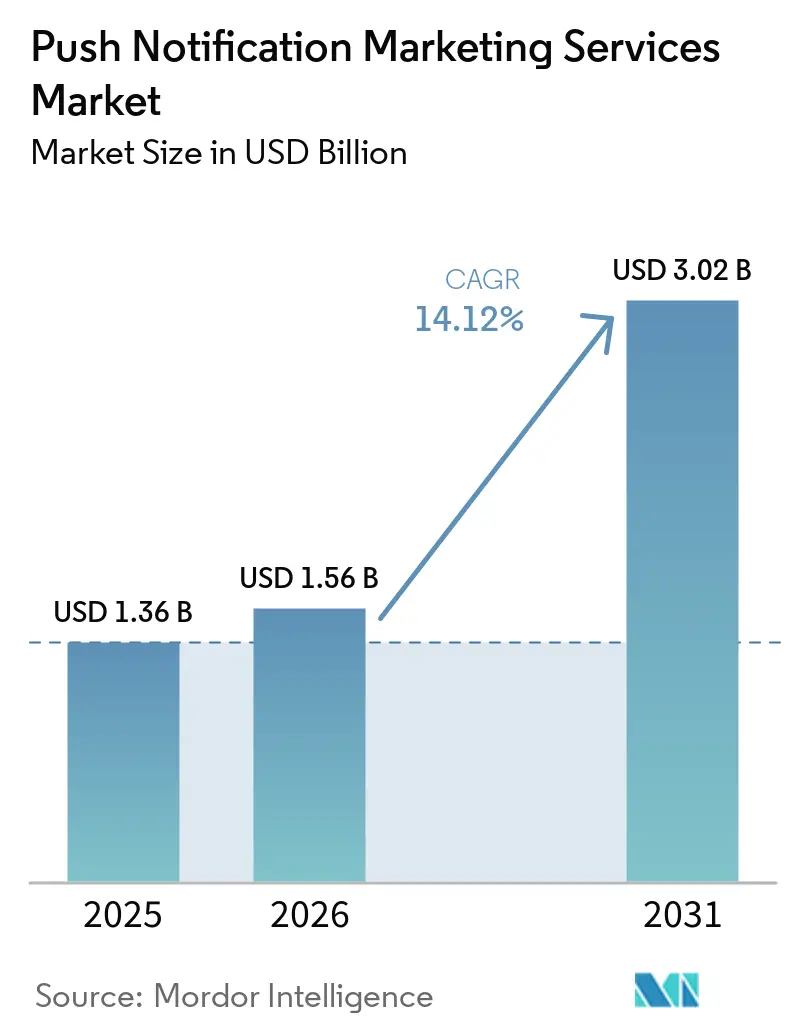
The push notification marketing services Market size is projected to expand from USD 1.36 billion in 2025 and USD 1.56 billion in 2026 to USD 3.02 billion by 2031, registering a CAGR of 14.12% between 2026 and 2031. The expansion reflects a clear budget shift away from paid acquisition and toward owned engagement channels as third-party cookie deprecation and rising programmatic CPMs reduce the efficiency gap that performance advertisers once relied on. AI-driven personalization is also changing campaign economics because brands now expect stronger delivery, better timing, and faster creative testing from the same subscriber base. The push notification marketing services market is also benefiting from demand for direct re-engagement assets that can be reused at near-zero marginal messaging cost once consent is in place. Competition is moving toward proprietary AI layers, cross-channel orchestration, and compliance-ready infrastructure, rather than focusing solely on message delivery. Consent complexity across regions and smaller opt-in pools on Android devices remain important limit, but demand stays firm because enterprises still want durable alternatives to paid channel dependence.
Key Report Takeaways
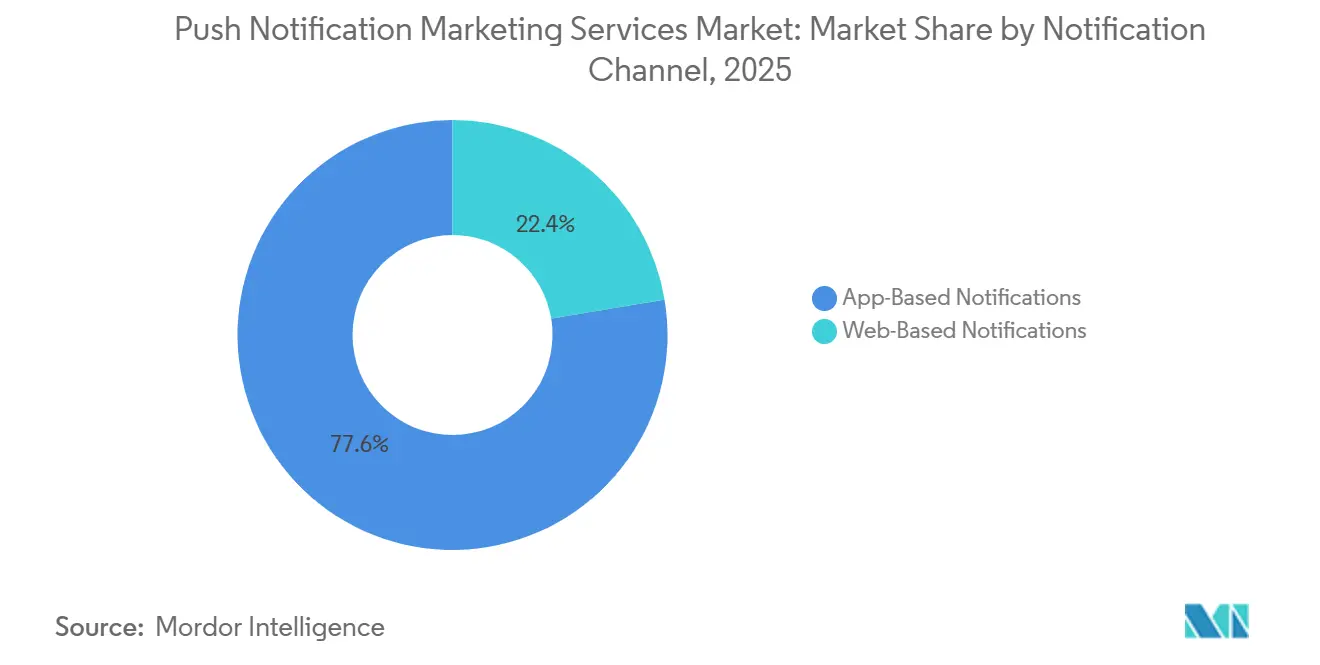
- By notification channel, app-based notifications accounted for 77.63% of the push notification marketing services market share in 2025, and are projected to expand at a 16.54% CAGR through 2031.
- By service type, push strategy and campaign design accounted for 63.58% of the push notification marketing services market share in 2025, and push notification execution and automation are projected to expand at a 15.78% CAGR through 2031.
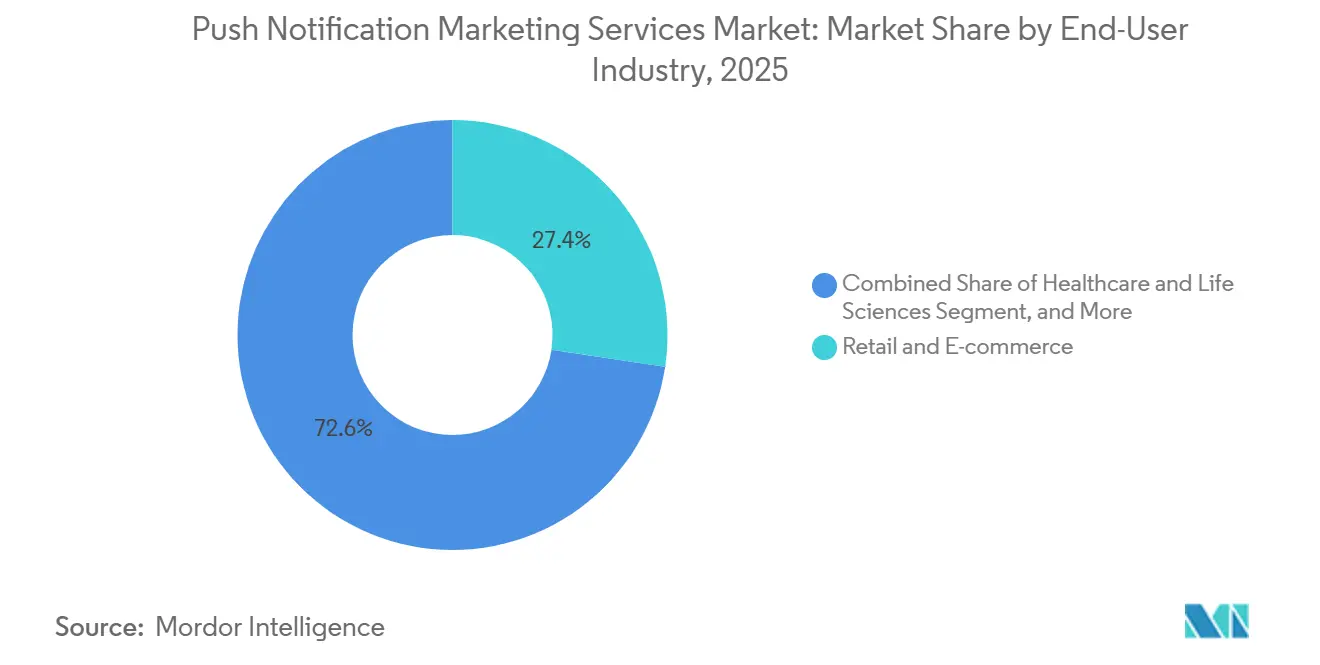
- By end-user industry, retail and e-commerce held 27.36% of revenue in 2025, while healthcare and life sciences are projected to expand at a 15.37% CAGR through 2031.
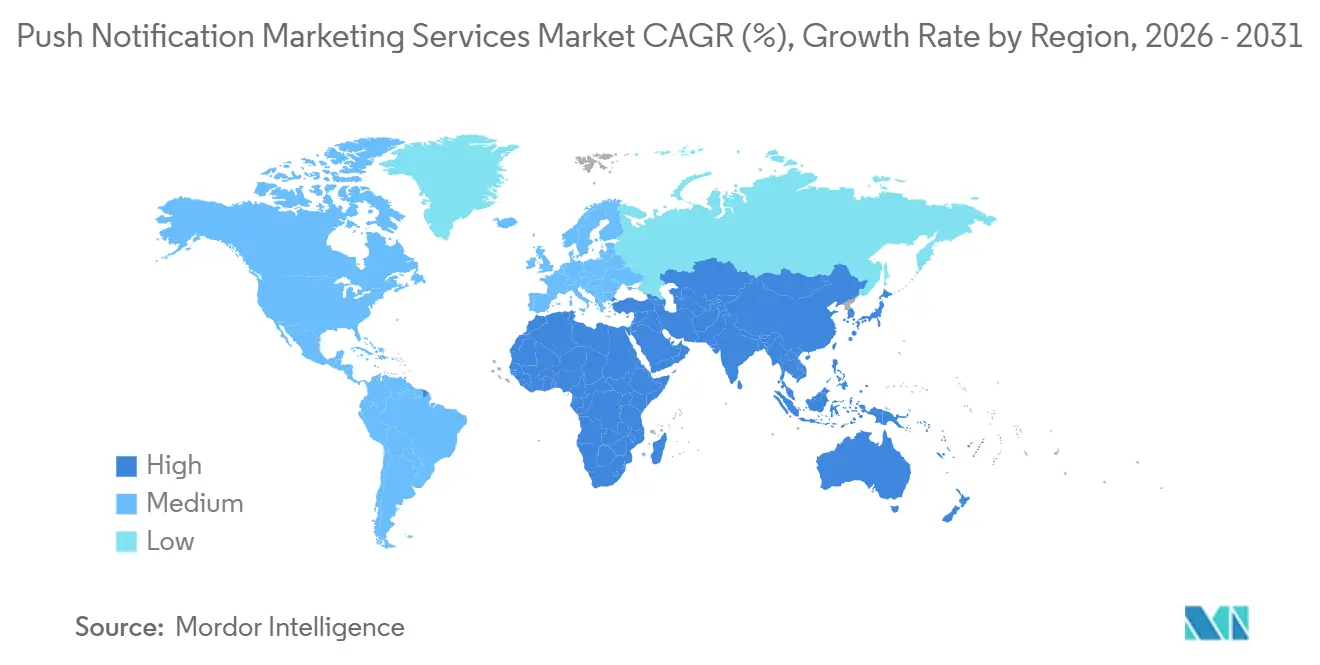
- By geography, North America held 38.52% of the push notification marketing services market share in 2025, while Asia-Pacific is projected to expand at a 15.82% CAGR through 2031.
Note: Market size and forecast figures in this report are generated using Mordor Intelligence’s proprietary estimation framework, updated with the latest available data and insights as of January 2026.
Market Trends and Insights
Drivers Impact Analysis of Push Notification Marketing Services Market*
| Driver | (~) % Impact on CAGR Forecast | Geographic Relevance | Impact Timeline |
|---|---|---|---|
| AI-Powered Personalization and Journey Orchestration | +3.2% | Global, concentrated in North America and Western Europe | Medium term (2-4 years) |
| Triggered Lifecycle Campaign Performance in Cart Recovery and Retention | +2.4% | Global, strongest in North America and the Asia-Pacific e-commerce | Short term (≤ 2 years), Medium term (2-4 years) |
| Browser-Based Web Push Adoption Across Commerce and Publishing | +1.9% | Global, early gains in North America, Europe, and India | Short term (≤ 2 years) |
| Enterprise Spend Shift Toward Owned-Channel Customer Engagement | +1.8% | North America and Europe | Medium term (2-4 years) |
| Android-Weighted Mobile-First Markets Improving Campaign Economics | +1.4% | Asia-Pacific core, with spillover to the Middle East and Africa and South America | Medium term (2-4 years) |
| GenAI-Led Creative Testing at Lower Operating Cost | +1.0% | Global | Short term (≤ 2 years) |
| Source: Mordor Intelligence | |||
AI-Powered Personalization and Journey Orchestration
AI-powered personalization has become the main point of differentiation in the push notification marketing services market, as enterprise buyers now judge platforms on orchestration quality rather than raw send capacity. MoEngage’s 2026 benchmark study across 40 billion messages sent between November 2024 and November 2025 found that behavior-triggered campaigns achieved a 93.07% delivery rate, compared with 80.73% for broadcast campaigns. Academic work also supports this shift, with a 2025 study indexed in the ACM Digital Library reporting 12.5% higher click-through rates and 8.3% higher conversion rates for LLM-generated push copies in e-commerce than templated alternatives. Braze added practical proof in April 2026, when it said that the BrazeAI Operator reduced unsubscribes by 81% and lifted push notification engagement by 124% for Cleo, showing that AI layers are already affecting retention outcomes.
Browser-Based Web Push Adoption Across Commerce and Publishing
Browser-based web push has moved from a niche publishing tool toward a broader retention channel in the push notification marketing services market, especially for commerce and media brands that want direct reach without forcing an app download. The W3C Declarative Web Push standard, which Apple began shipping natively across iOS and macOS in 2026, improved payload handling and battery efficiency for browser-delivered notifications on Apple devices. This matters because iOS Safari has long limited the effective reach of web push notifications, keeping Apple users outside the main addressable base for many browser-first programs. At the same time, Chrome usage data cited by Shopify showed that only 17% of users accept notification permission prompts on average websites, which means prompt timing and page context matter as much as platform choice. As Apple coverage improves and consent design becomes more deliberate, web push becomes a more credible owned channel for brands that want to expand reach without investing in a native app.
Triggered Lifecycle Campaign Performance in Cart Recovery and Retention
Triggered lifecycle campaigns have become a major revenue driver in the push notification marketing market because they align notifications with user intent rather than batch schedules. Plotline’s 2026 analysis found that automated push triggers represented 5% of total retail push volume but drove 28% of all push-attributed orders in mobile commerce. This gap shows why vendors that offer event-based orchestration, cart recovery logic, and multi-step journey design can command more budget than delivery-only tools. OneSignal’s 2026 State of Customer Engagement also found that 75.8% of marketing and product teams saw push as the channel with the greatest impact on long-term retention in the first 30 days after installation. The result is that brands now treat triggered recovery and retention sequences as core operating programs, not experimental campaigns, which raises the value of platforms that can manage those flows at scale in the push notification marketing services market.
Enterprise Spend Shift Toward Owned-Channel Customer Engagement
Enterprise spending is shifting toward owned-channel engagement, and this budget shift continues to support the push notification marketing services market as brands seek durable alternatives to paid acquisition. Braze reported USD 593.4 million in revenue for the fiscal year ended January 31, 2025, up 25.8% year over year, and its customer count reached 2,296, indicating wider enterprise adoption of dedicated engagement platforms. By the fiscal year ended January 31, 2026, Braze reported USD 738 million in revenue, indicating that large customers continued to increase spending even as the market grew more competitive. Vendors are also responding by widening their channel scope, as seen in Airship’s October 2025 launch of native RCS messaging inside the same platform used for push, email, SMS, and wallet experiences. Merkle, Airship, and Salesforce Marketing Cloud extended this pattern in October 2025 through a mobile loyalty accelerator partnership that tied loyalty workflows to real-time mobile engagement, reflecting buyer interest in unified orchestration rather than point solutions in the push notification marketing services market.
Restraints Impact Analysis of Push Notification Marketing Services Market*
| Restraint | (~) % Impact on CAGR Forecast | Geographic Relevance | Impact Timeline |
|---|---|---|---|
| Privacy Regulation and Consent Enforcement Complexity | -2.1% | Europe, North America, increasingly global | Medium term (2-4 years) |
| Notification Fatigue and Opt-Out Pressure | -1.8% | Global, pronounced in high-frequency verticals | Short term (≤ 2 years) |
| OS and Browser Permission UX Changes Reducing Opt-In Conversion | -1.2% | Global, with the highest impact in Android-dominant emerging markets | Medium term (2-4 years) |
| Real-Time Data Integration Latency Across Martech Stacks | -0.9% | Global, concentrated in mid-market enterprise segments | Long term (≥ 4 years) |
| Source: Mordor Intelligence | |||
Privacy Regulation and Consent Enforcement Complexity
Privacy rules are making it harder to scale push notification marketing services across borders because consent now has to be managed at a more granular level than device-level permission prompts. Gibson Dunn’s March 2026 Europe data protection review noted that marketing push notifications require separately obtained, purpose-specific consent under GDPR Articles 6 and 7, and that operating system permission prompts alone do not meet that standard. Turkey’s Personal Data Protection Authority also signaled the same direction in 2024 by requiring separate consent paths for operational and marketing push notifications in mobile applications. For vendors and enterprise buyers, this creates extra work around consent records, policy logic, and jurisdiction-specific workflows across GDPR, KVKK, LGPD, and healthcare requirements such as HIPAA. These tasks add legal and technology costs, and they weigh more heavily on mid-market entrants than on large incumbents with established compliance teams in the push notification marketing services market.
Notification Fatigue and Opt-Out Pressure
Notification fatigue continues to restrain the push notification marketing services market because repeated alerts can erode the value of a hard-won opt-in base. Batch reported that Android 13 changed push permissions from default-granted to explicit opt-in, and average Android opt-in rates fell from 85-90% to 67% as adoption spread.[1] That shift permanently reduced the subscriber pool available to brands in Android-heavy markets, especially where mobile growth depends on high-volume consumer apps. Plotline also noted that iOS 26 notification summarization can condense multiple app alerts into a single AI-generated line, thereby weakening the creative distinction between carefully written messages and generic batch sends. Preference centers and more granular frequency controls can reduce this pressure, but vendors still need more UX investment to achieve higher retention without sacrificing reach in the push notification marketing services market.
*Our forecasts treat driver/restraint impacts as directional, not additive. The impact forecasts reflect baseline growth, mix effects, and variable interactions.
Push Notification Marketing Services Market Segment Analysis
By Notification Channel:
App-Based Delivery Leads While SMS Convergence Gains GroundApp-based notifications held 77.63% of the push notification marketing services market share in 2025, giving them the largest channel position because native apps remain the main consumer touchpoint in retail, financial services, and media. The channel benefits from persistent device tokens, direct delivery measurement, rich media support, and deep links that route users to specific screens instead of general landing pages. Airship’s 2026 benchmarks, based on 681 billion notifications sent to more than 3 billion users across 15 verticals, showed that e-commerce and retail apps on Android posted a 3.78% click-through rate, compared with 3.05% on iOS.[2] That gap reflects Android’s historically stronger opt-in performance, which made app-based messaging especially effective for conversion-led programs before explicit permission models tightened the funnel. Web-based notifications held the second-largest channel position and continued to expand as commerce brands used them to add direct reach beyond app users, while publishers and media groups used them for time-sensitive alerts in the push notification marketing services market.
Web-based notifications accounted for the remaining 22.37% of revenue in 2025, and this segment of the push notification marketing services market is becoming increasingly useful as brands seek reach beyond app-installed audiences. The channel is particularly relevant for commerce and publishing businesses that attract repeat visitors but do not convert all of them into app users on the first visit. Publisher research showed that adopting push notifications can raise active users by up to 60% over 3 months, which supports the role of browser messaging in repeat engagement programs. The push notification marketing services industry is therefore seeing more need for vendors that can manage browser permissions, audience logic, and content sequencing in the same environment used for app campaigns. Over time, the push notification marketing services market should continue to treat web push as a complementary channel that expands reachable audiences without replacing the structural lead of app-based delivery.
By Service Type:
Automation Contracts Gain Ground Against Design EngagementsPush strategy and campaign design accounted for 63.58% of the push notification marketing services market in 2025, indicating that enterprises still rely heavily on external expertise to shape audience logic, journey design, and campaign governance. This leadership also reflects the fact that many buyers still need help setting the operating model before they can scale automated communication confidently across teams and channels. Even so, the push notification marketing services market is gradually shifting value away from one-time planning work and toward software-assisted execution because core design tasks are becoming easier to standardize. Oracle added generative AI support for web push, in-app messages, and message center content in its Responsys 25A release, demonstrating how execution features are being absorbed into platform functionality rather than remaining only within service teams. OneSignal also introduced AI Message Composer in fall 2025, which brought AI-generated push copy directly into the workflow used by marketers and reduced reliance on manual drafting for routine campaigns
Push notification execution and automation are projected to expand at a 15.78% CAGR through 2031, making it the fastest-growing service type in the push notification marketing services market. That growth signals a clear move toward recurring operating contracts, where vendors are paid to keep campaigns running, tuned, and responsive to new user signals rather than only designing initial frameworks. The push notification marketing services industry is also seeing more demand for analytics and performance optimization because large clients want clearer evidence of what push contributes beyond email and SMS activity. This is raising the value of attribution, incrementality checks, and reporting quality, especially in clients that already have mature data environments and finance oversight. As AI features spread across core platforms, the push notification marketing services market should continue shifting from advice-led revenue toward automation-led and measurement-led revenue.
By End-User Industry:
Healthcare Accelerates While Retail Anchors RevenueRetail and e-commerce accounted for 27.36% of revenue in 2025, keeping this segment as the largest end-user base in the push notification marketing services market. Its lead comes from the direct commercial use of abandoned cart reminders, promotional alerts, replenishment prompts, loyalty nudges, and reactivation flows that can be closely tied to purchase behavior. The push notification marketing services market remains especially attractive to retail accounts because transaction-linked messaging is easier to test, attribute, and defend in budget reviews than broader awareness campaigns. Media and entertainment, travel and hospitality, and consumer goods also add meaningful demand because each depends on repeat attention, timely updates, or retention-led communication. This keeps end-user demand broad, even though the commercial logic is most visible in transaction-heavy verticals.
Healthcare and life sciences are projected to grow at a 15.37% CAGR through 2031, which makes it the fastest-growing end-user segment in the push notification marketing services market. A March 2025 study found that push notification outreach led to 9.0% more annual preventive care visits and a 20.8% improvement in urine microalbumin test completion among diabetic patients compared with a matched control group. That clinical evidence matters because it gives the push notification marketing services market a stronger use case in patient engagement, medication support, screening reminders, and follow-up compliance. At the same time, health-related notifications carry stricter expectations around consent, relevance, and data handling, which raises the value of vendors with compliance-ready workflows. The aggregated group of other end-user industries, including fintech, education, and utilities, is also gaining traction as firms use transactional alerts, fraud notifications, service reminders, and account updates to strengthen real-time engagement.

Geography Analysis
North America Push Notification Marketing Services Market
North America held 38.52% of the push notification marketing services market share in 2025, maintaining its lead. The region benefits from dense enterprise martech adoption and a mature mobile app ecosystem. It also remains the home base for Braze, OneSignal, and Airship, which keep product development and enterprise selling activity closely tied to buyer needs in the push notification marketing services market. Braze reported USD 738 million in revenue for the fiscal year ended January 31, 2026, reflecting continued enterprise platform spending concentrated in this market segment. Canada adds steady demand from e-commerce and financial services, while Mexico is expanding from a smaller base as smartphone use broadens the reachable app audience.
APAC Push Notification Marketing Services Market
Asia-Pacific is projected to grow at a 15.82% CAGR through 2031, making it the fastest-expanding region in the push notification marketing services market. The region’s growth stems from mobile-first commerce, larger Android user bases, and greater reliance on messaging-led engagement in India, Southeast Asia, and South Korea. Infobip’s 2026 messaging trends report said India had 550 million RCS users in 2025, along with 70% growth in RCS interactions and a 2,907% increase in marketing use, which shows how quickly richer messaging formats are scaling.[3] South Korea and Australia support higher-spend use cases in gaming, fintech, media, retail, and financial services, while Japan requires more localized product design and domestic partnerships for vendors that want deeper access.
EMEA and South America Push Notification Marketing Services Market
Europe held the second-largest share of the push notification marketing services market, with Germany and the United Kingdom as the main enterprise hubs. Buyers in this region place greater weight on consent tooling and governance support, favoring vendors that can combine campaign functions with data control. France, Spain, and Italy are adding mid-market demand as e-commerce usage widens. South America is becoming a larger part of the push notification marketing services market, led by Brazil and supported by fintech, mobile commerce, and expanding app usage in Argentina and Chile. The Middle East shows concentrated activity in the UAE and Saudi Arabia, while Africa remains earlier stage but is gaining relevance in Nigeria, South Africa, and Egypt as fintech and mobile money apps create more trigger-based communication needs.
Competitive Landscape
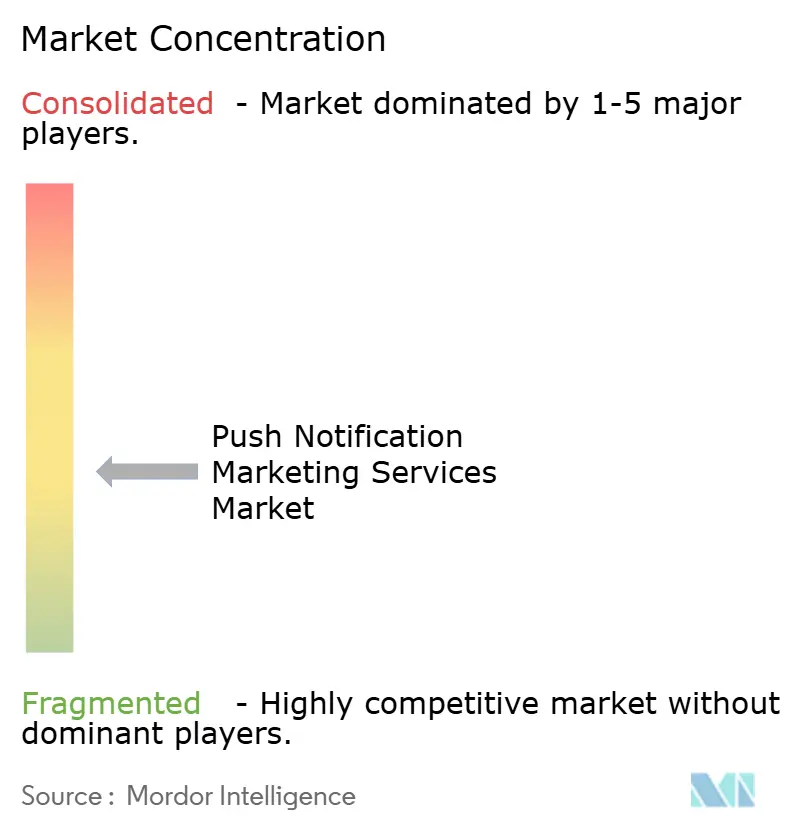
The push notification marketing services market remains fragmented, but competition is tightening around platform intelligence, workflow automation, and cross-channel orchestration rather than message delivery alone. Vendors are increasingly trying to prove they can manage relevance, fatigue, compliance, and timing within a single operating layer, since clients now expect push to work as part of a broader lifecycle system. This is pushing the push notification marketing services market toward deeper product ecosystems, where execution, reporting, and audience controls are closer together than in earlier campaign-centric models. Freemium and lower-friction vendors continue to appeal to small and mid-sized clients, while larger enterprise accounts place more weight on governance, security, and integration depth. The result is a push notification marketing services market where pricing power depends less on simple volume and more on the ability to support durable retention outcomes.
Several recent product moves show how the push notification marketing services market is evolving. Oracle embedded generative AI support for web push, in-app messaging, and message center content in Responsys 25A, strengthening the role of AI-assisted execution within an established enterprise suite. OneSignal released the AI Message Composer and an MCP Server in fall 2025, making it easier to create and schedule push content from AI-native workflows and expanding its appeal beyond basic notification use cases.[4]Netcore launched Interactive App Push Templates in February 2026, bringing more multi-action experiences to the lock screen and linking them to personalized recommendations. These moves show that the push notification marketing services market is rewarding vendors that improve usability and automation without weakening control over segmentation and campaign logic.
Strategic positioning is also being shaped by regional expansion, enterprise trust requirements, and specialization in regulated use cases. Airship expanded its global office footprint, including a New Delhi office, which points to a more direct approach to Asia-Pacific demand rather than serving those accounts only from North America or Europe. The push notification marketing services market is therefore seeing more investment in geographic coverage as well as in product capability. Providers that can combine compliance readiness, enterprise-grade controls, and scalable automation are better placed to win in healthcare, financial services, and other sectors where generic tooling is often not enough. This keeps the push notification marketing services market open to both platform consolidation and niche specialization at the same time.
Push Notification Marketing Services Industry Leaders
-
Braze, Inc.
-
OneSignal, Inc.
-
Airship Group, Inc.
-
MoEngage Global Inc.
-
Iterable, Inc.
- *Disclaimer: Major Players sorted in no particular order
Push Notification Marketing Services Market Companies Covered in this Report
- Braze, Inc.
- OneSignal, Inc.
- Airship Group, Inc.
- MoEngage Global Inc.
- Iterable, Inc.
- Pushwoosh Inc.
- Webklipper Technologies Private Limited
- Netcore Pvt. Ltd.
- Wingify Software Pvt. Ltd.
- SendPulse Inc.
- Push Engage LLC
- Datability Technologies Private Limited
- Sosyo Plus Bilgi Bilişim Tekn. Dan. Hiz. Tic. A.Ş.
- Brevo SAS
- Bloomreach, Inc.
- Salesforce, Inc.
- Oracle Corporation
- Adobe Inc.
- Amazon Web Services, Inc.
Recent Industry Developments in Push Notification Marketing Services Market
- April 2026: Airship expanded its AI Agent Fleet at Elevate'26 in Orlando, introducing the Campaigns AI Agent, the industry’s first enterprise-grade multi-agent system purpose-built on Google Cloud’s Gemini Enterprise Agent Platform for continuous goal optimization across mobile channels, including push, SMS, and email.
- January 2026: Bloomreach released platform version 1.300, introducing Adform identifier support and Mobile SDK updates to improve cross-device push notification attribution and audience targeting precision.
- October 2025: Airship launched native RCS messaging, embedded directly into its platform without requiring third-party integrations. The capability enables brands to orchestrate RCS alongside push notifications, email, SMS, and mobile wallets from a single canvas, with automatic SMS fallback for devices that don't support RCS.
- October 2025: Merkle, Airship, and Salesforce Marketing Cloud announced a mobile loyalty accelerator partnership, enabling Salesforce-managed loyalty programs to activate Airship’s wallet, push, and RCS capabilities via real-time bidirectional integration, shortening time-to-market for brands seeking mobile-first loyalty experiences.
Global Push Notification Marketing Services Market Report Scope
The Push Notification Marketing Services Market encompasses solutions and platforms that enable businesses to deliver targeted, real-time notifications directly to users' devices. These services are designed to enhance user engagement, improve customer retention, and drive conversions by delivering personalized, timely messages. The market includes various tools and technologies that support the creation, management, and analysis of push notification campaigns across multiple devices and operating systems.
The Push Notification Marketing Services Market Report is Segmented by Notification Channel (Web-Based Notifications, and App-Based Notifications), Service Type (Push Strategy and Campaign Design, Push Notification Execution and Automation, and Analytics and Performance Optimization), End-User Industry (Retail and E-Commerce, Media and Entertainment, Healthcare and Life Sciences, Travel and Hospitality, Consumer Goods, and Other End-User Industries), and Geography (North America, South America, Europe, Asia-Pacific, Middle East, and Africa). The Market Forecasts are Provided in Terms of Value (USD).
Segmentation Overview
| Web-Based Notifications |
| App-Based Notifications |
| Push Strategy and Campaign Design |
| Push Notification Execution and Automation |
| Analytics and Performance Optimization |
| Retail and E-commerce |
| Media and Entertainment |
| Healthcare and Life Sciences |
| Travel and Hospitality |
| Consumer Goods |
| Other End-User Industries |
| North America | United States |
| Canada | |
| Mexico | |
| South America | Brazil |
| Argentina | |
| Chile | |
| Rest of South America | |
| Europe | Germany |
| United Kingdom | |
| France | |
| Italy | |
| Spain | |
| Rest of Europe | |
| Asia-Pacific | China |
| Japan | |
| India | |
| South Korea | |
| Australia | |
| Rest of Asia-Pacific | |
| Middle East | United Arab Emirates |
| Saudi Arabia | |
| Qatar | |
| Rest of Middle East | |
| Africa | South Africa |
| Egypt | |
| Nigeria | |
| Rest of Africa |
| By Notification Channel | Web-Based Notifications | |
| App-Based Notifications | ||
| By Service Type | Push Strategy and Campaign Design | |
| Push Notification Execution and Automation | ||
| Analytics and Performance Optimization | ||
| By End-user Industry | Retail and E-commerce | |
| Media and Entertainment | ||
| Healthcare and Life Sciences | ||
| Travel and Hospitality | ||
| Consumer Goods | ||
| Other End-User Industries | ||
| By Geography | North America | United States |
| Canada | ||
| Mexico | ||
| South America | Brazil | |
| Argentina | ||
| Chile | ||
| Rest of South America | ||
| Europe | Germany | |
| United Kingdom | ||
| France | ||
| Italy | ||
| Spain | ||
| Rest of Europe | ||
| Asia-Pacific | China | |
| Japan | ||
| India | ||
| South Korea | ||
| Australia | ||
| Rest of Asia-Pacific | ||
| Middle East | United Arab Emirates | |
| Saudi Arabia | ||
| Qatar | ||
| Rest of Middle East | ||
| Africa | South Africa | |
| Egypt | ||
| Nigeria | ||
| Rest of Africa | ||
Key Questions Answered in the Report
What is the current and forecast size of the push notification marketing services market?
The push notification marketing services market stood at USD 1.36 billion in 2025, reached USD 1.56 billion in 2026, and is forecast to reach USD 3.02 billion by 2031, at a CAGR of 14.12%.
Which notification channel drives revenue?
App-based notifications led channel revenue with a 77.63% share in 2025 because native apps still offer stronger delivery control, deep linking, and richer engagement formats than other channels.
Why are enterprises increasing spending on push programs?
Enterprises are moving toward owned engagement channels, stronger retention programs, and AI-assisted orchestration that can improve timing, relevance, and automation without direct media costs per impression.
Which end-user vertical is growing the fastest?
Healthcare and life sciences is the fastest-growing vertical at a 15.37% CAGR through 2031, supported by published evidence that push outreach improved preventive care engagement and test completion.
Which region offers the strongest growth outlook?
Asia-Pacific has the strongest growth outlook with a projected 15.89% CAGR through 2031, supported by mobile-first usage patterns and large app-led engagement opportunities.
What are the main risks for service providers and buyers?
The main risks are stricter privacy and consent requirements and rising notification fatigue, both of which can reduce reachable audiences and weaken campaign efficiency if message volume is not managed well.