
Premium Apparel Market Size and Share
Market Overview
| Study Period | 2022 - 2032 |
|---|---|
| Market Size (2027) | USD 172.14 Billion |
| Market Size (2032) | USD 218.34 Billion |
| Growth Rate (2027 - 2032) | 4.87 % |
| Fastest Growing Market | Asia-Pacific |
| Largest Market | Asia-Pacific |
| Market Concentration | Medium |
Major Players *Disclaimer: Major Players sorted in no particular order Image © Mordor Intelligence. Reuse requires attribution under CC BY 4.0. | |
Premium Apparel Market Analysis by Mordor Intelligence
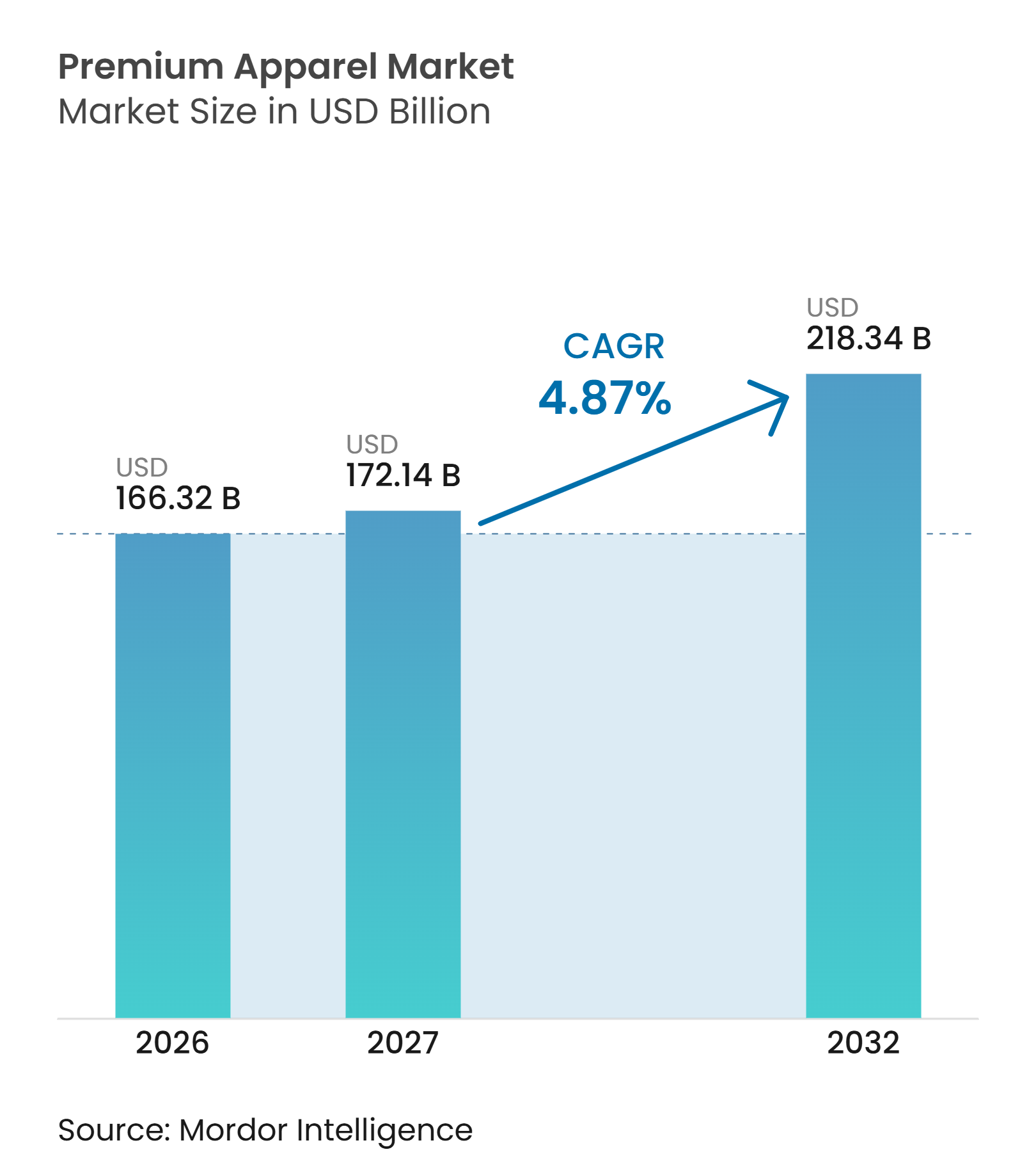
The premium apparel market size is expected to grow from USD 166.32 billion in 2026 to USD 172.14 billion in 2027 and is forecast to reach USD 218.34 billion by 2032 at a 4.87% CAGR over 2027-2032. The premium apparel market is experiencing steady growth, supported by evolving consumer preferences, increasing emphasis on quality and design, and the growing integration of fashion with lifestyle and personal identity. Rising brand engagement, product innovation, and demand for durable, differentiated clothing are strengthening the market's long-term growth prospects. The expansion of digital retail channels, alongside continued investment in physical retail experiences, is improving consumer accessibility and brand engagement. Additionally, growing interest in performance-oriented fashion, comfortable everyday clothing, and premium materials is broadening the market's appeal to consumers. Overall, continued product innovation, brand differentiation, and evolving purchasing preferences are expected to support sustained market expansion over the forecast period.
Key Report Takeaways
-
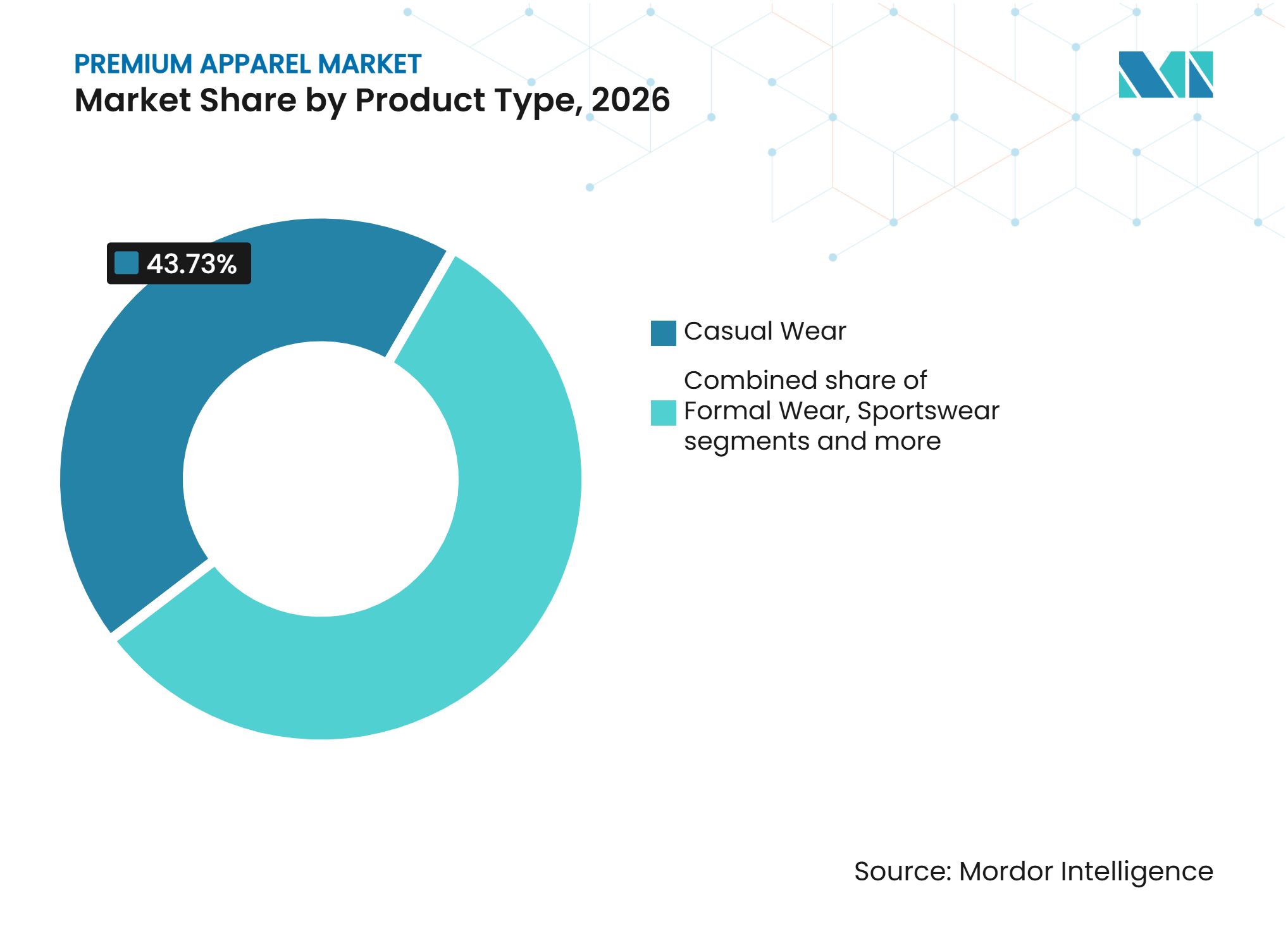
By product type, casual wear held 43.73% of the premium apparel market share in 2026, while sportswear is forecast to grow at a 6.37% CAGR during 2027-2032.
-
By end user, women held 52.86% of the premium apparel market size in 2026, while the children segment is forecast to grow at a 5.93% CAGR during 2027-2032.
-
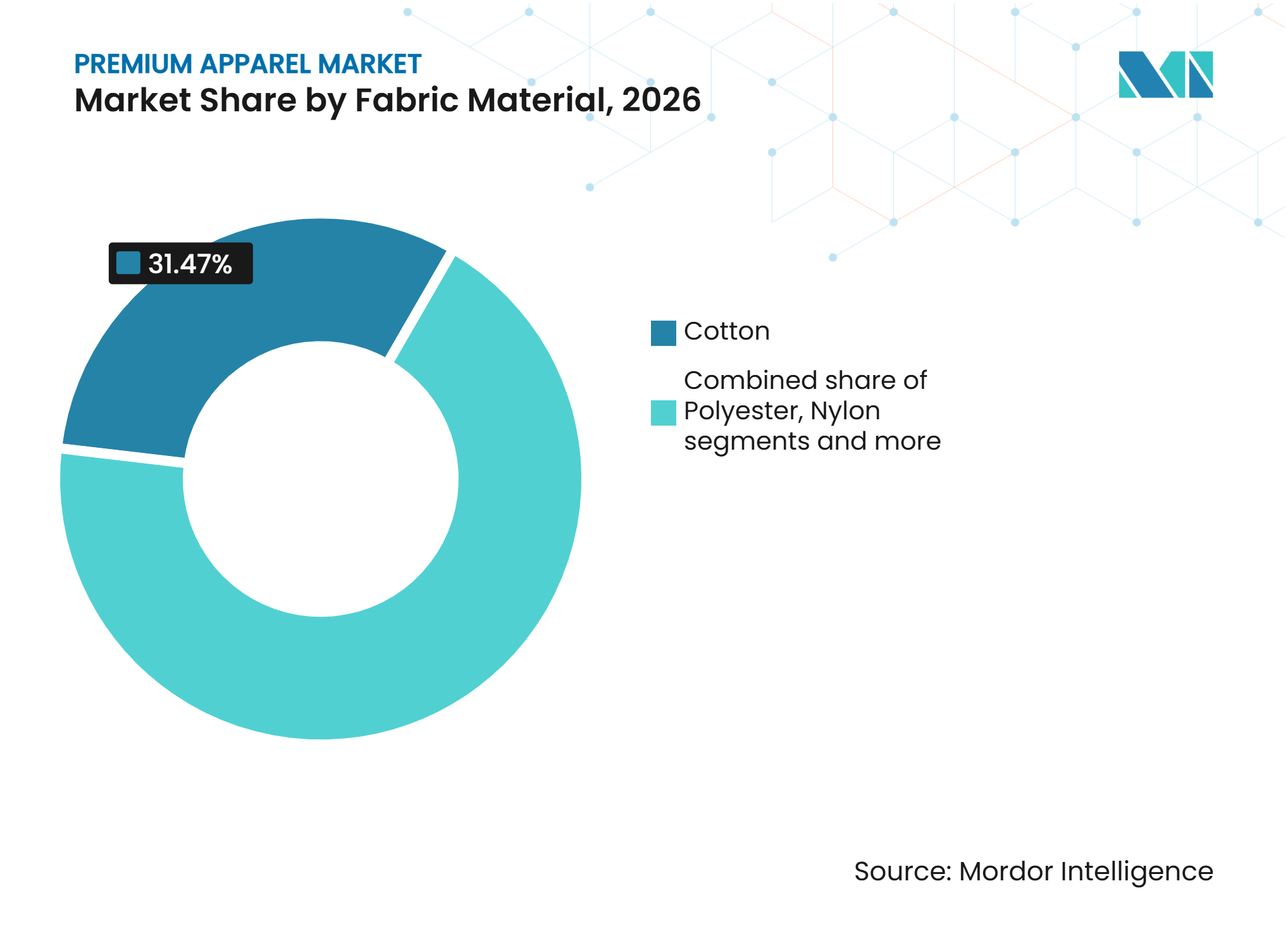
By fabric material, cotton held 31.47% of the premium apparel market size in 2026, while nylon is forecast to grow at a 6.67% CAGR during 2027-2032.
-
By distribution channel, offline stores held 63.74% of the premium apparel market share in 2026, while online stores are forecast to grow at a 6.24% CAGR from 2027 to 2032.
-
By geography, Asia-Pacific held 29.36% of the premium apparel market share in 2026 and is forecast to grow at a 6.48% CAGR from 2027 to 2032.
Note: Market numbers in this report are based on Mordor Intelligence's proprietary estimation framework, which combines nine months of actuals with Q4 projections for base year 2026.
Market Trends and Insights
Drivers Impact Analysis of Premium Apparel Market*
| Driver | (~) % Impact on CAGR Forecast | Geographic Relevance | Impact Timeline |
|---|---|---|---|
| Premiumization of wardrobes and luxury brand aspirations | +1.2% | Global; concentrated in Asia-Pacific and North America | Medium term (2–4 years) |
| Demand for quality, craftsmanship and long-lasting apparel | +0.8% | Global; leading in Europe and Japan | Long term (≥ 4 years) |
| Expansion of digital apparel purchasing and omnichannel retail | +0.9% | Global; strongest in Asia-Pacific and North America | Short term (≤ 2 years) |
| Athleisure and performance-led premium apparel demand | +0.7% | North America, Asia-Pacific, and Western Europe | Medium term (2–4 years) |
| Sustainability-driven material innovation and circularity | +0.4% | Europe and North America; growing in Asia-Pacific | Long term (≥ 4 years) |
| Demand for versatile, occasion-spanning premium apparel | +0.5% | Global; urban consumer markets | Short to medium term |
| Source: Mordor Intelligence | |||
Premiumization of Wardrobes and Luxury Brand Aspirations
The growing association of premium fashion with personal identity, social recognition, and aspirational lifestyles is supporting consumers' interest in luxury apparel brands. Brand reputation, distinctive design identities, exclusivity, and heritage are increasingly important elements of luxury positioning, encouraging consumers to seek products that reflect their individual aspirations and lifestyle preferences. The wider exposure to luxury fashion through celebrity endorsements, fashion events, and digital brand campaigns is also increasing awareness of premium labels and their collections. This encourages consumers to trade up from mainstream apparel to aspirational brands, while creating opportunities for premium apparel companies to strengthen brand loyalty through exclusive collections, distinctive aesthetics, and differentiated brand experiences.
Demand for Quality, Craftsmanship and Long-Lasting Apparel
Increasing consumer emphasis on product quality, construction standards, and garment longevity is supporting demand for premium apparel that offers greater value over repeated use. According to the European Commission's Joint Research Center (JRC) December 2025 preparatory study on textiles, a survey of 11,483 consumers across ten European countries found that 61% prioritized perceived quality when purchasing clothing, while 30% considered product longevity[1]. These preferences are encouraging apparel manufacturers to invest in superior fabric construction, refined stitching, finishing techniques, and improved garment performance. Greater attention to garment lifespan and overall product value is also strengthening the appeal of premium clothing designed to retain its appearance and functionality over extended periods.
Expansion of Digital Apparel Purchasing and Omnichannel Retail
The increasing adoption of online shopping is expanding consumer access to apparel brands, product collections, and fashion trends, supporting the growth of digitally enabled retail channels. According to Ireland's Central Statistics Office (CSO), its 2025 Household Digital Consumer Behavior survey found that 70% of internet users purchased clothing, footwear, or accessories online in 2025. Additionally, 85% of internet users made online purchases across product categories, highlighting the widespread adoption of digital commerce [2]. This growing acceptance of online apparel purchasing is encouraging brands to strengthen their e-commerce platforms, mobile shopping experiences, and digital product discovery capabilities. Simultaneously, the integration of online and physical retail channels through click-and-collect, unified inventory management, and flexible fulfillment options is enabling more seamless shopping experiences.
Athleisure and Performance-Led Premium Apparel Demand
The growing integration of fitness, wellness, and everyday fashion is strengthening demand for premium athleisure and performance-oriented apparel. Increasing participation in recreational sports, gym-based exercise, and outdoor activities is encouraging consumers to seek clothing that combines functional performance with contemporary styling. According to the National Sporting Goods Association (NSGA), 49 of the 61 sports and activities tracked recorded increases in participation in 2025, as reported in its 2026 Sports Participation in the United States report. Additionally, the Sports & Fitness Industry Association (SFIA) reported that 250 million Americans participated in at least one sport, fitness, or leisure activity in 2025, a record level of participation [3]. This is encouraging manufacturers to incorporate functional features such as moisture management, stretch, breathability, and ergonomic construction into premium collections, strengthening demand for apparel that combines technical functionality with contemporary design.
Restraints Impact Analysis of Premium Apparel Market*
| Restraint | (~) % Impact on CAGR Forecast | Geographic Relevance | Impact Timeline |
|---|---|---|---|
| High customer acquisition costs and limited conversion of aspirational buyers | -0.4% | Global; most acute in North America and Europe | Medium term (2–4 years) |
| Counterfeit products and unauthorized-market leakage | -0.3% | Global; particularly acute in Asia-Pacific and Southeast Asia | Short to long term |
| Rising product-traceability and regulatory-compliance requirements | -0.2% | Europe and North America; expanding to Asia-Pacific | Long term (≥ 4 years) |
| Limited availability of traceable and recycled material inputs | -0.3% | Global supply chains; most acute for Asia-Pacific-sourced materials | Long term (≥ 4 years) |
| Source: Mordor Intelligence | |||
High Customer Acquisition Costs and Limited Conversion of Aspirational Buyers
Premium apparel brands face challenges in acquiring new customers due to the substantial investment required to build brand awareness, maintain visibility, and communicate differentiated value propositions. High marketing expenditure, celebrity endorsements, premium retail experiences, and digital advertising campaigns contribute to elevated customer acquisition costs, particularly in an increasingly competitive fashion landscape. Additionally, aspirational consumers may be interested in premium brands but remain hesitant to convert that interest into purchases due to the higher price points. This creates challenges in translating brand engagement into consistent sales, requiring companies to balance customer acquisition investments with pricing strategies, brand positioning, and long-term customer retention initiatives.
Counterfeit Products and Unauthorized-Market Leakage
The presence of counterfeit apparel and unauthorized product distribution creates challenges for premium brands by undermining brand exclusivity, pricing integrity, and consumer trust. Counterfeit products often imitate established brand identities, designs, and trademarks, making it difficult for consumers to distinguish authentic merchandise from unauthorized replicas, particularly across online marketplaces and informal retail channels. Additionally, unauthorized distribution through grey-market networks can weaken brands' control over product pricing, geographical availability, and distribution strategies. These challenges can dilute brand positioning, affect relationships with authorized retail partners, and increase the need for investment in product authentication, supply chain monitoring, intellectual property protection, and channel oversight.
*Our forecasts treat driver/restraint impacts as directional, not additive. The impact forecasts reflect baseline growth, mix effects, and variable interactions.
Premium Apparel Market Segment Analysis
By Product Type:
Casual Wear Anchors Value, Sportswear AcceleratesCasual Wear accounts for the largest share of the premium apparel market, representing 43.73% in 2026. Its dominance is supported by sustained demand for versatile, comfortable, and quality-oriented clothing suitable for everyday use. Increasing preference for relaxed dressing and the integration of casual styles into professional and social settings are further supporting segment demand. Consumers are also incorporating premium casual clothing into their regular wardrobes, prompting brands to expand their offerings to include contemporary designs, elevated basics, and lifestyle-oriented collections. Continued emphasis on versatility, comfort, and everyday wearability is expected to sustain the segment's leading position throughout the forecast period.
Sportswear is the fastest-growing product segment, projected to register a CAGR of 6.37% over 2027–2032. Growth is supported by increasing consumer engagement with fitness and active lifestyles, alongside rising demand for apparel that combines functional performance with contemporary fashion. The growing adoption of athleisure is also extending sportswear usage beyond dedicated physical activities into everyday and leisure settings. Manufacturers are responding through product innovation, the integration of technical fabrics, and designs that balance functionality with aesthetic appeal. Increasing consumer interest in performance-oriented clothing and versatile activewear collections is expected to support the segment's expansion over the forecast period.



By End User:
Women Define the Core; Children Drive Future ShareWomen account for the largest share of the premium apparel market, representing 52.86% in 2026. Their leading position is supported by broad demand across casual, formal, sportswear, and occasion-based clothing categories. Continued interest in evolving fashion trends, diverse styling options, and premium wardrobe collections is sustaining demand across women's apparel. Brands are also expanding their product portfolios to address varied consumer preferences, incorporating contemporary designs, versatile clothing options, and collections suited to different lifestyles and social occasions. This broad product appeal is expected to maintain women's position as the dominant end-user segment throughout the forecast period.
Children represent the fastest-growing end-user segment, projected to register a CAGR of 5.93% over 2027–2032. Growth is supported by increasing parental interest in premium children's clothing, greater attention to product design, and the growing influence of established apparel brands across family wardrobes. A rising preference for fashionable, occasion-specific children's clothing is also encouraging brands to expand their dedicated kidswear collections. Furthermore, the increasing availability of premium children's apparel across online and offline retail channels is improving product accessibility and broadening consumer choice. These factors are expected to support continued expansion of the children's premium apparel segment over the forecast period.
By Fabric Material:
Cotton Dominates, Nylon OutpacesCotton accounts for the largest share of the premium apparel market by fabric material, representing 31.47% in 2026. Its leading position is supported by its widespread use in casual, formal, and everyday clothing, as well as established consumer preference for natural-fiber fabrics. Its versatility across different apparel categories allows manufacturers to incorporate cotton into a broad range of premium clothing collections. Other materials, including polyester, silk, linen, and cashmere, serve distinct applications based on their functional properties, texture, and positioning within premium apparel offerings. Continued demand for natural-fiber clothing and versatile fabric applications is expected to support cotton's leading market position throughout the forecast period.
Nylon is the fastest-growing fabric material, projected to register a CAGR of 6.67% over 2027–2032. Its growth is supported by increasing incorporation into performance-oriented apparel, premium outerwear, and lightweight clothing collections. The material's functional characteristics, including durability, flexibility, and lightweight construction, make it suitable for applications requiring a combination of comfort and performance. Growing demand for technical sportswear and contemporary outerwear is further encouraging manufacturers to expand their use of nylon across premium collections. Continued material innovation and broader application across performance-led and lifestyle apparel are expected to support the segment's growth over the forecast period.

By Distribution Channel:
Offline Stores Lead; Online Stores AccelerateOffline Stores account for the largest share of the premium apparel distribution market, representing 63.74% in 2026. Their leading position is supported by consumer preference for physical shopping experiences that allow direct product inspection, personalized assistance, and greater interaction with brand environments. Physical stores also provide opportunities for brands to communicate their identity through store design, product presentation, and exclusive collections. Premium apparel retailers continue to utilize flagship stores, boutiques, and dedicated retail spaces to strengthen customer engagement and provide differentiated shopping experiences. These factors are expected to sustain the dominance of offline distribution throughout the forecast period.
Online Stores are the fastest-growing distribution channel, projected to register a CAGR of 6.24% over 2027–2032. Growth is supported by increasing adoption of e-commerce platforms, wider smartphone usage, and greater consumer familiarity with digital apparel purchasing. Online channels enable consumers to explore broader product assortments, compare collections, and access brands beyond the reach of physical retail locations. Apparel companies are also strengthening their digital capabilities through personalized product recommendations, improved shopping interfaces, and integrated online-to-offline services. Continued development of omnichannel retail strategies and digital shopping experiences is expected to support the expansion of online premium apparel sales over the forecast period.
Geography Analysis
Asia-Pacific
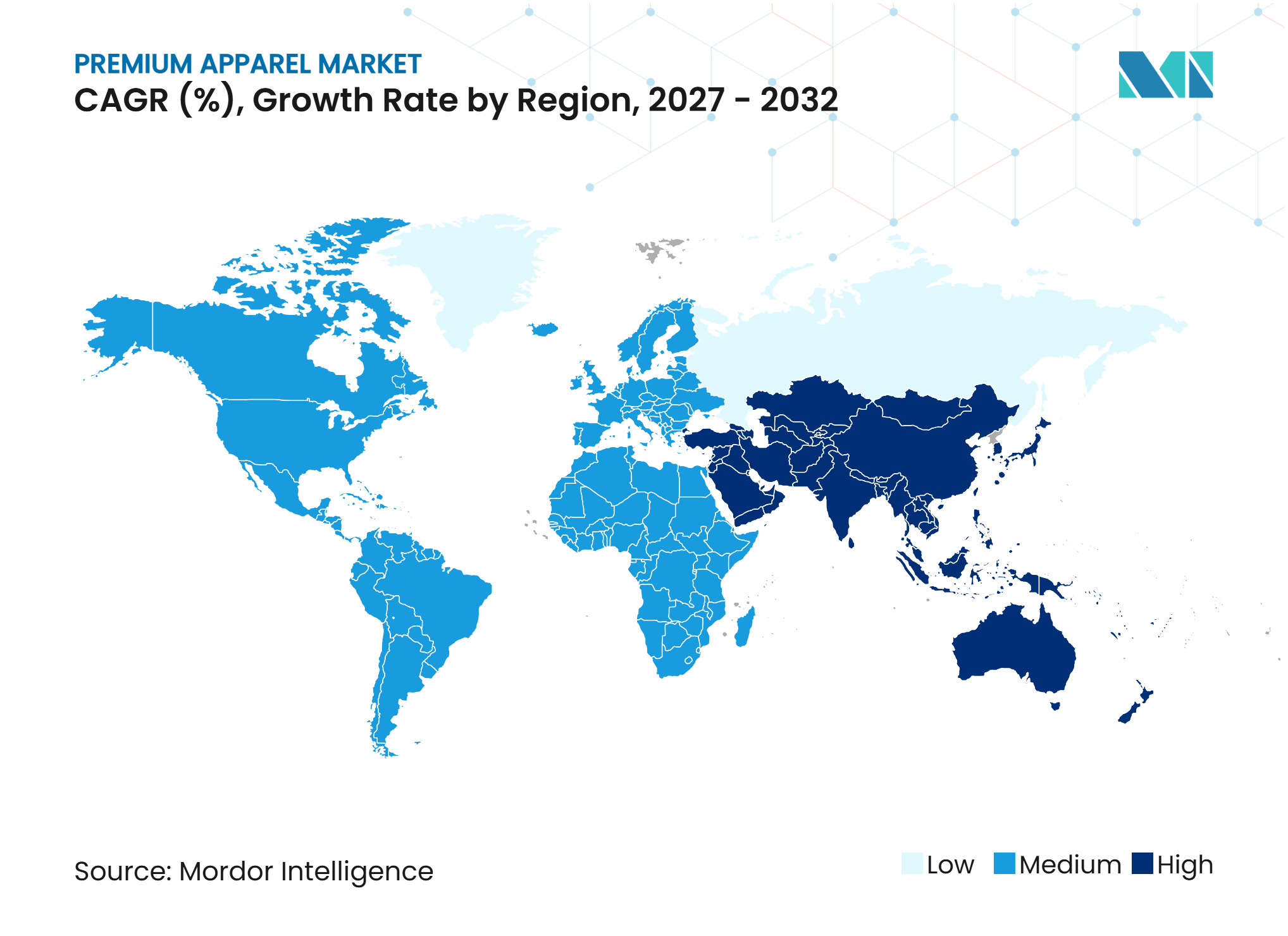
Asia-Pacific holds the largest share of the premium apparel market, accounting for 29.36% in 2026, and is also the fastest-growing region, projected to register a CAGR of 6.48% over 2027–2032. Its strong market position is supported by an expanding affluent consumer base, rising disposable incomes, and growing aspirations for international fashion brands. Growing exposure to global fashion trends, urbanization, and the expansion of premium retail infrastructure are further strengthening regional demand. Established fashion markets and emerging consumer economies are driving broader adoption of premium clothing, while rising digital retail penetration is improving access to premium brands, both international and domestic.
North America
North America represents a well-established premium apparel market, supported by strong brand presence, developed retail infrastructure, and established consumer familiarity with premium fashion. Demand is reinforced by the popularity of premium casualwear, sportswear, and lifestyle-oriented clothing, as well as continued interest in recognized international and domestic brands. The region's developed direct-to-consumer ecosystem and extensive physical retail networks also support brand accessibility and customer engagement. Furthermore, ongoing product innovation, evolving fashion preferences, and demand for differentiated apparel collections are sustaining opportunities for premium apparel brands across the region.
Europe, South America, and Middle East and Africa
Europe benefits from a strong heritage in luxury fashion, established premium apparel brands, and well-developed retail networks. Consumer interest in craftsmanship, distinctive designs, and recognized fashion labels continues to support regional demand. South America offers emerging opportunities as expanding affluent consumer groups, urbanization, and greater exposure to international fashion trends drive adoption of premium apparel. Meanwhile, the Middle East and Africa is benefiting from investments in high-end retail destinations, tourism-related shopping activity, and growing consumer interest in luxury and premium brands. Expanding retail availability and evolving lifestyle preferences are expected to support market development across these regions.
Competitive Landscape
Market Concentration
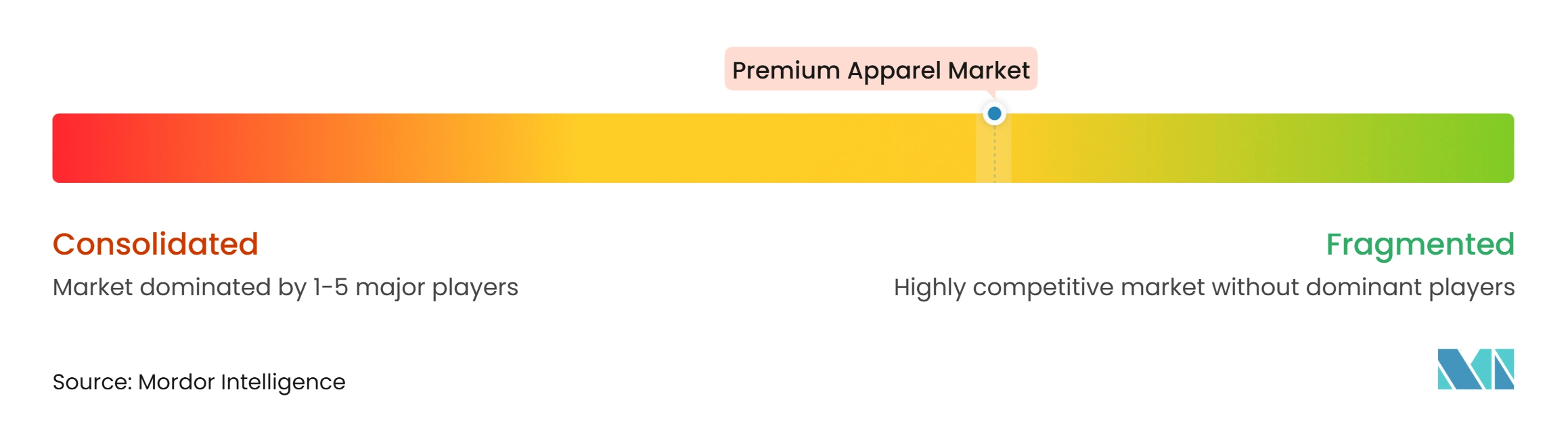
The premium apparel market is moderately fragmented, comprising a mix of diversified luxury conglomerates, established international fashion houses, and specialized premium apparel brands. Major participants include LVMH, Kering, Ralph Lauren, Chanel, and Hermès, which maintain strong market positions through established brand identities, extensive product portfolios, and international retail presence. These companies compete through brand recognition, product differentiation, design innovation, pricing strategies, and customer engagement. Their presence across multiple apparel categories and price tiers contributes to competitive intensity, while established brand heritage and customer loyalty remain important sources of market differentiation.
Leading players are focusing on strengthening their brand positioning, expanding product offerings, and improving retail experiences to maintain their competitive presence. Key strategic priorities include investment in flagship stores, expansion of direct-to-consumer channels, enhanced digital retail capabilities, and greater personalization of customer interactions. Companies are also refining product assortments, introducing new collections, and strengthening their presence across established and emerging consumer markets. Additionally, investments in supply chain capabilities, material innovation, and integrated retail strategies are supporting product differentiation and long-term brand development.
Emerging players and specialized premium apparel brands are gaining visibility through differentiated product offerings, focused brand identities, and targeted consumer engagement strategies. Direct-to-consumer brands, premium athleisure specialists, and niche fashion labels are expanding their presence by catering to specific lifestyle preferences and evolving apparel requirements. Smaller brands are also leveraging digital platforms, influencer collaborations, and community-led marketing to build consumer awareness and establish brand loyalty. Opportunities in specialized categories, including premium sportswear, children's apparel, and occasion-specific clothing, are providing additional avenues for emerging participants to strengthen their market presence.
Premium Apparel Industry Leaders
-
LVMH
-
Kering
-
Ralph Lauren
-
Chanel
-
Hermès
- *Disclaimer: Major Players sorted in no particular order
Premium Apparel Market Companies Covered in this Report
- LVMH
- Kering
- Ralph Lauren
- HUGO BOSS AG
- PVH Corp.
- Moncler S.p.A.
- Burberry Group plc
- Prada S.p.A.
- Giorgio Armani S.p.A.
- Chanel
- Hermès
- Lululemon Athletica Inc.
- Nike, Inc.
- adidas AG
- Canada Goose Holdings Inc.
- Columbia Sportswear Company
- VF Corporation
- Levi Strauss & Co.
- Patagonia, Inc.
- Aritzia Inc.
Recent Industry Developments in Premium Apparel Market
- May 2026: ASOS launched Muse Assembly, a premium contemporary womenswear label focused on occasion dressing. Its debut collection comprised 26 pieces, including dresses and coordinated outfits, with an emphasis on premium fabrics and refined finishing.
- March 2026: Mulberry entered a creative partnership with designer Christopher Kane to develop its women's ready-to-wear business. Kane was appointed Creative Director of Women's Ready-to-Wear, with the first Mulberry by Christopher Kane collection scheduled to debut in September 2026 and reach stores and online in January 2027.
- January 2026: Vera Wang introduced a new advanced contemporary ready-to-wear collection for women in the United Kingdom and Europe through its partnership with Batra Group. The Autumn/Winter 2026 collection included tailoring, knitwear, jersey, and outerwear, with market launch planned for May 2026.
- September 2025: Aditya Birla Fashion and Retail Limited launched Wishful, an accessible luxury women's occasion-wear brand targeting festive, wedding, and special-occasion apparel. The launch expanded the company's presence in the premium celebration-wear segment, with the collection initially showcased at W stores.
Global Premium Apparel Market Report Scope
The premium apparel market comprises high-quality clothing positioned above mass-market apparel, with an emphasis on design, materials, craftsmanship, brand value, and product differentiation. The Premium Apparel Market Report is segmented by product type into casual wear, formal wear, sportswear, nightwear/loungewear, intimate apparel, and other product types; by end user into women, men, and children; by fabric material into cotton, polyester, nylon, and silk; by distribution channel into offline stores and online stores; and by geography into North America, Europe, Asia-Pacific, South America, and the Middle East and Africa. The market forecasts are provided in USD.
Segmentation Overview
| Casual Wear |
| Formal Wear |
| Sportswear |
| Nightwear/Loungewear |
| Intimate Apparel |
| Others |
| Women |
| Men |
| Children |
| Cotton |
| Polyester |
| Nylon |
| Silk |
| Other Fabric Materials |
| Offline Stores |
| Online Stores |
| North America | United States |
| Canada | |
| Mexico | |
| Rest of North America | |
| Europe | Germany |
| United Kingdom | |
| Italy | |
| France | |
| Spain | |
| Netherlands | |
| Poland | |
| Belgium | |
| Sweden | |
| Rest of Europe | |
| Asia-Pacific | China |
| India | |
| Japan | |
| Australia | |
| Indonesia | |
| South Korea | |
| Thailand | |
| Singapore | |
| Rest of Asia-Pacific | |
| South America | Brazil |
| Argentina | |
| Colombia | |
| Chile | |
| Peru | |
| Rest of South America | |
| Middle East and Africa | South Africa |
| Saudi Arabia | |
| United Arab Emirates | |
| Nigeria | |
| Egypt | |
| Morocco | |
| Turkey | |
| Rest of Middle East and Africa |
| By Product Type | Casual Wear | |
| Formal Wear | ||
| Sportswear | ||
| Nightwear/Loungewear | ||
| Intimate Apparel | ||
| Others | ||
| By End User | Women | |
| Men | ||
| Children | ||
| By Fabric Material | Cotton | |
| Polyester | ||
| Nylon | ||
| Silk | ||
| Other Fabric Materials | ||
| By Distribution Channel | Offline Stores | |
| Online Stores | ||
| By Geography | North America | United States |
| Canada | ||
| Mexico | ||
| Rest of North America | ||
| Europe | Germany | |
| United Kingdom | ||
| Italy | ||
| France | ||
| Spain | ||
| Netherlands | ||
| Poland | ||
| Belgium | ||
| Sweden | ||
| Rest of Europe | ||
| Asia-Pacific | China | |
| India | ||
| Japan | ||
| Australia | ||
| Indonesia | ||
| South Korea | ||
| Thailand | ||
| Singapore | ||
| Rest of Asia-Pacific | ||
| South America | Brazil | |
| Argentina | ||
| Colombia | ||
| Chile | ||
| Peru | ||
| Rest of South America | ||
| Middle East and Africa | South Africa | |
| Saudi Arabia | ||
| United Arab Emirates | ||
| Nigeria | ||
| Egypt | ||
| Morocco | ||
| Turkey | ||
| Rest of Middle East and Africa | ||
Key Questions Answered in the Report
What is the premium apparel market size?
The premium apparel market size was USD 166.32 billion in 2026 and is forecast to reach USD 218.34 billion by 2032, growing at a 4.87% CAGR during 2027-2032.
Which product type leads premium apparel sales?
Casual Wear led product demand with a 43.73% share in 2026. Sportswear is the fastest-growing product type at a 6.37% CAGR through 2032.
Which customer group drives premium apparel demand?
Women accounted for 52.86% of sales in 2026. Children is forecast to grow fastest among end users at a 5.93% CAGR during 2027-2032.
Which region offers the strongest growth outlook?
Asia-Pacific held 29.36% of global sales in 2026 and is forecast to record a 6.48% CAGR during 2027-2032.