
Potato Powder Market Size and Share
Market Overview
| Study Period | 2022 - 2032 |
|---|---|
| Market Size (2027) | USD 557.86 Million |
| Market Size (2032) | USD 763.45 Million |
| Growth Rate (2027 - 2032) | 6.48 % |
| Fastest Growing Market | Asia-Pacific |
| Largest Market | North America |
| Market Concentration | Low |
Major Players *Disclaimer: Major Players sorted in no particular order Image © Mordor Intelligence. Reuse requires attribution under CC BY 4.0. | |
Potato Powder Market Analysis by Mordor Intelligence
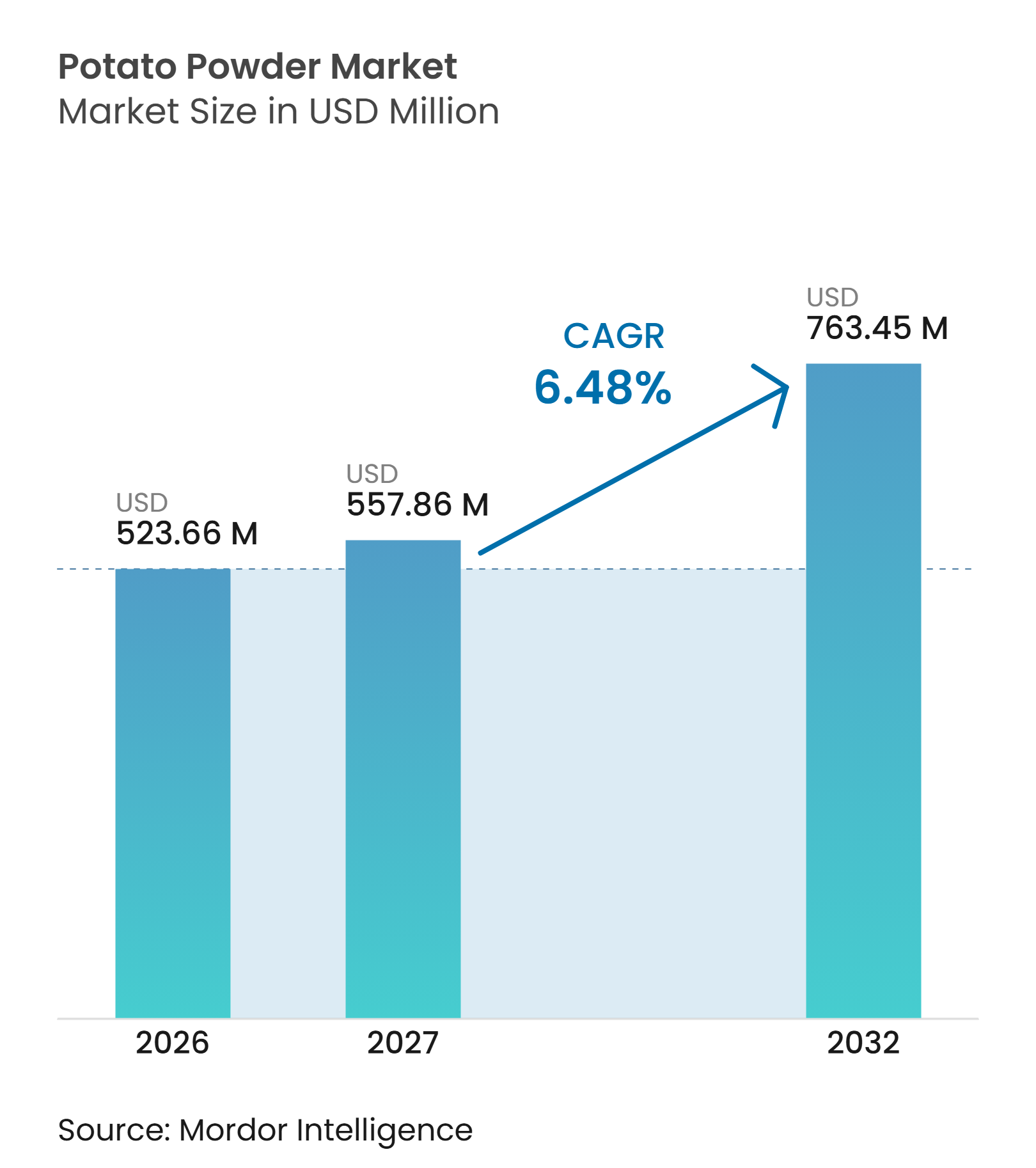
The potato powder market size was valued at USD 523.66 million in 2026 and is estimated to grow from USD 557.86 million in 2027 to reach USD 763.45 million by 2032, at a CAGR of 6.48% during the forecast period (2027-2032). The potato powder market benefits from food manufacturers’ demand for ingredients that are easier to store, transport, and use across diverse production environments. Its application in dry mixes, snacks, sauces, bakery products, and institutional kitchens supports demand, particularly in areas with limited refrigerated storage. Processing capacity is shifting closer to demand centers in Asia, changing how suppliers compete for regional food accounts. Large processors are expanding capacity and product grades, while regional suppliers are strengthening certifications and export capabilities.
Key Report Takeaways
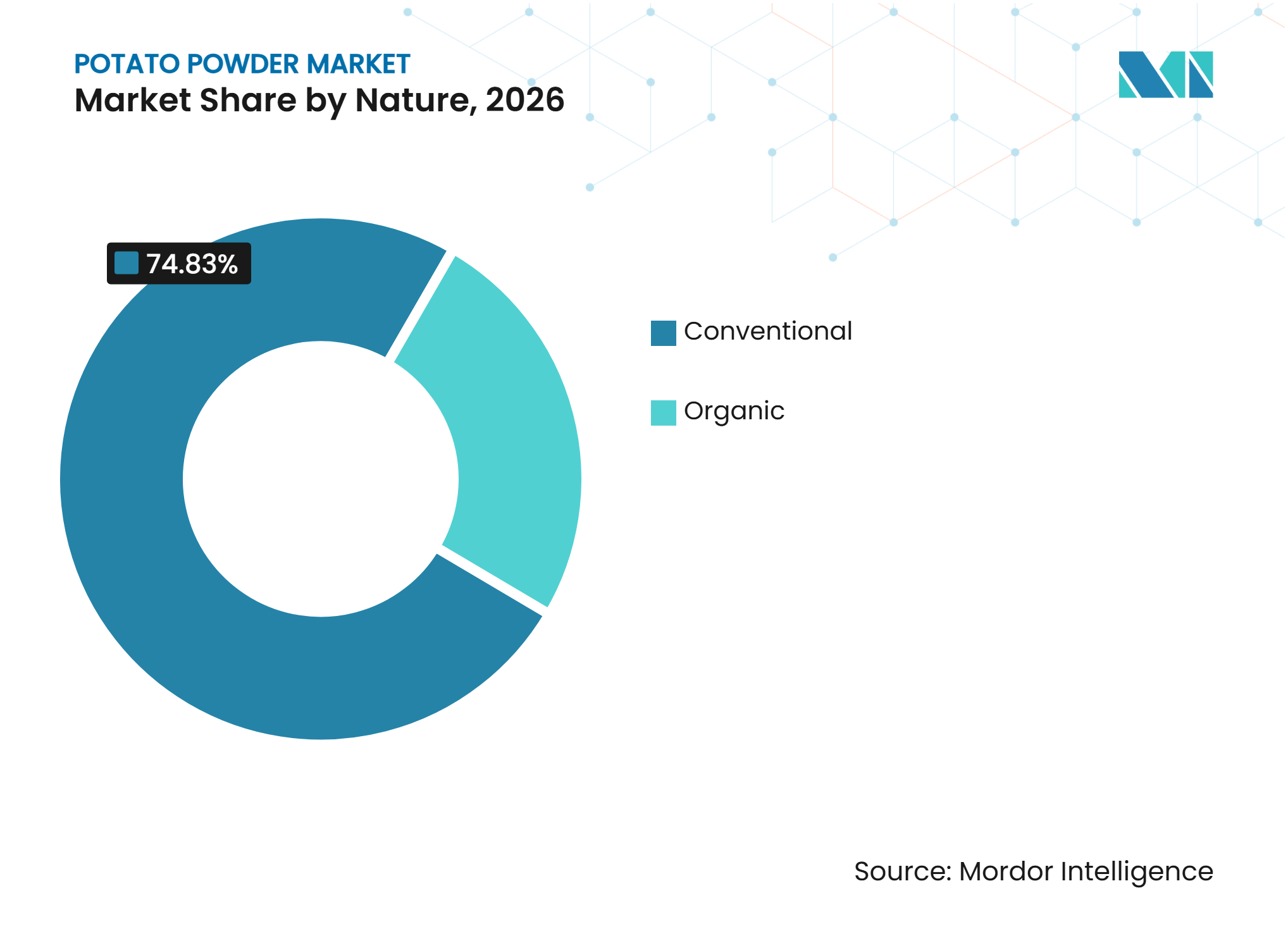
- By nature, conventional potato powder dominated the market with a share of 74.83% in 2026, while organic potato powder is anticipated to register the fastest CAGR of 7.58% during 2027-2032.
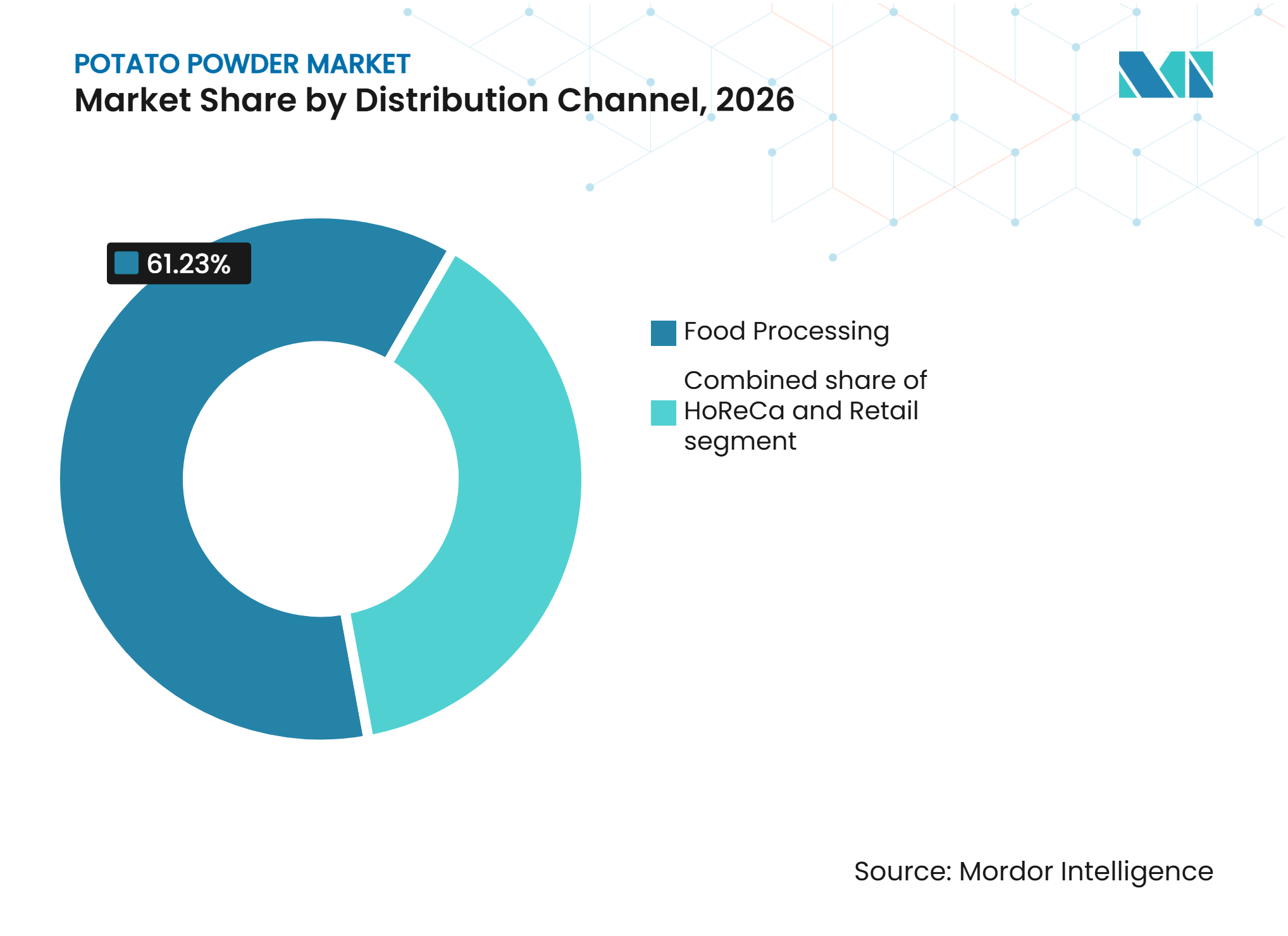
- By distribution channel, the food processing industry dominated the market with a share of 61.23% in 2026, while the retail segment is anticipated to register the fastest CAGR of 7.73% during 2027-2032.
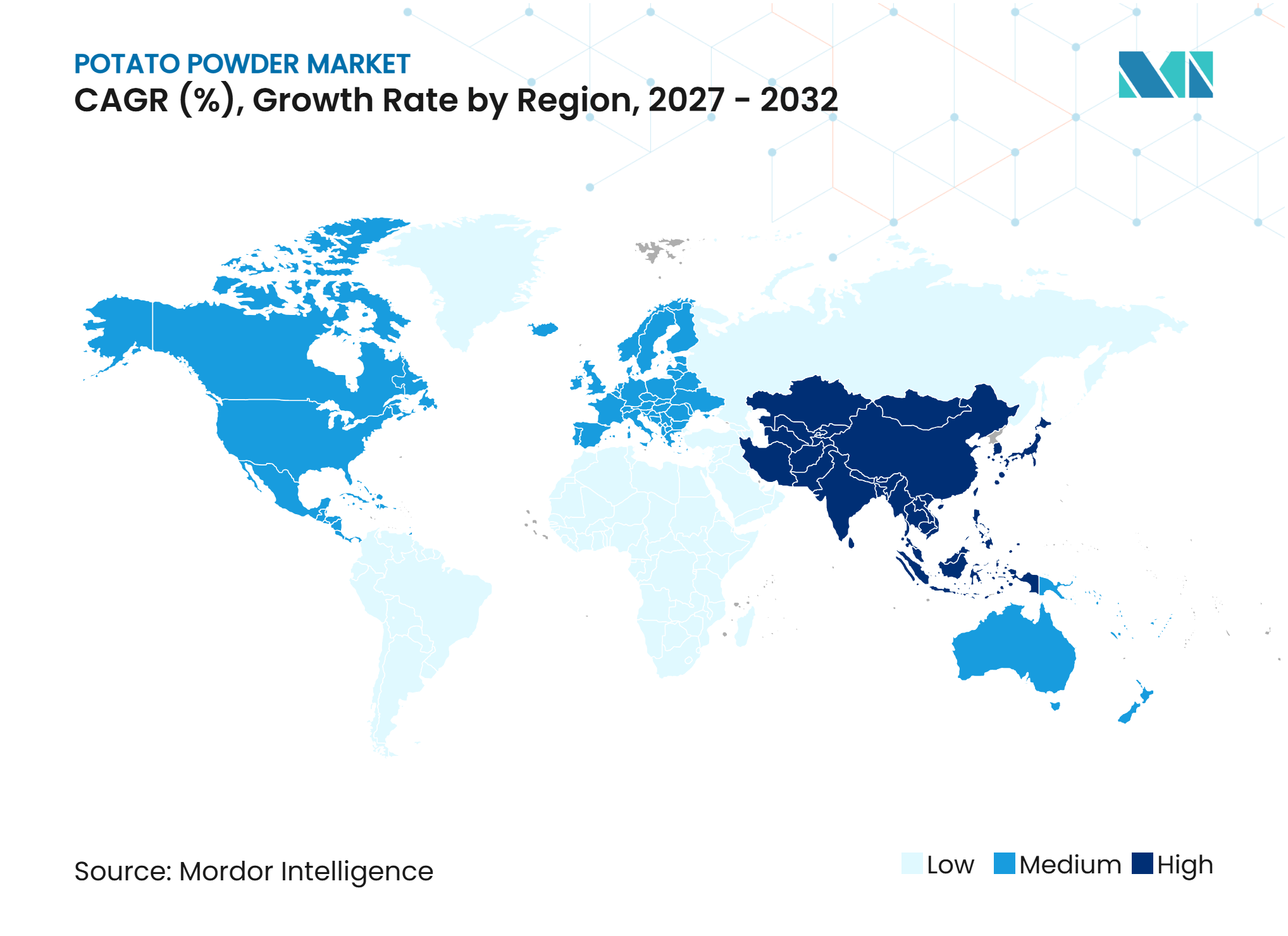
- By geography, North America dominated the potato powder market with a share of 38.12% in 2026, while Asia-Pacific is anticipated to register the fastest CAGR of 7.92% during 2027-2032.
Note: Market numbers in this report are based on Mordor Intelligence's proprietary estimation framework, which combines nine months of actuals with Q4 projections for base year 2026.
Market Trends and Insights
Drivers Impact Analysis of Potato Powder Market*
| Driver | (~) % Impact on CAGR Forecast | Geographic Relevance | Impact Timeline |
|---|---|---|---|
| Rising demand for convenience and ready-to-eat food products | +1.4% | Global, with Asia-Pacific and North America as primary demand engines | Long term (≥ 4 years) |
| Expanding applications in the snacks and savory food industry | +1.1% | Asia-Pacific and North America, with spillover to Middle East and Africa | Medium term (2-4 years) |
| Potato processing capacity and investment expansion | +0.9% | Asia-Pacific, North America, and Eastern Europe | Short term (≤ 2 years) |
| Increasing adoption in commercial foodservice and institutional kitchens | +0.7% | Asia-Pacific and the Middle East | Medium term (2-4 years) |
| Growing use of potato powder as a functional ingredient in bakery and food formulations | +0.8% | Europe and North America, with emerging adoption in Asia-Pacific | Long term (≥ 4 years) |
| Longer shelf life and improved storage convenience | +0.5% | Global, with strong relevance in the Middle East, Africa, and South America | Short term (≤ 2 years) |
| Source: Mordor Intelligence | |||
Rising Demand for Convenience and Ready-to-Eat Food Products
The potato powder market serves food companies that require ingredients with a long shelf life and simple preparation. Powdered formats reduce the handling requirements associated with fresh potatoes and limit reliance on refrigerated storage. Quick-service restaurants and institutional caterers use ambient ingredients when standardized preparation and consistent output are critical. Foodservice purchasing becomes more stable when restaurant groups include potato-based ingredients in approved supplier specifications. Longer shelf life also supports demand in markets with limited cold-chain capacity and underdeveloped last-mile logistics. Additionally, easier storage and transportation enable food manufacturers to maintain ingredient inventories and streamline procurement across multiple production locations.
Expanding Applications in the Snacks and Savory Food Industry
Potato powder is gaining broader application in the snack and savory food industry due to its versatility in product formulation, texture development, and processing convenience. Manufacturers use dehydrated potato ingredients in extruded snacks, fabricated chips, snack pellets, potato-based sticks, and savory coatings to impart potato flavor, improve binding, and ensure consistent texture. Potato powder also supports the production of snack fillings and formed products, helping manufacturers simplify preparation and maintain uniform product characteristics. In October 2026, the Press Information Bureau of the Government of India highlighted the processing applications of the Kufri Jamunia potato variety, including its conversion into dehydrated ingredients such as potato flour for use in processed food formulations, snack products, and breakfast preparations[1]. This development demonstrates the potential to diversify potato-derived ingredients across food applications. For snack manufacturers, potato powder offers an adaptable ingredient for developing differentiated products with distinct flavor, texture, and nutritional characteristics.
Potato Processing Capacity and Investment Expansion
Investment in broader dehydrated potato capacity influences the potato powder market, as flakes, granules, and powder can share raw materials, storage, and processing infrastructure. Agristo began construction of a production facility in Grand Forks, North Dakota, with a minimum investment of USD 450 million and a targeted operational start in summer 2028. Increased processing capacity can improve raw material utilization and expand sourcing options for buyers. Capacity additions can also mitigate the effects of localized supply disruptions when plants produce multiple product formats. Investment in cold storage and contract farming remains essential, as new processing lines require a reliable supply of raw potatoes. Such investments also encourage stronger coordination between potato growers and processors, supporting more consistent raw material quality and long-term supply planning.
Growing Use of Potato Powder as a Functional Ingredient in Bakery and Food Formulations
Potato powder is increasingly used as a functional ingredient in bakery and other food formulations due to its water-binding, thickening, and texture-enhancing properties. In bakery applications, manufacturers incorporate it into bread, biscuits, cookies, cakes, and savory baked products to improve moisture retention, maintain product consistency, and achieve a softer texture. Food manufacturers also use potato powder in soups, sauces, gravies, instant mixes, fillings, and prepared meals to attain the required thickness and formulation stability. In September 2026, the Indian Council of Agricultural Research–Central Potato Research Institute (ICAR-CPRI) updated its list of commercialized technologies to include dehydrated potato products, such as potato flour, semolina, porridge, and daliya[2]. The institute reported that it has licensed the technology to four entrepreneurs. Their functional properties and adaptability across sweet and savory products provide manufacturers with greater formulation flexibility and support the development of value-added processed foods.
Restraints Impact Analysis of Potato Powder Market*
| Restraint | (~) % Impact on CAGR Forecast | Geographic Relevance | Impact Timeline |
|---|---|---|---|
| Volatility in raw potato prices and seasonal availability | -1.0% | Europe, Asia-Pacific, and Eastern Europe | Short term (≤ 2 years) |
| High energy consumption and processing costs | -0.8% | Europe and North America | Medium term (2-4 years) |
| Fluctuations in potato crop yields and raw material quality | -0.7% | Europe, North America, and India | Short term (≤ 2 years) |
| Competition from alternative ingredients and substitutes | -0.6% | Global, with strong pressure in Europe and Asia-Pacific food formulations | Long term (≥ 4 years) |
| Source: Mordor Intelligence | |||
Volatility in Raw Potato Prices and Seasonal Availability
Potato powder manufacturers rely on a consistent supply of suitable-quality raw potatoes, making the market vulnerable to seasonal availability and procurement price fluctuations. Potato harvesting occurs during specific seasons, while fresh-crop arrivals, cold-storage inventories, weather conditions, and regional supply variations influence raw material availability throughout the year. In March 2026, the Government of India’s Agricultural and Processed Food Products Export Development Authority (APEDA) reported that domestic potato prices had declined by 25% year-on-year, driven by peak harvest arrivals and increased domestic availability[3]. Such price volatility makes it difficult for potato powder manufacturers to maintain stable procurement costs and consistent production schedules. Consequently, processors may need to strengthen cold-storage capacity, diversify sourcing regions, and establish long-term procurement agreements to reduce exposure to seasonal supply disruptions.
High Energy Consumption and Processing Costs
Potato dehydration is energy-intensive, as drying and ingredient processing involve heat-intensive stages, including washing, cooking, drying, milling, and packaging. European processors also face energy market volatility and carbon compliance costs under the European Union Emissions Trading System. Companies that invest in energy-efficient equipment, waste-heat recovery, and renewable energy systems are better positioned to manage these costs. Variations in crop yields and competition from tapioca starch, rice flour, and pea starch further increase the need for cost control and application-specific product development. Smaller processors may face additional pressure, as the substantial upfront investment required for energy-efficient machinery can limit their ability to achieve economies of scale and maintain competitive production costs.
*Our forecasts treat driver/restraint impacts as directional, not additive. The impact forecasts reflect baseline growth, mix effects, and variable interactions.
Potato Powder Market Segment Analysis
By Nature:
Conventional Products Retain Scale While Organic Products Grow FasterConventional potato powder accounted for 74.83% of the potato powder market in 2026. This segment maintains its leading position due to its widespread use in food processing, foodservice, and institutional applications, where procurement teams prioritize cost, availability, and standardized performance. Manufacturers use conventional potato powder in bakery and confectionery products, snacks and savory foods, soups, sauces, seasonings, and ready-to-eat foods. Its water-binding and texture-modifying properties provide manufacturers with flexibility across multiple product categories. Established manufacturing infrastructure and broader availability of conventional raw materials also support consistent procurement for large-scale food production.
Organic potato powder is projected to grow at a CAGR of 7.58% through 2032, outpacing the overall market growth rate. The segment benefits from manufacturers’ use of certified inputs to support clean-label product positioning. However, these requirements can increase the cost and time required to enter the category. Segregated storage and certified sourcing also make capacity expansion more challenging than conventional production. Established processors with integrated raw material supply chains and robust documentation systems are better positioned to serve organic buyers. The segment also offers opportunities for suppliers to serve premium food manufacturers seeking traceable ingredients that align with organic product standards and consumer preferences.


By Distribution Channel:
Food Processing Holds Volume While Retail ExpandsFood processing accounted for 61.23% of the potato powder market share in 2026. Manufacturers use potato powder in bakery and confectionery products, snacks, soups, sauces, seasonings, and ready-to-eat foods. Its neutral flavor and rapid rehydration properties support industrial meal production and instant food manufacturing. Commercial kitchens and quick-service restaurants also use potato powder to reduce fresh potato handling and improve preparation consistency. These customers prioritize supply reliability, as ingredient disruptions can affect standardized menus and factory output.
The retail segment is forecast to grow at a CAGR of 7.73% through 2032. Packaged mixes and dehydrated formats appeal to households seeking convenient pantry products. Online retail increases the visibility of specialty and organic products, as smaller brands do not require extensive physical shelf placement. The expansion of supermarkets and hypermarkets also supports broader access to packaged food products in urban areas. However, retail suppliers must balance product variety with clear usage instructions and consistent product quality. While the retail channel provides an avenue for differentiated products, food processing remains the primary volume base for the potato powder market.

Geography Analysis
North America
North America accounted for 38.12% of potato powder market in 2026. The region benefits from a large, technologically advanced potato processing base supported by well-established farming, storage, and food manufacturing networks. In July 2025, Maine enacted legislation (LD 1951) extending tax credits to support the expansion of an existing potato processing facility in Washburn and the development of a new potato chip manufacturing plant at Loring Commerce Centre in Limestone. These developments are expected to strengthen the region's investment environment for potato-based food processing. North America's established processing infrastructure and access to agricultural raw materials support the availability of processed potato ingredients for food manufacturers. These capabilities enable processors to meet varying ingredient specifications and supply requirements across bakery, snack, convenience food, and foodservice applications.
Asia-Pacific
Asia-Pacific is forecast to grow at a CAGR of 7.92% through 2032, making it the fastest-growing regional segment. Rising urban consumption, the expansion of quick-service restaurant networks, and investments in local food manufacturing are driving demand for dehydrated potato ingredients. In July 2025, McCain invested USD 480 million in a potato processing facility in Madhya Pradesh, India, underscoring the importance of local supply in the region. Food safety regulations and buyer certification standards will remain critical as local processors pursue contracts with multinational food companies. The region’s expanding production base is also reducing its dependence on imports from traditional Western suppliers.
Europe, South America, and the Middle East and Africa
Europe remains an important production center; however, high energy costs, carbon compliance requirements, and raw material uncertainty challenge processors without integrated supply arrangements. Investments in energy efficiency and product development can help European firms maintain their position in specialty grades. In South America, urban food consumption and the expansion of quick-service restaurants support demand, while limited local processing capacity creates opportunities for imported ingredients. The Middle East and Africa generate demand from catering, airline foodservice, and packaged food manufacturing, where ambient storage offers significant value. Products with consistent quality and extended shelf stability are particularly relevant in markets where logistics constraints limit reliable cold-chain or import access.
Competitive Landscape
Market Concentration
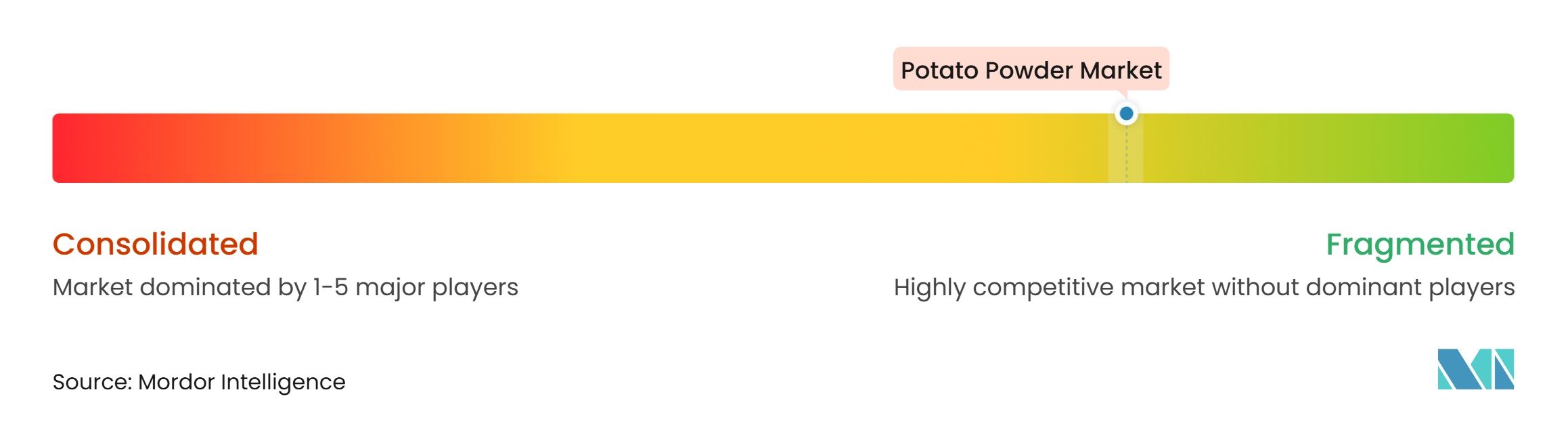
The potato powder market is fragmented, with participants including McCain Foods, Lamb Weston, Aviko, Emsland Group, J.R. Simplot, regional processors, and private-label suppliers. Large integrated companies leverage broad distribution networks and have the resources to invest in processing capacity, sustainability initiatives, and specialized product grades. Regional processors compete through lower costs, access to local raw materials, and flexible service for nearby food manufacturers. Buyers can source from multiple suppliers, limiting the pricing power of individual companies. This structure creates opportunities for specialist producers offering application-specific ingredients.
Companies increasingly focus on expanding regional capacity and deepening their product portfolios. Emsland Group’s development of potato-based snack solutions reflects a product strategy targeting low-fat, protein-enriched, and clean-label food applications. These initiatives enable established companies to address demand beyond commodity reconstitution products and increase the importance of technical support in supplier selection.
Indian and other regional processors can gain market share by combining competitive production costs with recognized food safety and quality systems. Their expansion may intensify competition for Asian supply contracts historically served by European or North American suppliers. European suppliers can respond by offering specialty grades, application support, and stronger regional distribution relationships. Commodity-grade suppliers face increasing pressure as customers qualify multiple producers. Consequently, the potato powder market rewards investments in reliable supply, certifications, and functional product development.
Potato Powder Industry Leaders
-
McCain Foods Limited
-
Lamb Weston Holdings, Inc.
-
Aviko B.V.
-
AGRANA Beteiligungs-AG
-
Bob’s Red Mill Natural Foods, Inc.
- *Disclaimer: Major Players sorted in no particular order
Potato Powder Market Companies Covered in this Report
- McCain Foods Limited
- Lamb Weston Holdings, Inc.
- Aviko B.V.
- Emsland Group
- Idahoan Foods, LLC
- Idaho Pacific Corporation
- Rixona B.V.
- Agrarfrost GmbH and Co. KG
- Lutosa SA
- Garlico Industries
- AGRANA Beteiligungs-AG
- Bob’s Red Mill Natural Foods, Inc.
- Idaho Supreme Potatoes Inc.
- Oregon Potato Company
- Augason Farms
- KMC Ingredients
- Birkamidon Rohstoffhandels GmbH
- Euro Foods Industries
- J.R. Simplot Company
- Chhatariya Foods Pvt. Ltd.
Recent Industry Developments in Potato Powder Market
- August 2025: Jepuan Peruna, Finland, completed a 4,500 m² factory extension and added a new production line featuring modern peeling technology and energy-efficient solutions.
- August 2025: Dutch potato ingredient producer Royal Avebe announced the acquisition of Solan, a Poland-based manufacturer of potato flakes and granules. The acquisition gave Avebe full ownership of Solan and added Solan’s established production technology, customer relationships, and processing expertise to Avebe’s portfolio.
- May 2025: Lutosa SA, Belgium, inaugurated a EUR 225 million investment at its Waregem site, including a new potato flake production line.
Global Potato Powder Market Report Scope
Potato powder is a dehydrated potato ingredient produced by drying and finely grinding processed potatoes into a shelf-stable powder.
The potato powder market is segmented by nature, distribution channel, and geography. By nature, the market is segmented into organic and conventional. By distribution channel, the market is segmented into food processing (bakery and confectionery, snacks and savory products, soups, sauces and seasonings, ready-to-eat and convenience foods, and other food and beverage applications), HoReCa, and retail (hypermarkets and supermarkets, convenience/grocery stores, online retail, and other distribution channels). Based on geography, the market is classified into North America, Europe, South America, Asia-Pacific, and the Middle East and Africa. The market forecasts are provided in terms of value (USD).
Segmentation Overview
| Organic |
| Conventional |
| Food Processing | Bakery and Confectionery |
| Snacks and Savory Products | |
| Soups, Sauces and Seasonings | |
| Ready-to-Eat and Convenience Foods | |
| Other Food and Beverage Applications | |
| HoReCa | |
| Retail | Hypermarkets and Supermarkets |
| Convenience/Grocery Stores | |
| Online Retail | |
| Other Distribution Channels |
| North America | United States |
| Canada | |
| Mexico | |
| Rest of North America | |
| Europe | Germany |
| United Kingdom | |
| Italy | |
| France | |
| Spain | |
| Netherlands | |
| Rest of Europe | |
| Asia-Pacific | China |
| India | |
| Japan | |
| Australia | |
| Indonesia | |
| Thailand | |
| Rest of Asia-Pacific | |
| South America | Brazil |
| Argentina | |
| Rest of South America | |
| Middle East and Africa | South Africa |
| Saudi Arabia | |
| United Arab Emirates | |
| Turkey | |
| Rest of Middle East and Africa |
| By Nature | Organic | |
| Conventional | ||
| By Distribution Channel | Food Processing | Bakery and Confectionery |
| Snacks and Savory Products | ||
| Soups, Sauces and Seasonings | ||
| Ready-to-Eat and Convenience Foods | ||
| Other Food and Beverage Applications | ||
| HoReCa | ||
| Retail | Hypermarkets and Supermarkets | |
| Convenience/Grocery Stores | ||
| Online Retail | ||
| Other Distribution Channels | ||
| By Geography | North America | United States |
| Canada | ||
| Mexico | ||
| Rest of North America | ||
| Europe | Germany | |
| United Kingdom | ||
| Italy | ||
| France | ||
| Spain | ||
| Netherlands | ||
| Rest of Europe | ||
| Asia-Pacific | China | |
| India | ||
| Japan | ||
| Australia | ||
| Indonesia | ||
| Thailand | ||
| Rest of Asia-Pacific | ||
| South America | Brazil | |
| Argentina | ||
| Rest of South America | ||
| Middle East and Africa | South Africa | |
| Saudi Arabia | ||
| United Arab Emirates | ||
| Turkey | ||
| Rest of Middle East and Africa | ||
Key Questions Answered in the Report
What is the current size and future growth outlook of the potato powder market?
The potato powder market was valued at USD 523.66 million in 2026 and is estimated to reach USD 557.86 million in 2027. The market is projected to grow to USD 763.45 million by 2032, registering a CAGR of 6.48% during 2027–2032.
Which nature segment held the largest share of the potato powder market in 2026?
The conventional segment was the largest nature segment in 2026, accounting for 74.83% of the potato powder market.
Which distribution channel held the largest share of the potato powder market in 2026?
Food processing was the largest distribution channel in 2026, accounting for 61.23% of the potato powder market.
Which region held the largest share of the potato powder market in 2026?
North America was the largest regional market in 2026, accounting for 38.12% of the potato powder market.