
Potassium Fluoride Market Size and Share
Market Overview
| Study Period | 2022 - 2032 |
|---|---|
| Market Size (2027) | USD 455.18 Million |
| Market Size (2032) | USD 543.48 Million |
| Growth Rate (2027 - 2032) | 3.61 % |
| Fastest Growing Market | Asia-Pacific |
| Largest Market | Asia-Pacific |
| Market Concentration | Medium |
Major Players *Disclaimer: Major Players sorted in no particular order Image © Mordor Intelligence. Reuse requires attribution under CC BY 4.0. | |
Potassium Fluoride Market Analysis by Mordor Intelligence
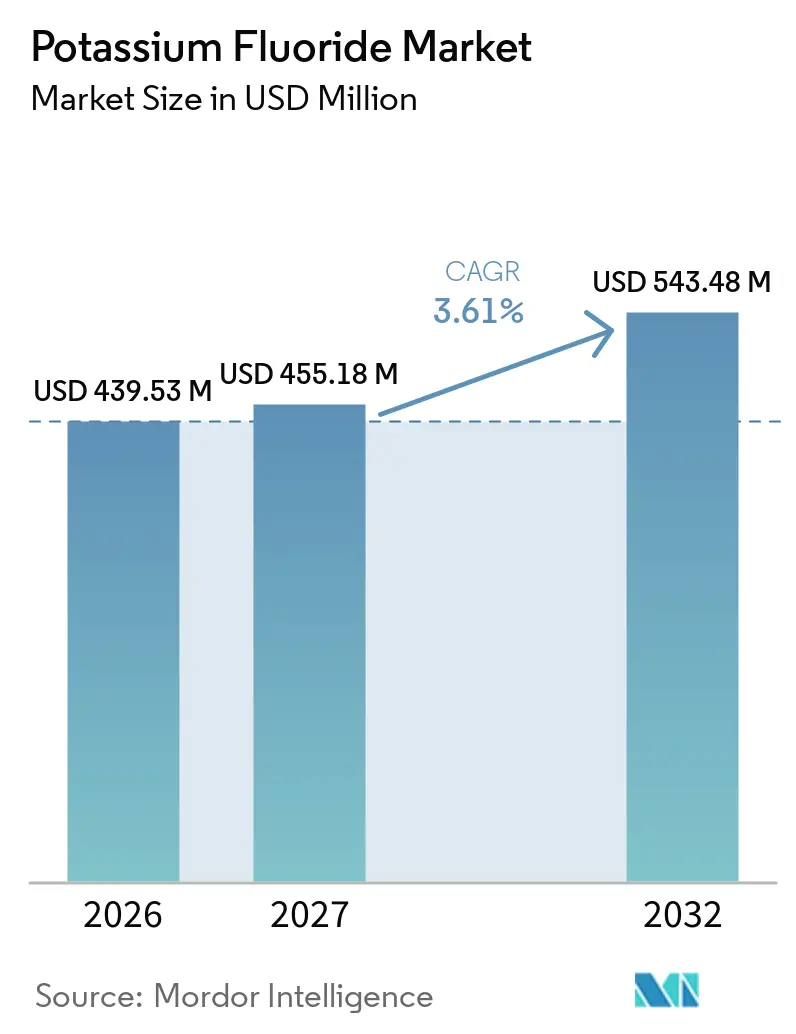
The Potassium Fluoride Market size was valued at USD 439.53 million in 2026 and is estimated to grow from USD 455.18 million in 2027 to reach USD 543.48 million by 2032, at a CAGR of 3.61% during the forecast period (2027-2032). Demand is supported by wider use of fluorinated inputs in crop-protection chemicals, pharmaceutical synthesis, semiconductor processing, specialty glass, and metal treatment. Potassium fluoride is also gaining attention where manufacturers seek fluorination routes that avoid direct use of hydrogen fluoride, including work published by Oxford researchers and Pfizer collaborators in 2026. Production economics remain sensitive to fluorspar availability because hydrofluoric acid is a necessary upstream input, and the United States remains fully import reliant for fluorspar. The potassium fluoride market is becoming more dependent on suppliers that can control feedstock quality, meet safety requirements, and produce consistent high-purity material. These conditions favor established fluorochemical producers while creating room for suppliers that can serve electronics and pharmaceutical customers with qualified grades.
Key Report Takeaways
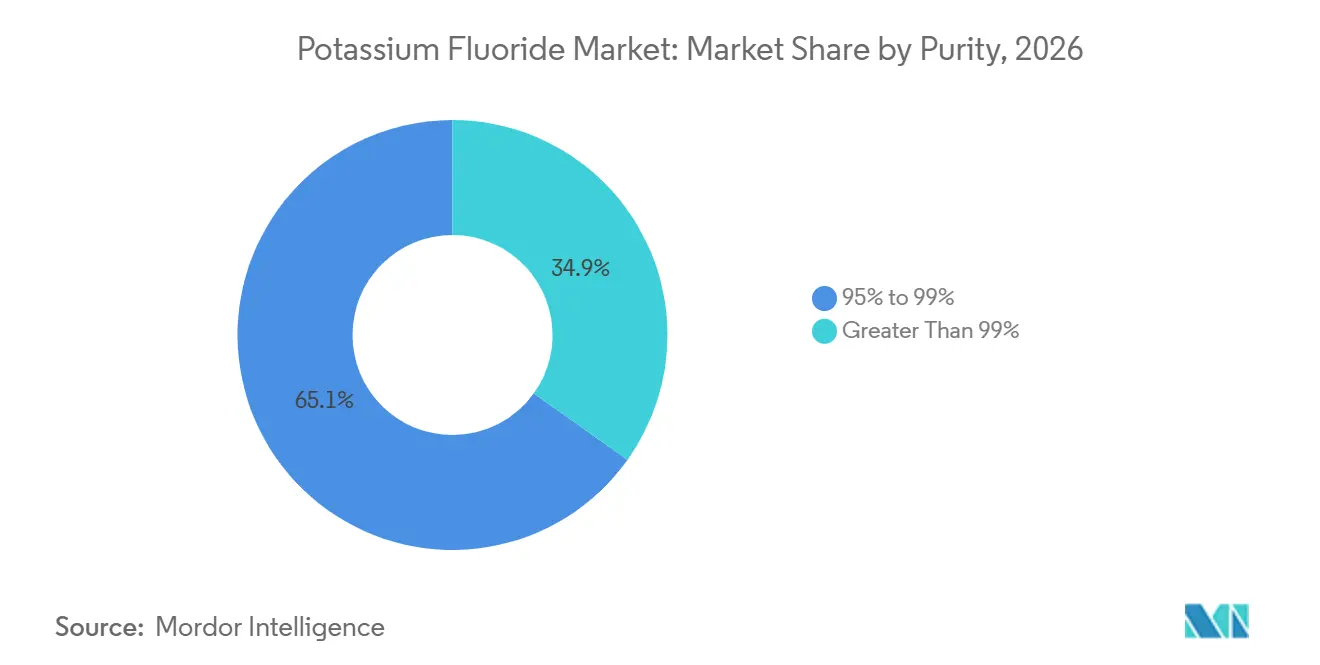
- By purity, the 95% to 99% held 65.12% of the potassium fluoride market share in 2026, while the greater than 99% is forecast to advance at a 3.89% CAGR through 2032.
- By form, solid potassium fluoride held 80.27% of the potassium fluoride market share in 2026 and is forecast to advance at a 4.04% CAGR through 2032.
- By application, agrochemical formulations held 38.35% of the potassium fluoride market share in 2026 and are forecast to advance at a 4.26% CAGR through 2032.
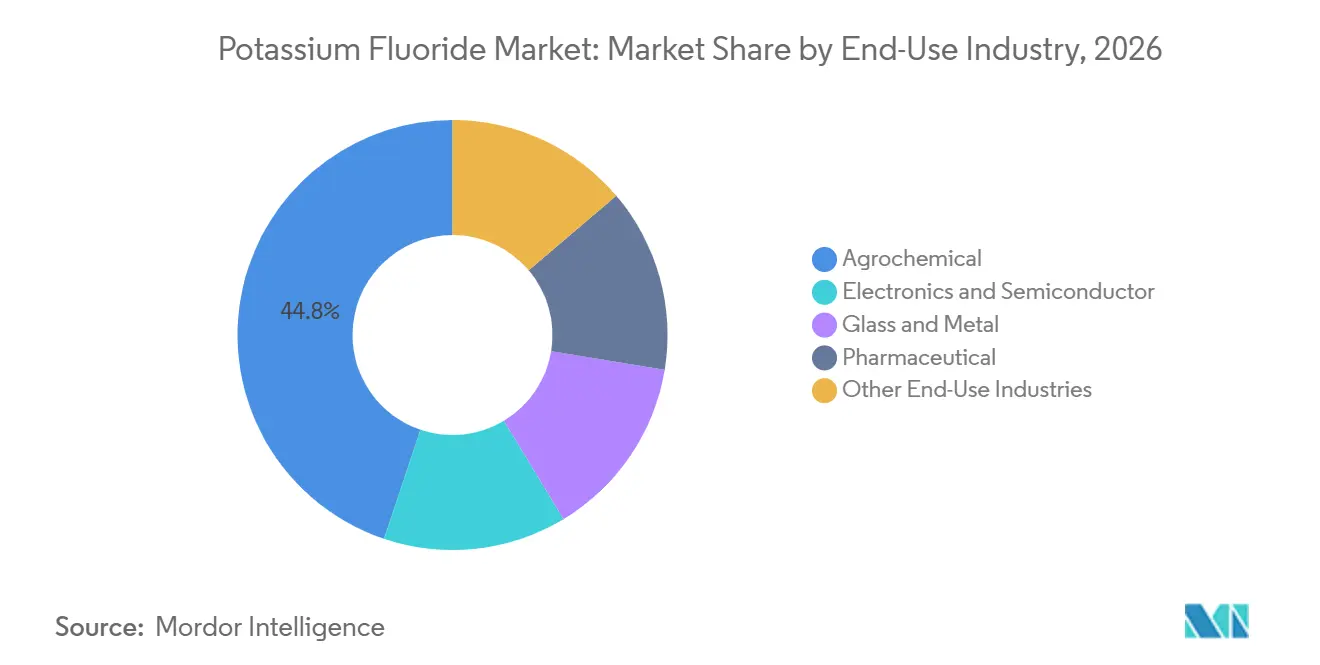
- By end-use industry, agrochemicals held 44.83% of the potassium fluoride market share in 2026 and are forecast to advance at a 4.41% CAGR through 2032.
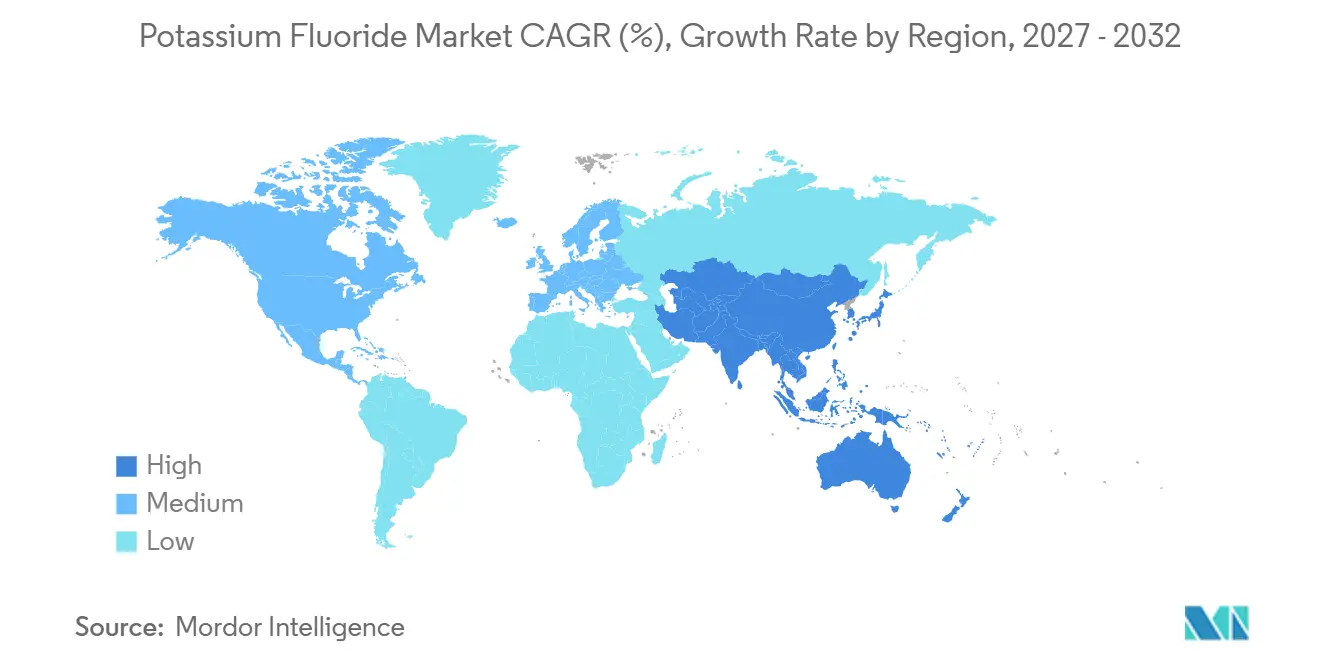
- By geography, Asia-Pacific held 39.44% of the potassium fluoride market share in 2026 and is forecast to advance at a 4.33% CAGR through 2032.
Note: Market numbers in this report are based on Mordor Intelligence's proprietary estimation framework, which combines nine months of actuals with Q4 projections for base year 2026.
Market Trends and Insights
Drivers Impact Analysis of Potassium Fluoride Market*
| Driver | (~) % Impact on CAGR Forecast | Geographic Relevance | Impact Timeline |
|---|---|---|---|
| Expansion of Fluorinated Pharmaceutical and Agrochemical Synthesis | +1.2% | Global, concentrated in Asia-Pacific, Europe, and North America | Long term (≥ 4 years) |
| Rising Semiconductor and Display Manufacturing Demand for High-Purity Fluoride Reagents | +0.9% | East Asia (China, South Korea, Japan), ASEAN, and India | Medium term (2-4 years) |
| Asia-Pacific Fluorochemical Capacity Expansion and Supply-Chain Localization | +0.7% | Asia-Pacific core, with spillover to global supply | Medium term (2-4 years) |
| Growth in Glass Etching, Metallurgy, and Welding-Flux Applications | +0.5% | Global, with significant activity in Europe and North America | Short term (≤ 2 years) |
| Battery Materials and Electrolyte-Additive Research Demand | +0.4% | Global, with R&D concentration in Asia-Pacific and North America | Long term (≥ 4 years) |
| Source: Mordor Intelligence | |||
Expansion of Fluorinated Pharmaceutical and Agrochemical Synthesis
Fluorine has become more common in newly developed crop-protection products and pharmaceutical compounds. A 2025 review found that fluorinated pesticides accounted for more than half of newly approved pesticides, while nearly 70% of agrochemicals approved in recent years contained at least 1 fluorine substituent. This supports a durable need for fluoride sources used in halogen-exchange reactions and other synthesis steps. The potassium fluoride market benefits because the compound provides fluoride ions without requiring manufacturers to handle hydrogen fluoride directly in every process. Oxford and Pfizer researchers reported a potassium fluoride-based Appel fluorination method that converted alcohols into alkyl fluorides and produced more than 80 fluorinated molecules, including enantioenriched pharmaceutical intermediates[1]. The method may increase demand for tightly specified grades where drug-development and process-chemistry teams require predictable impurity control.
Rising Semiconductor and Display Manufacturing Demand for High-Purity Fluoride Reagents
Semiconductor fabrication requires highly controlled chemical inputs for cleaning, etching, and deposition processes. High-purity potassium fluoride can support silicon-oxide removal and related wafer-processing applications where trace contaminants can reduce process yields. The potassium fluoride market, therefore, has an opportunity to move toward grades with stronger qualification requirements and higher technical service needs. Gujarat Fluorochemicals Limited identified electronic specialty chemicals as a planned investment area in its FY2026-27 capital program. India has also increased its policy focus on semiconductor manufacturing, which supports local investment in electronic materials and associated chemical supply chains. Suppliers that can document product consistency, packaging integrity, and contamination controls are better positioned to serve this demand.
Asia-Pacific Fluorochemical Capacity Expansion and Supply-Chain Localization
Asia-Pacific combines a large fluorochemical manufacturing base with expanding downstream demand from agriculture, electronics, automotive production, and specialty chemicals. The potassium fluoride market in the region benefits when producers integrate hydrofluoric acid, fluorine intermediates, and finished specialty products within shorter supply chains. Gujarat Fluorochemicals Limited reported investments across fluorochemicals, battery materials, and electronic specialty chemicals, which reflect this broader regional move toward integrated capacity. Aarti Industries Ltd. also described backward-integration activity at Dahej that is intended to improve feedstock security for its specialty chemical operations. Local production can reduce exposure to import delays and improve coordination with customers who need regular deliveries. It can also increase competition for standard grades as more regional suppliers seek to capture domestic demand.
Growth in Glass Etching, Metallurgy, and Welding-Flux Applications
Glass etching, aluminum brazing, welding flux, and surface-treatment processes provide a stable industrial base for the potassium fluoride market. Potassium fluoride can supply fluoride activity in formulations that need controlled melting behavior, surface preparation, or oxide removal. These applications are less dependent on a single technology cycle than electronics, which can help balance demand across the supplier base. MORITA CHEMICAL INDUSTRIES CO., LTD. lists fluorine chemical production at its Sakai operations, where the company serves advanced fluorine-material applications. Automotive lightweighting and thermal-management systems continue to support aluminum-brazing activity in several manufacturing regions. Suppliers with long-standing customer approvals can benefit from recurring orders because process changes are usually reviewed carefully in industrial applications.
Restraints Impact Analysis of Potassium Fluoride Market*
| Restraint | (~) % Impact on CAGR Forecast | Geographic Relevance | Impact Timeline |
|---|---|---|---|
| Fluoride Toxicity, Corrosivity, and Hazardous-Material Compliance Costs | -0.6% | Global, most stringent in North America and EU (OSHA, REACH) | Short term (≤ 2 years) |
| Concentrated Fluorspar and Hydrofluoric-Acid Feedstock Supply | -0.4% | Global, acutely felt in China, USA, and Europe | Short term (≤ 2 years) |
| Moisture Sensitivity and Grade-Consistency Requirements | -0.2% | Global, heightened in high-humidity Asian production environments | Medium term (2-4 years) |
| Source: Mordor Intelligence | |||
Fluoride Toxicity, Corrosivity, and Hazardous-Material Compliance Costs
Potassium fluoride requires careful handling because fluoride compounds can create worker-safety and storage risks. Manufacturers and distributors in the United States must maintain hazard communication systems, labels, safety data sheets, employee training, and appropriate protective procedures under federal workplace rules. The potassium fluoride market faces higher operating requirements when customers demand audited safety practices and reliable documentation. The U.S. Environmental Protection Agency and Occupational Safety and Health Administration strengthened coordination on chemical-safety efforts in 2025, reinforcing the importance of compliance across chemical operations. Large producers can spread these fixed costs across broader operations, while smaller suppliers may find expansion more difficult. This can limit new capacity in regulated markets even when downstream demand is favorable.
Concentrated Fluorspar and Hydrofluoric-Acid Feedstock Supply
Hydrofluoric acid is an important precursor for potassium fluoride production, and its availability depends on fluorspar supply. The United States was 100% import reliant for fluorspar in 2024, with Mexico providing 62% of U.S. imports, Vietnam 14%, and South Africa 9%[2]. This concentration exposes the potassium fluoride market to shipping interruptions, trade conditions, mine availability, and input-price volatility. Producers with long-term feedstock arrangements may be better able to maintain delivery schedules and manage costs. Suppliers without reliable fluorspar access may face pressure on margins when hydrofluoric acid prices rise. The issue is especially significant for buyers seeking high-purity material because substitute feedstocks and rapid supplier changes may not meet their qualification requirements.
*Our forecasts treat driver/restraint impacts as directional, not additive. The impact forecasts reflect baseline growth, mix effects, and variable interactions.
Potassium Fluoride Market Segment Analysis
By Purity:
95% to 99% Leads, While Greater Than 99% AccelerateThe 95% to 99% segment accounted for 65.12% of the market share in 2026. It is widely used in agrochemical intermediates, glass-treatment compounds, aluminum brazing fluxes, and welding-flux formulations. These uses need dependable fluoride activity and consistent handling characteristics, but many do not require the impurity limits applied in semiconductor or pharmaceutical production. Do-Fluoride Chemicals Co., Ltd. and Fengyuan Group serve Chinese industrial chemical demand, while DERIVADOS DEL FLUOR (DDF) supplies industrial customers in Europe. The price difference between standard and ultra-high-purity grades supports continued demand for the 95% to 99% category in cost-sensitive processes. Buyers may maintain this grade when it meets technical specifications and offers lower input costs. Demand for this category will remain tied to agricultural chemical production, metal processing, and established industrial contracts.
The greater than 99% segment is projected to expand at a 3.89% CAGR through 2032, faster than the overall potassium fluoride market. Pharmaceutical synthesis, semiconductor processing, and certain advanced materials applications require controlled impurity profiles that general industrial grades may not provide. Small amounts of ionic contamination can affect a reaction, a wafer-cleaning sequence, or a regulated manufacturing process. The Oxford and Pfizer fluorination work showed how potassium fluoride can be used in a route that prepares complex fluorinated molecules without hydrogen fluoride. This gives process-chemistry teams another reason to specify a material with predictable quality. The potassium fluoride industry is likely to compete more on quality validation, batch consistency, and customer qualification in this grade. Gujarat Fluorochemicals Limited has identified high-purity electronic specialty chemicals within its capital plans. This indicates that Indian suppliers are seeking to participate in applications that historically demanded specialist fluoride materials.
By Form:
Solid Material Retains a Clear Commercial AdvantageSolid potassium fluoride accounted for 80.27% of the market share in 2026 and is forecast to advance at a 4.04% CAGR through 2032. The material is easier to meter for batch reactions, easier to ship in controlled packaging, and more stable during storage than many prepared liquid forms. Anhydrous solid potassium fluoride also provides defined stoichiometry for applications that require precise fluoride additions. This makes the format suitable for agrochemical synthesis, analytical reagents, pharmaceutical chemistry, and several metal-treatment formulations. The potassium fluoride market continues to favor solid material because large-volume customers often design their processes around weighed additions of dry reagents. MORITA CHEMICAL INDUSTRIES CO., LTD. operates fluorine-material manufacturing at its Sakai Plant and demonstrates the production base available for specialized solid fluoride products. Quality systems remain important because hygroscopic materials need packaging and storage controls that protect product quality. Solid suppliers that provide clear handling guidance can support customers in both routine and high-specification uses.
Liquid potassium fluoride is used where continuous dosing or compatibility with an aqueous process is more important than long storage life. Metal surface-treatment lines and some glass-etching baths can use liquid material because the application already manages solution concentration. The segment remains smaller because moisture uptake can make concentration control more challenging across distribution and storage periods. Customers also consider freight efficiency, container management, and safety procedures when selecting between the two forms. The potassium fluoride market retains a place for liquid products where suppliers can provide dependable concentration specifications and continuous-process support. Established liquid-handling infrastructure can create customer stickiness in metal-finishing operations. Suppliers with nearby service networks may have an advantage because they can coordinate deliveries with customer production schedules. The liquid category is, therefore, likely to remain a focused part of the broader product mix rather than replace the dominant solid format.
By Application:
Agrochemical Formulations Support Both Revenue and GrowthAgrochemical formulations held 38.35% of the market share in 2026 and are projected to advance at a 4.26% CAGR through 2032. The application uses potassium fluoride in fluorination steps that help create intermediates for crop-protection products. A 2025 American Chemical Society review identified the growing presence of fluorine in modern pesticides and reported that fluorinated compounds accounted for 40% of halogen-substituted agrochemicals registered from 2016 to 2022. This demand base is important because it links potassium fluoride consumption to recurring product-development and production activity. Aarti Industries Ltd. supplies specialty chemical intermediates and has stated that it works with global customers under long-term arrangements. The application also supports demand for grades that balance purity with cost discipline. Producers that can provide secure supplies and technical documentation are well placed to serve this use.
Fluorination and analytical reagents form a quality-focused application area for the potassium fluoride industry. Research laboratories and pharmaceutical teams use controlled-grade reagents when reaction reliability and impurity documentation are important. FUJIFILM Wako Pure Chemical Corporation, KANTO KAGAKU, and NACALAI TESQUE, INC. are among the suppliers associated with laboratory and specialty chemical requirements. Glass etching uses potassium fluoride because fluoride ions can react with silicon-containing surfaces under controlled conditions. Flux applications support aluminum brazing and related metal-joining processes, while metal surface treatment uses fluoride activity in preparation and activation steps. Catalyst applications provide an additional industrial outlet in chemical production. The potassium fluoride market benefits from this mix because no single application fully determines demand. It also requires producers to manage different packaging, specifications, and customer-service expectations across applications.
By End-Use Industry:
Agrochemicals Have the Broadest Demand PositionAgrochemicals held 44.83% of the market share in 2026 and are projected to advance at a 4.41% CAGR through 2032. The end-use industry benefits from the continued development of fluorinated active ingredients that can offer useful biological and performance properties. The academic evidence on fluorinated pesticides supports the relevance of fluorination chemistry to modern crop-protection development. Demand also has a broad geographic base because agricultural production and crop-protection manufacturing operates across Asia-Pacific, Europe, North America, and South America. The potassium fluoride market is supported when manufacturers enter longer supply arrangements for intermediates and qualified raw materials. Producers must still manage high safety standards because customers in this industry require consistent documentation and dependable deliveries. Higher-quality grades may gain a larger role where end users seek tighter control over synthesis outcomes. This could increase the value contribution of purity management even when tonnage growth remains steady.
Electronics and semiconductor users require high-purity fluoride reagents for process steps involving wafer surfaces and specialty materials. Their requirements differ from agrochemical demand because qualification, contamination control, and supply assurance are central purchasing criteria. Japan and South Korea remain important locations for advanced electronics chemical demand, while India and Southeast Asia are developing additional manufacturing capacity. Kanto Denka Kogyo Co., Ltd. and MORITA CHEMICAL INDUSTRIES CO., LTD. are positioned within Japan’s established fluorochemical and electronic-materials supply environment. The glass and metal end-use group provides a stable source of industrial demand through aluminum processing, specialty glass, and automotive components. Pharmaceutical customers also value potassium fluoride, where it can replace more difficult-to-handle fluorination inputs in selected synthesis routes. These end-use groups reduce dependence on any single customer cycle in the potassium fluoride market. Their different technical needs make service quality and product differentiation important alongside price.

Geography Analysis
APAC Potassium Fluoride Market
Asia-Pacific held 39.44% of the market share in 2026 and is projected to advance at a 4.33% CAGR through 2032. China combines significant chemical manufacturing capacity with great demand from electronics, agrochemicals, battery materials, and industrial processing. India is strengthening its domestic fluorochemical base through investment in integrated capacity and electronic specialty chemicals. Gujarat Fluorochemicals Limited reported a broad FY2026-27 capital program that includes high-purity electronic specialty chemicals. Aarti Industries Ltd. has also stated that its Dahej activities are intended to strengthen integrated specialty chemical operations. Japan and South Korea contribute high-value demand through semiconductor and precision chemical production. Kanto Denka Kogyo Co., Ltd., KANTO KAGAKU, MORITA CHEMICAL INDUSTRIES CO., LTD., FUJIFILM Wako Pure Chemical Corporation, and NACALAI TESQUE, INC. represent the region’s established base of specialty chemical suppliers.
North America Potassium Fluoride Market
North America is an important regional demand center for pharmaceutical synthesis, semiconductor materials, specialty glass, and industrial processing. The United States is fully dependent on imported fluorspar, which exposes producers to external feedstock conditions. Compliance expectations under federal workplace and chemical-safety rules can increase entry barriers for smaller suppliers. Solstice Advanced Materials US, Inc. provides a dedicated fluorine-chemistry presence following the separation of Honeywell’s Advanced Materials business. American Elements and Solvay also operate within North America’s broad specialty materials and fluorochemical landscape. Customers in the region are likely to value documented compliance, reliable packaging, and resilient feedstock planning. These factors can support qualified suppliers even where imported raw materials add cost exposure.
EMEA and South America Potassium Fluoride Market
Europe relies on pharmaceutical intermediates, specialty glass, automotive aluminum components, and industrial surface-treatment demand. DERIVADOS DEL FLUOR (DDF) serves European industrial buyers and provides a regional production presence for fluoride chemicals. Regulation encourages close attention to worker safety, hazardous-material documentation, and storage conditions. These obligations can make established suppliers more attractive to industrial customers who need dependable compliance records. South America is supported by Brazil’s large agrochemical sector and related demand for fluorinated chemical inputs. The Middle East and Africa have a smaller collective demand, although glass, petrochemical, mining, and metals activities create localized use. South Africa also has strategic relevance as a fluorspar supplier, even though its regional potassium fluoride consumption is limited. The potassium fluoride market, therefore, reflects a regional balance between high-volume Asian production, technically demanding developed markets, and smaller industrial demand centers.
Competitive Landscape
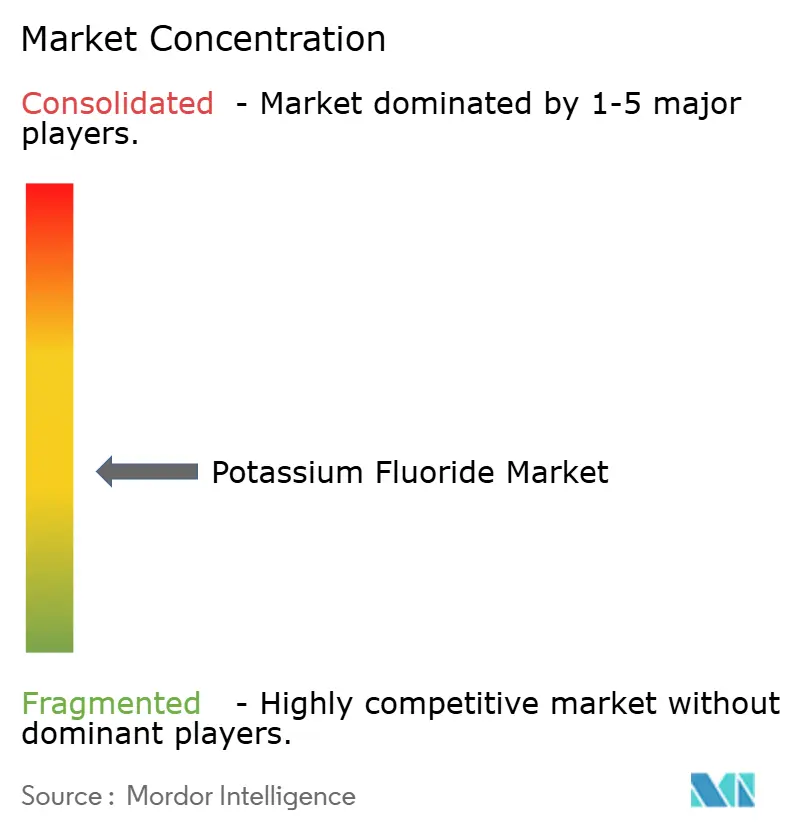
The potassium fluoride market is moderately concentrated, with the top five players including MORITA CHEMICAL INDUSTRIES CO., LTD., Solvay, Navin Fluorine International Limited, Solstice Advanced Materials US, Inc., and Gujarat Fluorochemicals Limited. Competitive positions vary by purity level, form, customer qualification, and access to upstream fluorine inputs. High-purity grades demand more extensive quality systems and customer validation. This split makes the competitive environment more specialized than a simple commodity chemical market.
Backward integration is a central competitive approach because fluorspar and hydrofluoric acid availability can determine production reliability. Aarti Industries Ltd. described a backward-integration project at Dahej that is intended to enhance end-to-end manufacturing resilience. Gujarat Fluorochemicals Limited has directed part of its capital program toward high-purity electronic specialty chemicals, which supports a move toward higher-value fluorine materials. MORITA CHEMICAL INDUSTRIES CO., LTD. established Morita Materials, Inc. in 2024 to broaden distribution for its advanced fluorine materials. These moves show that companies are pursuing supply assurance, specialized product development, and better customer access rather than relying only on price. The potassium fluoride market also gives an advantage to suppliers that can meet semiconductor and pharmaceutical qualification requirements.
Japanese specialists retain strengths in advanced quality expectations, but Indian and Chinese producers are expanding their capabilities in higher-purity fluorine chemistry. This can narrow the gap between established specialists and newer suppliers that can invest in analytical controls and qualified production systems. The potassium fluoride market has an opening in Southeast Asia, where electronics manufacturing is growing, but the local supply of specialized fluoride products remains limited. Suppliers seeking this opportunity need reliable regional logistics and relationships with electronics customers. Buyers are likely to assess feedstock security, product consistency, safety documentation, and the supplier’s ability to meet changing technical specifications. New capacity in standard grades may intensify competition where products are readily interchangeable. Higher-purity material should remain more differentiated because qualification takes time, and customers face switching costs. Overall, competition is likely to stay balanced between integrated capacity, specialized quality, and customer-specific service.
Potassium Fluoride Industry Leaders
-
MORITA CHEMICAL INDUSTRIES CO., LTD.
-
Solvay
-
Navin Fluorine International Limited
-
Solstice Advanced Materials US, Inc.
-
Gujarat Fluorochemicals Limited
- *Disclaimer: Major Players sorted in no particular order
Potassium Fluoride Market Companies Covered in this Report
- Aarti Industries Ltd.
- American Elements
- DERIVADOS DEL FLUOR (DDF)
- Do-Fluoride Chemicals Co., Ltd.
- Fengyuan Group
- FLUORO CHEMICALS
- FUJIFILM Wako Pure Chemical Corporation
- Gujarat Fluorochemicals Limited
- Harshil Industries
- Jiangxi Dongyan Pharmacy Co., Ltd.
- Kanto Denka Kogyo Co., Ltd.
- KANTO KAGAKU
- MORITA CHEMICAL INDUSTRIES CO., LTD.
- NACALAI TESQUE, INC.
- Navin Fluorine International Limited
- Solstice Advanced Materials US, Inc.
- Solvay
Recent Industry Developments in Potassium Fluoride Market
- April 2026: TANFAC Industries Limited signed a long-term supply agreement with Blue Star Limited for fluorinated products, with supplies scheduled to commence in January 2027. The agreement supports the potassium fluoride market indirectly by strengthening domestic supply relationships for fluorinated chemicals used across industrial and refrigeration-related applications.
- February 2026: Navin Fluorine International Limited commenced commercial production at its new anhydrous hydrofluoric acid plant in Dahej, Gujarat, with an annual capacity of 40,000 metric tons. The expansion supports the potassium fluoride market by strengthening the upstream supply of hydrofluoric acid, a key raw material used in potassium fluoride manufacturing.
Global Potassium Fluoride Market Report Scope
Potassium fluoride is an inorganic fluoride compound used as a source of fluoride ions in chemical synthesis, surface treatment, and specialized industrial processes. Its chemical reactivity and ability to support fluorination reactions make it useful across chemical manufacturing, glass processing, and other technical applications.
The Potassium Fluoride Market is segmented by purity, form, application, end-use industry, and geography. By purity, the market is segmented into 95% to 99% and greater than 99%. By form, the market is segmented into solid and liquid. By application, the market is segmented into fluorination and analytical reagent, glass etching, flux, metal surface treatment, catalyst, agrochemical formulations, and other applications. By end-use industry, the market is segmented into agrochemical, glass and metal, pharmaceutical, electronics and semiconductor, and other end-use industries. The report also covers the market size and forecasts for potassium fluoride across 15 countries. For each segment, the market sizing and forecasts have been done on the basis of value (USD).
Segmentation Overview
| 95% to 99% |
| Greater Than 99% |
| Solid |
| Liquid |
| Fluorination and Analytical Reagent |
| Glass Etching |
| Flux |
| Metal Surface Treatment |
| Catalyst |
| Agrochemical Formulations |
| Other Applications |
| Agrochemical |
| Glass and Metal |
| Pharmaceutical |
| Electronics and Semiconductor |
| Other End-Use Industries |
| Asia-Pacific | China |
| India | |
| Japan | |
| South Korea | |
| ASEAN Countries | |
| Rest of Asia-Pacific | |
| North America | United States |
| Canada | |
| Mexico | |
| Europe | Germany |
| United Kingdom | |
| France | |
| Italy | |
| NORDIC Countries | |
| Rest of Europe | |
| South America | Brazil |
| Argentina | |
| Rest of South America | |
| Middle East and Africa | Saudi Arabia |
| South Africa | |
| Rest of Middle East and Africa |
| By Purity | 95% to 99% | |
| Greater Than 99% | ||
| By Form | Solid | |
| Liquid | ||
| By Application | Fluorination and Analytical Reagent | |
| Glass Etching | ||
| Flux | ||
| Metal Surface Treatment | ||
| Catalyst | ||
| Agrochemical Formulations | ||
| Other Applications | ||
| By End-Use Industry | Agrochemical | |
| Glass and Metal | ||
| Pharmaceutical | ||
| Electronics and Semiconductor | ||
| Other End-Use Industries | ||
| By Geography | Asia-Pacific | China |
| India | ||
| Japan | ||
| South Korea | ||
| ASEAN Countries | ||
| Rest of Asia-Pacific | ||
| North America | United States | |
| Canada | ||
| Mexico | ||
| Europe | Germany | |
| United Kingdom | ||
| France | ||
| Italy | ||
| NORDIC Countries | ||
| Rest of Europe | ||
| South America | Brazil | |
| Argentina | ||
| Rest of South America | ||
| Middle East and Africa | Saudi Arabia | |
| South Africa | ||
| Rest of Middle East and Africa | ||
Key Questions Answered in the Report
What is the size of the potassium fluoride market?
The potassium fluoride market size was valued at USD 439.53 million in 2026 and is estimated to grow from USD 455.18 million in 2027 to reach USD 543.48 million by 2032, at a CAGR of 3.61% during the forecast period (2027-2032).
What is driving demand for potassium fluoride?
Demand is supported by fluorinated agrochemicals and pharmaceuticals, high-purity electronics chemicals, glass etching, and metal-processing applications.
Which grade is projected to advance fastest through 2032?
The greater than 99% purity is projected to advance at a 3.89% CAGR through 2032, supported by pharmaceutical and semiconductor requirements.
Which form held the largest share in 2026?
Solid held an 80.27% share in 2026 because it is stable in storage and suitable for precise batch dosing.