
Positive Displacement Gas Compressor Market Size and Share
Market Overview
| Study Period | 2022 - 2032 |
|---|---|
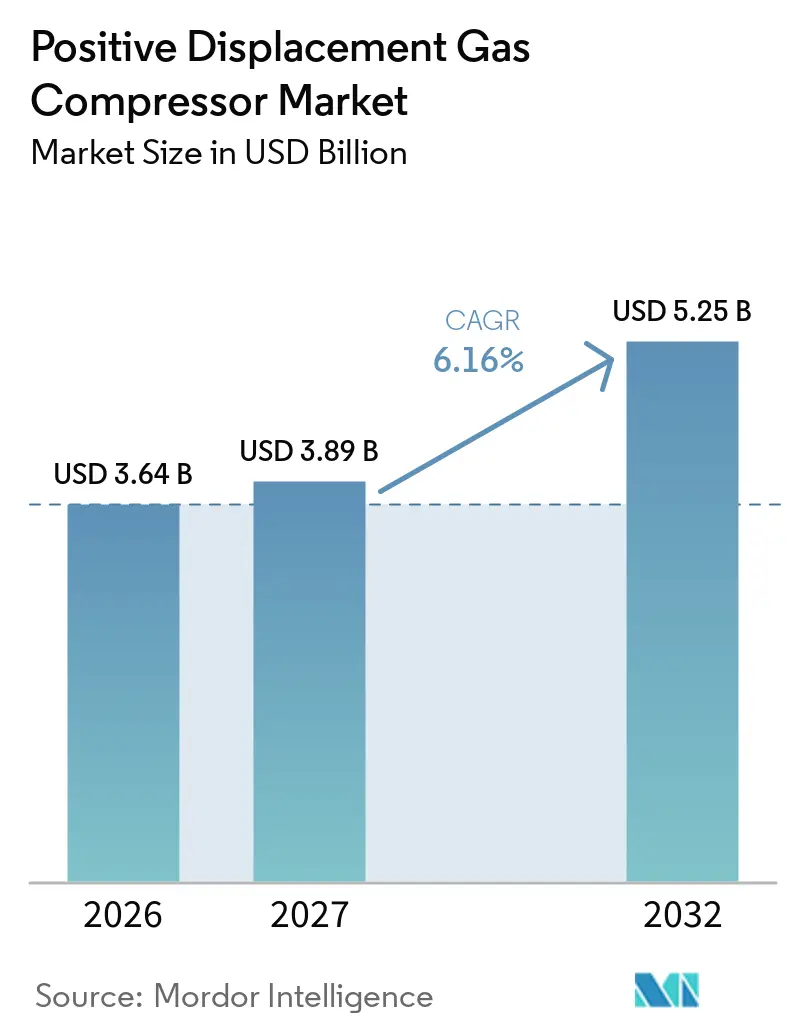
| Market Size (2027) | USD 3.89 Billion |
| Market Size (2032) | USD 5.25 Billion |
| Growth Rate (2027 - 2032) | 6.16 % |
| Fastest Growing Market | Asia-Pacific |
| Largest Market | Asia-Pacific |
| Market Concentration | Low |
Major Players *Disclaimer: Major Players sorted in no particular order Image © Mordor Intelligence. Reuse requires attribution under CC BY 4.0. | |
Positive Displacement Gas Compressor Market Analysis by Mordor Intelligence
The Positive Displacement Gas Compressor Market size is projected to expand from USD 3.64 billion in 2026 and USD 3.89 billion in 2027 to USD 5.25 billion by 2032, registering a CAGR of 6.16% between 2027 and 2032. The positive displacement gas compressor market is supported by investment in natural gas transmission, Liquefied Natural Gas (LNG) export capacity, and gas processing infrastructure, where compression is needed to move, treat, and condition gas through each stage of the value chain. Industrial gas-handling demand in Asia-Pacific adds a separate source of equipment orders, particularly for process and manufacturing applications that need consistent gas flow, specified purity, and dependable service. Hydrogen, biomethane, and other renewable-gas projects broaden the range of gas streams that require specialized compression systems, while also increasing the need for oil-free arrangements, sealing performance, and materials that suit more demanding gas compositions. Replacement of aging installed equipment also supports demand because operators need improved capacity, reliability, and emissions performance and must maintain availability at existing facilities. Suppliers are responding with service coverage, digital monitoring, and equipment designs suited to high-pressure and oil-free duties, which makes the positive displacement gas compressor market relevant to both new-build projects and modernization work.
Key Report Takeaways
- By compressor type, reciprocating compressors held 46.4% of the positive displacement gas compressor market share in 2026, while rotary screw compressors are projected to grow at a 6.8% CAGR through 2032.
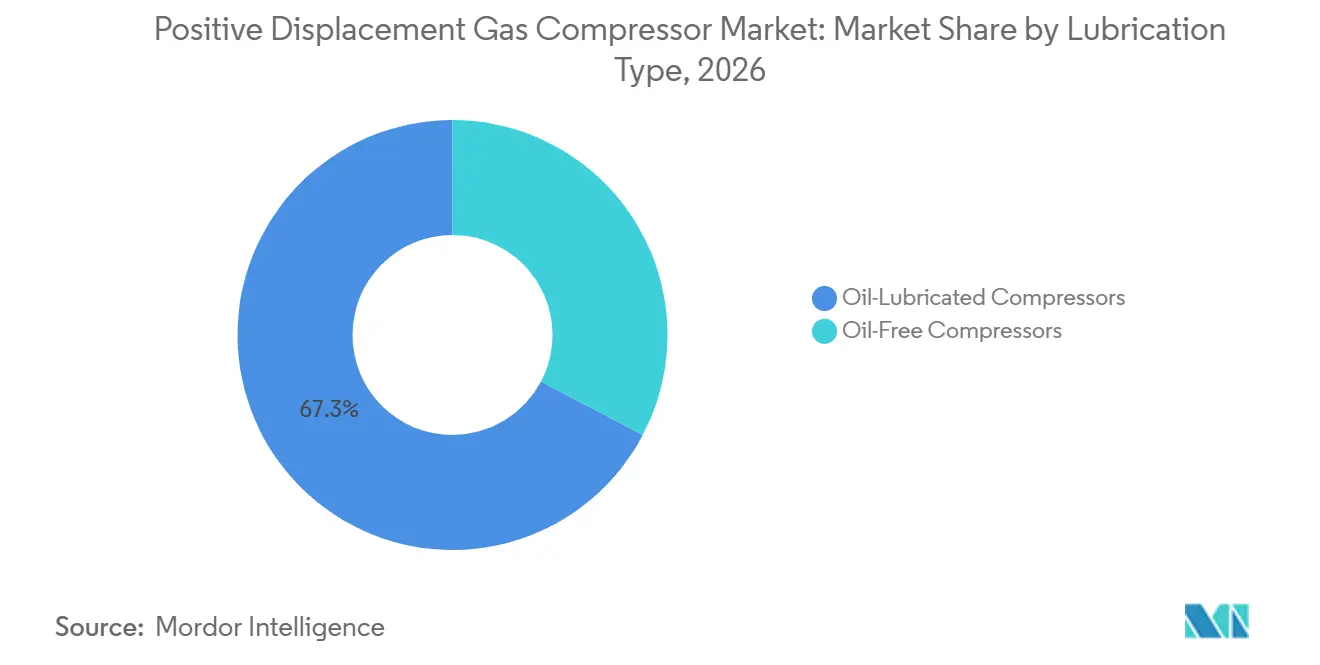
- By lubrication type, oil-lubricated compressors accounted for 67.3% of the positive displacement gas compressor market size in 2026, while oil-free compressors are projected to expand at a 6.3% CAGR through 2032.
- By power rating, the 100–500 kW segment held 32.6% share in 2026, while the above-1,000 kW segment is projected to grow at a 6.5% CAGR through 2032.
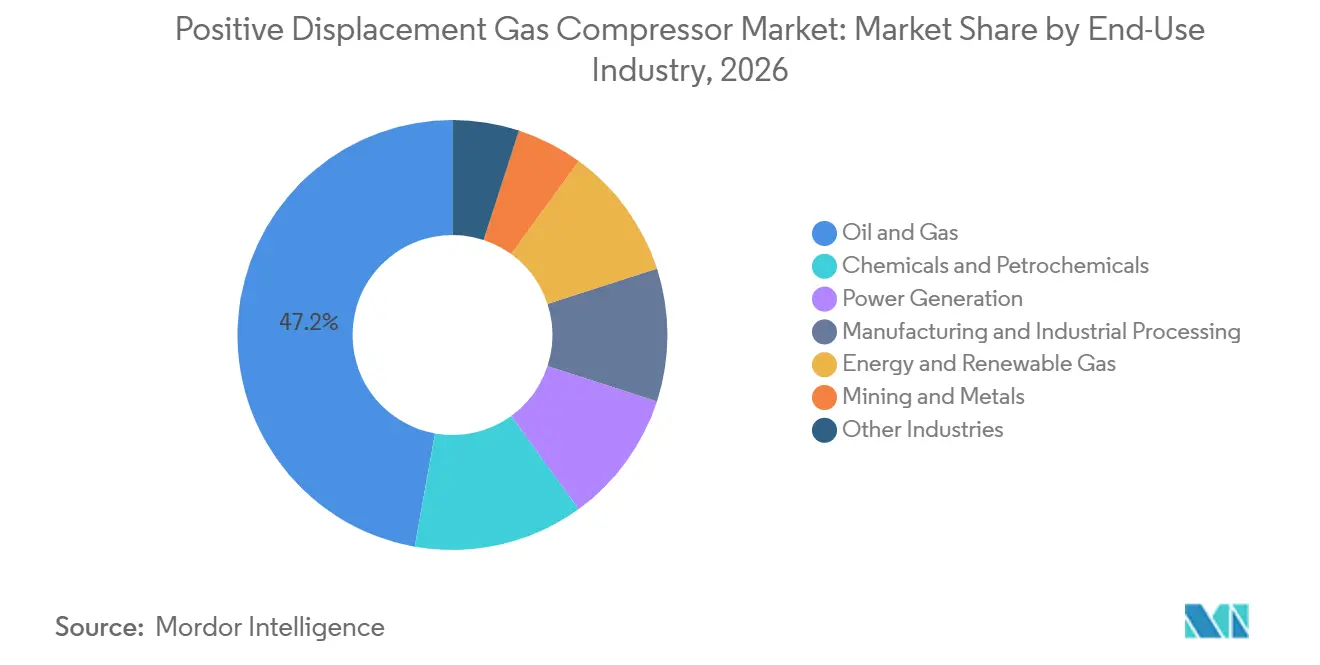
- By end-use industry, oil and gas accounted for 47.2% of the positive displacement gas compressor market share in 2026, while energy and renewable gas are forecast to grow at a 7.3% CAGR through 2032.
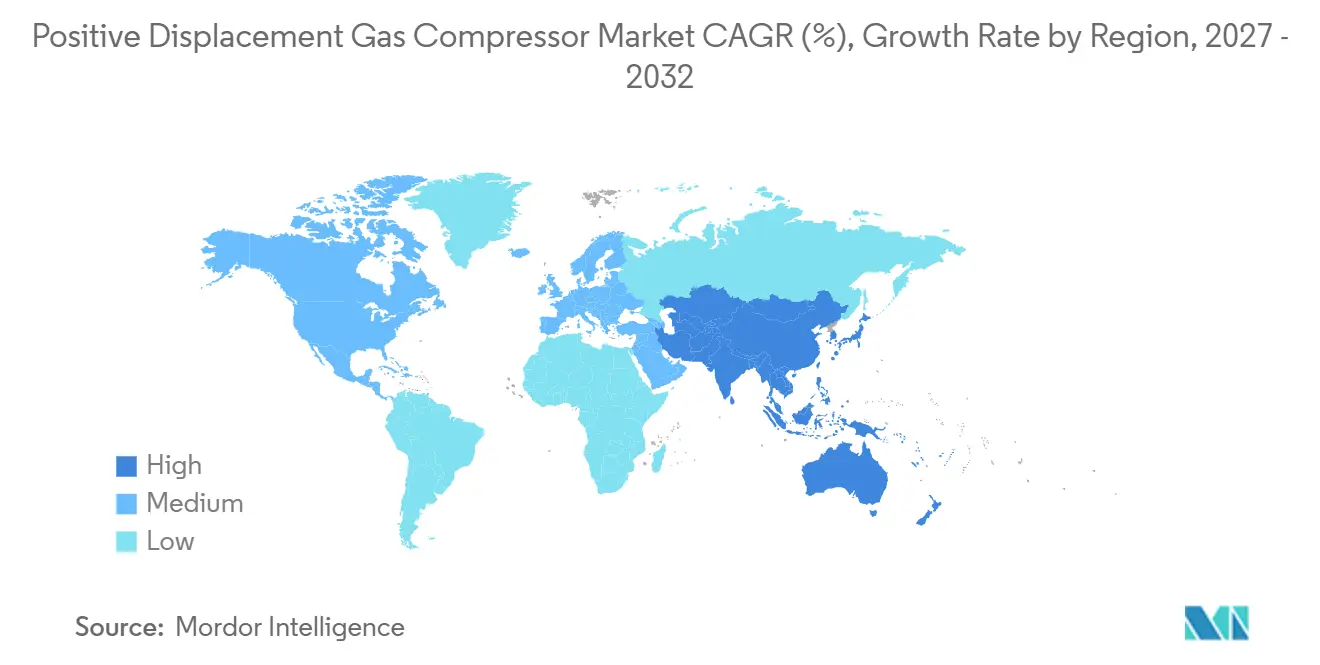
- By geography, Asia-Pacific held 31.6% share in 2026 and is forecast to expand at a 6.9% CAGR through 2032.
Note: Market numbers in this report are based on Mordor Intelligence's proprietary estimation framework, which combines nine months of actuals with Q4 projections for base year 2026.
Market Trends and Insights
Drivers Impact Analysis of Positive Displacement Gas Compressor Market*
| Driver | (~) % Impact on CAGR Forecast | Geographic Relevance | Impact Timeline |
|---|---|---|---|
| Natural Gas Transmission, LNG, and Processing Infrastructure | +2.0% | Global, concentrated in North America, the Middle East, and Asia-Pacific | Short term (≤ 2 years) |
| Industrial Automation and Gas Handling in Asia-Pacific | +1.2% | Asia-Pacific, with effects in South America | Medium term (2-4 years) |
| Hydrogen, Biogas, and Renewable-Gas Compression | +0.8% | Europe, North America, and early-stage Asia-Pacific | Medium term (2-4 years) |
| Energy Efficiency, Variable-Speed, and Oil-Free Upgrades | +0.7% | Global, with early gains in Europe and North America | Medium term (2-4 years) |
| Aging Fleet Replacement and Brownfield Modernization | +0.6% | North America, Europe, Russia, and Central Asia | Medium term (2-4 years) |
| Digital Monitoring, Predictive Maintenance, and Remote Service | +0.4% | Global, with concentration in established industrial locations | Long term (≥ 4 years) |
| Source: Mordor Intelligence | |||
Natural Gas Transmission, LNG, and Processing Infrastructure Expansion
Natural gas transmission, LNG, and processing investment remains an important source of demand for the positive displacement gas compressor market. New pipelines, compressor stations, and LNG-linked facilities need equipment for gathering, transport, and process duties. The United States has a deep resource base, with the Potential Gas Committee reporting 4,562 trillion cubic feet of total future natural gas supply in its 2025 assessment. That resource base supports long-term upstream, midstream, and export-related compression activity, including replacement work at operating stations. Data-center electricity demand is also drawing attention to gas supply for power generation in several U.S. regions. The effect is to add demand pathways without changing the importance of conventional oil and gas infrastructure, which continues to support orders across the positive displacement gas compressor market.[1]
Industrial Automation and Gas Handling Demand in Asia-Pacific
Manufacturing expansion in China, India, and Southeast Asia supports demand for process gas and compressed-gas equipment. Pharmaceutical, electronics, and food-processing facilities use oil-free systems when air or gas purity is essential. India’s industrial investment is also attracting local manufacturing by global equipment suppliers. Hitachi Industrial Equipment Systems opened its Gandhinagar facility in Gujarat in November 2025 for oil-flooded screw air compressor production and sales. The facility places manufacturing closer to industrial customers and service requirements, while creating a local base for sales and equipment support. This demand mix gives the positive displacement gas compressor market exposure to manufacturing investment as well as energy projects.[2]
High-Pressure Hydrogen, Biogas, and Renewable-Gas Compression
Hydrogen, biogas, and renewable gas create requirements that differ from conventional natural gas service. Hydrogen applications need oil-free and tightly sealed equipment that can manage high pressures and protect gas purity. Biogas handling also needs materials and sealing systems that can manage moisture, carbon dioxide, and hydrogen sulfide. These operating conditions increase the importance of application design, materials selection, and commissioning support for suppliers. They also favor equipment packages that can operate reliably at dispersed biomethane and hydrogen sites. These applications allow the positive displacement of gas compressor market to serve a growing set of renewable-gas projects.
Energy Efficiency, Variable-Speed, and Oil-Free System Upgrades
Efficiency requirements are influencing replacement decisions within the installed base. U.S. energy conservation standards in 10 Code of Federal Regulations (CFR) § 431.345 took effect on January 10, 2025, setting minimum isentropic efficiency requirements for covered rotary lubricated compressors. The rule gives operators a defined reason to replace noncompliant fixed-speed machines. Variable-speed systems can reduce energy use compared with fixed-speed equipment where operating loads vary, so they can be relevant to facilities with changing process conditions. Brownfield projects can also replace turbine-driven equipment with electric motor-driven systems. An IEEE conference paper published in 2025 reported efficiency of 96% for electric drives compared with 35% to 45% for turbine-driven trains in the applications it considered.[3]
Restraints Impact Analysis of Positive Displacement Gas Compressor Market*
| Restraint | (~) % Impact on CAGR Forecast | Geographic Relevance | Impact Timeline |
|---|---|---|---|
| Capital, Installation, and Lifecycle Energy Costs | -1.1% | Global, with greater effect in emerging markets | Long term (≥ 4 years) |
| Specialty Alloy, Bearing, and Magnet Price Volatility | -0.5% | Global, with supply exposure in South Africa and Southeast Asia | Medium term (2-4 years) |
| Skilled Technician and High-Pressure Commissioning Shortages | -0.4% | North America, Europe, and South America | Medium term (2-4 years) |
| Methane-Leak, Noise, and Contamination Compliance Complexity | -0.3% | North America and Europe | Medium term (2-4 years) |
| Source: Mordor Intelligence | |||
High Capital, Installation, and Lifecycle Energy Costs
Large positive displacement compressors need significant equipment, installation, and power investment. This is particularly relevant for reciprocating packages above 1,000 kW and for greenfield infrastructure projects where equipment is one element of a broader pipeline, treatment, or liquefaction investment. Compression stations can represent 30% to 40% of pipeline operating expenditure, with energy as a major cost component. Power-price changes therefore affect the operating case for long-lived infrastructure and can affect the timing of a project approval. Grid constraints and financing conditions can make premium packages harder to justify in parts of South America, Africa, and Southeast Asia. Buyers in these markets may prefer lower-capital configurations even where their lifetime efficiency is lower.
Specialty Alloy, Bearing, and Magnet Price Volatility
Compressor manufacturers use precision alloys in crankshafts, piston rods, valve seats, and high-temperature bearings. Changes in material prices can affect margins, component availability, and delivery schedules. The issue is most significant for equipment that must meet demanding process-gas specifications and for projects with fixed delivery commitments. Smaller manufacturers have less scope of managing this exposure through captive sourcing or forward purchasing. They may face pressure to use alternative materials in noncritical parts, which can affect equipment reliability over time. Volatility therefore remains a constraint on the positive displacement gas compressor market, even as customers seek more specialized packages.
*Our forecasts treat driver/restraint impacts as directional, not additive. The impact forecasts reflect baseline growth, mix effects, and variable interactions.
Positive Displacement Gas Compressor Market Segment Analysis
By Compressor Type:
Reciprocating Machines Anchor Revenue While Rotary Screw Gains PaceReciprocating compressors held 46.4% of 2026 value, making them the leading technology in the positive displacement gas compressor market. Their position reflects their use in high-pressure and variable-flow applications, including gathering systems, LNG processing, and hydrogen service. The machines can work across a broad range of gas molecular weights and operating conditions. They also achieve high compression ratios, which remains important in demanding process applications. Ariel presented its Connected Compressor platform at the 2025 Gas Machinery Conference. The platform includes an Electronic Variable Clearance Pocket for capacity control and a KBH series compressor for hydrogen mobility applications.[4]
Rotary screw compressors are forecast to grow at 6.8% CAGR through 2032, the highest rate among compressor types. Continuous-duty operation and lower vibration support their use in industrial automation, manufacturing, and pharmaceutical gas handling. Rotary lobe compressors continue to serve lower-pressure boosting duties. Rotary vane machines remain relevant to smaller gas recovery and light process applications. This part of the positive displacement gas compressor industry benefits from a wider manufacturing customer base than high-pressure oil and gas systems. Suppliers need to balance standardized packages with application-specific controls and purity requirements.
By Lubrication Type:
Oil-Lubricated Predominates but Oil-Free Reshapes the Growth MarginOil-lubricated compressors hold 67.3% of market value in 2026. Their cost position, broad pressure range, and established service ecosystem support use in oil and gas and industrial processing. The large conventional installed base also creates a substantial replacement pool. American Petroleum Institute (API) 618 remains relevant to reciprocating process-gas design and supports established equipment practices in many covered applications. These systems will continue to serve applications where gas purity is not the deciding requirement. The positive displacement of gas compressor market therefore retains a large base of oil-lubricated equipment.
Oil-free compressors are projected to grow at a 6.3% CAGR through 2032. They are used where gas purity is essential, including pharmaceutical production, food processing, hydrogen dispensing, and biomethane injection. International Organization for Standardization (ISO) 8573-1 Class 0 specifications are increasingly included in procurement requirements for sensitive applications. AERZEN exhibited multistage oil-free screw compressors at Hannover Messe 2025 for biogas extraction, nitrogen recovery, and boil-off gas handling. The range illustrates the extension of oil-free equipment into heavy industrial processes. The price premium remains a constraint when purity standards do not require an oil-free configuration.
By Power Rating:
Mid-Range Leads by Value as High-Power Tier Captures the Fastest GrowthThe 100–500 kW band held 32.6% of 2026 value in the positive displacement gas compressor market. It serves gas gathering stations, industrial utilities, chemical processing, and distributed energy systems. Buyers can often procure cataloged packages in this range rather than fully bespoke systems. This can shorten procurement cycles and reduce execution risk. The range also attracts global original equipment manufacturers (OEMs) and regional suppliers, creating a competitive choice for customers. The up-to-100 kW segment supports biogas upgrading, compressed natural gas (CNG) refueling, and laboratory gas supply, where skid-mounted systems are increasingly relevant.
The above-1,000 kW tier is forecast to grow at a 6.5% CAGR through 2032. LNG liquefaction trains, pipeline booster stations, and refinery and petrochemical complexes support demand for these larger units. Baker Hughes received an order in January 2025 for 6 gas compression trains and 6 propane compressors for the third expansion of Aramco’s Jafurah gas field. The company said the equipment would use electric motor-driven compression solutions. The 500–1,000 kW range serves regional pipeline, industrial gas, and large mining applications. Certified component lead times mean that equipment orders can be an important indication of forward activity in the positive displacement gas compressor market.
By End-Use Industry:
Oil and Gas Dominates as Renewable Gas Rewrites the Growth NarrativeOil and gas accounted for 47.2% of 2026 value in the positive displacement gas compressor market. Upstream gathering, midstream transport, and LNG processing require compression services that are difficult to substitute. These activities create both original equipment and service demand. The installed base also requires periodic overhauls and replacement equipment. Chemicals and petrochemicals and power generation form other major end-use categories. Their recurring process needs to support stable equipment demand when project activity is less intensive.
Energy and renewable gas are expected to expand at a 7.3% CAGR through 2032. Biomethane injection, green hydrogen production and dispensing, and power-to-gas installations are the main demand areas. Renewable-gas service often needs corrosion-resistant materials and enhanced sealing because biogas may contain moisture, carbon dioxide, and hydrogen sulfide. These requirements can increase the value of an individual compressor package compared with conventional gas service. Manufacturing, industrial processing, and mining also contribute to equipment demand as industrial capacity expands. This broad customer base makes the positive displacement gas compressor market less dependent on a single end-use cycle.
Geography Analysis
APAC Positive Displacement Gas Compressor Market
Asia-Pacific held 31.6% of global value in 2026 and is forecast to grow at a 6.9% CAGR through 2032. The region is the largest and fastest-growing part of the positive displacement gas compressor market. China drives demand through gas infrastructure, industrial activity, and domestic production capacity. India adds demand through manufacturing investment, oil-free compressor applications, and urban gas distribution expansion. Southeast Asia supports orders through LNG regasification projects and industrial park development. International suppliers compete with Chinese-origin equipment on price and local support in Indonesia, Malaysia, Thailand, and the Philippines. Atlas Copco inaugurated its Compressor Technique Wuxi Campus in May 2025, adding training and Asia-Pacific innovation functions to its Chinese manufacturing base.
North America Positive Displacement Gas Compressor Market
North America is the second-largest region by revenue in the positive displacement gas compressor market. Pipeline investment, LNG export projects, and gas-fired power supply support the regional order base. The U.S. natural gas resource assessment supports a long operating horizon for midstream compression. Data-center electricity demand can increase gas requirements for power generation, particularly in Texas and the Southeast. U.S. efficiency rules also create replacement demand for covered rotary equipment. The resulting mix combines greenfield infrastructure spending with installed-base modernization, which creates a varied opportunity base for the positive displacement gas compressor market.
EMEA, APAC and South America Positive Displacement Gas Compressor Market
Europe is centered on fleet modernization, biomethane integration, and hydrogen infrastructure rather than large new gas capacity. Methane requirements can make leak detection, repair, and equipment monitoring more important at compressor stations, while creating demand for upgrades that improve operating visibility. This favors suppliers that combine hardware with monitoring and field service. Central Asia remains competitive as operators evaluate cost, process capability, and service availability. China National Petroleum Corporation (CNPC) Jichai reported stable operation of 4 sour-gas-resistant 4 MW compressor packages at the Amu-Darya section of the Turkmenistan-China pipeline in October 2025. South America and the Middle East and Africa provide project opportunities linked to Brazil’s pre-salt gas processing and Saudi Arabia’s Jafurah expansion.
Competitive Landscape
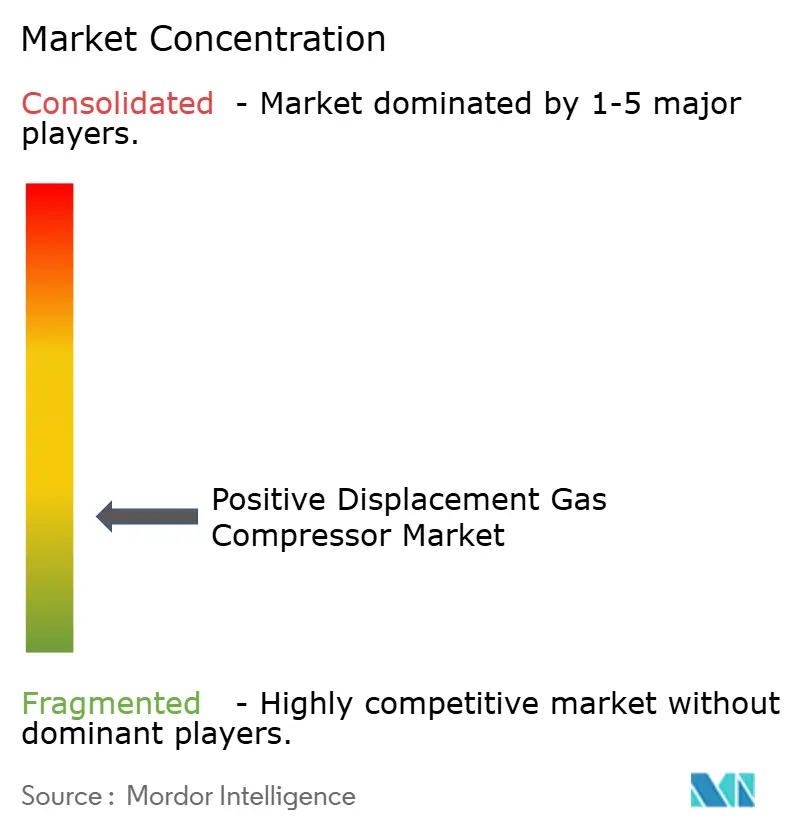
The positive displacement gas compressor market is fragmented across mid-range equipment and field service. Leading suppliers are expanding aftermarket coverage because installed equipment creates continuing demand for parts, overhaul work, field technicians, and technical support. Digital monitoring also helps suppliers improve uptime, make maintenance planning more predictable, and maintain ties with customers after original equipment is delivered. Burckhardt Compression acquired Advanced Compressor Technology in September 2025 to strengthen local U.S. service capabilities. It also expanded its service footprint through facilities in Pottstown, Pennsylvania, and Sarnia, Ontario.
Modular containerized compressors for biomethane and smaller hydrogen facilities remain a developing opportunity. These sites can require compact equipment, flexible deployment, and service support across dispersed locations, instead of the operating model used at a large centralized station. Large equipment in Africa and parts of South America can face longer maintenance lead times because local service coverage is limited. Chinese manufacturers, including China National Petroleum Corporation (CNPC) Jichai and Dongfang Electric, are targeting Central Asia and Africa with cost-competitive packages. Their progress increases pressure on established suppliers in projects where price and delivery matter as much as legacy supplier relationships. Qualification to API 618 and ISO 13631 remains relevant for high-pressure process-gas applications. The positive displacement gas compressor industry therefore requires both proven engineering and local execution capability across the positive displacement gas compressor market.
Suppliers are using strategic moves to build positions beyond equipment sales. Burckhardt Compression’s September 2025 acquisition of ACT added spare-parts manufacturing and downstream service capability in the United States. Baker Hughes’ January 2025 Jafurah award demonstrates the value of motor-driven compression in large gas-field projects. Atlas Copco’s Wuxi campus expands its training and innovation presence in Asia-Pacific. These actions address service access, application development, regional customer proximity, and the availability of skills required to operate and maintain systems. Competitive strength depends on technology fit, service responsiveness, and the ability to meet project specifications. This structure leaves room for global firms, regional builders, and specialist service providers throughout the positive displacement gas compressor market.
Positive Displacement Gas Compressor Industry Leaders
-
Atlas Copco AB
-
Ingersoll Rand Inc.
-
Siemens Energy AG
-
Baker Hughes Company
-
Burckhardt Compression AG
- *Disclaimer: Major Players sorted in no particular order
Positive Displacement Gas Compressor Market Companies Covered in this Report
- Ariel Corporation
- Atlas Copco AB
- Baker Hughes Company
- Burckhardt Compression AG
- Corken, Inc.
- EBARA CORPORATION
- Enerflex Ltd.
- Fluitron, Inc.
- Gardner Denver, Inc.
- GEA Group Aktiengesellschaft
- Hitachi Industrial Equipment Systems Co., Ltd.
- Howden Compressors Limited
- IHI Corporation
- Ingersoll Rand Inc.
- Kirloskar Pneumatic Company Limited
- KOBELCO COMPRESSORS CORPORATION
- NEUMAN & ESSER GmbH & Co. KG
- PDC Machines, Inc.
- Siemens Energy AG
- Sundyne, LLC
Recent Industry Developments in Positive Displacement Gas Compressor Market
- September 2025: Burckhardt Compression acquired Advanced Compressor Technology (ACT), a U.S.-based reciprocating compressor service specialist with facilities in Batavia, Illinois and Pasadena, Texas. The acquisition adds local spare-parts manufacturing and downstream-market service capability in the United States, significantly strengthening the company’s North American aftermarket position.
- September 2025: Baker Hughes secured an order from Bechtel Energy for the main liquefaction equipment for Train 4 of NextDecade’s Rio Grande LNG facility in Brownsville, Texas, supplying 2 Frame 7 gas turbines and 6 centrifugal compressors. This order supports an additional 6 million tons per annum of LNG export capacity.
- June 2025: Baker Hughes was awarded a contract by Saipem to supply 3 CO₂ centrifugal compressor trains with electric motors for Eni’s Liverpool Bay Carbon Capture and Storage project in the United Kingdom. The project reached financial close in 2025 and will permanently store CO₂ in depleted offshore fields under Liverpool Bay.
- May 2025: Atlas Copco inaugurated its Compressor Technique Wuxi Campus in Wuxi, China, adding a compressed-air technology training center and Asia-Pacific innovation functions to its existing Chinese manufacturing base.
Global Positive Displacement Gas Compressor Market Report Scope
A positive displacement gas compressor is a mechanical device that increases gas pressure by trapping a fixed volume of gas in a closed chamber and reducing that chamber's volume.
The global positive displacement gas compressor market is segmented by compressor type, lubrication type, power rating, end-use industry, and geography. By compressor type, the market is segmented into reciprocating compressors, rotary screw compressors, rotary vane compressors, rotary lobe (Roots) compressors, and other positive displacement compressors. By lubrication type, the market is segmented into oil-lubricated and oil-free compressors. By power rating, the market is segmented into up to 100 kW, 100–500 kW, 500–1,000 kW, and above 1,000 kW. By end-use industry, the market is segmented into oil and gas, chemicals and petrochemicals, power generation, manufacturing and industrial processing, energy and renewable gas, mining and metals, and other industries. The report also covers the market size and forecasts for the global positive displacement gas compressor market across 29 countries in key regions. For each segment, the market sizing and forecasts have been provided on the basis of value (USD).
Segmentation Overview
| Reciprocating Compressors |
| Rotary Screw Compressors |
| Rotary Vane Compressors |
| Rotary Lobe (Roots) Compressors |
| Other Positive Displacement Compressors |
| Oil-Lubricated Compressors |
| Oil-Free Compressors |
| Up to 100 kW |
| 100–500 kW |
| 500–1,000 kW |
| Above 1,000 kW |
| Oil and Gas |
| Chemicals and Petrochemicals |
| Power Generation |
| Manufacturing and Industrial Processing |
| Energy and Renewable Gas |
| Mining and Metals |
| Other Industries |
| North America | United States |
| Canada | |
| Mexico | |
| Europe | Germany |
| France | |
| Italy | |
| Spain | |
| United Kingdom | |
| Poland | |
| Netherlands | |
| Russia | |
| Rest of Europe | |
| Asia-Pacific | China |
| India | |
| Japan | |
| South Korea | |
| Australia | |
| Indonesia | |
| Malaysia | |
| Thailand | |
| Philippines | |
| Rest of Asia-Pacific | |
| South America | Brazil |
| Argentina | |
| Colombia | |
| Rest of South America | |
| Middle East and Africa | Saudi Arabia |
| United Arab Emirates | |
| South Africa | |
| Kenya | |
| Egypt | |
| Nigeria | |
| Rest of Middle East and Africa |
| By Compressor Type | Reciprocating Compressors | |
| Rotary Screw Compressors | ||
| Rotary Vane Compressors | ||
| Rotary Lobe (Roots) Compressors | ||
| Other Positive Displacement Compressors | ||
| By Lubrication Type | Oil-Lubricated Compressors | |
| Oil-Free Compressors | ||
| By Power Rating | Up to 100 kW | |
| 100–500 kW | ||
| 500–1,000 kW | ||
| Above 1,000 kW | ||
| By End-Use Industry | Oil and Gas | |
| Chemicals and Petrochemicals | ||
| Power Generation | ||
| Manufacturing and Industrial Processing | ||
| Energy and Renewable Gas | ||
| Mining and Metals | ||
| Other Industries | ||
| By Geography | North America | United States |
| Canada | ||
| Mexico | ||
| Europe | Germany | |
| France | ||
| Italy | ||
| Spain | ||
| United Kingdom | ||
| Poland | ||
| Netherlands | ||
| Russia | ||
| Rest of Europe | ||
| Asia-Pacific | China | |
| India | ||
| Japan | ||
| South Korea | ||
| Australia | ||
| Indonesia | ||
| Malaysia | ||
| Thailand | ||
| Philippines | ||
| Rest of Asia-Pacific | ||
| South America | Brazil | |
| Argentina | ||
| Colombia | ||
| Rest of South America | ||
| Middle East and Africa | Saudi Arabia | |
| United Arab Emirates | ||
| South Africa | ||
| Kenya | ||
| Egypt | ||
| Nigeria | ||
| Rest of Middle East and Africa | ||
Key Questions Answered in the Report
What is the projected value of positive displacement gas compressors by 2032?
The sector is projected to reach USD 5.25 billion by 2032, from USD 3.89 billion in 2027, at a 6.16% CAGR, supported by energy infrastructure, industrial demand, and equipment modernization. The forecast also reflects replacement demand as operators update older units to improve capacity, maintenance performance, and compliance with efficiency requirements.
Which compressor type has the largest revenue share?
Reciprocating compressors lead with 46.4% of 2026 value because they are well suited to high-pressure and variable-flow duties in gas handling.
Which positive displacement compressor technology is growing fastest?
Rotary screw compressors are projected to record the highest growth among types, at a 6.8% CAGR through 2032, supported by industrial automation and continuous-duty requirements.
Why are oil-free compressors becoming more important?
They meet purity requirements in pharmaceutical production, food processing, hydrogen dispensing, and biomethane injection, and are forecast to grow at 6.3% CAGR through 2032.
Which region leads demand for positive displacement gas compressors?
Asia-Pacific held 31.6% of value in 2026 and is forecast to grow at 6.9% CAGR through 2032 because of industrial investment and gas infrastructure activity. China, India, and Southeast Asian countries each support a distinct mix of energy, manufacturing, and process-gas requirements.
What end-use application is growing fastest?
Energy and renewable gas is projected to expand at 7.3% CAGR through 2032, supported by biomethane injection, green hydrogen production, and dispensing applications. These applications often require equipment with enhanced sealing, corrosion resistance, gas-purity control, and dependable field support. Their technical needs make specialized designs an important part of supplier selection and project planning, especially where sites are dispersed and gas quality varies.