
Portable Industrial CT Systems Market Size and Share
Market Overview
| Study Period | 2020 - 2031 |
|---|---|
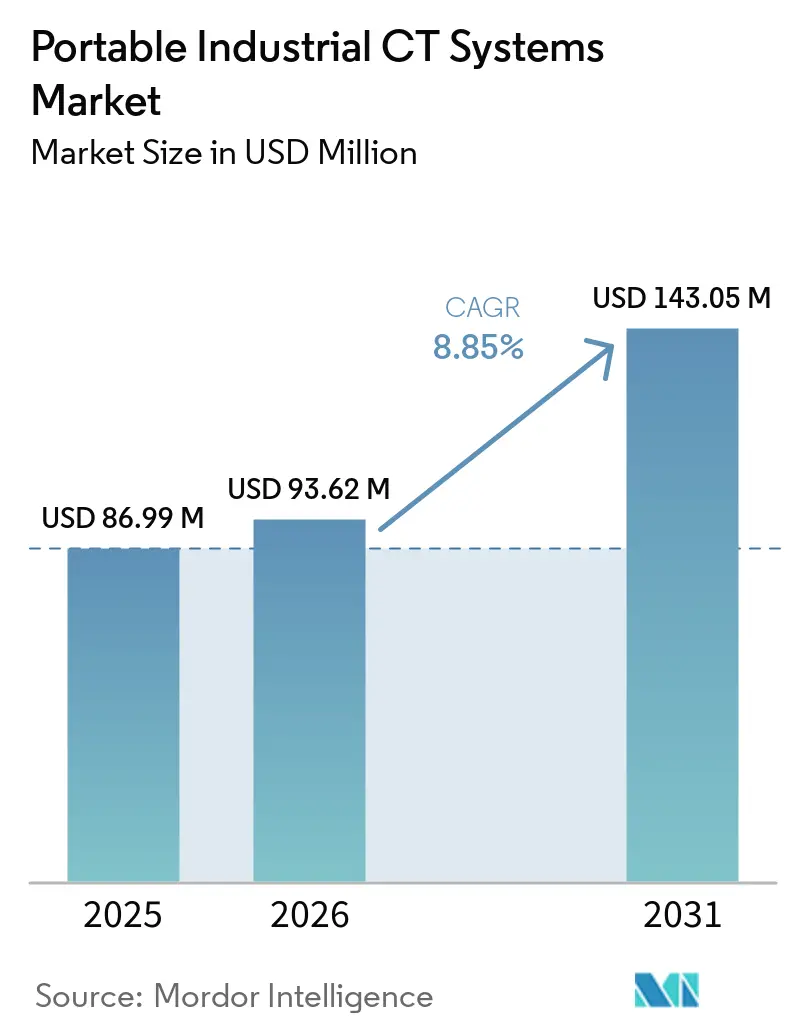
| Market Size (2026) | USD 93.62 Million |
| Market Size (2031) | USD 143.05 Million |
| Growth Rate (2026 - 2031) | 8.85 % |
| Fastest Growing Market | Asia-Pacific |
| Largest Market | North America |
| Market Concentration | Medium |
Major Players *Disclaimer: Major Players sorted in no particular order Image © Mordor Intelligence. Reuse requires attribution under CC BY 4.0. | |
Portable Industrial CT Systems Market Analysis by Mordor Intelligence
The portable industrial CT systems market size is projected to expand from USD 86.99 million in 2025 to USD 93.62 million in 2026, and to USD 143.05 million by 2031, registering a CAGR of 8.85% between 2026 and 2031. Manufacturers are moving inspection closer to production and maintenance sites to reduce component transport and inspection delays. This supports use cases where parts cannot be easily moved, including aircraft structures, pipeline assets, and battery cells. Hardware vendors can protect pricing through systems that combine mobility, reliable imaging, and field support. Service providers can benefit as smaller manufacturers use flexible inspection capacity instead of buying equipment. The portable industrial CT systems market also faces high purchase costs and varying radiation regulations across regions.
Key Report Takeaways
- By product type, portable industrial CT scanners accounted for 62.47% of revenue in 2025, while portable CT inspection services are projected to expand at an 11.27% CAGR through 2031.
- By form factor, mobile cart-based systems held 44.73% revenue share in 2025, while hand-carry systems are projected to expand at a 10.73% CAGR through 2031.
- By application, flaw detection and inspection accounted for 46.37% of revenue in 2025, while reverse engineering and additive manufacturing inspection are projected to expand at an 11.67% CAGR through 2031.
- By end-user industry, aerospace and defense accounted for 30.83% of revenue in 2025, while automotive and electric vehicles are projected to expand at an 11.93% CAGR through 2031.
- By geography, North America held 32.67% of the portable industrial CT systems market share in 2025, while Asia-Pacific is projected to expand at an 11.47% CAGR through 2031.
Note: Market size and forecast figures in this report are generated using Mordor Intelligence’s proprietary estimation framework, updated with the latest available data and insights as of January 2026.
Global Portable Industrial CT Systems Market Trends and Insights
Drivers Impact Analysis*
| Driver | (~) % Impact on CAGR Forecast | Geographic Relevance | Impact Timeline |
|---|---|---|---|
| Non-Destructive Inspection in Safety-Critical Manufacturing | +3.5% | Global, strongest in North America, Europe, and Japan | Short term (≤ 2 years) |
| Additive Manufacturing Qualification and Process Control | +2.2% | North America and Europe, with early activity in Asia-Pacific aerospace clusters | Medium term (2-4 years) |
| AI-Assisted Defect Recognition and Automated Reporting | +1.8% | Global, strongest in North American and European advanced manufacturing hubs | Short term (≤ 2 years) |
| Electric Vehicle Battery and Power-Electronics Inspection | +1.5% | China, South Korea, Japan, North America, and Europe | Short term (≤ 2 years) |
| Field Inspection of Aging Energy and Aerospace Assets | +1% | North America, Europe, and the Middle East energy sector | Medium term (2-4 years) |
| Remote Expert Review Enabled by Secure Connectivity | +0.7% | North America and Europe, with emerging use in Asia-Pacific | Long term (≥ 4 years) |
| Source: Mordor Intelligence | |||
Non-Destructive Inspection In Safety-Critical Manufacturing
Aerospace, defense, and medical-device producers use non-destructive testing because internal quality checks are required for many critical components. Portable CT brings volumetric inspection to the production or maintenance location without disassembling the part. That capability can shorten the time between a defect finding and a production decision. ISO 15708-4:2025 sets CT performance and qualification guidance for industrial systems, including portable configurations. Suppliers serving defense programs need traceable inspection records, which can favor vendors with established quality documentation. The portable industrial CT systems market benefits when qualification requirements make internal imaging a standard part of supplier approval.
Additive Manufacturing Qualification And Process Control
Additive manufacturing creates internal channels, lattice structures, and embedded features that contact-based measurement tools cannot fully inspect. CT provides a volumetric view that helps manufacturers examine these features before parts move into the supply chain. ISO/ASTM 52971, published in June 2026, provides a recognized method for dimensional measurement of additive manufacturing series-production parts using cone-beam XCT.[1] International Organization for Standardization and ASTM International, “Additive Manufacturing, Non-Destructive Testing and Evaluation, Guideline for Dimensional Measurements Based on Cone Beam X-Ray Computed Tomography,” Austrian Standards, austrian-standards.at Oak Ridge National Laboratory and ZEISS Industrial Metrology reported that their Simurgh AI-powered XCT framework reduced scan acquisition time by more than 10× and improved defect detection limits by up to 4× against the referenced reconstruction approaches. The research also reported scan-cost reductions of more than 50%, which can improve the case for broad inspection coverage. These conditions support service demand for portable industrial CT systems when manufacturers need qualification capacity during production ramps.
AI-Assisted Defect Recognition And Automated Reporting
AI-assisted analysis can reduce the manual work needed to interpret CT images and prepare inspection records. This may allow field teams to spend more time collecting images and less time reviewing each scan. Lumafield introduced Quality Agent in September 2026, describing it as an AI system trained on hundreds of thousands of industrial part scans that identifies defects without predefined failure-mode libraries. The company demonstrated the system with 1,054 lithium-ion cells from 10 manufacturers and reported identifying 2 brands that used cells from the same OEM. The portable industrial CT systems market still needs traceable automated reporting because quality teams must be able to review how a result was reached. North Star Imaging’s work on ASTM CT standards for additive manufacturing reflects the importance of controlled inspection records.
Electric Vehicle Battery And Power-Electronics Inspection
Battery cells and power-electronics assemblies have internal features that cannot be assessed through surface inspection alone. CT can detect internal shorts, foreign objects, and electrode alignment issues that affect safety and product quality. Innometry secured orders for CT inspection equipment for Samsung SDI lithium iron phosphate battery lines operated by SPE, with contracts valued at KRW 15.8 billion (USD 11.5 million). The company also reported an in-line CT system for 46-series cylindrical batteries and a foreign-object detection system. In the portable industrial CT systems market, mobile cart-based systems can move between production bays without major lifting equipment, which suits fixed battery-production facilities. Waygate Technologies and Liminal Insights formed a partnership in March 2026 for multimodal battery inspection that combines CT, ultrasonic testing, and AI analytics.
Restraints Impact Analysis*
| Restraint | (~) % Impact on CAGR Forecast | Geographic Relevance | Impact Timeline |
|---|---|---|---|
| High System Acquisition and Lifecycle Cost | -2.8% | Global, most acute in emerging markets and mid-tier manufacturing | Long term (≥ 4 years) |
| Radiation-Safety Compliance and Site Readiness | -1.5% | Europe, North America, and Asia-Pacific markets with varying regulations | Medium term (2-4 years) |
| Portable CT Calibration Drift in Harsh Field Environments | -1% | Global, particularly oil and gas fields and outdoor aerospace maintenance sites | Medium term (2-4 years) |
| Data-Residency and Cybersecurity Constraints for Connected Inspection | -0.7% | Europe, North America, and emerging Asia-Pacific requirements | Short term (≤ 2 years) |
| Source: Mordor Intelligence | |||
High System Acquisition And Lifecycle Cost
Portable industrial CT hardware involves substantial upfront investment, even before accounting for additional expenses such as shielding, operator certification, and software maintenance. These combined costs can create a significant financial burden, making it difficult for lower-tier suppliers to adopt and deploy portable industrial CT systems. Shimadzu launched the inspeXio 7000 in October 2025 at a list price of JPY 114.95 million (USD 750,000).[2]Shimadzu Corporation, “Shimadzu Launches inspeXio 7000 Microfocus X-Ray CT System,” Shimadzu Corporation, shimadzu.co.jp Large OEMs and tier-1 suppliers can purchase equipment, while smaller firms may choose contract inspection services. Sealed X-ray tubes used in field operations have a limited operating life, and their replacement can create a significant maintenance expense. These replacement requirements increase overall lifecycle costs and require operators to plan for periodic equipment maintenance and component replacement. Microvista offers rental access to its SCANEXPRESS system for portable industrial CT systems market participants that need capacity for limited inspection campaigns.
Radiation-Safety Compliance And Site Readiness
Portable CT systems can be used at multiple sites, so operators must meet safety requirements at each location. In Europe, Directive 2013/59/Euratom and national rules require radiation protection assessments, area surveys, and supervised-zone controls for deployments. These steps can extend field mobilization and require local radiation-protection support. The EU Data Act became applicable in September 2025 and requires access to connected-device data in machine-readable formats, adding a data-management requirement for connected systems. Thailand’s 2025 framework requires safety documents from the country of origin and biennial safety inspections for portable X-ray CT systems. Larger providers in the portable industrial CT systems market can manage these requirements more easily because they have dedicated compliance resources.
*Our forecasts treat driver/restraint impacts as directional, not additive. The impact forecasts reflect baseline growth, mix effects, and variable interactions.
Segment Analysis
By Product Type: Scanner Hardware Leads While Service Models Gain Momentum
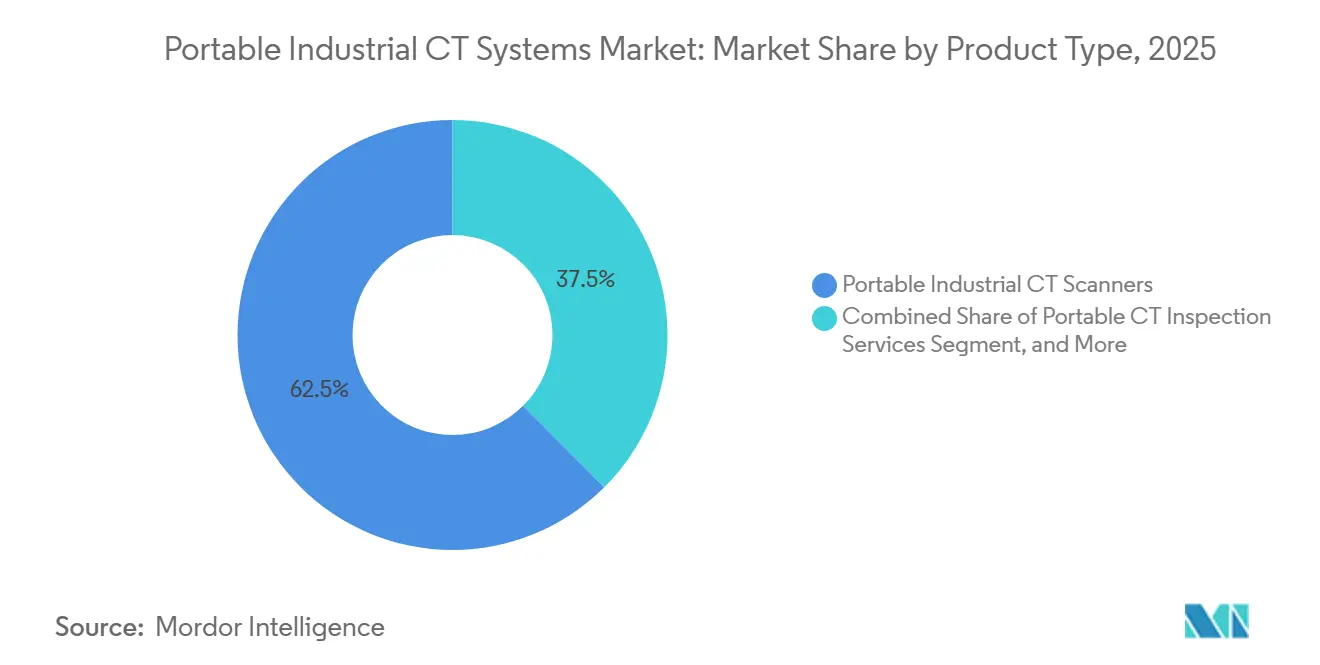
Portable industrial CT scanners accounted for 62.47% of revenue in 2025, indicating that well-funded manufacturers continue to purchase critical inspection equipment. Aerospace and defense prime contractors often need traceable records linked to individual assets and part serial numbers. This requirement supports ownership of systems that can remain under internal quality control. Portable CT modules and retrofit kits provide a lower-cost route for facilities that already use fixed CT equipment. They can extend scanning capability to satellite inspection points without requiring a complete new installation. The portable industrial CT systems industry, therefore, includes a middle ground between major equipment purchases and outsourced inspection.
Portable CT inspection services are projected to expand at an 11.27% CAGR through 2031. These services address companies with limited capital budgets and firms that need CT only during failure investigations or production ramp qualification. Microvista offers SCANEXPRESS as a rental system for batch inspections at the start of production. Rental availability supports short-cycle requirements without a long equipment commitment. Smaller systems and automated analysis are narrowing the practical gap between company-owned and service-bureau equipment. This supports continued demand for flexible capacity within the portable industrial CT systems market, especially where inspection needs change across sites.



By Form Factor: Cart-Based Systems Lead As Hand-Carry Systems Expand
Mobile cart-based systems accounted for 44.73% of revenue in 2025, giving them the highest revenue share by form factor. These systems can use higher-energy X-ray sources and larger flat-panel detectors than hand-carry devices. This makes them suitable for automotive castings, battery modules, and mid-sized aerospace assemblies in factory settings. Microvista introduced SCANEXPRESS in October 2025 as a container-mounted mobile CT system with automated evaluation and LTE and satellite connectivity. Its design demonstrates how mobility can be integrated into a large inspection enclosure. Cart-based equipment also fits battery plants where systems may need to move between production bays.
Hand-carry systems are projected to expand at a 10.73% CAGR through 2031. Demand comes from sites where carts cannot reach the inspection point, including confined pipeline locations and aircraft wing areas. Rayim introduced the XTOMO-CUBE in September 2026, weighing 6 kg and measuring 140×132×220 mm. Trailer-mounted equipment serves larger parts such as wind turbine blades and pipeline sections that require more stable positioning and shielding. Its specialized infrastructure needs limit its pace relative to hand-carry systems. Robotic CT platforms such as RadalyX use X-ray sources and detectors on 6-joint arms for flexible scan paths, with reported spatial resolution up to 60 µm.
By Application: Flaw Detection Anchors Demand While Additive Manufacturing Inspection Advances
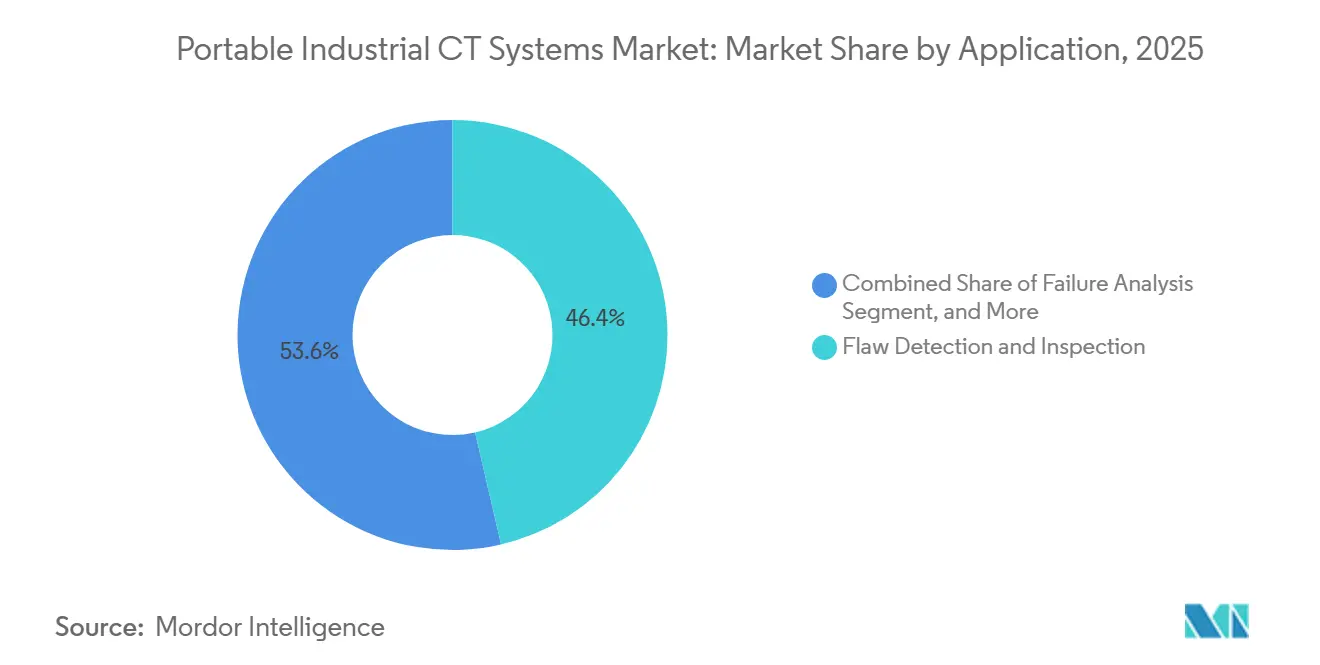
Flaw detection and inspection held 46.37% of revenue in 2025, reflecting established quality requirements in aerospace and automotive production. Cast, forged, and welded components may require volumetric defect assessment before acceptance. The portable industrial CT systems market size for this application is supported by the need to inspect components without destructive testing. Failure analysis preserves the condition of a part before it is taken apart for examination. Assembly analysis helps teams assess fasteners and joints without disassembly. Dimensioning and tolerancing analysis uses CT-derived point clouds to evaluate complex internal geometry.
Reverse engineering and additive manufacturing inspection are projected to expand at an 11.67% CAGR through 2031. The expansion reflects wider use of additive manufacturing in aerospace and medical-device production. ISO/ASTM 52971 recognizes cone-beam XCT for dimensional measurement of additive manufacturing series-production parts. Research on industrial X-ray CT gauges reported dimensional deviations of up to 10% of nominal diameter using the referenced image-quality approach. ASTM F3704M-24 sets inspection levels and acceptance criteria for laser-based powder bed fusion parts. Such requirements can place CT in the inspection sequence for titanium and nickel-alloy additive parts.
By End-User Industry: Aerospace And Defense Lead While Automotive And Electric Vehicles Accelerate
Aerospace and defense accounted for 30.83% of revenue in 2025, the largest share among end-user industries. Flight-critical components such as composite overwrapped pressure vessels, solid-fuel rocket motors, and turbine blades require non-destructive volumetric examination. Field-based CT can avoid the need to move these components to central inspection sites. North Star Imaging designed its X7000LT system for long aerospace and defense parts, including rotor blades and missile bodies. This reflects the premium placed on high-penetration scanning for specialized defense applications. The portable industrial CT systems market remains closely tied to the inspection standards and documentation needs of these buyers.
Automotive and electric vehicles are projected to expand at an 11.93% CAGR through 2031. Battery-cell and module inspection, rather than conventional vehicle inspection, is central to this demand. Internal battery defects require imaging methods beyond ultrasonic and 2D X-ray testing. Electronics and semiconductors also require internal inspection as chiplets, 2.5D and 3D integrated circuits, and high-bandwidth memory stacks become more complex. Comet Yxlon’s FF35 CT is certified to SEMI S2-0818 and SEMI S8-0218 standards for semiconductor applications. Oil and gas, energy and power, industrial manufacturing, medical devices, and academic research provide stable demand where complex welds, composite pressure vessels, implants, and instruments require internal assessment.
Geography Analysis
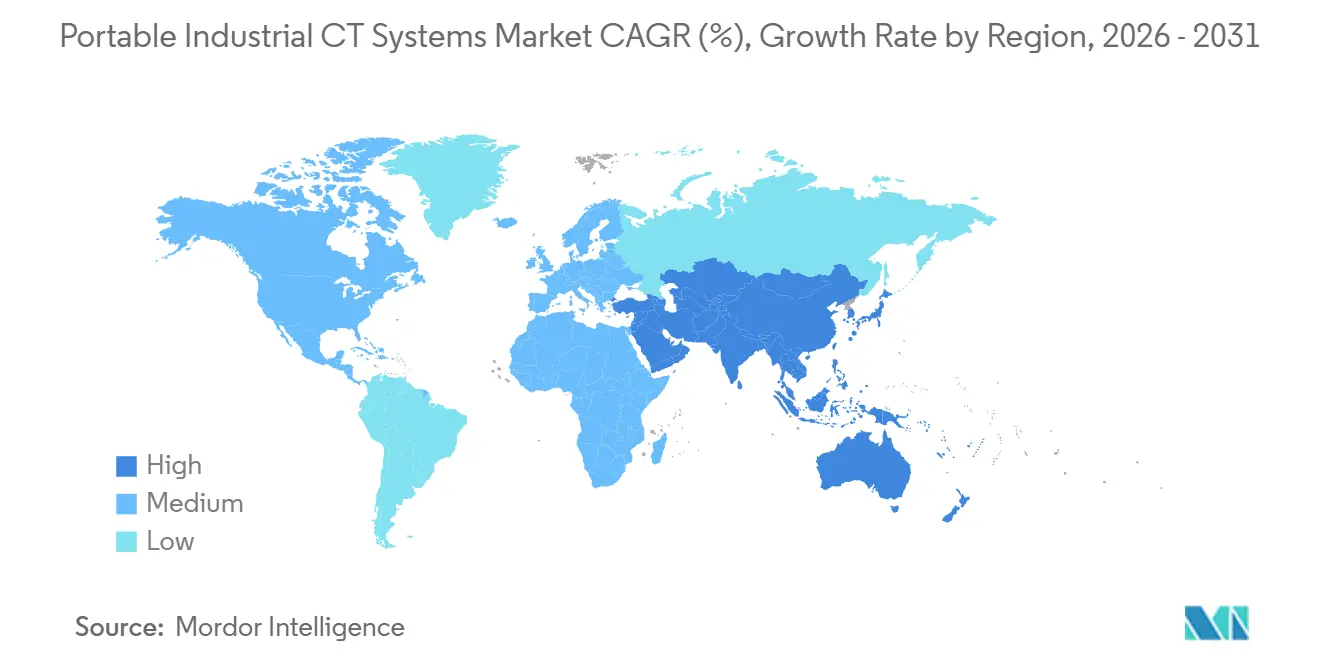
North America accounted for 32.67% of revenue in 2025, the largest share. Defense production, commercial aerospace maintenance, and battery-plant investment support demand across the region. U.S. regulations under 10 CFR 34 and equivalent state rules govern the deployment of portable X-ray sources. These requirements favor vendors that can provide radiation-safety support and compliance documentation. The Cybersecurity and Infrastructure Security Agency issued guidance in 2024 supporting zero-trust architecture and multifactor authentication for industrial data flows. Lumafield added on-premise NVIDIA DGX Spark computing to Triton and Neptune systems for sites that cannot send data to the cloud.
Asia-Pacific is projected to expand at an 11.47% CAGR through 2031, the fastest regional rate in the portable industrial CT systems market. China’s EV and consumer-electronics production, South Korea’s battery supply position, and Japan’s precision manufacturing base support this pace. Rayim’s September 2026 XTOMO-CUBE launch showed that regional developers are also producing compact CT hardware. The system weighs 6 kg, compared with 19 kg for an earlier Fraunhofer portable CT unit. Shimadzu launched the inspeXio 7000 in October 2025 with a narrow-angle CT mode for large lithium-ion batteries and high-Z metal components. Orders for battery inspection equipment also show that gigafactory investment is directing capital toward the portable industrial CT systems market and in-line CT infrastructure.
Europe accounted for a meaningful share in 2025, supported by Germany’s automotive and precision-engineering clusters and the UK aerospace maintenance sector. Directive 2013/59/Euratom and the EU Data Act encourage robust safety documentation and data interoperability capabilities. Ready Metrology introduced COREX ONE at ECNDT 2026 in Verona in June 2026. The self-shielded system is designed for shop-floor use and requires 30 minutes of operator training. South America, the Middle East, and Africa remain earlier-stage markets for portable CT. Demand in these regions is concentrated in oil and gas pipeline inspection and energy asset integrity work within the portable industrial CT systems market.[3]Lumafield, “Triton and Neptune Now Deliver On-Premise AI Compute with On-Board NVIDIA DGX Spark,” Lumafield, lumafield.com

Competitive Landscape
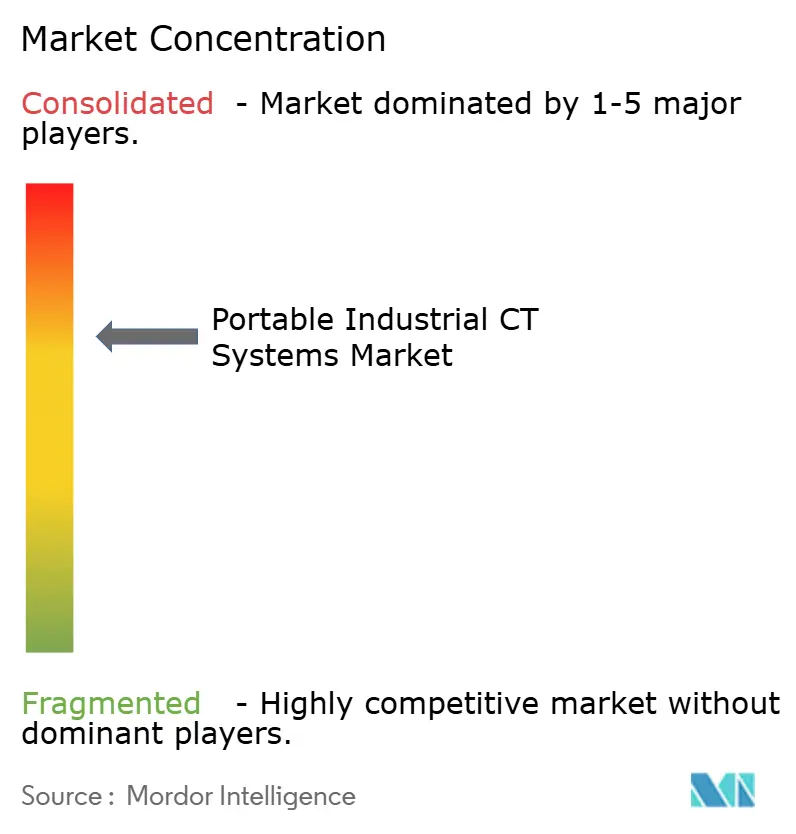
The portable industrial CT systems market is moderately concentrated in technology platforms and fragmented in service delivery. Baker Hughes, through Waygate Technologies; Carl Zeiss AG; Nikon Corporation; Comet Group, through Comet Yxlon; and Shimadzu Corporation compete on X-ray energy, detector capability, voxel resolution, and reconstruction speed. These companies also build software capabilities around defect recognition and inspection data. ZEISS uses Automated Defect Detection, Waygate uses Automated Defect Recognition, and Lumafield provides Voyager analytics. Software integration can distinguish systems where core imaging hardware becomes more widely available. Buyers in the portable industrial CT systems market also evaluate field support, safety controls, and reporting requirements.
Hexagon AB signed an agreement in April 2026 to acquire Waygate Technologies from Baker Hughes for USD 1.45 billion. The deal brings Waygate’s X-ray tube manufacturing and CT equipment together with Hexagon’s coordinate-measuring-machine and Volume Graphics software businesses. This combination can integrate surface measurement with internal inspection to enable a broader quality workflow in the portable industrial CT systems market. Lumafield introduced Neptune Performance and Triton Performance in June 2026, reporting 12× faster scans and 4× higher data quality than the preceding Neptune generation. The company stated that Triton Performance can produce a full CT reconstruction in 10 seconds. This approach targets production-line inspection where speed and ease of use are important.
Established suppliers have left room for equipment that manufacturers can operate without dedicated metrology teams. Ready Metrology’s COREX ONE is a self-shielded shop-floor unit designed to reduce specialized-room and training needs. Microvista’s SCANEXPRESS provides a container-deployable CT option for on-site work. Vendors in the portable industrial CT systems market are differentiating through AI, secure connectivity, and compliance support rather than X-ray power alone. North Star Imaging participates in ASTM E3166 and F3624 work, while LNE and Safran submitted a preliminary draft on additive-manufacturing CT metrology to ISO TC261 and ASTM F42. Standards activity can influence future procurement specifications in regulated applications.
Portable Industrial CT Systems Industry Leaders
Baker Hughes Company (Waygate Technologies)
Nikon Corporation
Carl Zeiss AG
Comet Group
Wenzel Group GmbH and Co. KG
- *Disclaimer: Major Players sorted in no particular order

Recent Industry Developments
- September 2026: Lumafield launched Quality Agent, an agentic AI system integrated into its Voyager platform that detects manufacturing defects by training on hundreds of thousands of real industrial CT part scans, the system demonstrated the ability to identify shared-cell OEM relationships across 10 battery brands in a blind validation test, establishing a new capability threshold for autonomous defect intelligence.
- June 2026: Ready Metrology premiered COREX ONE with Falcon software at ECNDT 2026 in Verona, the system's global debut, presenting a self-shielded shop-floor industrial CT requiring no radiation room, no specialized training, and capable of scanning in 20-30 seconds with a 1-minute metrological report, directly targeting the European mid-tier manufacturing segment.
- April 2026: Hexagon AB signed a definitive agreement to acquire Waygate Technologies from Baker Hughes for USD 1.45 billion, Waygate reported USD 630 million FY2025 revenue across NDT, CT, and remote visual inspection businesses, and the transaction is expected to close in H2 2026, subject to regulatory approvals.
- March 2026: Waygate Technologies and Liminal Insights announced a strategic partnership to develop multi-modal battery inspection combining CT hardware, nano-CT for cell development, high-energy CT for battery pack and module level inspection, and ultrasonic testing with an AI analytics layer for inline EV battery production lines.


Global Portable Industrial CT Systems Market Report Scope
The Portable Industrial CT Systems Market comprises revenue generated from portable or transportable industrial X-ray computed tomography equipment, CT modules and retrofit kits, and portable CT inspection services used to create two-dimensional or three-dimensional images of the internal and external structure of industrial components, assemblies, and materials. These systems support non-destructive testing, defect detection, dimensional measurement, assembly verification, failure analysis, reverse engineering, and additive manufacturing inspection across industrial and research environments. Industrial CT generates volumetric representations that can reveal concealed defects and geometries without physically sectioning or damaging the inspected part.
The Portable Industrial CT Systems Market Report is Segmented by Product Type (Portable Industrial CT Scanners, Portable CT Modules and Retrofit Kits, and Portable CT Inspection Services), Form Factor (Hand-Carry Sytems, Trailer-Mounted Systems, Mobile Cart-Based Systems, Other Portable Form Factors), Application (Flaw Detection and Inspection, Failure Analysis, Assembly Analysis, Dimensioning and Tolerancing Analysis, Reverse Engineering and Additive Manufacturing Inspection, and Other Applications), End-User Industry (Aerospace and Defense, Automotive and Electric Vehicles, Electronics and Semiconductors, Oil and Gas, Energy and Power, Medical Devices, Industrial Manufacturing, Academic and Research Institutes, and Other End-User Industries), and Geography (North America, South America, Europe, Asia-Pacific, and Middle East and Africa). The Market Forecasts are Provided in Terms of Value (USD).
| Portable Industrial CT Scanners |
| Portable CT Modules and Retrofit Kits |
| Portable CT Inspection Services |
| Hand-Carry Systems |
| Trailer-Mounted Systems |
| Mobile Cart-Based Systems |
| Other Portable Form Factors |
| Flaw Detection and Inspection |
| Failure Analysis |
| Assembly Analysis |
| Dimensioning and Tolerancing Analysis |
| Reverse Engineering and Additive Manufacturing Inspection |
| Other Applications |
| Aerospace and Defense |
| Automotive and Electric Vehicles |
| Electronics and Semiconductors |
| Oil and Gas |
| Energy and Power |
| Medical Devices |
| Industrial Manufacturing |
| Academic and Research Institutes |
| Other End-User Industries |
| North America | United States | |
| Canada | ||
| Mexico | ||
| South America | Brazil | |
| Argentina | ||
| Rest of South America | ||
| Europe | Germany | |
| United Kingdom | ||
| France | ||
| Italy | ||
| Spain | ||
| Rest of Europe | ||
| Asia-Pacific | China | |
| Japan | ||
| India | ||
| South Korea | ||
| ASEAN | ||
| Rest of Asia-Pacific | ||
| Middle East and Africa | Middle East | Saudi Arabia |
| United Arab Emirates | ||
| Turkey | ||
| Rest of the Middle East | ||
| Africa | South Africa | |
| Nigeria | ||
| Rest of Africa | ||
| By Product Type | Portable Industrial CT Scanners | ||
| Portable CT Modules and Retrofit Kits | |||
| Portable CT Inspection Services | |||
| By Form Factor | Hand-Carry Systems | ||
| Trailer-Mounted Systems | |||
| Mobile Cart-Based Systems | |||
| Other Portable Form Factors | |||
| By Application | Flaw Detection and Inspection | ||
| Failure Analysis | |||
| Assembly Analysis | |||
| Dimensioning and Tolerancing Analysis | |||
| Reverse Engineering and Additive Manufacturing Inspection | |||
| Other Applications | |||
| By End-User Industry | Aerospace and Defense | ||
| Automotive and Electric Vehicles | |||
| Electronics and Semiconductors | |||
| Oil and Gas | |||
| Energy and Power | |||
| Medical Devices | |||
| Industrial Manufacturing | |||
| Academic and Research Institutes | |||
| Other End-User Industries | |||
| By Geography | North America | United States | |
| Canada | |||
| Mexico | |||
| South America | Brazil | ||
| Argentina | |||
| Rest of South America | |||
| Europe | Germany | ||
| United Kingdom | |||
| France | |||
| Italy | |||
| Spain | |||
| Rest of Europe | |||
| Asia-Pacific | China | ||
| Japan | |||
| India | |||
| South Korea | |||
| ASEAN | |||
| Rest of Asia-Pacific | |||
| Middle East and Africa | Middle East | Saudi Arabia | |
| United Arab Emirates | |||
| Turkey | |||
| Rest of the Middle East | |||
| Africa | South Africa | ||
| Nigeria | |||
| Rest of Africa | |||


Key Questions Answered in the Report
What is the 2026 size of the portable industrial CT systems market?
The portable industrial CT systems market was estimated at USD 93.62 million in 2026 and is projected to reach USD 143.05 million by 2031.
What is driving demand for portable industrial CT systems?
Demand is supported by on-site non-destructive inspection, additive manufacturing qualification, automated defect analysis, and battery-cell inspection.
Which product type held the largest revenue share in 2025?
Portable industrial CT scanners held 62.47% of revenue in 2025, while inspection services are projected to expand at an 11.27% CAGR through 2031.
Which form factor is expanding fastest?
Hand-carry systems are projected to expand at a 10.73% CAGR through 2031, supported by applications with limited physical access.
Which end-user group is expanding fastest?
Automotive and electric vehicles are projected to expand at an 11.93% CAGR through 2031, with battery-cell and module inspection supporting demand.
Which region is projected to expand fastest through 2031?
Asia-Pacific is projected to expand at an 11.47% CAGR through 2031, led by EV, battery, electronics, and precision-manufacturing activity.
Page last updated on:


 Your data is secure and never sold or shared.


