
Polybenzoxazine Resins Market Size and Share
Market Overview
| Study Period | 2022 - 2032 |
|---|---|
| Market Size (2027) | USD 115.81 Million |
| Market Size (2032) | USD 154.11 Million |
| Growth Rate (2027 - 2032) | 5.88 % |
| Fastest Growing Market | Asia-Pacific |
| Largest Market | North America |
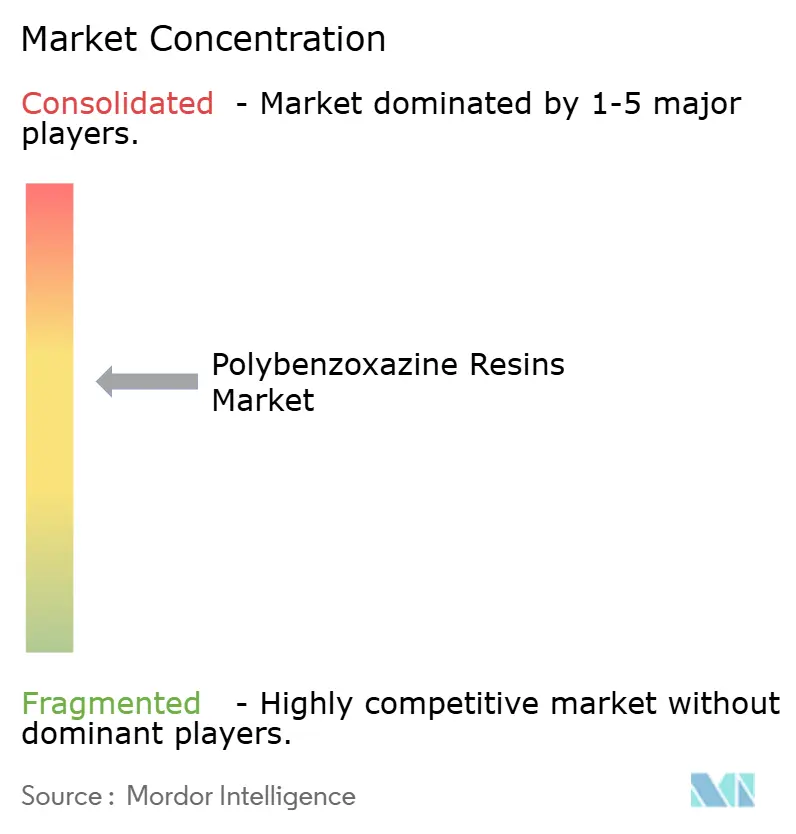
| Market Concentration | Medium |
Major Players *Disclaimer: Major Players sorted in no particular order Image © Mordor Intelligence. Reuse requires attribution under CC BY 4.0. | |
Polybenzoxazine Resins Market Analysis by Mordor Intelligence
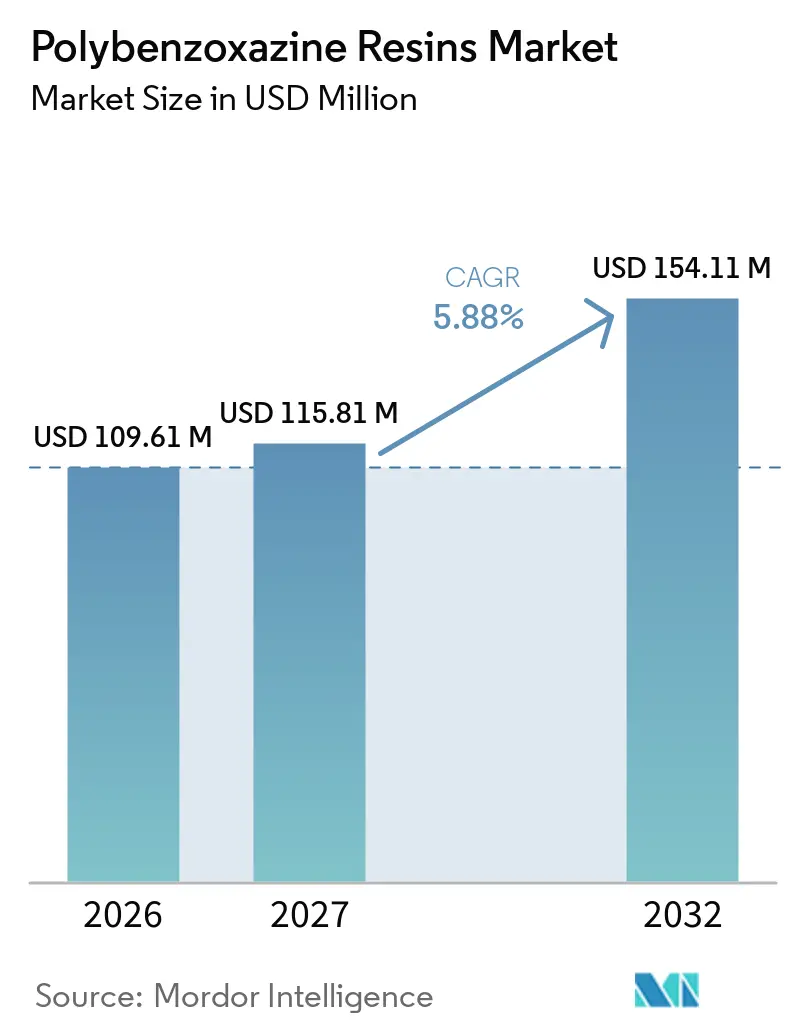
The polybenzoxazine resins market size was valued at USD 109.61 million in 2026 and is estimated to grow from USD 115.81 million in 2027 to USD 154.11 million by 2032, at a CAGR of 5.88% during the forecast period (2027-2032). The polybenzoxazine resins market is supported by applications requiring thermal stability, low cure shrinkage, flame resistance, and low dielectric loss in a single resin system. Demand is concentrated in applications where conventional phenolic and epoxy materials collectively fail to meet these requirements. The market is moving into a more established phase, with buyers placing greater weight on performance and qualification records than on initial material cost. Aerospace, defense, electronics, and advanced composite programs present opportunities due to their exacting material specifications. Processing temperature and the availability of bio-based feedstocks remain constraints, but these factors are application-specific and do not alter the stated forecast for the polybenzoxazine resins market.
Key Report Takeaways
- By product type, Bisphenol-A Benzoxazine held 49.13% market share in 2026, while Bio-Based Benzoxazine is forecast to expand at a 6.94% CAGR through 2032.
- By end-user industry, aerospace and defense held 44.56% market share in 2026, while electrical and electronics are forecast to expand at a CAGR of 6.77% through 2032.
- By geography, North America held 35.81% market share in 2026, while Asia-Pacific is forecast to expand at a CAGR of 6.41% through 2032.
Note: Market numbers in this report are based on Mordor Intelligence's proprietary estimation framework, which combines nine months of actuals with Q4 projections for base year 2026.
Global Polybenzoxazine Resins Market Trends and Insights
Drivers Impact Analysis*
| Drivers | (~) % Impact on CAGR Forecast | Geographic Relevance | Impact Timeline |
|---|---|---|---|
| Lightweight, high-temperature composite demand | +2.0% | Global, with core demand in North America, Europe, and APAC defense corridors | Long term (≥ 4 years) |
| High-reliability electronics and Printed Circuit Board (PCB) laminate use | +1.5% | APAC core, including China, Japan, and South Korea, with spillover to North America and Europe | Medium term (2-4 years) |
| Aerospace and defense composite program expansion | +1.2% | North America and Europe, with spillover to India and South Korea | Long term (≥ 4 years) |
| Halogen-free flame-retardant system adoption | +0.8% | EU-led, with compliance pressure extending globally | Medium term (2-4 years) |
| Near-zero cure shrinkage for stable components | +0.5% | Global, particularly precision electronics and satellite sub-assemblies | Short term (≤ 2 years) |
| Source: Mordor Intelligence | |||
Demand for Lightweight, High-Temperature Composite Materials
Aerospace and next-generation mobility programs are raising performance requirements for matrix resins used in structural parts. A 2025 study led by the Indian Institute of Technology (IIT) Delhi reported that polybenzoxazine-based imine vitrimer composites retained tensile strength comparable to that of pristine carbon-fiber-reinforced polymer panels after closed-loop chemical recycling. The same study reported stress-relaxation times as short as 50 seconds at 140°C, which could support repair approaches for composite panels rather than replacement. Polybenzoxazine systems exhibit glass transition temperatures of 200°C to 300°C without requiring separate flame-retardant additives. This avoids the added weight associated with additive packages in competing thermosets with comparable flame, smoke, and toxicity performance. The polybenzoxazine resins market, therefore, benefits when structural weight, heat resistance, and compliance requirements are considered together.
Composite content is increasing in aircraft and other advanced mobility platforms, keeping resin selection tied to mechanical performance and long qualification cycles. Aerospace-grade polybenzoxazine formulations have been reported to achieve flexural modulus values up to 50% higher than those of conventional epoxies, supporting their use in applications where structural stiffness is important. The material can also be used in ablative applications that require predictable behavior at high temperatures. Research published in 2025 found that a polybenzoxazine-silica fabric composite with 3 wt% alumina achieved a mass ablation rate of 0.0284 g/s during oxyacetylene testing. This result was reported as the lowest value for fiber-reinforced ablative composites in the cited open literature. These capabilities support evaluation for thruster nozzles and re-entry vehicle components, although qualification remains specific to each program.
Increasing Use in High-Reliability Electronics and Printed Circuit Board (PCB) Laminates
The shift from conventional FR-4 epoxy laminates to newer substrates is being driven by 5G, AI server, and power-electronics requirements. These systems require dielectric constants below 3.5 and loss tangents below 0.01 at frequencies of 1 GHz and above. JFE Chemical Corporation states that its JBZ benzoxazine resin series has dielectric constants of 2.9-3.5 and dielectric losses of 0.009–0.02 at 1 GHz. The company also describes higher-performance grades with dielectric loss from 0.005 to 0.01 at 10 GHz. These values make the polybenzoxazine resins market relevant to laminate and encapsulation choices that require both electrical and thermal performance.
A December 2025 review in ACS Applied Materials & Interfaces linked the material's low dielectric behavior to near-zero shrinkage during ring-opening polymerization. The curing process is catalyst-free and does not generate by-products, thereby reducing residual stress and micro-void formation that can increase dielectric loss[1]. This behavior can be useful in high-density interconnect structures where performance must remain stable across several layers. It also gives copper-clad laminate manufacturers a reason to assess the material beyond a single bulk dielectric constant. Substrate selection for AI inference accelerator boards increasingly considers frequency stability, thermal management, and dimensional control together.
Moisture absorption of 0.3% to 0.4% has been reported for polybenzoxazine materials, compared with 1.0% to 2.0% for standard epoxies. Lower moisture uptake helps preserve impedance control in humid operating conditions. This is relevant to Class 3 high-reliability electronics, where board performance must remain dependable over a demanding service life. The polybenzoxazine resins market is thus supported by the combined requirements of high-speed data infrastructure and compact electronic assemblies. The opportunity is most evident in base stations, server boards, and silicon-carbide electric-vehicle power modules. Adoption remains dependent on laminate maker qualification and on the equipment available to process higher-temperature resin systems.
Expansion of Aerospace and Defense Composite Programs
Defense spending in North America and Europe, urban air mobility development, and satellite constellation activity are widening the range of composite applications under review. The resulting demand extends beyond traditional narrow-body and wide-body aircraft structures to propulsion-adjacent parts, orbital structures, and emerging defense systems. Kaneka Aerospace presented a modified benzoxazine formulation for carbon-carbon composite applications with a high char yield at technical sessions of the Society for the Advancement of Material and Process Engineering. The company has also described its SR6400 epoxy-amine repair resin for composite repair work. These examples reflect the continuing development of specialty resin performance for demanding aerospace applications.
A 2025 University of Bristol study examined deployable polybenzoxazine nanocomposites under simulated low Earth orbit conditions. The work included exposure to atomic oxygen, gamma radiation, and vacuum-ultraviolet conditions over 18 months. Polyhedral Oligomeric Silsesquioxane (POSS)-reinforced polybenzoxazine composites retained thermal and thermomechanical stability, with glass transition temperatures increasing by up to 26°C. This finding provides technical support for the use of these materials in space structures. It links the polybenzoxazine resins market to programs where both high-temperature stability and radiation exposure are relevant.
Toray Advanced Composites highlighted thermoset composite systems for next-generation aircraft, defense, and space systems at the Paris Air Show in 2025. This activity shows the supplier's continued focus on aerospace qualification and composite system development. The polybenzoxazine resins market benefits from this broader effort because resin decisions are made within an ecosystem of prepregs, reinforcements, tooling, repair methods, and fabrication processes. Qualification cycles can slow near-term conversion, but they also make approved material positions durable. Buyers value documented test results, production consistency, and traceable supply, which maintain a high barrier for materials without an established aerospace record.
Adoption of Halogen-Free Flame-Retardant Systems
Regulatory attention to halogenated substances is increasing demand for materials that can provide flame resistance without halogen-containing additives. For polybenzoxazine, the opportunity lies in its intrinsic char-forming network and its ability to enhance flame-retardant performance within the matrix resin. European rules, including the Restriction of Hazardous Substances Directive and the Registration, Evaluation, Authorization and Restriction of Chemicals (REACH) Regulation, remain important reference points for material compliance across global supply chains. Manufacturers supplying European customers often apply these requirements when screening materials for products sold across multiple regions. This provides the polybenzoxazine resins market with a compliance-driven demand channel across both electronics and structural composites.
A 2025 RSC Advances study found that a 9,10-dihydro-9-oxa-10-phosphaphenanthrene-10-oxide (DOPO)-containing polymer derived from main-chain benzoxazine achieved a limiting oxygen index of 34.1% and a UL-94 V-0 rating in epoxy thermosets at 0.3 wt% phosphorus content. This result illustrates how benzoxazine hybridization can provide halogen-free V-0 performance with lower additive loading than conventional phosphorus-based systems. It also suggests a route for improving flame performance where a fully neat polybenzoxazine system is not suitable for existing production methods. The emphasis is on maintaining electrical, mechanical, and thermal properties while meeting safety requirements, as qualification teams must assess the complete formulation rather than flame performance alone.
Research published in 2025 on furan-derived bio-based polybenzoxazines reported intrinsic flame resistance and high thermal stability without halogen or phosphorus additives. These materials can support electronics packaging applications where procurement teams are seeking fewer substances of concern. Material safety data sheet review is now an explicit qualification step for many Tier 1 electronics suppliers serving the European Union, the United Kingdom, and U.S. federal markets. Commercial grades can achieve V-1 or V-0 classifications without external additives in many formulations, potentially reducing the need for a retrofit approach involving added flame-retardant packages. The outcome still depends on the resin grade, final article design, and the applicable test method.
Restraints Impact Analysis*
| Restraints | (~) % Impact on CAGR Forecast | Geographic Relevance | Impact Timeline |
|---|---|---|---|
| High production cost and limited economies of scale | -0.9% | Global, particularly acute in South America, the Middle East, and Africa | Long term (≥ 4 years) |
| Complex processing and high-temperature curing requirements | -0.6% | Global, most restrictive in small and medium-sized fabrication environments in emerging markets | Medium term (2-4 years) |
| Competition from epoxy, phenolic, polyimide, and bismaleimide resins | -0.7% | North America and Europe, where epoxy supply chains are entrenched | Long term (≥ 4 years) |
| Source: Mordor Intelligence | |||
High Production Cost and Limited Economies of Scale
Benzoxazine monomers are produced through a Mannich-type condensation of phenol, formaldehyde, and an amine under controlled conditions. This production route is less suited to continuous-flow manufacturing than the esterification or epoxidation routes used for high-volume thermosets. Many current facilities therefore use batch or semi-batch processes, which increases unit cost compared with bisphenol A epoxy resin, which benefits from mature, continuous catalytic production. The polybenzoxazine resins market is most exposed to this cost difference in applications that do not require the material's full thermal, dielectric, or flame-resistance profile.
The material can qualify for defense and aerospace applications where performance and certification requirements outweigh resin cost. The comparison is less favorable in automotive laminates and general industrial composites, where incumbent epoxies can be 30% to 50% cheaper at commercial scale. Price-sensitive buyers may accept lower performance when an existing epoxy system meets the minimum requirement. This constrains demand in applications without strong safety or heat-resistance requirements and requires resin suppliers to demonstrate a clear cost-in-use benefit rather than relying on technical specifications alone.
Bio-based grades face an additional cost challenge because renewable phenols, including vanillin, cardanol, and eugenol, are produced in smaller quantities and with greater variability than petrochemical-grade bisphenol A. This can slow cost convergence even as research investment increases. A 2025 publication reported processable bio-based polybenzoxazine systems with tunable toughness ranging from 9.0 to 24.1 MJ/m³ and a dielectric constant of 2.99 at 3 GHz. While these results support technical development, large-scale commercial adoption remains dependent on consistent feedstock supply and reliable synthesis yields.
Complex Processing and High-Temperature Curing Requirements
Many polybenzoxazine formulations cure at 180°C to 220°C, which is higher than the 120°C to 150°C curing window commonly associated with epoxy systems. Fabricators with limited press, oven, or autoclave capability may find this range difficult to accommodate. This constraint is particularly relevant for smaller manufacturers and operations in emerging markets with limited high-temperature processing equipment, as it can add cycle time, energy consumption, and capital requirements to a production line.
Processing considerations extend beyond cure temperature. Resin transfer molding and liquid infusion applications require controlled viscosity and predictable fiber wet-out. Bisphenol-F grades offer lower melt viscosity than Bisphenol-A grades, which can improve processability in these methods and provide a route for suppliers to address some handling limitations without changing the intended end use. However, the polybenzoxazine resins market still competes against systems that are already familiar to operators and integrated into existing factory processes.
Product strategy often involves balancing performance with modifications that allow fabricators to use available equipment. Blends with other thermosets can reduce the disruption associated with adopting a fully neat benzoxazine system. Suppliers are also investigating lower-viscosity liquid grades for ambient-temperature resin transfer molding and infusion. These options can broaden the practical applications of the chemistry, but must retain the thermal and dielectric benefits that justify the transition. The processing barrier is therefore not uniform across the polybenzoxazine resins market. It is most significant where manufacturers have limited equipment flexibility or where material cost and cycle time are the primary procurement criteria.
*Our forecasts treat driver/restraint impacts as directional, not additive. The impact forecasts reflect baseline growth, mix effects, and variable interactions.
Segment Analysis
By Product Type: Bisphenol-A Grade Leads, Bio-Based Grades Accelerate
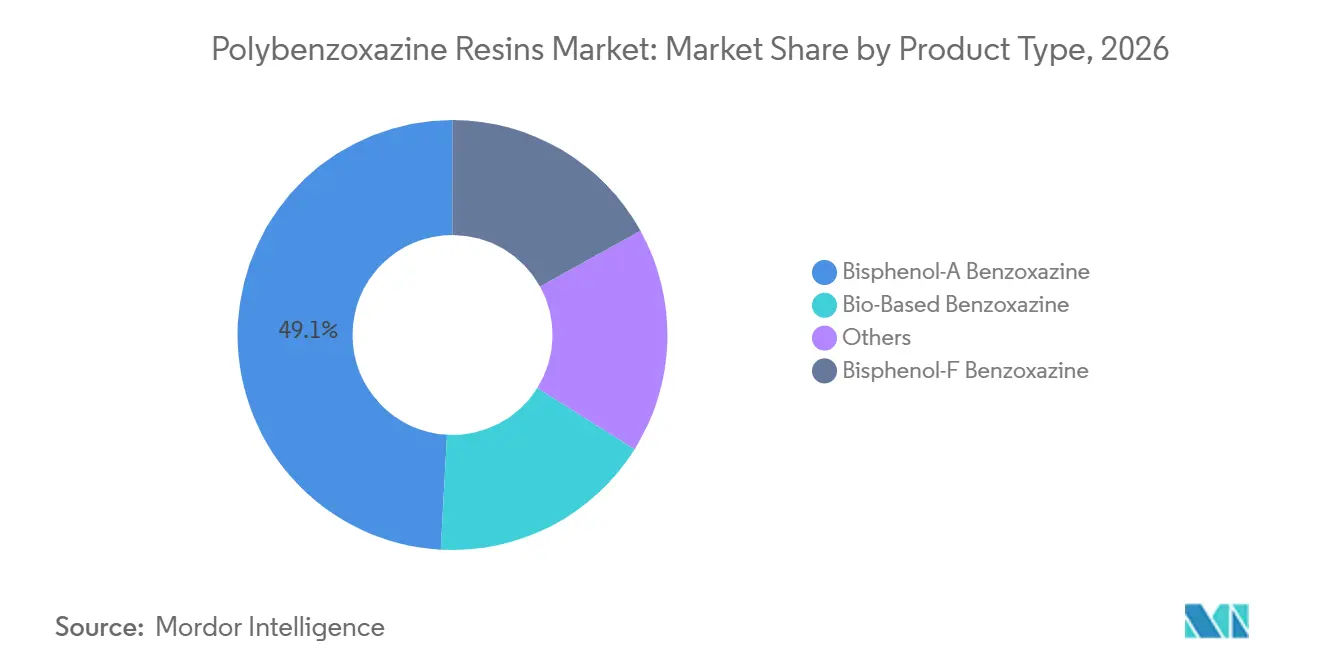
Bisphenol-A Benzoxazine held 49.13% of the polybenzoxazine resins market share in 2026. Its position reflects established supplier qualification data, known prepreg processing procedures, and compatibility with autoclave infrastructure used by aerospace and electronics fabricators. After ring-opening polymerization, the grade provides high crosslink density, glass transition temperatures commonly ranging from 180°C to 220°C, and char yields above 45% in thermogravimetric analysis. These properties support its use in structural composites and high-reliability laminates. A U.S. patent granted in May 2025 described a multifunctional benzoxazine composition for fiber-reinforced composite materials that combines Bisphenol-A and Bisphenol-F resins with cycloaliphatic epoxy components. The composition was designed for high-temperature, high-compressive-load aerospace environments. This indicates continued formulation work in a commercially established portion of the polybenzoxazine resins market.
Bisphenol-F Benzoxazine and other conventional grades form the remainder of the non-bio-based portfolio. Bisphenol-F materials have slightly lower melt viscosity than Bisphenol-A materials, which can improve handling in resin transfer molding and liquid infusion, where consistent fiber wet-out is necessary. Bio-Based Benzoxazine is the fastest-growing product type, with a projected CAGR of 6.94% from 2027 to 2032. Research from 2025 reported bio-based formulations with tunable toughness ranging from 9.0 to 24.1 MJ/m³ and a dielectric constant of 2.99 at 3 GHz. Another 2025 study reported that bio-based polybenzoxazine made from tannic acid and aniline improved corrosion resistance while maintaining thermal stability. These results indicate a possible path toward marine and offshore applications, alongside a more immediate focus on electronics and the procurement of sustainable materials. They also broaden the polybenzoxazine resins market beyond established petrochemical feedstock options, keeping it relevant to buyers seeking renewable material pathways.

By End-User Industry: Aerospace Leads in Demand, Electronics Drives Growth
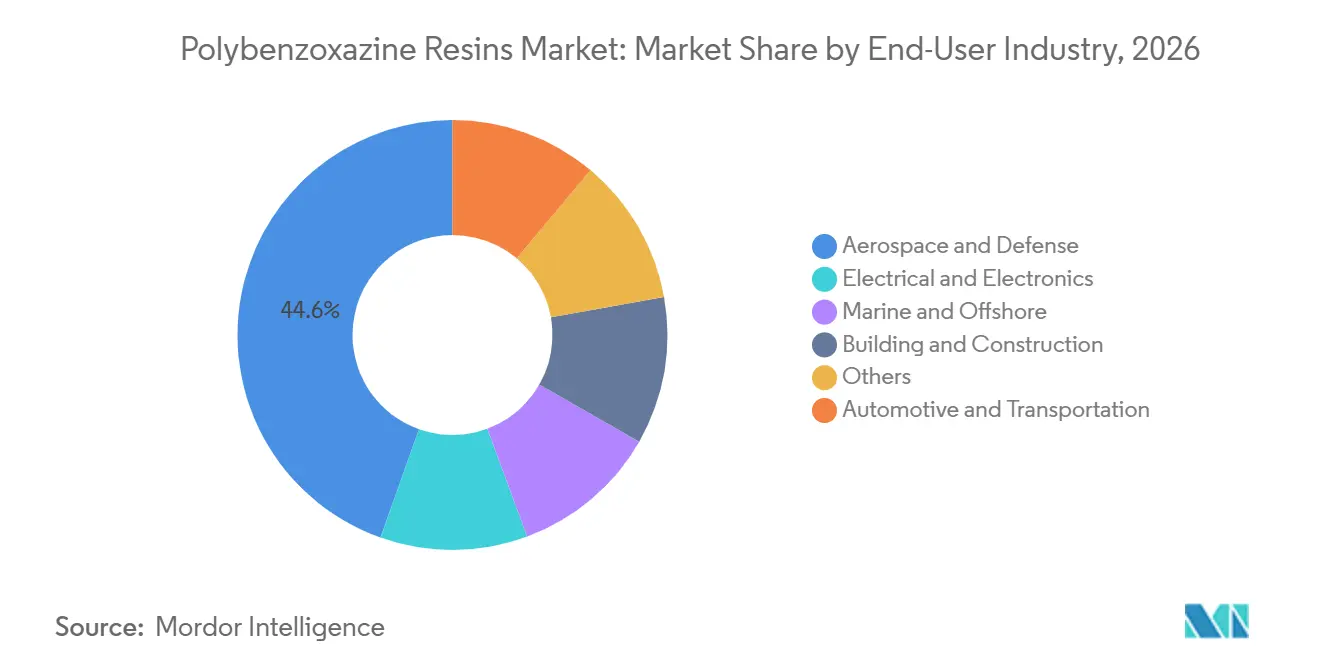
Aerospace and defense accounted for 44.56% of total revenue in 2026. The segment benefits from material qualification cycles that make approved resin positions durable once they reach flight certification. Requirements under 14 Code of Federal Regulations (CFR) Part 25 and related military standards address flame, smoke, and toxicity for cabin interior materials. These requirements create ongoing demand for certified systems for repair and maintenance work, as well as for new-build programs. Kaneka Aerospace presented benzoxazine formulations ABZ and F-ABZ, which exhibit high char yield for carbon-carbon composite applications, at the Composites and Advanced Materials Expo (CAMX) 2024. This was followed by a bismaleimide tooling prepreg in 2025 that cures at 120°C while retaining 177°C service performance, demonstrating continued development of high-performance thermoset systems. Aerospace and defense remain the largest end-user segment because certification, heat resistance, and fire performance are evaluated together.
Electrical and electronics have the highest projected growth rate, at a CAGR of 6.77% from 2027 to 2032. AI server infrastructure, 5G base stations, and electric vehicle power electronics combine high operating frequency, high junction temperature, and dense packaging requirements. High glass transition temperature and low moisture absorption are important for encapsulants and substrate materials in high-density electronic components. Automotive and transportation demand is tied to underhood thermal-management parts and electric vehicle power-module encapsulants that operate above the service limits of standard epoxy compounds. Marine and offshore demand centers on structural adhesives and coating matrices that require salt-spray resistance, thermal-cycling stability, and halogen-free flame resistance. Building and construction is the smallest end-user segment, but fire-resistant panels and facade composites provide a long-cycle infrastructure demand base for the polybenzoxazine resins market.
Geography Analysis
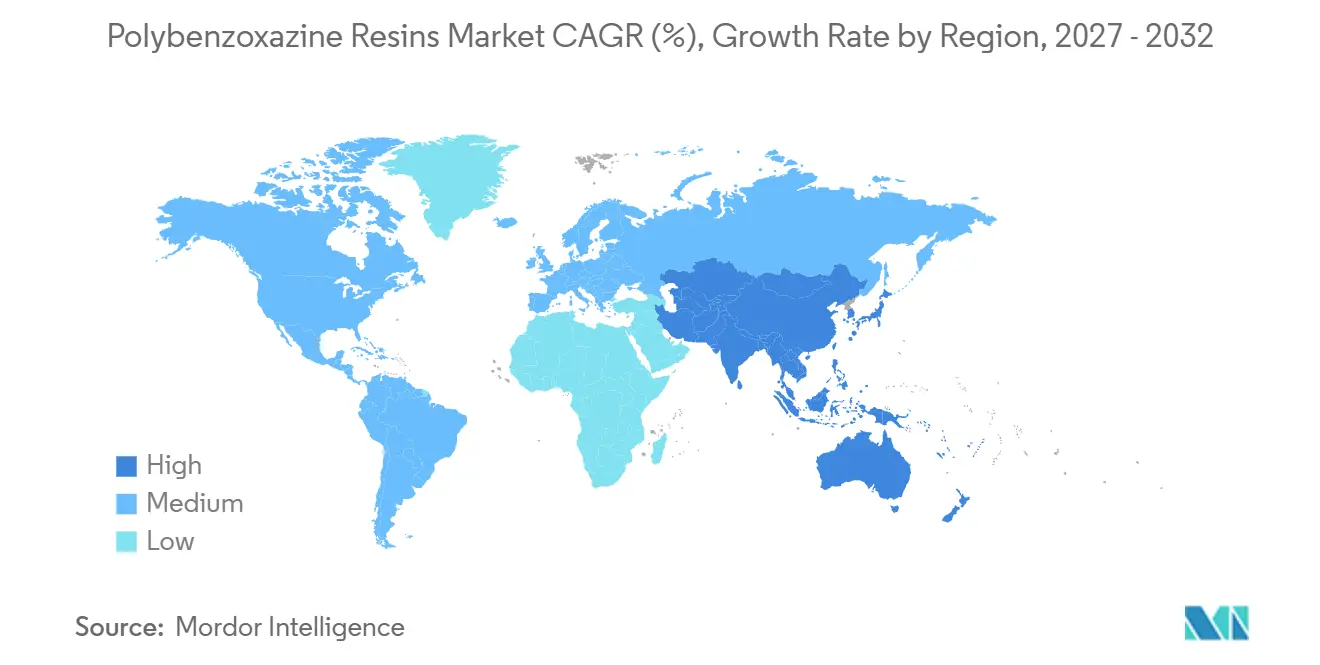
North America accounted for 35.81% of the polybenzoxazine resins market in 2026. The United States has a large aerospace and defense industrial base that includes airframe manufacturers, defense contractors, and composite fabrication supply chains. These customers procure according to detailed specifications, which makes demand less sensitive to cost pressures than in general industrial applications. Canada contributes through satellite and space-system activity, where ablative and structural composites are tested against radiation and thermal-shock requirements. Mexico supports the manufacturing chain for US-headquartered composite fabricators. Kaneka Aerospace and Composite Technology Development maintains a North American presence in the development of specialty benzoxazines for ablative and structural composite applications.
North America also remains a technology anchor for advanced composite procurement. In July 2025, Toray Advanced Composites announced it would supply space-grade epoxy-based composite materials for Constellation solar arrays[2]. This announcement reinforces the role of qualified composite materials in space programs, even when the specific supply is an epoxy-based system. Asia-Pacific is the fastest-growing region, with a forecast CAGR of 6.41% from 2027 to 2032. Japan is home to several advanced benzoxazine producers, including JFE Chemical Corporation, which supplies its JBZ series for prepregs, laminates, and semiconductor encapsulation. South Korea's electronics ecosystem and China's growing 5G infrastructure support demand for copper-clad laminates. In the Asia-Pacific region, the polybenzoxazine resins market is shifting from manufacturing scale to more active research, specification development, and local qualification activities.
China has published patent applications for high-toughness, low-dielectric bio-based benzoxazine resins intended for copper-clad laminates, indicating efforts to develop local formulations. India's aerospace development and defense indigenization efforts create an emerging qualification path for high-temperature composite resins. ABR Organics Limited and Atul Ltd. are positioned in India's specialty chemical distribution channels. Malaysia and Singapore add electronics manufacturing capacity within the ASEAN corridor. Europe has demand from Germany's automotive and aerospace production base, including carbon-fiber-reinforced polymer structures and high-voltage power electronics. The Araldite benzoxazine line from Huntsman Advanced Materials is used for primary and secondary aerospace structures, while Nordic maritime and offshore customers require halogen-free, thermally durable structural adhesives. South America, the Middle East, and Africa remain smaller markets, although Brazil's Embraer-linked supply chain and Gulf investment in oil and gas, infrastructure, and defense maintain demand for high-performance composites. EU RoHS and REACH requirements influence material selection beyond Europe, as suppliers often apply EU-compliant specifications across global programs. These conditions continue to support growth in the polybenzoxazine resins market across multiple end uses and regions.
Competitive Landscape
The polybenzoxazine resins market is moderately consolidated. JFE Chemical Corporation, Shikoku Chemicals Corporation, Sumitomo Bakelite Co., Ltd., and Japan Material Technologies Corporation hold positions due to their formulation expertise and records in downstream qualification. Huntsman International LLC and DIC Corporation also participate through broader thermoset portfolios, which allow them to offer benzoxazine blended with epoxy, bismaleimide, or cyanate ester. These blends can improve processability while retaining the thermal and dielectric properties associated with benzoxazine chemistry. As a result, the competitive focus is on formulation fit and qualification support rather than on single-resin products.
Hybrid resin systems represent an important competitive approach, as they enable customers to improve performance without replacing existing processes. A 2025 U.S. patent covering two benzoxazine types and a cycloaliphatic epoxy component illustrates this approach for aerospace composite applications. DIC Corporation has also pursued work on phenolic hydroxyl-containing compounds, curable resin compositions, and copper-clad laminates incorporating benzoxazine as a co-resin component for electronic applications. Patent activity indicates continued attention to blends and application-specific formulations. JFE Chemical's commercial JBZ portfolio reflects a second approach, providing materials for prepregs, laminates, and semiconductor applications with defined electrical characteristics. Sumitomo Bakelite's biomass-derived PFA prepreg represents a third example, where the company is pursuing flame resistance and a renewable-materials position for aircraft interiors.
Opportunities remain in bio-based grade scale-up, ablative reformulation for commercial space launch components, and low-viscosity liquid grades for resin transfer molding at ambient infusion temperatures. Bitrez Group Limited serves custom-formulation needs for specialized substrate and adhesive applications in the United Kingdom and European markets. KONISHI CHEMICAL IND CO., LTD. supplies standard benzoxazine grades cited in academic and industrial patent literature. Research into vitrimer chemistry has demonstrated closed-loop recyclability in polybenzoxazine carbon-fiber composites, which could address end-of-life concerns for aerospace composite platforms, though this work remains pre-commercial.
Polybenzoxazine Resins Industry Leaders
-
Huntsman International LLC
-
KANEKA CORPORATION
-
SHIKOKU CHEMICALS CORPORATION
-
Japan Material Technologies Corporation
-
Bitrez Group Limited
- *Disclaimer: Major Players sorted in no particular order
Recent Industry Developments
- January 2026: Sumitomo Bakelite Co., Ltd. developed a biomass-derived PFA resin-based (PolyFurfuryl Alcohol) prepreg under the sbPFA brand for aircraft interior materials. The material meets FST standards under 14 CFR Part 25 and OSU heat-release requirements, with mechanical strength comparable to that of petroleum-based phenolic resins. The company targets customer evaluation in 2026 and mass production by 2028, with plans to extend the technology to other high-flame-retardancy applications beyond aviation.
- September 2025: RSC Publishing (IIT Delhi) published a peer-reviewed study in Polymer Chemistry on polybenzoxazine imine vitrimer carbon-fiber composites. The study demonstrated closed-loop recyclability under mild chemical conditions, with the tensile strength of recycled CFRP comparable to that of pristine panels. These findings support the qualification of recyclable polybenzoxazine composites in aviation and defense markets, where end-of-life management regulations are tightening.
Global Polybenzoxazine Resins Market Report Scope
Polybenzoxazine resins are a relatively new class of high-performance thermosetting phenolic resins containing nitrogen and oxygen. They are synthesized via a condensation reaction of a phenol, an amine, and formaldehyde to form benzoxazine monomers, which then polymerize by ring-opening polymerization without the need for traditional hardeners or catalysts.
The polybenzoxazine resins market is segmented by product type, end-user industry, and geography. By product type, the market is segmented into bisphenol-A benzoxazine, bisphenol-F benzoxazine, bio-based benzoxazine, and others. By end-user industry, the market is segmented into aerospace and defense, automotive and transportation, electrical and electronics, marine and offshore, building and construction, and others. The report also covers the market size and forecasts for polybenzoxazine resins in 15 countries across major regions. The market sizes and forecasts are provided in terms of value (USD).
| Bisphenol-A Benzoxazine |
| Bisphenol-F Benzoxazine |
| Bio-Based Benzoxazine |
| Others |
| Aerospace and Defense |
| Automotive and Transportation |
| Electrical and Electronics |
| Marine and Offshore |
| Building and Construction |
| Others |
| Asia-Pacific | China |
| India | |
| Japan | |
| South Korea | |
| ASEAN Countries | |
| Rest of Asia-Pacific | |
| North America | United States |
| Canada | |
| Mexico | |
| Europe | Germany |
| United Kingdom | |
| France | |
| Italy | |
| NORDIC Countries | |
| Rest of Europe | |
| South America | Brazil |
| Argentina | |
| Rest of South America | |
| Middle East and Africa | Saudi Arabia |
| South Africa | |
| Rest of Middle East and Africa |
| By Product Type | Bisphenol-A Benzoxazine | |
| Bisphenol-F Benzoxazine | ||
| Bio-Based Benzoxazine | ||
| Others | ||
| By End-User Industry | Aerospace and Defense | |
| Automotive and Transportation | ||
| Electrical and Electronics | ||
| Marine and Offshore | ||
| Building and Construction | ||
| Others | ||
| By Geography | Asia-Pacific | China |
| India | ||
| Japan | ||
| South Korea | ||
| ASEAN Countries | ||
| Rest of Asia-Pacific | ||
| North America | United States | |
| Canada | ||
| Mexico | ||
| Europe | Germany | |
| United Kingdom | ||
| France | ||
| Italy | ||
| NORDIC Countries | ||
| Rest of Europe | ||
| South America | Brazil | |
| Argentina | ||
| Rest of South America | ||
| Middle East and Africa | Saudi Arabia | |
| South Africa | ||
| Rest of Middle East and Africa | ||
Key Questions Answered in the Report
What is current market size of Polybenzoxazine Resins Market?
The polybenzoxazine resins market size was valued at USD 109.61 million in 2026 and is estimated to grow from USD 115.81 million in 2027 to USD 154.11 million by 2032, at a CAGR of 5.88% during the forecast period (2027-2032).
Which product type leads global demand?
Bisphenol-A Benzoxazine leads, holding a 49.13% market share in 2026 due to its established qualification record and processing familiarity.
Which application has the highest growth rate?
The electrical and electronics sector is projected to grow at a 6.77% CAGR through 2032, supported by AI servers, 5G base stations, and electric-vehicle power electronics.
Which region is growing fastest?
Asia-Pacific is projected to grow at a 6.41% CAGR through 2032, driven by electronics manufacturing and substrate qualification activities.