
Polarimetric Machine Vision Systems Market Size and Share
Market Overview
| Study Period | 2020 - 2031 |
|---|---|
| Market Size (2026) | USD 154.44 Million |
| Market Size (2031) | USD 472.51 Million |
| Growth Rate (2026 - 2031) | 25.06 % |
| Fastest Growing Market | Asia-Pacific |
| Largest Market | Asia-Pacific |
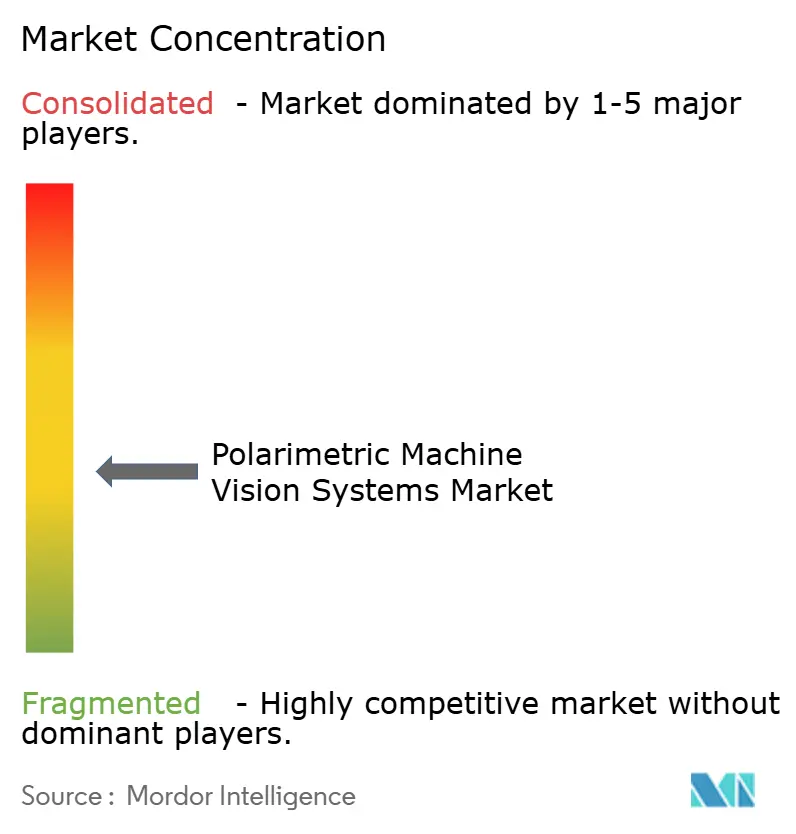
| Market Concentration | Medium |
Major Players *Disclaimer: Major Players sorted in no particular order Image © Mordor Intelligence. Reuse requires attribution under CC BY 4.0. | |
Polarimetric Machine Vision Systems Market Analysis by Mordor Intelligence
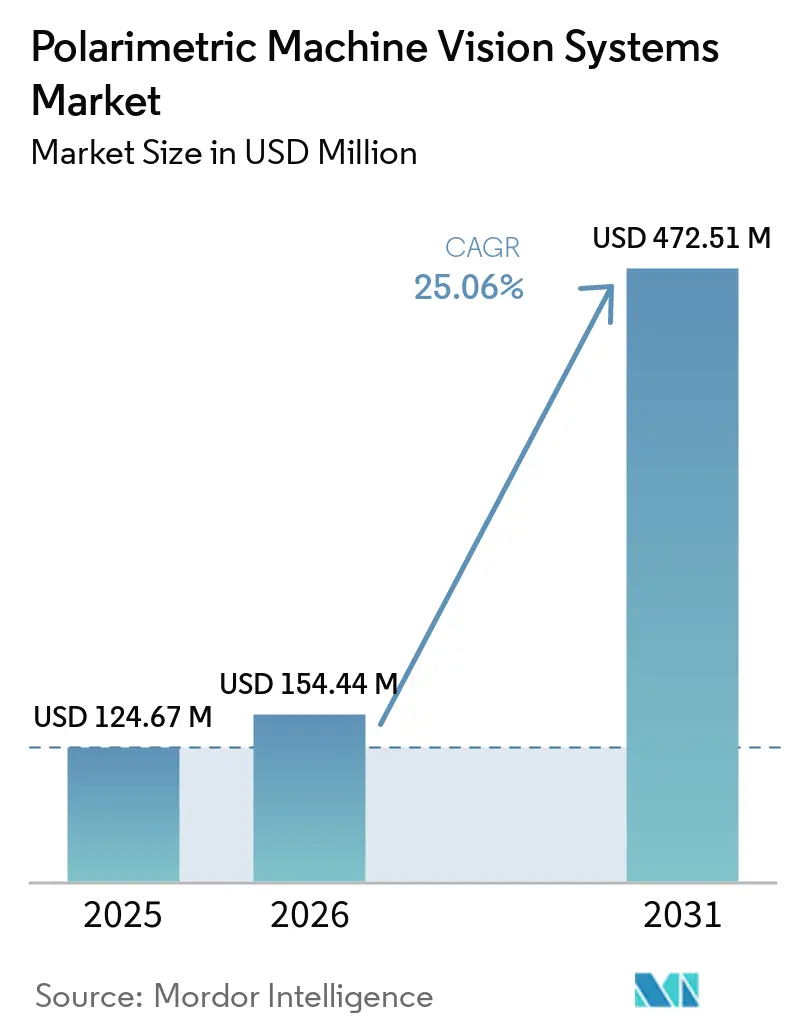
The Polarimetric Machine Vision Systems Market size is projected to expand from USD 124.67 million in 2025 to USD 154.44 million in 2026, and to USD 472.51 million by 2031, registering a CAGR of 25.06% between 2026 and 2031. Manufacturers are adopting polarization-state imaging, in which standard intensity cameras cannot reliably detect stress, glare, or subsurface defects. This need is strongest in semiconductor, automotive, and packaging lines that inspect reflective or transparent materials. Sony’s on-chip Polarsens arrays have made division-of-focal-plane cameras more accessible for industrial deployment. The Polarimetric Machine Vision Systems Market also benefits when AI defect classifiers use polarization data to reduce glare-related errors. Calibration needs and limited polarimetric skills still favor specialist integrators over general production teams.
Key Report Takeaways
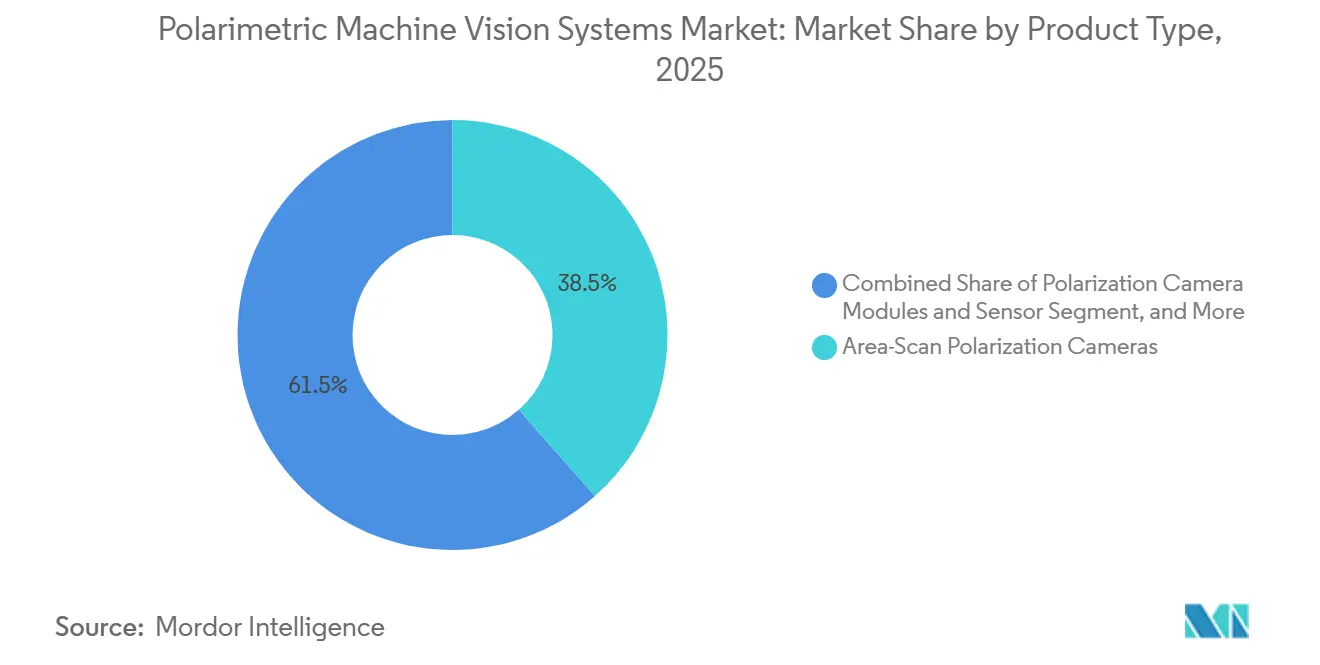
- By product type, area-scan polarization cameras held 38.46% of the 2025 Polarimetric Machine Vision Systems Market revenue, while polarization camera modules and sensor cores are projected to expand at a 26.12% CAGR through 2031.
- By polarization technique, DoFP accounted for 56.73% of 2025 revenue, while the division of aperture is projected to expand at a 25.19% CAGR through 2031.
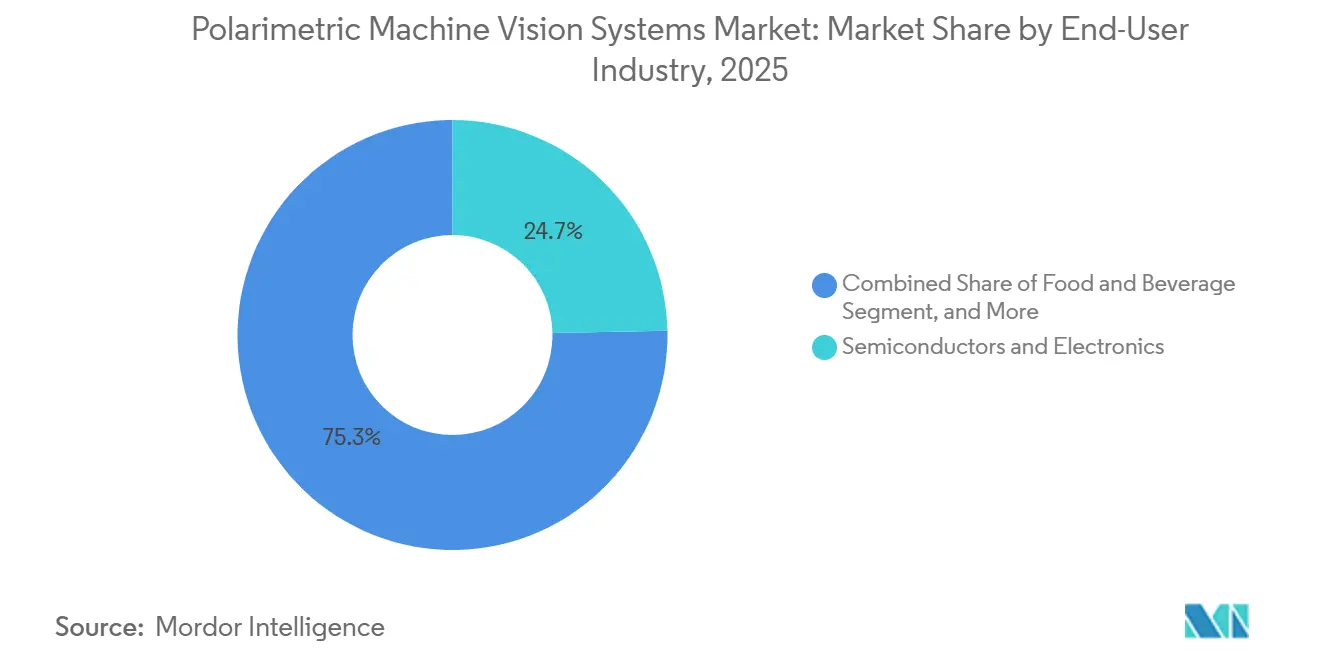
- By end-user industry, semiconductors and electronics held 24.68% of the 2025 Polarimetric Machine Vision Systems Market revenue, while food and beverage is projected to expand at a 27.23% CAGR through 2031.
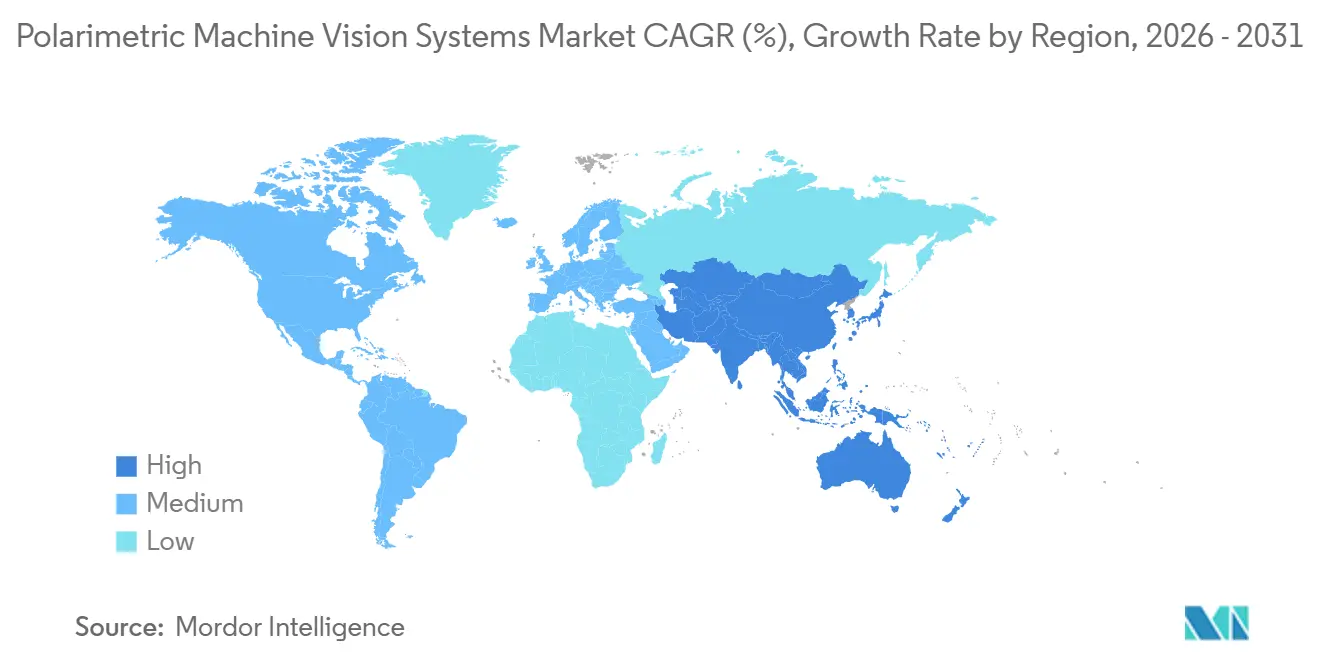
- By geography, Asia-Pacific held 43.27% of 2025 revenue and is projected to expand at a 26.13% CAGR through 2031.
Note: Market size and forecast figures in this report are generated using Mordor Intelligence’s proprietary estimation framework, updated with the latest available data and insights as of January 2026.
Global Polarimetric Machine Vision Systems Market Trends and Insights
Drivers Impact Analysis*
| Driver | (~) % Impact on CAGR Forecast | Geographic Relevance | Impact Timeline |
|---|---|---|---|
| Zero-Defect Inspection of Reflective and Transparent Components | +6.5% | Global, with strong relevance in North America, Europe, and Asia-Pacific manufacturing hubs | Short term (≤ 2 years) |
| On-Chip Polarizer Adoption | +5.8% | Global, concentrated in Asia-Pacific OEM and embedded vision applications | Short term (≤ 2 years) |
| Semiconductor Wafer Stress Monitoring | +4.9% | Asia-Pacific, with spillover to North America fabs | Medium term (2-4 years) |
| Polarization Data for AI Defect Classification | +3.7% | Global, led by automotive manufacturing hubs in Germany, the United States, and China | Medium term (2-4 years) |
| Contactless Packaging Seal Inspection | +2.1% | North America and Europe food and pharmaceutical packaging lines | Medium term (2-4 years) |
| Fiber Orientation and Birefringence Mapping | +1.8% | Europe aerospace composites and North America | Long term (≥ 4 years) |
| Source: Mordor Intelligence | |||
Rising Zero-Defect Requirements in Reflective and Transparent Component Inspection
Zero-defect production targets are increasing interest in the Polarimetric Machine Vision Systems Market for difficult optical surfaces. Standard cameras can lose contrast on glass covers, polished metals, and transparent polymer films. Those materials are widely used in EV battery packs, OLED covers, and pharmaceutical blister packaging. Polarization imaging separates reflected and transmitted light, which can reveal delamination, weak seals, and residual-stress areas. Porsche’s Leipzig facility has adopted AI-enabled robotic paint inspection, illustrating the broader shift toward optical methods to reduce errors on glossy surfaces. Inspection failures in automotive and consumer electronics can create costs that exceed the expense of a polarimetric retrofit.
On-Chip Polarizer Adoption Reducing System Complexity
On-chip polarizers are lowering system complexity in the Polarimetric Machine Vision Systems Market. Earlier rotating-polarizer systems needed motorized assemblies and synchronized exposures. Sony’s IMX250, IMX253, and IMX264 sensors capture 0°, 45°, 90°, and 135° polarization states in one exposure through a 2×2 pixel arrangement.[1]Sony Semiconductor Solutions, “Polarization Image Sensor with Four-Directional On-Chip Polarizer and Global Shutter Function,” Sony Semiconductor Solutions, sony-semicon.com. This design supports real-time imaging at more than 70 frames per second and is well-suited to high-throughput production settings. CCS launched a pupil-division polarization unit in May 2026 for wafer and glass inspection, using single-shot imaging to visualize surface warp, tilt, and roughness. Greater sensor availability may strengthen adoption by Asia-Pacific OEMs and embedded-vision suppliers.
Semiconductor Wafer Stress Monitoring for Advanced Nodes and Compound Materials
Semiconductor process control is a major source of demand for the Polarimetric Machine Vision Systems Market. Mechanical stress can affect lithography alignment and create local defect sites at advanced nodes.[2]PVA TePla AG, “Scanning InfraRed Depolarization,” PVA TePla AG, pvatepla.com. PVA TePla’s SIRD platform measures laser depolarization to identify stress fields, dislocations, cracks, and slip lines in silicon and compound semiconductor wafers. Its SIRD SiC 200 system addresses silicon carbide wafers, in which crystal-growth stress can damage subsequent production stages. Semilab’s PSI platform supports quantitative shear-stress measurements at 300 mm scale, with 50 µm spatial resolution and throughput of 12 wafers per hour. These capabilities enable stress inspection in high-volume fabs.[3]Semilab Zrt., “Polarized Infrared Imaging,” Semilab Zrt., semilab.com.
Polarization Features Improving AI Defect Classification Under Glare
Polarization features can improve AI inspection on curved and reflective parts. Intensity-only models can mistake moving highlights for defects when part orientation or lighting changes. Polarimetric preprocessing suppresses glare before images enter the classifier. A 2025 study found that DoFP data with YOLOv11 improved precision by 3.9% for defects on highly reflective curved surfaces. A separate 2025 study reported a 3.1% improvement in mean average precision for a modified YOLOv5s model on specular additive-manufactured surfaces.[4]Zhiyuan He et al., “Defect Detection Method for Large-Curvature and Highly Reflective Surfaces Based on Polarization Imaging and Improved YOLOv11,” Photonics, mdpi.com. Cognex’s In-Sight 3900, launched in May 2026, provides embedded AI processing capacity that can support data-intensive vision workloads.
Restraints Impact Analysis*
| Restraint | (~) % Impact on CAGR Forecast | Geographic Relevance | Impact Timeline |
|---|---|---|---|
| Calibration and Algorithm Skills Shortage | -3.2% | Global, most acute in South and Southeast Asia, Eastern Europe, and the Middle East and Africa | Medium term (2-4 years) |
| Microgrid Resolution and Signal-to-Noise Trade-Offs | -2.1% | Global, affecting high-resolution and low-light DoFP applications | Long term (≥ 4 years) |
| Fragmented Camera, Lighting, and Software Interfaces | -1.8% | Global, especially multi-vendor integration at small and midsized manufacturers | Medium term (2-4 years) |
| Limited Validation Data for Niche Materials and Defects | -1.0% | Global, especially aerospace composites, specialty glass, and compound semiconductors | Long term (≥ 4 years) |
| Source: Mordor Intelligence | |||
Calibration and Algorithm Skills Shortage for Polarimetric Deployments
A shortage of polarimetric expertise limits the broader adoption of Polarimetric Machine Vision Systems. Effective DoFP deployment requires knowledge of Stokes parameters, Mueller-matrix calibration, and demosaicking. These skills are uncommon among teams trained in standard automated optical inspection or color vision. As a result, a small group of specialized integrators handles many projects. This can extend delivery times and add costs, the benefit of lower-priced sensors. Vendor training and ready-to-use software libraries can help, but broad workforce development will take time.
Resolution and Signal-to-Noise Trade-Offs From Microgrid Sampling
DoFP cameras distribute 4 polarizer orientations across nearby pixels to capture an image in a single exposure. This arrangement reduces effective resolution within each polarization channel. Division-of-time systems can provide higher-fidelity data, but moving objects can create motion artifacts. A 2026 preprint described this resolution-signal-to-noise trade-off as a core limitation of current single-shot designs. The issue matters for fine defects on patterned semiconductor wafers and low-light inspection settings. Metasurface approaches may avoid the microgrid penalty, but research systems have not yet become commercial products.
*Our forecasts treat driver/restraint impacts as directional, not additive. The impact forecasts reflect baseline growth, mix effects, and variable interactions.
Segment Analysis
By Product Type: Area-Scan Cameras Lead While Modules and Sensor Cores Advance Fastest
Area-scan polarization cameras accounted for 38.46% of the Polarimetric Machine Vision Systems Market size in 2025. Their broad use across wafer handling, vehicle body panels, and pharmaceutical packaging supports this leading position. Allied Vision, LUCID Vision Labs, Basler, JAI, and IDS offer DoFP models using Sony IMX250 or IMX264 sensor families. These cameras allow established GigE Vision installations to add polarization capability without a full hardware redesign. Line-scan cameras address roll-to-roll webs and high-speed conveyors that require continuous coverage.
Polarization camera modules and sensor cores are projected to expand at a 26.12% CAGR through 2031. TU Wien validated an inline imaging ellipsometer in March 2026 using Allied Vision’s EXO250ZU3 polarized camera for optical-thickness measurement on moving foils. Integrated polarization systems combine calibrated optics, software, and application support for complex inspections. These packages can command higher selling prices because they reduce integration work. Camera modules and sensor cores have a strategic role as Asia-Pacific OEMs integrate Polarsens sensors directly into embedded platforms. The Leibniz Institute for Composite Materials validated a Baumer VCXU-50MP camera for real-time CFRP fiber-orientation monitoring.



By Polarization Technique: DoFP Leads While Division of Aperture Advances Fastest
DoFP held 56.73% of 2025 revenue. Commercial Sony Polarsens CMOS sensors and their use in industrial camera platforms support the technique’s position. DoFP removes moving parts and avoids multi-exposure synchronization. This is valuable in dynamic production environments that need real-time inspection. A 2024 study examined DoFP demosaicking and identified three-stage interpolation as an active method for recovering spatial detail.
The division of Aperture is projected to expand at a 25.19% CAGR through 2031. Commercial DoFP sensors primarily detect linear polarization states, thereby limiting Mueller-matrix characterization of coatings and chiral materials. Division-of-time systems remain useful in research benches and metrology settings where motion is controlled. Division-of-aperture and division-of-amplitude techniques remain focused on scientific instruments and security imaging. A pixelated metasurface waveplate could enable full Stokes-vector capture without the microgrid resolution constraint. This approach remains an emerging technical path rather than a volume production option.
By End-User Industry: Semiconductors Lead While Food and Beverage Advances Fastest
Semiconductors and electronics held 24.68% of 2025 revenue. The Polarimetric Machine Vision Systems Market size for this use is supported by wafer-stress monitoring, compound substrate qualification, and package-level birefringence checks. Semilab PSI systems and PVA TePla SIRD SiC 200 systems illustrate the shift toward process-control applications. A 2024 study reported quantitative shear-stress mapping on 300 mm wafers at 50 µm resolution. These capabilities are relevant because residual stress increases yield risk at smaller process nodes.
Food and beverage is projected to expand at a 27.23% CAGR through 2031. General manufacturing and automotive applications use polarization imaging to inspect paint, coatings, glazing, and lightweight composite structures. A 2024 study measured the CFRP winding angle to within 0.3° and the tow width to within 0.4 mm using a polarization camera. Food, beverage, and pharmaceutical users apply contactless inspection to packaging seals. Fraunhofer IIS demonstrated inline inspection of glass containers using polarization to identify residual material stress at production speeds. Aerospace, defense, security, and research users complete the application base, with composite inspection supporting aerospace demand.
Geography Analysis
Asia-Pacific held 43.27% of the Polarimetric Machine Vision Systems Market share in 2025 and is projected to expand at a 26.13% CAGR through 2031. China, South Korea, Japan, and India combine semiconductor fabrication, electronics assembly, and vehicle manufacturing capacity. The region is also expected to be the fastest-growing area. Samsung, SK hynix, TSMC, and Japanese integrated device manufacturers support demand for wafer stress monitoring. JAI produces its GO-5100MP-PGE DoFP area camera in Japan, giving semiconductor customers a locally sourced option with 4-directional polarization filtering and GigE connectivity.
Toshiba and Toshiba Information Systems announced a 2026 collaboration on single-shot nanoscale 3D optical inspection for semiconductor surface defects. North America and Europe account for the second-largest concentration of demand in the Polarimetric Machine Vision Systems Market. North America has semiconductor capacity investment at Intel, GlobalFoundries, Wolfspeed, and Coherent. Europe has strong activity in aerospace composites, automotive body panels, food packaging, and pharmaceutical inspection. Germany, France, and the United Kingdom account for much of the European demand for these applications.
TU Wien’s 2026 inline ellipsometer work shows continued European development in roll-to-roll coating inspection. South America, the Middle East, and Africa represent a smaller but developing portion of global demand. Brazil’s electronics assembly base provides incremental demand for automated optical inspection. Saudi Arabia’s semiconductor packaging ambitions are creating early discussions around inspection technologies. Lower-cost DoFP sensors may reduce the access gap with North America and Europe over time.

Competitive Landscape
The Polarimetric Machine Vision Systems Market is moderately fragmented. Sony’s Polarsens platform serves as a major supply hub, enabling many camera makers to bring products to market quickly. Basler, Allied Vision, LUCID Vision Labs, JAI, IDS Imaging Development Systems, Photonfocus, Alkeria, and The Imaging Source offer DoFP area-scan cameras based on the IMX250, IMX264, or IMX253 families. Competition, therefore, centers on lens quality, interfaces, software, and application support. Sony also markets polarization-image-sensor technology for industrial applications, including pixel-level polarization capture.
Cognex and Keyence can pair polarizing accessories with established AI vision controllers. Cognex launched the In-Sight 6900 Vision Controller in April 2026 with NVIDIA Jetson technology and a modular design for selected cameras, optics, and lighting. In September 2026, Cognex signed a definitive agreement to acquire RealSense for USD 500 million. The transaction adds 3D perception capabilities that can complement other optical sensing methods. This acquisition could expand the sensor options available in the Polarimetric Machine Vision Systems Market. PVA TePla and Semilab compete through integrated hardware, software, and calibration workflows for wafer-stress measurement.
These specialist systems can create installed-base retention because users depend on process recipes and calibration knowledge. Chinese filings in crystal-stress detection and 3D polarization microscopy indicate that Asia-Pacific suppliers are building local intellectual property. The Polarimetric Machine Vision Systems Market does not have a reported combined share for its leading suppliers. A numeric concentration rating, therefore, cannot be assigned without creating an unsupported estimate. The supplier base remains differentiated between sensor platforms, camera manufacturers, and integrated inspection vendors.
Polarimetric Machine Vision Systems Industry Leaders
Sony Corporation
Teledyne Technologies Incorporated
Allied Vision Technologies GmbH
LUCID Vision Labs Inc.
Basler AG
- *Disclaimer: Major Players sorted in no particular order

Recent Industry Developments
- September 2026: Cognex Corporation signed a definitive agreement to acquire RealSense for USD 500 million. RealSense, spun out from Intel in 2025, has an established position in 3D robotic perception across fixed-arm, mobile robot, and humanoid platforms. The acquisition positions Cognex to build multimodal sensing stacks where polarimetric and depth-sensing channels address complementary inspection dimensions. This acquisition could extend sensor options used around the Polarimetric Machine Vision Systems Market.
- August 2026: UCID Vision Labs announced the Triton 10, an 8K line-scan camera combining 10GigE performance with GigE Vision 3.0, RDMA support, and Power over Ethernet in an IP67 Factory Tough housing. The launch expanded its line-scan portfolio for automated optical inspection and surface inspection applications. The Polarimetric Machine Vision Systems Market may benefit where lines need rugged, high-speed imaging infrastructure.
- May 2026: Cognex launched the In-Sight 3900 Vision System, powered by Qualcomm Dragonwing platforms. It provides high-capacity AI edge processing for demanding industrial inspection workloads without external PC dependencies. The system integrates with Cognex OneVision for cloud-to-edge model deployment across multi-site networks. Its processing capacity is relevant to the Polarimetric Machine Vision Systems Market because polarization data requires analysis close to the inspection line.
- May 2026: CCS Inc. launched the pupil-division polarization unit and differential interference unit for semiconductor wafer and glass-substrate inspection. The pupil-division unit provides single-shot surface warp, tilt, and roughness visualization and reduces inspection cycle time by 8x compared with white-light interferometry. The product targets demand linked to generative AI adoption and semiconductor device miniaturization. It provides a direct product example for the Polarimetric Machine Vision Systems Market.


Global Polarimetric Machine Vision Systems Market Report Scope
Polarimetric Machine Vision Systems are advanced imaging solutions that capture and analyze the polarization state of light reflected from or transmitted through objects, enabling the detection of surface stress, material composition, and subtle defects that are invisible to conventional intensity-based cameras, thereby enhancing inspection capabilities in complex industrial environments.
The Polarimetric Machine Vision Systems Market Report is Segmented by Product Type (Area-Scan Polarization Cameras, Line-Scan Polarization Cameras, Polarization Camera Modules and Sensor Cores (embedded/OEM), and Polarization Inspection Systems (integrated, software + optics)), Polarization Technique (Division of Focal Plane (DoFP), Division of Time and Rotating Polarizer, Division of Aperture, and Division of Amplitude), End-User Industry (Manufacturing (General/Discrete), Automotive and Transportation, Semiconductors and Electronics, Food and Beverage, Pharmaceuticals, Aerospace and Defense, Security and Public Safety, Research and Scientific Institutions, and Other End-User Industries), and Geography (North America, South America, Europe, Asia-Pacific, Middle East and Africa). The Market Forecasts are Provided in Terms of Value (USD).
| Area-Scan Polarization Cameras |
| Line-Scan Polarization Cameras |
| Polarization Camera Modules and Sensor Cores (embedded/OEM) |
| Polarization Inspection Systems (integrated, software + optics) |
| Division of Focal Plane (DoFP) |
| Division of Time and Rotating Polarizer |
| Division of Aperture |
| Division of Amplitude |
| Manufacturing (General/Discrete) |
| Automotive and Transportation |
| Semiconductors and Electronics |
| Food and Beverage |
| Pharmaceuticals |
| Aerospace and Defense |
| Security and Public Safety |
| Research and Scientific Institutions |
| Other End-User Industries |
| North America | United States | |
| Canada | ||
| Mexico | ||
| South America | Brazil | |
| Argentina | ||
| Rest of South America | ||
| Europe | Germany | |
| United Kingdom | ||
| France | ||
| Italy | ||
| Spain | ||
| Rest of Europe | ||
| Asia-Pacific | China | |
| Japan | ||
| India | ||
| South Korea | ||
| Rest of Asia-Pacific | ||
| Middle East and Africa | Middle East | Saudi Arabia |
| United Arab Emirates | ||
| Turkey | ||
| Rest of the Middle East | ||
| Africa | South Africa | |
| Nigeria | ||
| Rest of Africa | ||
| By Product Type | Area-Scan Polarization Cameras | ||
| Line-Scan Polarization Cameras | |||
| Polarization Camera Modules and Sensor Cores (embedded/OEM) | |||
| Polarization Inspection Systems (integrated, software + optics) | |||
| By Polarization Technique | Division of Focal Plane (DoFP) | ||
| Division of Time and Rotating Polarizer | |||
| Division of Aperture | |||
| Division of Amplitude | |||
| By End-User Industry | Manufacturing (General/Discrete) | ||
| Automotive and Transportation | |||
| Semiconductors and Electronics | |||
| Food and Beverage | |||
| Pharmaceuticals | |||
| Aerospace and Defense | |||
| Security and Public Safety | |||
| Research and Scientific Institutions | |||
| Other End-User Industries | |||
| By Geography | North America | United States | |
| Canada | |||
| Mexico | |||
| South America | Brazil | ||
| Argentina | |||
| Rest of South America | |||
| Europe | Germany | ||
| United Kingdom | |||
| France | |||
| Italy | |||
| Spain | |||
| Rest of Europe | |||
| Asia-Pacific | China | ||
| Japan | |||
| India | |||
| South Korea | |||
| Rest of Asia-Pacific | |||
| Middle East and Africa | Middle East | Saudi Arabia | |
| United Arab Emirates | |||
| Turkey | |||
| Rest of the Middle East | |||
| Africa | South Africa | ||
| Nigeria | |||
| Rest of Africa | |||


Key Questions Answered in the Report
What is the size of the Polarimetric Machine Vision Systems Market?
The 2026 value is USD 154.44 million and is projected to reach USD 472.51 million by 2031 at a 25.06% CAGR.
What is driving adoption of polarimetric inspection systems?
Zero-defect requirements for reflective and transparent surfaces, on-chip polarizers, wafer stress inspection, and AI glare reduction are supporting demand.
Which product category had the largest share in 2025?
Area-scan polarization cameras held 38.46% of 2025 revenue because they serve several static-field inspection uses.
Which polarization technique led in 2025?
DoFP held 56.73% of 2025 revenue because it captures polarization data in a single exposure without moving parts.
Which end-user application has the strongest outlook?
Food and beverage is projected to expand at a 27.23% CAGR through 2031, while semiconductors and electronics held the largest 2025 share at 24.68%.
Which region leads demand for these systems?
Asia-Pacific held 43.27% of 2025 revenue and is projected to expand at a 26.13% CAGR through 2031.
Page last updated on:


 Your data is secure and never sold or shared.


