
Point-of-Care Medical Software Market Size and Share
Market Overview
| Study Period | 2020 - 2031 |
|---|---|
| Market Size (2026) | USD 5.74 Billion |
| Market Size (2031) | USD 12.77 Billion |
| Growth Rate (2026 - 2031) | 17.33 % |
| Fastest Growing Market | Asia-Pacific |
| Largest Market | North America |
| Market Concentration | Medium |
Major Players *Disclaimer: Major Players sorted in no particular order Image © Mordor Intelligence. Reuse requires attribution under CC BY 4.0. | |
Point-of-Care Medical Software Market Analysis by Mordor Intelligence
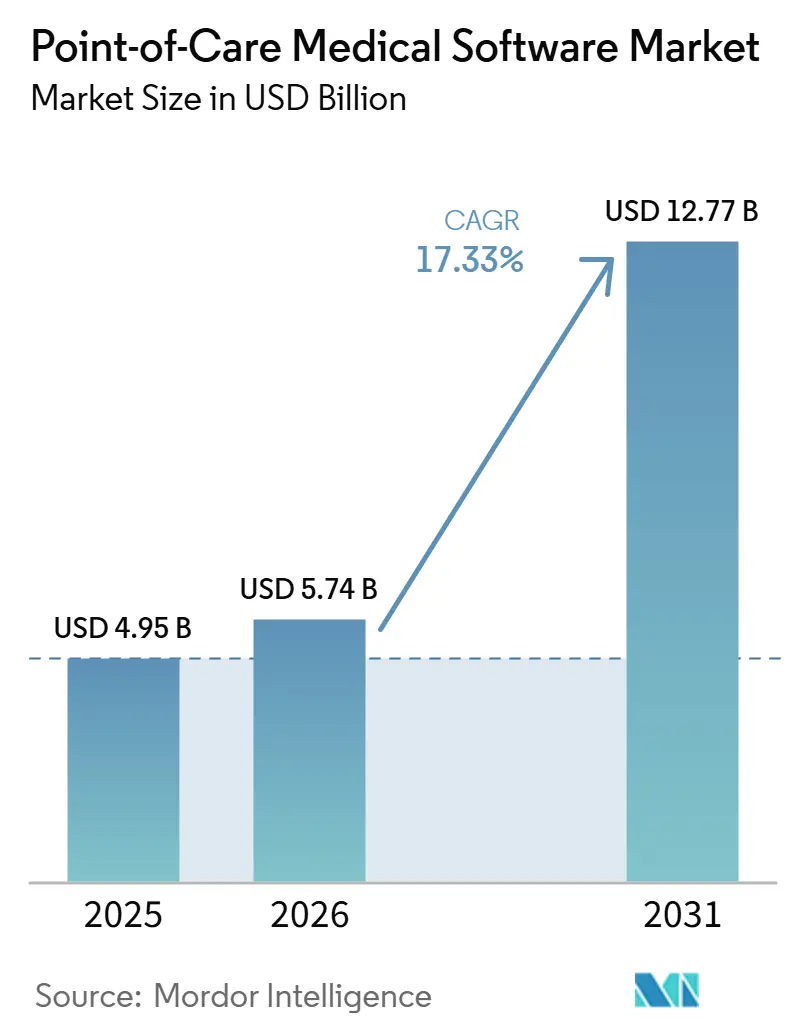
The Point-of-Care Medical Software Market size is expected to grow from USD 4.95 billion in 2025 to USD 5.74 billion in 2026 and is forecast to reach USD 12.77 billion by 2031 at 17.33% CAGR over 2026-2031.
The point-of-care medical software market is expanding as health systems move diagnostics away from central laboratories and need software that can control operator access, monitor quality, and route results into LIS and EMR environments. The point-of-care medical software market is also benefiting from pandemic-era investments in distributed testing networks, because those installed device bases now require durable governance tools that sit outside routine reagent budgets. In the United States, the January 2027 FHIR R4 compliance deadline under CMS-0057-F and the January 2025 HIPAA Security Rule proposal are pushing replacement cycles for older middleware and data management stacks that cannot support modern interoperability or stronger security controls. Competition in the point-of-care medical software market is therefore shifting toward cloud-ready, vendor-neutral, API-based platforms that fit broader hospital IT modernization plans rather than standalone laboratory tools. Adoption still faces friction from integration costs, multi-vendor device estates, and a limited pool of specialists who can validate middleware against laboratory and accreditation requirements, which keeps rollout speed uneven across regions and care settings.
Key Report Takeaways
By component, software platform held 64.8% share of the point-of-care medical software market in 2025 and is projected to expand at a 17.2% CAGR through 2031.
By deployment mode, cloud-based solutions accounted for 56.4% of the point-of-care medical software market size in 2025 and are forecast to grow at an 18.4% CAGR through 2031.
By end user, hospitals and critical care units held 38.2% share in 2025, while home healthcare is projected to record the fastest growth at a 17.8% CAGR through 2031.
By application, glucose monitoring accounted for 24.6% share of the point-of-care medical software market size in 2025, while cardiometabolic monitoring is advancing at an 18.9% CAGR through 2031.
By geography, North America held 38.1% of the point-of-care medical software market share in 2025, while Asia Pacific is projected to expand at a 34.5% CAGR through 2031.
Note: Market size and forecast figures in this report are generated using Mordor Intelligence’s proprietary estimation framework, updated with the latest available data and insights as of January 2026.
Global Point-of-Care Medical Software Market Trends and Insights
Drivers Impact Analysis*
| Driver | (~) % Impact on CAGR Forecast | Geographic Relevance | Impact Timeline |
|---|---|---|---|
| Cloud Migration for Distributed Point-of-Care Workflows | +3.5% | Global | Medium term (2-4 years) |
| Interoperability Requirements Across LIS, EMR, and POCT Devices | +2.8% | North America and EU, with spillover to APAC | Short term (≤ 2 years) |
| Value-Based Care and Outcome-Based Reimbursement | +2.2% | North America primarily, EU emerging | Medium term (2-4 years) |
| Expansion of Remote and Home-Based Point-of-Care Testing | +3.0% | Global, concentrated in North America, EU, and APAC | Long term (≥ 4 years) |
| AI-Enabled Analytics for Antimicrobial Stewardship and Quality Control | +2.5% | Global, with highest initial uptake in North America and EU | Medium term (2-4 years) |
| Cybersecurity and Compliance-Driven Software Replacement Cycles | +1.8% | North America and EU, with spillover to APAC | Short term (≤ 2 years) |
| Source: Mordor Intelligence | |||
Cloud Migration for Distributed Point-of-Care Workflows
Cloud adoption in the point-of-care medical software market has moved beyond early adopters and is gaining traction among hospital networks that previously depended on local middleware. The main attraction is operational, because cloud-hosted platforms can push software updates, renew operator credentials, and track cross-site quality trends without requiring technical support at every testing location. This matters most when a health system runs POCT programs across clinics, physician offices, ambulatory centers, and hospital departments that share the same governance requirements but do not share the same IT staffing depth. In January 2026, WellSpan Health announced a broad migration of its technology portfolio to AWS, with scalability for AI integration highlighted as a key rationale, which supports the direction of travel toward cloud-native clinical software environments[1]Amazon Web Services, “WellSpan Health Announces Comprehensive Migration of Technology Portfolio to AWS,” AWS Press Center. As EMR vendors continue to modernize their architectures, the point-of-care medical software market is placing more value on platforms that can sit inside a larger cloud data layer instead of serving only as a narrow laboratory compliance utility.
Interoperability Requirements Across LIS, EMR, and POCT Devices
Interoperability is becoming a purchasing filter in the point-of-care medical software market because hospitals want device data to move cleanly across LIS, EMR, and remote care workflows. The January 2027 CMS-0057-F timeline is especially important in the United States because it requires specified workflows to support FHIR R4 APIs, which many legacy stacks cannot deliver without major redesign work. A 2024 study[2]Studies in Health Technology and Informatics, “Integrating Laboratory Testing Results at Point-of-Care in Hospital@Home Care Settings, A FHIR-Based Approach,” Studies in Health Technology and Informatics on Hospital@Home workflows showed that combining cloud infrastructure with HL7 FHIR enables point-of-care results to flow across several stakeholder systems at the same time, which is a capability older implementations do not support as effectively. That is giving open, vendor-neutral middleware an advantage when provider organizations compare long-term integration options across mixed device environments. The point-of-care medical software market is therefore rewarding platforms that support current messaging standards while preserving backward compatibility with installed device fleets and existing laboratory workflows.
Expansion of Remote and Home-Based Point-of-Care Testing
The point-of-care medical software market is seeing a distinct demand pattern from remote and home-based testing, because patient-generated results need to be reconciled, monitored, and governed differently from hospital-originated data. Home testing creates fragmented data streams that must be tied back to clinical records, checked for quality compliance, and routed into remote oversight processes without introducing workflow delays. The installed base of connected home devices is also changing what vendors must support, because a continuous stream of patient signals places greater pressure on ingestion, alerting, and triage functions than conventional bedside testing does. Abbott received CE Mark in May 2026 for Libre Duo, described as the first dual glucose-ketone continuous sensing system, and that launch reflects the increasing need for software able to handle dense and frequent physiological data flows outside the hospital. For that reason, the point-of-care medical software market is moving toward modular architectures that can support hospital, outpatient, and home-testing workflows inside a common governance structure.
AI-Enabled Analytics for Antimicrobial Stewardship and Quality Control
AI is becoming more visible in the point-of-care medical software market as vendors move from static alerts toward tools that support prediction, triage, and more automated quality interpretation. In June 2026, a study published in npj Digital Medicine showed that deep learning models trained on MALDI-TOF data could identify bacteria and predict antibiotic resistance at the same time, which reinforces the commercial case for analytics-rich software layers in diagnostic workflows. The value for providers is not limited to clinical interpretation, because the same software environments can also support quality control escalation, exception handling, and workflow standardization across multi-site device estates. Abbott received FDA clearance and CE Mark in April 2026 for Ultreon 3.0, an AI-powered coronary imaging platform, and Roche launched the Liver Disease Panel on the navify Algorithm Suite in Europe in May 2026, both of which show how digital analytics are becoming a practical product feature rather than a future concept. As a result, the point-of-care medical software market is giving more weight to analytics depth, especially when providers want value from device fleets that come from different manufacturers.
Restraints Impact Analysis*
| Restraint | (~) % Impact on CAGR Forecast | Geographic Relevance | Impact Timeline |
|---|---|---|---|
| High Deployment, Validation, and Integration Costs | -1.8% | Global, most severe in multi-site health systems in North America and EU | Long term (≥ 4 years) |
| Legacy Device Fragmentation and Vendor Lock-In | -1.4% | Global, concentrated in Europe and APAC community hospitals | Long term (≥ 4 years) |
| Data Privacy, Auditability, and Cybersecurity Risk | -1.2% | Global, with the heaviest regulatory burden in North America and EU | Medium term (2-4 years) |
| Shortage of Clinical IT and Middleware Specialists | -0.9% | Global, most acute in APAC and MEA | Long term (≥ 4 years) |
| Source: Mordor Intelligence | |||
High Deployment, Validation, and Integration Costs
The point-of-care medical software market still faces a hard economic barrier because enterprise rollouts cost much more than middleware license fees alone suggest. Health systems must pay for LIS integration work, site-by-site workflow validation, device interface qualification, user training, and recurring support contracts that expand with every instrument type and location. Those costs rise quickly when a provider network uses several device brands, because each interface adds separate development and testing work before the platform can run at scale. CLSI guidance on POCT communications underlines how multi-vendor environments create recurring interface overhead, which helps explain why project teams often underestimate total implementation effort CLSI.ORG. That cost burden slows purchasing decisions in the point-of-care medical software market and tends to favor vendors with larger prebuilt interface libraries and stronger implementation service capabilities.
Legacy Device Fragmentation and Vendor Lock-In
Device fragmentation remains a structural restraint in the point-of-care medical software market because many hospitals operate instruments from several manufacturers at the same time. A software upgrade in that setting often requires parallel middleware environments during migration, or it forces a provider to accept temporary compatibility gaps that affect quality control and operator management. The problem is deeper when institutions already rely on instrument-bundled software, because switching to a vendor-neutral platform can require new interfaces, retraining, and workflow redesign that purchasing committees may postpone. TELCOR states that its QML platform supports more than 160 device types across more than 2,700 hospitals and ambulatory sites, which illustrates how interface breadth itself has become a competitive requirement. This keeps the point-of-care medical software market tilted toward established vendors whose device libraries are broad enough to reduce migration risk for large integrated delivery networks.
*Our forecasts treat driver/restraint impacts as directional, not additive. The impact forecasts reflect baseline growth, mix effects, and variable interactions.
Segment Analysis
By Component: Software Platforms Anchor Compliance-Driven Enterprise Adoption
Software platforms accounted for 64.8% of the point-of-care medical software market size in 2025 and are projected to grow at a 17.2% CAGR through 2031. That alignment between leading share and fastest growth shows that providers still see the platform layer as the core control point for operator management, quality workflows, utilization tracking, and downstream data routing. In the point-of-care medical software market, these functions matter because hospitals are not only buying a data viewer, they are buying a governance system that must standardize decentralized testing activity across many departments and sites. Middleware remains strategically important because it sits between older device interfaces and newer interoperability demands, which makes it central to health systems preparing for API-led connectivity requirements. Services form the smallest component, but they retain steady relevance because validation, training, deployment support, and compliance preparation are getting harder for internal teams to absorb on their own.
The second effect of platform dominance is competitive, because incumbent vendors can use their installed base to sell adjacent modules such as analytics, predictive quality tools, and extra connectivity tiers. Siemens Healthineers[3]Siemens Healthineers, “UniPOC Data Management System,” Siemens Healthineers USA released UniPOC version 1.9 in June 2025, and the platform remained notable for automated operator validation and recertification workflows together with regular device interface updates. The same product was also referenced in U.S. government technology documentation in late 2025, which reinforces the staying power of established enterprise footprints once a platform is embedded in regulated care settings. FDA’s Quality Management System Regulation took effect on February 2, 2026 and brought ISO 13485 concepts more directly into U.S. device quality controls, adding another layer of scrutiny around software design, documentation, and cybersecurity readiness. In the point of care medical software industry, that raises the barrier for smaller challengers that may offer new features but lack the audit history, documentation discipline, and long-cycle customer relationships that large platforms already possess.
By Deployment Mode: Cloud Dominance Deepens as Hybrid Becomes the Migration Bridge
Cloud-based deployment held 56.4% share in 2025 and is also the fastest-growing deployment model with an 18.4% CAGR through 2031. The point-of-care medical software market favors cloud options because they let providers push security patches, device drivers, and regulatory updates across distributed testing locations without waiting for on-site intervention. This is especially valuable when the testing network includes outpatient facilities and satellite sites that run important POCT volumes but have thin local IT support. A 2024 Hospital@Home study showed that cloud architecture combined with HL7 FHIR can support real-time result exchange across multiple stakeholder systems, which supports the practical value of cloud-hosted models in distributed care environments. On-premise deployments still matter in facilities with stricter data-sovereignty expectations and in government or military environments where external routing controls remain tight.
Hybrid deployment is emerging as the migration route for large provider systems that cannot replace older middleware in a single capital cycle. In the point-of-care medical software market, this model lets the cloud handle API translation and remote administration while keeping certain device-to-LIS flows inside local infrastructure. That approach fits organizations that need partial interoperability progress before 2027 but still have a meaningful installed base of on-premise systems. It also introduces extra governance work, because auditors and internal teams must validate both the cloud layer and the local layer against the same quality and compliance expectations. As a result, the point of care medical software industry is seeing hybrid win bids as a practical bridge, even while cloud continues to take the leading role in new deployments.
By End User: Acute Care Remains the Volume Anchor While Home Healthcare Accelerates
Hospitals and critical care units held 38.2% of the 2025 end-user market, making them the largest demand center in the point-of-care medical software market. Their leading share reflects high bedside test volumes, dense multi-manufacturer device estates, and the strongest need for real-time quality controls and bidirectional LIS integration. These settings also carry the highest regulatory pressure around user authorization, result traceability, and documented compliance at the patient event level. Diagnostic centers, clinics, and outpatient facilities form the middle tier, where adoption is expanding but requirements are usually lighter than in acute-care hospitals. In many of those sites, cloud subscriptions and standardized remote administration tools are more attractive than full enterprise licenses with heavier implementation demands.
Home healthcare is the fastest-growing end-user segment and is projected to expand at a 17.8% CAGR between 2026 and 2031. The point-of-care medical software market is being pulled in that direction by chronic disease management, especially where patient monitoring is shifting from clinic workflows toward persistent digital oversight. Abbott’s 2026 Libre Duo launch shows why this matters, because continuous sensing creates a much denser data stream than traditional episodic testing and requires software that can ingest, flag, and route information reliably. Growth will still vary by region because reimbursement, device connectivity quality, and remote clinical supervision models are maturing at different speeds. Other end users such as pharmacies, occupational health centers, and employer wellness programs remain smaller, but they are giving the point-of-care medical software market additional room to expand outside hospital-led procurement cycles.
By Application: Glucose Monitoring Leads but Cardiometabolic Software Reshapes Revenue Mix
Glucose monitoring held 24.6% share in 2025, making it the largest application in the point-of-care medical software market. That leadership reflects the long-established role of bedside glucometry in hospitals and the need to document quality control, operator certification, and result transfer with a high level of consistency. It is also one of the most mature software workflows in this space, which means enterprise platforms already support broad connectivity and established governance routines for this testing area. Infectious disease devices remain another important application because the testing infrastructure built during the pandemic left behind durable software requirements that now support respiratory, antimicrobial, and sexually transmitted infection workflows. Coagulation monitoring, urinalysis, and hematology occupy the mid-tier of the application mix, where demand is steadier and more shaped by replacement cycles than first-time adoption.
Cardiometabolic monitoring is the fastest-growing application and is forecast to rise at an 18.9% CAGR through 2031. Humana reported in 2026, using 2024 Medicare Advantage data, that value-based care patients had 24.3% fewer inpatient admissions than Original Medicare enrollees, which supports the commercial logic for software that links biomarker monitoring to outcome documentation. In the point-of-care medical software market , that makes cardiometabolic workflows increasingly relevant for contracts that reward real-time oversight of HbA1c, lipid, and cardiac marker trends outside acute settings. Cancer markers remain smaller, but they are drawing attention where longitudinal treatment pathways need cleaner digital reporting and more structured documentation. The broader direction is clear, because the point-of-care medical software market is shifting toward multi-analyte workflow management rather than single-test governance inside isolated application silos.
Geography Analysis
North America held 38.1% of the point-of-care medical software market share in 2025, making it the largest regional contributor. The United States drove most of that position because it combines high POCT test density, mature reimbursement systems, and active hospital IT modernization. The region is also moving faster on replacement cycles because providers must prepare for FHIR R4 interoperability obligations under CMS-0057-F by January 2027, while also responding to tighter cybersecurity expectations under the HIPAA Security Rule proposal CMS. Canada adds a smaller but growing contribution as provincial networks use cloud tools to manage distributed POCT programs across remote care settings. In the United States, the point-of-care medical software market also benefits from value-based care incentives, with Humana reporting 13.4% fewer emergency department visits among value-based care Medicare Advantage members than comparable non-value-based-care members.
Europe remained the second-largest region in the point-of-care medical software market, with demand centered on Germany, the United Kingdom, France, Italy, and Spain. Germany and the United Kingdom stand out for stronger digital hospital adoption and structured laboratory reporting requirements, which make POCT software governance more important in procurement discussions. France and Italy are also moving forward through public hospital modernization programs, while Spain remains more fragmented because regional health systems shape purchasing patterns more than a single national buying structure. Across the region, the point-of-care medical software market continues to face slower adoption than North America where reimbursement remains more fragmented and where multi-country provider groups must manage different local operating conditions.
Asia Pacific is the fastest-growing region and is projected to expand at a 34.5% CAGR between 2026 and 2031. The point-of-care medical software market is gaining momentum there because healthcare digitization spending is rising, provider networks are broadening beyond major urban hospitals, and connected care programs are pulling more testing activity into decentralized settings. Demand is strongest where software can support geographically dispersed facilities without a large on-site IT footprint, which makes cloud-hosted dashboards and remote administration especially relevant. South Korea and Australia add premium demand from hospital systems that place a high value on quality documentation and structured data exchange. South America and the Middle East and Africa remain smaller today, but the point-of-care medical software market has long-term room to expand there as private hospital groups, diagnostic chains, and wider healthcare IT investment continue to build out the underlying infrastructure.
Competitive Landscape
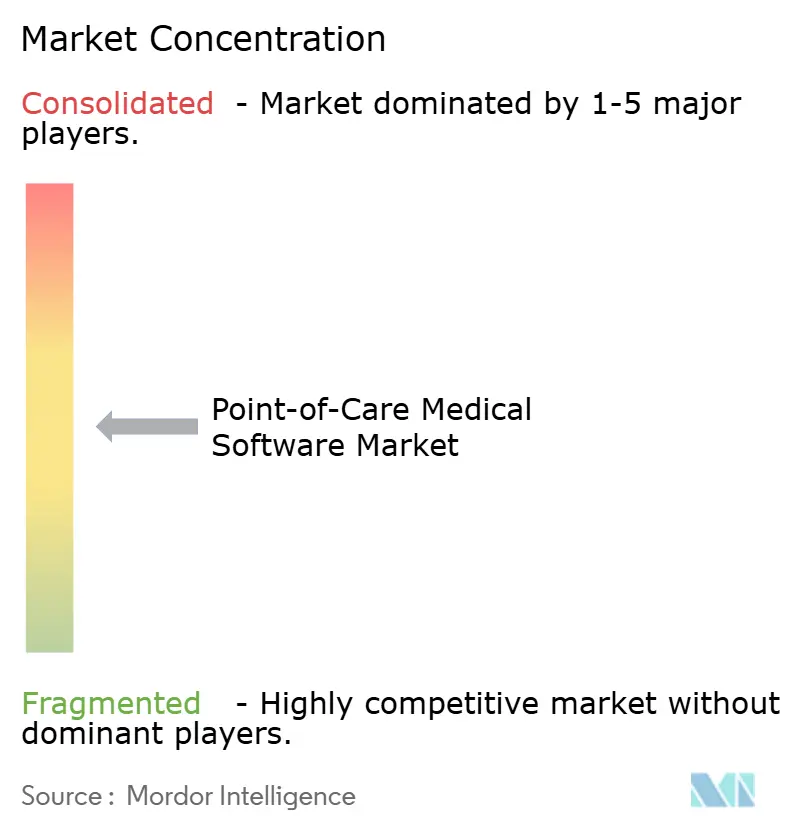
The point-of-care medical software market remained moderately concentrated in 2026, with large diagnostics groups such as Siemens Healthineers, Abbott Laboratories, and F. Hoffmann-La Roche competing alongside specialist middleware providers such as TELCOR and Orchard Software under Clinisys. The central divide is strategic, because closed ecosystems offer tight hardware-to-software integration while open platforms offer broader vendor neutrality across mixed device fleets. For many hospital buyers, that choice is less about preference and more about installed reality, since a multi-manufacturer estate often makes vendor-neutral control layers more practical than device-specific stacks. Danaher’s agreement to acquire Masimo for USD 9.9 billion, announced in February 2026, signaled how aggressively large healthcare groups are moving to combine monitoring, diagnostics, and software under broader acute-care portfolios. In the point-of-care medical software market, moves like this increase pressure on independent vendors that do not have the same bundled sales reach across patient monitoring, blood gas, molecular diagnostics, and enterprise informatics.
There is still open space in home-care software, molecular POCT workflow management, and analytics modules that sit on top of installed middleware. BD’s launch of the BD Incada Connected Care Platform in October 2025 showed how device manufacturers are moving further up the software layer with cloud-based and AI-enabled connectivity systems. That matters because the point-of-care medical software market is no longer competing only on device-to-LIS connectivity; it is competing on analytics, workflow visibility, and cross-setting orchestration. Vendors that built their position mainly on interface libraries now face a market where customers also expect real-time dashboards, broader interoperability, and upgrade paths into AI-assisted functions.
Incumbents still retain clear advantages, because installed platforms bring renewal revenue, regulatory familiarity, and a track record that matters in hospital procurement. Siemens Healthineers’ UniPOC version 1.9 release in 2025 and its continued position in government technology references show how platform incumbency can translate into durable adoption in complex care settings. TELCOR’s stated support for more than 160 device types across more than 2,700 hospitals and ambulatory sites also highlights how broad interface depth remains a strong competitive asset. At the same time, the point-of-care medical software market is shifting toward a mix of vendor-neutral architecture, compliance readiness, and analytics capability rather than simple connectivity breadth alone. The vendors best placed for the next phase are those that can connect legacy estates, support modern APIs, and extend into remote care and higher-frequency data workflows without forcing customers into disruptive replacement cycles.
Point-of-Care Medical Software Industry Leaders
Siemens Healthineers AG
F. Hoffmann-La Roche Ltd.
Thermo Fisher Scientific Inc.
Medtronic plc
Danaher Corporation
- *Disclaimer: Major Players sorted in no particular order


Recent Industry Developments
- June 2026: Abbott secured CE Mark for the world's first dual glucose-ketone continuous sensing technology, branded as Libre Duo and Libre Duo 10 Day. The systems continuously measure glucose and ketone levels every minute, enabling real-time detection of rising ketones without traditional blood or urine testing, and integrate with Abbott's Libre digital health ecosystem for caregiver data sharing. Abbott intends to launch in select European countries later in 2026.
- April 2026: Abbott received FDA 510(k) clearance and CE Mark for Ultreon 3.0 Software, a next-generation AI-powered coronary imaging platform that integrates OCT imaging with AI-automated insights to support percutaneous coronary intervention.
- March 2026: Roche received FDA 510(k) clearance for the cobas c 703 and cobas ISE neo analytical units, next-generation modules for the scalable cobas pro integrated solutions platform, offering advanced lab-automation to address staffing shortages and growing test volume demands.
- October 2025: BD launched the BD Incada Connected Care Platform, a scalable, AI-enabled, cloud-based platform that unifies BD device data into a single intelligent ecosystem for the first time. The platform debuted alongside the BD Pyxis Pro Automated Medication Dispensing Solution and establishes enterprise-wide device connectivity and data-to-insight translation across healthcare settings.


Global Point-of-Care Medical Software Market Report Scope
| Software |
| Hardware |
| Services |
| In Vivo Diagnostics |
| In Vitro Diagnostics |
| Cloud Based |
| Hybrid |
| On Premises |
| Hospitals |
| Diagnostic Imaging Centers |
| Diagnostic Laboratories |
| Clinics and Other Healthcare Providers |
| North America | United States |
| Canada | |
| Mexico | |
| Europe | Germany |
| United Kingdom | |
| France | |
| Italy | |
| Spain | |
| Rest of Europe | |
| Asia-Pacific | China |
| India | |
| Japan | |
| South Korea | |
| Australia | |
| Rest of Asia-Pacific | |
| Middle East & Africa | GCC |
| South Africa | |
| Rest of Middle East and Africa | |
| South America | Brazil |
| Argentina | |
| Rest of South America |
| By Component | Software | |
| Hardware | ||
| Services | ||
| By Application | In Vivo Diagnostics | |
| In Vitro Diagnostics | ||
| By Deployment Mode | Cloud Based | |
| Hybrid | ||
| On Premises | ||
| By Tend User | Hospitals | |
| Diagnostic Imaging Centers | ||
| Diagnostic Laboratories | ||
| Clinics and Other Healthcare Providers | ||
| By Geography | North America | United States |
| Canada | ||
| Mexico | ||
| Europe | Germany | |
| United Kingdom | ||
| France | ||
| Italy | ||
| Spain | ||
| Rest of Europe | ||
| Asia-Pacific | China | |
| India | ||
| Japan | ||
| South Korea | ||
| Australia | ||
| Rest of Asia-Pacific | ||
| Middle East & Africa | GCC | |
| South Africa | ||
| Rest of Middle East and Africa | ||
| South America | Brazil | |
| Argentina | ||
| Rest of South America | ||


Key Questions Answered in the Report
Which component leads revenue generation in point of care medical software?
Software platforms lead, with 64.8% share in 2025, because hospitals rely on them for operator control, quality monitoring, and LIS and EMR connectivity.
Why are cloud-based deployments growing faster in this space?
Cloud-based solutions held 56.4% share in 2025 and are growing at 18.4% CAGR because they support remote updates, centralized oversight, and easier management across distributed care sites.
Which end-user group is driving the most current demand?
Hospitals and critical care units are the largest end-user group with 38.2% share in 2025, reflecting high POCT volumes and stronger compliance requirements.
What is the fastest-growing application area through 2031?
Cardiometabolic monitoring is the fastest-growing application, with an 18.9% CAGR, supported by stronger demand for biomarker-linked outcome tracking in value-based care models.
Which region offers the strongest growth outlook for vendors?
Asia Pacific shows the strongest growth outlook with a projected 34.5% CAGR through 2031, while North America remains the largest regional revenue base with 38.1% share in 2025.
Page last updated on:





