
Plastic-Coated Wire Ropes Market Size and Share
Market Overview
| Study Period | 2022 - 2032 |
|---|---|
| Market Size (2027) | USD 1.57 Billion |
| Market Size (2032) | USD 2.11 Billion |
| Growth Rate (2027 - 2032) | 6.13 % |
| Fastest Growing Market | Asia-Pacific |
| Largest Market | North America |
| Market Concentration | Low |
Major Players *Disclaimer: Major Players sorted in no particular order Image © Mordor Intelligence. Reuse requires attribution under CC BY 4.0. | |
Plastic-Coated Wire Ropes Market Analysis by Mordor Intelligence
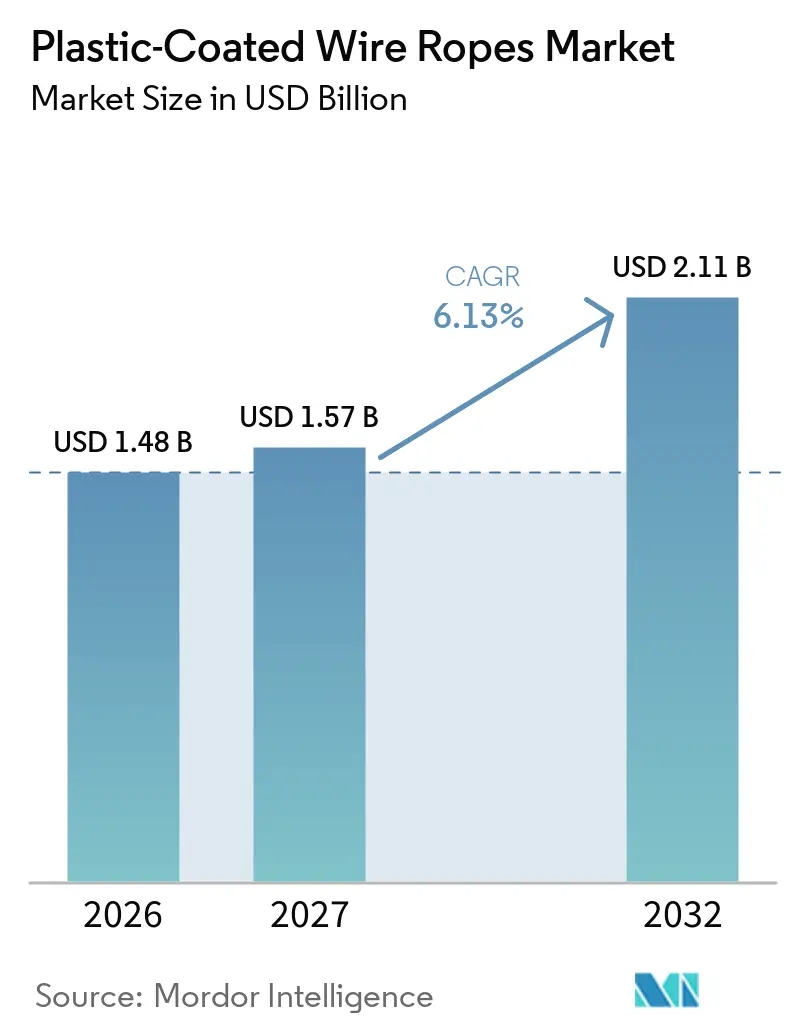
The Plastic-Coated Wire Ropes Market size was valued at USD 1.48 billion in 2026 and is estimated to grow from USD 1.57 billion in 2027 to reach USD 2.11 billion by 2032, at a CAGR of 6.13% during the forecast period (2027-2032). The plastic-coated wire ropes market covers galvanized or stainless steel ropes that are sheathed with polyvinyl chloride, polyethylene, polypropylene, or other thermoplastic polymers, which are applied over the steel construction to provide an extra protective layer for work in corrosive, abrasive, and ultraviolet-intensive settings. Construction cranes, offshore mooring systems, vessel rigging, underground mining equipment, port handling equipment, and heavy lifting systems use these products where uncoated ropes can degrade faster, require more frequent inspection, and create greater replacement disruption. Infrastructure activity across Asia-Pacific and the expansion of offshore wind facilities in Europe and North America support demand for corrosion-resistant rope systems with lower maintenance requirements, particularly where exposure to saltwater, weather, repeated bending, and abrasion can shorten the useful service life of a conventional rope. Buyers are increasingly evaluating lifecycle performance, inspection intervals, service conditions, replacement logistics, and the consequences of equipment downtime alongside initial rope cost, especially in remote or safety-critical applications that cannot tolerate unexpected rope failure. Manufacturers are responding through coated-core designs, polymer-impregnation methods, technical service, certification, and more automated production, while polyethylene and polypropylene options gain attention where disposal, recycling requirements, material selection, and operating temperature influence procurement, allowing suppliers to address both routine industrial demand and projects where rope maintenance must be planned around access limits, safety procedures, availability of skilled labor, the continuity of crane, marine, mining, or transport operations, and the practical need to keep lifting equipment working through demanding shifts without frequent, disruptive rope changes, equipment delays, additional inspection work, or avoidable replacement planning in facilities where maintenance must be coordinated with project teams, safety personnel, and active equipment use across varied work sites.
Key Report Takeaways
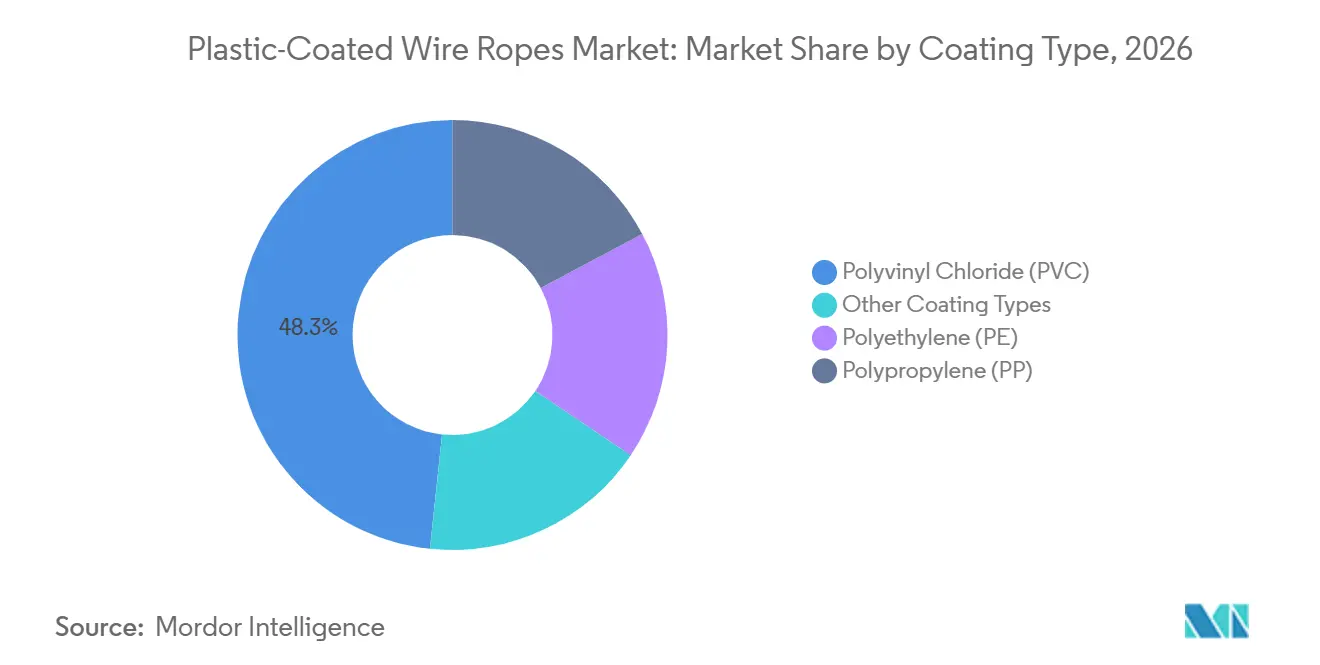
- By coating type, polyvinyl chloride (PVC) held 48.33% of the plastic-coated wire ropes market share in 2026, while polypropylene (PP) is forecast to advance at a 6.78% CAGR through 2032.
- By material type, galvanized steel wire rope held 45.10% of the plastic-coated wire ropes market share in 2026, while stainless steel wire rope is forecast to advance at a 6.94% CAGR through 2032.
- By diameter, above 1/4 inch held 52.27% of the plastic-coated wire ropes market share in 2026 and is forecast to advance at a 6.83% CAGR through 2032.
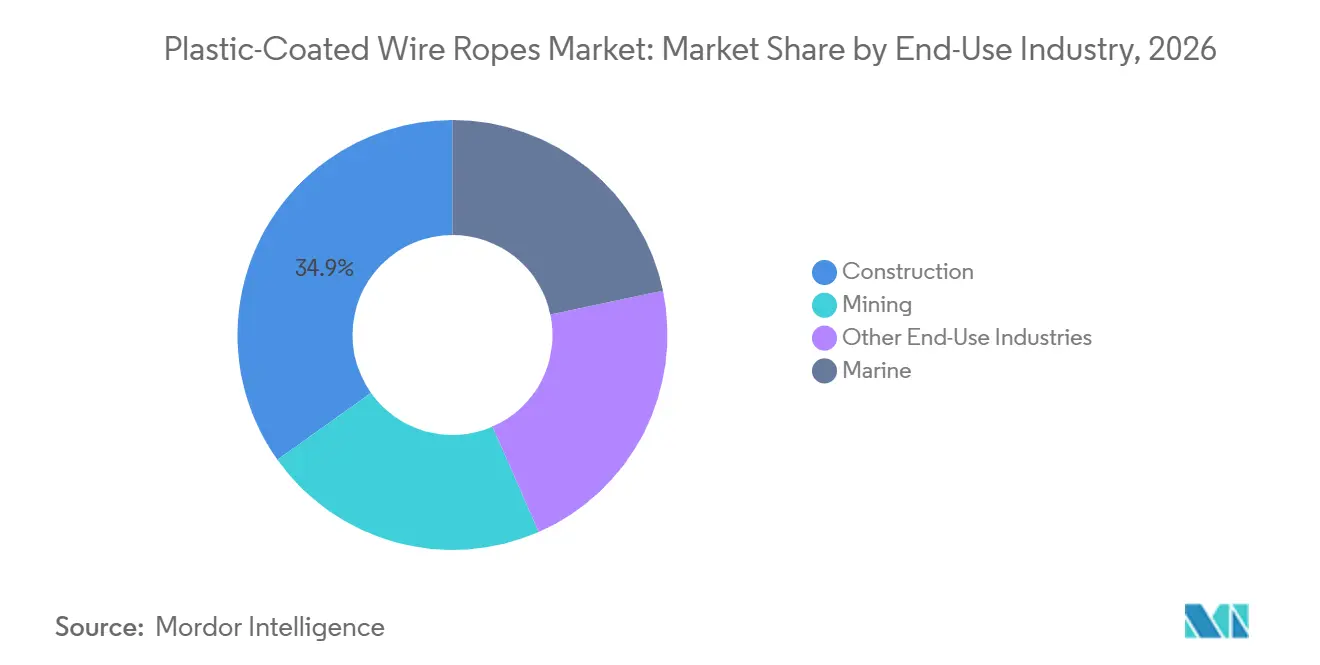
- By end-use industry, construction held 34.85% of the plastic-coated wire ropes market share in 2026, while marine is forecast to advance at a 7.15% CAGR through 2032.
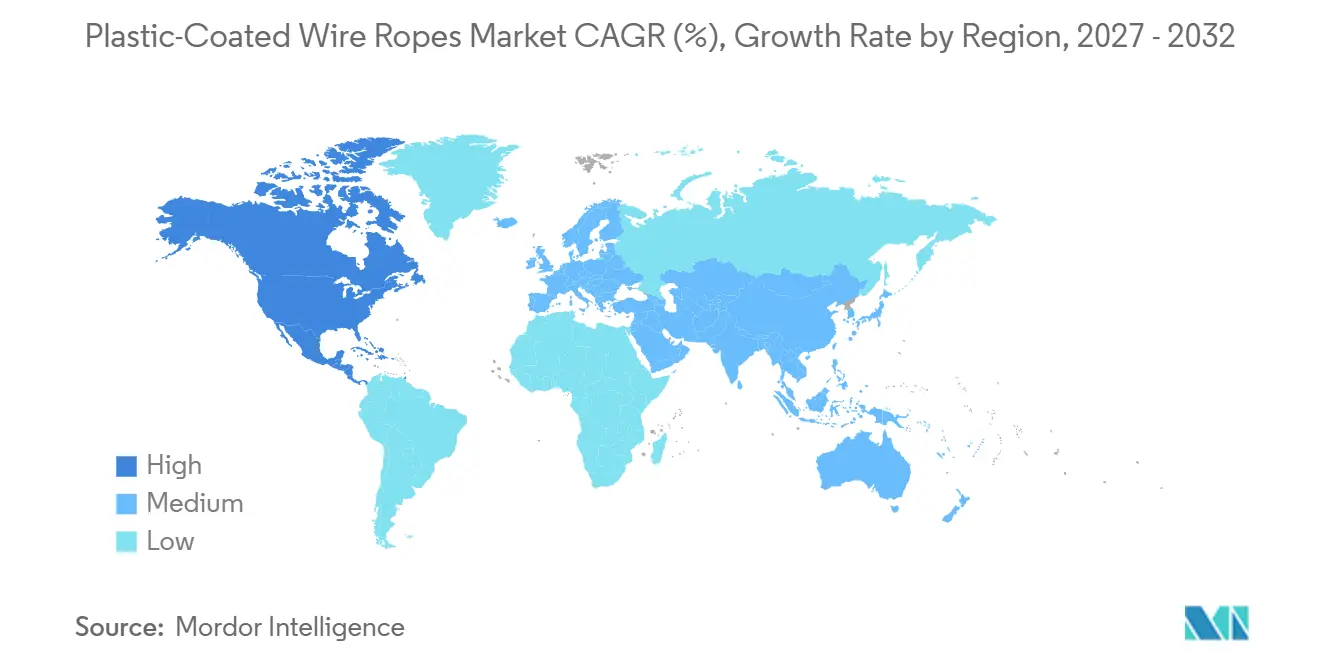
- By geography, Asia-Pacific held 43.04% of the plastic-coated wire ropes market share in 2026, while North America is forecast to advance at a 7.06% CAGR through 2032.
Note: Market numbers in this report are based on Mordor Intelligence's proprietary estimation framework, which combines nine months of actuals with Q4 projections for base year 2026.
Market Trends and Insights
Drivers Impact Analysis of Plastic-Coated Wire Ropes Market*
| Driver | (~) % Impact on CAGR Forecast | Geographic Relevance | Impact Timeline |
|---|---|---|---|
| Construction and Infrastructure Investment | +1.9% | Global, led by Asia-Pacific, Middle East, and North America | Medium term (2-4 years) |
| Marine and Offshore Wind Deployment | +1.5% | Europe, Asia-Pacific, North America | Long term (≥ 4 years) |
| Polymer-Impregnation and Low-Maintenance Rope Adoption | +1.2% | Global, with early leadership in Europe and North America | Medium term (2-4 years) |
| Corrosion, Abrasion, and UV Protection Requirements | +0.8% | Global, strongest in coastal, offshore, and tropical industrial regions | Short term (≤ 2 years) |
| Mining and Heavy-Lifting Modernization | +0.5% | APAC core, spillover to South America and MEA | Medium term (2-4 years) |
| Source: Mordor Intelligence | |||
Construction and Infrastructure Investment
Construction and infrastructure investment creates the broadest demand base for the plastic-coated wire ropes market because crane hoist systems, cable stays, and temporary works use ropes through demanding lifting cycles. Grid construction also requires tower erection, substation work, and transmission projects that depend on lifting equipment, which supports the need for durable rope systems. The International Energy Agency (IEA) reported that global grid investment reached USD 400 billion in 2025, reflecting the scale of construction activity associated with energy infrastructure[1]. Taller urban buildings and heavier tower crane configurations require above 1/4 Inch ropes and support specifications that give greater weight to fatigue performance and coating protection. Public infrastructure programs in the United States and India can sustain procurement cycles across multiple years, which gives the plastic-coated wire ropes market a demand base that is less dependent on short construction cycles.
Marine and Offshore Wind Deployment
Marine and offshore wind deployment changes the demand profile of the plastic-coated wire ropes market because ropes must withstand dynamic loading, salt spray, moisture, and repeated handling. A 2025 study on hybrid-catenary mooring systems assessed steel wire and polyester ropes for offshore wind applications, showing the technical relevance of rope selection in these installations. Offshore turbine installation vessels, port cranes, and commercial fishing winches require rope constructions that retain performance in saline environments where corrosion can interrupt operations. Deep-sea aquaculture cage anchoring in Japan, South Korea, and Indonesia also supports the use of polyethylene-coated galvanized ropes for recurring mooring work. This set of applications supports a longer-term opportunity for suppliers that can document corrosion resistance, elongation control, and reliable field performance for the plastic-coated wire ropes market.
Corrosion, Abrasion, and UV Protection Requirements
Corrosion, abrasion, and ultraviolet protection requirements support the plastic-coated wire ropes market because outdoor and marine users seek longer service intervals and fewer unplanned rope changes. Plastic coatings can limit moisture contact with individual wires and reduce surface damage from handling, guide sheaves, and contact with surrounding equipment. Polypropylene-impregnated constructions can also reduce internal wire-on-wire abrasion, a failure mode that surface coatings do not address in the same way. Tropical construction sites in the Association of Southeast Asian Nations and open-air industrial facilities in the Gulf Cooperation Council present strong cases for ultraviolet-resistant coated products. Where rope failure creates safety, downtime, or liability concerns, users are more willing to consider the maintenance and performance benefits offered by the plastic-coated wire ropes market.
Polymer-Impregnation and Low-Maintenance Rope Adoption
Polymer-impregnation and low-maintenance rope adoption support the plastic-coated wire ropes market by placing thermoplastic material within the rope structure rather than only around the outer surface. A coated core can improve resistance to crushing and multi-layer spooling forces in heavy-duty crane work, where rope geometry changes under load. WireCo launched Casar Boomfit in April 2025 with a plastic-coated steel core for heavy-duty crane applications, presenting a product example of this design direction. Crane, mining, and offshore users value ropes that can operate with reduced relubrication because maintenance access can be difficult at remote sites. Suppliers that can show extended inspection intervals under recognized testing and classification frameworks can strengthen their position in the plastic-coated wire ropes market.
Restraints Impact Analysis of Plastic-Coated Wire Ropes Market*
| Restraint | (~) % Impact on CAGR Forecast | Geographic Relevance | Impact Timeline |
|---|---|---|---|
| Premium Cost Versus Uncoated Steel Wire Rope | -0.8% | Global, strongest in price-sensitive emerging markets in Asia-Pacific and South America | Short term (≤ 2 years) |
| Temperature and Coating-Degradation Limits | -0.5% | Industrial regions with extreme temperatures: Middle East, Sub-Saharan Africa, Arctic North America | Medium term (2-4 years) |
| PVC Sustainability, Disposal, and Recycling Constraints | -0.4% | Europe, North America | Long term (≥ 4 years) |
| Source: Mordor Intelligence | |||
Premium Cost Versus Uncoated Steel Wire Rope
Premium cost versus uncoated steel wire rope restrains the plastic-coated wire ropes market because coated products carry a 20% to 50% price premium over uncoated alternatives. In general construction, lifting, and agricultural fencing, buyers can select uncoated galvanized ropes and accept shorter replacement cycles to reduce initial expenditure. This preference is stronger where labor costs for replacement are low, and the lifecycle benefit of the coating is less visible in the purchase decision. The challenge is most evident among mid-market construction and light industrial buyers who view coatings as an optional upgrade rather than a required performance feature. Wider use of lifecycle cost evaluation in procurement would help address this barrier, but the initial cost gap remains relevant in price-sensitive locations.
Temperature and Coating-Degradation Limits
Temperature and coating-degradation limits restrict standard product use because thermoplastic coatings have operating conditions that uncoated wire ropes do not share. Standard polyvinyl chloride formulations can soften and deform above 60 °C during sustained exposure and can become brittle in subzero conditions. Polypropylene-coated ropes offer a broader operating range and better ultraviolet stability, although specialist formulations are still needed to maintain flexibility below -20 °C. These limitations narrow use in furnace cranes, foundries, Arctic offshore sites, and hot outdoor settings, where operators may select specialist heat-resistant coatings or uncoated alternatives. The need for a more specialized material raises product cost and limits the addressable scope of the plastic-coated wire ropes market in extreme-climate applications.
*Our forecasts treat driver/restraint impacts as directional, not additive. The impact forecasts reflect baseline growth, mix effects, and variable interactions.
Plastic-Coated Wire Ropes Market Segment Analysis
By Coating Type:
PVC Holds Ground as PP Reshapes Growth DynamicsPolyvinyl chloride (PVC) accounted for 48.33% of the plastic-coated wire ropes market share in 2026, supported by established supply chains and broad familiarity across construction, agriculture, and utility uses. Its material cost and protection performance have kept it widely used where users need a practical coating for routine exposure and handling. Polyethylene-coated ropes are used in marine fending, guidewire, and architectural tension work, where color differentiation or optical clarity can be relevant. Nylon and thermoplastic polyurethane variants serve high-abrasion and appearance-sensitive uses. A 2025 scientific review identified contamination, hazardous additives, and inconsistent regulation as continuing barriers to polyvinyl chloride recycling, which remains relevant for buyers with circularity requirements.
Polyvinyl chloride retains a substantial installed base because many applications continue to prioritize availability, cost, and familiar processing methods. At the same time, procurement teams in environmentally exposed applications increasingly consider whether a coating choice can meet performance needs and align with end-of-life expectations. Polypropylene (PP) is projected to advance at a 6.78% CAGR through 2032 as polymer-impregnation methods improve internal abrasion protection and create a stronger maintenance proposition. Polyethylene and polypropylene provide alternatives for manufacturers seeking to reduce reliance on one coating family while retaining suitable mechanical protection. This shift does not remove polyvinyl chloride from the plastic-coated wire ropes industry during the forecast period, but it directs development spending toward materials with different durability and disposal profiles.

By Material Type:
Stainless Steel Wire Rope Gains Share in High-Performance ApplicationsGalvanized steel wire rope held 45.10% of the plastic-coated wire ropes market share in 2026 because it provides a familiar cost-performance balance for construction, general lifting, and agricultural activity. The material is widely accepted for civil and industrial uses, allowing manufacturers to pair an established steel core with an added polymer layer. Its broad use reflects the continuing need for dependable lifting products where the service environment is demanding but does not always require a stainless steel core. Galvanized products also fit applications where customers must manage rope cost while seeking better resistance to surface wear and moisture. The segment, therefore, remains central to the plastic-coated wire ropes market even as customers raise requirements for certified performance and traceable material quality.
Stainless steel wire rope is projected to advance at a 6.94% CAGR through 2032 as offshore operators, marine architects, and food-processing facilities seek stronger corrosion resistance and lower replacement needs. The premium material is more relevant where saltwater, hygiene requirements, or long service intervals justify a higher initial cost. SuYang completed a 20,000-metric-ton annual-capacity stainless steel wire rope facility in China during March 2025, using 1,040 high-speed automated drawing machines for offshore, elevator, and deep-sea applications. Quality expectations create meaningful differentiation because buyers in cross-border and specialty procurement often need documented testing, packaging, certification, and traceability. The plastic-coated wire ropes industry, therefore, gives stainless steel a growing role in applications where polymer protection alone cannot meet the service environment.
By Diameter:
Above 1/4 Inch Anchors Market Revenue and GrowthAbove 1/4 Inch rope held 52.27% of the plastic-coated wire ropes market share in 2026 and is forecast to advance at a 6.83% CAGR through 2032. These ropes receive higher per-meter pricing than smaller products and can justify coated designs when the performance benefit reduces the consequences of fatigue, abrasion, or corrosion. The scale of the load and the cost of equipment downtime make inspection, rope life, and safety central to the purchase decision for this category. Heavy-duty operators also gain more value from specification upgrades because the coating premium is considered alongside higher replacement and operational costs. This makes the segment a major revenue anchor for the plastic-coated wire ropes market.
Below 1/4 Inch ropes serve architectural tension systems, automotive control cables, security fencing, bicycle brakes, fitness equipment, and other precision uses. In these applications, polyvinyl chloride and nylon coatings can add grip, finish quality, and protection without requiring the load capability of a heavy hoist rope. Urban ropeway investment creates an adjacent use case, as these projects require engineered ropes that combine geometric stability with dependable service performance. Teufelberger presented its Solitec XD rope for urban cable car systems at Interalpin 2025, illustrating the relevance of ropeway infrastructure to specialized rope development. The mix of industrial and precision uses allows suppliers to address different performance requirements while using coatings to protect the steel construction.
By End-Use Industry:
Construction Leads, While Marine ExpandsConstruction held 34.85% of the plastic-coated wire ropes market share in 2026, supported by residential towers, port projects, and transport infrastructure across Asia-Pacific and the Middle East. Construction equipment uses coated ropes in lifting, material movement, temporary works, and related site activities that expose the product to dirt, moisture, friction, and repeated bending. The breadth of this demand supports large-volume sales and gives producers a significant route to market through crane and lifting equipment channels. Mining also requires ropes for hoists, draglines, and material-handling systems in underground environments that can be chemically aggressive and difficult to access. Other end uses, including agriculture, utilities, consumer goods, and architectural applications, provide a demand base for smaller coated constructions in Europe and North America.
Marine is projected to advance at a 7.15% CAGR through 2032 as offshore wind installation, vessel winches, port crane upgrades, commercial fishing, and aquaculture mooring increase demand for ropes that resist salt spray and frequent loading. Usha Martin supplied OCEANMAX wire ropes for Huisman’s 2,600-metric-ton crane on Cadeler’s WIND MAKER wind turbine installation vessel, demonstrating the role of high-specification ropes in offshore wind operations. Deep-sea aquaculture in the Asia-Pacific also creates demand for coated mooring and anchor ropes used around cage systems. This demand can recur through maintenance and replacement cycles, which makes marine activity valuable to suppliers with appropriate rope constructions.
Geography Analysis
APAC Plastic-Coated Wire Ropes Market
Asia-Pacific held 43.04% of the plastic-coated wire ropes market share in 2026, supported by China’s large production and consumption base and by construction activity across India, the Association of Southeast Asian Nations, and South Korea. The region combines demand from civil construction, marine engineering, port activity, logistics, shipbuilding, and industrial lifting. India’s National Infrastructure Pipeline and support for specialty steel production strengthen both domestic capacity and project demand through port, metro, and highway work. Japan and South Korea support precision applications, including elevator traction ropes, automotive cables, and architectural cables, where coated stainless steel products can achieve premium pricing.
North America and Europe Plastic-Coated Wire Ropes Market
North America is projected to advance at a 7.06% CAGR through 2032 as offshore wind development, federal infrastructure programs, and critical-mineral mining activity support new lifting and mooring requirements. Offshore projects on the Atlantic and Gulf coasts can require engineered ropes for installation vessels and associated port handling. Mining activity also supports demand where operators need reliable hoists and material-handling systems for difficult environments. Europe has a more mature demand pattern, centered on industrial lifting, ropeway infrastructure, and marine applications in Germany, the United Kingdom, and the Nordic countries. European buyers give significant attention to technical performance, documented service life, and environmental considerations, which support polyethylene and polypropylene alternatives in selected applications.
MEA and South America Plastic-Coated Wire Ropes Market
South America remains a developing demand area, with Brazil and Argentina supporting use through port modernization, agro-industrial lifting, and mining for copper and lithium. The Middle East and Africa benefit from construction programs, port expansion, and mining modernization that require crane, haulage, and marine rope systems. Saudi Arabia’s Vision 2030 projects, port development in the United Arab Emirates, and mining activity in South Africa create relevant conditions for coated products, while extreme heat in parts of the Middle East raises the need for coating selection and testing suited to the actual service condition. Together, these regions expand the geographic opportunity for the plastic-coated wire ropes market and favor suppliers that can match rope construction, polymer choice, inspections, and local support to operating requirements rather than selling a uniform product across distinct climates and uses.
Competitive Landscape
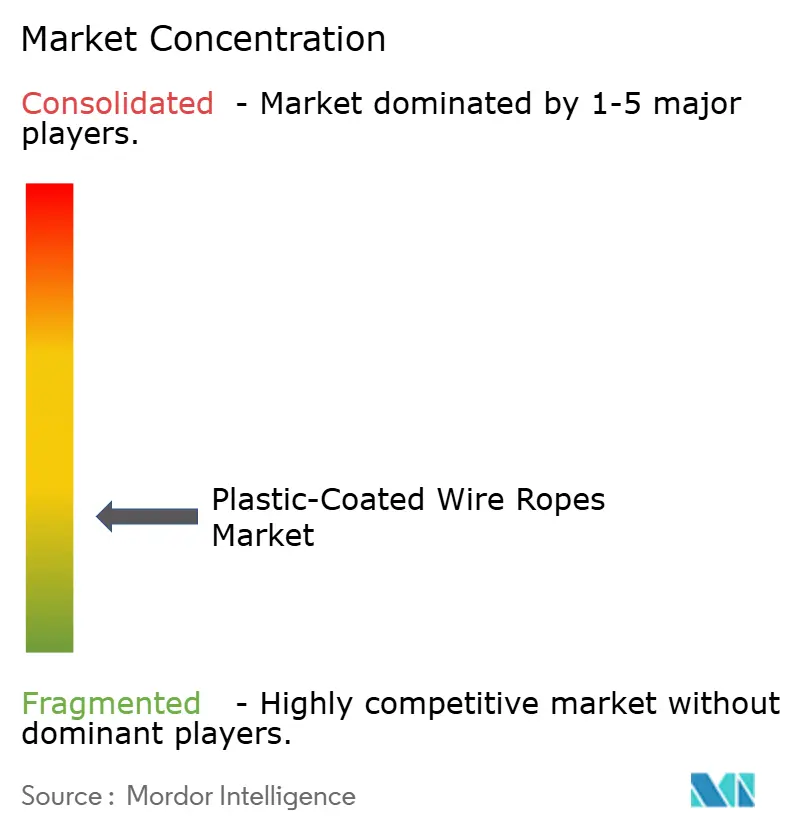
The plastic-coated wire ropes market is highly fragmented, with the top five players including Bekaert, WireCo, Axel Johnson International, Teufelberger, and Usha Martin. Chongqing Titan Suhe Co., Ltd. and Jiangyin Jinliyuan Steel Wire Rope Co., Ltd. represent the regional manufacturing presence that competes on production scale and cost. The competitive choice often depends on certification, application engineering, product availability, service support, and the ability to meet a specific operating condition. This structure creates pressure on suppliers to distinguish their products through performance rather than relying only on price.
Bekaert reported its 2025 full-year results in February 2026 and described the consolidation of synthetic rope manufacturing in Belgium, large specialty-rope contract wins, and divestment of Steel Wire Solutions businesses in Costa Rica, Ecuador, and Venezuela. That action indicates a focus on higher-value products and selected product lines rather than lower-margin geographic exposure. Teufelberger introduced the Solitec XD rope and its Alliance for Intelligent Rope Monitoring system at Interalpin 2025, combining a ropeway product with digital monitoring capabilities. Usha Martin expanded its specialized fine-cord production line in Thailand during May 2025, adding equipment for 1.5 mm to 5 mm wire ropes, elevator ropes, and automotive cables[2]. These moves show that leading companies are pursuing manufacturing specialization, technical performance, monitoring, and regional capacity to address different parts of the plastic-coated wire ropes market.
There is an opening in mid-market construction and mining applications in Southeast Asia and Africa, where buyers need more capability than a commodity product but may not select premium European specifications. Suppliers that combine credible technical standards, practical product selection, competitive cost, responsive delivery, and clear maintenance guidance can address this gap, particularly when users need help matching a coating and core material to moisture, abrasion, load, temperature, and local service conditions. Chinese producers use lower input costs and automated manufacturing to compete in standardized segments, which increases pressure on multinational suppliers to offer certification, technical service, application engineering, responsive product availability, and evidence that a higher-specification rope can improve service life in the buyer’s operating environment.
Plastic-Coated Wire Ropes Industry Leaders
-
Bekaert
-
WireCo
-
Axel Johnson International
-
Teufelberger
-
Usha Martin
- *Disclaimer: Major Players sorted in no particular order
Plastic-Coated Wire Ropes Market Companies Covered in this Report
- Asahi Ropes
- Axel Johnson International
- Bekaert
- Carl Stahl Technocables GmbH
- Chongqing Titan Suhe Co., Ltd.
- Gustav Wolf GmbH
- Hamburger Drahtseilerei A. Steppuhn GmbH
- Hindustan Engineers
- Jiangyin Jinliyuan Steel Wire Rope Co., Ltd.
- Lexco Cable
- Loos & Co. Inc.
- SWR Ltd.
- Teufelberger
- Usha Martin
- WireCo
Recent Industry Developments in Plastic-Coated Wire Ropes Market
- August 2026: Indolift standardized corrosion-resistant coating specifications across its steel wire rope portfolio, introducing a consistent galvanized finish across rope constructions used in lifting, crane operations, and outdoor material handling. The initiative supports the plastic-coated wire ropes market by highlighting the importance of standardized corrosion protection and longer service life in demanding operating environments.
- June 2026: Bharat Wire Ropes Limited resumed manufacturing operations at its Chalisgaon facility after receiving restart approval from the Maharashtra Pollution Control Board. The restart supports the plastic-coated wire ropes market indirectly by restoring domestic wire rope manufacturing capacity and strengthening the potential supply base for industrial rope applications.
Global Plastic-Coated Wire Ropes Market Report Scope
Plastic-coated wire ropes are steel wire ropes covered with a protective polymer layer to improve corrosion resistance, reduce abrasion, and protect the underlying wires from environmental exposure. The coating also helps improve handling and durability in applications involving demanding operating conditions.
The Plastic-Coated Wire Ropes Market is segmented by coating type, material type, diameter, end-use industry, and geography. By coating type, the market is segmented into polyvinyl chloride (PVC), polyethylene (PE), polypropylene (PP), and other coating types. By material type, the market is segmented into galvanized steel wire rope and stainless steel wire rope. By diameter, the market is segmented into below 1/4 inch and above 1/4 inch. By end-use industry, the market is segmented into construction, mining, marine, and other end-use industries. The report also covers the market size and forecasts for plastic-coated wire ropes across 15 countries. For each segment, the market sizing and forecasts have been done on the basis of value (USD).
Segmentation Overview
| Polyvinyl Chloride (PVC) |
| Polyethylene (PE) |
| Polypropylene (PP) |
| Other Coating Types |
| Galvanized Steel Wire Rope |
| Stainless Steel Wire Rope |
| Below 1/4 Inch |
| Above 1/4 Inch |
| Construction |
| Mining |
| Marine |
| Other End-Use Industries |
| Asia-Pacific | China |
| India | |
| Japan | |
| South Korea | |
| ASEAN Countries | |
| Rest of Asia-Pacific | |
| North America | United States |
| Canada | |
| Mexico | |
| Europe | Germany |
| United Kingdom | |
| France | |
| Italy | |
| NORDIC Countries | |
| Rest of Europe | |
| South America | Brazil |
| Argentina | |
| Rest of South America | |
| Middle East and Africa | Saudi Arabia |
| South Africa | |
| Rest of Middle East and Africa |
| By Coating Type | Polyvinyl Chloride (PVC) | |
| Polyethylene (PE) | ||
| Polypropylene (PP) | ||
| Other Coating Types | ||
| By Material Type | Galvanized Steel Wire Rope | |
| Stainless Steel Wire Rope | ||
| By Diameter | Below 1/4 Inch | |
| Above 1/4 Inch | ||
| By End-Use Industry | Construction | |
| Mining | ||
| Marine | ||
| Other End-Use Industries | ||
| By Geography | Asia-Pacific | China |
| India | ||
| Japan | ||
| South Korea | ||
| ASEAN Countries | ||
| Rest of Asia-Pacific | ||
| North America | United States | |
| Canada | ||
| Mexico | ||
| Europe | Germany | |
| United Kingdom | ||
| France | ||
| Italy | ||
| NORDIC Countries | ||
| Rest of Europe | ||
| South America | Brazil | |
| Argentina | ||
| Rest of South America | ||
| Middle East and Africa | Saudi Arabia | |
| South Africa | ||
| Rest of Middle East and Africa | ||
Key Questions Answered in the Report
What is the size of the plastic-coated wire ropes market?
The plastic-coated wire ropes market size was valued at USD 1.48 billion in 2026 and is estimated to grow from USD 1.57 billion in 2027 to reach USD 2.11 billion by 2032, at a CAGR of 6.13% during the forecast period (2027-2032).
What is driving demand for plastic-coated wire ropes?
Construction investment, offshore wind deployment, corrosion protection needs, and interest in lower-maintenance rope systems support demand.
Which coating type held the largest share in 2026?
Polyvinyl chloride (PVC) held 48.33% of the market share in 2026.
Which end-use industry is projected to advance fastest through 2032?
Marine is projected to advance at a 7.15% CAGR through 2032, supported by offshore wind, ports, vessel systems, and aquaculture.