
Plant Breeding and CRISPR Plants Market Size and Share
Market Overview
| Study Period | 2021 - 2031 |
|---|---|
| Market Size (2026) | USD 15.5 Billion |
| Market Size (2031) | USD 24.40 Billion |
| Growth Rate (2026 - 2031) | 9.50 % |
| Fastest Growing Market | North America |
| Largest Market | Asia-Pacific |
| Market Concentration | Medium |
Major Players *Disclaimer: Major Players sorted in no particular order Image © Mordor Intelligence. Reuse requires attribution under CC BY 4.0. | |
Plant Breeding and CRISPR Plants Market Analysis by Mordor Intelligence
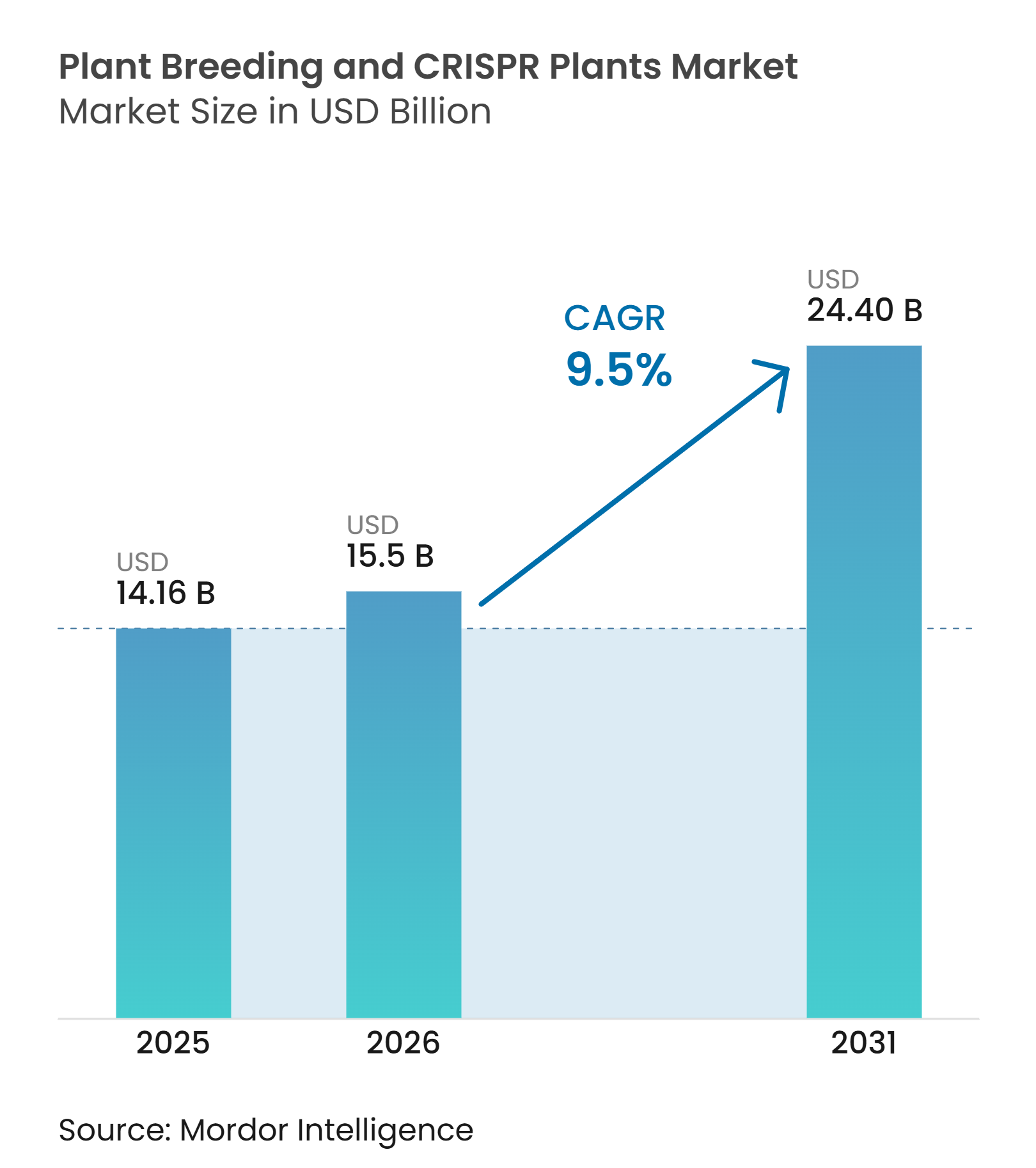
The plant breeding and CRISPR plants market was valued at USD 14.16 billion and is projected to grow from USD 15.50 billion in 2026 to USD 24.40 billion by 2031, registering a CAGR of 9.50% during the forecast period. Lower sequencing costs, early regulatory decisions, and wider use of artificial intelligence are changing how breeding programs select and test traits. Food security pressures are sustaining focus on yield stability, disease resistance, and climate resilience. Regulatory clarity can shorten development timelines for some gene-edited plants, while differing national regulations continue to influence where companies choose to launch first. The plant breeding and CRISPR plant markets also give large seed companies reasons to combine internal research with licensing agreements for specialized editing tools.
Key Report Takeaways
- By type, biotechnological breeding accounted for the largest 62.0% of the plant breeding and the CRISPR plants market share in 2025, and is projected to grow at the fastest CAGR of 11.8% from 2026 to 2031.
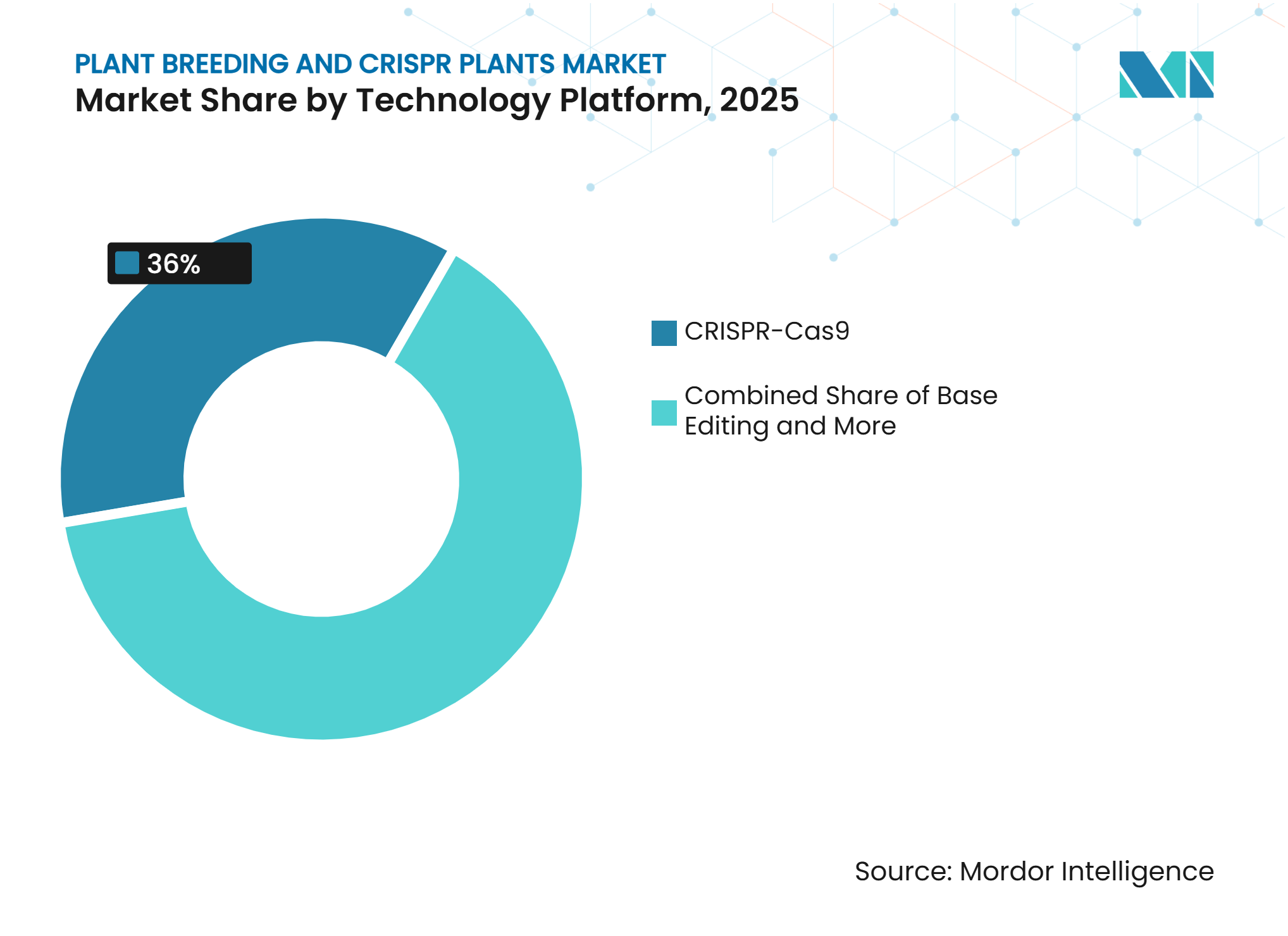
- By technology platform, CRISPR-Cas9 accounted for the largest share at 36.0% in 2025, while base editing is projected to grow at the fastest CAGR of 17.0% from 2026 to 2031.
- By trait, herbicide tolerance accounted for the largest share at 30.5% in 2025, while the plant breeding and the CRISPR plants market size for nutritional enhancement and biofortification is projected to grow at the fastest CAGR of 16.9% from 2026 to 2031.
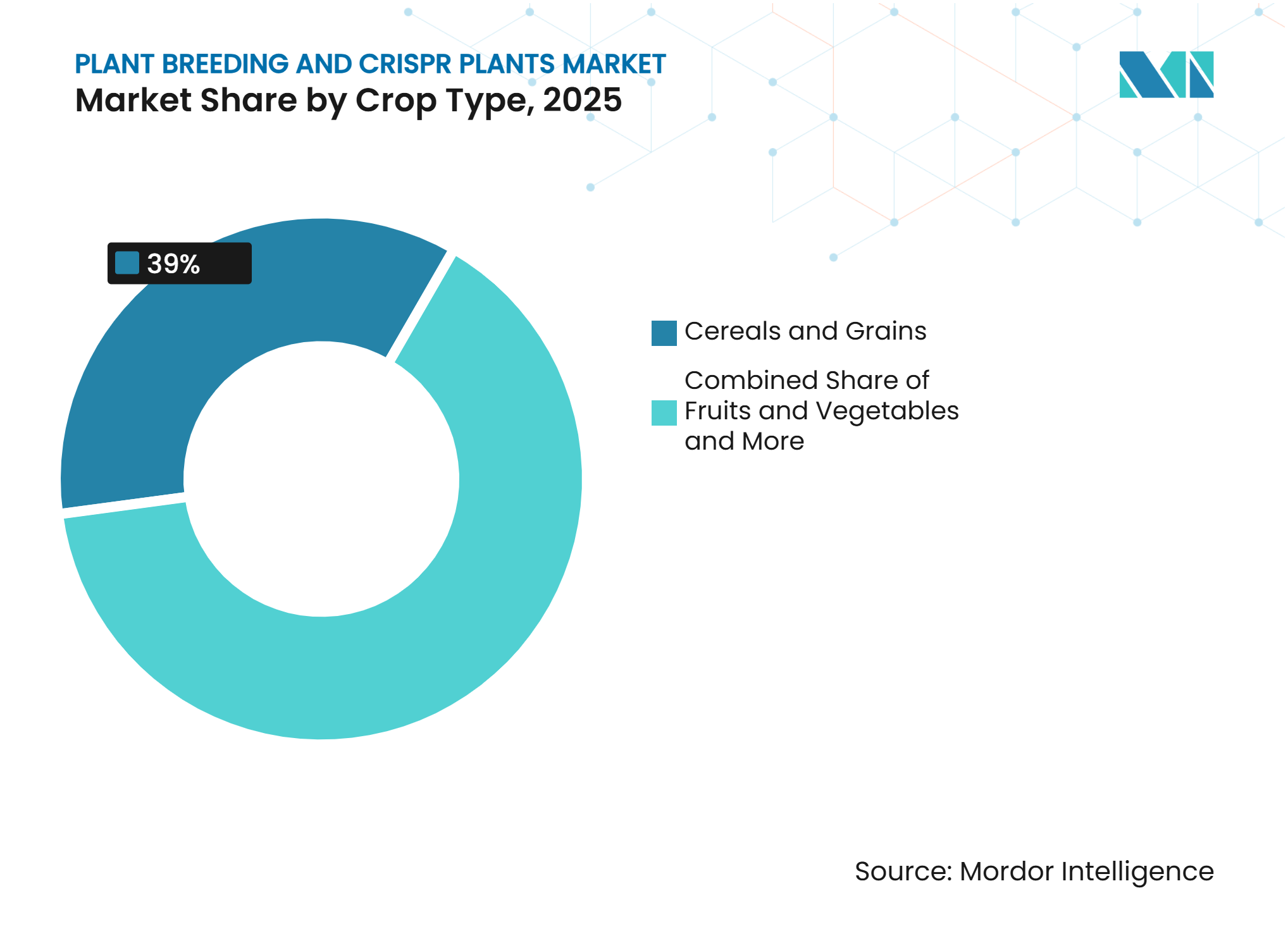
- By crop type, cereals and grains accounted for the largest share at 39.0% in 2025, while fruits and vegetables are projected to grow at the fastest CAGR of 15.5% from 2026 to 2031.
- By application, commercial agriculture accounted for the largest share at 52.0% in 2025, while research and public breeding programs are projected to grow at the fastest CAGR of 13.8% from 2026 to 2031.
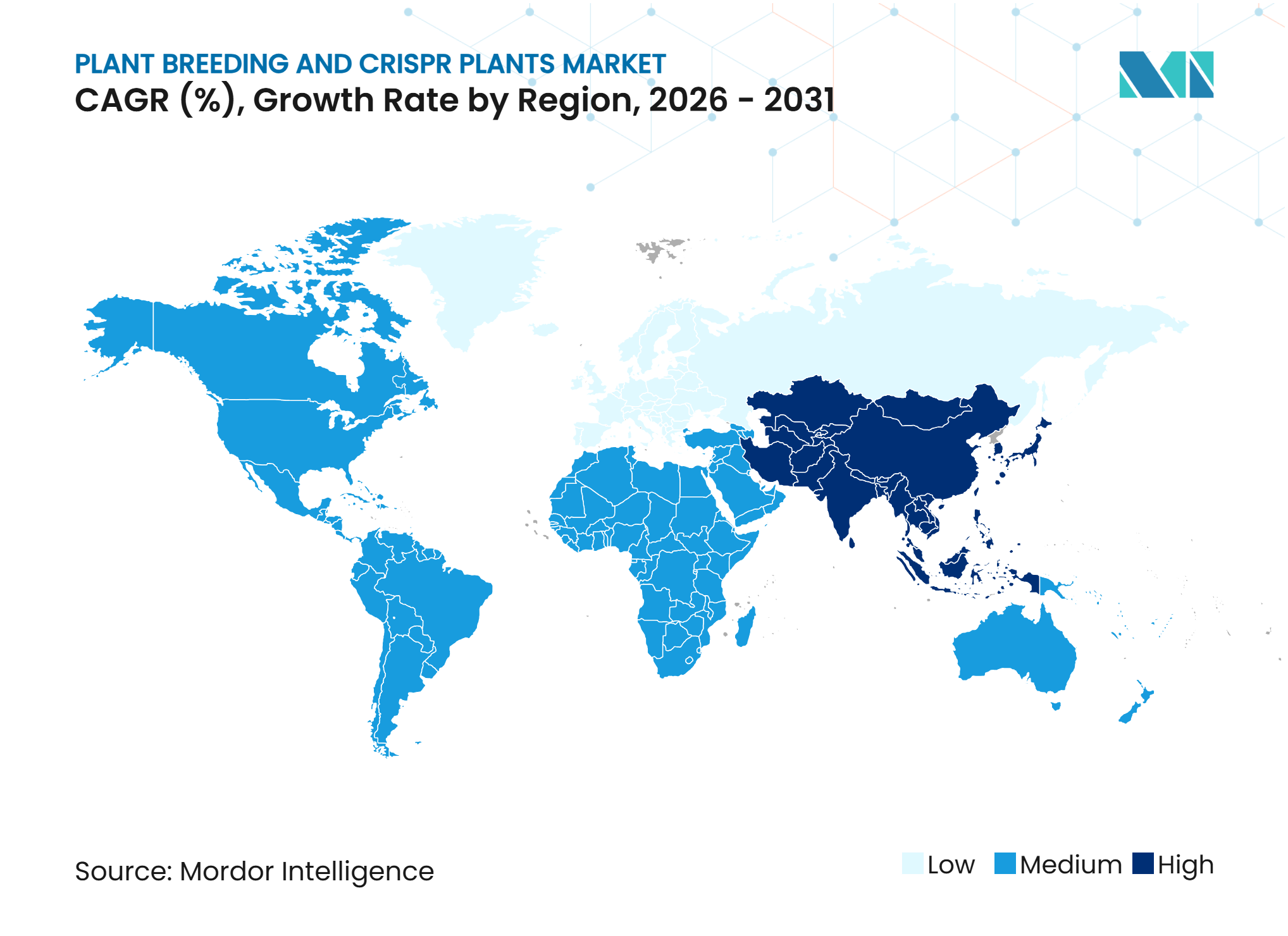
- By geography, North America accounted for the largest share at 35.1% in 2025, while Asia-Pacific is projected to grow at the fastest CAGR of 14.0% from 2026 to 2031.
Note: Market size and forecast figures in this report are generated using Mordor Intelligence’s proprietary estimation framework, updated with the latest available data and insights as of January 2026.
Market Trends and Insights
Drivers Impact Analysis of Plant Breeding and CRISPR Plants Market*
| Driver | (~) % Impact on CAGR Forecast | Geographic Relevance | Impact Timeline |
|---|---|---|---|
| Demand for climate-resilient crop traits | +2.8% | Global, with the strongest relevance in South Asia, Sub-Saharan Africa, and Asia-Pacific | Long term (≥ 4 years) |
| Food-security pressure and yield-stability requirements | +1.9% | Global, especially low-income food-deficit countries and densely populated parts of Asia-Pacific and Africa | Long term (≥ 4 years) |
| Regulatory acceptance of gene-edited crops | +2.1% | North America, Europe, Asia-Pacific, and South America | Medium term (2-4 years) |
| Artificial intelligence-enabled breeding and high-throughput phenotyping | +1.5% | North America and Europe, with rising adoption in Asia-Pacific | Short term (≤ 2 years) |
| Falling genomics and sequencing costs | +0.8% | Global, with higher incremental relevance in emerging breeding programs | Short term (≤ 2 years) |
| Demand for nutritionally enhanced and resource-efficient crops | +0.7% | Asia-Pacific and Africa, with growing relevance in North America and Europe | Long term (≥ 4 years) |
| Source: Mordor Intelligence | |||
Demand for Climate-Resilient Crop Traits
Climate stress converts trait performance into a measurable field variable, enabling breeding programs to be funded based on yield retained under drought, salinity, and heat rather than on potential yield alone. According to the Indian Council of Agricultural Research (ICAR), its genome-edited variety Pusa DST Rice 1 can increase yields by 9.66% to 30.4% in saline and alkaline soils as of 2025[1]. Quantified stress-condition gains in an established cultivar background give breeders a defensible return case, directing funding toward trait discovery, editing platforms, and licensing across public and commercial breeding programs.
Food-Security Pressure and Yield-Stability Requirements
Yield stability is a distinct breeding objective from yield potential, as buyers of genetics pay for output that holds when weather conditions turn unfavorable. According to the Food and Agriculture Organization of the United Nations (FAO), global wheat production in 2026/27 is projected to decline by 3.8% to 810.9 million metric tons due to smaller harvests in major exporting countries[2]. Supply concentrated in weather-exposed exporters turns seasonal variance into a food-security risk, sustaining funding for traits and breeding tools that narrow the gap between good and poor years.
Regulatory Acceptance of Gene-Edited Crops
Regulatory classification determines the development cost and timeline for an edited variety, as GMO authorization requires risk assessment, dossier preparation, and several years before commercial release. According to the Official Journal of the European Union, Regulation (EU) 2026/1388 entered into force on 16 July 2026 and will apply from 17 July 2028, placing category 1 plants outside GMO rules subject to a verification procedure. A defined, shorter regulatory route allows breeders to plan programs against a known timeline, supporting pipeline commitments across crops and techniques.
Artificial Intelligence-Enabled Breeding and High-Throughput Phenotyping
Selection decisions depend on how quickly a program can link genotype data to measured field performance, as each cycle is limited by phenotyping capacity rather than sequencing cost. Unmanned aerial and sensor-based imaging can now capture canopy traits across entire trials in a single pass, and machine learning models convert those readings into predictions that rank lines before harvest. Shorter, better-informed cycles improve the return on every trait a program develops, which sustains spending on phenotyping platforms, analytics, and the breeding tools that act on the results.
Restraints Impact Analysis of Plant Breeding and CRISPR Plants Market*
| Restraint | (~) % Impact on CAGR Forecast | Geographic Relevance | Impact Timeline |
|---|---|---|---|
| Regulatory divergence and approval delays | -1.5% | Europe during the transition period, South Asia, and Africa | Medium term (2-4 years) |
| High research and development, field-trial, and commercialization costs | -1.0% | Global, with the largest burden on small and medium-sized enterprises and public programs in emerging markets | Long term (≥ 4 years) |
| Public skepticism and gene-edited crop acceptance risk | -0.5% | Europe, parts of Asia-Pacific, and selected African countries | Long term (≥ 4 years) |
| Intellectual-property concentration and access constraints | -0.8% | Global, especially public programs and small and medium-sized enterprise breeders in lower-income markets | Long term (≥ 4 years) |
| Source: Mordor Intelligence | |||
High Research and Development, Field-Trial, and Commercialization Costs
Advancing an edited variety from target discovery through multisite field trials to regulatory submission requires sustained annual spending, not a one-time project budget. BASF SE reported that its Agricultural Solutions segment recorded research and development expenses of EUR 990 million (USD 1.09 billion) in 2025[3]. This level of expenditure sets the practical threshold for running a full commercial program. Organizations unable to fund containment facilities, genotyping capacity, and location-specific trials across jurisdictions advance fewer candidates to launch, limiting the number of products reaching growers.
Intellectual-Property Concentration and Access Constraints
Freedom-to-operate must be cleared before an edited line can be commercialized, as the nuclease, guide sequence, delivery method, and resulting trait can each carry separate rights. According to the Swiss Federal Institute of Intellectual Property (IPI), its 2025 CRISPR patent and license landscape for plants counted 23,696 patent families on CRISPR, based on data up to and including December 2024. Clearing an estate of that size requires legal search and negotiation before any fieldwork begins, and unresolved rights stall candidates, limiting the number of programs that reach commercialization.
*Our forecasts treat driver/restraint impacts as directional, not additive. The impact forecasts reflect baseline growth, mix effects, and variable interactions.
Plant Breeding and CRISPR Plants Market Segment Analysis
By Type:
Biotechnological Breeding Leads Adoption and GrowthBiotechnological breeding accounted for the largest 62.0% of the plant breeding and the CRISPR plants market share in 2025. This position reflects sustained investment in genomics, genetic selection, and editing capabilities within commercial and public pipelines. Genome editing and CRISPR represent the fastest-growing area within this segment. Conventional breeding remains central for complex polyploid crops, including wheat, where trait architecture resists simple intervention, while biotechnology tools are becoming accessible to a wider range of programs. Mutation breeding retains a defined role, as induced variation continues to deliver useful diversity for selection in specific crops.
Biotechnological breeding is projected to grow at the fastest CAGR of 11.8% from 2026 to 2031. Marker-assisted selection, genomic selection, and genome editing are increasingly deployed together rather than as separate approaches. Genomic selection and artificial intelligence models narrow germplasm pools before precise edits are introduced, reducing costly field-evaluation cycles and shortening the time to advancement decisions. Integrated platforms address multiple crops and traits from a single capability base, sustaining demand for reagents, informatics, transformation services, and trained personnel across public and commercial programs.
By Technology Platform:
CRISPR-Cas9 Leads While Base Editing ExpandCRISPR-Cas9 accounted for the largest share at 36.0% in 2025. Established delivery systems, broad crop applicability, and extensive published validation keep it a foundational tool in commercial and public programs. High-throughput phenotyping and AI-assisted breeding serve as significant non-editing platforms, making trial evaluation more effective at a commercial scale. Sequencing, genotyping, and bioinformatics benefit from lower costs and wider deployment. Transcription activator-like effector nucleases (TALENs), MegaTALs, and zinc finger nucleases (ZFNs) retain relevance where CRISPR delivery is less effective and where legacy investment continues to support their use in defined programs.
Base editing is projected to grow at the fastest CAGR of 17.0% from 2026 to 2031. The category sits alongside CRISPR-Cas9, including CRISPR-Cas12a and prime editing, and these newer tools enable highly specific changes without requiring double-strand DNA breaks. This property suits traits governed by known point variants in coding or promoter regions and reduces the screening burden associated with unintended outcomes. Licensing arrangements for newer editors are drawing commercial programs into evaluation agreements as these editors extend precision-editing work across crops and target species.



By Trait:
Herbicide Tolerance Holds the Largest Position While Nutritional Enhancement and Biofortification Grow FastestHerbicide tolerance accounted for the largest share at 30.5% in 2025. This position reflects established weed-management practices in row-crop agriculture, where growers apply these traits within existing crop protection and seed-purchasing systems. Familiar agronomic handling and predictable field outcomes support continued specification by seed companies. Regulatory treatment varies by jurisdiction, and herbicide-tolerant plants developed through new genomic techniques face more stringent authorization requirements in some markets than other edited plants. Disease resistance, drought resistance, and salinity tolerance remain substantial areas of ongoing crop development activity across major field and horticultural crops.
The plant breeding and the CRISPR plants market size for nutritional enhancement and biofortification is projected to grow at the fastest CAGR of 16.9% from 2026 to 2031. These traits support food-manufacturing partnerships that monetize benefits beyond the farm gate, as composition can be specified contractually by processors. Multi-disease resistance work in corn and other staples continues alongside this. Shelf-life and quality improvement, carbon sequestration, and nitrogen-use efficiency also create differentiated positions, giving developers routes to recover trait costs through channels other than seed price alone in commercial markets.
By Crop Type:
Cereals and Grains Provide Volume While Fruits and Vegetables Add ValueCereals and grains accounted for the largest share at 39.0% in 2025. Corn, wheat, rice, sorghum, and barley are the subject of extensive breeding activity, cover major cultivated areas, and supply a large share of dietary calories worldwide. Established seed distribution channels and long-standing public breeding infrastructure support the trial capacity required for variety advancement. Hybrid wheat programs are advancing through germplasm agreements aimed at commercialization in Europe and North America. Reference genomes and dense marker resources for these species reduce the technical work required before editing programs begin in a new crop.
Fruits and vegetables are projected to grow at the fastest CAGR of 15.5% from 2026 to 2031. Specialty crops command premium prices for seedlessness, flavor, shelf life, and disease resistance, making trait development commercially attractive even at lower volumes. Many of these species are vegetatively propagated or highly heterozygous, making trait introduction through repeated crossing slow and disruptive to an established variety. Oilseeds and pulses remain important for soybean and canola trait stacks, while turf and ornamental, forage and cover, and industrial and bioenergy crops retain smaller roles in the segment.

By Application:
Commercial Agriculture Has Scale While Public Breeding Programs Grow FastestCommercial agriculture accounted for the largest share at 52.0% in 2025. Seed and trait deployment in staple grains supports this position across the Americas and Asia-Pacific, where seed companies convert traits into varieties, manage multisite trials, and handle registration in each country of sale. Their volumes justify dedicated editing groups, transformation facilities, and regulatory affairs teams. Horticulture remains relevant because precision editing can deliver fruit and vegetable traits that would otherwise require long breeding cycles. Commercial buyers set specification requirements that shape how upstream tool providers package their offerings.
Research and public breeding programs are projected to grow at the fastest CAGR of 13.8% from 2026 to 2031. International research institutes have secured long-term humanitarian licenses for gene editing in smallholder crops across Asia and Africa, making editing capabilities available to programs without commercial licensing budgets. Food production and animal feed applications benefit from higher protein content and improved amino acid profiles. Pharmaceutical and specialty crops can benefit from precise changes in secondary metabolite pathways, while biofuel and biochemical production remains at an early stage within the plant breeding and CRISPR plant industry.
Geography Analysis
North America accounted for the largest share at 35.1% in 2025. The United States operates an Animal and Plant Health Inspection Service pathway that allows certain gene-edited crops without introduced foreign sequences to proceed outside the review process applied to transgenic events, providing developers with early clarity on their regulatory route. Canada uses a novelty-based assessment approach that evaluates the trait rather than the breeding method. Mexico remains relevant for commercial seed production and off-season nurseries. Large planted areas in corn, soybean, and cotton support extensive trial capacity across the region.
Asia-Pacific is projected to grow at the fastest CAGR of 14.0% from 2026 to 2031. China has approved gene-edited crop events covering soybean, corn, wheat, and rice, and India has released and begun seed multiplication of genome-edited rice ahead of commercial deployment. Japan has commercial experience with genome-edited produce, including a gamma-aminobutyric acid-enriched tomato, while South Korea and Australia are expanding their pipelines. Regional germplasm holdings and local partnerships carry considerable weight, and companies with domestic breeding relationships and distribution reach are better positioned to convert approvals into planted area.
Europe is preparing for the implementation of the new genomic techniques framework, with breeders moving editing work from research into product development and field trials. Public financing is supporting that shift. According to the European Investment Bank (EIB), in 2026, it will lend Limagrain EUR 300 million (USD 324 million) to accelerate the development of more productive and resilient crops through a research program led by Vilmorin and Cie. The Middle East is investing in desert-adapted crop genetics, while Africa is advancing through public programs and international research partnerships focused on staple crops.
Competitive Landscape
Market Concentration
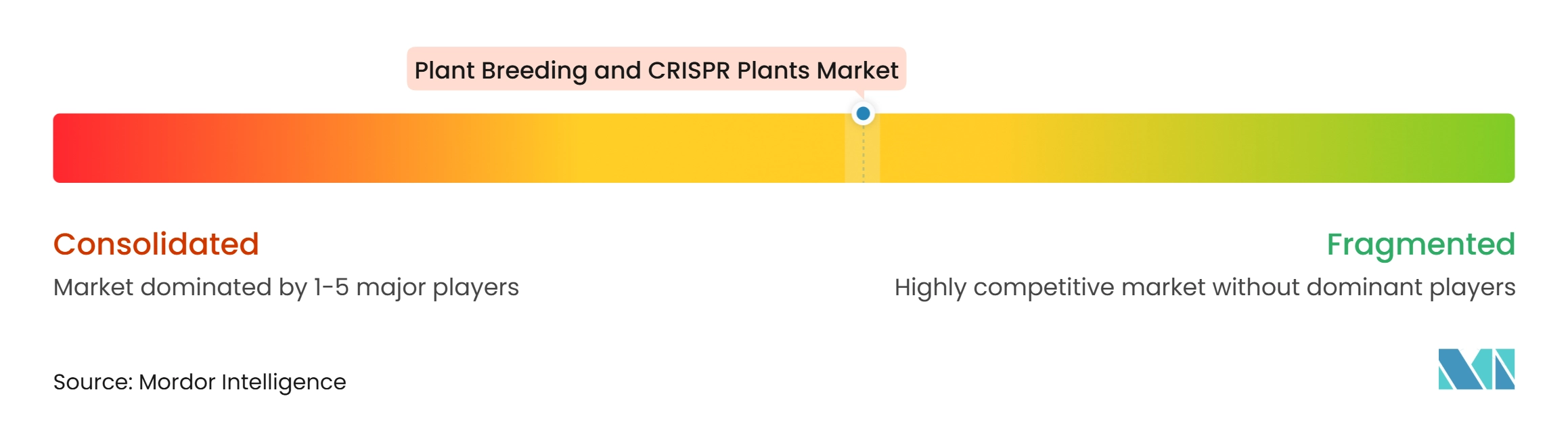
The plant breeding and CRISPR plants market remained moderately fragmented in 2025, with key players including Bayer AG, Corteva, Inc., Syngenta AG, BASF SE, and Groupe Limagrain Holding SA. These companies hold germplasm, distribution, and trait licensing positions, and their scale supports research, field trials, and regulatory submissions across multiple jurisdictions. Consolidation is concentrated at the commercial product level, while technology development remains open, with specialized developers competing through editing platforms and targeted traits rather than broad germplasm portfolios.
Established companies supplement internal capabilities with specialized tools through licensing and collaboration rather than developing every platform in-house. This approach is reflected in worldwide licensing agreements for genome-editing technologies, evaluation licenses for newer editing chemistries, and partnerships covering gene editing, induced gene silencing, and artificial intelligence-based prediction of variety performance. Specialized developers use regional partnerships to reach commercialization where they lack distribution. Intellectual property remains a key factor, as foundational editing rights and emerging claims around base editing, prime editing, and guide ribonucleic acid (RNA) design shape the cost and availability of tools for smaller developers.
Research intensity distinguishes participants in this market, as variety development operates on multi-year cycles that require continuous funding rather than a project-by-project approach. According to Rijk Zwaan Zaadteelt en Zaadhandel B.V., in 2025, the company will invest 30% of its annual turnover in research and development, applying DNA marker technology, genomic selection, and machine learning to accelerate selection decisions and shorten time to market. Sustained investment at that level allows breeding organizations to maintain long pipelines while adopting editing and prediction tools as they mature commercially.
Plant Breeding and CRISPR Plants Industry Leaders
-
Bayer AG
-
Corteva, Inc.
-
Syngenta AG
-
BASF SE
-
Groupe Limagrain Holding SA
- *Disclaimer: Major Players sorted in no particular order
Plant Breeding and CRISPR Plants Market Companies Covered in this Report
- Bayer AG
- Corteva, Inc.
- Syngenta AG
- BASF SE
- KWS SAAT SE & Co. KGaA
- Groupe Limagrain Holding SA
- UPL Limited
- Rijk Zwaan Zaadteelt en Zaadhandel B.V.
- Sakata Seed Corporation
- Beijing Dabeinong Technology Group Co., Ltd.
- Pairwise Plants LLC
- Cibus, Inc.
- Inari Agriculture, Inc.
- Bioceres Crop Solutions Corp.
- Enza Zaden Beheer B.V.
Recent Industry Developments in Plant Breeding and CRISPR Plants Market
- September 2026: Bayer SE announced the development of a genome-edited standable soybean within its seed pipeline, using genome editing to improve plant architecture while maintaining yield potential. This initiative directly supports genome editing, soybean breeding, yield improvement, and commercial agriculture applications.
- July 2026: Groupe Limagrain Holding SA and Qi Biodesign signed a worldwide licensing agreement for genome-editing technologies to accelerate the development of next-generation crop varieties. The partnership expands Limagrain's access to genome-editing capabilities and supports genome editing and CRISPR-related plant breeding across crop programs.
- June 2026: Sakata Seed Corporation is expanding breeding research for crops suited to tropical and subtropical conditions at its Ishigaki Research Station in Okinawa, Japan. The facility supports the development of climate-adapted varieties and conventional and biotechnological breeding activities for improved crop resilience.
Global Plant Breeding and CRISPR Plants Market Report Scope
Plant breeding and CRISPR plants involve developing improved crop varieties through conventional, biotechnological, and gene-editing techniques. These methods are used to enhance yield, disease resistance, climate resilience, nutritional quality, and resource efficiency, among other desirable traits, while accelerating the development of targeted crop characteristics.
The plant breeding and CRISPR plants market report is segmented by type (conventional breeding and biotechnological breeding), by technology platform (CRISPR-Cas9, CRISPR-Cas12a, base editing, prime editing, transcription activator-like effector nucleases and MegaTALs, zinc-finger nucleases, sequencing, genotyping, and bioinformatics, high-throughput phenotyping, and artificial intelligence-assisted breeding), by trait (herbicide tolerance, insect resistance, disease resistance, yield and grain-size improvement, drought resistance, temperature and stress tolerance, salinity tolerance, water-use efficiency, nutritional enhancement and biofortification, shelf-life and quality improvement, and carbon-sequestration and nitrogen-use efficiency), by crop type (cereals and grains, oilseeds and pulses, fruits and vegetables, turf and ornamental crops, forage and cover crops, and industrial and bioenergy crops), by application (commercial agriculture, horticulture, food production, animal feed production, biofuel and biochemical production, pharmaceutical and specialty crops, and research and public breeding programs), and by geography (North America, South America, Europe, Asia-Pacific, Middle East, and Africa). The market forecasts are provided in terms of value (USD).
Segmentation Overview
| Conventional Breeding | |
| Biotechnological Breeding | Molecular Breeding |
| Marker-Assisted Selection | |
| Genomic Selection | |
| Genetic Engineering | |
| Genome Editing and CRISPR |
| CRISPR-Cas9 |
| CRISPR-Cas12a |
| Base Editing |
| Prime Editing |
| TALENs and MegaTALs |
| Zinc-Finger Nucleases |
| Sequencing, Genotyping, and Bioinformatics |
| High-Throughput Phenotyping |
| Artificial Intelligence-Assisted Breeding |
| Herbicide Tolerance |
| Insect Resistance |
| Disease Resistance |
| Yield and Grain-Size Improvement |
| Drought Resistance |
| Temperature and Stress Tolerance |
| Salinity Tolerance |
| Water-Use Efficiency |
| Nutritional Enhancement and Biofortification |
| Shelf-Life and Quality Improvement |
| Carbon-Sequestration and Nitrogen-Use Efficiency |
| Cereals and Grains | Corn |
| Wheat | |
| Rice | |
| Sorghum | |
| Barley | |
| Oilseeds and Pulses | Soybean |
| Canola | |
| Sunflower | |
| Pea | |
| Chickpea | |
| Fruits and Vegetables | Tomato |
| Potato | |
| Lettuce and Leafy Greens | |
| Melon, Squash, and Watermelon | |
| Banana | |
| Strawberry | |
| Turf and Ornamental Crops | |
| Forage and Cover Crops | |
| Industrial and Bioenergy Crops |
| Commercial Agriculture |
| Horticulture |
| Food Production |
| Animal Feed Production |
| Biofuel and Biochemical Production |
| Pharmaceutical and Specialty Crops |
| Research and Public Breeding Programs |
| North America | United States |
| Canada | |
| Mexico | |
| Rest of North America | |
| South America | Brazil |
| Argentina | |
| Chile | |
| Rest of South America | |
| Europe | Germany |
| France | |
| United Kingdom | |
| Italy | |
| Spain | |
| Russia | |
| Rest of Europe | |
| Asia-Pacific | China |
| India | |
| Japan | |
| South Korea | |
| Australia | |
| Rest of Asia-Pacific | |
| Middle East | Saudi Arabia |
| United Arab Emirates | |
| Israel | |
| Rest of Middle East | |
| Africa | South Africa |
| Egypt | |
| Nigeria | |
| Rest of Africa |
| By Type | Conventional Breeding | |
| Biotechnological Breeding | Molecular Breeding | |
| Marker-Assisted Selection | ||
| Genomic Selection | ||
| Genetic Engineering | ||
| Genome Editing and CRISPR | ||
| By Technology Platform | CRISPR-Cas9 | |
| CRISPR-Cas12a | ||
| Base Editing | ||
| Prime Editing | ||
| TALENs and MegaTALs | ||
| Zinc-Finger Nucleases | ||
| Sequencing, Genotyping, and Bioinformatics | ||
| High-Throughput Phenotyping | ||
| Artificial Intelligence-Assisted Breeding | ||
| By Trait | Herbicide Tolerance | |
| Insect Resistance | ||
| Disease Resistance | ||
| Yield and Grain-Size Improvement | ||
| Drought Resistance | ||
| Temperature and Stress Tolerance | ||
| Salinity Tolerance | ||
| Water-Use Efficiency | ||
| Nutritional Enhancement and Biofortification | ||
| Shelf-Life and Quality Improvement | ||
| Carbon-Sequestration and Nitrogen-Use Efficiency | ||
| By Crop Type | Cereals and Grains | Corn |
| Wheat | ||
| Rice | ||
| Sorghum | ||
| Barley | ||
| Oilseeds and Pulses | Soybean | |
| Canola | ||
| Sunflower | ||
| Pea | ||
| Chickpea | ||
| Fruits and Vegetables | Tomato | |
| Potato | ||
| Lettuce and Leafy Greens | ||
| Melon, Squash, and Watermelon | ||
| Banana | ||
| Strawberry | ||
| Turf and Ornamental Crops | ||
| Forage and Cover Crops | ||
| Industrial and Bioenergy Crops | ||
| By Application | Commercial Agriculture | |
| Horticulture | ||
| Food Production | ||
| Animal Feed Production | ||
| Biofuel and Biochemical Production | ||
| Pharmaceutical and Specialty Crops | ||
| Research and Public Breeding Programs | ||
| By Geography | North America | United States |
| Canada | ||
| Mexico | ||
| Rest of North America | ||
| South America | Brazil | |
| Argentina | ||
| Chile | ||
| Rest of South America | ||
| Europe | Germany | |
| France | ||
| United Kingdom | ||
| Italy | ||
| Spain | ||
| Russia | ||
| Rest of Europe | ||
| Asia-Pacific | China | |
| India | ||
| Japan | ||
| South Korea | ||
| Australia | ||
| Rest of Asia-Pacific | ||
| Middle East | Saudi Arabia | |
| United Arab Emirates | ||
| Israel | ||
| Rest of Middle East | ||
| Africa | South Africa | |
| Egypt | ||
| Nigeria | ||
| Rest of Africa | ||
Key Questions Answered in the Report
How large is the plant breeding and CRISPR plants market in 2026?
The plant breeding and CRISPR plants market value is USD 15.50 billion in 2026.
What is driving growth in plant breeding and CRISPR plants?
Climate resilience, food security needs, regulatory acceptance, artificial intelligence tools, and lower genomics costs support growth.
Which type leads plant breeding and CRISPR plants?
Biotechnological Breeding held the largest share at 62.0% in 2025 and is projected to grow at the fastest CAGR of 11.8% from 2026 to2031.
Which region is expanding fastest for gene-edited crops?
Asia-Pacific is projected to grow at the fastest regional CAGR of 14.0% from 2026 to 2031.