
Plant Based Yogurt Market Size and Share
Market Overview
| Study Period | 2021 - 2031 |
|---|---|
| Market Size (2026) | USD 3.56 Billion |
| Market Size (2031) | USD 6.41 Billion |
| Growth Rate (2026 - 2031) | 12.48 % |
| Fastest Growing Market | Asia-Pacific |
| Largest Market | Europe |
| Market Concentration | Medium |
Major Players *Disclaimer: Major Players sorted in no particular order Image © Mordor Intelligence. Reuse requires attribution under CC BY 4.0. | |
Plant Based Yogurt Market Analysis by Mordor Intelligence
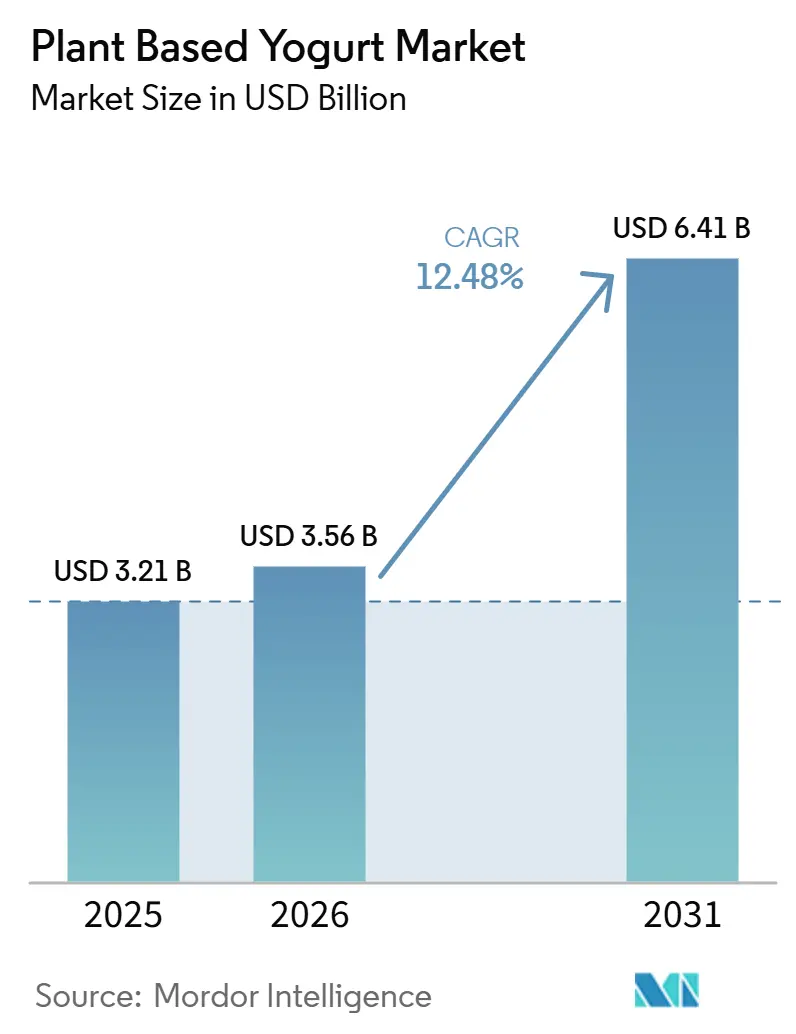
The plant based yogurt market size is expected to grow from USD 3.21 billion in 2025 to USD 3.56 billion in 2026 and is forecast to reach USD 6.41 billion by 2031 at 12.48% CAGR over 2026-2031. Growth reflects a lasting shift from simple lactose avoidance toward nutrition, convenience, and products that fit plant-forward diets. High-protein, probiotic, and functional claims are becoming more important as shoppers compare plant-based products with dairy yogurt. The plant based yogurt market is also supported by environmental concerns and rising interest in flexible eating patterns, which widen its appeal beyond vegan consumers and make repeat purchases possible across several everyday meal and snack occasions. Brands are responding with better formulations, clearer ingredient information, and pack sizes suited to both home and on-the-go use. Price gaps, uneven sensory performance, and limited awareness in developing retail markets remain important constraints for the plant based yogurt market.
Key Report Takeaways
- By source, almond-based yogurt held 28.41% of plant based yogurt market share in 2025, while oat-based yogurt is forecast to expand at a 14.15% CAGR through 2031.
- By product type, spoonable yogurt accounted for 72.76% of the plant based yogurt market size in 2025, while drinkable yogurt is projected to grow at a 14.56% CAGR through 2031.
- By packaging, cups and tubs held 79.25% of plant based yogurt market share in 2025, while bottles are forecast to grow at a 13.87% CAGR through 2031.
- By distribution channel, supermarkets/hypermarkets accounted for 44.69% of the plant based yogurt market size in 2025, while online retail channels are projected to expand at a 14.08% CAGR through 2031.
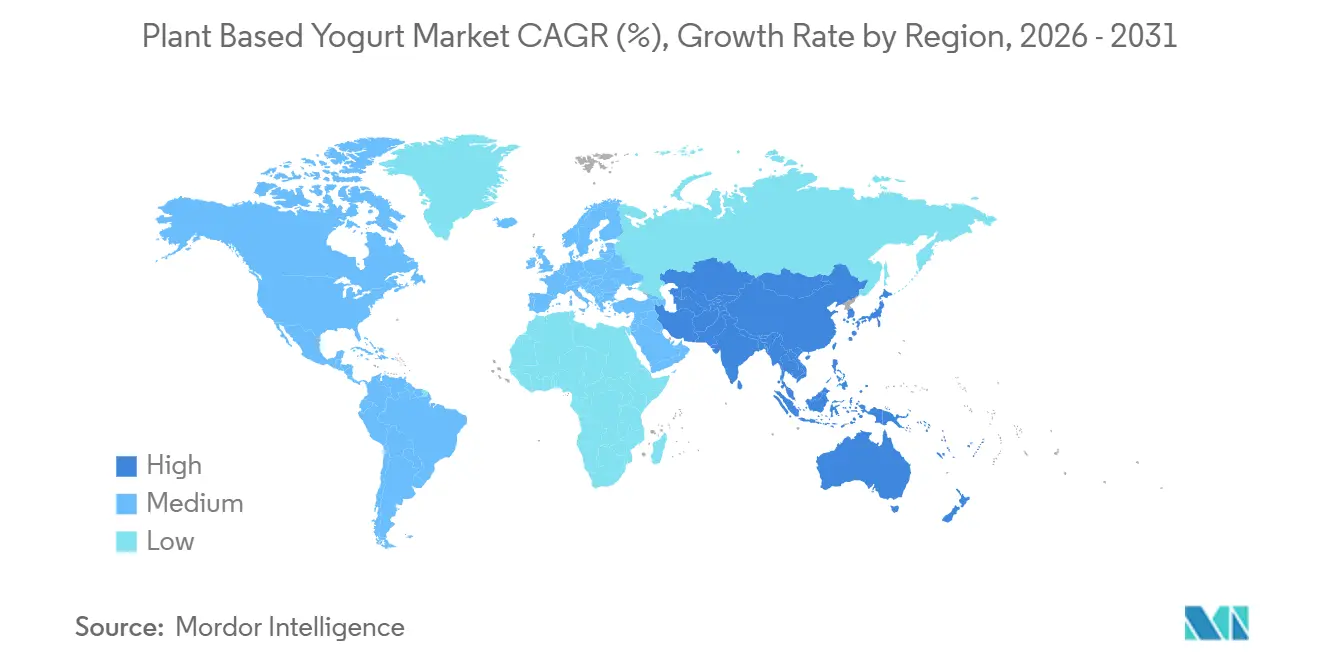
- By geography, Europe accounted for 36.51% regional share in 2025, while Asia-Pacific is projected to grow at a 13.78% CAGR through 2031.
Note: Market size and forecast figures in this report are generated using Mordor Intelligence’s proprietary estimation framework, updated with the latest available data and insights as of January 2026.
Market Trends and Insights
Drivers Impact Analysis of Plant Based Yogurt Market*
| Driver | (~) % Impact on CAGR Forecast | Geographic Relevance | Impact Timeline |
|---|---|---|---|
| Rising Demand for Plant-Based and Vegan Foods | +2.5% | Global, strongest in Europe and North America | Medium term (2-4 years) |
| Growing Lactose Intolerance and Dairy Allergy Concerns | +2.0% | Global, highest in Asia-Pacific and Europe | Long term (≥ 4 years) |
| Increasing Health and Wellness Consciousness | +1.5% | Global, with early gains in North America | Medium term (2-4 years) |
| Expansion of Vegan and Flexitarian Consumer Base | +1.2% | Europe and North America, expanding to Asia-Pacific | Medium term (2-4 years) |
| Growing Innovation in Plant-Based Yogurt Formulations | +1.4% | Global, accelerating in North America and Europe | Short term (≤ 2 years) |
| Premiumization of Plant-Based Dairy Alternatives | +1.2% | North America and Europe core, expanding to Asia-Pacific | Medium term (2-4 years) |
| Source: Mordor Intelligence | |||
Rising Demand for Plant-Based and Vegan Foods
Plant-based eating is becoming a routine food choice for a broader consumer base, expanding the addressable audience for the plant-based yogurt market. The OECD and FAO identify health concerns, environmental awareness, and shifting views on animal agriculture as key factors supporting plant-based dairy replacements in North America, Europe, and East Asia. Many shoppers are not fully vegan, but they still seek plant-based foods that match dairy products in taste and texture. This consumer group can support premium products when brands deliver a familiar experience and a clear nutrition proposition, and it is often less price-sensitive than consumers who purchase only the lowest-priced dairy alternatives. New product activity in plant-based yogurt and related snacks shows that companies continue to test formats rather than treat the category as mature, giving mid-market brands a practical route into established retail accounts. Therefore, the plant-based yogurt market has room for brands that serve both committed plant-based consumers and occasional buyers without excluding either group.
Growing Lactose Intolerance and Dairy Allergy Concerns
Lactose intolerance provides a consistent reason for consumers to choose non-dairy yogurt, even as broader diet trends change. According to the U.S. National Institute of Diabetes and Digestive and Kidney Diseases (NIDDK), approximately 68% of the global population has lactose malabsorption in 2025[1]. This condition creates a large potential consumer base for the plant-based yogurt market, particularly in regions where dairy remains a regular part of breakfast and snacking. Consumer awareness varies significantly across regions, and many consumers in Southeast Asia and Sub-Saharan Africa may not associate their symptoms with lactose intolerance or know which alternatives are available. Wider modern grocery coverage in second- and third-tier cities can convert this unmet need into regular purchases when products are affordable and easy to understand. Allergen declarations for soy, almond, oat, and coconut also remain important, as clear labeling helps shoppers make more confident choices.
Increasing Health and Wellness Consciousness
Growing health and wellness consciousness is encouraging consumers to choose food products that align with balanced and preventive dietary habits, supporting demand for plant-based yogurt. Consumers are increasingly seeking products with clean-label ingredients, lower saturated fat, and naturally derived formulations as part of healthier lifestyles. Plant-based yogurt is also gaining popularity among individuals looking for lactose-free and dairy-free alternatives without compromising convenience. Manufacturers are responding by introducing products fortified with probiotics, calcium, vitamins, and plant-based protein to enhance nutritional value. The rising focus on gut health, digestive wellness, and overall nutrition is further strengthening consumer interest in fermented plant-based products.
Expansion of Vegan and Flexitarian Consumer Base
The expansion of vegan and flexitarian consumer groups is increasing demand for plant-based yogurt as more consumers reduce their consumption of animal-derived foods and incorporate plant-based alternatives into their diets. According to ProVeg International, in 2025, 40% of consumers in Germany and the UK intended to eat more plant-based foods, highlighting the growing preference for plant-based diets[2]. This shift is encouraging consumers to explore dairy alternatives, including yogurt products made from soy, almond, coconut, oat, and other plant-based sources. Flexitarian consumers are particularly contributing to market growth by alternating between conventional dairy products and plant-based alternatives. The expanding vegan population is also supporting demand for dairy-free products across retail and foodservice channels.
Restraints Impact Analysis of Plant Based Yogurt Market*
| Restraint | (~) % Impact on CAGR Forecast | Geographic Relevance | Impact Timeline |
|---|---|---|---|
| Higher Prices Compared with Conventional Yogurt | -1.5% | Global, most acute in emerging markets | Long term (≥ 4 years) |
| Taste and Texture Challenges | -1.0% | Global | Medium term (2-4 years) |
| Limited Consumer Awareness in Emerging Markets | -0.8% | Middle East and Africa, South America, and Asia-Pacific emerging markets | Long term (≥ 4 years) |
| High Cost of Plant-Based Ingredients | -0.9% | Global | Medium term (2-4 years) |
| Source: Mordor Intelligence | |||
Higher Prices Compared with Conventional Yogurt
Price parity with dairy yogurt remains difficult in the plant based yogurt market because plant ingredients, processing, marketing, and distribution can raise costs. In mature markets, brands also spend heavily on formulation upgrades and retail promotion to stand out in a crowded refrigerated aisle. The challenge is sharper in developing markets, where cold-chain coverage is less complete and local production scale remains limited. A 25% to 35% premium can be sustainable in premium European urban retail but can limit adoption in Brazilian and Indonesian mass-market channels. The shortage of private-label plant-based yogurt in many emerging markets means early entrants must fund consumer education without lower-cost alternatives broadening the category. Ingredient cost reductions in almond, oat, and pea supply chains would help, but the pricing issue is likely to remain structural over the forecast period because early entrants also bear the cost of category education.
Taste and Texture Challenges
Taste and texture remain a barrier when plant bases deliver off-flavors, a thin texture, or excessive gumminess. Oat and soy can require different fermentation approaches, while low-fat bases can create a watery result if the formulation is not carefully managed. The 2026 research on fermented plant-based alternatives supports the importance of process control because changes in starch, fiber, and protein affect the final sensory result. Smaller producers may find this work difficult because base-specific fermentation needs more research funding and longer development cycles. Limited awareness in emerging markets compounds the problem, since first-time buyers may not receive enough guidance on flavor, use occasions, or nutritional value. High ingredient costs also restrict the use of premium inputs and can make reformulation less affordable, which slows the path to repeat purchases in the plant based yogurt market and leaves smaller companies at a disadvantage.
*Our forecasts treat driver/restraint impacts as directional, not additive. The impact forecasts reflect baseline growth, mix effects, and variable interactions.
Plant Based Yogurt Market Segment Analysis
By Source:
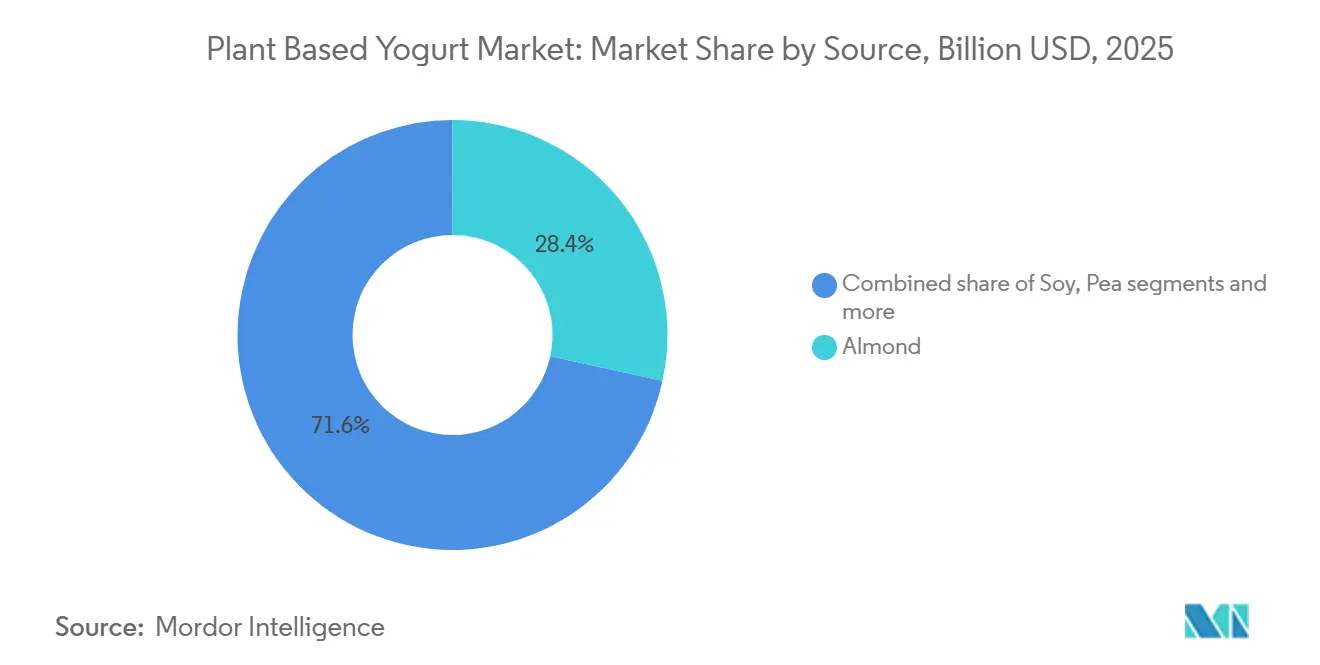
Oat Fermentation Advances Challenge Almond’s Established LeadBy source, almond-based yogurt remained the leading segment of the plant-based yogurt market, accounting for 28.41% of the market share in 2025. Its strong position is supported by widespread consumer familiarity and the established use of almonds in dairy-alternative products. Almond yogurt is available across multiple product formats, including spoonable, drinkable, flavored, and Greek-style variants. Its relatively mild taste and creamy texture also support its appeal among consumers transitioning from conventional dairy yogurt. In addition, the broad availability of almond-based products across supermarkets, specialty stores, and online retail channels strengthens segment penetration.
Oat-based yogurt is projected to be the fastest-growing source segment, expanding at a 14.15% CAGR through 2031. The segment is benefiting from rising consumer interest in plant-based products with a smooth texture and neutral flavor profile. Oat-based formulations are also gaining traction among consumers seeking alternatives to dairy and other nut-based products. Growing investments in product innovation are supporting the development of flavored, fortified, and functional oat-based yogurt products. In addition, the increasing popularity of oat-based beverages and other oat-derived products is improving consumer familiarity with the ingredient.

By Product Type:
Drinkable Formats Redefine the Convenience OpportunitySpoonable yogurt commanded 72.76% of the plant based yogurt market in 2025 because it fits established breakfast, snacking, and cooking occasions. The format also benefits from broad placement in mainstream refrigerated retail. Greek-style plant-based products add a thicker texture and higher protein proposition within this large base. Plain, unsweetened, probiotic-enriched, and high-protein options give shoppers more reasons to use spoonable products throughout the day. This breadth of choices gives the format a durable retail role that emerging product forms will need time to match.
Drinkable yogurt is forecast to grow at a 14.56% CAGR from 2026 to 2031, the strongest product-type outlook in the plant based yogurt industry. Foodservice expansion and on-the-go consumption are making drinkable products more relevant to consumers who want convenience. The format also overlaps with demand for ready-to-drink protein beverages, which increases its appeal beyond traditional yogurt buyers. Manufacturers need different packaging equipment and cold-chain investments to scale drinkable products, creating a clear distinction between committed category participants and small opportunistic entrants.
By Packaging:
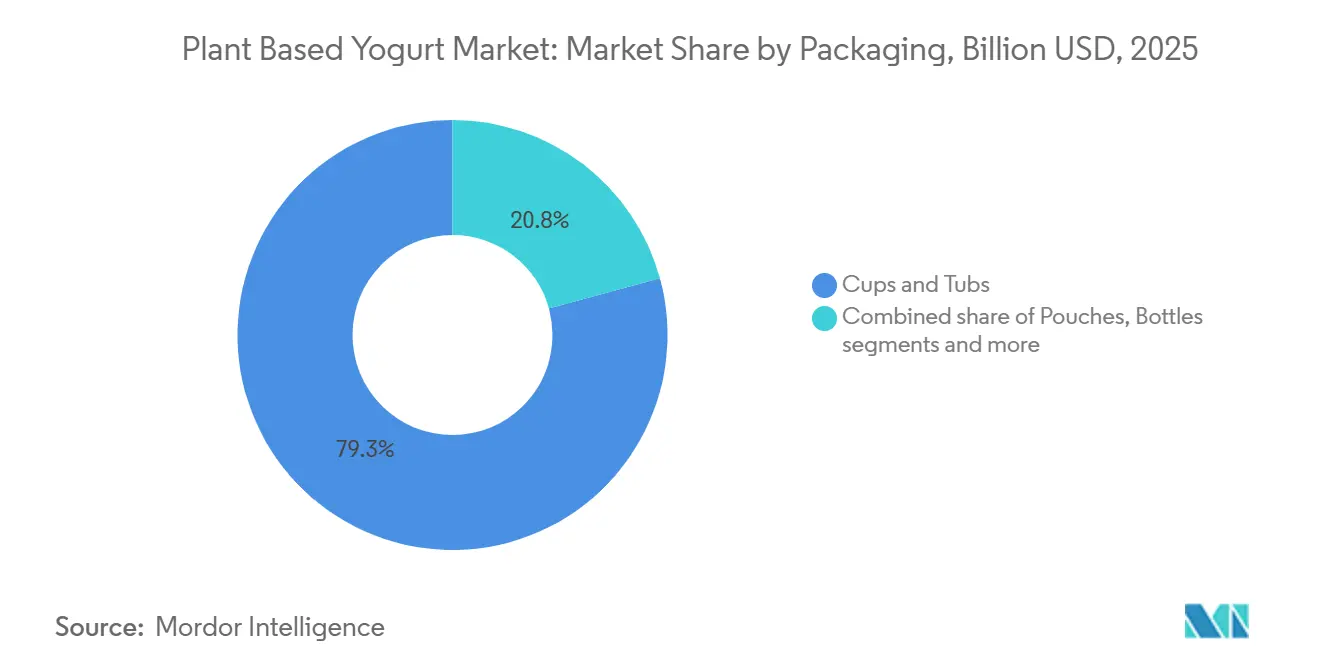
Bottle Growth Tracks the Drinkable Format ShiftCups and tubs represented 79.25% of the plant based yogurt market in 2025 because they are well suited to spoonable consumption. Retail shelves, cold-chain logistics, and manufacturing lines are already designed around these pack types. This established system makes it difficult for other formats to displace cups and tubs without a clear convenience or cost benefit. Pouches remain a smaller option for children’s products and foodservice meal accompaniments, where portion control and lower mess can be useful. Their role is more specialized, so they are unlikely to replace the broad retailer familiarity that cups and tubs have built.
Bottles are forecast to grow at a 13.87% CAGR from 2026 to 2031 as drinkable yogurt gains momentum. Consumers can associate bottles with functional beverages and premium positioning, especially in specialty retail. Danone introduced Silk Protein Yogurt in 5.3oz cups and 24oz tubs at USD 1.99 and USD 6.79, respectively, using pack architecture alongside formulation to support a premium position. Packaging decisions therefore affect price perception, product use, and the ability to serve both individual and family occasions. The plant based yogurt market can use bottles to reach a convenience-focused audience without weakening the established role of cups and tubs. It can also use this format to separate premium functional beverages from basic spoonable offerings on store shelves.
By Distribution Channel:
Supermarkets/Hypermarkets Leads, Online AcceleratesSupermarkets and hypermarkets represented the largest distribution channel in the plant-based yogurt market, accounting for 44.69% of the market size in 2025. Their leading position is supported by extensive product availability and high consumer footfall across major retail outlets. These stores provide consumers with access to a broad range of plant-based yogurt brands, flavors, and product formats in one location. The ability to compare products and prices directly on shelves also supports purchasing decisions. In addition, established cold-chain infrastructure enables supermarkets and hypermarkets to store and distribute refrigerated plant-based yogurt products effectively.
Online retail is projected to be the fastest-growing distribution channel, expanding at a 14.08% CAGR through 2031. The rapid growth of e-commerce is improving access to plant-based yogurt products across a wider geographic area. Online platforms offer consumers greater product variety, including specialized, premium, and niche vegan brands that may have limited physical retail availability. The convenience of home delivery is particularly attractive for consumers seeking regular purchases of refrigerated and plant-based food products. Digital platforms also support product discovery through targeted advertising, customer reviews, subscriptions, and promotional offers.
Geography Analysis
Europe Plant Based Yogurt Market
Europe held the largest regional share of the plant-based yogurt market, accounting for 36.51% in 2025. The region’s leadership is supported by strong consumer awareness of vegan and flexitarian diets, established demand for dairy alternatives, and broad product availability across retail channels. Consumers in major European markets are increasingly seeking sustainable and plant-based food products, supporting the expansion of yogurt alternatives made from oats, almonds, soy, coconut, and other sources. The presence of established food and beverage companies, along with ongoing product innovation, further strengthens the market.
APAC Plant Based Yogurt Market
Asia-Pacific is projected to be the fastest-growing regional market, expanding at a 13.78% CAGR through 2031. Growth is supported by rising urbanization, increasing health awareness, and the expansion of vegan and flexitarian consumer groups. Currently, Asia is home to 54% of the global urban populace, translating to over 2.2 billion individuals. Projections indicate that by 2050, Asia's urban demographic will swell by another 1.2 billion, marking a 50% increase[3]. Growing consumer interest in lactose-free and dairy-alternative products is also supporting demand across countries such as China, Japan, Australia, and India. Manufacturers are increasingly introducing products tailored to local taste preferences and dietary needs.
The Americas and MEA Plant Based Yogurt Market
North America, South America, and the Middle East and Africa are expected to witness steady growth, supported by rising awareness of plant-based diets, increasing product availability, and expanding retail distribution. North America benefits from a mature dairy-alternative market, while South America is supported by growing urban consumer demand. The Middle East and Africa are gradually adopting plant-based yogurt products as health awareness and modern retail penetration increase.
Competitive Landscape
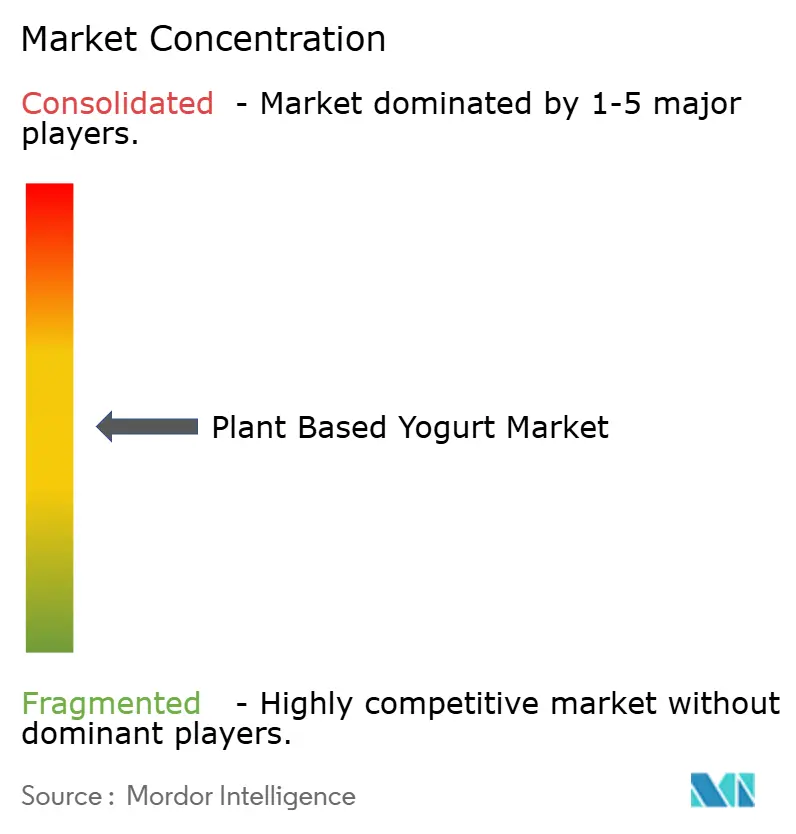
The plant-based yogurt market is fragmented. Large companies leverage distribution scale and established brands, while specialists such as Forager Project, COYO, and The Coconut Collaborative compete through ingredient quality, sustainability positioning, and targeted consumer segments. This structure creates opportunities for new products, but it also makes brand loyalty and retail execution critical, particularly as chilled distribution, shelf placement, and promotional support influence whether shoppers notice specialist brands. The plant-based yogurt market includes a broad range of manufacturers with varying source bases, price positions, and regional priorities. As a result, competition depends on product quality and route to market as much as company scale, with regional product knowledge often giving smaller companies a defensible position in specific niches.
Danone launched Silk Protein Yogurt in July 2026, offering 12 g of complete soy protein per serving and no artificial additives. The launch targets consumers seeking a bridge between high-protein dairy products and functional plant-based foods. Danone is also expected to extend Alpro into high-protein plant-based products in Europe, applying a similar protein-led approach across regions. Oatly is expected to report a 33.9% gross margin in the second quarter of 2026 while closing its Singapore facility and consolidating manufacturing in Europe. These moves indicate that leading participants are combining product claims with supply chain decisions, rather than treating manufacturing efficiency and consumer-facing innovation as separate priorities.
Companies are broadening their portfolios into drinkable formats and protein beverages as the plant-based yogurt market develops. Producers are also investing in fermentation capabilities that can reduce reliance on commodity stabilizers and improve texture. Protein fortification and cleaner labels remain central to premium product strategies. The competitive environment will favor brands that deliver consistent sensory quality, credible nutrition, and broad retail access at a price that supports repeat purchases, as a single disappointing first experience can reduce acceptance among consumers new to dairy alternatives.
Plant Based Yogurt Industry Leaders
-
Danone S.A.
-
Nestlé S.A.
-
Oatly Group AB
-
The Hain Celestial Group, Inc.
-
Chobani Global Holdings, LLC
- *Disclaimer: Major Players sorted in no particular order
Plant Based Yogurt Market Companies Covered in this Report
- Danone S.A.
- Nestlé S.A.
- Oatly Group AB
- General Mills, Inc.
- Chobani Global Holdings, LLC
- The Hain Celestial Group, Inc.
- Daiya Foods Inc.
- Blue Diamond Growers
- Vitasoy International Holdings Limited
- SunOpta Inc.
- Tofutti Brands, Inc.
- Califia Farms, LLC
- Valio Ltd.
- Granarolo S.p.A.
- GT's Living Foods, LLC
- Barambah Organics Pty Ltd
- COYO Pty Ltd
- The Coconut Collaborative Ltd
- Springfield Creamery, Inc.
- Forager Project, LLC
Recent Industry Developments in Plant Based Yogurt Market
- July 2026: Danone’s Silk brand launched Silk Protein Yogurt and Silk Protein Shakes in the United States. The products offered 12 g of complete soy protein per serving of yogurt, twice the category average, and 30 g of protein per ready-to-drink shake. The launch targeted millennial and Gen Z consumers who prioritized functional nutrition. The brand positioned Silk Protein Yogurt as the only plant-based yogurt in the segment that sourced all its protein from a single complete-protein ingredient.
- March 2026: Chobani announced a USD 567 million investment to expand its La Colombe manufacturing facility in Michigan. This investment added to USD 1.7 billion in U.S. plant investments committed in 2025, including USD 500 million in Idaho and USD 1.2 billion in New York. The total capital commitment of USD 2.3 billion across three facilities signaled sustained confidence in demand for high-protein yogurt.
- July 2025: Danone completed the acquisition of a majority stake in Kate Farms, the United States’ leading doctor-recommended plant-based medical nutrition brand, following a definitive agreement signed in May 2025. The acquisition strengthened Danone’s position at the intersection of plant-based nutrition and clinical health management.
Global Plant Based Yogurt Market Report Scope
Plant-based yogurt is a yogurt-like food product made from non-dairy plant sources such as soy, almond, coconut, oat, cashew, and pea. The plant based yogurt market is segmented by source, product type, packaging, distribution channel and geography. Based on source, the market is segmented into soy, almond, coconut, oat, cashew, pea and others. Based on product type, the market is segmented into drinkabale and spoonable yogurt. Based on packaging, the market is segmented into cups and tubs, pouches, bottles and other packaging formats. Based on distribution channel, the market is segmented into supermarkets/hypermarkets, convenience stores, online retail stores and other distribution channels. By geography, the market is segmented into North America, Europe, Asia-Pacific, South America, and Middle-East and Africa. For each segment, the market sizing and forecasting have been done in value terms (USD billion) and volume (tons).
| Soy |
| Almond |
| Coconut |
| Oat |
| Cashew |
| Pea |
| Others |
| Drinakable Yogurt |
| Spoonable Yogurt |
| Cups and Tubs |
| Pouches |
| Bottles |
| Other Packaging Formats |
| Supermarkets/Hypermarkets |
| Convenience Stores |
| Online Retail Stores |
| Other Distribution Channels |
| North America | United States |
| Canada | |
| Mexico | |
| Rest of North America | |
| Europe | Germany |
| United Kingdom | |
| Italy | |
| France | |
| Spain | |
| Netherlands | |
| Rest of Europe | |
| Asia-Pacific | China |
| India | |
| Japan | |
| Australia | |
| Indonesia | |
| Rest of Asia-Pacific | |
| South America | Brazil |
| Argentina | |
| Rest of South America | |
| Middle East and Africa | South Africa |
| Saudi Arabia | |
| United Arab Emirates | |
| Rest of Middle East and Africa |
| By Source | Soy | |
| Almond | ||
| Coconut | ||
| Oat | ||
| Cashew | ||
| Pea | ||
| Others | ||
| By Product Type | Drinakable Yogurt | |
| Spoonable Yogurt | ||
| By Packaging | Cups and Tubs | |
| Pouches | ||
| Bottles | ||
| Other Packaging Formats | ||
| By Distribution Channel | Supermarkets/Hypermarkets | |
| Convenience Stores | ||
| Online Retail Stores | ||
| Other Distribution Channels | ||
| By Geography | North America | United States |
| Canada | ||
| Mexico | ||
| Rest of North America | ||
| Europe | Germany | |
| United Kingdom | ||
| Italy | ||
| France | ||
| Spain | ||
| Netherlands | ||
| Rest of Europe | ||
| Asia-Pacific | China | |
| India | ||
| Japan | ||
| Australia | ||
| Indonesia | ||
| Rest of Asia-Pacific | ||
| South America | Brazil | |
| Argentina | ||
| Rest of South America | ||
| Middle East and Africa | South Africa | |
| Saudi Arabia | ||
| United Arab Emirates | ||
| Rest of Middle East and Africa | ||
Key Questions Answered in the Report
What is driving demand for plant based yogurt?
Lactose intolerance, plant-forward eating, protein demand, and product improvements are supporting demand. The category is projected to grow at a 12.48% CAGR from 2026 to 2031.
Which source is growing fastest in plant based yogurt?
Oat-based yogurt is projected to grow at a 14.15% CAGR through 2031. Improving fermentation and interest in oat fiber support this outlook.
What product type leads plant based yogurt sales?
Spoonable yogurt held 72.76% of sales in 2025. Its established role in breakfast, snacking, and cooking supports its position.
Why are drinkable plant based yogurts gaining popularity?
Drinkable yogurt is forecast to grow at a 14.56% CAGR through 2031 because it fits foodservice and on-the-go occasions.
Which region has the highest demand for plant based yogurt?
Europe held 36.51% of sales in 2025. Mature retail systems and strong interest in plant-based foods support regional demand.