
Plant Based Seafood Market Size and Share
Market Overview
| Study Period | 2021 - 2031 |
|---|---|
| Market Size (2026) | USD 611.36 Million |
| Market Size (2031) | USD 983.65 Million |
| Growth Rate (2026 - 2031) | 9.98 % |
| Fastest Growing Market | Asia-Pacific |
| Largest Market | North America |
| Market Concentration | Low |
Major Players *Disclaimer: Major Players sorted in no particular order Image © Mordor Intelligence. Reuse requires attribution under CC BY 4.0. | |
Plant Based Seafood Market Analysis by Mordor Intelligence
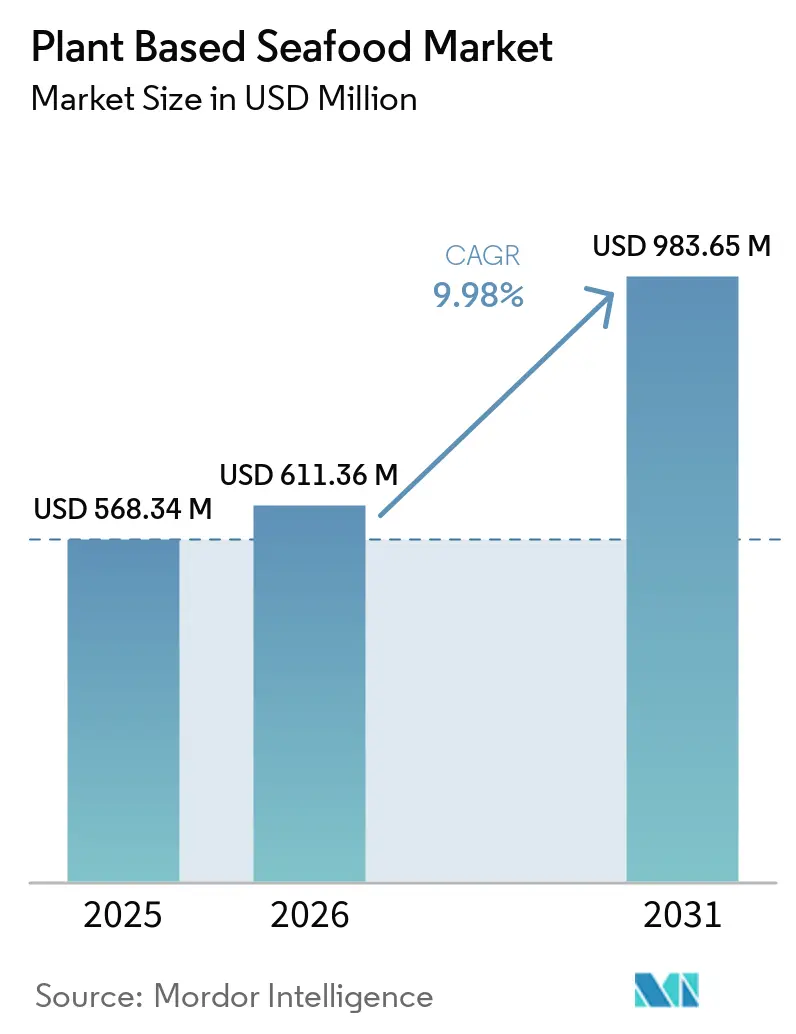
The plant-based seafood market size is expected to grow from USD 568.34 million in 2025 to USD 611.36 million in 2026 and is forecast to reach USD 983.65 million by 2031 at 9.98% CAGR over 2026-2031. The plant-based seafood market is supported by flexitarian eating patterns, pressure on wild fish stocks, and ongoing work to improve texture and flavor. Food and Agriculture Organization (FAO) reported in 2025 that 35.5% of assessed marine fish stocks were overfished, which keeps supply reliability and marine sustainability central to seafood purchasing decisions[1]. Product developers are therefore focusing on familiar formats that can fit existing grocery, restaurant, and institutional purchasing systems. Health positioning also matters because products that can clearly communicate their nutritional profile may reach buyers who do not primarily choose food for environmental reasons. The plant-based seafood market can also gain from procurement standards in dining, health care, and education, where stable specifications and dependable supply can matter as much as consumer marketing.
Key Report Takeaways
- By product type, plant-based fish led with 53.67% of the plant-based seafood market share in 2025, while plant-based shrimp is forecast to grow at a 12.11% CAGR through 2031.
- By source, soy protein held 29.42% of revenue in 2025, while algae and seaweed is forecast to grow at a CAGR of 11.78% through 2031.
- By distribution channel, off-trade held 74.71% of the plant-based seafood market share in 2025, while on-trade is forecast to advance at an 11.24% CAGR through 2031.
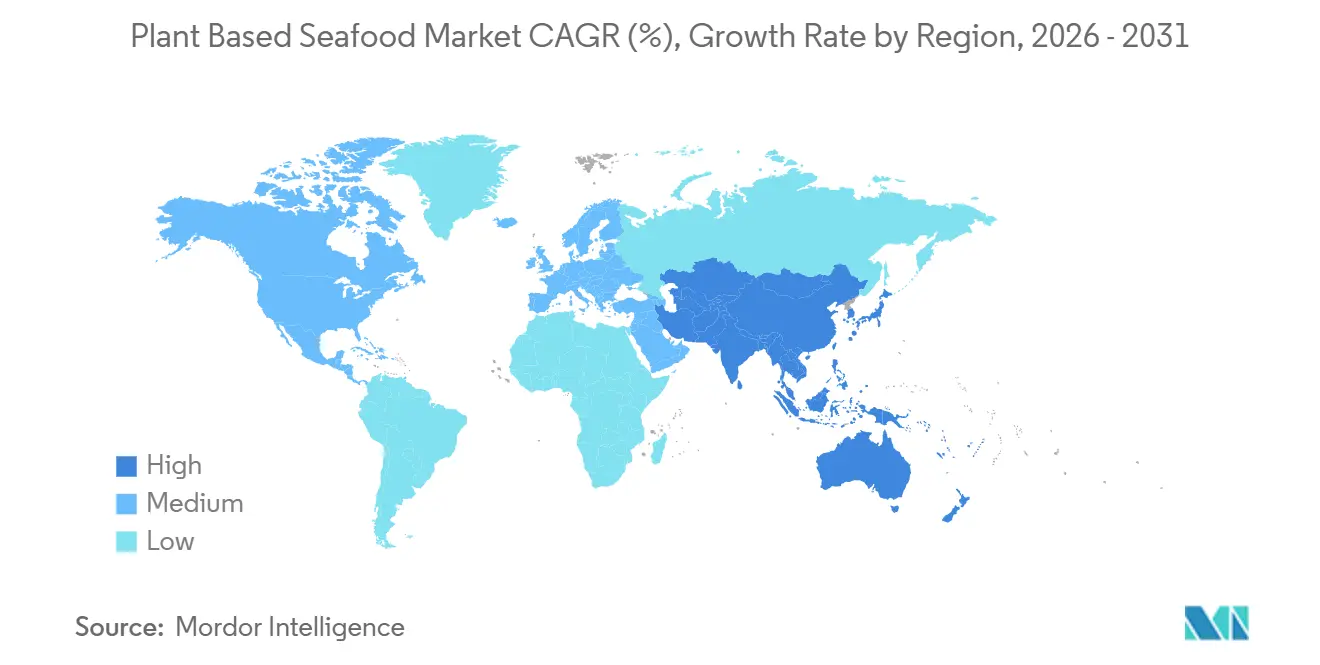
- By geography, North America held 37.51% of revenue in 2025, while Asia-Pacific is forecast to record a 12.45% CAGR through 2031.
Note: Market size and forecast figures in this report are generated using Mordor Intelligence’s proprietary estimation framework, updated with the latest available data and insights as of January 2026.
Market Trends and Insights
Drivers Impact Analysis of Plant Based Seafood Market*
| Driver | (~) % Impact on CAGR Forecast | Geographic Relevance | Impact Timeline |
|---|---|---|---|
| Rising vegan and flexitarian consumer population | +2.8% | Global | Short term (≤ 2 years) |
| Growing concerns over overfishing and marine biodiversity loss | +2.1% | Global | Medium term (2-4 years) |
| Increasing demand for sustainable seafood alternatives | +1.7% | North America and Europe | Short term (≤ 2 years) |
| Health-driven preference for cholesterol-free and low-mercury products | +1.5% | Global | Medium term (2-4 years) |
| Government and institutional support for sustainable food systems | +1.2% | Asia-Pacific, North America, and Europe | Long term (≥ 4 years) |
| Rising awareness of seafood contamination and food safety risks | +0.9% | Global | Medium term (2-4 years) |
| Source: Mordor Intelligence | |||
Rising Vegan and Flexitarian Consumer Population
The plant-based seafood market is benefiting from the growing number of vegan and flexitarian consumers who are increasingly choosing plant-based alternatives for health, sustainability, and ethical reasons. Flexitarian eating habits are expanding demand for products such as plant-based fish, shrimp, tuna, and shellfish alternatives across retail and foodservice channels. In 2025, approximately 25.8 million people worldwide chose to try a vegan diet during Veganuary, highlighting continued growth in vegan and flexitarian adoption of plant-based foods[2]. This expanding consumer base is encouraging manufacturers to increase product innovation and distribution of plant-based seafood products. Health-focused communication can also be more relevant than animal welfare messaging for consumers managing diet-related concerns. In the plant-based seafood market, repeat demand is likely to depend on clear nutrition, reliable preparation, and a flavor profile that does not require consumers to change their normal meal routines.
Growing Concerns over Overfishing and Marine Biodiversity Loss
Increasing awareness of overfishing and marine biodiversity loss is encouraging consumers to choose plant-based seafood as a more sustainable alternative to conventional seafood products. Declining wild fish stocks, habitat degradation, and pressure on marine ecosystems are strengthening demand for alternative protein sources that reduce dependence on wild-caught species. Governments, environmental organizations, and food companies are also promoting responsible seafood consumption and sustainable sourcing practices. Plant-based seafood supports ocean conservation goals while providing products that closely replicate the taste and texture of traditional seafood. This shift is driving greater investment, product innovation, and retail expansion across the plant-based seafood industry.
Health-driven Preference for Cholesterol-free and Low-mercury Products
Health-conscious consumers are increasingly choosing plant-based seafood because it offers cholesterol-free and low-mercury alternatives to conventional seafood products. Concerns about mercury accumulation in certain fish species and the long-term effects of excessive seafood consumption are influencing purchasing decisions across many markets. Plant-based seafood products are often positioned as cleaner-label options with lower saturated fat and fewer contaminants associated with marine pollution. These products appeal to consumers seeking heart-friendly, preventive-health, and wellness-oriented diets. The trend is encouraging food manufacturers to develop nutritionally enhanced seafood alternatives and expand plant-based seafood offerings across retail and foodservice channels.
Government and Institutional Support for Sustainable Food Systems
The European Commission has identified algae as an alternative source of food and feed protein and has supported work on algae cultivation and use in food systems. The Commission also noted in 2026 that legume protein production in the European Union reached 1.3 million tonnes in 2025 and 2026, reflecting increased attention to alternative protein inputs[3]. These policy signals can strengthen the supply base for ingredients used in seafood alternatives. Institutional buyers can provide dependable volume when products meet nutrition, price, packaging, and preparation requirements. School, hospital, corporate dining, and university kitchens also require products that can work across large batches without inconsistent results. This support gives the plant-based seafood market a route to scale that is less dependent on short retail promotions, while placing more emphasis on consistent quality, purchasing specifications, documented ingredients, product availability, and foodservice preparation requirements.
Restraints Impact Analysis of Plant Based Seafood Market*
| Restraint | (~) % Impact on CAGR Forecast | Geographic Relevance | Impact Timeline |
|---|---|---|---|
| High product prices compared with conventional seafood | -3.5% | Global | Short term (≤ 2 years) |
| Taste and texture gap versus real seafood | -2.8% | Global | Medium term (2-4 years) |
| Restricted product variety across seafood categories | -1.2% | Asia-Pacific, Middle East and Africa | Long term (≥ 4 years) |
| Limited consumer awareness in emerging markets | -0.9% | Asia-Pacific, Middle East and Africa, and South America | Long term (≥ 4 years) |
| Source: Mordor Intelligence | |||
High Product Prices Compared with Conventional Seafood
Price remains a major barrier because commodity shrimp, whitefish, and canned tuna can be affordable protein options in many markets. A 2026 article in Nature Food identified price parity as a central threshold for alternative protein commercialization. Food-grade protein isolates, high-moisture extrusion, specialty flavor inputs, and smaller production volumes can keep unit costs high. A product may gain trial purchases if its claims are appealing, but repeat demand can weaken when the price gap remains clear and sensory performance is uncertain. This challenge is especially important in the plant-based seafood market because shoppers can easily return to conventional seafood when promotions end. Producers need manufacturing methods that reduce cost without weakening texture, nutrition, or shelf stability, since a lower-price product may still fail if it separates during cooking, lacks expected flavor, or cannot move through normal retail and foodservice distribution systems.
Taste and Texture Gap Versus Real Seafood
Seafood alternatives face a difficult sensory task because fish, shrimp, calamari, crab, and salmon have distinct textures and moisture behavior. A 2025 American Chemical Society (ACS) study found that the texture of a calamari alternative depended on precise changes in gellan gum, oil, and microalgae content. The study illustrates why formulations that work for a fish fillet may not work for a shrimp or shellfish product. A 2026 Nature Food article also described the challenge of maintaining performance as alternative protein products move from pilot work to commercial production. Inconsistent cooking results can reduce trust among flexitarian buyers who have readily available conventional options. For the plant-based seafood market, better texture, aroma, and cooking consistency are necessary to turn one-time curiosity into stable demand, particularly when consumers compare the experience directly with conventional seafood that they already know how to choose, prepare, and serve.
*Our forecasts treat driver/restraint impacts as directional, not additive. The impact forecasts reflect baseline growth, mix effects, and variable interactions.
Plant Based Seafood Market Segment Analysis
By Product Type:
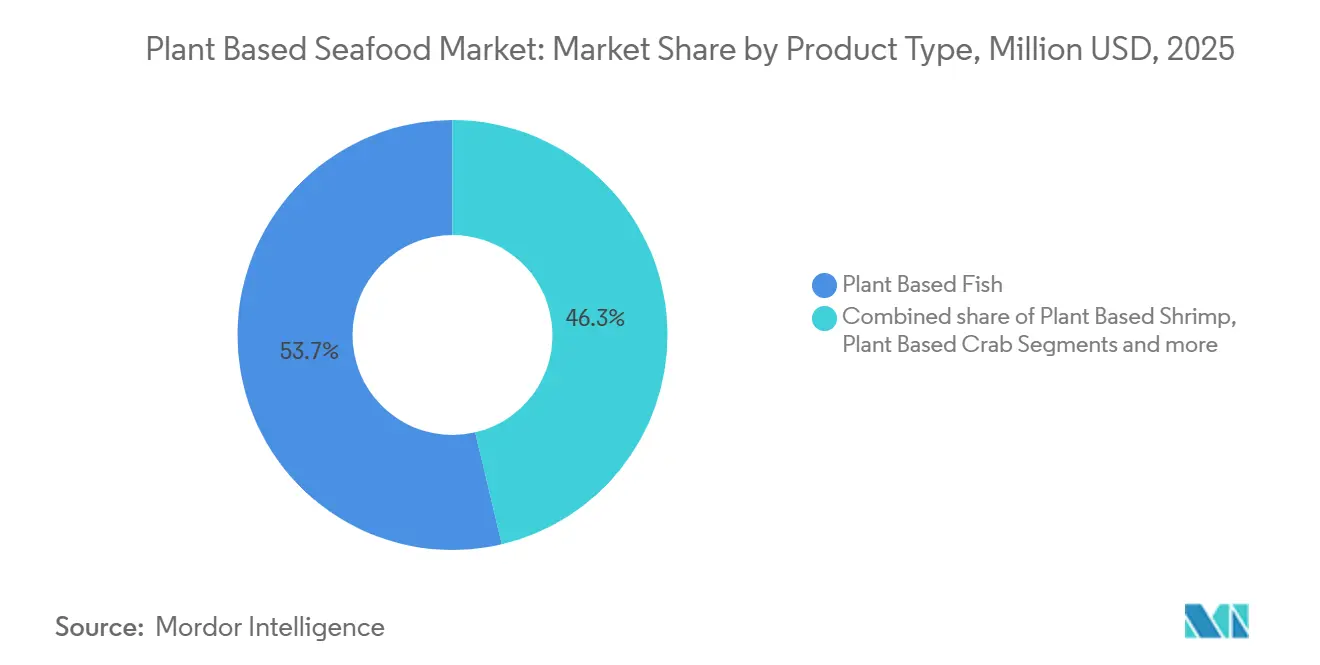
Plant-Based Fish Leads, While Shrimp Expands the Addressable MenuPlant-based fish held 53.67% of the plant-based seafood market share in 2025, supported by familiar items such as breaded fillets, fish sticks, and burgers. These formats fit established frozen-food distribution systems and require little change in how shoppers or kitchen staff prepare meals. Plant-based shrimp is the fastest-growing product type at a 12.11% CAGR through 2031, supported by its use in bowls, pasta, appetizers, stir-fries, and catering. Plant-based tuna can appeal to consumers who want to limit high-mercury fish choices, while crab and salmon alternatives can target premium retail and restaurant occasions. The plant-based seafood market benefits when each format solves a defined recipe need rather than simply copying a broad seafood category, because shoppers and kitchen operators often decide between products based on the dish they intend to prepare, not on the protein source alone.
Plant-based salmon needs a flaky structure, visible layers, cooking tolerance, and a balanced fat profile for credible use in everyday recipes. Microalgae-based oils can help developers add docosahexaenoic acid (DHA) and eicosapentaenoic acid (EPA), nutrients commonly associated with seafood, while reducing reliance on fish-derived inputs. Plant-based crab and scallop products suit specialty retail and chef-led menus where texture, appearance, and serving format all matter. Calamari and other seafood alternatives remain smaller categories, but published research is widening the technical options for structured products. Food and Drug Administration (FDA) draft guidance issued in January 2025 helps clarify labeling expectations for plant-based alternatives to animal-derived foods, reducing uncertainty for brands entering new product categories.

By Source:
Soy Supports Scale, While Algae and Seaweed Add Functional ValueSoy protein held 29.42% of revenue in 2025 because it has a mature supply base, strong protein content, and established use in extrusion. Its availability supports larger production runs and helps maintain cost control for products sold through grocery channels. Pea protein offers a neutral flavor and can serve consumers seeking soy-free formulations, while wheat protein can provide useful fibers in appropriate products. Algae and seaweed are projected to grow at an 11.78% CAGR through 2031 because they can contribute marine-associated flavor, color, and fatty-acid components. The plant-based seafood market requires several source options because price, labeling, functionality, and consumer preferences vary across products and regions.
The European Commission stated in 2024 that more than 20 algae species could be sold as food or food supplements in the European Union. This wider regulatory pathway can support ingredient development and reduce uncertainty for product teams considering algae-based formulations. Algae ingredients may help manufacturers develop nutrition narratives around microalgae-derived docosahexaenoic acid (DHA) and eicosapentaenoic acid (EPA), subject to applicable rules on claims. Soy-based products can add those nutrients through separate oil inputs, while algae-based formats can keep the relevant ingredient closer to the product concept. The plant-based seafood industry can use both platforms because they serve different price points, texture needs, nutrition goals, and food preferences, allowing brands to select ingredients according to whether the product is intended for mainstream grocery, premium retail, restaurant menus, or institutional purchasing.
By Distribution Channel:
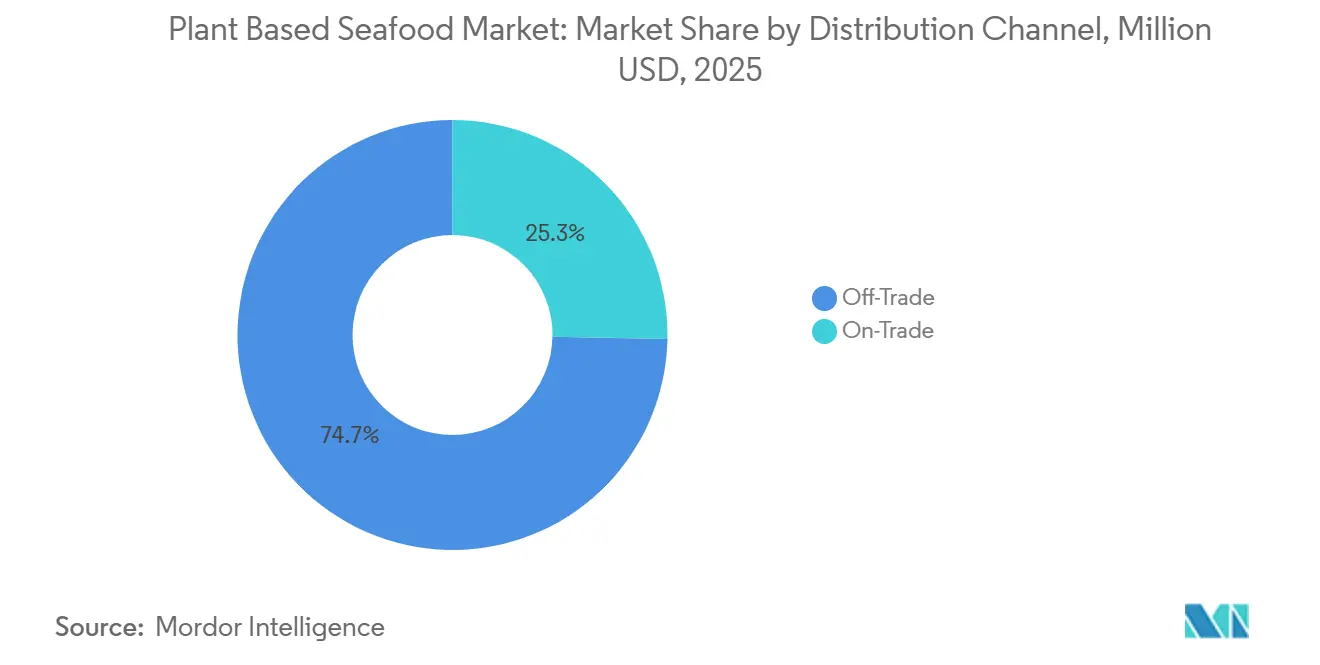
Off-Trade Provides Scale, While On-Trade Builds Menu ExposureOff-trade represented 74.71% of revenue in 2025, making supermarkets, hypermarkets, convenience stores, and online retail the main sales route. Frozen formats suit these channels because they use existing cold-chain systems and allow consumers to keep products at home for later use. Retail provides space for ingredient, nutrition, preparation, and storage information that can support a confident first purchase. Online sales can help smaller brands reach a national customer base before they secure broad shelf placement. The plant-based seafood market still depends primarily on household purchasing behavior, despite expanding interest from foodservice buyers, so packaging clarity, freezer placement, product familiarity, preparation instructions, and a convincing everyday value proposition remain important for retail performance.
On-trade is expected to grow at an 11.24% CAGR through 2031 as restaurants, hotels, caterers, and institutions test more seafood-free menu options. This channel can support a higher unit price when a product is included in a chef-designed dish or a sustainability-focused menu. It can also allow consumers to try a product before buying it for home preparation, which lowers perceived purchase risk. Kitchen operators need stable supply, predictable yield, clear cooking instructions, and formats that work across several recipes and preparation methods. The plant-based seafood market size for on-trade use will depend on operator-grade products rather than retail products simply repackaged for foodservice.
Geography Analysis
North America Plant Based Seafood Market
North America accounted for 37.51% of revenue in 2025, making it the largest regional contributor to the plant-based seafood market. The region has established alternative-protein retail distribution, cold-chain capacity, and a broad base of grocery and foodservice buyers familiar with plant-based foods. These factors give companies more established pathways to test new products, assess repeat purchase behavior, refine packaging, and identify the seafood formats best suited for each channel. The United States provides a large market for product trials through supermarkets, specialty stores, restaurants, and institutional menus.
Europe Plant Based Seafood Market
Europe is an important production and ingredient base, as several countries support protein processing, extrusion equipment, fermentation capacity, and algae development. The European Commission’s work on alternative proteins and algae gives the region a policy basis for new ingredient and product development. This work may help companies assess ingredient availability, food-use pathways, environmental requirements, and the practical conditions needed to move from small-scale formulation to broader commercial production. Food rules across the European Union (EU) require reviews of novel foods, naming, and ingredient status, but clearer pathways can favor companies that prepare early. Established grocery systems, foodservice activity, and demand for familiar fish alternatives give the plant-based seafood market a practical route to regional expansion.
APAC and MEA Plant Based Seafood Market
Asia-Pacific is expected to be the fastest-growing region, registering a 12.45% CAGR through 2031. The region’s high seafood consumption means even limited adoption of alternatives can generate meaningful product volumes. Japan supports ready-to-eat applications, including convenience-store meals, while China offers a large foodservice market for branded menu partnerships. Algae and seaweed are familiar food ingredients in several regional cuisines, which can make some formulations easier to explain to consumers. India’s labeling requirements emphasize standardized formulations and transparent claims. Meanwhile, the Middle East and Africa remain early-stage markets, where modern retail, urban dining, localized recipes, suitable price points, and consumer education will be critical before the category can establish stable distribution and scale widely.
Competitive Landscape
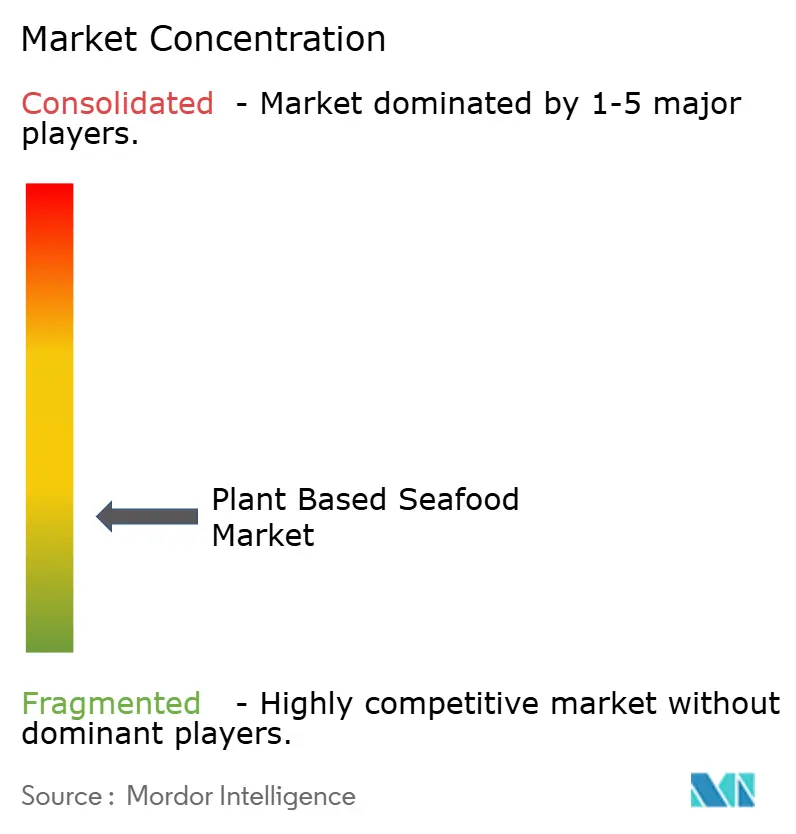
The plant-based seafood market remains fragmented, with no single company able to set category pricing. Competition includes seafood-alternative brands, ingredient suppliers, and technology developers across the value chain. Some companies focus on specific alternatives, such as tuna, shrimp, scallop, salmon, or crab, while others develop platforms for multiple seafood formats. This structure creates opportunities for specialists but can constrain smaller companies as they manage funding, ingredient procurement, production capacity, and distribution. Product quality, supply reliability, and distribution access therefore matter more than broad brand recognition.
Technology remains a key differentiator because seafood products require specific textures, aromas, colors, moisture levels, and cooking behavior. Whole-cut formats need more structure than breaded or minced formats, raising the technical barrier for new entrants. Research on microalgae and mung bean systems shows the formulation control needed to optimize texture for seafood analogues. Food and Drug Administration’s March 2025 no-questions letter for a soy leghemoglobin preparation provides an example of regulatory progress for ingredient systems used in plant-based fish alternatives. Food and Drug Administration’s January 2025 draft labeling guidance provides a clearer basis for communicating the plant-based nature of products, giving developers a clearer reference point for package language and product naming.
The strongest opportunities remain in products that do not yet fully meet consumer or professional kitchen needs. Premium salmon fillets, formed shrimp, crab products, and foodservice-ready formats need better texture and preparation performance. Companies that reduce manufacturing costs while maintaining quality can address the category’s main commercial constraint. The market can also benefit from algae-based ingredients that support substantiated nutrition and sustainability claims, provided they deliver a reliable eating experience and meet channel cost and preparation requirements. Companies will build stronger positions through clear product focus, dependable supply, and channel-specific execution across packaging, order quantities, storage, cooking parameters, menu applications, and buyer support.
Plant Based Seafood Industry Leaders
-
Gathered Foods Corporation (Good Catch)
-
Ocean Hugger Foods, Inc.
-
New Wave Foods, Inc.
-
Sophie's Kitchen, Inc.
-
The Plant Based Seafood Co.
- *Disclaimer: Major Players sorted in no particular order
Plant Based Seafood Market Companies Covered in this Report
- Gathered Foods Corporation (Good Catch)
- Ocean Hugger Foods, Inc.
- New Wave Foods, Inc.
- Sophie's Kitchen, Inc.
- The Plant Based Seafood Co.
- Current Foods, Inc.
- Hooked Foods AB
- Kuleana, Inc.
- Atlantic Natural Foods, LLC
- Beyond Meat, Inc.
- Impossible Foods Inc.
- Turtle Island Foods SPC
- Conagra Brands, Inc. (Gardein)
- Kellanova (MorningStar Farms)
- OmniFoods (Green Monday Holdings)
- Prime Roots
- Tofuna Fysh, Inc.
- SoFine Foods B.V.
- Bonsan GmbH
- Daiya Foods Inc.
Recent Industry Developments in Plant Based Seafood Market
- May 2026: Oshi, a U.S.-based plant-based seafood startup, secured a USD 3 million strategic investment and launched a whole-cut plant-based Whitefish fillet as part of its national expansion strategy. The product was developed using proprietary technology to replicate the delicate, flaky texture and sensory profile of conventional whitefish after several years of research and development.
- November 2024: Mind Blown Plant Based Seafood Co. launched Crispy, Crunchy, Fried Shrimp, a limited-time ready-to-heat-and-eat plant-based shrimp product designed to closely replicate the taste and texture of traditional fried shrimp. The product is made with konjac, a plant-derived ingredient increasingly used in seafood analogues for its shrimp-like texture, and was introduced through direct-to-consumer and foodservice channels.
- January 2025: The US FDA released draft guidance for the industry on labeling plant-based alternatives to animal-derived foods, including seafood, meat, eggs, and poultry products under FDA jurisdiction. The guidance outlines recommendations to help manufacturers clearly identify plant-based products and ensure labels provide consumers with accurate, transparent information about the nature and composition of these alternatives.
Global Plant Based Seafood Market Report Scope
Plant based seafood refers to seafood alternatives made primarily from plant-derived ingredients that are formulated to replicate the taste, texture, appearance, and nutritional characteristics of conventional seafood such as fish, shrimp, crab, tuna, salmon, and calamari. The plant-based seafood market is segmented into product type, source, distribution channel and geography. Based on product type, the market is segmented into plant-based fish, shrimp, crab, tuna, salmon, and other product types. Based on source, the market is segmented into soy protein, pea protein, wheat protein, algae & seaweed, and others. Based on the distribution channel, the market is segmented into off-trade and on-trade. By geography, the market is segmented into North America, Europe, Asia-Pacific, South America, and Middle East and Africa. The market forecasts are provided in terms of value (USD).
Segmentation Overview
| Plant-Based Fish |
| Plant-Based Shrimp |
| Plant-Based Crab |
| Plant-Based Tuna |
| Plant-Based Salmon |
| Other Product Types |
| Soy Protein |
| Pea Protein |
| Wheat Protein |
| Algae & Seaweed |
| Others |
| Off-Trade | Supermarkets/Hypermarkets |
| Convenience Stores | |
| Online Retail Stores | |
| Other Distribution Channels | |
| On-Trade |
| North America | United States |
| Canada | |
| Mexico | |
| Rest of North America | |
| Europe | Germany |
| United Kingdom | |
| Italy | |
| France | |
| Spain | |
| Netherlands | |
| Rest of Europe | |
| Asia-Pacific | China |
| India | |
| Japan | |
| Australia | |
| Indonesia | |
| Rest of Asia-Pacific | |
| South America | Brazil |
| Argentina | |
| Rest of South America | |
| Middle East and Africa | South Africa |
| Saudi Arabia | |
| United Arab Emirates | |
| Rest of Middle East and Africa |
| By Product Type | Plant-Based Fish | |
| Plant-Based Shrimp | ||
| Plant-Based Crab | ||
| Plant-Based Tuna | ||
| Plant-Based Salmon | ||
| Other Product Types | ||
| By Source | Soy Protein | |
| Pea Protein | ||
| Wheat Protein | ||
| Algae & Seaweed | ||
| Others | ||
| By Distribution Channel | Off-Trade | Supermarkets/Hypermarkets |
| Convenience Stores | ||
| Online Retail Stores | ||
| Other Distribution Channels | ||
| On-Trade | ||
| By Geography | North America | United States |
| Canada | ||
| Mexico | ||
| Rest of North America | ||
| Europe | Germany | |
| United Kingdom | ||
| Italy | ||
| France | ||
| Spain | ||
| Netherlands | ||
| Rest of Europe | ||
| Asia-Pacific | China | |
| India | ||
| Japan | ||
| Australia | ||
| Indonesia | ||
| Rest of Asia-Pacific | ||
| South America | Brazil | |
| Argentina | ||
| Rest of South America | ||
| Middle East and Africa | South Africa | |
| Saudi Arabia | ||
| United Arab Emirates | ||
| Rest of Middle East and Africa | ||
Key Questions Answered in the Report
What is driving growth in plant-based seafood?
The category is forecast to grow at a 9.98% CAGR from 2026 to 2031.
How large is the plant-based seafood category?
It is estimated at USD 611.36 million in 2026 and is forecast to reach USD 983.65 million by 2031.
Which plant-based seafood product leads sales?
Plant-based fish led product revenue with 53.67% in 2025, helped by familiar formats such as fillets, fish sticks, and burgers.
Which ingredient source is growing fastest for seafood alternatives?
Algae and seaweed are forecast to grow at an 11.78% CAGR through 2031 because they can support texture, color, flavor, and nutrition design.
Why are prices still high for plant-based seafood products?
Specialty ingredients, extrusion equipment, flavor inputs, and limited production scale can keep costs above conventional seafood.