
Pink Hydrogen Market Size and Share
Market Overview
| Study Period | 2021 - 2031 |
|---|---|
| Market Size (2026) | USD 31.61 Billion |
| Market Size (2031) | USD 88.35 Billion |
| Growth Rate (2026 - 2031) | 22.82 % |
| Fastest Growing Market | Asia-Pacific |
| Largest Market | Europe |
| Market Concentration | Low |
Major Players *Disclaimer: Major Players sorted in no particular order Image © Mordor Intelligence. Reuse requires attribution under CC BY 4.0. | |
Pink Hydrogen Market Analysis by Mordor Intelligence
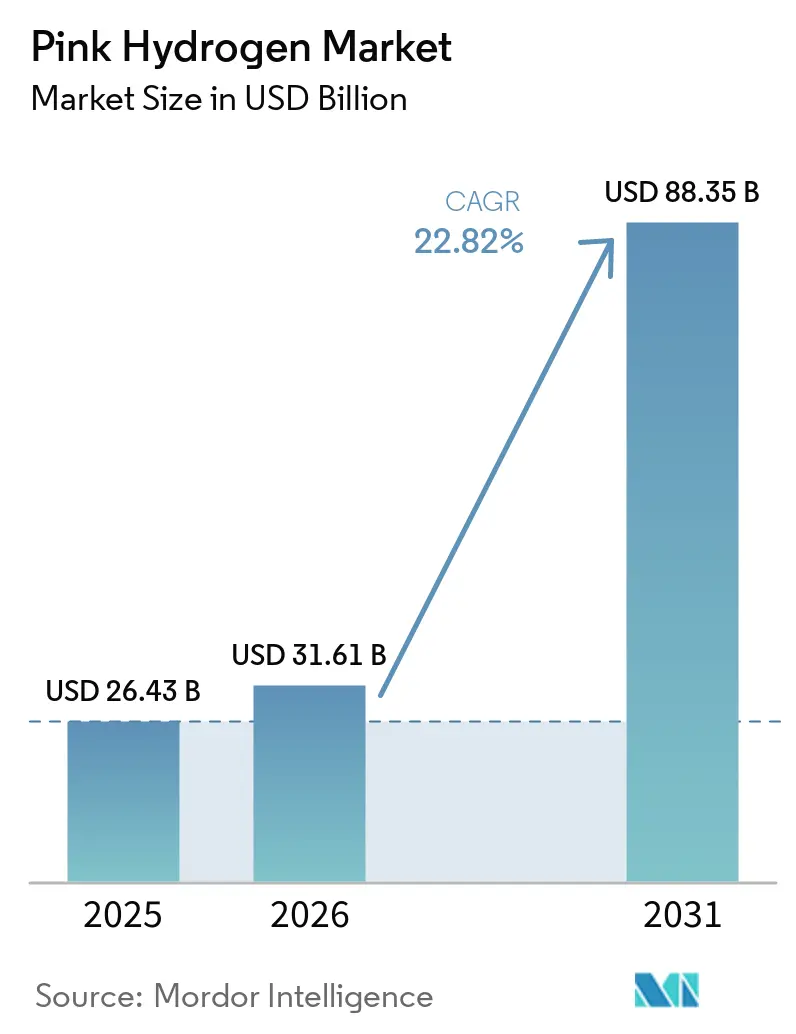
The pink hydrogen market size was valued at USD 26.43 billion in 2025 and is estimated to grow from USD 31.61 billion in 2026 to reach USD 88.35 billion by 2031, at a CAGR of 22.82% during the forecast period (2026-2031). The pink hydrogen market is supported by nuclear generation, which can supply electricity to electrolyzers continuously, a key requirement for large industrial users. The US Department of Energy states that a 1,000 MW nuclear reactor can produce up to 150,000 tons of hydrogen annually, giving nuclear-linked production the scale needed for refinery and chemical demand. Policy design, project finance, and licensing will shape the pace at which the pink hydrogen market moves from demonstrations to commercial projects. Europe remains the center of current activity, while the Asia-Pacific is building a strong pipeline through Korean, Japanese, and Indian programs. The pink hydrogen market also benefits when nuclear operators direct surplus output toward hydrogen production instead of reducing generation.
Key Report Takeaways
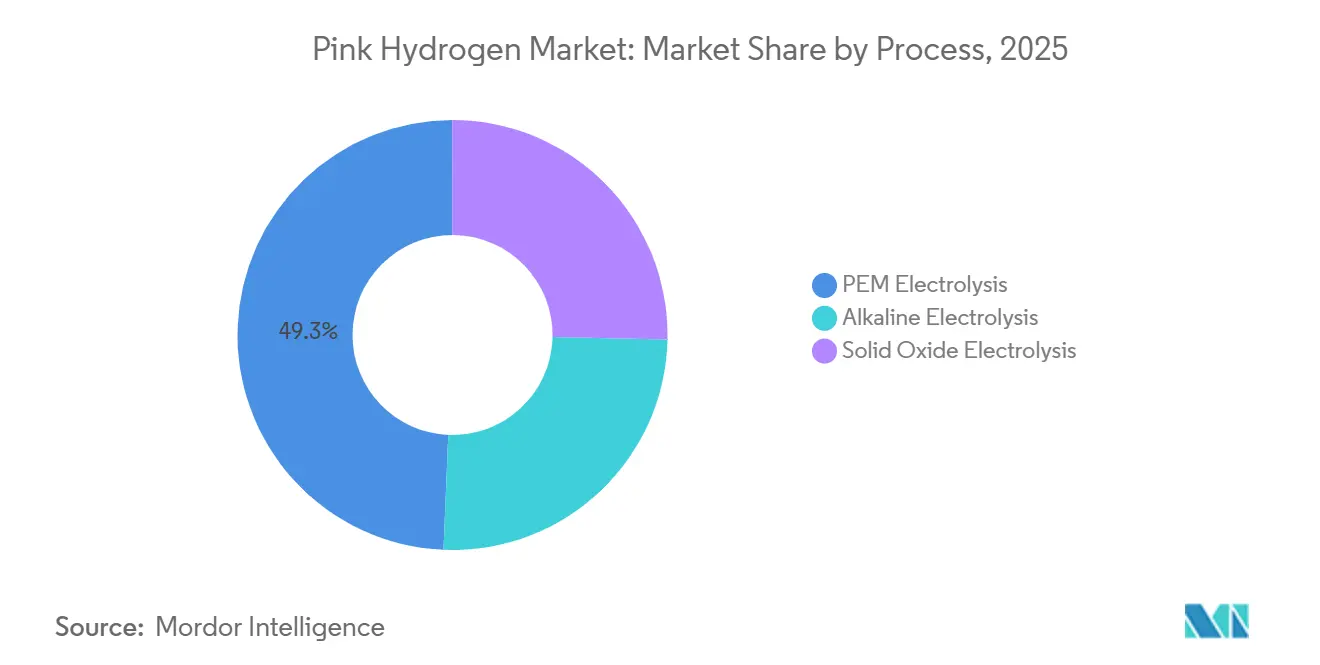
- By process, Proton Exchange Membrane (PEM) electrolysis held 49.34% of the pink hydrogen share in 2025, while solid oxide electrolysis is forecast to grow at a CAGR at 23.56% through 2031.
- By form, gaseous hydrogen accounted for 81.56% of the pink hydrogen share in 2025, while liquid hydrogen is forecast to grow at a CAGR of 24.75% through 2031.
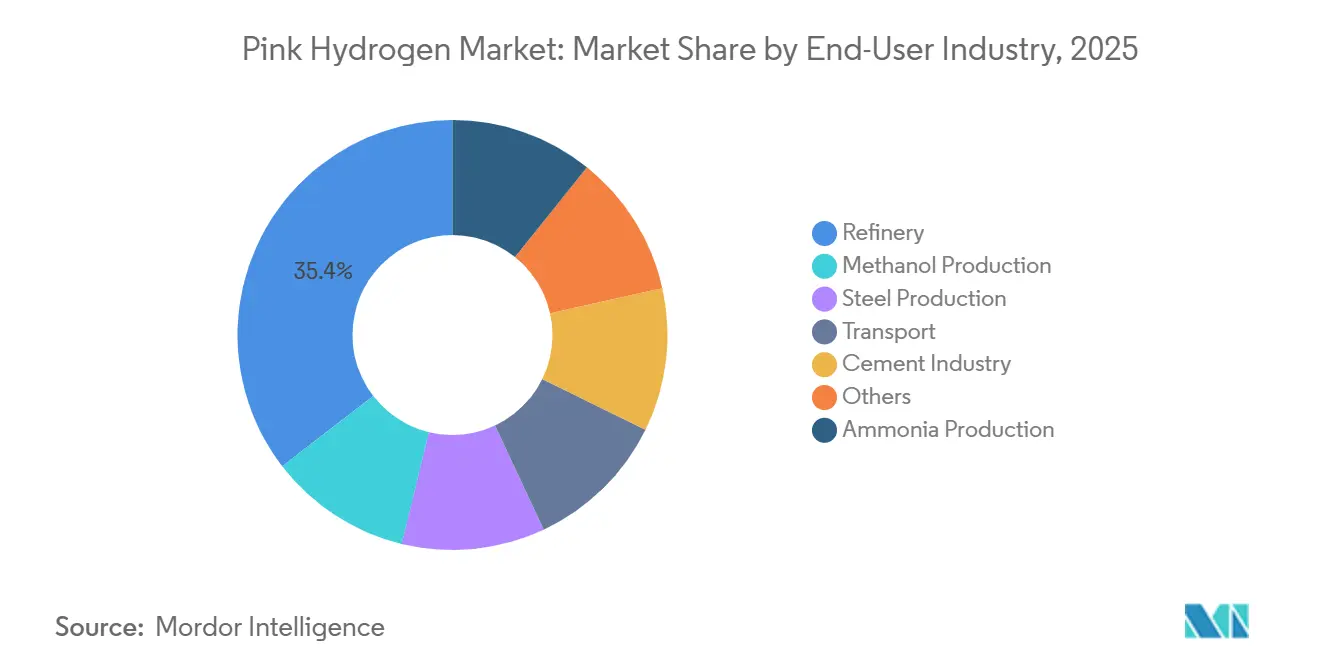
- By end-user industry, refineries held 35.45% of the pink hydrogen share in 2025, while transport is expected to expand at a CAGR of 25.12% through 2031.
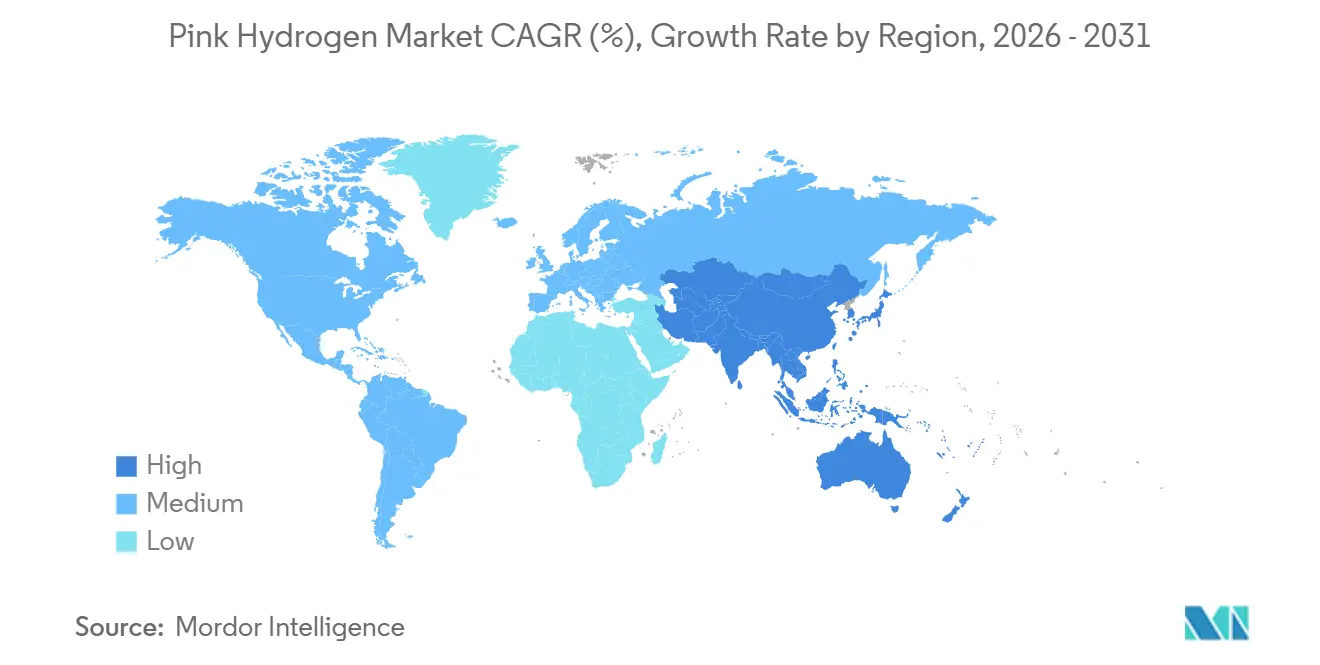
- By geography, Europe accounted for 58.38% of the pink hydrogen share in 2025, while the Asia-Pacific is forecast to grow at a CAGR of 24.18% through 2031.
Note: Market size and forecast figures in this report are generated using Mordor Intelligence’s proprietary estimation framework, updated with the latest available data and insights as of January 2026.
Market Trends and Insights
Drivers Impact Analysis of Pink Hydrogen Market*
| Drivers | (~) % Impact on CAGR Forecast | Geographic Relevance | Impact Timeline |
|---|---|---|---|
| Nuclear Power Availability for Continuous Electrolysis | +7.2% | Europe, Asia-Pacific, North America | Long term (≥ 4 years) |
| Government Clean-Hydrogen Funding and Net-Zero Policies | +5.1% | Global | Medium term (2-4 years) |
| Decarbonization of Refining and Chemical Hydrogen Demand | +3.8% | North America, Europe, the Middle East, and Africa | Medium term (2-4 years) |
| Hydrogen Demand from Steel, Heavy Transport, and Energy Storage | +3.2% | Europe, Asia-Pacific | Long term (≥ 4 years) |
| Monetization of Nuclear Power Surplus and Curtailment Periods | +2.4% | Europe, Asia-Pacific, North America | Short term (≤ 2 years) |
| Source: Mordor Intelligence | |||
Nuclear Power Availability for Continuous Electrolysis
Nuclear power enables electrolyzers to operate at utilization rates above 90%, supporting steady hydrogen output. This operating pattern spreads equipment costs across a larger production output than intermittent power sources can support. A U.S. Gulf Coast assessment found that nuclear-integrated hydrogen can become competitive under Section 45V credits at a hydrogen price of USD 2.50/kg and electricity prices ranging from USD 32.86/MWh to USD 60/MWh. Reactor heat can also support solid oxide electrolysis, reducing electricity use compared with systems that rely solely on electrical input. EDF reports that thermal coupling can improve hydrogen yield by 20% to 30% compared with Proton Exchange Membrane (PEM) and alkaline alternatives[1]. These operating characteristics provide the pink hydrogen market with a path to continuous output for refinery-scale operations without relying on large storage buffers.
Government Clean-Hydrogen Funding and Net-Zero Policies
The United States finalized rules for the Section 45V clean hydrogen production credit in January 2025. The program provides an incentive of up to USD 3.00/kg for hydrogen that meets the lowest carbon-intensity threshold. The rules include eligibility pathways for qualifying merchant reactors, restarted reactors, and reactors receiving power uprates. The European Commission introduced its Small Modular Reactor (SMR) strategy in March 2026 and proposed SMR Valleys that can cluster hydrogen, ammonia, and synthetic fuel production near new reactor sites. The United Kingdom launched its Advanced Nuclear Framework in February 2025 to support planning, regulation, and fuel supply processes for advanced reactor projects. Together, these measures improve investment conditions for the pink hydrogen market by reducing uncertainty across reactor and electrolyzer development.
Decarbonization of Refining and Chemical Hydrogen Demand
Refineries and chemical producers already use hydrogen at scale and require a dependable supply. The Clean Air Task Force reports that more than 90% of U.S. hydrogen demand is concentrated in petroleum refining, ammonia, and methanol production. Refining accounted for more than half of that demand, creating an immediate opportunity to replace it with a lower-carbon supply. Hydrogen demand is also rising, as sulfur regulations require more hydroprocessing, while emissions targets encourage facilities to lower the carbon intensity of their hydrogen supply. The U.S. Department of Energy mapping identified several large Gulf Coast reactors within 2 to 50 miles of existing hydrogen pipelines. This proximity reduces the infrastructure required to connect the pink hydrogen market to established refinery users.
Hydrogen Demand from Steel, Heavy Transport, and Energy Storage
Steel production requires a continuous hydrogen supply when direct reduced iron processes replace natural gas. Research published in Environmental Research Letters found that Europe could meet 79% of its steelmaking natural gas demand with hydrogen by 2040 under a 2°C scenario. Heavy transport is developing in parallel through liquid hydrogen logistics and vehicle deployment. Daimler Truck, MB Energy, and Kawasaki Heavy Industries agreed to develop a liquid hydrogen supply chain through the Port of Hamburg, and Daimler Truck plans to place 100 liquid hydrogen-powered NextGenH2 trucks into customer operations by the end of 2026. Nuclear operators can also convert surplus electricity during periods of low grid demand into stored hydrogen. These uses broaden demand for the pink hydrogen market and reduce reliance on a single end-user group.
Restraints Impact Analysis of Pink Hydrogen Market*
| Restraints | (~) % Impact on CAGR Forecast | Geographic Relevance | Impact Timeline |
|---|---|---|---|
| High Nuclear and Electrolysis Capital Requirements | -4.8% | Global | Medium term (2-4 years) |
| Limited Nuclear Fleet and Project-Siting Availability | -3.7% | North America, Asia-Pacific | Long term (≥ 4 years) |
| Nuclear-Hydrogen Licensing Interface and Safety Case Complexity | -2.6% | Global | Short term (≤ 2 years) |
| Source: Mordor Intelligence | |||
High Nuclear and Electrolysis Capital Requirements
Pink hydrogen projects require investment in reactor capacity, electrolyzers, storage, and connecting infrastructure before revenue begins. Proton Exchange Membrane (PEM) installations in Europe cost USD 2,000/kW to USD 2,550/kW. A 2026 study found that balance-of-plant capital for PEM systems fell from USD 848/kW at 1 MW to USD 87/kW at 1 GW, demonstrating the role of scale in lowering costs. Large reactors can cost more than USD 6 billion per unit, adding another layer of capital expenditure to co-located projects. Long-term offtake contracts are therefore important for recovering investment across the pink hydrogen market. Compliance with International Electrotechnical Commission (IEC) electrolyzer standards and Nuclear Regulatory Commission requirements adds preparation work and upfront expense.
Limited Nuclear Fleet and Project-Siting Availability
Nuclear capacity is concentrated in a limited number of locations, and many hydrogen demand centers are far from suitable reactor sites. Projects must align nuclear adjacency, industrial zoning, water availability, transmission capacity, and hydrogen transport links. Small modular reactors may improve siting flexibility, but many designs remain in licensing or pre-commercial development. This limits the number of projects that can proceed in the near term. Siting challenges also lengthen project schedules where local requirements need separate review. The pink hydrogen market will remain dependent on the availability of nuclear sites until advanced reactors become commercially established.
*Our forecasts treat driver/restraint impacts as directional, not additive. The impact forecasts reflect baseline growth, mix effects, and variable interactions.
Pink Hydrogen Market Segment Analysis
By Process:
PEM Supports Current Deployment, While Solid Oxide Improves Thermal EfficiencyPEM electrolysis accounted for 49.34% of the pink hydrogen market share in 2025. This position reflects operating reliability, established component supply chains, and compatibility with existing nuclear output profiles. PEM systems can manage varying electrical loads when nuclear stations follow grid demand, making the technology practical for operators seeking commercial deployment without specialized heat integration. In February 2025, Korea Hydro & Nuclear Power Co., Ltd. (KHNP) partnered with Nel ASA to combine alkaline technology with nuclear power. This collaboration followed KHNP's national demonstration program, which began in April 2024. Alkaline systems remain relevant as a lower-capital option for large installations. The pink hydrogen market, therefore, has more than one process route available for early deployment.
Solid oxide electrolysis is projected to grow at a CAGR of 23.56% through 2031. This process uses high-temperature steam from reactor heat exchangers and can reduce the electrical input required for hydrogen production. EDF estimates that reactor heat integration can raise hydrogen yield by 20% to 30% compared with low-temperature systems. A 2026 study evaluated intermediate-temperature solid oxide electrolysis supplied with high-temperature reactor steam. KHNP presented preliminary work on process-heat capacity and potential demonstration sites at its July 2026 K-SOC symposium. The process remains less established than Proton Exchange Membrane (PEM) for commercial projects. However, its energy profile is suited to nuclear systems that can supply steady heat. This gives the pink hydrogen market a technology option focused on higher system efficiency and explains why process selection will depend on reactor configuration and project timeline.

By Form:
Gaseous Supply Serves Current Users, While Liquid Supply Enables Longer RoutesGaseous hydrogen held 81.56% of the pink hydrogen market share in 2025. Existing refinery and chemical users commonly rely on compressed gas delivered through dedicated pipelines. The U.S. Gulf Coast has more than 1,000 miles of dedicated hydrogen pipeline, concentrated near industrial facilities. This infrastructure supports a continuous supply without requiring an additional conversion and shipping step. Nuclear plants near those networks can connect production more directly to industrial demand. Gaseous delivery is therefore suited to captive users and regional supply chains, and will remain important where pipelines and purification systems are already in place. The pink hydrogen market can use this existing network to support initial commercial output.
Liquid hydrogen is expected to expand at a CAGR of 24.75% from 2026 to 2031. Growth is linked to investments in heavy transport, maritime shipping, and cross-border trade. In January 2026, Kawasaki Heavy Industries and Japan Suiso Energy contracted a liquid hydrogen carrier with 40,000 cubic meters of cargo capacity, intended to operate with the Kawasaki LH2 Terminal at Ogishima. Samsung C&T is constructing a 30,000-ton double-walled liquid hydrogen storage tank at its Samcheok clean energy hub, with completion targeted for July 2027. In March 2026, KBR received a contract to design and build a Port of Amsterdam terminal capable of receiving, storing, and distributing up to 200,000 tons of liquid hydrogen annually at full initial capacity. These facilities demonstrate how the pink hydrogen market can serve routes that pipelines cannot reach. Liquid supply and gaseous supply are likely to operate alongside each other through 2031.
By End-User Industry:
Refineries Provide Current Demand, While Transport Expands New UsesRefineries held 35.45% of the pink hydrogen market share in 2025. They already consume hydrogen in hydroprocessing and can substitute a lower-carbon supply through established piping and purification systems. A Gulf Coast assessment found that nuclear-integrated hydrogen at refineries can reach economic viability under Section 45V credits when hydrogen prices are USD 2.50/kg. Ammonia production also requires steady, high-purity hydrogen and remains an important end use. Methanol production has similar requirements, although it represents a smaller application. EDF and Heidelberg Materials are demonstrating hydrogen burner technology for asphalt production at the Criggion plant in Wales. Existing industrial demand provides the pink hydrogen market with an early route to output and favors projects near established consumption hubs.
Transport is projected to grow at a CAGR of 25.12% from 2026 to 2031. Fuel-cell trucks and hydrogen trains require high-purity hydrogen, which nuclear electrolysis can produce continuously. The main near-term limitation is the lack of a widespread liquid hydrogen bunkering network, which requires fleet operators to be located near a supply source or to invest in storage and distribution. Daimler Truck plans to deploy 100 liquid hydrogen-powered Mercedes-Benz NextGenH2 trucks with customers by the end of 2026. Steel is another expanding end use, as direct-reduced iron facilities require a reliable hydrogen supply. Under a 2°C pathway, Europe could meet 79% of its natural-gas demand for steelmaking with hydrogen by 2040. These requirements position the pink hydrogen market to serve the transport and steel sectors, where supply continuity is valued.
Geography Analysis
Europe Pink Hydrogen Market
Europe accounted for 58.38% of the pink hydrogen market share in 2025. France plays a central role in the region, with its 56-reactor fleet providing substantial nuclear generation capacity. France's Multi-Year Energy Plan 3 (PPE3) for 2026 to 2035 sets a nuclear production target of 380-420 TWh annually. In July 2026, EDF signed its first Nuclear Production Allocation Contract with H4 Marseille Fos. The agreement allocates 150 MW of nuclear capacity for 10 years, starting in 2032, to power a EUR 1.6 billion (USD 1.85 billion) electro-Sustainable Aviation Fuel (e-SAF) facility[2]. EDF is also assessing solid oxide electrolysis at its Bay Hydrogen Hub near Heysham. France and Poland support low-carbon recognition for nuclear hydrogen, while the European Commission has deferred formal classification until July 2028. Sweden and Finland also have nuclear capacity that could support certified production if the classification is resolved.
APAC Pink Hydrogen Market
Asia-Pacific is expected to grow at a CAGR of 24.18% through 2031. South Korea's program includes KHNP's national nuclear hydrogen research project, which has operated since April 2024 with 8 industrial partners. The pilot facility is targeted for completion in 2027. KHNP's July 2026 K-SOC council linked research among industry, academia, and national laboratories. Japan is developing liquid hydrogen infrastructure at the Kawasaki LH2 Terminal in Ogishima. The project includes a 50,000-cubic-meter storage tank and is paired with the January 2026 carrier contract. The Japan Atomic Energy Agency filed a regulatory review application in March 2025 for a hydrogen facility at the High Temperature Engineering Test Reactor. India inaugurated a copper-chlorine thermochemical cycle hydrogen facility at Kalpakkam in June 2026, adding a non-electrolytic route to the regional production base.
Competitive Landscape
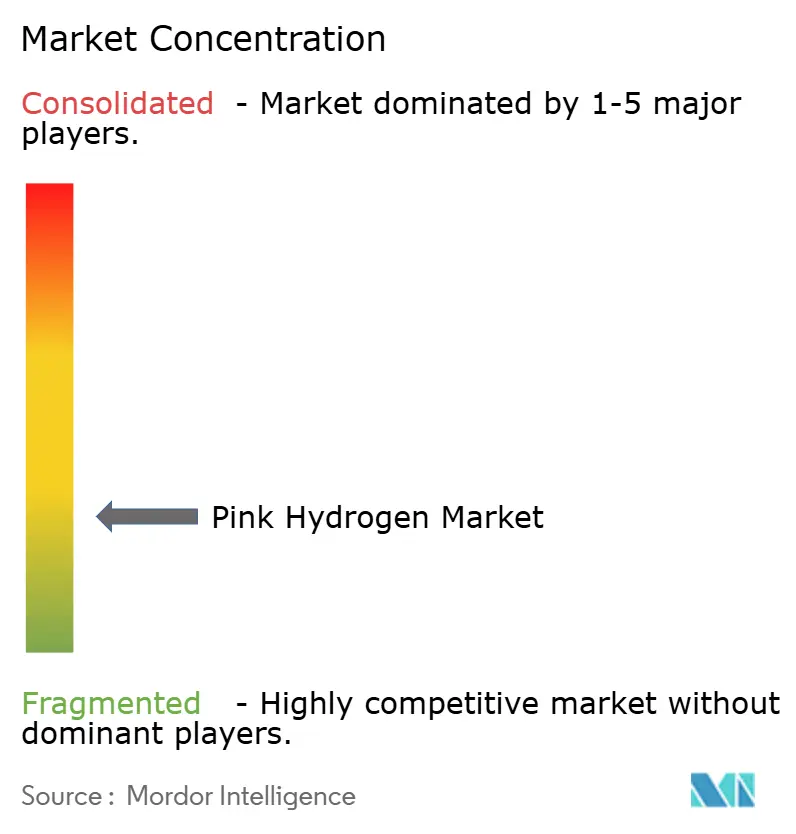
The pink hydrogen market is fragmented because nuclear operators, electrolyzer manufacturers, and reactor developers each control different parts of the value chain. No single company holds a commercialized position across reactor supply, electrolysis, and hydrogen distribution. EDF has an integrated position through reactor operations, solid oxide research at the Bay Hydrogen Hub, and its July 2026 allocation contract with H4 Marseille-Fos. KHNP has built partnerships across alkaline and solid oxide technologies while operating its national demonstration project. This approach allows KHNP to evaluate multiple process routes rather than relying on a single technology. The competitive structure leaves room for companies that can integrate nuclear assets with hydrogen systems, and makes partnerships important given that few participants have capabilities across the full value chain.
Small modular reactors are drawing attention for industrial sites where hydrogen, ammonia, or sustainable fuel facilities could share infrastructure with reactor projects. Rolls-Royce SMR, ULC-Energy, and McDermott are examining these configurations in the Netherlands. NuScale has demonstrated integrated hydrogen and desalination configurations with Pacific Northwest National Laboratory. Westinghouse completed zero-power criticality testing for its eVinci microreactor in August 2026 and identifies hydrogen generation as a core commercial application for the reactor. These developments indicate that companies are positioning advanced reactors as a source of power and heat for hydrogen production, widening the technology choices available to the pink hydrogen market.
The most active opportunities involve direct integration of reactors and electrolyzers at new industrial parks. High-temperature gas reactors and solid oxide electrolyzer systems can use reactor heat directly, avoiding an electricity-conversion step. The Nuclear Regulatory Commission's technology-inclusive Part 53 framework was published in the Federal Register in March 2026 and may reduce some of the regulatory advantage that established operators have over greenfield developers. However, developers still need to manage safety cases, capital requirements, and customer offtake commitments. The pink hydrogen market is therefore likely to remain partnership-led while first commercial projects establish reliable operating models.
Pink Hydrogen Industry Leaders
-
Westinghouse Electric Company LLC
-
EDF
-
Korea Hydro & Nuclear Power (KHNP)
-
OKG Aktiebolag
-
Rosatom State Atomic Energy Corporation
- *Disclaimer: Major Players sorted in no particular order
Pink Hydrogen Market Companies Covered in this Report
- EDF
- Korea Hydro & Nuclear Power (KHNP)
- NuScale Power Corporation
- OKG Aktiebolag
- Rolls-Royce SMR Limited
- Rosatom State Atomic Energy Corporation
- Westinghouse Electric Company LLC
Recent Industry Developments in Pink Hydrogen Market
- August 2026: Westinghouse Electric Company completed zero-power criticality testing for its eVinci microreactor at the Nevada National Security Site, in partnership with Los Alamos and Idaho National Laboratories, validating core design assumptions for a reactor with hydrogen generation as a primary commercial application.
- July 2026: EDF and H4 Marseille Fos signed a Nuclear Production Allocation Contract, dedicating 150 MW of nuclear capacity for 10 years from 2032 to power a EUR 1.6 billion (USD 1.85 billion) e-SAF plant in Fos-sur-Mer, utilizing pink hydrogen with a production capacity of 75,000 tons per year of sustainable aviation fuel and annual CO2-equivalent avoidance of 240,000 tons.
Global Pink Hydrogen Market Report Scope
Pink hydrogen is produced by splitting water molecules into hydrogen and oxygen through electrolysis, using electricity and high-temperature steam generated by nuclear power. Because nuclear reactors do not burn fossil fuels, they generate zero carbon emissions and provide a continuous, round-the-clock energy supply that is independent of weather conditions.
The pink hydrogen market is segmented by process, form, end-user industry, and geography. By process, the market is segmented into PEM electrolysis, alkaline electrolysis, and solid oxide electrolysis. By form, the market is segmented into gaseous hydrogen and liquid hydrogen. By end-user industry, the market is segmented into refinery, ammonia production, methanol production, steel production, transport, cement industry, and others. The report also covers market size and forecasts for pink hydrogen across 15 countries in major regions. The market sizes and forecasts are provided in terms of value (USD).
Segmentation Overview
| PEM Electrolysis |
| Alkaline Electrolysis |
| Solid Oxide Electrolysis |
| Gaseous Hydrogen |
| Liquid Hydrogen |
| Refinery |
| Ammonia Production |
| Methanol Production |
| Steel Production |
| Transport |
| Cement Industry |
| Others |
| Asia-Pacific | China |
| India | |
| Japan | |
| South Korea | |
| Rest of Asia-Pacific | |
| North America | United States |
| Canada | |
| Mexico | |
| Europe | Germany |
| United Kingdom | |
| France | |
| Italy | |
| Rest of Europe | |
| South America | Brazil |
| Argentina | |
| Rest of South America | |
| Middle East and Africa | Saudi Arabia |
| South Africa | |
| Rest of Middle East and Africa |
| By Process | PEM Electrolysis | |
| Alkaline Electrolysis | ||
| Solid Oxide Electrolysis | ||
| By Form | Gaseous Hydrogen | |
| Liquid Hydrogen | ||
| By End-User Industry | Refinery | |
| Ammonia Production | ||
| Methanol Production | ||
| Steel Production | ||
| Transport | ||
| Cement Industry | ||
| Others | ||
| By Geography | Asia-Pacific | China |
| India | ||
| Japan | ||
| South Korea | ||
| Rest of Asia-Pacific | ||
| North America | United States | |
| Canada | ||
| Mexico | ||
| Europe | Germany | |
| United Kingdom | ||
| France | ||
| Italy | ||
| Rest of Europe | ||
| South America | Brazil | |
| Argentina | ||
| Rest of South America | ||
| Middle East and Africa | Saudi Arabia | |
| South Africa | ||
| Rest of Middle East and Africa | ||
Key Questions Answered in the Report
What is current market size of Pink Hydrogen Market?
The pink hydrogen market size was valued at USD 26.43 billion in 2025 and is estimated to grow from USD 31.61 billion in 2026 to reach USD 88.35 billion by 2031, at a CAGR of 22.82% during the forecast period (2026-2031).
Which process held the largest share in 2025?
Proton Exchange Membrane (PEM) electrolysis led the process category with a 49.34% share in 2025.
Which region is growing fastest through 2031?
Asia-Pacific is forecast to grow at a CAGR of 24.18% through 2031, supported by programs in South Korea, Japan, and India.
What is the main challenge for commercial projects?
High capital requirements and complex licensing for co-located reactors and electrolyzer facilities remain major challenges.