
Pickleball Market Size and Share
Market Overview
| Study Period | 2022 - 2032 |
|---|---|
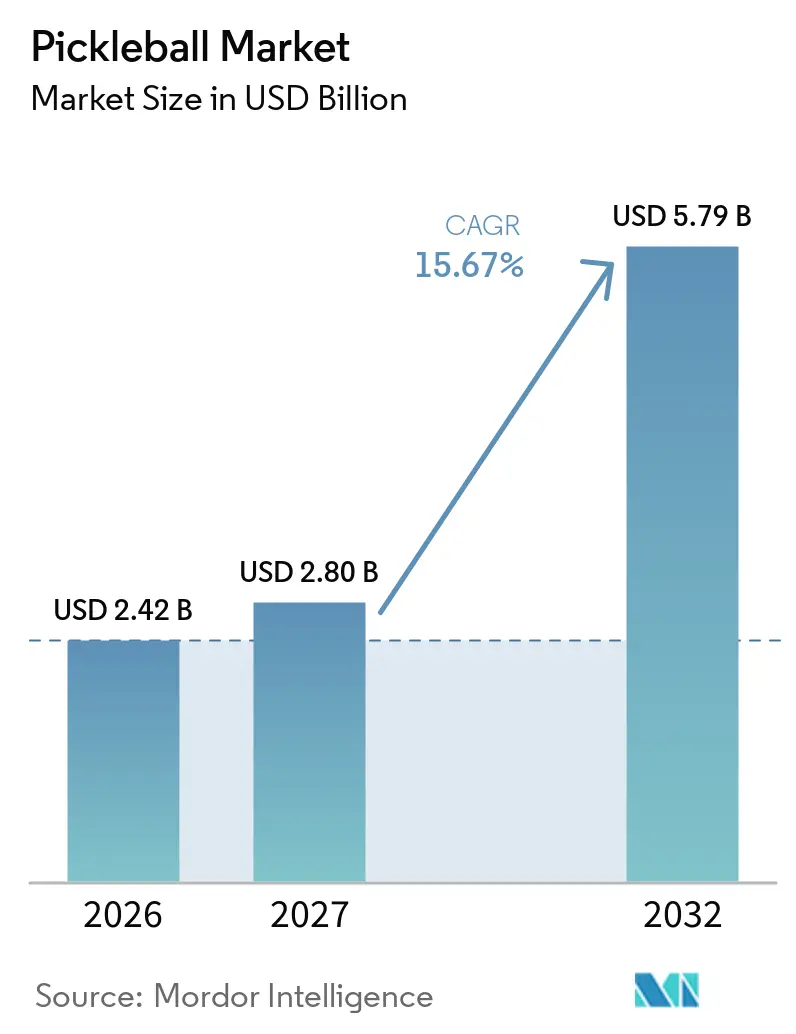
| Market Size (2027) | USD 2.80 Billion |
| Market Size (2032) | USD 5.79 Billion |
| Fastest Growing Market | Asia-Pacific |
| Largest Market | North America |
| Market Concentration | Medium |
Major Players *Disclaimer: Major Players sorted in no particular order Image © Mordor Intelligence. Reuse requires attribution under CC BY 4.0. | |
Pickleball Market Analysis by Mordor Intelligence
The Pickleball Market size was valued at USD 2.42 billion in 2026 and estimated to grow from USD 2.8 billion in 2027 to reach USD 5.79 billion by 2032, at a CAGR of 15.7% during the forecast period (2027-2032). Participation growth is expanding the buyer base while more frequent play is increasing replacement demand for paddles, balls, and related equipment. The Sports & Fitness Industry Association reported 24.3 million U.S. players in 2025 and identified 7.5 million core participants who played at least 8 times annually. The Pickleball Market is also gaining support from dedicated venues, professional events, and a wider range of products across entry and performance tiers. Equipment certification and counterfeit prevention have become more important as brands compete for trust in tournament and online channels. North America remains the commercial center, while Asia-Pacific offers the highest projected regional growth as participation and digital purchasing expand.
Key Report Takeaways
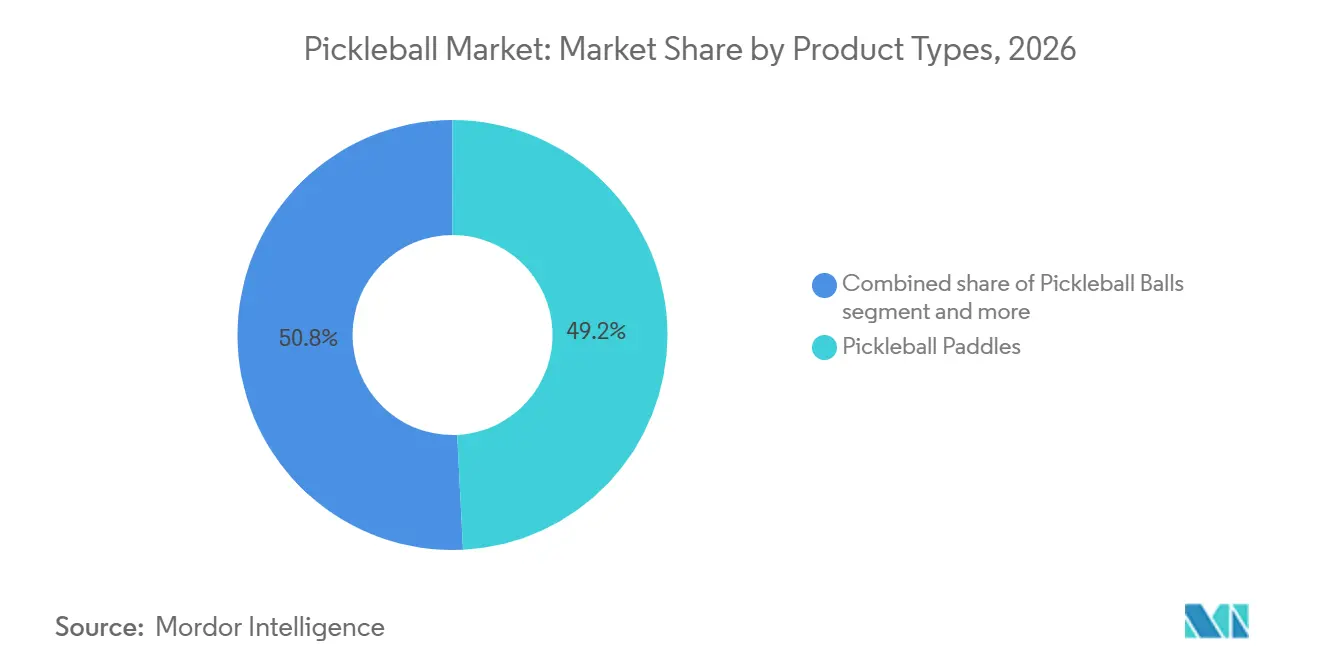
- By product type, paddles held 49.23% of the Pickleball Market in 2026, while paddles are projected to grow at a 16.32% CAGR through 2032.
- By gender, male players held 64.53% of the Pickleball Market in 2026, while the female segment is projected to grow at a 16.68% CAGR through 2032.
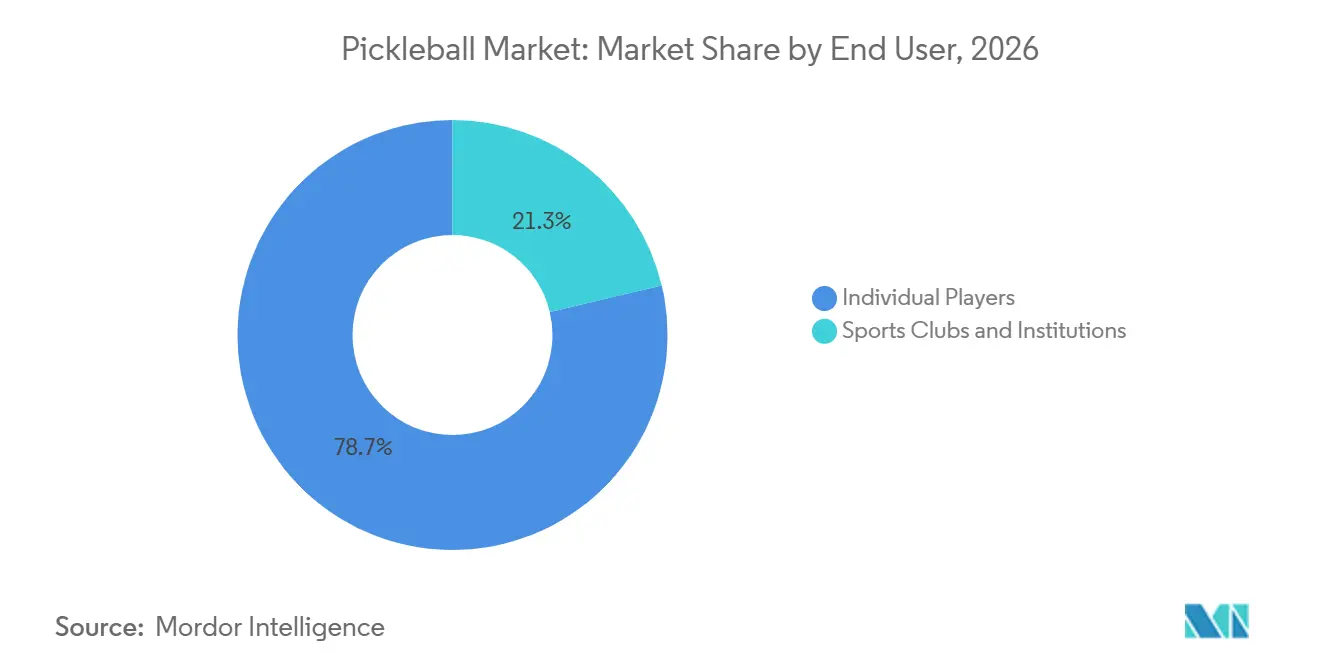
- By end user, individual players held 78.65% of the Pickleball Market in 2026, while sports clubs and institutions are projected to grow at a 16.43% CAGR through 2032.
- By distribution channel, offline channels held 63.87% of the Pickleball Market in 2026, while online channels are projected to grow at a 16.79% CAGR through 2032.
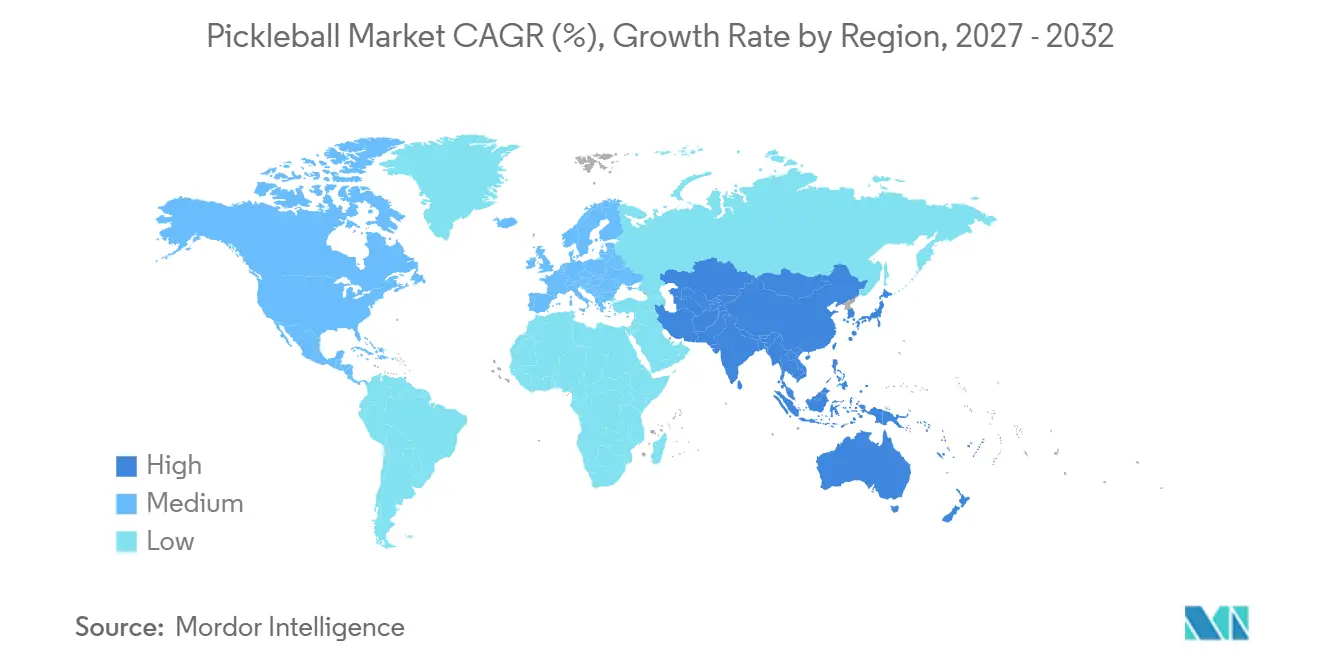
- By geography, North America held 59.56% of the Pickleball Market in 2026, while Asia-Pacific is projected to grow at a 16.54% CAGR through 2032.
Note: Market numbers in this report are based on Mordor Intelligence's proprietary estimation framework, which combines nine months of actuals with Q4 projections for base year 2026.
Global Pickleball Market Trends and Insights
Drivers Impact Analysis*
| Driver | (~) % Impact on CAGR Forecast | Geographic Relevance | Impact Timeline |
|---|---|---|---|
| Broadening Participation Across Age, Gender, and Skill Cohorts | +4.0% | Global | Medium term (2-4 years) |
| Expansion of Dedicated Courts, Indoor Venues, and Facility Supply | +2.5% | North America and Asia-Pacific | Short term (≤ 2 years) |
| Professional Tour Expansion, Tournament Commercialization, and Media Visibility | +2.0% | North America, Europe, and Asia-Pacific | Short term (≤ 2 years) |
| Wider Availability of Affordable, Beginner-Friendly, and Regulation-Compliant Equipment | +1.5% | Asia-Pacific, South America, and Middle East and Africa | Medium term (2-4 years) |
| Product Innovation in Paddle Materials, Power, Spin, and Ergonomic Design | +2.0% | Global | Medium term (2-4 years) |
| Professional Endorsements, Sponsor-Funded Visibility, and Player Collaborations | +1.0% | North America and Asia-Pacific | Short term (≤ 2 years) |
| Source: Mordor Intelligence | |||
Broadening Participation Across Age, Gender, and Skill Cohorts
The Pickleball Market benefits from a player base that now extends well beyond its original retiree audience. SFIA identified people aged 13-24 as the largest group by participation in 2025. Women represented 42.9% of all players in 2025, which broadens demand for equipment and apparel suited to different needs. The 7.5 million core participants support recurring purchases because regular play increases wear on paddles, balls, grips, and footwear[1]. This broader base of participants gives retailers a larger mix of first-time, recreational, and performance-oriented buyers. It also gives brands a stronger reason to offer products at multiple price points rather than relying on a single premium tier.
Expansion of Dedicated Courts, Indoor Venues, and Facility Supply
New courts and indoor clubs directly raise demand for nets, balls, paddles, and facility equipment. USA Pickleball tracked 82,613 courts in the United States during 2025 and recorded 14,155 new courts during 2024[2]. In October 2025, Picklr had 52 open clubs and announced plans for 70 additional locations over the following 12 months. Indoor venues allow play during colder or wetter months and help make equipment spending less seasonal. Clubs also drive repeat purchases of balls, loaner paddles, and replacement nets. This growth in supply strengthens the link between organized play and institutional procurement across the Pickleball Market.
Professional Tour Expansion, Tournament Commercialization, and Media Visibility
Professional events make the sport more visible to consumers, sponsors, and retailers. Major League Pickleball and the PPA Tour reported USD 25 million in sponsorship revenue in 2024, up from USD 16 million in 2023, with USD 35 million projected for 2025. The same release reported that MLP’s CBS Finals broadcast averaged 499,000 viewers[3]. Tournament coverage provides equipment makers with a practical way to demonstrate their products in use. Athlete partnerships can also link new launches to recognizable players and event moments. This visibility supports consumer interest across the Pickleball Market, particularly for performance equipment.
Product Innovation in Paddle Materials, Power, Spin, and Ergonomic Design
Paddle makers are differentiating products through materials, core construction, feel, and tournament approval. JOOLA introduced its Pro V collection in March 2026, featuring KineticFrame paddle geometry and the Kosmos shape, developed with Federico Staksrud. USA Pickleball’s PBCoR.43 framework influences which products can be used in sanctioned tournament play. Certification creates a clear distinction between recreational options and products designed for competitive use. Faster product approval can help a manufacturer reach retailers before comparable models arrive. Product innovation, therefore, supports premium pricing, but it also increases the importance of clear compliance communication in the Pickleball Market.
Restraints Impact Analysis*
| Restraint | (~) % Impact on CAGR Forecast | Geographic Relevance | Impact Timeline |
|---|---|---|---|
| High Cost of Premium and Professional-Grade Pickleball Equipment | -2.0% | Global, concentrated in Asia-Pacific and South America | Medium term (2-4 years) |
| Counterfeit, Non-Compliant, and Inconsistent-Quality Equipment | -0.8% | Global, elevated in online channels | Short term (≤ 2 years) |
| Limited Federation, Court, and Distribution Infrastructure in Emerging Markets | -1.0% | South America, Middle East and Africa, and Southeast Asia-Pacific | Long term (≥ 4 years) |
| Competition from Established Racquet and Outdoor Sports for Courts, Time, and Consumer Spend | -0.7% | Europe and North America | Medium term (2-4 years) |
| Source: Mordor Intelligence | |||
High Cost of Premium and Professional-Grade Pickleball Equipment
Premium paddles can create a price barrier to access in price-sensitive markets. The research identifies entry-level models at USD 80 and professional-grade constructions at USD 200-350. That gap can limit the number of consumers who upgrade as their skill level improves. It can also make certified products less accessible in markets where imported equipment carries higher landed costs. The affordability issue is especially relevant where access to the courts and formal retail distribution are still developing. Brands that offer reliable beginner products and clear product progression can address more of the Pickleball Market without lowering confidence in performance models.
Counterfeit, Non-Compliant, and Inconsistent-Quality Equipment
Counterfeit paddles can damage consumer confidence and make tournament compliance harder to assess. USA Pickleball launched a unified Anti-Counterfeit Initiative in December 2025 with the APP Tour, DUPR, MLP, PPA Tour, UPA-A, and the World Pickleball Federation. USA Pickleball also reported work with Pickleball Instruments to support compliance testing. Online marketplaces make product traceability more difficult than specialty retail channels. The risk becomes greater when unauthorized copies appear soon after a popular certified product launches. Clear certification guidance, authorized retail networks, and enforcement efforts can help legitimate brands protect the Pickleball Market.
*Our forecasts treat driver/restraint impacts as directional, not additive. The impact forecasts reflect baseline growth, mix effects, and variable interactions.
Segment Analysis
By Product Types: Paddles Anchor Value, Accessories Widen the Basket
Paddles accounted for 49.23% of the Pickleball Market share in 2026. Their lead reflects the paddle's essential role in every form of play. Buyers often compare grip, weight, face material, shape, control, and power before selecting a model. Recreational users may choose an affordable starter product, while frequent players may consider a certified performance paddle. The paddle category also benefits from replacement demand, whether due to regular wear or to a player’s changing preferences. Pickleball balls represent another important recurring purchase because they are consumable products. Nets and posts depend more heavily on facility construction, community programs, and club procurement. Bags, grips, wristbands, and protective equipment can increase the value of each retail purchase. This range of secondary products gives retailers a broader basket than paddles alone. It also allows brands to support customers through several stages of participation.
The paddles segment is projected to grow at a 16.32% CAGR through 2032, which makes it the fastest-growing product category. This Pickleball Market size measure reflects continued demand for higher-specification designs. Carbon fiber faces, thermoformed structures, foam-filled edges, and tailored core geometries have created a wider range of performance choices. JOOLA’s March 2026 Pro V launch shows how brands are using new geometry and athlete collaboration to refresh their product lines. USA Pickleball equipment standards make approval an important part of the commercial process for tournament products. Manufacturers can use certification to explain product suitability to serious players. The same process can increase the cost and time required to introduce a new model. Balls, nets, bags, and accessories remain useful complements because they address training, travel, comfort, and facility needs. Together, these categories widen the product offer while paddles remain the main value driver.

By Gender: Female Segment Narrows the Participation Gap
Male players held 64.53% of the market in 2026. This position reflects the sport’s earlier pattern of competitive participation. Men remain a major audience for performance paddles and tournament-oriented equipment. Their purchasing behavior supports broad demand for products that emphasize power, spin, and durability. Retailers can serve this base through pro shops, clubs, specialty sporting goods stores, and direct online channels. The segment also supports visibility for equipment through professional events and player endorsements. Its current scale gives manufacturers a large existing customer base for new product releases. However, a male-led revenue position does not mean that brands can rely only on unisex product design. Participation data show a more balanced player base than historical revenue shares suggest. This makes gender-specific product development increasingly relevant across the pickleball industry.
The female segment is forecast to grow at a 16.68% CAGR through 2032. SFIA reported that women represented 42.9% of players in 2025. This participation base supports demand for products that recognize fit, comfort, style, and performance preferences. JOOLA expanded its R4LLy shoe collection with women’s sizing in April 2026. This product development shows that brands are moving beyond generic product adaptation. It also gives retailers new reasons to organize product displays and digital campaigns around female players. Stronger professional visibility can encourage first-time buyers and help existing players move into higher-value products. The female segment therefore creates a clear growth opportunity for brands that combine performance credibility with fit and product choice.
By End User: Individual Players Lead, Institutions Accelerate
Individual players represented 78.65% of the market in 2026. This lead is consistent with a sport built around personal participation and self-funded equipment purchases. Individuals buy paddles, balls, bags, footwear, and accessories for social, recreational, and competitive play. Product choice is often shaped by comfort, skill level, price, and the ability to test equipment at a club or store. Direct-to-consumer sites also allow consumers to compare models and receive brand education. The large individual base helps manufacturers reach customers through several retail formats. It also supports recurring replacement purchases among regular players. Community leagues and local facilities can encourage players to add equipment as they become more engaged. This consumer-led model remains central to the Pickleball Market. It gives brands a large base for entry-level products and premium upgrades.
Sports clubs and institutions are projected to grow at a 16.43% CAGR through 2032. New indoor facilities require bulk purchases of balls, nets, storage equipment, and loaner paddles. The Picklr’s stated expansion pipeline illustrates the demand created by dedicated club openings. Institutions also include schools, recreation centers, community venues, and corporate wellness programs. These buyers are more likely to purchase repeated quantities than a single household. Their procurement decisions often emphasize durability, safety, availability, and price consistency. They can also introduce the sport to new groups of players who later make individual purchases. This connection makes facility growth important for both business-to-business and consumer sales. Reliable product supply and training support can help manufacturers build long-term relationships with institutional buyers. The result is a growing channel that complements, rather than replaces, individual demand.
By Distribution Channel: Offline Retains Scale, Online Commands Growth
Offline channels held 63.87% of the market in 2026. Specialty retailers, pro shops, sporting goods stores, and club-based outlets help buyers assess paddle weight, grip size, balance, and feel before making a purchase. This hands-on process remains important for players choosing their first paddle or replacing a familiar model. Physical stores can also provide local product advice and immediate availability. Clubs can sell equipment directly where consumers play and learn. These outlets are well placed to explain tournament certification and compatible accessories. Retail staff can help customers distinguish between entry, intermediate, and performance products. Offline retail, therefore, remains valuable for building trust and reducing purchase uncertainty. It also provides an important control point for authorized distribution. These strengths help explain why in-person sales remain the largest channel in the Pickleball Market.
Online channels are projected to expand at a 16.79% CAGR through 2032. Digital stores give brands access to customers beyond established pickleball cities and club networks. They also allow product comparisons, athlete partnerships, educational content, and direct customer support to appear within a single purchase journey. Selkirk expanded its international presence in 2025 with headquarters in Malaysia and Estonia, supporting its ability to serve Asia and Europe. Digital sales are especially useful where local specialty retail remains limited. However, online growth also increases exposure to counterfeit or unclear product listings. USA Pickleball’s anti-counterfeit efforts are therefore relevant to how online sales develop. Brands that clearly identify authorized sellers can protect buyers and preserve product credibility. A balanced retail strategy can combine physical product testing with convenient online replenishment and repeat purchasing.
Geography Analysis
North America held 59.56% of the Pickleball Market share in 2026. The United States is the region’s main contributor because it combines the deepest player base with the most developed court and event infrastructure. SFIA reported 24.3 million U.S. players in 2025, while USA Pickleball recorded 82,613 courts that year. The region has established specialty retailers, club networks, tournaments, and professional tours. Its club expansion also creates sustained demand for institutional equipment. The Picklr’s 52 operating clubs and the proposed 70 additional locations demonstrate continued investment in facilities. North American brands benefit from an informed consumer base that is more likely to recognize certification, athlete endorsements, and product differences. Canada and Mexico add regional demand, although the United States remains the central commercial and competitive market.
Asia-Pacific is projected to register a 16.54% CAGR through 2032, the highest regional growth rate in the Pickleball Market. The region has a large potential audience, but court availability, organized competition, and retail networks vary widely by country. China, India, Indonesia, and the Philippines are among the markets drawing attention from brands and tournament organizers. The Pickleball Market size in Asia-Pacific is supported by digital retail access and growing interest in low-barrier social sports. Asia-based professional activity can improve equipment visibility and give local distributors an entry point. PPA Tour Asia identified Facolos, Paddletek, and Franklin as official paddle partners for its 2025 season. Affordable certified products and clear distribution arrangements will be important in converting awareness into regular purchases.
Europe is developing through interest in Spain, Italy, and the United Kingdom, where clubs and organizers are building local participation communities. Regional growth is constrained by differences in venue access, sporting body registration, and retail coverage. South America offers early-stage opportunity as Brazil adds players and courts, while access to affordable certified equipment remains important. Middle East and Africa demand is also developing through wellness programs, dedicated clubs, and local event activity. These regions can create new sales channels, but they require local partners that understand pricing, facility conditions, and product service needs. The global competitive environment will depend on who can pair product innovation with dependable local distribution. Brands with strong online capabilities may enter newer markets quickly, while physical partners remain important for product testing and customer confidence.
Competitive Landscape
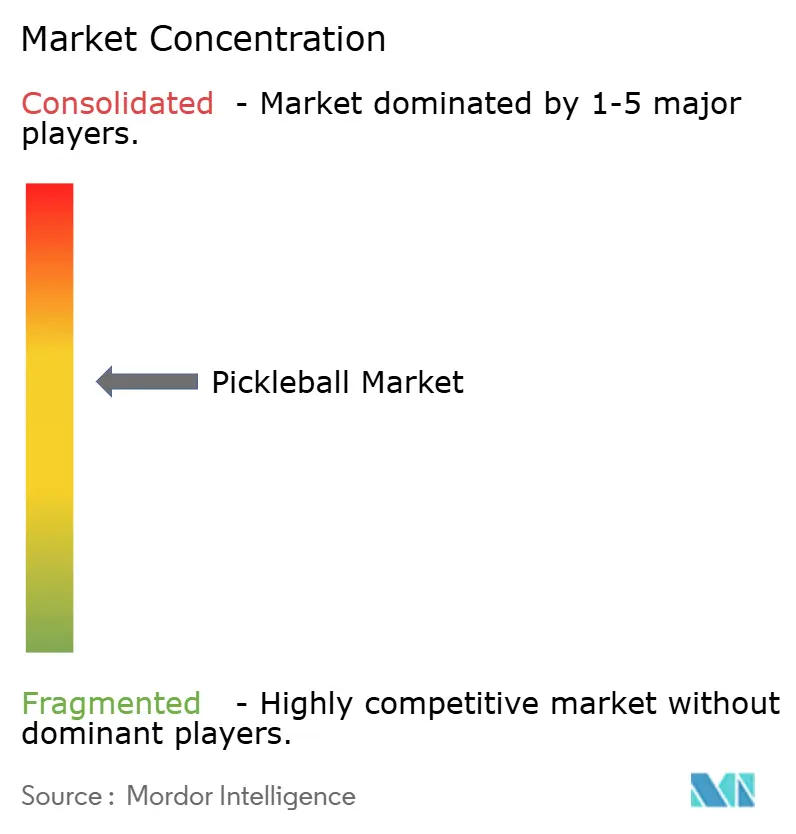
The Pickleball Market is moderately concentrated, with multisport brands and specialists competing across price tiers. Wilson, HEAD, Franklin, Selkirk, JOOLA, CRBN, and other specialists compete with different product and channel strengths. Established multi-sport brands can use wider retail relationships and familiar sporting goods portfolios. Specialist brands often focus on paddle technology, athlete partnerships, and direct customer engagement. This mix keeps competition active across entry, intermediate, and premium products. Certification requirements also influence market position because tournament-focused customers need products that meet applicable standards. USA Pickleball’s equipment requirements make compliance a commercial consideration for brands serving organized play. The result is a competitive setting where product credibility and distribution access matter as much as brand visibility. Smaller entrants can still gain attention with a focused design, but they must build confidence in product quality and availability. This competitive balance will shape how the Pickleball Market develops across established and emerging regions.
Recent strategic moves show how leading brands are investing in new products and broader reach. Selkirk received an investment from Bluestone Equity Partners in January 2026 to support product innovation, omnichannel retail, and targeted expansion in Asia. JOOLA launched its Pro V collection in March 2026, using KineticFrame design and a new paddle shape to refresh its performance range. These actions combine product development with credible player association and retail storytelling. Razer and JOOLA also introduced a limited-edition paddle in late 2025, which brought a gaming brand into a pickleball product collaboration. Such moves can broaden awareness beyond existing players, but they must be supported by reliable product quality and supply. Strategic partnerships therefore influence competition when they provide a clear product, customer, or channel advantage.
The next competitive opportunity lies in serving underdeveloped needs without losing performance credibility. Female players represent a growing customer base, and purpose-built products can help brands compete where generic designs are no longer sufficient. Certified products at accessible price points are also important in countries where imported premium gear remains expensive. Online expansion can widen access, but it requires authorized distribution and simple verification tools to control counterfeit risk. Venue growth creates opportunities for bulk supply relationships with clubs, schools, and recreation operators. Selkirk’s expanded partnership with Invited placed equipment and coaching certification programs at more than 50 private golf and country clubs in 2025. Competition also extends beyond paddles into products where durability and consistent play affect product choice. Companies that combine product development, tournament compliance, local availability, and after-sales trust are better positioned as the Pickleball Market expands.
Pickleball Industry Leaders
-
Selkirk Sport
-
JOOLA Pickleball
-
Franklin Sports, Inc.
-
Paddletek
-
Escalade Sports, Inc.
- *Disclaimer: Major Players sorted in no particular order
Recent Industry Developments
- September 2026: JOOLA launched POWER FX, its first foam-construction paddle built on patented Propulsion Core technology, retailing at USD 179.95 at nationwide retailers, marking JOOLA’s entry into the foam paddle category in response to growing player demand for alternative core materials.
- March 2026: JOOLA launched its Pro V collection featuring patent-pending KineticFrame hybrid paddle geometry, including the new Kosmos shape co-developed with professional athlete Federico Staksrud, JOOLA’s most comprehensive performance lineup to date.
- February 2026: Selkirk overhauled its SLK lineup with 3 new models, Valkyrie, Geo, and Dauntless, retiring 6 legacy SKUs to create a 4-paddle player-progression architecture addressing retailer and consumer feedback on market overcrowding.
Global Pickleball Market Report Scope
Pickleball refers to a paddle sport played on a court using solid paddles and a perforated plastic ball, supported by equipment and accessories designed for recreational and competitive play. The Pickleball Market is segmented by product type, gender, end user, distribution channel, and geography. By product type, the market includes Pickleball Paddles, Pickleball Balls, Nets and Posts, Pickleball Bags, and Accessories (Grips, Wristbands, and Protective Accessories). By gender, the market is segmented into Male and Female. By end user, the market is categorized into Individual Players and Sports Clubs & Institutions. By distribution channel, the market is divided into Online Channels and Offline Channels. By geography, the report covers North America, South America, Europe, Asia-Pacific, and Middle East and Africa, with market size and forecasts provided for each region. The market sizing has been done in value terms in USD for all the abovementioned segments.
| Pickleball Paddles |
| Pickleball Balls |
| Nets and Posts |
| Pickleball Bags |
| Accessories (Grips, Wristbands, and Protective Accessories) |
| Male |
| Female |
| Individual Players |
| Sports Clubs & Institutions |
| Online Channels |
| Offline Channels |
| North America | United States |
| Canada | |
| Mexico | |
| Rest of North America | |
| South America | Brazil |
| Argentina | |
| Rest of South America | |
| Europe | United Kingdom |
| Germany | |
| France | |
| Italy | |
| Spain | |
| Sweden | |
| Netherlands | |
| Rest of Europe | |
| Asia-Pacific | China |
| Japan | |
| India | |
| Thailand | |
| Indonesia | |
| South Korea | |
| Australia | |
| Rest of Asia-Pacific | |
| Middle East and Africa | Isreal |
| South Africa | |
| Nigeria | |
| Egypt | |
| Morocco | |
| Turkey | |
| Rest of Middle East and Africa |
| By Product Types | Pickleball Paddles | |
| Pickleball Balls | ||
| Nets and Posts | ||
| Pickleball Bags | ||
| Accessories (Grips, Wristbands, and Protective Accessories) | ||
| By Gender | Male | |
| Female | ||
| By End User | Individual Players | |
| Sports Clubs & Institutions | ||
| By Distribution Channel | Online Channels | |
| Offline Channels | ||
| By Geography | North America | United States |
| Canada | ||
| Mexico | ||
| Rest of North America | ||
| South America | Brazil | |
| Argentina | ||
| Rest of South America | ||
| Europe | United Kingdom | |
| Germany | ||
| France | ||
| Italy | ||
| Spain | ||
| Sweden | ||
| Netherlands | ||
| Rest of Europe | ||
| Asia-Pacific | China | |
| Japan | ||
| India | ||
| Thailand | ||
| Indonesia | ||
| South Korea | ||
| Australia | ||
| Rest of Asia-Pacific | ||
| Middle East and Africa | Isreal | |
| South Africa | ||
| Nigeria | ||
| Egypt | ||
| Morocco | ||
| Turkey | ||
| Rest of Middle East and Africa | ||
Key Questions Answered in the Report
What is the projected value of the pickleball equipment sector by 2032?
It is forecast to reach USD 5.79 billion by 2032, growing at a 15.7% CAGR from 2027 to 2032.
Which pickleball product category is largest?
Paddles lead with 49.23% share in 2026 and are also projected to grow at a 16.32% CAGR through 2032.
Which sales route is growing fastest for pickleball equipment?
Online channels are projected to grow at a 16.79% CAGR through 2032, supported by direct sales and wider geographic access.
Which region offers the fastest growth for pickleball equipment suppliers?
Asia-Pacific is projected to grow at a 16.54% CAGR through 2032, supported by increasing awareness and developing retail access.