
Photochromic Dyes Market Size and Share
Market Overview
| Study Period | 2021 - 2031 |
|---|---|
| Market Size (2026) | USD 252.71 Million |
| Market Size (2031) | USD 355.60 Million |
| Growth Rate (2026 - 2031) | 7.07 % |
| Fastest Growing Market | Asia-Pacific |
| Largest Market | North America |
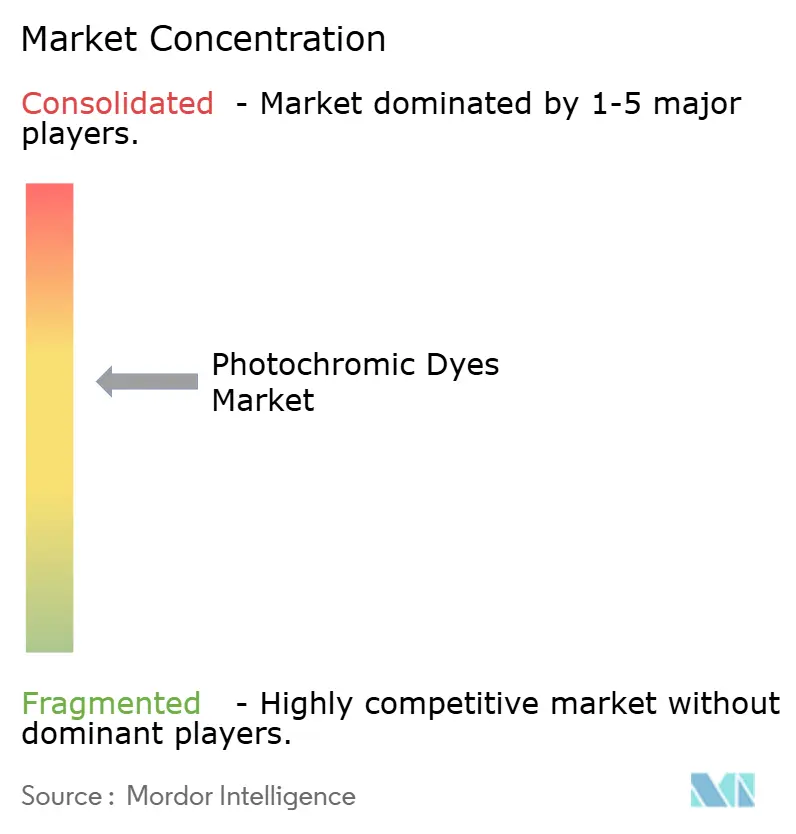
| Market Concentration | Medium |
Major Players *Disclaimer: Major Players sorted in no particular order Image © Mordor Intelligence. Reuse requires attribution under CC BY 4.0. | |
Photochromic Dyes Market Analysis by Mordor Intelligence
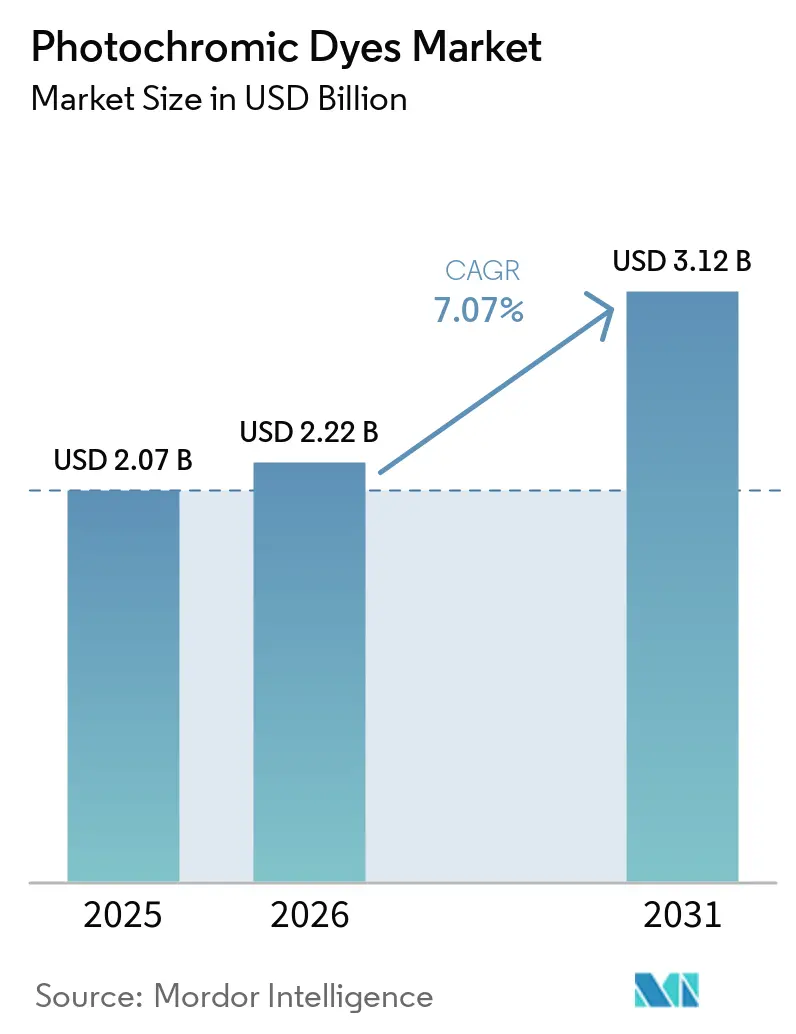
The Photochromic Dyes Market size was valued at USD 236.18 million in 2025 and is estimated to grow from USD 252.71 million in 2026 to reach USD 355.60 million by 2031, at a CAGR of 7.07% during the forecast period (2026-2031). Demand from ophthalmic lens producers remained the main source of revenue in 2025, while smart plastics, security printing, and functional coatings broadened the use base. Premium eyewear brands increasingly relied on clinically tested performance claims, which raised specifications for activation, fade-back behavior, and fatigue resistance. This shift favored suppliers that could document consistent production quality and meet optical-device requirements. UV-protective benefits and color customization also expanded the appeal of the photochromic dyes market beyond conventional lenses. Suppliers faced continued limits from synthesis costs and photochemical fatigue, although microencapsulation improved compatibility with plastics, coatings, and textile substrates.
Key Report Takeaways
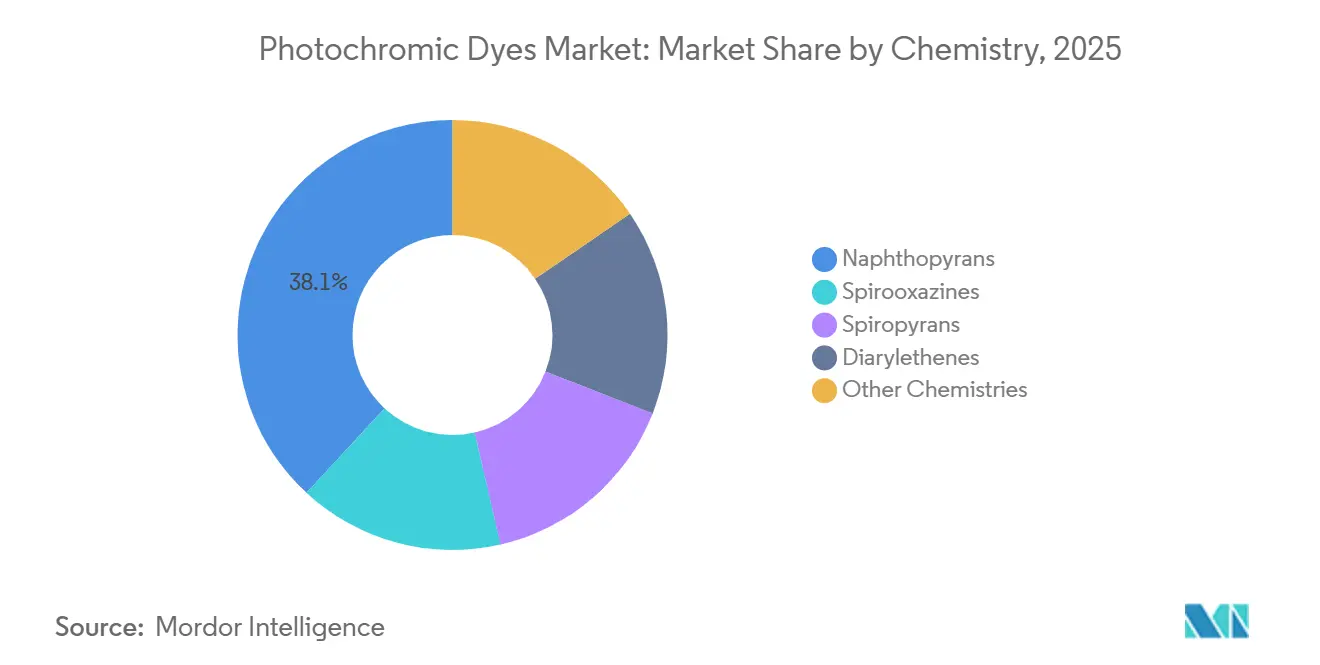
- By chemistry, naphthopyrans held 38.12% of the photochromic dyes market share in 2025, while diarylethenes are projected to advance at an 8.05% CAGR through 2031.
- By form, powder held 42.54% of the photochromic dyes market share in 2025, while liquid is projected to advance at a 7.84% CAGR through 2031.
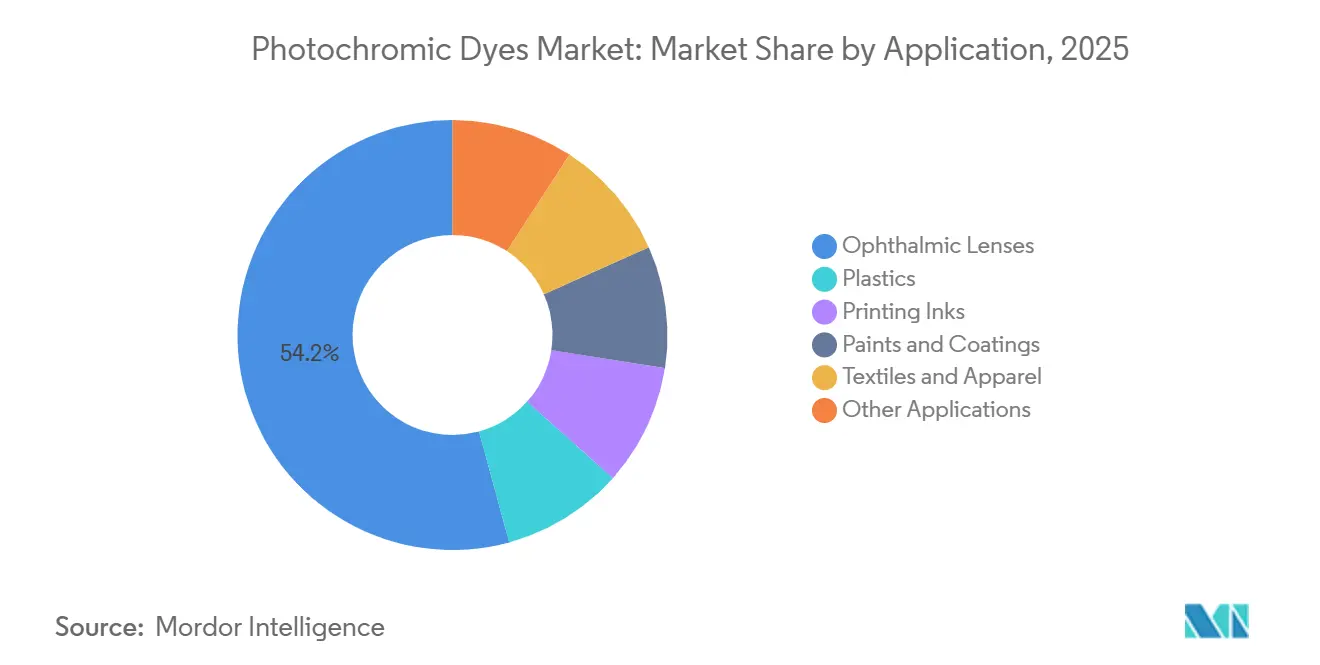
- By application, ophthalmic lenses held 54.25% of the photochromic dyes market share in 2025, while plastics are projected to advance at an 8.44% CAGR through 2031.
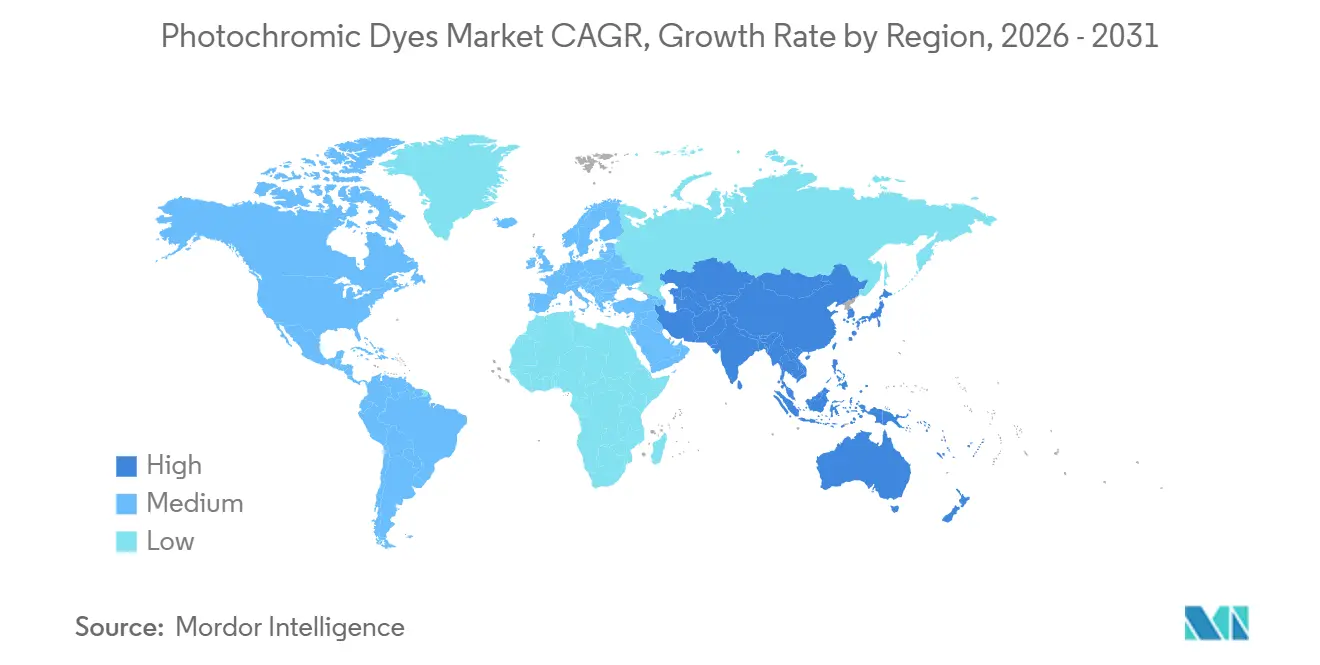
- By geography, North America held 32.02% of the photochromic dyes market share in 2025, while Asia-Pacific is projected to advance at an 8.17% CAGR through 2031.
Note: Market size and forecast figures in this report are generated using Mordor Intelligence’s proprietary estimation framework, updated with the latest available data and insights as of January 2026.
Market Trends and Insights
Drivers Impact Analysis of Photochromic Dyes Market*
| Driver | (~) % Impact on CAGR Forecast | Geographic Relevance | Impact Timeline |
|---|---|---|---|
| Rising Demand for Adaptive Optical and UV-Protective Products | +2.2% | Global, with peak adoption in North America and Western Europe | Medium term (2–4 years) |
| Expansion of Smart Packaging, Labels, and Security Printing | +1.8% | APAC core, spill-over to MEA | Medium term (2–4 years) |
| Growth of Smart Materials in Electronics and Optical Devices | +1.5% | North America, East Asia | Long term (≥ 4 years) |
| Advances in Photochromic Formulation and Microencapsulation | +1.2% | Global | Medium term (2–4 years) |
| Under-Reported: Demand for Application-Specific Color and Fade Profiles | +0.9% | North America, Europe | Short term (≤ 2 years) |
| Under-Reported: Integration of Photochromics Into Low-Order, Digital-Printing Workflows | +0.6% | APAC, Europe | Short term (≤ 2 years) |
| Source: Mordor Intelligence | |||
Rising Demand for Adaptive Optical and UV-Protective Products
Premium ophthalmic lenses created demand for photochromic systems with measurable performance advantages. In April 2026, HOYA Vision Care launched Sensity 3, the third generation of its light-adaptive lens range. HOYA stated that internal tests showed up to 4× greater fatigue resistance and 4× improved color stability than a leading competitor. The company also stated that the lens had a 25% faster fade-back speed than the prior Sensity generation. The Association of Optometrists reported in 2025 that Transitions GEN S was the first photochromic product positioned with double-blind, randomized clinical trial evidence of improved visual health. These claims increased the need for dye chemistries with reliable activation thresholds, repeatable fade-back behavior, and controlled production quality across the photochromic dyes market.
Expansion of Smart Packaging, Labels, and Security Printing
Brand owners used photochromic inks to improve visible authentication in packaging and printed documents. Photochromic UV inks responded under specified ultraviolet wavelengths, which made their response harder to reproduce with ordinary photographic methods. Inspectors could observe the color response without using dedicated reading equipment. A 2025 study demonstrated screen-printed spiropyran sensors on paper substrates for document authentication. The response could be measured against a pre-calibrated color scale for customs and quality-control use. This evidence supported wider interest in the photochromic dyes market for labels, documents, and brand-protection applications.
Growth of Smart Materials in Electronics and Optical Devices
Diarylethene materials moved from laboratory studies toward electronic and optical-device architectures. Research published in 2025 showed that 3D-printable photochromic materials based on spiropyran and diarylethene derivatives could perform all-optical arithmetic and logic operations. The materials also showed repeated photoswitching and longer-term information storage. Separate 2025 research showed that diarylethene-functionalized molybdenum disulfide, MoS₂, transistor channels enabled reversible switching of photoluminescence and electrical conductivity. These findings expanded the technical role of the photochromic dyes market beyond fade-back performance in eyewear. They also supported demand for materials designed around device integration rather than bulk optical supply.
Advances in Photochromic Formulation and Microencapsulation
Microencapsulation helped extend photochromic dyes from specialty optics into plastics and textiles. A 2025 study reported photochromic microcapsules with highly cross-linked polyurethane shells reinforced with nano-titanium dioxide, or nano-TiO₂. The shells protected dye cores from ultraviolet degradation and thermal decomposition up to 180 °C. This temperature range supported use in standard polyolefin injection-molding processes. It also improved the ability of converters to use photochromic materials in high-temperature manufacturing settings. These advances widened the addressable applications for the photochromic dyes market.
Restraints Impact Analysis of Photochromic Dyes Market*
| Restraint | (~) % Impact on CAGR Forecast | Geographic Relevance | Impact Timeline |
|---|---|---|---|
| High Manufacturing Complexity and Specialty-Chemical Costs | -0.7% | Global, most pronounced in price-sensitive emerging markets | Long term (≥ 4 years) |
| Photochemical Fatigue and Environmental Stability Limitations | -0.5% | Global | Medium term (2–4 years) |
| Under-Reported: Formulation Compatibility Risk Across Binders, Solvents, and Substrates | -0.4% | Global | Short term (≤ 2 years) |
| Under-Reported: Limited Standardization of Performance Testing Across Applications | -0.3% | Global | Medium term (2–4 years) |
| Source: Mordor Intelligence | |||
High Manufacturing Complexity and Specialty-Chemical Costs
Multi-step organic synthesis created high costs for naphthopyran and diarylethene compounds. These costs limited new supplier entry and constrained adoption in high-volume plastic and textile uses. Spirooxazines and spiropyrans could be produced at a lower unit cost. However, their narrower temperature ranges meant that more expensive naphthopyran systems remained important for ophthalmic lenses. This maintained higher pricing across the premium part of the photochromic dyes market. Specialty aromatic intermediates also exposed producers to input-cost changes when they lacked longer-term supply arrangements.
Photochemical Fatigue and Environmental Stability Limitations
Repeated ultraviolet activation degraded photochromic chromophores over time. This limited their use in applications that require many activation cycles, including reusable textiles, outdoor sensor labels, and smart packaging. Conventional naphthopyran lens formulations were designed for thousands of activation cycles. Industrial applications could require substantially more cycles to meet durability expectations. Spiropyran systems faced ring-opening irreversibility under prolonged ultraviolet exposure. This limitation constrained broader use of lower-cost chemistries in the photochromic dyes market.
*Our forecasts treat driver/restraint impacts as directional, not additive. The impact forecasts reflect baseline growth, mix effects, and variable interactions.
Photochromic Dyes Market Segment Analysis
By Chemistry:
Naphthopyrans Lead Revenue While Diarylethenes Gain MomentumNaphthopyrans held 38.12% revenue share in 2025, supported by their extensive use in ophthalmic lens formulations. Their behavior suited high-volume lens-casting resin systems and established optical production processes. Naphthopyrans also offered faster fade-back behavior and a broader operating temperature range than earlier alternatives. These characteristics supported their use in premium eyewear. Spirooxazines retained a role in lower-cost lens grades and selected printing-ink applications. Spiropyrans are used in photonic paper, anti-counterfeiting labels, and textile substrates where ultraviolet reversibility and color contrast are important. Other chemistries, including fulgide derivatives and organic-inorganic hybrids, remained commercially smaller. They continued to receive research attention because applications needed distinct activation wavelengths and switching behavior. The photochromic dyes industry retained a chemistry mix shaped by the performance requirements of each end-use.
Diarylethenes are projected to advance at an 8.05% CAGR through 2031. Their thermal bistability supported optical logic, data storage, fluorescence sensing, and other applications where a retained switched state was necessary. A 2025 review covered diarylethenes, spiropyrans, and 5 other photoswitch classes. It showed the range of photophysical behaviors available to formulators seeking tailored activation wavelengths and switching kinetics. Research published in 2025 introduced ferrocene-containing push-pull naphthopyran structures with panchromatic visible-light absorption. This work could support future adaptive lenses that respond beyond ultraviolet-dependent use cases. ISO 8980-3 continued to define performance requirements for ophthalmic qualification. These requirements reinforced naphthopyran adoption while alternative chemistries completed commercial validation. The photochromic dyes market supported both established lens chemistry and newer materials for specialized devices.

By Form:
Powder Retains Scale While Liquid Supports Precision WorkflowsPowder held 42.54% revenue share in 2025, reflecting its cost efficiency in high-temperature polymer processing and batch lens-casting operations. Its established use made it suitable for applications that required predictable handling at a larger scale. Encapsulated pigments occupied a different functional position. Their core-shell design protected dye molecules from thermal and chemical stresses during processing. This protection enabled use in binder environments such as polyvinyl chloride, plastisols, and water-based coatings. A 2025 study confirmed that nano-TiO₂-reinforced polyurethane shells stabilized photochromic cores up to 180 °C while retaining high optical transmittance. This threshold was relevant to polypropylene and acrylonitrile butadiene styrene (ABS), injection molders. The photochromic dyes market size for protected pigments was shaped by the need to preserve functionality during demanding conversion processes.
The liquid is projected to advance at a 7.84% CAGR through 2031, the fastest rate in the form segment. Digital label printing and customized lens-coating workflows required solution-phase delivery instead of powder pre-dispersion. SDC Technologies offered CrystalChrome photochromic liquid coatings for dip, flow, and spin applications. Its 2025 alliance with James Robinson Speciality Ingredients strengthened the liquid-phase value chain through an exclusive license for the Reversacol brand. Other forms, including pre-polymerized solution systems and organic-inorganic dispersions, remained at an early commercial stage. Formulators increasingly differentiate products through shelf-life stability and compatibility with real converter conditions. This emphasis favored materials that performed consistently in digital and precision coating workflows. The photochromic dyes market remained dependent on form selection because process requirements varied across lens, print, plastic, and coating uses.
By Application:
Ophthalmic Lenses Lead While Plastics Accelerate AdoptionOphthalmic lenses held 54.25% revenue share in 2025 and remained the largest application for photochromic dyes. Premium lens programs supported this position through demand for faster fade-back behavior, greater fatigue resistance, and consistent color performance. HOYA Vision Care introduced Sensity 3 in April 2026 with claims of up to 4× greater fatigue resistance and 4× better color stability than a leading competitor. It also stated that the lens had a 25% faster fade-back speed than the preceding Sensity generation[1]. Printing inks and paints and coatings represented mid-tier application areas. These applications benefited from security-printing requirements and interest in functional architectural coatings. Textiles and apparel remained an emerging area for microencapsulated fibers, ultraviolet-exposure indicator garments, and rewritable patterned fabrics. The photochromic dyes market share in lenses reflected a mature, high-value demand base rather than a broad commodity materials position.
Plastics are projected to advance at an 8.44% CAGR through 2031, the strongest application growth rate. Toy and novelty goods, automotive interior panels, smart food packaging, and wearable device housings supported this demand. Dye loading in plastic extrusion ranged from 0.8% to 3%, so additional photochromic plastic output directly increased material demand. A 2026 study demonstrated photochromic spiropyran in screen-printable cholesteric liquid crystal elastomer coatings. The system combined viewing-angle color shifts, circularly polarized reflection, and ultraviolet-tunable random lasing for anti-counterfeiting uses. This work illustrated the performance potential of printed coatings and security applications. Plastic converters required materials that remained stable through processing and use. The photochromic dyes market was therefore supported by both higher plastic volumes and application-specific formulation needs.
Geography Analysis
North America Photochromic Dyes Market
North America held 32.02% revenue share of the photochromic dyes market in 2025. Managed vision care networks shaped lens dispensing and supported premium photochromic upgrades at the retail level, providing a relatively stable demand base for optical products. The Association of Optometrists reported that the development of Transitions GEN S involved 165 scientists and 55 doctoral-level chemists over 5 years, reflecting the depth of the regional photochromic supply chain. Security printing and brand protection in pharmaceuticals and premium spirits also supported secondary demand as counterfeiting pressures increased.
Europe Photochromic Dyes Market
Europe remained a technically demanding region for the photochromic dyes market because it combined optical manufacturing, European Union Registration, Evaluation, Authorisation and Restriction of Chemicals (REACH) compliance, and interest from aerospace and automotive users. Germany, France, and the United Kingdom represented the larger European centers, while France-based OliKrom presented VisioKrom at the Paris Air Show in June 2025[2]. The company positioned the additive for visualizing anti-corrosion treatments on aerospace and automotive metal components, using photochromic chemistry for quality control rather than a consumer lens product. Nordic countries supported higher per-capita lens adoption through outdoor use patterns and strong optical retail access, while Eastern European manufacturing hubs supported security-printing and smart-packaging demand for domestic and export supply chains.
South America, APAC and MEA Photochromic Dyes Market
Asia-Pacific is projected to advance at an 8.17% CAGR through 2031, the highest regional rate, as rising myopia prevalence in East Asia has increased demand for adaptive eyewear among school-age populations. A growing middle-class customer base supported premium lens demand, while security-printing requirements across the Association of Southeast Asian Nations, or ASEAN, markets added another use case. Japan remained important for photochromic chemistry development and manufacturing, while South Korea and Japan’s ASEAN trading partners contributed through security printing and coatings. South America and Middle East and Africa remained smaller geographic segments, with Brazil representing South America’s main demand center as organized optical retail chains expanded photochromic lens attachment programs. The photochromic dyes market size in Asia-Pacific is supported by both eyewear demand and expanding functional-material applications.
Competitive Landscape
The photochromic dyes market is moderately concentrated. Tokuyama Corporation and Mitsui Chemicals held important positions through patent activity and relationships with ophthalmic lens original equipment manufacturers, supported by integration across materials, coatings, and lens-processing activities. Mid-tier companies included Chromatic Technologies Inc., Kolortek Co., Ltd., QCR Solutions Corp, and LCR Hallcrest. These companies competed through application engineering, customization speed, and proximity to converter customers, with roles more closely tied to formulation and customer support than to new dye synthesis, creating higher entry barriers in the photochromic dyes market.
SDC Technologies, a Mitsui Chemicals subsidiary, entered a strategic alliance with James Robinson Speciality Ingredients in 2025. The agreement transferred the Reversacol brand and a comprehensive photochromic dye intellectual-property portfolio under SDC’s exclusive license. This move extended Mitsui Chemicals’ reach from dye synthesis to lens-coating systems and processing equipment, while narrowing the independently accessible intellectual-property base for third-party formulators. SDC Technologies announced in 2026 that it was expanding its research and development and manufacturing base in the United States, with relocation scheduled for completion in October 2026, while HOYA Vision Care raised performance expectations in April 2026 through the launch of Sensity 3. These moves show that competitive activity centers on intellectual property, technical validation, and integrated supply capabilities.
Precision digital printing remained an area with room for product development because liquid-phase dyes for ultraviolet inkjet and flexographic digital label systems still required specialized formulations. Many existing presses relied on pre-formulated ink concentrates instead of general-purpose photochromic dye solutions. This gap favored companies with flexible formulation capabilities and close converter relationships. University spinouts and deep-technology ventures also pursued diarylethene optical transistors and multi-stimulus anti-counterfeiting films, while a 2026 Proceedings of the National Academy of Sciences (PNAS) study showed that printable coatings could integrate photochromic switching with structural optical effects. The photochromic dyes market could benefit as companies establish validated supply positions in functional security printing and optoelectronics, and as specialized uses reach wider commercial scale.
Photochromic Dyes Industry Leaders
-
Mitsui Chemicals, Inc.
-
Milliken
-
Tokuyama Corporation
-
James Robinson Speciality Ingredients
-
Yamada Chemical Co., Ltd.
- *Disclaimer: Major Players sorted in no particular order
Photochromic Dyes Market Companies Covered in this Report
- Bloclo Technology Company
- Chromatic Technologies Inc.
- FX Pigments Pvt. Ltd.
- James Robinson Speciality Ingredients
- Kolortek Co., Ltd.
- LCR Hallcrest
- Matsui International
- Milliken
- Mitsui Chemicals, Inc.
- OliKrom
- QCR Solutions Corp
- Tokuyama Corporation
- Vivimed Labs
- Yamada Chemical Co., Ltd.
Recent Industry Developments in Photochromic Dyes Market
- April 2026: HOYA Vision Care launched Sensity 3, the third generation of its Sensity photochromic lens line, claiming up to 4× greater fatigue resistance and 4× improved color stability compared to a competitor, and a 25% faster fade-back speed compared to the prior generation. The lens became available through Vision Service Plan (VSP) managed vision care on April 16, 2026, reinforcing HOYA's premium positioning in the North American optical channel and increasing technical demand on photochromic dye supply partners.
- June 2025: OliKrom presented VisioKrom at the Paris Air Show 2025, a patented photochromic additive that makes colorless anti-corrosion treatments visible on aerospace and automotive metal components. The development expands the application of photochromic dyes into industrial coatings, supporting demand for advanced functional photochromic materials in quality inspection and surface treatment.
Global Photochromic Dyes Market Report Scope
Photochromic dyes are light-responsive compounds that reversibly change color when exposed to ultraviolet (UV) radiation and return to their original state when the UV source is removed. They are widely used in ophthalmic lenses, plastics, coatings, inks, textiles, and other applications where dynamic color-changing and UV-responsive properties are required.
The Photochromic Dyes Market is segmented by chemistry, form, application, and geography. By chemistry, the market is segmented into naphthopyrans, spirooxazines, spiropyrans, diarylethenes, and other chemistries. By form, the market is segmented into powder, liquid, encapsulated pigments, and other forms. By application, the market is segmented into ophthalmic lenses, plastics, printing inks, paints and coatings, textiles and apparel, and other applications. The report also covers the market size and forecasts for photochromic dyes in 15 countries across major regions. For each segment, the market sizing and forecasts have been done on the basis of value (USD).
| Naphthopyrans |
| Spirooxazines |
| Spiropyrans |
| Diarylethenes |
| Other Chemistries |
| Powder |
| Liquid |
| Encapsulated Pigments |
| Other Forms |
| Ophthalmic Lenses |
| Plastics |
| Printing Inks |
| Paints and Coatings |
| Textiles and Apparel |
| Other Applications |
| Asia-Pacific | China |
| India | |
| Japan | |
| South Korea | |
| ASEAN Countries | |
| Rest of Asia-Pacific | |
| North America | United States |
| Canada | |
| Mexico | |
| Europe | Germany |
| United Kingdom | |
| France | |
| Italy | |
| NORDIC Countries | |
| Rest of Europe | |
| South America | Brazil |
| Argentina | |
| Rest of South America | |
| Middle East and Africa | Saudi Arabia |
| South Africa | |
| Rest of Middle East and Africa |
| By Chemistry | Naphthopyrans | |
| Spirooxazines | ||
| Spiropyrans | ||
| Diarylethenes | ||
| Other Chemistries | ||
| By Form | Powder | |
| Liquid | ||
| Encapsulated Pigments | ||
| Other Forms | ||
| By Application | Ophthalmic Lenses | |
| Plastics | ||
| Printing Inks | ||
| Paints and Coatings | ||
| Textiles and Apparel | ||
| Other Applications | ||
| By Geography | Asia-Pacific | China |
| India | ||
| Japan | ||
| South Korea | ||
| ASEAN Countries | ||
| Rest of Asia-Pacific | ||
| North America | United States | |
| Canada | ||
| Mexico | ||
| Europe | Germany | |
| United Kingdom | ||
| France | ||
| Italy | ||
| NORDIC Countries | ||
| Rest of Europe | ||
| South America | Brazil | |
| Argentina | ||
| Rest of South America | ||
| Middle East and Africa | Saudi Arabia | |
| South Africa | ||
| Rest of Middle East and Africa | ||
Key Questions Answered in the Report
What is the size of the photochromic dyes market?
The Photochromic Dyes Market size was valued at USD 236.18 million in 2025 and is estimated to grow from USD 252.71 million in 2026 to reach USD 355.60 million by 2031, at a CAGR of 7.07% during the forecast period (2026-2031).
Which chemistry led revenue in 2025?
Naphthopyrans led the chemistry segment with 38.12% revenue share in 2025 because of their established role in ophthalmic lens formulations.
Which application is expected to grow fastest through 2031?
Plastics are projected to advance at an 8.44% CAGR through 2031, supported by uses in automotive interiors, packaging, toys, and wearable-device housings.
Which region is expected to grow fastest through 2031?
Asia-Pacific is projected to advance at an 8.17% CAGR through 2031, supported by adaptive eyewear demand and security-printing requirements.