
Philippines Pet Veterinary Diets Market Size and Share
Market Overview
| Study Period | 2021 - 2031 |
|---|---|
| Forecast Data Period | 2026 - 2031 |
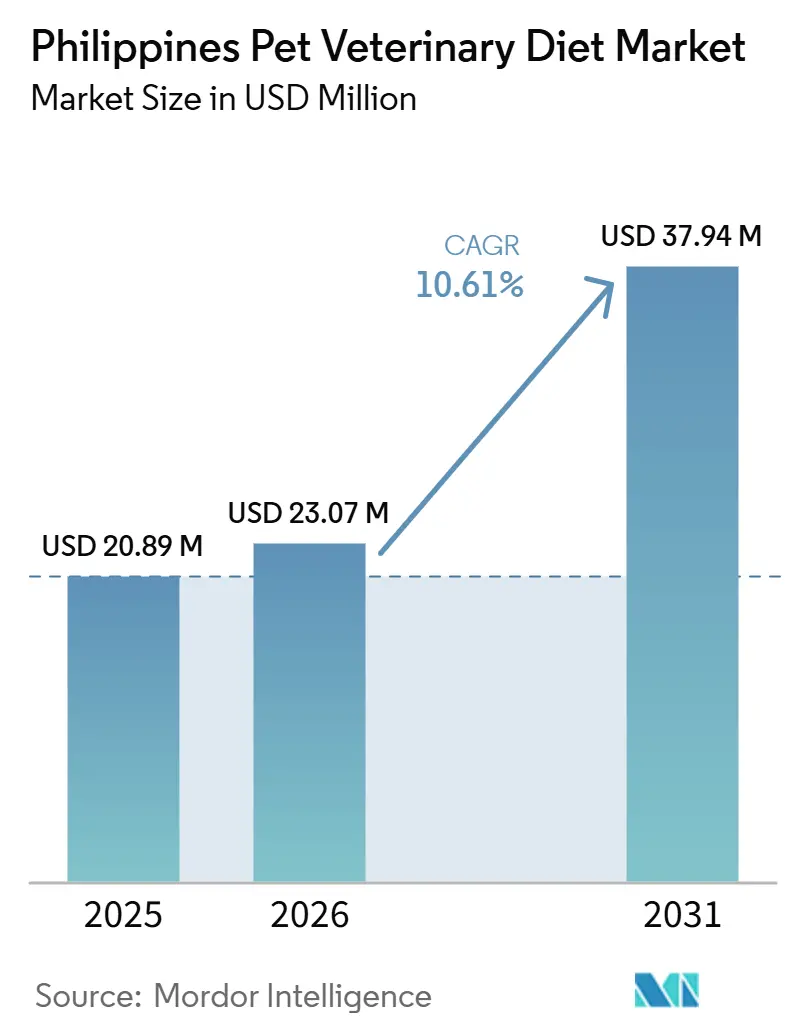
| Base Year Market Size (2025) | USD 20.89 Million |
| Market Size (2026) | USD 23.07 Million |
| Market Size (2031) | USD 37.94 Million |
| Growth Rate (2026 - 2031) | 10.61 % |
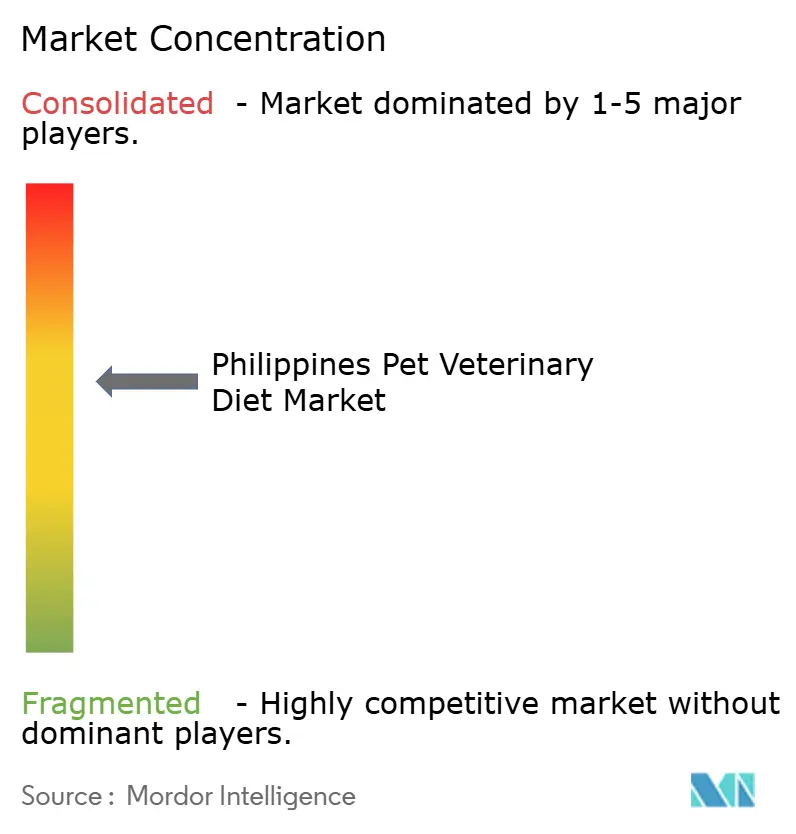
| Market Concentration | Medium |
Major Players *Disclaimer: Major Players sorted in no particular order Image © Mordor Intelligence. Reuse requires attribution under CC BY 4.0. | |
Philippines Pet Veterinary Diets Market Analysis by Mordor Intelligence
The Philippines pet veterinary diets market size stood at USD 20.89 million in 2025 and is estimated to grow from USD 23.07 million in 2026 to reach USD 37.94 million by 2031, at a CAGR of 10.6% during the forecast period 2026-2031. The Philippines pet veterinary diets market is also being shaped by stricter enforcement against unregistered products sold online, giving compliant multinational brands a clearer advantage in the fastest-growing channels. Regulatory agencies have increased monitoring of e-commerce platforms, requiring sellers to demonstrate product registration before listing veterinary diet products. This has reduced the presence of unverified imports and gray-market goods, creating a more structured competitive environment. At the same time, domestic feed and nutrition companies are moving toward functional and therapeutic pet food, increasing the likelihood of lower-priced local competition during the forecast period. Several local manufacturers have begun investing in research partnerships and reformulating existing product lines to meet veterinary diet standards, which could allow them to capture price-sensitive segments that multinational brands have traditionally underserved.
Key Report Takeaways
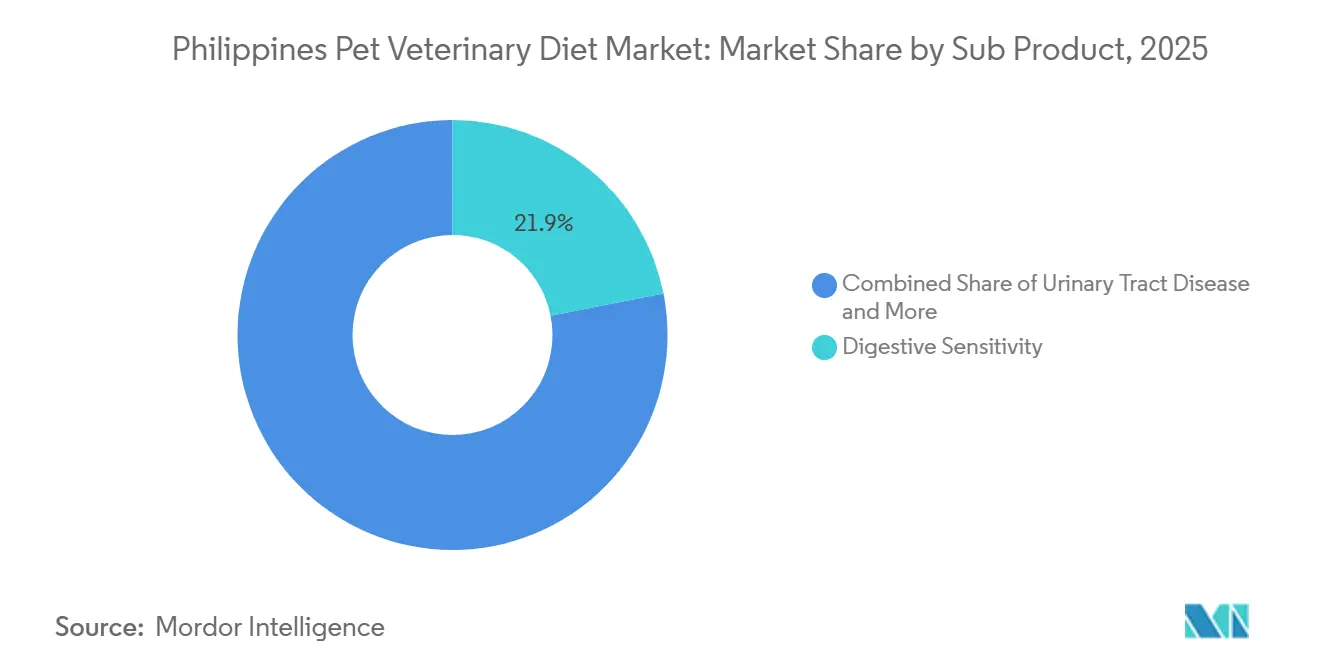
- By sub-product, digestive sensitivity held 21.9% of the Philippines pet veterinary diets market share in 2025 as the largest segment, while oral care diets is the fastest-growing segment and is projected to advance at a 12.2% CAGR from 2026 to 2031.
- By pet type, dogs held 61.8% of the Philippines pet veterinary diets market share in 2025, as the largest segment and the fastest-growing at a 13.2% CAGR from 2026 to 2031.
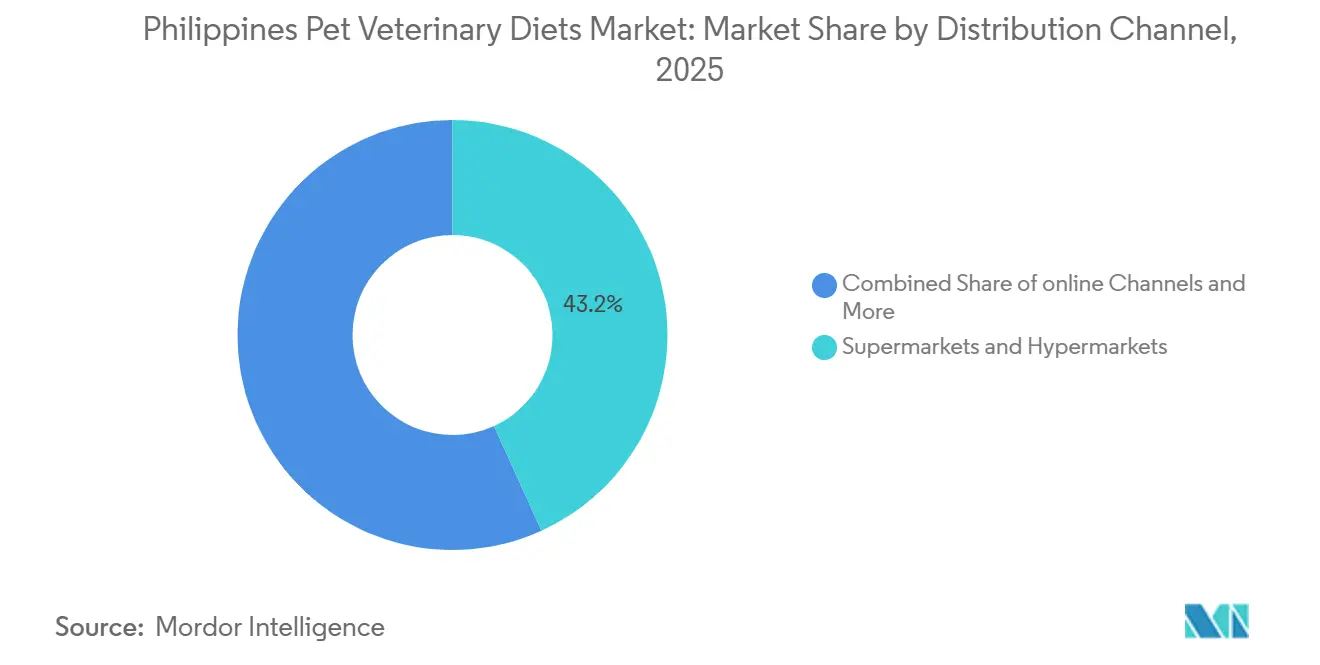
- By distribution channel, supermarkets and hypermarkets accounted for 43.2% of the Philippines pet veterinary diets market in 2025, making them the largest channel, while the Online Channel is the fastest-growing, projected to expand at a 14.1% CAGR from 2026 to 2031.
Note: Market size and forecast figures in this report are generated using Mordor Intelligence’s proprietary estimation framework, updated with the latest available data and insights as of January 2026.
Philippines Pet Veterinary Diets Market Trends and Insights
Drivers Impact Analysis*
| Driver | (~) % Impact on CAGR Forecast | Geographic Relevance | Impact Timeline |
|---|---|---|---|
| Rising pet humanization and premium health spend | +2.5% | National, strongest in Metro Manila, Cebu, and Davao | Medium term (2-4 years) |
| Expansion of veterinary advice through digital consultations | +1.7% | National, early gains in Metro Manila and Cebu | Short term (≤ 2 years) |
| Growth of prescription diet awareness in urban philippines | +2.0% | Metro Manila, Cebu, Davao | Short term (≤ 2 years) |
| E-commerce access to specialized diet Stock Keeping Units (SKUs) | +1.5% | National, early gains in Metro Manila, Calabarzon, and Central Luzon | Short term (≤ 2 years) |
| Underused conversion of feed milling capacity into therapeutic pet nutrition | +1.0% | Manufacturing hubs in Luzon and Mindanao | Medium term (2-4 years) |
| Rising demand for condition-specific diets in secondary cities | +1.2% | Secondary cities across Luzon, Visayas, and Mindanao | Medium term (2-4 years) |
| Source: Mordor Intelligence | |||
Rising Pet Humanization and Premium Health Spend
Pet ownership in the Philippines has moved beyond simple companionship and is now tied more closely to spending on health and nutrition. According to the United States Department of Commerce, the 94% household ownership rate reported in early 2024 shows that pets are part of daily family life across a broad consumer base. That shift matters for the Philippines pet veterinary diets market because it raises acceptance of food as part of treatment rather than only as a routine purchase[1]Source: International Trade Administration, “Philippines Upscale Pet Food and Supplies,” trade.gov. Younger pet owners are more willing to seek advice, compare products online, and follow prescribed feeding plans when a veterinarian explains the benefits. They are also more likely to research ingredients, read product reviews, and switch brands if they find a better option that aligns with their pet's health needs. This behavior is reinforced by greater access to digital platforms, where peer recommendations and veterinary guidance are readily available. As a result, premium health spending among this group is linked not only to income growth, but also to a greater willingness to pay for targeted care.
Expansion of Veterinary Advice Through Digital Consultations
Digital veterinary access is starting to reduce a long-standing gap between demand and clinical guidance in the country. Research named "SMART Vet: A Knowledge Management Platform Application for Enhancing Local Government Unit Veterinary Services," published in 2024, showed that local government veterinary services in the Philippines still relied heavily on manual walk-in systems, with Las Piñas City identified as the first local government unit veterinary office with an information technology management system as of early 2024[2]Source: Bureau of Animal Industry, “Citizen’s Charter 2024 – Issuance of LTO and CFPR, Animal Feeds, Veterinary Drugs and Biologics Control Division,” bai.gov.ph. That slow starting point creates room for online consultations and remote follow-up to influence treatment decisions more quickly. Royal Canin Philippines also used its September 2025 Vet Symposium in Cebu to connect gut health education with digital practice change, which shows that brand strategies are adapting to this shift. The Philippines pet veterinary diets market should benefit as refills and condition monitoring become easier for owners outside top clinic clusters. Early investment in veterinary partnerships is likely to matter, as digital touchpoints can shape repeat purchases before price competition becomes the main factor.
Growth of Prescription Diet Awareness in Urban Philippines
Urban awareness is rising because large cities continue to receive the strongest mix of veterinary exposure, organized retail access, and education from global brands. Royal Canin Philippines opened Southeast Asia's first dedicated pet nutrition educational hub in Cainta, Rizal. Operations began in early 2025, following the October 2024 launch, which aimed to strengthen pet nutrition education among veterinarians and pet owners nationwide. Hill’s Pet Nutrition (Colgate-Palmolive Co.) also introduced new Hill’s Prescription Diet products featuring ActivBiome+ technology at VMX 2025, expanding clinical options for multi-condition care in the Philippines market. The formal rule that pet food with therapeutic claims must be registered with the Bureau of Animal Industry also supports trust in legitimate clinical products. The Philippines pet veterinary diets market is therefore seeing awareness build through both education and regulation. That combination tends to favor brands with larger portfolios, stronger training support, and more complete product registration.
E-Commerce Access to Specialized Diet Stock Keeping Units (SKUs)
Online platforms are making specialized diets easier to find, compare, and reorder, especially for owners who already have a prescription. It shows that Shopee, Lazada, and TikTok Shop now carry multiple Royal Canin and Hill’s prescription lines through specialist pet retailers and channel partners. This improves reach in the Philippine pet veterinary diet market because repeat buyers no longer need to rely solely on clinic shelves or limited local assortments. At the same time, the Bureau of Animal Industry warned in 2025 and again in 2026 that unregistered pet food and veterinary nutrition products were being sold through these same platforms[3]Source: Bureau of Animal Industry, “Public Warning Against Unregistered Pet Food Products Sold Online,” philstar.com. The channel is therefore opening access while also making compliance and seller control more important.
Restraints Impact Analysis*
| Restraint | (~) % Impact on CAGR Forecast | Geographic Relevance | Impact Timeline |
|---|---|---|---|
| High price sensitivity and table-scrap feeding habits | -1.8% | National, stronger in provincial and secondary cities | Medium term (2-4 years) |
| Slow product registration and clearance cycles | -0.9% | National | Short term (≤ 2 years) |
| Limited veterinarian density outside major urban centers | -0.8% | Visayas, Mindanao, provincial Luzon | Long term (≥ 4 years) |
| Counterfeit and gray-market product risk | -0.6% | National, prominent on e-commerce platforms | Short term (≤ 2 years) |
| Source: Mordor Intelligence | |||
High Price Sensitivity and Table-Scrap Feeding Habits
Price remains the most significant barrier to wider adoption of therapeutic diets. Trade sources noted significantly lower annual dog food spending in the Philippines than in several Asian peers. The same sources also pointed to household use of table scraps, which limits routine acceptance of higher-priced formulated food. As a result, many pet owners opt for conventional or homemade feeding practices over prescription or condition-specific formulations. The cost gap between standard commercial pet food and veterinary diet products is considerable, making therapeutic options inaccessible to a large portion of the pet-owning population. This keeps demand for veterinary diet products concentrated among urban middle- and higher-income households, where disposable income is sufficient to support routine veterinary care and specialized nutrition. It also raises the possibility that lower-priced domestic functional products could gain market share if they establish credible clinical positioning, particularly as awareness of pet health conditions grows among a broader consumer base.
Slow Product Registration and Clearance Cycles
The regulatory pathway is clear, but the time and process burden remain significant. The Bureau of Animal Industry Citizens’ Charter for 2024 requires product registration documents that include the formal application form, a Certificate of Analysis from an accredited laboratory, a product label, and proof of payment. The United States Department of Agriculture and United States Food and Drug Administration report also clarified that therapeutic claims create an added regulatory layer through the Philippine Food and Drug Administration. That slows the speed at which new stock-keeping units can reach the market. For global brands with broad portfolios, the Philippines pet veterinary diets market can lag other Association of Southeast Asian Nations markets because each therapeutic indication may require separate clearance. Limited accredited testing capacity can also stretch launch timing for both imports and local entrants.
*Our forecasts treat driver/restraint impacts as directional, not additive. The impact forecasts reflect baseline growth, mix effects, and variable interactions.
Segment Analysis
By Sub Product: Digestive and Urinary Formulations Remain the Main Clinical Focus
Digestive sensitivity was the largest sub-product and held 21.9% market share in 2025, reflecting how often digestive issues are discussed in veterinary care for the country’s large small-breed dog base. Royal Canin Philippines has built a visible digestive portfolio through veterinary channels, including Gastrointestinal, Sensitivity Control, and Intestinal formulations, and it reinforced that focus through its 2025 veterinary symposium in Cebu. Renal diets remain another core category because aging pets need sustained nutritional support, and owners tend to stay on treatment once a condition is clearly diagnosed. The Philippines pet veterinary diets market also shows a compliance advantage for brands that already have multiple therapeutic products registered. That advantage matters because new entrants must clear individual products rather than enter the full clinical basket at once.
The Philippines pet veterinary diets market for oral care diets is projected to expand at a 12.2% CAGR between 2026 and 2031, making it the fastest-growing sub-product. Oral care is growing from a smaller base, but its progress still depends on stronger specialist access beyond Metro Manila. The growth pattern aligns with urban feeding habits and rising diagnoses, especially among cats that rely heavily on dry food and have lower hydration rates. Virbac SA has also linked obesity nutrition to a broader need for clinical weight management, which supports the view that targeted diets will diversify as routine body condition scoring becomes more common. In the Philippines pet veterinary diet industry, the sub product mix is still led by digestive and urinary need states, but local functional nutrition investment may gradually widen the field. That makes portfolio depth and registration coverage important competitive tools.



By Pets: Dogs are Largest and Fastest with Adding Premium Depth
Dogs were the largest pet segment, accounting for 61.8% market share in 2025, which aligned with their central role in household pet ownership nationwide. Royal Canin Philippines aligns with the country's preference for small companion breeds, supporting condition-specific feeding tied to breed size and digestive sensitivity. The Philippines pet veterinary diets market remains dog-led, as dogs are more numerous and more frequently seen in regular veterinary visits. This keeps the clinical sales cycle closely tied to dog health management, even as other pet categories expand.
Dogs are also the fastest-growing, with a 13.2% CAGR from 2026 to 2031, and still anchor the Philippines pet veterinary diets market by pet type, but cats offer an important premium opportunity, as their clinical needs often require specialized long-term feeding. Hill’s Pet Nutrition's (Colgate-Palmolive Co.) Hill’s Prescription Diet portfolio in the Philippines covers renal, urinary, digestive, and dermatological conditions, while its ONC Care rollout into Asia shows continued innovation in higher-value therapeutic nutrition. Other pets remain a small part of demand and do not materially shape the Philippines pet veterinary diet industry today. The pet mix, therefore, supports a broad dog volume base with a more specialized cat growth layer.
By Distribution Channel: Organized Grocery Leads Today While Online Gains Speed
Supermarkets and Hypermarkets were the largest distribution channel and held 43.2% market share in 2025, supported by national retail visibility and easier consumer access. This linked this position to the strength of chains such as SM Hypermarket and Robinsons Supermarket, which help place premium and therapeutic products in routine shopping environments. In the Philippines pet veterinary diets market, this matters because shelf visibility still shapes initial awareness among owners who may later ask a veterinarian about condition-specific nutrition. Nestle S.A. has used supermarket shelf space as an important route to expand its reach beyond the National Capital Region into provincial capitals. Organized grocery, therefore, continues to support scale, product discovery, and mainstream acceptance. It remains the broadest offline channel even when prescription intensity is higher elsewhere.
The Philippines pet veterinary diets market size through online channels is projected to expand at a 14.1% CAGR from 2026 to 2031, making it the fastest-growing distribution channel. That pace reflects the convenience of replenishment, greater availability of stock-keeping units, and easier access for repeat buyers living outside the strongest clinic clusters. Specialty stores still play a key role because trained staff and clinic-adjacent selling help owners act on a veterinarian’s recommendation with more confidence. Robinsons Retail Holdings Inc. plans to add 5 more Pet Lovers branches in 2026, which should strengthen this advisory retail layer in regional markets. Convenience stores remain minor for therapeutic volume because they are better suited to smaller and more impulse-led purchases. In the Philippines pet veterinary diet industry, the long-term shift is less about replacing stores and more about moving refill behavior into more convenient channels.
Geography Analysis
The Philippines pet veterinary diets market is led geographically by the National Capital Region and nearby Luzon provinces, where veterinary access and spending power are strongest. According to the Bureau of Animal Industry (BAI), the National Capital Region had 194 registered veterinary clinics as of May 2024, while Calabarzon had 111, which gave these areas a clear advantage in prescription generation and follow-up care. This clinic's concentration supports the largest base of legitimate veterinary diet recommendations in the country. It also aligns with the strongest presence of premium retail and organized distribution. The Philippines pet veterinary diets market share remains most concentrated in these urban corridors because that is where clinical advice, product availability, and household spending most often meet.
Cebu and Davao are the main secondary demand centers because they serve as distribution and service hubs for the Visayas and Mindanao. Virbac Philippines distributes animal health and nutritional products across Luzon, the Visayas, and Mindanao, demonstrating how organized coverage spreads outward from the largest city clusters. Royal Canin Philippines also chose Cebu for its 2025 veterinary symposium, underscoring the city’s importance in professional engagement beyond Metro Manila. These cities give national brands a workable bridge between top-tier and less penetrated regional markets.
Mindanao’s secondary and tertiary cities represent the clearest whitespace for future expansion in the Philippines pet veterinary diets market. The 2025 Nature Communications study showed that more than 75% of the country’s livestock units were in veterinary coldspot zones, with Mindanao carrying a disproportionate share of these access gaps. That finding points to broader service limitations that also affect companion animal care. Cargill, Incorporated’s June 2025 partnership in Tantangan, South Cotabato adds more agricultural and feed infrastructure in the region, which may support downstream nutrition distribution over time. Robinsons Retail Holdings Inc. is also expanding pet specialty retail into secondary cities in 2026, which could improve access where fixed clinic networks remain thin. The result is a market that is still urban-led today but increasingly open to regional development through better retail and service reach.
Competitive Landscape
The Philippines pet veterinary diets market is moderately concentrated around a small group of multinational clinical nutrition brands. General Mills, Inc., Charoen Pokphand Foods Public Company Limited, Hill’s Pet Nutrition (Colgate-Palmolive Co.), Mars, Incorporated, and Nestle S.A. (Purina), supported by strong veterinarian relationships and deeper product offerings across digestive, renal, urinary, and dermatological care. Nestle S.A. adds competitive pressure through organized retail presence and wider grocery visibility beyond the National Capital Region. Virbac SA remains an important specialist participant with veterinary channel distribution across the main island groups. The overall structure favors companies that can combine science-backed positioning, compliant registration, and broad refill availability.
Several company developments in 2025 and 2026 illustrate how market competition is evolving. Royal Canin previewed additional therapeutic product innovations at VMX 2026, signaling continued portfolio expansion targeting veterinary professionals in the Philippines. Hill's Pet Nutrition (Colgate-Palmolive Co.) highlighted new ActivBiome+ formulations at VMX 2025, reinforcing its microbiome-based differentiation strategy and strengthening its position among clinically focused pet food brands. Both companies continue to invest in science-based product development as a means of maintaining relevance with veterinary professionals and informed pet owners. These developments indicate that science-based brand investment will remain a core competitive tool in the market.
The strongest local competitive signal came from Aboitiz Foods, which in January 2026 acquired Diasham Resources Pte. Ltd. to strengthen its functional and scientific nutrition capabilities. That move matters because it could narrow the price gap between imported therapeutic products and locally developed alternatives. Charoen Pokphand Foods Public Company Limited and other regional feed-linked players also have manufacturing relationships that could move them closer to veterinary nutrition if they choose. In the Philippines' pet veterinary diet market, regulatory compliance remains a structural moat, as brands with broader Bureau of Animal Industry registration coverage can defend their shelf presence and online legitimacy more effectively than informal competitors.
Philippines Pet Veterinary Diets Industry Leaders
General Mills, Inc.
Charoen Pokphand Foods Public Company Limited
Mars, Incorporated
Nestle S.A. (Purina)
Hill’s Pet Nutrition (Colgate-Palmolive Co.)
- *Disclaimer: Major Players sorted in no particular order

Recent Industry Developments
- January 2026: Aboitiz Foods, through subsidiary Gold Coin Management Holdings Pte. Ltd., completed the acquisition of specialty nutrition firm Diasham Resources Pte. Ltd is upgrading its pet food brands, Maxime, Tommy, and Woofy, to incorporate functional and scientific nutrition, responding to the growing demand for premium pet care in the Philippines. This move aims to shift local commercial brands toward high-value, non-antibiotic health solutions to better compete with imported premium and therapeutic pet diets.
- September 2025: Royal Canin Philippines hosted its inaugural Vet Symposium at Bai Hotel, Cebu, themed “From Gut to Great: Transforming Veterinary Practice.” The event gathered veterinarians from across the Philippines to engage with microbiome science and digital practice transformation, reinforcing Royal Canin’s vet-partnership model as a primary commercial and educational channel for prescription diet recommendations nationwide.
- October 2024: Royal Canin Philippines inaugurated Southeast Asia's first dedicated Pet Nutrition Hub in Cainta, Rizal. The facility provides education and training for veterinarians, breeders, and pet owners, strengthening awareness of scientific nutrition and supporting the adoption of therapeutic pet nutrition in the Philippines.


Philippines Pet Veterinary Diets Market Report Scope
The Philippines pet veterinary diets, also known as a therapeutic or prescription diet, is a specialized pet food scientifically formulated to help manage, treat, or prevent specific medical conditions, including kidney disease, allergies, and obesity. The Pet Veterinary Diets Market Report is Segmented by Sub Product (Diabetes, Digestive Sensitivity, Oral Care Diets, Renal, Urinary Tract Disease, Derma Diets, Obesity Diets, and Other Veterinary Diets), by Pets (Cats, Dogs, and Other Pets), and by Distribution Channel (Convenience Stores, Online Channel, Specialty Stores, Supermarkets/Hypermarkets, and Other Channels). The Market Forecasts are Provided in Terms of Value (USD) and Volume (Metric Tons)
| Diabetes |
| Renal |
| Urinary Tract Disease |
| Digestive Sensitivity |
| Oral Care Diets |
| Derma Diets |
| Obesity Diets |
| Other Veterinary Diets |
| Cats |
| Dogs |
| Other Pets |
| Convenience Stores |
| Online Channel |
| Specialty Stores |
| Supermarkets/Hypermarkets |
| Other Channels |
| Sub Product | Diabetes |
| Renal | |
| Urinary Tract Disease | |
| Digestive Sensitivity | |
| Oral Care Diets | |
| Derma Diets | |
| Obesity Diets | |
| Other Veterinary Diets | |
| Pets | Cats |
| Dogs | |
| Other Pets | |
| Distribution Channel | Convenience Stores |
| Online Channel | |
| Specialty Stores | |
| Supermarkets/Hypermarkets | |
| Other Channels |


Key Questions Answered in the Report
What is the projected value of the Philippines pet veterinary diets market by 2031?
The Philippines pet veterinary diets market is projected to reach USD 37.94 million by 2031, up from USD 23.07 million in 2026.
What is driving demand for prescription pet food in the Philippines?
High pet ownership, rising premium health spending, growing veterinary advice, stronger urban awareness, and better online access are the main demand drivers.
Which sub product leads sales in the Philippines pet veterinary diets market?
Digestive Sensitivity was the largest sub product in 2025 with a 21.9% share, while oral care diets is the fastest-growing segment and is projected to advance at a 12.2% CAGR from 2026 to 2031.
Why do dogs account for the largest share of veterinary diet demand?
Dogs held 61.8% share in 2025 and remain the largest clinical base with numbers projected to keep rising by 2029.
Which sales channel is expanding the fastest for therapeutic pet nutrition?
The Online Channel is the fastest-growing route and is projected to expand at a CAGR 14.1% from 2026 to 2031, supported by wider product access and refill convenience.
What limits faster adoption of therapeutic pet diets in the Philippines?
Price sensitivity, table-scrap feeding habits, slow product registration, thin veterinarian density outside major cities, and counterfeit online products remain the main barriers.
Page last updated on:





