
Pharmaceutical Processing Seals Market Size and Share
Market Overview
| Study Period | 2021 - 2031 |
|---|---|
| Market Size (2026) | USD 2.9 Billion |
| Market Size (2031) | USD 4.51 Billion |
| Growth Rate (2026 - 2031) | 9.19 % |
| Fastest Growing Market | Asia-Pacific |
| Largest Market | Asia-Pacific |
| Market Concentration | Low |
Major Players *Disclaimer: Major Players sorted in no particular order Image © Mordor Intelligence. Reuse requires attribution under CC BY 4.0. | |
Pharmaceutical Processing Seals Market Analysis by Mordor Intelligence
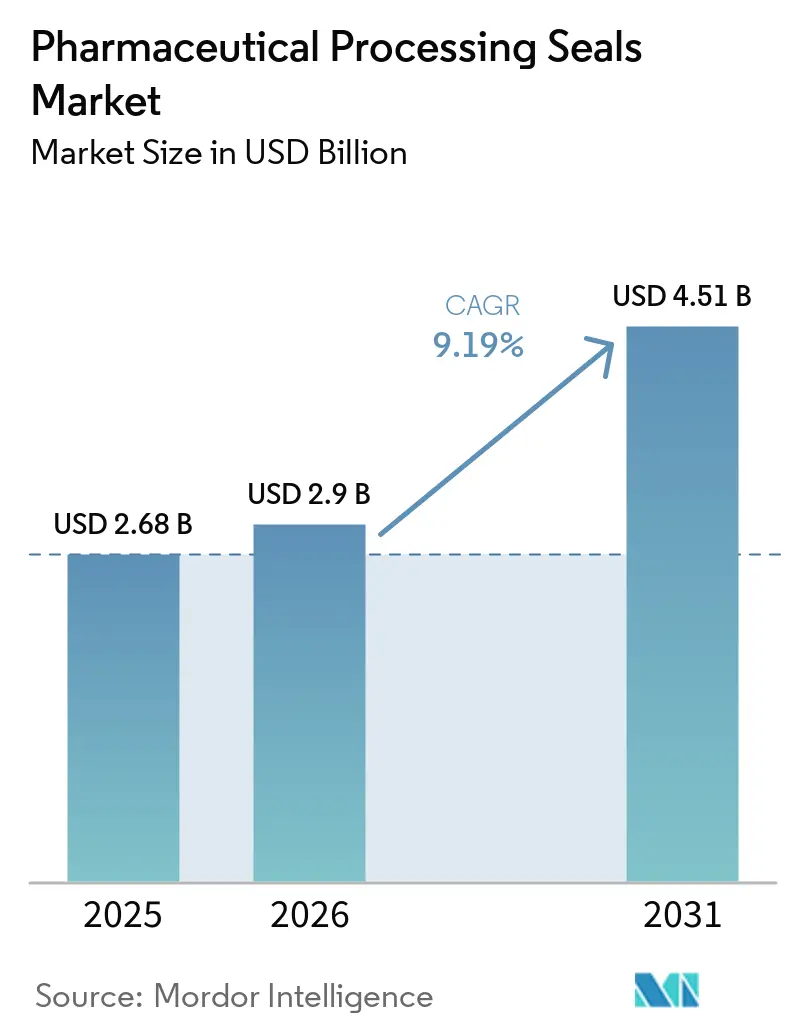
The pharmaceutical processing seals market size was valued at USD 2.68 billion in 2025 and is estimated to grow from USD 2.90 billion in 2026 to reach USD 4.51 billion by 2031, at a CAGR of 9.19% during the forecast period from 2026 to 2031. The pharmaceutical processing seals market is being shaped by the expansion of biologic drugs, including monoclonal antibodies, recombinant proteins, and cell and gene therapies, which require high-purity materials at critical process-contact points. WuXi AppTec raised its 2026 capital expenditure guidance to CNY 7.5 billion (~USD 1.11 billion) to CNY 8.5 billion (~USD 1.26 billion) for drug substance and drug product capacity across Asia, Europe, and the United States, supporting demand for validated seals in bioreactors, agitators, fill-finish lines, and sterile fluid-handling equipment. Higher specifications for contamination control and material documentation are shifting purchasing toward suppliers that can provide validated compounds and technical records. Competition is centered on material performance, regulatory support, and supply reliability, while qualification requirements make customer relationships difficult to displace. Suppliers that pre-validate products against relevant requirements reduce customer qualification work, thereby further supporting demand in this market.
Key Report Takeaways
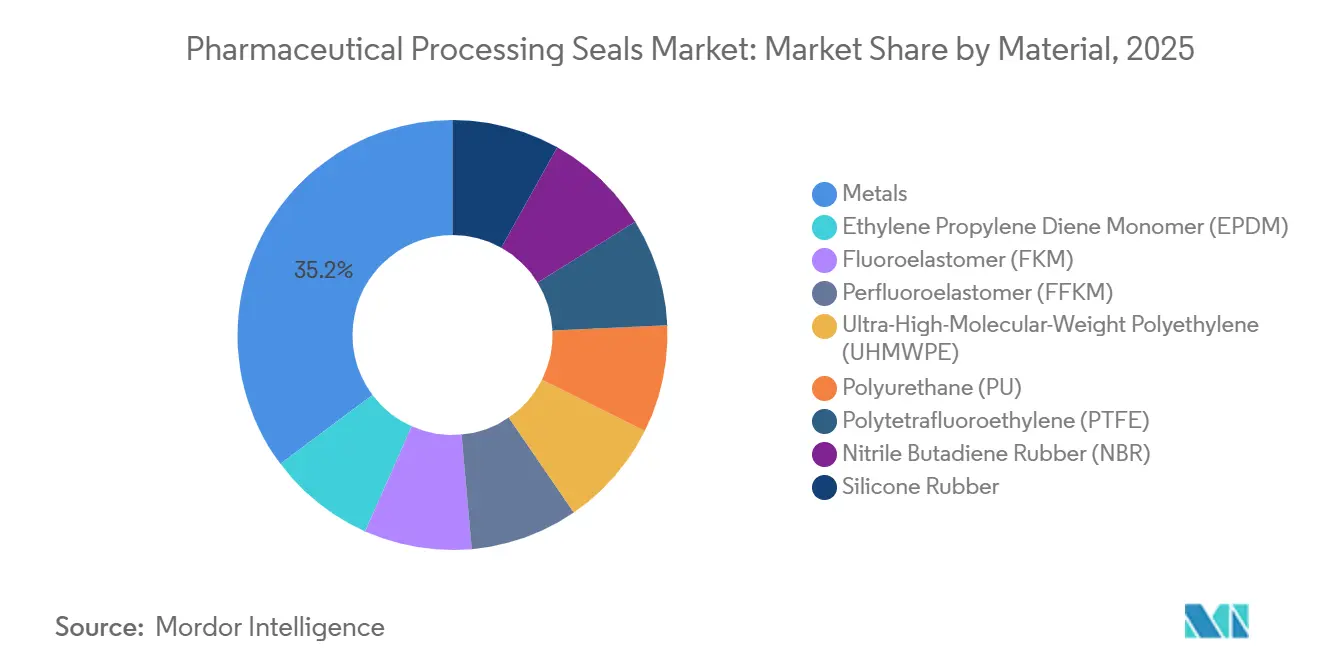
- By material, metals held 35.23% of the pharmaceutical processing seals market share in 2025, while silicone rubber is forecast to grow at a 10.02% CAGR through 2031.
- By seal type, O-ring seals held 33.67% of the pharmaceutical processing seals market share in 2025 and are projected to expand at a 10.35% CAGR through 2031.
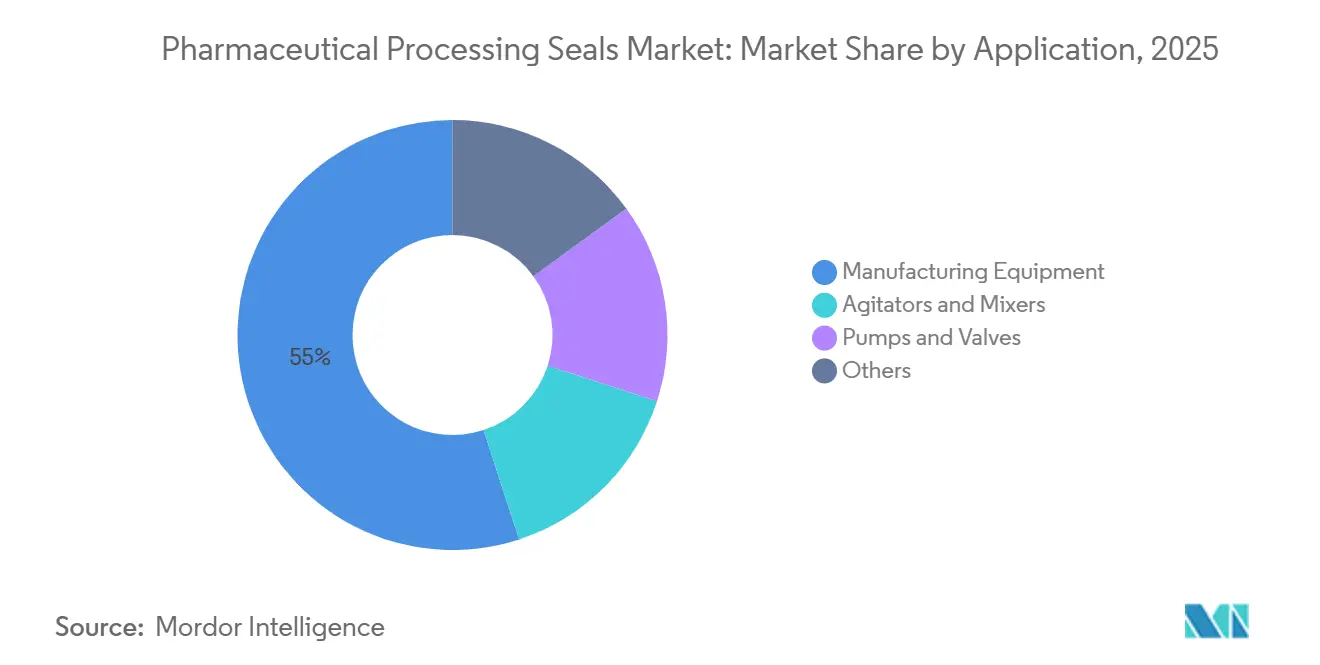
- By application, manufacturing equipment accounted for 55.02% of the pharmaceutical processing seals market size in 2025 and is forecast to advance at an 11.08% CAGR through 2031.
- By geography, Asia-Pacific accounted for 31.91% of revenue in 2025 and is forecast to record a 10.59% CAGR through 2031.
Note: Market size and forecast figures in this report are generated using Mordor Intelligence’s proprietary estimation framework, updated with the latest available data and insights as of January 2026.
Global Pharmaceutical Processing Seals Market Trends and Insights
Drivers Impact Analysis*
| Drivers | (~) % Impact on CAGR Forecast | Geographic Relevance | Impact Timeline |
|---|---|---|---|
| Expansion of Biologics, Vaccines, and Cell and Gene Therapy Manufacturing | +2.8% | Global, with APAC, North America, and the EU as primary centers | Short term (≤ 2 years) |
| Stringent Sterility, Contamination-Control, and Product-Integrity Requirements | +1.9% | Global | Short term (≤ 2 years) |
| Growth of Pharmaceutical Manufacturing Capacity in Asia-Pacific and Emerging Markets | +1.7% | APAC core, with spillover to the Middle East and Africa (MEA) and South America | Medium term (2-4 years) |
| Increasing Adoption of Automated and High-Throughput Processing Equipment | +1.1% | North America and the EU, with accelerating APAC adoption | Medium term (2-4 years) |
| Rising Use of Validated Clean-in-Place (CIP) and Steam-in-Place (SIP)-Compatible Sealing Systems | +1.0% | Global | Long term (≥ 4 years) |
| Source: Mordor Intelligence | |||
Expansion of Biologics, Vaccines, and Cell and Gene Therapy Manufacturing
The shift from small-molecule products toward biologic drug pipelines is a key driver for the pharmaceutical processing seals market. Biologic and advanced therapy manufacturing requires seals that meet lower extractable and leachable limits and reduce the risk of particulate contamination from wear debris. WuXi Biologics announced the topping-out of its Singapore drug product facility in June 2026, which is designed to produce 100 million pre-filled syringes and vials annually once operational in 2027. Chugai Pharmaceutical's subsidiary completed the UT3 biopharmaceutical drug substance manufacturing building at its Utsunomiya plant in May 2026, adding capacity for clinical and early commercial biologics supply in Japan[1]. New bioreactor vessels, sterile mixing skids, and fill-finish lines each require validated sealing components across multiple connection points. These installations support demand after commissioning, as operating equipment also requires maintenance and replacement seals.
Stringent Sterility, Contamination-Control, and Product-Integrity Requirements
Tighter contamination-control requirements are increasing demand for higher-specification materials in the pharmaceutical processing seals market. The FDA published draft guidance on container-closure systems for human drugs and biological products in August 2026, setting out a risk-based approach to the characterization and toxicological assessment of extractables and leachables from relevant materials. The European Medicines Agency issued guidance in July 2026 that extends formal contamination control strategy requirements to non-sterile medicinal product manufacturing. Facilities producing high-value biologics are more likely to specify perfluoroelastomer O-rings over standard FKM or Ethylene Propylene Diene Monomer (EPDM) where chemical inertness and low extractables are required. Trelleborg's Isolast grades are manufactured in ISO Class 5 cleanrooms, reflecting the documentation and controlled production standards expected for these applications. The resulting product mix supports higher unit values even when seal quantities do not increase at the same rate.
Growth Of Pharmaceutical Manufacturing Capacity in Asia-Pacific and Emerging Markets
New manufacturing investment across Asia-Pacific is expanding the installed equipment base in the pharmaceutical processing seals market, increasing replacement and maintenance demand. India's Production Linked Incentive scheme for bulk drugs had attracted INR 467.4 billion (~USD 4.85 billion) in actual investment by June 2026, compared with a target of INR 172.8 billion, and 39 projects had been commissioned across 28 APIs and key starting materials. Pharmaron Beijing announced a CNY 3 billion (~USD 0.44 billion) investment in a 200-ton-per-year pharmaceutical intermediates and Active Pharmaceutical Ingredient (API) facility in Shaoxing in May 2026, with Phase I targeting operations in 2028. Nipro Pharma completed and began operating its Omi Plant Vial Building in August 2026, with an annual capacity of 4,770 million units. New sites in the region must incorporate validated systems from the outset, under the oversight of regulators such as Japan's Pharmaceuticals and Medical Devices Agency (PMDA) and India's Central Drugs Standard Control Organization (CDSCO). This raises baseline seal specifications and limits the use of lower-grade alternatives in critical processing positions.
Rising Use of Validated Clean-in-Place (CIP) and Sterilize-in-Place (SIP)-Compatible Sealing Systems
Clean-in-place (CIP) and sterilize-in-place (SIP) validation is a basic compliance requirement in the pharmaceutical processing seals market. FDA 21 Code of Federal Regulations (CFR) 211.67 requires cleaning and sanitization of equipment at appropriate intervals, while EU GMP Annex 15 requires documented qualification of cleaning and sterilization cycles. As a result, seals must retain performance through repeated cleaning and sterilization exposure. Pharmaceutical-grade EPDM validated to United States Pharmacopeia (USP) Class VI, Perfluoroelastomer (FFKM) compounds, and Polytetrafluoroethylene (PTFE)-lined gaskets are suited to these conditions, while many commodity elastomers are not. John Crane states that its Type 5280 dry-running agitator seal enables CIP and SIP of the product-wetted area with the seal in place and meets hygienic design requirements. The need for compatible hardware and qualification records supports suppliers capable of providing both the seal and the associated documentation.
Restraints Impact Analysis*
| Restraints | (~) % Impact on CAGR Forecast | Geographic Relevance | Impact Timeline |
|---|---|---|---|
| High Qualification and Change-Control Costs for Seal Materials | -1.2% | Global | Medium term (2-4 years) |
| Refurbished Equipment and Longer Asset-Replacement Cycles | -0.8% | North America and Europe | Short term (≤ 2 years) |
| Material Compatibility Trade-Offs Across Chemicals, Temperature, and Sterilization | -0.5% | Global | Long term (≥ 4 years) |
| Source: Mordor Intelligence | |||
High Qualification and Change-Control Costs for Seal Materials
Qualification and change-control requirements slow adoption in the pharmaceutical processing seals market. FDA requirements under 21 CFR Parts 210 and 211, together with EU GMP Annex 15, require re-validation when a critical equipment component changes. For an established bioprocess, this work can take 12 to 18 months and cost hundreds of thousands of dollars per manufacturing line. This creates a strong incentive to retain an existing seal supplier for the life of a product process. Biologics license applications and new drug applications can also reference specific material specifications, making a material change subject to further regulatory submissions. These requirements reduce the pace of replacement that might otherwise be expected for a consumable component.
Refurbished Equipment and Longer Asset-Replacement Cycles
The pharmaceutical processing seals market experiences lower demand for new units when refurbishment programs extend the working life of existing pharmaceutical equipment. RB Mechanical Seals reported 50% cost savings compared with an Original Equipment Manufacturer (OEM) replacement, making refurbishment attractive even when re-qualification costs are considered. In mature North American and European facilities, refurbishment extends the working life of installed equipment rather than replacing it with new assets. A September 2025 paper documented a case in which the refurbishment of an isolator membrane cost USD 50,000, compared with an OEM quotation of USD 110,000. Refurbishment supports aftermarket service revenue for incumbent suppliers, but it displaces new-unit sales. This effect is most visible in established small-molecule API and generic tablet-coating lines where equipment and process conditions have changed little.
*Our forecasts treat driver/restraint impacts as directional, not additive. The impact forecasts reflect baseline growth, mix effects, and variable interactions.
Segment Analysis
By Material: Premium Elastomers Gain at Process-Critical Interfaces
Metals accounted for 35.23% of revenue in 2025, as stainless steel and Hastelloy-grade components are used at static sealing interfaces in high-pressure reactors, large-bore valves, and flanged connections. Their dimensional stability under thermal cycling remains important in these applications. Silicone rubber is forecast to expand at a 10.02% CAGR through 2031, supported by its suitability for biopharmaceutical cell cultivation and sterile fill-finish equipment. Its low extractables and flexibility across a wide temperature range are relevant for repeated gamma sterilization and autoclave exposure. PTFE remains important for aggressive-solvent API synthesis applications. EPDM continues to serve steam-sterilization environments validated to USP Class VI at temperatures up to 121°C.
NBR faces substitution pressure in regulated bioprocessing applications due to extractable concerns. Freudenberg Sealing Technologies offers white EPDM compounds formulated without softeners for application-specific pharmaceutical requirements. FFKM and high-grade silicone are increasingly selected at process-critical positions where high purity and documented performance are required. Metals retain a broad installed base due to their use in many static and structural interfaces. The pharmaceutical processing seals market for premium-material positions is supported by higher per-unit values, even when unit counts remain lower than for basic components. Material selection in the pharmaceutical processing seals market reflects a balance between broad metal use and the adoption of premium elastomers.

By Seal Type: O-Ring Seals Support Bioreactor and Fluid-Handling Demand
O-ring seals held 33.67% market share in 2025 and are projected to record the fastest growth among seal types at a 10.35% CAGR through 2031. This reflects their use in bioreactors, single-use connectors, sterile fluid-handling manifolds, and aseptic valve bodies, hardware categories that are expanding with biologics manufacturing capacity. DuPont Kalrez 6221 and 6230 FFKM O-ring grades are qualified for Water for Injection, ozonated deionized water, and repeated Steam-In-Place (SIP) cycles to 260°C. Such performance requirements illustrate why high-grade O-rings are used in demanding bioreactor sealing positions. The pharmaceutical processing seals market continues to favor O-rings, as their flexible geometry can accommodate varied pressure, temperature, and chemical conditions.
Gaskets hold the second-largest share in the seal-type category due to their use in large-bore flange connections and sterile vessel closures. Their growth is slower than that of O-rings because static connections typically require replacement less often. Lip seals and D seals are used in rotary shaft and agitator applications where bearing protection and product stream integrity must be balanced. Flowserve introduced its LMX Cartridge Lip Seal in April 2026 for top-entry pharmaceutical mixers, using a carbon-free, unpressurized design to address contamination concerns. ASME BPE requirements for elastomeric seals and the 3-A Sanitary Standard 18-03 for hygienic gasket applications establish key documentation expectations. The pharmaceutical processing seals market, therefore, requires seal geometries that combine hygienic design with validated material performance.
By Application: Manufacturing Equipment Remains the Main Demand Base
Manufacturing equipment accounted for 55.02% of the pharmaceutical processing seals market in 2025 and is forecast to grow at an 11.08% CAGR through 2031. This category includes bioreactors, sterile mixing and blending vessels, API reactors, and continuous manufacturing trains, assets that are expanding across regions as pharmaceutical companies add internal manufacturing capacity. Bioreactors and API reactors require seals at multiple process-contact and utility connection points, while sterile mixing vessels require materials that tolerate repeated cleaning and sterilization. This concentration of equipment explains the segment's leading position.
Agitators and mixers constitute the second-largest application group, in which shaft seals must maintain sterility and prevent contamination by barrier fluids. John Crane's Type 5280 and CK-series products are examples of dry-running or gas-lubricated configurations used for these duties. Pumps and valves represent another major source of demand, as sterile transfer lines and critical flow paths are subject to chemical and sterilization exposure. Continuous pharmaceutical manufacturing can favor longer-lived perfluoroelastomer (FFKM) or composite materials, as equipment operates at steady conditions for extended periods. The FDA has encouraged continuous pharmaceutical manufacturing to improve quality, thereby supporting premium specifications on newly commissioned lines. The pharmaceutical processing seals market is therefore linked to both new equipment installations and the maintenance of operating process systems.
Geography Analysis
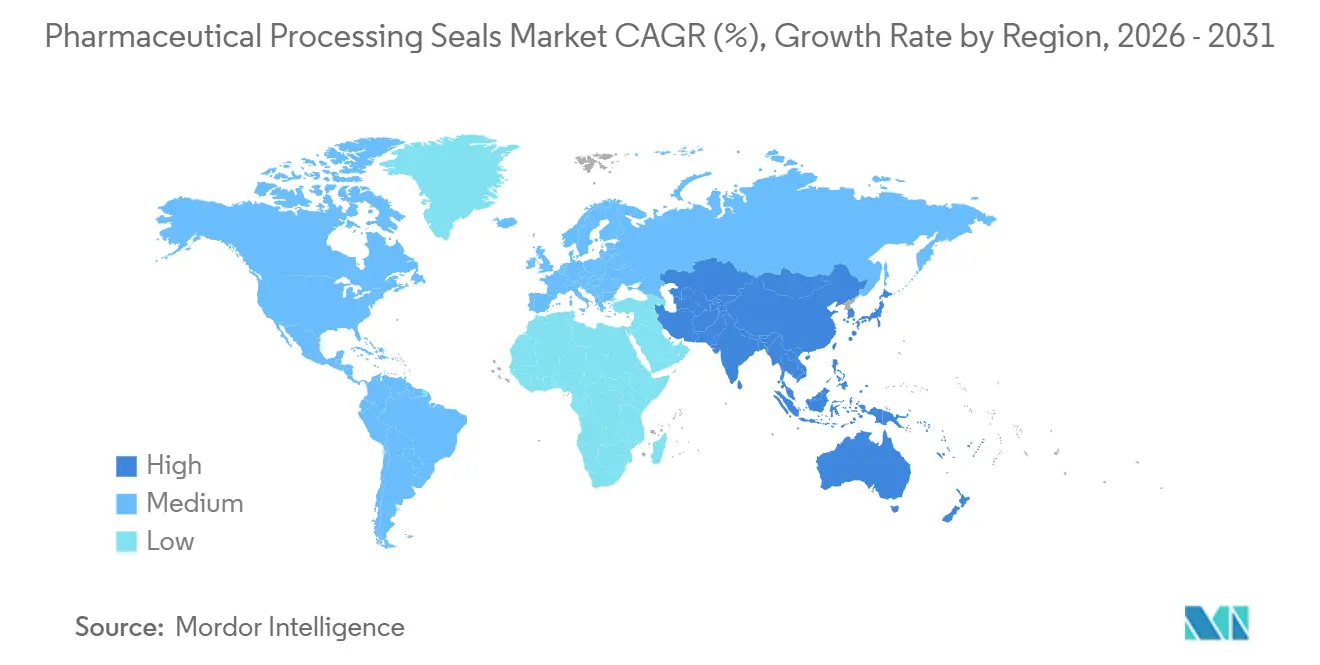
Asia-Pacific accounted for 31.91% of regional revenue in 2025 and is forecast to grow at a 10.59% CAGR through 2031. China and India anchor regional output through their large populations of Contract Development and Manufacturing Organizations (CDMOs) and API manufacturers. Gerresheimer began operations at a new plant in Zhenjiang, China, in July 2026, doubling its primary glass packaging capacity for injectable pharmaceuticals[2]. India commissioned 39 API and key starting material production lines under its Production-Linked Incentive (PLI) scheme by June 2026. These projects increase the number of reactors, purification systems, and fill-finish assets that require validated sealing components. In the Asia-Pacific region, capacity additions combined with replacement needs at operating plants drive demand in the pharmaceutical processing seals market.
Japan represents a higher-value source of demand within the region. Chugai completed its UT3 biopharmaceutical drug substance building in Utsunomiya in May 2026. Eli Lilly announced a JPY 20 billion (~USD 0.12 billion) investment at its Seishin plant in Kobe for new production lines and a warehouse through 2028. South Korea and ASEAN countries add demand through multinational subsidiaries and domestic generic drug producers that are expanding capacity. North America is the second-largest regional market due to its concentration of biopharmaceutical research and commercial manufacturing facilities. FDA Current Good Manufacturing Practice (CGMP) requirements sustain demand for documented validation of cleaning and sterilization across process-contact components. The United States is the largest country-level source of demand in North America, while Canada and Mexico contribute through generic production, API sites, and nearshoring activity.
Europe has high per-unit specification requirements due to the combined effect of EU GMP Annex 1, Annex 15, and the European Medicines Agency (EMA)'s 2026 contamination-control guidance. Vetter Pharma began construction of a EUR 480 million (~USD 540.10 million) production facility in Saarlouis in 2026, with operations targeted for 2031. CordenPharma committed EUR 80 million (~USD 90.01 million) to sterile injectable fill-finish capacity at its Latina site, adding 30-40 million units annually. Freudenberg Medical opened an ISO Class 5 CleanAssure cleanroom in Kaiserslautern in April 2026 for the pre-sterilization of single-use assemblies. South America, the Middle East, and Africa remain smaller markets, with Brazil supported by its generic drug sector and Saudi Arabia adding early demand through domestic pharmaceutical production under Vision 2030.
Competitive Landscape
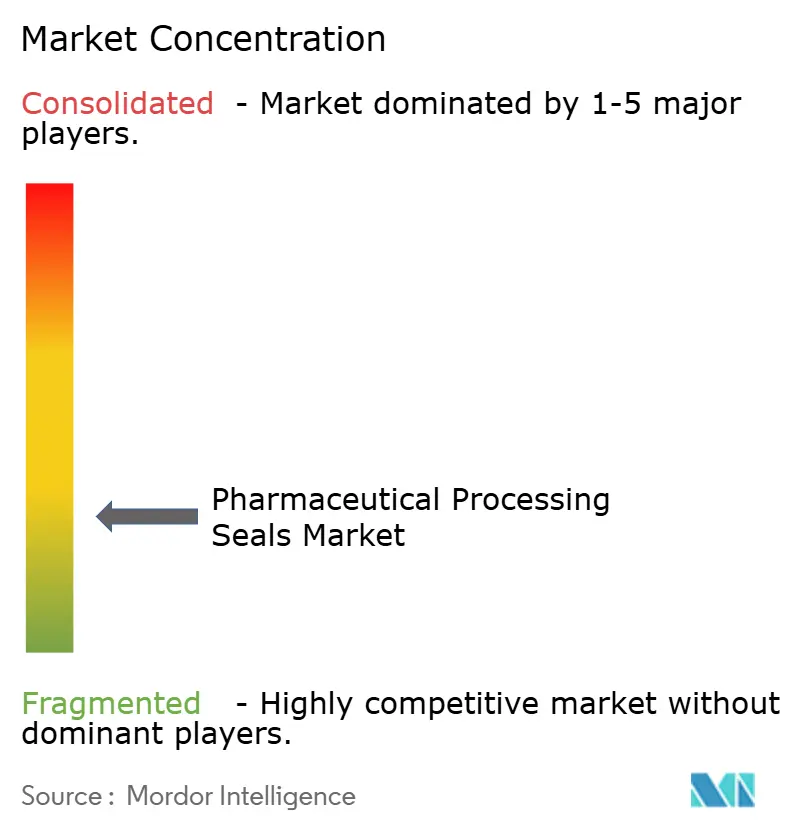
The pharmaceutical processing seals market is fragmented, with Trelleborg AB, Freudenberg Sealing Technologies, Parker Hannifin, John Crane, Flowserve Corporation, and EagleBurgmann among the competitors for validation-critical pharmaceutical applications. These suppliers compete on material science capabilities, regulatory documentation, and manufacturing networks that support supply continuity across customer sites. In 2025, Trelleborg opened a biopharmaceutical manufacturing facility in Malta and expanded its BioPharma Center of Excellence in Northborough, Massachusetts. The company also broke ground on a 50,000-square-meter facility in Bengaluru, India, targeted for completion in 2027, which will combine R&D, customer solutions engineering, and manufacturing. These investments improve geographic coverage and support customers requiring supply redundancy. The pharmaceutical processing seals market favors suppliers that can support validated specifications across multiple manufacturing locations.
Freudenberg Sealing Technologies holds a materials position in white EPDM and Simriz FFKM compounds that meet USP Class VI requirements. Precision Polymer Engineering and Greene Tweed focus on high-value FFKM materials for life science and bioprocessing applications. Precision Polymer Engineering states that its Perlast materials support life-science applications in which chemical resistance and compliance documentation are critical. In April 2026, Flowserve launched the LMX Cartridge Lip Seal for pharmaceutical mixers, featuring a carbon-free design and proprietary float technology. John Crane's Performance Plus framework combines seal supply with reliability monitoring, thermography analysis, and maintenance contracting. In the pharmaceutical processing seals market, these developments shift supplier offerings from individual components toward integrated service and operating reliability.
Parker Hannifin completed its acquisition of Filtration Group Corporation for USD 9.25 billion on August 13, 2026. The acquisition expands Parker's fluid management and contamination-control portfolio and is expected to reinforce its pharmaceutical solutions offering. Smart seals with embedded sensors for wear, barrier-fluid pressure, and leakage monitoring have yet to achieve broad commercial adoption. The FDA's 2026 draft guidance on container closure systems is expected to increase attention to material characterization and documentation, favoring suppliers with pre-certified material packages and reducing end-user qualification work. The pharmaceutical processing seals market remains competitive, as established suppliers must continue to improve materials, documentation, and lifecycle services, while customers retain strong incentives to avoid unnecessary changes.
Pharmaceutical Processing Seals Industry Leaders
-
Trelleborg AB
-
Freudenberg Sealing Technologies
-
Flowserve Corporation
-
PARKER HANNIFIN CORP
-
Saint-Gobain
- *Disclaimer: Major Players sorted in no particular order
Recent Industry Developments
- September 2026: CordenPharma acquired a new 11,000-square-meter facility adjacent to its Latina site in Italy as part of a EUR 80 million (~USD 90.01 million) multi-year investment in sterile injectable fill-finish capacity. The expansion is expected to add 30 to 40 million sterile injectable units annually across vial, prefilled syringe, and cartridge formats for biologics, GLP-1 peptides, and oligonucleotides, supporting demand for pharmaceutical processing seals used in these filling lines.
- July 2026: Gerresheimer commenced operations at its new plant in Zhenjiang, China, doubling primary glass packaging capacity for injectable pharmaceuticals in the country. The 40,000-square-meter facility was constructed over four years and meets regulatory requirements for pharmaceutical and biotech applications, driving demand for pharmaceutical processing seals across its production lines.
Global Pharmaceutical Processing Seals Market Report Scope
Pharmaceutical processing seals are specialized barriers used in drug manufacturing equipment to prevent leaks, block external contamination, and maintain sterility in closed production systems. These seals are critical components in ensuring that manufacturing processes meet stringent regulatory standards and product quality requirements.
The pharmaceutical processing seals market is segmented by material, seal type, application, and geography. By material, the market is segmented into metals, polytetrafluoroethylene (PTFE), nitrile-butadiene rubber (NBR), silicone rubber, ethylene-propylene-diene monomer (EPDM), fluoroelastomer (FKM), perfluoroelastomer (FFKM), ultra-high-molecular-weight polyethylene (UHMWPE), and polyurethane (PU). By seal type, the market is segmented into O-ring seals, gaskets, lip seals, d seals, and others. By application, the market is segmented into manufacturing equipment, agitators and mixers, pumps and valves, and others. The report also covers the market size and forecasts for pharmaceutical processing seals in 15 countries across major regions. The market sizes and forecasts are provided in terms of value (USD).
| Metals |
| Polytetrafluoroethylene (PTFE) |
| Nitrile Butadiene Rubber (NBR) |
| Silicone Rubber |
| Ethylene Propylene Diene Monomer (EPDM) |
| Fluoroelastomer (FKM) |
| Perfluoroelastomer (FFKM) |
| Ultra-High-Molecular-Weight Polyethylene (UHMWPE) |
| Polyurethane (PU) |
| O-Ring Seals |
| Gaskets |
| Lip Seals |
| D Seals |
| Others |
| Manufacturing Equipment |
| Agitators and Mixers |
| Pumps and Valves |
| Others |
| Asia-Pacific | China |
| India | |
| Japan | |
| South Korea | |
| ASEAN Countries | |
| Rest of Asia-Pacific | |
| North America | United States |
| Canada | |
| Mexico | |
| Europe | Germany |
| United Kingdom | |
| France | |
| Italy | |
| NORDIC Countries | |
| Rest of Europe | |
| South America | Brazil |
| Argentina | |
| Rest of South America | |
| Middle East and Africa | Saudi Arabia |
| South Africa | |
| Rest of Middle East and Africa |
| By Material | Metals | |
| Polytetrafluoroethylene (PTFE) | ||
| Nitrile Butadiene Rubber (NBR) | ||
| Silicone Rubber | ||
| Ethylene Propylene Diene Monomer (EPDM) | ||
| Fluoroelastomer (FKM) | ||
| Perfluoroelastomer (FFKM) | ||
| Ultra-High-Molecular-Weight Polyethylene (UHMWPE) | ||
| Polyurethane (PU) | ||
| By Seal Type | O-Ring Seals | |
| Gaskets | ||
| Lip Seals | ||
| D Seals | ||
| Others | ||
| By Application | Manufacturing Equipment | |
| Agitators and Mixers | ||
| Pumps and Valves | ||
| Others | ||
| By Geography | Asia-Pacific | China |
| India | ||
| Japan | ||
| South Korea | ||
| ASEAN Countries | ||
| Rest of Asia-Pacific | ||
| North America | United States | |
| Canada | ||
| Mexico | ||
| Europe | Germany | |
| United Kingdom | ||
| France | ||
| Italy | ||
| NORDIC Countries | ||
| Rest of Europe | ||
| South America | Brazil | |
| Argentina | ||
| Rest of South America | ||
| Middle East and Africa | Saudi Arabia | |
| South Africa | ||
| Rest of Middle East and Africa | ||
Key Questions Answered in the Report
What is current market size of Pharmaceutical Processing Seals Market?
The pharmaceutical processing seals market size was valued at USD 2.68 billion in 2025 and is estimated to grow from USD 2.90 billion in 2026 to reach USD 4.51 billion by 2031, at a CAGR of 9.19% during the forecast period from 2026 to 2031.
Which seal type leads pharmaceutical processing applications?
O-ring seals held 33.67% share in 2025 and are projected to grow at a 10.35% CAGR through 2031.
Which application creates the greatest demand for pharmaceutical seals?
Manufacturing equipment held 55.02% share in 2025 and is forecast to grow at an 11.08% CAGR through 2031.
Which region is expanding fastest for pharmaceutical processing seals?
Asia-Pacific held 31.91% share in 2025 and is expected to record a 10.59% CAGR through 2031.