
Pharmaceutical-Grade Sodium Chloride Market Size and Share
Market Overview
| Study Period | 2021 - 2031 |
|---|---|
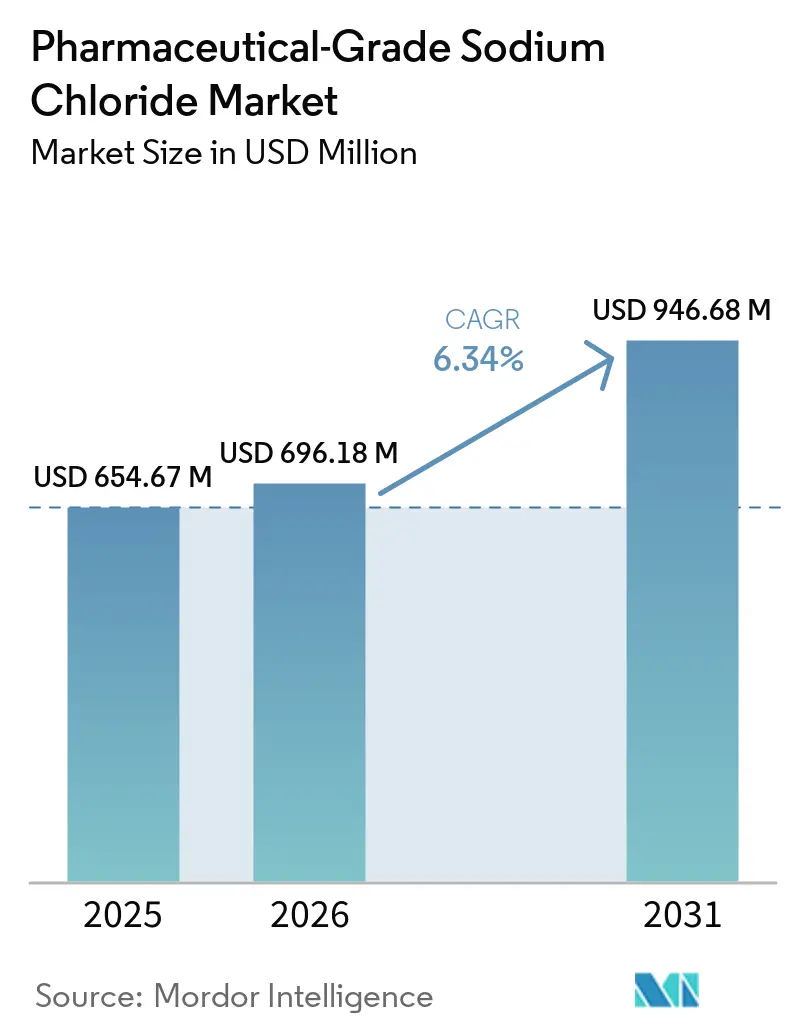
| Market Size (2026) | USD 696.18 Million |
| Market Size (2031) | USD 946.68 Million |
| Growth Rate (2026 - 2031) | 6.34 % |
| Fastest Growing Market | Asia-Pacific |
| Largest Market | Asia-Pacific |
| Market Concentration | Medium |
Major Players *Disclaimer: Major Players sorted in no particular order Image © Mordor Intelligence. Reuse requires attribution under CC BY 4.0. | |
Pharmaceutical-Grade Sodium Chloride Market Analysis by Mordor Intelligence
The Pharmaceutical-Grade Sodium Chloride Market size was valued at USD 654.67 million in 2025 and is estimated to grow from USD 696.18 million in 2026 to reach USD 946.68 million by 2031, at a CAGR of 6.34% during the forecast period (2026-2031). The pharmaceutical-grade sodium chloride market is supported by demand from sterile intravenous therapy, renal replacement therapy, and parenteral drug manufacturing. Sodium chloride serves as an active pharmaceutical ingredient in dialysis concentrates and as an excipient in injectable, biologic, and vaccine formulations, which connects high-volume demand with stringent purity requirements. Recent intravenous (IV) fluid disruptions have made hospitals and drug manufacturers place more weight on supplier redundancy, regional production, and buffer inventories. The pharmaceutical-grade sodium chloride market also benefits from investment in biologics and dialysis capacity, although energy use, compliance costs, and price-focused hospital tenders limit margins in standard grades. Higher-specification materials for biologics, high-volume hemodiafiltration, and parenteral oncology treatments are expected to account for a larger share of future value creation.
Key Report Takeaways
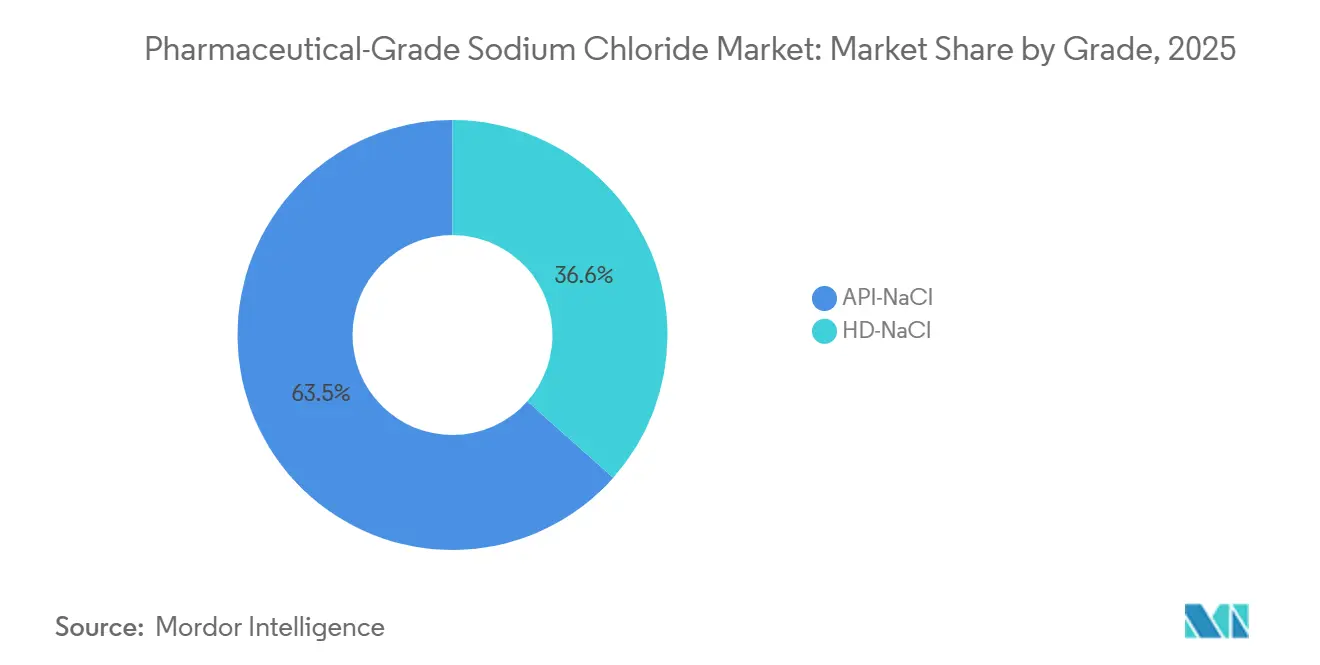
- By grade, API-NaCl held 63.45% of the pharmaceutical-grade sodium chloride market share in 2025, while HD-NaCl is projected to advance at a 6.95% CAGR through 2031.
- By product form, liquid held 60.13% of the pharmaceutical-grade sodium chloride market share in 2025 and is projected to advance at a 6.83% CAGR through 2031.
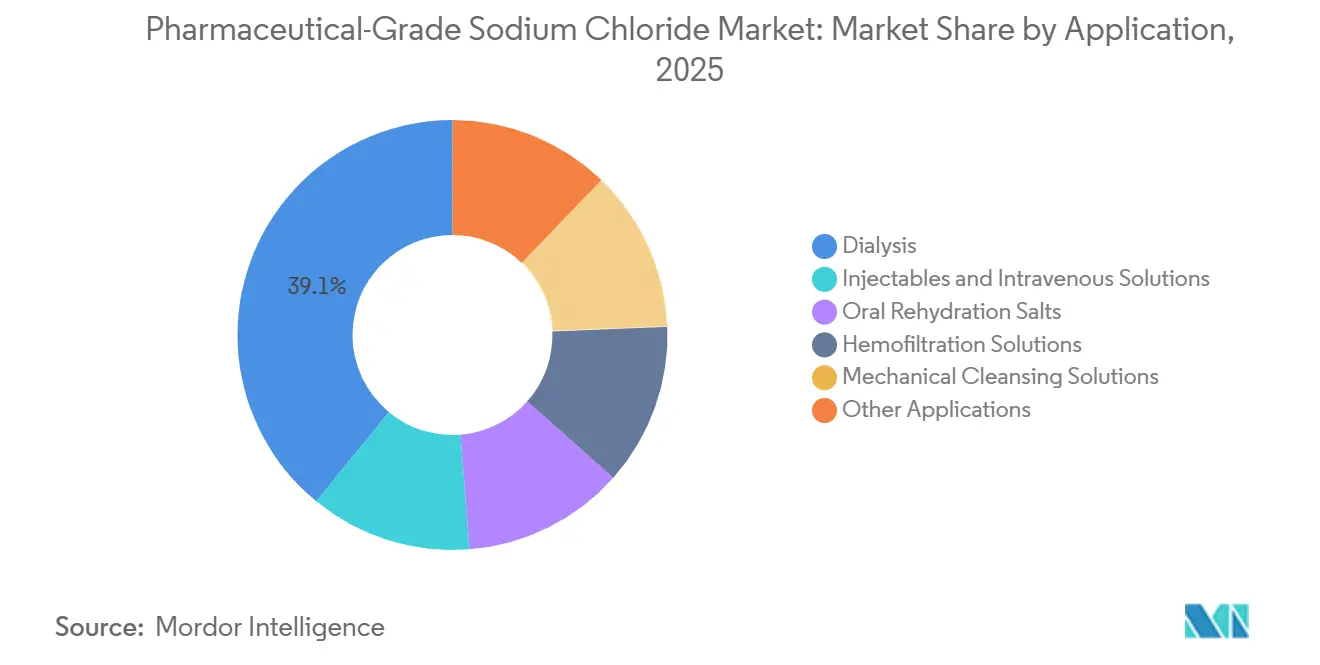
- By application, dialysis held 39.07% of the pharmaceutical-grade sodium chloride market share in 2025 and is projected to advance at a 7.16% CAGR through 2031.
- By geography, Asia-Pacific held 36.72% of the pharmaceutical-grade sodium chloride market share in 2025 and is projected to advance at a 7.04% CAGR through 2031.
Note: Market size and forecast figures in this report are generated using Mordor Intelligence’s proprietary estimation framework, updated with the latest available data and insights as of January 2026.
Global Pharmaceutical-Grade Sodium Chloride Market Trends and Insights
Drivers Impact Analysis*
| Driver | (~) % Impact on CAGR Forecast | Geographic Relevance | Impact Timeline |
|---|---|---|---|
| Rising Demand for Sterile IV and Injectable Therapies | +1.8% | Global, with greatest intensity in North America, Europe, and APAC core | Short term (≤ 2 years) |
| Expansion of Dialysis and Renal-Care Capacity | +1.5% | APAC core (China, India, ASEAN); spill-over to MEA and South America | Medium term (2–4 years) |
| Biologics, Vaccine, and Parenteral Manufacturing Growth | +1.2% | Global; concentrated in Singapore, South Korea, Ireland, and India | Medium term (2–4 years) |
| Healthcare Infrastructure Expansion in Asia-Pacific and Emerging Markets | +1.0% | APAC (India, ASEAN, Rest of APAC); spillover to MEA | Long term (≥ 4 years) |
| Shift Toward Certified, Traceable, Multi-Compendial Inputs | +0.6% | Global; strongest in markets with GDP-linked regulatory uplift | Medium term (2–4 years) |
| Source: Mordor Intelligence | |||
Rising Demand for Sterile IV and Injectable Therapies
Sterile IV and injectable therapy remains the largest demand channel for pharmaceutical-grade sodium chloride. Isotonic 0.9% saline is used as a diluent, volume expander, and carrier solution for many hospital-administered parenteral medicines. Pediatric clinical guidance published in 2026 specified isotonic 0.9% normal saline as the preferred maintenance fluid rather than hypotonic alternatives, reinforcing the clinical role of saline in inpatient care. The 2024-2025 storm-related disruption changed procurement practices as providers sought to reduce dependence on single production sites. B. Braun Medical Inc. announced an investment exceeding USD 1 billion over 5 years in U.S. production capacity, while Baxter reported inventory normalization at its North Cove facility in May 2025. These investments support larger safety stocks and dual-sourcing arrangements, which add purchasing demand beyond immediate clinical consumption.
Biologics, Vaccine, and Parenteral Manufacturing Growth
Pharmaceutical-grade sodium chloride is used as a tonicity agent and buffer component in injectable biologics. Published excipient mapping found sodium chloride in 18% of high-concentration monoclonal antibody formulations. WuXi Biologics completed the topping-out of its Drug Product facility at the Singapore Contract Research, Development and Manufacturing Organization (CRDMO) Hub in June 2026. The facility adds 120,000 liters of manufacturing capacity to the company’s global network. Singapore also received commitments for antibody-drug conjugate, contract development and manufacturing, and active pharmaceutical ingredient capacity from AstraZeneca, WuXi Biologics, and Pfizer.
Healthcare Infrastructure Expansion in Asia-Pacific and Emerging Markets
The combined buildout of drug manufacturing and treatment capacity supports the pharmaceutical-grade sodium chloride market in Asia-Pacific. The region’s pharmaceutical pipeline has expanded as countries develop specialized roles in biologics, generics, and dialysis care. Telangana inaugurated Telangana Bio 1 in December 2025 as India’s first single-use bioprocess design and scale-up facility. The facility expands domestic biologics capabilities that require Good Manufacturing Practice (GMP)-grade sodium chloride during formulation. Singapore continues to attract biologics investment, while Vietnam remains a significant generics production location, and the Philippines is expanding dialysis capacity. This distribution of capabilities increases demand across API-NaCl, HD-NaCl, and hospital-use grades rather than concentrating demand in a single application.
Shift Toward Certified, Traceable, Multi-Compendial Inputs
Drug manufacturers increasingly require sodium chloride suppliers to demonstrate consistent quality, documentation, and traceability. USP requires intended-use labeling for sodium chloride used in injectable dosage forms, peritoneal dialysis solutions, hemodialysis solutions, or hemofiltration solutions[1]United States Pharmacopeia, “Sodium Chloride Monograph,” United States Pharmacopeia, usp.org. Suppliers that meet United States Pharmacopeia, European Pharmacopoeia, Japanese Pharmacopoeia, Korean Pharmacopoeia, and Indian Pharmacopoeia requirements can serve a wider group of regulated customers. Sanal Salt lists API pharmaceutical grades that meet European Pharmacopoeia (Ph. Eur.), USP, Japanese Pharmacopoeia (JP), KP, and IP requirements. The documentation burden reduces the number of suppliers that can qualify for sensitive injectable and dialysis applications. It also makes established quality systems and validated production lines more valuable in the pharmaceutical-grade sodium chloride market.
Restraints Impact Analysis*
| Restraint | (~) % Impact on CAGR Forecast | Geographic Relevance | Impact Timeline |
|---|---|---|---|
| Energy-Intensive Purification and Sterilization Economics | -0.7% | Global; most acute in Europe and North America | Long term (≥ 4 years) |
| Pharmacopoeial Compliance and Audit-Cost Burden | -0.5% | Global; disproportionate impact on emerging-market producers entering regulated markets | Medium term (2–4 years) |
| Hospital Tendering and Low-Margin Pricing Pressure | -0.4% | Global; most pronounced in centralized procurement systems (UK NHS, EU member states, national health authorities in India and China) | Short term (≤ 2 years) |
| Source: Mordor Intelligence | |||
Energy-Intensive Purification and Sterilization Economics
Vacuum evaporation is the main route used to produce sodium chloride that meets United States Pharmacopeia and European Pharmacopoeia quality requirements. The process requires more energy and equipment than food-grade or industrial salt crystallization. Mechanical vapor recompression can lower operating costs relative to traditional multiple-effect evaporators, but pharmaceutical production still requires specialized materials, controlled surface finishes, and extended crystallization times. These requirements are intended to support low-endotoxin levels and reproducible material quality. The capital burden favors producers that already operate validated high-specification evaporation lines. New suppliers must absorb these costs before they can compete in the pharmaceutical-grade sodium chloride market.
Pharmacopoeial Compliance and Audit-Cost Burden
Multi-compendial compliance requires producers to maintain specifications across USP, Ph. Eur., JP, and other relevant pharmacopoeias. The USP sodium chloride monograph reached Stage 6 in the Pharmacopoeial Discussion Group harmonization process and became official through the USP 39-NF 34 second supplement. U.S. current good manufacturing practice rules under 21 Code of Federal Regulations (CFR) Parts 210 and 211 apply to pharmaceutical manufacturing and packaging, including critical controls for sterile products[2]Electronic Code of Federal Regulations, “Current Good Manufacturing Practice in Manufacturing, Processing, Packing, or Holding of Drugs,” eCFR, ecfr.gov. Customer audits, analytical packages, and certificates of analysis can extend supplier qualification by 12-18 months. Smaller regional suppliers can, therefore, struggle to respond quickly when a supply shortage creates new demand. This lead time protects established suppliers but limits short-term supply flexibility.
*Our forecasts treat driver/restraint impacts as directional, not additive. The impact forecasts reflect baseline growth, mix effects, and variable interactions.
Segment Analysis
By Grade: API-NaCl Anchors Market Value and HD-NaCl Advances with Dialysis Demand
API-NaCl held 63.45% of the pharmaceutical-grade sodium chloride market share in 2025. Its position reflects use in sterile injectable solutions, biologics formulation buffers, and vaccine diluents. Sodium chloride intended for injectable dosage forms, peritoneal dialysis solutions, hemodialysis solutions, or hemofiltration solutions must carry intended-use labeling under the USP monograph. These requirements support demand for materials with proven purity and documentation. Sanal Salt lists API-grade products with greater than 99% purity and compliance with Ph. Eur., USP, JP, KP, and IP requirements. Morton Salt, Inc. operates multiple U.S. plants producing USP sodium chloride, which gives customers an additional supply-continuity option. The API-NaCl segment, therefore, benefits from both technical demand and qualification barriers.
HD-NaCl is projected to advance at a 6.95% CAGR through 2031. The pharmaceutical-grade sodium chloride market size for this grade is supported by dialysis capacity additions in China, India, and ASEAN countries. The move from standard hemodialysis toward high-volume hemodiafiltration raises dialysate quality requirements. Fresenius Medical Care’s 5008X CAREsystem supports this treatment transition in the U.S. market. Tata Chemicals commissioned its Medi-Salt facility in Middlewich, United Kingdom, and targeted European Pharmacopoeia (EP) and USP pharmaceutical salt sales in the second half of fiscal year 2027. The project shows that established chemical producers can enter the grade after making the required investments in qualification and certification. Demand growth will favor suppliers that can meet dialysis quality requirements at a consistent scale.


By Product Form: Liquid Leads in Scale and Growth Pace
Liquid held 60.13% of the pharmaceutical-grade sodium chloride market share in 2025 and is projected to advance at a 6.83% CAGR through 2031. Hospitals and IV-fluid manufacturers use liquid sodium chloride as concentrated saline or bulk pharmaceutical-grade brine. These formats can enter sterile filling lines without the dissolution and quality-control steps required for solid inputs. The National Health Service framework for IV fluids illustrates the institutional scale of liquid sodium chloride procurement. Ready-to-use formats also suit hospital pharmacy operations that need dependable, standardized materials. This operational fit keeps liquid products central to the pharmaceutical-grade sodium chloride market.
Solid sodium chloride serves compounding pharmacies, solid oral dosage production, and processes that require dry mixing. Biologics manufacturers may use solid API-NaCl granules to prepare buffers at contract development and manufacturing organizations. These customers value controlled moisture content and batch-level flexibility. Morton Salt improved traceability, documentation, and ultra-high-purity GMP practices at its pharmaceutical salt operations in 2024. Such investments address the needs of formulation customers using solid material. Expansion of contract manufacturing in India and South Korea should provide incremental demand for dry-granule grades. Growth remains tied more closely to complex formulation activity than to high-volume parenteral filling.
By Application: Dialysis Drives Both Revenue and Growth
Dialysis held 39.07% of the pharmaceutical-grade sodium chloride market share in 2025 and is projected to advance at a 7.16% CAGR through 2031. A typical hemodialysis session uses 120 liters of dialysate, and the sodium chloride component must meet HD-grade specifications. This combination of volume and purity makes dialysis the most demanding application by consumed quantity. Rising chronic kidney disease rates and increased dialysis access support this position. ISO 23500-1:2025 sets preparation and quality-management requirements for fluids used in hemodialysis and related therapies. High-volume hemodiafiltration further reinforces demand for ultrapure dialysate. The application will remain important for suppliers with validated HD-NaCl capabilities.
Injectables and intravenous solutions form another major use area and are highly sensitive to supply disruption. Injectable saline is an essential medicine, so demand changes little when availability tightens. Oral rehydration salts generate substantial volumes in lower-middle-income markets but face stronger price constraints. Hemofiltration solutions benefit from growing intensive-care capacity, especially in private hospital networks across Asia-Pacific. Mechanical cleansing solutions and other uses include wound irrigation and diagnostic-preparation protocols. These applications are stable and support recurring demand in institutional care. Their varied quality needs allow producers to serve both standardized and specialized customer requirements.

Geography Analysis
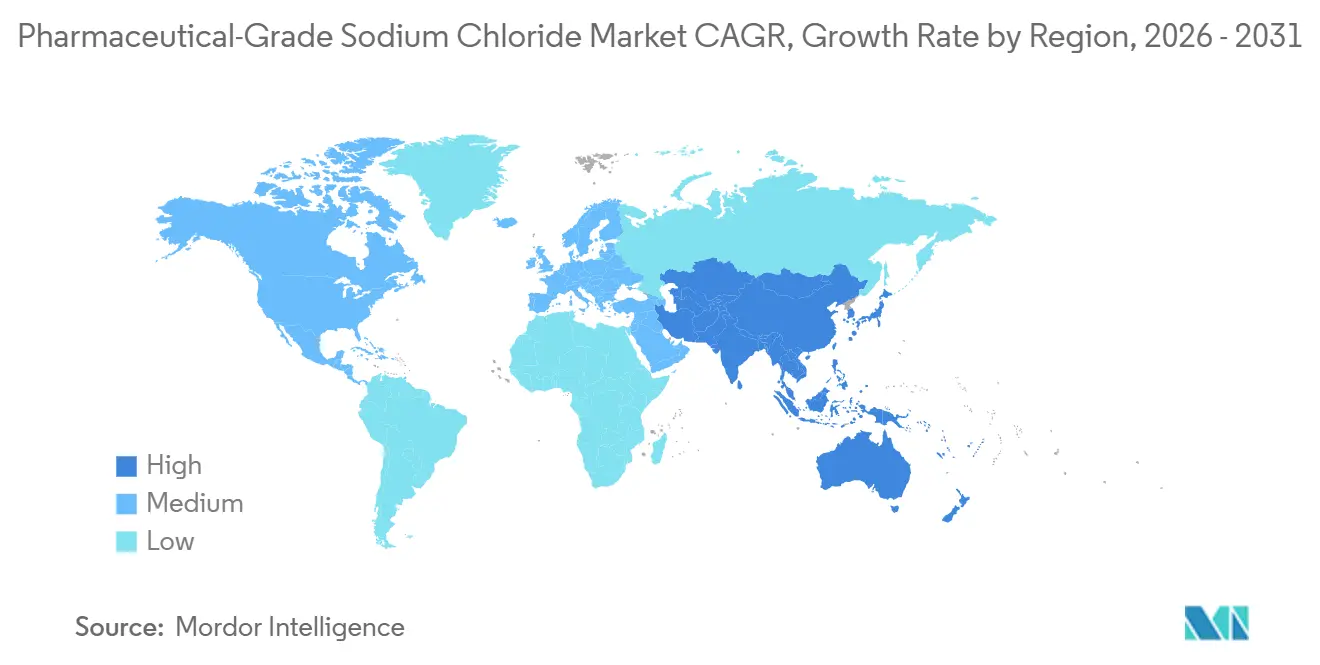
Asia-Pacific held 36.72% of the pharmaceutical-grade sodium chloride market share in 2025 and is projected to advance at a 7.04% CAGR through 2031. The region combines injectable drug manufacturing growth, dialysis capacity expansion, and vaccine investment. India adds 220,000 new end-stage renal disease patients each year, which increases the need for dialysis materials. The Philippine Information Agency reported plans for a National Kidney and Transplant Institute facility with 200 dialysis machines, which is expected to become Southeast Asia’s largest dialysis center. WuXi Biologics’ Singapore capacity expansion further supports demand for formulation-grade salt. The pharmaceutical-grade sodium chloride market in the region, therefore, spans both manufacturing and clinical demand.
North America and Europe represent mature demand centers for high-purity and multi-compendial grades. The U.S. market relies on a large base of hospital IV therapy users and biologics manufacturers. Canada also supplies rock salt feedstock to downstream refiners. Compass Minerals stated that Canadian salt production remained exempt from certain U.S. tariffs under the United States-Mexico-Canada Agreement in 2026. Germany has a dense hospital network and a strong producer base that includes K+S Aktiengesellschaft and Südwestdeutsche Salzwerke AG. K+S Aktiengesellschaft stated that 1 in 3 infusions in Germany contains high-purity salts from its portfolio.
South America and the Middle East and Africa remain underpenetrated regions with developing demand. Brazil and Argentina are important South American markets because public dialysis-access programs create a stable clinical requirement. Salinen Austria Aktiengesellschaft stated that much of its high-purity pharmaceutical salt for dialysis, hygiene products, and medicines is exported to South America and Asia. Saudi Arabia supports demand through healthcare investment and pharmaceutical manufacturing development. The rest of the Middle East and Africa depend on hospital construction and wider dialysis access. Public-private partnerships can improve treatment availability in these areas. Regional demand is likely to favor suppliers that can provide reliable imports, local distribution, and compliant technical support.

Competitive Landscape
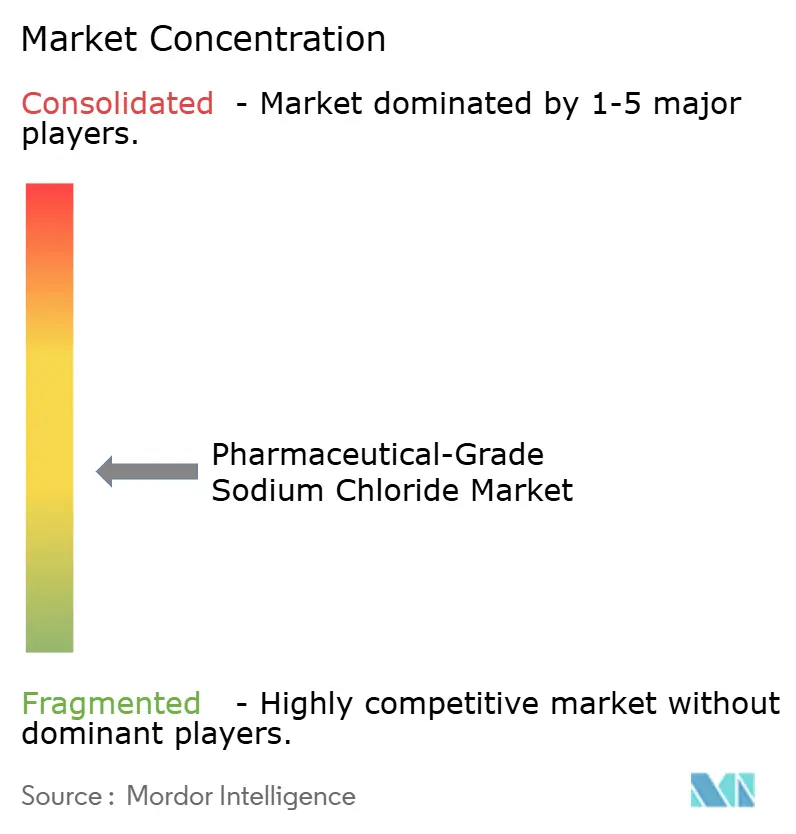
The pharmaceutical-grade sodium chloride market is moderately concentrated, with the top five players including K+S Aktiengesellschaft, Südwestdeutsche Salzwerke AG, Dominion Salt, Morton Salt, Inc., and Salinen Austria Aktiengesellschaft. Multi-compendial certification creates a barrier because customers require validated quality, traceability, and supply reliability. K+S Aktiengesellschaft offers high-purity salts for more than 5,000 applications and reported that pharmaceutical uses contributed 4% of Industry+ segment revenue in the first quarter of 2026. Long operating histories in regulated applications reinforce the company’s premium product position. This structure makes qualification capability as important as raw material access.
K+S Aktiengesellschaft formed a global distribution partnership with Brenntag Specialties Pharma in December 2024 to extend the reach of APISAL NaCl GMP, potassium chloride 99.9% Ph. Eur. and USP, and HD-NaCl grades. The agreement used specialized distribution to widen geographic coverage without matching investment in owned commercial infrastructure. Salinen Austria Aktiengesellschaft is investing EUR 200 million (approximately USD 217 million) over 5 years to expand Ebensee production and increase its focus on pharmaceutical and tablet salt. Tata Chemicals Limited commissioned the Medi-Salt facility at Middlewich and plans EP and USP pharmaceutical salt sales from the second half of fiscal year 2027. These investments show how suppliers are moving from broad salt portfolios toward higher-value regulated applications. Competitive strategies, therefore, combine capacity investment, quality certification, and route-to-market partnerships.
Opportunities are concentrated in ultra-high-specification API-NaCl grades for continuous biopharmaceutical manufacturing and regional supply for import-dependent markets. Diversified chemical producers can use existing brine infrastructure to enter pharmaceutical grades if they can meet qualification requirements. Technology such as mechanical vapor recompression and Oslo crystallization can improve efficiency while supporting controlled crystal and endotoxin profiles. K+S Aktiengesellschaft announced the acquisition of Qemetica’s salt business in Janikowo, Poland, and Stassfurt, Germany, in June 2026. The acquisition strengthens its Central European salt asset base. The competitive environment remains shaped by compliance capability, capacity location, and dependable delivery rather than by price alone.
Pharmaceutical-Grade Sodium Chloride Industry Leaders
K+S Aktiengesellschaft
Südwestdeutsche Salzwerke AG
Dominion Salt
Morton Salt, Inc.
Salinen Austria Aktiengesellschaft
- *Disclaimer: Major Players sorted in no particular order

Recent Industry Developments
- June 2026: Tata Chemicals Limited confirmed the commissioning of its Medi-Salt facility in Middlewich, United Kingdom, with plans to begin sales of EP and USP pharmaceutical salt in the second half of FY2027. The facility strengthens Tata Chemicals Limited’s capacity to supply high-purity pharmaceutical salt for pharma and hemodialysis applications.
- June 2026: K+S Aktiengesellschaft acquired Qemetica’s evaporated salt production sites in Janikowo, Poland, and Stassfurt, Germany. The acquisition expands K+S Aktiengesellschaft’s European pharmaceutical-grade sodium chloride base.


Global Pharmaceutical-Grade Sodium Chloride Market Report Scope
Pharmaceutical-grade sodium chloride is highly purified sodium chloride manufactured to meet stringent quality requirements for pharmaceutical formulations and medical applications. It provides controlled purity and composition for products where consistent chemical quality is essential.
The Pharmaceutical-Grade Sodium Chloride Market is segmented by grade, product form, application, and geography. By grade, the market is segmented into API-NaCl and HD-NaCl. By product form, the market is segmented into liquid and solid. By application, the market is segmented into dialysis, injectables and intravenous solutions, oral rehydration salts, hemofiltration solutions, mechanical cleansing solutions, and other applications. The report also covers the market size and forecasts for pharmaceutical-grade sodium chloride in 15 countries across major regions. For each segment, the market sizing and forecasts have been done on the basis of value (USD).
| API-NaCl |
| HD-NaCl |
| Liquid |
| Solid |
| Dialysis |
| Injectables and Intravenous Solutions |
| Oral Rehydration Salts |
| Hemofiltration Solutions |
| Mechanical Cleansing Solutions |
| Other Applications |
| Asia-Pacific | China |
| India | |
| Japan | |
| South Korea | |
| ASEAN Countries | |
| Rest of Asia-Pacific | |
| North America | United States |
| Canada | |
| Mexico | |
| Europe | Germany |
| United Kingdom | |
| France | |
| Italy | |
| NORDIC Countries | |
| Rest of Europe | |
| South America | Brazil |
| Argentina | |
| Rest of South America | |
| Middle East and Africa | Saudi Arabia |
| South Africa | |
| Rest of Middle East and Africa |
| By Grade | API-NaCl | |
| HD-NaCl | ||
| By Product Form | Liquid | |
| Solid | ||
| By Application | Dialysis | |
| Injectables and Intravenous Solutions | ||
| Oral Rehydration Salts | ||
| Hemofiltration Solutions | ||
| Mechanical Cleansing Solutions | ||
| Other Applications | ||
| By Geography | Asia-Pacific | China |
| India | ||
| Japan | ||
| South Korea | ||
| ASEAN Countries | ||
| Rest of Asia-Pacific | ||
| North America | United States | |
| Canada | ||
| Mexico | ||
| Europe | Germany | |
| United Kingdom | ||
| France | ||
| Italy | ||
| NORDIC Countries | ||
| Rest of Europe | ||
| South America | Brazil | |
| Argentina | ||
| Rest of South America | ||
| Middle East and Africa | Saudi Arabia | |
| South Africa | ||
| Rest of Middle East and Africa | ||


Key Questions Answered in the Report
What is the size of the pharmaceutical-grade sodium chloride market?
The Pharmaceutical-Grade Sodium Chloride Market size was valued at USD 654.67 million in 2025 and is estimated to grow from USD 696.18 million in 2026 to reach USD 946.68 million by 2031, at a CAGR of 6.34% during the forecast period (2026-2031).
What is driving demand for pharmaceutical-grade sodium chloride?
Sterile IV therapy, dialysis, biologics production, vaccine manufacturing, and parenteral formulation support demand.
Which grade held the largest share in 2025?
API-NaCl held 63.45% of the market share in 2025 because it is used in sterile injectables, biologics buffers, and vaccine diluents.
Which application is projected to advance fastest through 2031?
Dialysis is projected to advance at a 7.16% CAGR through 2031.
Page last updated on:


 Your data is secure and never sold or shared.


