
Pharmaceutical Electronic Manufacturing Services (EMS) Market Size and Share
Market Overview
| Study Period | 2020 - 2031 |
|---|---|
| Market Size (2026) | USD 35.17 Billion |
| Market Size (2031) | USD 51.91 Billion |
| Growth Rate (2026 - 2031) | 8.10 % |
| Fastest Growing Market | Asia-Pacific |
| Largest Market | North America |
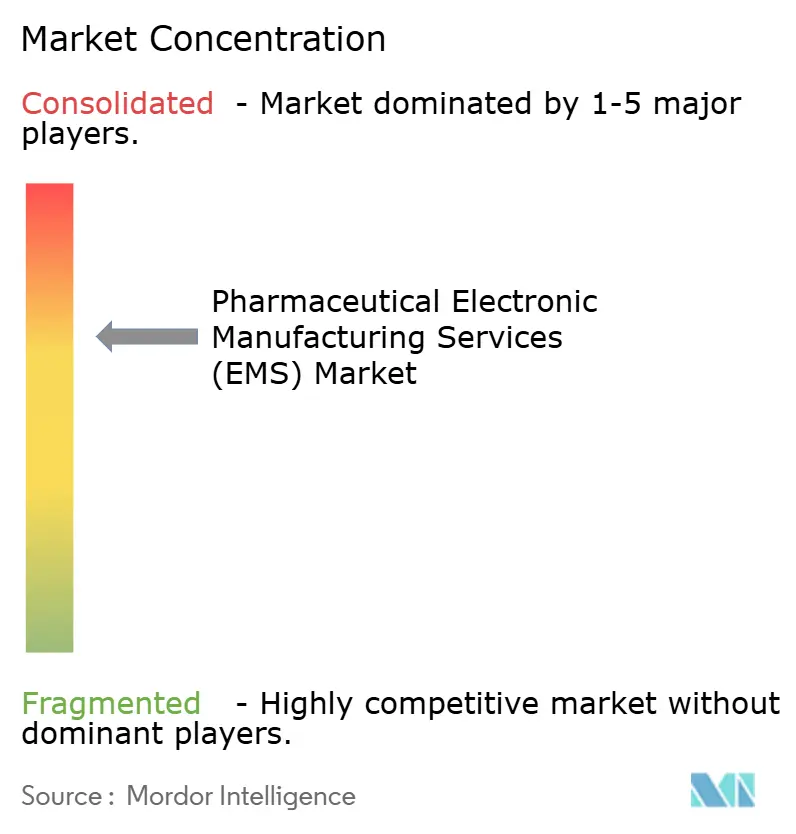
| Market Concentration | Medium |
Major Players *Disclaimer: Major Players sorted in no particular order Image © Mordor Intelligence. Reuse requires attribution under CC BY 4.0. | |
Pharmaceutical Electronic Manufacturing Services (EMS) Market Analysis by Mordor Intelligence
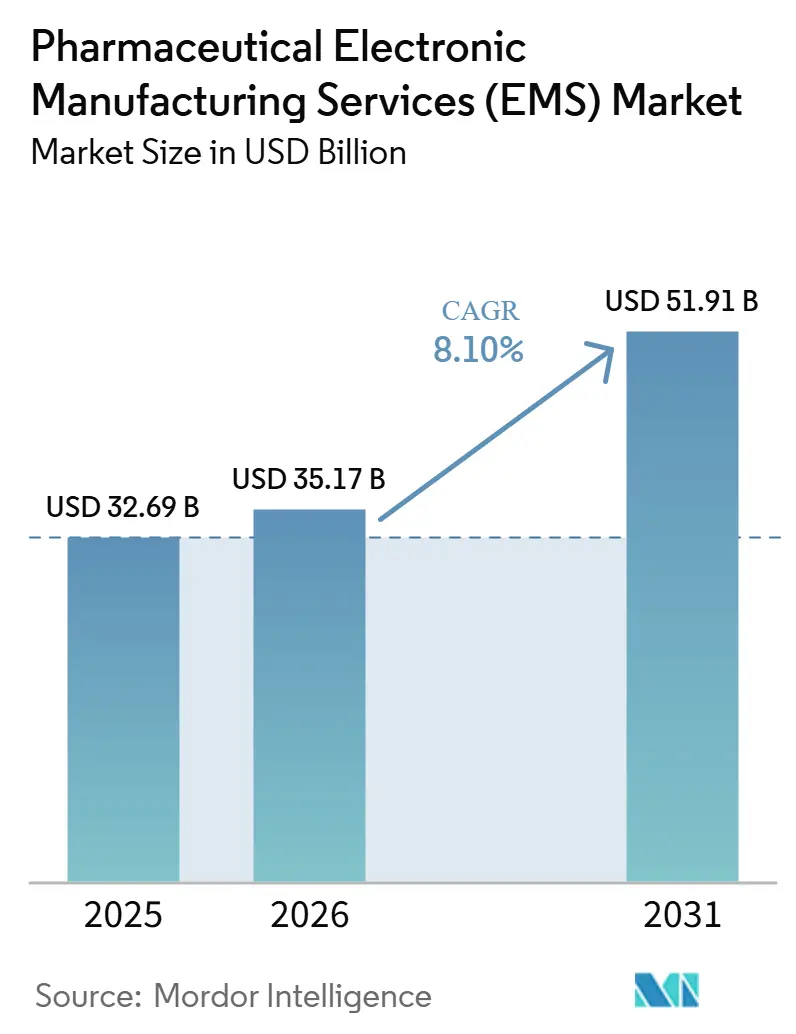
The pharmaceutical electronic manufacturing services (EMS) market is projected to expand from USD 32.69 billion in 2025 and USD 35.17 billion in 2026 to USD 51.91 billion by 2031, registering a CAGR of 8.10% between 2026 and 2031. The pharmaceutical electronic manufacturing services market is growing because drug makers are shifting more internal budgets toward research, clinical work, and software while relying on outside partners for validated electronics production. Demand in the pharmaceutical electronic manufacturing services market is also widening because newer bioreactor systems, laboratory platforms, serialization equipment, and combination products use more electronic content than older equipment generations. Compliance expectations in 2026 favor providers that already operate disciplined quality systems, documented testing routines, and regulated manufacturing processes, which makes scale and prior validation more valuable in contract awards. The pharmaceutical electronic manufacturing services market also benefits from steady investment in laboratory automation, where robotic workflows, cloud-linked equipment, and data handling requirements continue to raise the need for specialized assembly and integration work. Competition is staying active because leading suppliers are adding adjacent capabilities through acquisitions, bundled design support, and compliance-ready software platforms, which expand their role well beyond basic assembly work.
Key Report Takeaways
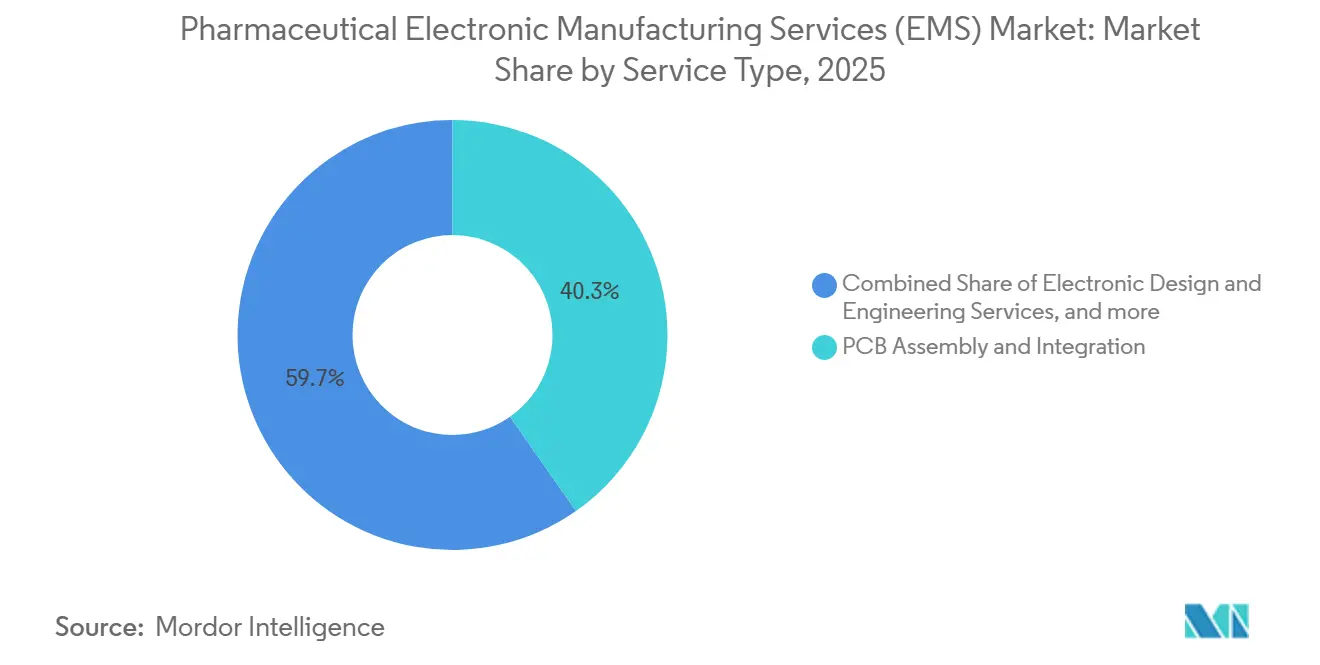
- By service type, PCB assembly and integration led with 40.13% revenue share in 2025, while electronic design and engineering is forecasted to expand at a 10.84% CAGR through 2031.
- By product type, pharmaceutical manufacturing equipment electronics held 42.27% share in 2025, while laboratory automation electronics recorded the highest projected CAGR at 10.96% through 2031.
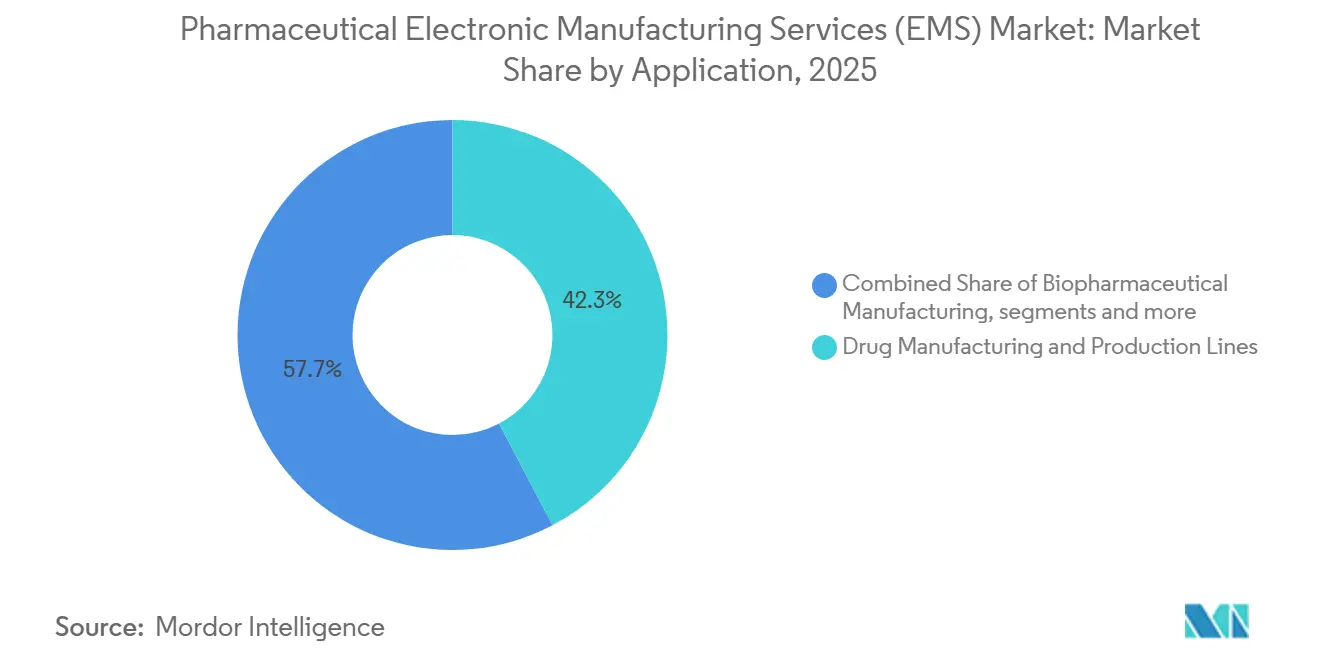
- By application, drug manufacturing and processing accounted for 42.33% share in 2025, while Clinical research and laboratory automation are expected to advance at an 11.12% CAGR through 2031.
- By end-user, pharmaceutical and biotech companies contributed 49.11% of revenue in 2025, while contract manufacturing organizations posted the fastest projected CAGR at 11.18% through 2031.
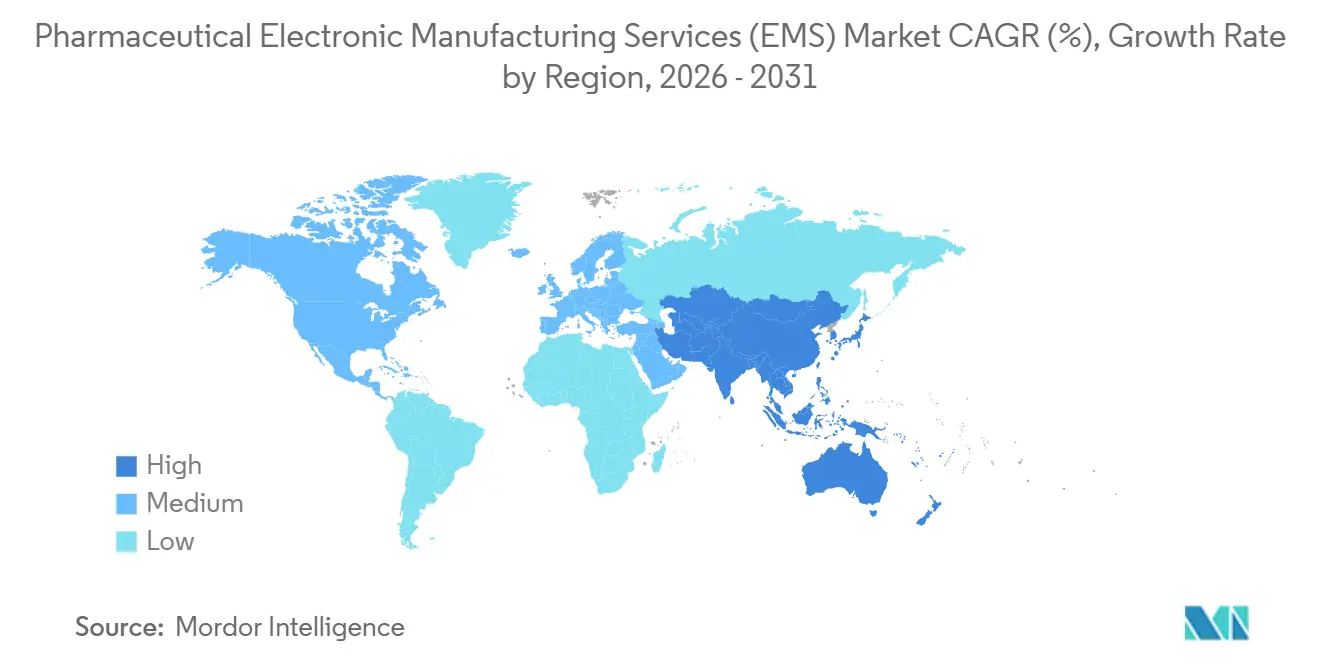
- By geography, North America accounted for 46.36% share in 2025, while the Asia-Pacific is expected to advance at an 11.24% CAGR through 2031.
Note: Market size and forecast figures in this report are generated using Mordor Intelligence’s proprietary estimation framework, updated with the latest available data and insights as of January 2026.
Global Pharmaceutical Electronic Manufacturing Services (EMS) Market Trends and Insights
Drivers Impact Analysis*
| Driver | (~) % Impact on CAGR Forecast | Geographic Relevance | Impact Timeline |
|---|---|---|---|
| Increasing Outsourcing of Pharma Device Manufacturing | +2.4% | Global | Short term (≤ 2 years) |
| Rising Complexity of Drug Delivery Electronics | +1.9% | Global, concentrated in North America and Europe | Short term (≤ 2 years) |
| Tightening Compliance Burden Across ISO, FDA, And EU MDR | +1.5% | North America and Europe, spill-over to Asia-Pacific | Medium term (2-4 years) |
| Nearshoring Of Regulated Production for Supply Chain Control | +1.3% | Global | Medium term (2-4 years) |
| Validation-Ready Digital Traceability and Data Integrity Requirements | +0.8% | North America, Europe, Japan, South Korea | Long term (≥ 4 years) |
| Requalification Delays Created by Serialized Component Obsolescence | +0.4% | North America and Europe | Short term (≤ 2 years) |
| Source: Mordor Intelligence | |||
Increasing Outsourcing of Pharma Device Manufacturing
The pharmaceutical electronic manufacturing services market is gaining from a steady rise in outsourcing by drug makers that want to keep more capital focused on research programs and product development. Jabil reported 14% growth in its healthcare segment in 2025, and 60% of its new contracts bundled design for manufacturing with supply chain support, which shows that customers are asking for broader services from one partner.[1]Jabil Inc., “Annual Report 2025,” Jabil, jabil.com This shift changes the role of contract manufacturers because they are now expected to manage documentation, quality routines, and material control instead of only producing boards and assemblies. The pharmaceutical electronic manufacturing services market therefore rewards providers that already operate across more than one regulated site and can move programs without rebuilding every process from the start. Buyers also tend to stay with qualified suppliers longer because switching a validated manufacturing setup creates extra work across engineering, quality, and procurement teams.
Rising Complexity of Drug Delivery Electronics
The pharmaceutical electronic manufacturing services market is also being pushed higher by the growing electronic content inside drug delivery systems, wearable injectors, and connected combination products. These products need tighter integration between electronics, packaging, assembly, and documentation because failure at any point can affect both device performance and product release. Jabil’s February 2025 acquisition of Pharmaceutics International added aseptic filling, lyophilization, and oral solid dose capabilities, which shows how leading suppliers are trying to cover more of the drug device workflow under one operating structure. This kind of expansion supports the pharmaceutical electronic manufacturing services market because customers prefer fewer handoffs when they move from design work into regulated production. Providers that can combine design, validated assembly, and packaging related support are in a stronger position to win longer contracts and protect pricing.
Tightening Compliance Burden Across ISO, FDA, and EU MDR
The pharmaceutical electronic manufacturing services market is moving toward suppliers that already work within formal quality systems and regulated production controls. In 2026, buyers are placing more weight on audit readiness, traceable production records, and disciplined process control because electronics used in pharmaceutical settings have to fit into broader quality frameworks.[2]Kimball Electronics, Drug/Combination Manufacturing Services (DCMS),” Kimball Electronics, kimballelectronics.com That raises the gap between large certified providers and smaller regional firms that may have technical capability but weaker documentation infrastructure. The pharmaceutical electronic manufacturing services market also becomes harder to enter when customers expect suppliers to show proven experience under FDA and ISO aligned environments before the first production order. As a result, compliance readiness is turning into a commercial advantage instead of a back-office requirement.
Validation-Ready Digital Traceability and Data Integrity Requirements
The pharmaceutical electronic manufacturing services market is being shaped by stronger demand for digital traceability, structured audit trails, and data integrity across manufacturing and packaging environments. As of May 2026, 26 markets required mandatory pharmaceutical serialization, which increases the need for hardware integration, line electronics, and event capture across packaging systems.[3]Global Serialization Is No Longer Optional: What the 2026 Regulatory Landscape Means for Pharmaceutical Manufacturers,” Pharma Trax, pharmatrax.netThis requirement strengthens the pharmaceutical electronic manufacturing services market because customers need equipment that can support GS1 DataMatrix encoding and EPCIS event generation within validated workflows. Providers with proven software-linked hardware capabilities can therefore win recurring work from retrofit projects, system expansions, and multi-site standardization programs. Over time, these needs should keep traceability-related engineering and integration work as a durable demand pool rather than a short one-time upgrade cycle.
Restraints Impact Analysis*
| Restraint | (~) % Impact on CAGR Forecast | Geographic Relevance | Impact Timeline |
|---|---|---|---|
| High Capital Intensity for Cleanroom and Automated Assembly Lines | -1.3% | Global, most acute for smaller providers in emerging markets | Long term (≥ 4 years) |
| Component Allocation Risk for Miniaturized Medical Electronics | -0.6% | Global, with gradual recovery in Middle East and Africa and Asia-Pacific | Short term (≤ 2 years) |
| Extended Validation Cycles and Change-Control Overhead | -0.8% | Global, particularly North America and Europe | Medium term (2-4 years) |
| Limited Pool of Pharma-Grade EMS Suppliers with Regulated Manufacturing Capability | -0.5% | South America and Middle East and Africa | Medium term (2-4 years) |
| Source: Mordor Intelligence | |||
High Capital Intensity for Cleanroom and Automated Assembly Lines
The pharmaceutical electronic manufacturing services market still faces a hard barrier in the cost of building and maintaining regulated electronics capacity. Cleanroom lines, testing systems, environmental controls, and validation support demand more upfront spending than ordinary industrial assembly operations. This burden is heavier in smaller regional markets where financing depth, skilled labor availability, and supporting suppliers are not as strong. The pharmaceutical electronic manufacturing services market therefore remains tilted toward larger firms that can spread compliance and facility costs over bigger production volumes. Smaller providers can still win niche work, but scaling those accounts into broad multi-program relationships is much harder when capital reinvestment stays limited.
Component Allocation Risk for Miniaturized Medical Electronics
The pharmaceutical electronic manufacturing services market is also exposed to component allocation pressure because compact medical and laboratory electronics often depend on specialized parts with fewer direct substitutes. When lead times stretch or approved parts become harder to secure, production scheduling becomes less flexible and qualification work can take longer. This issue matters more in miniaturized devices and control assemblies where board redesign is not simple and any change can ripple through documentation requirements. The pharmaceutical electronic manufacturing services market can manage some of that pressure through deeper sourcing networks and lifecycle planning, but smaller firms often have weaker leverage with global component suppliers. The result is a near-term drag on responsiveness, especially for projects that need tight delivery windows or repeat validation using the same approved electronics bill of materials.
*Our forecasts treat driver/restraint impacts as directional, not additive. The impact forecasts reflect baseline growth, mix effects, and variable interactions.
Segment Analysis
By Service Type: PCB Assembly Holds the Lead While Design Services Grow Faster
PCB assembly and integration held 40.13% of the pharmaceutical electronic manufacturing services market share in 2025, which kept it as the core revenue base across service offerings. This lead comes from the large number of circuit boards used in bioreactor controls, line automation, serialization systems, monitoring devices, and laboratory instruments. Testing and Quality Assurance also remained central because electronics used in pharmaceutical settings need documented performance checks before release into validated operations. In practice, the leading service categories benefit from repeat demand because every expansion in production, packaging, and lab capacity needs dependable assembly and verification work.
Electronic design and engineering is projected to grow at a 10.84% CAGR through 2031, which makes it the fastest-moving service category in the pharmaceutical electronic manufacturing services market. Growth is tied to earlier outsourcing by OEMs that want specialist partners involved before design choices are locked into regulated workflows. Aftermarket Services also form a durable revenue stream because older pharmaceutical equipment still needs board replacement, firmware support, and controlled updates over long operating lives. Across the pharmaceutical electronic manufacturing services industry, this mix shows a clear shift from pure assembly toward broader design, lifecycle support, and compliance-linked services.



By Product Type: Manufacturing Electronics Dominate While Lab Automation Expands Quickly
Pharmaceutical manufacturing equipment electronics captured 42.27% of 2025 revenue, giving this category the largest position within the pharmaceutical electronic manufacturing services market. The segment stayed ahead because new fill-finish lines, sterile facilities, and oral solid dose plants all require electronics-heavy instrumentation and control hardware. Packaging Line Electronics also showed resilience because serialization, coding, and verification functions keep creating upgrade work across established production lines. These product categories give the pharmaceutical electronic manufacturing services market a large installed base that continues to generate both new build and retrofit demand.
Laboratory automation electronics is forecasted to grow at a 10.96% CAGR through 2031, which makes it the fastest-rising product type. Daiichi Sankyo established a 24-hour automated drug discovery setup in the United States in January 2025, which showed how large research organizations are adopting robot-linked and cloud-connected laboratory environments. This supports the pharmaceutical electronic manufacturing services market because more research automation means more demand for validated boards, sensors, controllers, and integrated assemblies. Smart drug delivery and wearable electronics remain a smaller base today, but their electronics content per device suggests stronger long-run value potential than conventional instrument builds.
By Application: Drug Manufacturing Leads While Clinical Research and Serialization Grow Faster
Drug manufacturing and processing accounted for 42.33% share in 2025, which made it the largest application across the pharmaceutical electronic manufacturing services market. The segment stayed on top because fluid handling, dispensing, fermentation, mixing, and power management systems all rely on durable electronics assemblies and control modules. Biopharmaceutical manufacturing also kept expanding as cell therapy, mRNA, and GLP-1 related production platforms required more sensors, monitoring systems, and closed-loop equipment. This pattern keeps the pharmaceutical electronic manufacturing services market tied to both factory expansion and the broader shift toward more instrumented production environments.
Clinical research and laboratory automation are projected to rise at an 11.12% CAGR through 2031, giving it the fastest pace among applications. The category is moving faster because research environments are automating more tasks and because packaging operations need stronger digital traceability across regulated product flows. Large companies are also standardizing data exchange, repository structures, and packaging line controls across sites, which raises the technical requirements for suppliers working with those systems. The pharmaceutical electronic manufacturing services industry therefore gains from both expanding research automation and persistent packaging compliance work.
By End-User: Pharma and Biotech Companies Hold the Largest Share While CMOs Grow Faster
Pharmaceutical and biotech companies contributed 49.11% of 2025 revenue, which gave them the largest end-user position in the pharmaceutical electronic manufacturing services market. Large innovators supported this lead through multi-year investment plans in U.S. manufacturing, including major commitments from AbbVie, Eli Lilly, Merck, and Johnson & Johnson. Those commitments matter because new plants and upgrades drive prolonged demand for process controls, lab systems, environmental monitoring electronics, and inspection hardware. Once a sponsor has a qualified supplier inside its validated network, switching becomes harder because the documentation and reapproval burden spreads across several internal teams. That helps explain why top customers often sign longer relationships with providers that already understand their quality routines and equipment standards.
Contract manufacturing organizations are forecasted to expand at an 11.18% CAGR through 2031, which makes them the fastest-growing end-user segment. This change reflects the fact that CMOs are now major buyers of serialization hardware, bioreactor controls, inspection electronics, and monitoring systems for their own operating platforms. Kimball Electronics is well placed in this area because it already highlights FDA CDER and CDRH registrations together with ISO 13485 and 21 CFR Parts 210 and 211 compliance for drug and combination manufacturing services. That kind of certification profile shortens onboarding friction and makes CMO demand a meaningful growth pool over the forecast period.
Geography Analysis
North America accounted for 46.36% of the pharmaceutical electronic manufacturing services market share in 2025, which kept it as the largest regional contributor. The region benefits from the highest concentration of regulated electronics contract manufacturers and a mature pharmaceutical customer base. Major investment commitments from AstraZeneca, Eli Lilly, Merck, Johnson & Johnson, and Pfizer continue to support local demand for electronics-intensive manufacturing infrastructure. Canada adds stable mid-market demand, while Mexico is gaining attention as a nearshore assembly base with logistical advantages for U.S.-bound programs.
Asia-Pacific is projected to be the fastest-growing regional block in the pharmaceutical electronic manufacturing services market with 11.24% CAGR through 2031. Growth is being supported by India’s policy push, broader supply chain diversification, and the established precision electronics strengths of Japan and South Korea. This mix gives the region a good position for new capacity, especially where customers want an alternative to single-country sourcing. China remains important for large-volume manufacturing, but higher-value validated work is being redistributed more selectively across the region. That shift should keep India, South Korea, and parts of Southeast Asia relevant to new supplier qualification cycles during the forecast period.
Europe forms the second-largest regional revenue cluster, supported by a strong pharmaceutical production base and active modernization of manufacturing systems. Germany, France, the United Kingdom, Italy, and Spain remain the core demand centers, with Germany especially relevant for control systems and process engineering applications. The Middle East and Africa are still early in development, though Gulf countries are building local pharmaceutical capacity that should lift future electronics demand. South America is led by Brazil and Argentina, but near-term expansion remains constrained by a limited pool of pharma-grade EMS providers and higher qualification costs.

Competitive Landscape
The pharmaceutical electronic manufacturing services market is moderately concentrated, with Jabil, Flex, Celestica, Sanmina, and Plexus holding significant revenue in 2025. That position rests on scale, established customer relationships, and certifications that smaller firms cannot quickly. The pharmaceutical electronic manufacturing services market also shows a clear preference for providers that can combine design support, validated production, testing, packaging-related integration, and lifecycle service under one contract.
Plexus offers a second example of how the upper tier is competing for complex healthcare programs. The company reported record Q2F26 manufacturing wins of USD 355 million, including USD 116 million from healthcare, which points to continued demand for higher-value regulated electronics work. The pharmaceutical electronic manufacturing services market is also being shaped by digital capability because customers want lower defect rates and stronger audit trails from the same manufacturing environment.
There is still room for regional players that serve mid-sized CMOs and specialty pharmaceutical companies with smaller program sizes. Those accounts may be less attractive to the largest firms, but they still require regulated manufacturing discipline and dependable supply support. The pharmaceutical electronic manufacturing services market should therefore remain led by a recognized top tier while allowing selective regional growth where certification depth and customer proximity line up well. Over the next few years, the main competitive divide is likely to stay centered on validated infrastructure, service breadth, and the ability to handle more complex electronics programs without disrupting compliance routines.
Pharmaceutical Electronic Manufacturing Services (EMS) Industry Leaders
Jabil Inc.
Flex Ltd.
Sanmina Corporation
Plexus Corp.
Celestica Inc.
- *Disclaimer: Major Players sorted in no particular order

Recent Industry Developments
- June 2026: Jabil inaugurated its advanced manufacturing facility at Ranjangaon, Pune, India, with an investment of INR 1,500 crore (approximately USD 180 million), creating up to 11,000 jobs. The facility manufactures AI-enabled data center equipment, 5G systems, advanced networking gear, and industrial power electronics for domestic use and export, strengthening India's position in the global EMS supply chain.
- May 2026: Opentrons launched Compliance Ready Software (CRS) for the Opentrons Flex robotic platform, the first US FDA 21 CFR Part 11-aligned software for an accessible benchtop liquid handling system. CRS brings authentication, signed audit trails, and role-based access to regulated pharmaceutical laboratories at approximately one-fifth the cost of purpose-built GxP platforms, with general availability planned for August 2026.
- May 2026: Jabil secured a contract with Siemens to operate a new power distribution and switchgear manufacturing facility in Prince George County, Virginia, involving a USD 6.1 million investment and creating 352 jobs, with operations scheduled to open in fall 2026. The deal reinforces Jabil's US industrial electronics manufacturing footprint alongside its pharmaceutical-oriented operations.
- February 2025: Jabil acquired Pharmaceutics International Inc. (Pii), a science-driven CDMO specializing in aseptic filling, lyophilization, and oral solid dose manufacturing, adding four FDA-registered GMP facilities in Hunt Valley, Maryland, totaling over 360,000 sq ft. The acquisition positions Jabil as a one-stop provider from drug device concept through commercialization, including fill-finish capabilities.


Global Pharmaceutical Electronic Manufacturing Services (EMS) Market Report Scope
According to the report’s scope, the pharmaceutical electronic manufacturing services (EMS) market covers outsourced production of electronic components and assemblies, such as PCBs, sensors, and electromechanical modules, used in drug‑delivery devices, diagnostics, and connected health systems, ensuring compliant, high‑reliability manufacturing for pharma applications.
The pharmaceutical electronic manufacturing services (EMS) market is segmented into service type, product type, application, end-user, and geography. By service type, the market is segmented into electronic design and engineering services, PCB assembly and integration, box build assembly, testing and quality assurance services, packaging and labeling electronics integration, and aftermarket services and maintenance. By product type, the market is segmented into control systems and automation electronics, pharmaceutical manufacturing equipment electronics, laboratory automation electronics, packaging line electronics systems, and other product types. By application, the market is segmented into drug manufacturing and production lines, biopharmaceutical manufacturing, clinical research and laboratory automation, packaging and serialization systems, and other applications. By end-user, the market is segmented into pharmaceutical and biotechnological companies, contract manufacturing organizations, and other end-users. By geography, the market is segmented into North America, Europe, Asia-Pacific, the Middle East and Africa, and South America. The report also covers the estimated market sizes and trends for 17 countries across major regions globally. The report offers values (USD) for all the above segments.
| Electronic Design and Engineering Services |
| PCB Assembly and Integration |
| Box Build Assembly |
| Testing and Quality Assurance Services |
| Packaging and Labeling Electronics Integration |
| Aftermarket Services and Maintenance |
| Control Systems and Automation Electronics |
| Pharmaceutical Manufacturing Equipment Electronics |
| Laboratory Automation Electronics |
| Packaging Line Electronics Systems |
| Other Product Types |
| Drug Manufacturing and Production Lines |
| Biopharmaceutical Manufacturing |
| Clinical Research and Laboratory Automation |
| Packaging and Serialization Systems |
| Other Applications |
| Pharmaceutical and Biotechnological Companies |
| Contract Manufacturing Organizations |
| Other End-Users |
| North America | United States |
| Canada | |
| Mexico | |
| Europe | Germany |
| United Kingdom | |
| France | |
| Italy | |
| Spain | |
| Rest of Europe | |
| Asia-Pacific | China |
| Japan | |
| India | |
| Australia | |
| South Korea | |
| Rest of Asia-Pacific | |
| Middle East and Africa | GCC |
| South Africa | |
| Rest of Middle East and Africa | |
| South America | Brazil |
| Argentina | |
| Rest of South America |
| By Service Type | Electronic Design and Engineering Services | |
| PCB Assembly and Integration | ||
| Box Build Assembly | ||
| Testing and Quality Assurance Services | ||
| Packaging and Labeling Electronics Integration | ||
| Aftermarket Services and Maintenance | ||
| By Product Type | Control Systems and Automation Electronics | |
| Pharmaceutical Manufacturing Equipment Electronics | ||
| Laboratory Automation Electronics | ||
| Packaging Line Electronics Systems | ||
| Other Product Types | ||
| By Application | Drug Manufacturing and Production Lines | |
| Biopharmaceutical Manufacturing | ||
| Clinical Research and Laboratory Automation | ||
| Packaging and Serialization Systems | ||
| Other Applications | ||
| By End-User | Pharmaceutical and Biotechnological Companies | |
| Contract Manufacturing Organizations | ||
| Other End-Users | ||
| By Geography | North America | United States |
| Canada | ||
| Mexico | ||
| Europe | Germany | |
| United Kingdom | ||
| France | ||
| Italy | ||
| Spain | ||
| Rest of Europe | ||
| Asia-Pacific | China | |
| Japan | ||
| India | ||
| Australia | ||
| South Korea | ||
| Rest of Asia-Pacific | ||
| Middle East and Africa | GCC | |
| South Africa | ||
| Rest of Middle East and Africa | ||
| South America | Brazil | |
| Argentina | ||
| Rest of South America | ||


Key Questions Answered in the Report
What is the 2031 outlook for pharmaceutical electronic manufacturing services?
The pharmaceutical electronic manufacturing services (EMS) market is forecasted to reach USD 51.91 billion by 2031 from USD 32.69 billion in 2025 to USD 35.17 billion in 2026, which reflects an 8.10% CAGR over 2026 to 2031.
Which service area generates the most revenue?
PCB Assembly and Integration led all service types with 40.13% share in 2025, showing that core board assembly remains the largest revenue pool even as design services grow faster.
Which product category is growing the fastest in this space?
Laboratory Automation Electronics is expected to be the fastest-growing product type at a 10.96% CAGR through 2031, supported by wider use of robotic and AI-linked laboratory workflows.
Why is North America still the leading regional base?
North America held 46.36% share in 2025 because it has a dense regulated supplier base, a large pharmaceutical customer base, and strong investment in manufacturing infrastructure.
Page last updated on:





