
Peptide Synthesis Reagents Market Size and Share
Market Overview
| Study Period | 2021 - 2031 |
|---|---|
| Market Size (2026) | USD 2.85 Billion |
| Market Size (2031) | USD 4.12 Billion |
| Growth Rate (2026 - 2031) | 7.65 % |
| Fastest Growing Market | Asia-Pacific |
| Largest Market | North America |
| Market Concentration | Medium |
Major Players *Disclaimer: Major Players sorted in no particular order Image © Mordor Intelligence. Reuse requires attribution under CC BY 4.0. | |
Peptide Synthesis Reagents Market Analysis by Mordor Intelligence
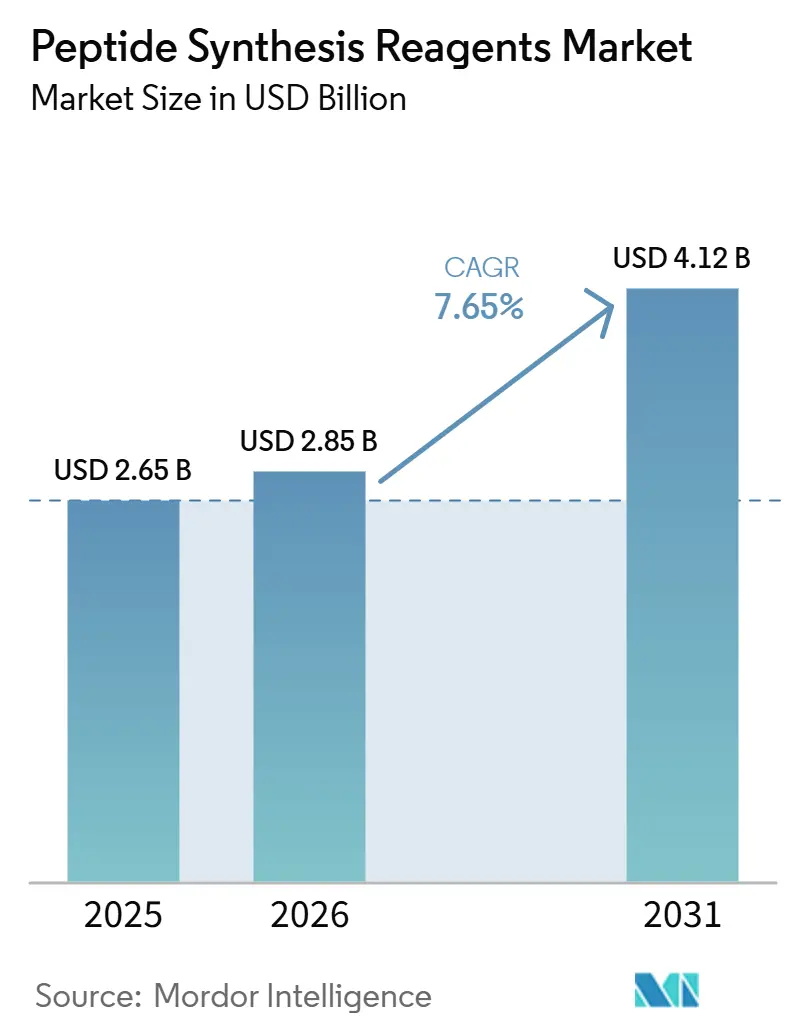
The Peptide Synthesis Reagents Market size is expected to grow from USD 2.65 billion in 2025 to USD 2.85 billion in 2026 and is forecast to reach USD 4.12 billion by 2031 at 7.65% CAGR over 2026-2031. The peptide synthesis reagents market is advancing amid a larger therapeutic peptide pipeline, steady demand for glucagon-like peptide-1 (GLP-1) drugs, and rising interest in oral peptide formats that require tighter purity controls and more specialized inputs. Commercial capacity additions at major peptide manufacturing sites are also supporting market growth, as each new large-scale synthesis line raises recurring demand for protected amino acids, coupling agents, resins, and related additives. A parallel shift is underway in solvent selection, where regulatory pressure on dimethylformamide (DMF) and growing scrutiny around fluorinated processing materials are pushing the market toward reformulated coupling systems and greener synthesis setups. Stricter documentation standards in regulated programs, particularly in Europe, are further shaping the market, as synthetic peptide guidance now emphasizes impurity traceability and supplier qualification. Competitive positioning in this market depends less on catalog breadth alone and more on supply reliability, compliance support, green chemistry readiness, and the ability to serve both research and commercial peptide manufacturing programs.
Key Report Takeaways
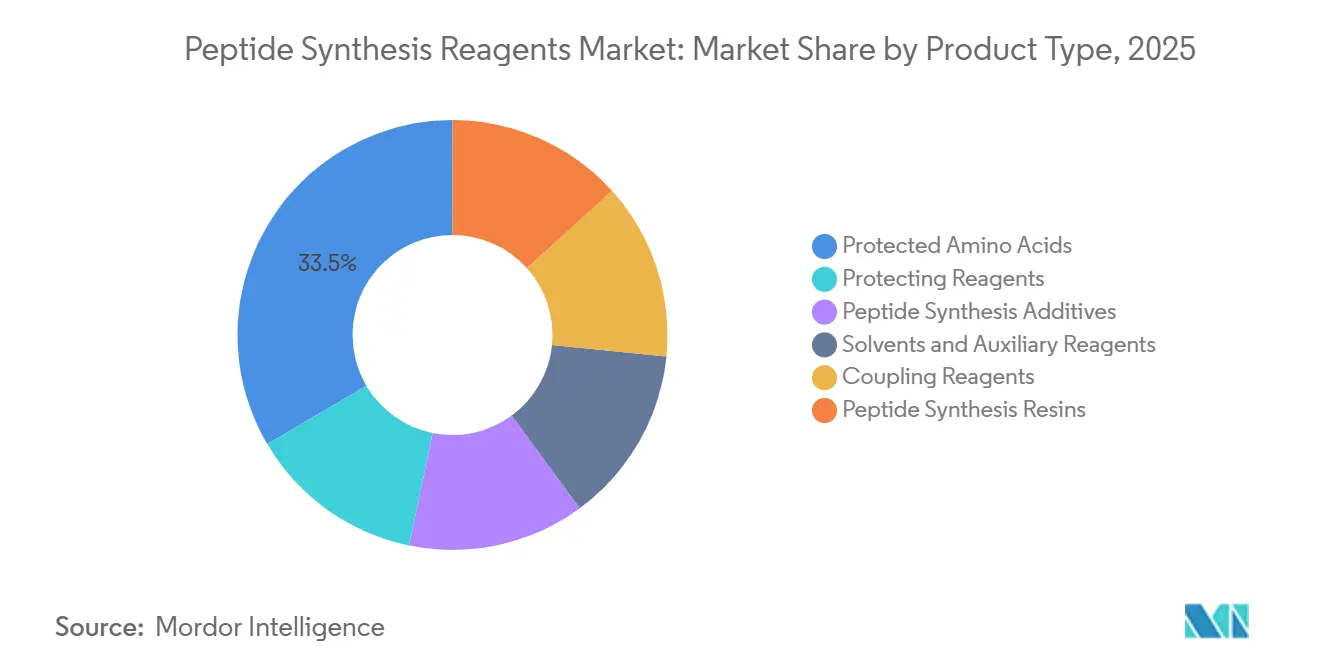
- By product type, protected amino acids held 33.47% share in 2025, while coupling reagents are projected to expand at 8.41% CAGR through 2031.
- By synthesis method, solid-phase peptide synthesis held 74.31% of the peptide synthesis reagents market share in 2025, while hybrid peptide synthesis is forecast to grow at 9.27% CAGR through 2031.
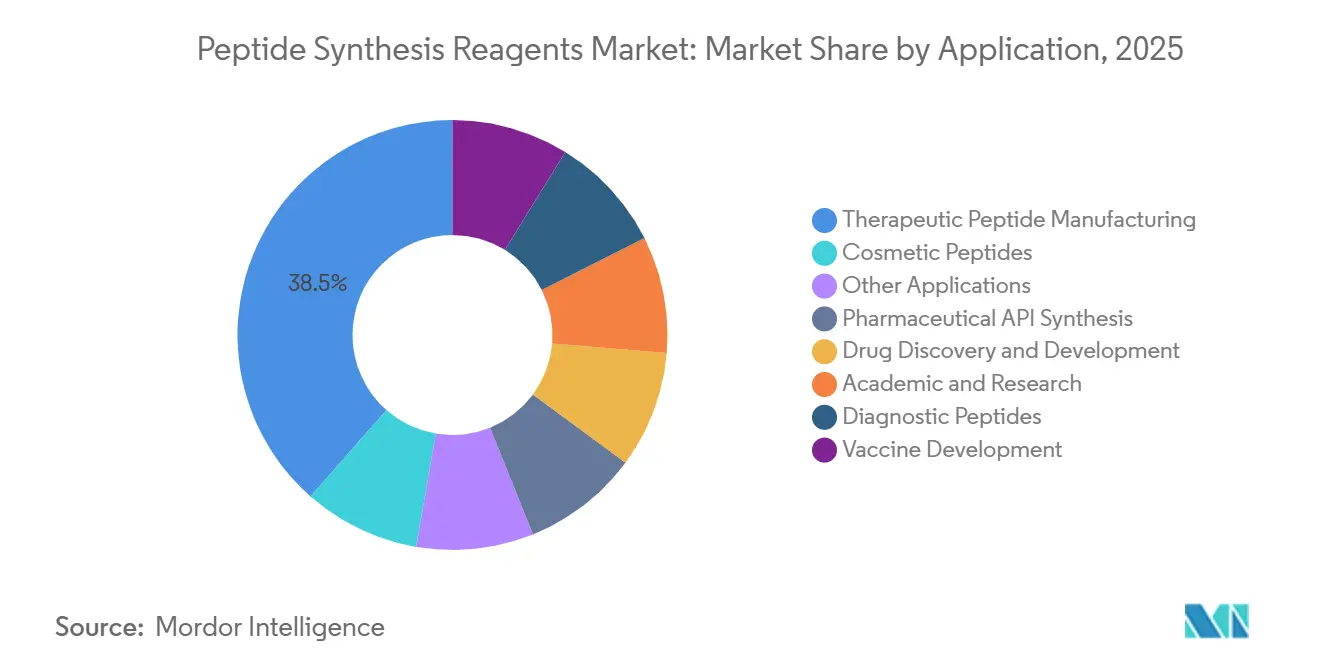
- By application, therapeutic peptide manufacturing accounted for 38.52% of the peptide synthesis reagents market size in 2025, while vaccine development is projected to expand at 8.54% CAGR through 2031.
- By geography, North America led with 39.82% share in 2025, while Asia-Pacific is forecast to grow at 9.03% CAGR through 2031.
Note: Market size and forecast figures in this report are generated using Mordor Intelligence’s proprietary estimation framework, updated with the latest available data and insights as of January 2026.
Market Trends and Insights
Drivers Impact Analysis of Peptide Synthesis Reagents Market*
| Drivers | (~) % Impact on CAGR Forecast | Geographic Relevance | Impact Timeline |
|---|---|---|---|
| Rapid Growth of Peptide Therapeutics | +2.8% | Global, with the highest intensity in North America and the EU | Long term (≥ 4 years) |
| Increasing Adoption of Continuous Manufacturing | +1.2% | North America and the EU, emerging in the Asia-Pacific | Medium term (2-4 years) |
| Rising Pharmaceutical R&D Expenditure | +1.5% | Global, with China-linked R&D activity at high levels | Long term (≥ 4 years) |
| Expansion of CDMO Services | +1.8% | Global, with Asia-Pacific as a core center and spillover to the Middle East and Africa | Medium term (2-4 years) |
| Technological Advancements in Peptide Synthesis | +1.0% | Global, with early adoption gains in the EU and North America | Medium term (2-4 years) |
| Source: Mordor Intelligence | |||
Rapid Growth of Peptide Therapeutics
Peptide drugs now represent a meaningful revenue stream in global pharmaceuticals, although they remain a smaller share of total molecules. This keeps the peptide synthesis reagents market closely tied to late-stage therapeutic progress. More than 150 peptide candidates entered clinical trials for the first time in 2025, supporting a broad base of future reagent consumption across discovery, development, and scale-up activities. Demand in the peptide synthesis reagents market rises sharply as high-volume metabolic or cardiovascular programs move closer to commercial production, as they consume repeated equivalents of protected residues and coupling agents at each synthesis step. Progress in oral peptides also changes the mix of required inputs, since developers need cleaner building blocks and tighter process control to support complex bioavailability strategies. This makes the peptide synthesis reagents market more sensitive to pipeline quality and manufacturing readiness than to molecule count alone.
Expansion of Contract Development and Manufacturing Organization (CDMO) Services
The peptide synthesis reagents market is being supported by a new phase of peptide CDMO expansion, as manufacturers expand their synthesis footprints and broaden their process capabilities across regions. Bachem is ramping up Building K in Bubendorf in 2026, which strengthens large-scale production capacity for modern APIs and reinforces long-duration purchasing demand for peptide inputs[1]Bachem Holding AG, “Bachem Inaugurates Building K in Bubendorf,” Bachem News, bachem.com. CordenPharma's agreement to acquire AmbioPharm in May 2026 adds manufacturing sites in the United States and China, shifting the geography of peptide supply and strengthening a broader global production network. PharmaBlock's first GMP pilot-scale peptide plant in Zhejiang became operational in June 2026, with liquid-phase, continuous-flow, and enzyme-assisted capabilities that broaden the reagent basket used in commercial development. As a result, the peptide synthesis reagents market is increasingly shaped by a smaller number of large buyers that can influence grade selection, documentation needs, and preferred chemistry platforms.
Rising Pharmaceutical Research and Development (R&D) Expenditure
The peptide synthesis reagents market depends on early-stage research activity, because discovery and preclinical work determine the future pipeline that later moves into GMP-scale peptide manufacturing. Research institutions and early drug developers buy small batches of high-purity building blocks, multiple orthogonal protecting groups, and specialized coupling systems for structure-activity work and sequence optimization. That demand profile is important because it supports a broad SKU mix in the peptide synthesis reagents market even before commercial scale is visible. The value of these research programs lies not only in near-term catalog revenue, but also in the future conversion of successful programs into larger clinical and commercial orders over the next several years. This gives the peptide synthesis reagents market a layered demand structure, in which small research lots can later become large manufacturing contracts.
Technological Advancements in Peptide Synthesis
A 2025 study in Nature Communications described a fully automated, software-directed peptide synthesis workflow that combined fluorenylmethoxycarbonyl (Fmoc) chemistry, on-resin cyclization, and in-solution ligation into a single uninterrupted digital process. Continuous-flow Solid-Phase Peptide Synthesis (SPPS) has also shown value at the multigram scale, where faster campaign times and tighter reagent dosing can shift procurement toward more frequent, better-controlled replenishment cycles. Microwave-assisted SPPS has demonstrated waste reduction through wash-free methods validated in both R&D and production settings, supporting lower solvent use and improved operating efficiency. A 2026 Nature Sustainability study showed water-based amino acid coupling with yields comparable to dimethylformamide (DMF)-based protocols under Fmoc conditions, and a 2026 Green Chemistry paper reported solvent-less amide coupling with lower reagent input. These developments are pushing the peptide synthesis reagents market toward higher-efficiency products that work across automated, flow-based, and greener synthesis systems.
Restraints Impact Analysis of Peptide Synthesis Reagents Market*
| Restraints | (~) % Impact on CAGR Forecast | Geographic Relevance | Impact Timeline |
|---|---|---|---|
| High Cost of Premium Synthesis Reagents | -0.8% | Global, amplified in price-sensitive Asia-Pacific markets | Short term (≤ 2 years) |
| Complex Multi-Step Purification Requirements | -0.6% | Global, with the highest burden for mid-scale and emerging-market manufacturers | Medium term (2-4 years) |
| Regulatory and Quality Compliance Challenges | -0.5% | North America and the EU, with spillovers to the Asia-Pacific as manufacturers pursuing FDA and EMA registration | Long term (≥ 4 years) |
| Source: Mordor Intelligence | |||
High Cost of Premium Synthesis Reagents
The peptide synthesis reagents market faces a persistent cost barrier, as pharmaceutical-grade protected amino acids and specialty coupling agents remain more expensive than lower-grade alternatives. Purification accounts for a significant portion of this burden, with peptide manufacturers reporting that it can account for 50% to 60% of total manufacturing costs and that conventional C18 methods can consume substantial solvent volumes per kilogram of purified Active Pharmaceutical Ingredient (API)[2]Neuland Laboratories, “Overcoming Challenges in Complex Peptide Purification,” Neuland Labs Insights, neulandlabs.com. This cost pressure intensifies when manufacturers select lower-specification inputs, as incomplete coupling and higher racemization can increase the need for additional purification cycles. The impact is more pronounced for long, modified, or cyclic peptides, where reagent loads are heavier and each synthesis error is more costly to correct. As a result, market growth is uneven across customer groups, with smaller manufacturers and budget-constrained laboratories more exposed to total cost pressure than large commercial peptide producers.
Regulatory and Quality Compliance Challenges
The peptide synthesis reagents market is further restrained by a complex compliance burden spanning ICH Q11, ICH Q7, relevant USP chapters, and the EMA's synthetic peptide guideline, effective from June 2026. The European guidance requires flowcharts for reagent synthesis steps and criticality assessments of starting material impurities, increasing the level of supplier documentation required for regulated programs. Suppliers unable to provide this documentation face exclusion from EU-facing projects, narrowing the qualified supply base for manufacturers that depend on audited vendors. The same compliance burden slows the adoption of new green chemistry inputs in GMP settings, as technical performance alone is insufficient without complete analytical and quality support. As a result, the market favors suppliers that can combine product performance with strong documentation systems and consistent batch records.
*Our forecasts treat driver/restraint impacts as directional, not additive. The impact forecasts reflect baseline growth, mix effects, and variable interactions.
Peptide Synthesis Reagents Market Segment Analysis
By Product Type:
Protected Amino Acids Retain the Dominant Feedstock PositionProtected amino acids held 33.47% of the peptide synthesis reagents market share in 2025, reflecting their universal use across both solid-phase and liquid-phase synthesis routes. Their demand remains high because every peptide program relies on repeated incorporation of protected residues, and large glucagon-like peptide-1 (GLP-1) programs multiply that requirement across long sequences and high production volumes. Coupling reagents are projected to grow at an 8.41% CAGR through 2031, making them the fastest-growing product category in the peptide synthesis reagents market. A 2025 study showed that the coupling reagent TBEC, used with green binary solvents, delivered liraglutide synthesis yields comparable to those of conventional dimethylformamide (DMF)-based methods, supporting commercial interest in next-generation reagent systems.
Peptide synthesis resins remained the third-largest product category, as they provide the solid support needed for solid-phase peptide synthesis (SPPS) and continue to be relevant as long as SPPS dominates commercial production. Interest is rising in silica-based non-swelling resin systems, as they reduce solvent requirements and align more closely with flow-based processing platforms used in parts of the peptide synthesis reagents industry. Protecting reagents and synthesis additives represent a smaller category by volume, but offer greater value potential where safety, stability, and established regulatory acceptance are important. Solvents and auxiliary reagents face near-term pressure as manufacturers evaluate DMF alternatives. FUJIFILM Wako expanded its CertiPro GMP-compliant line in 2025 to support customers requiring stronger purity assurance and supply reliability.



By Synthesis Method:
SPPS Dominance Persists While Hybrid Approaches AccelerateSolid-phase peptide synthesis (SPPS) held a 74.31% share in 2025, underscoring its continued dominance as the primary production route for many commercial peptide active pharmaceutical ingredients (APIs) in the peptide synthesis reagents market. Its position is reinforced by the installed base being expanded across major peptide manufacturing sites, which keeps resin demand and standard SPPS input demand structurally high. Hybrid peptide synthesis is forecast to grow at a 9.27% CAGR through 2031, making it the fastest-growing method in the peptide synthesis reagents market. It combines fragment condensation, enzymatic steps, or solution processing with SPPS, improving yield or reducing solvent use. PharmaBlock's Zhejiang Good Manufacturing Practice (GMP) facility, which became operational in June 2026, integrates SPPS, liquid-phase, continuous-flow, and enzyme-assisted synthesis on a single platform, demonstrating how mixed-method production is moving into practical use.
Liquid-phase peptide synthesis retains a clear role in cosmetics and selected shorter-chain APIs where solution chemistry can offer a cost benefit. Its standalone use remains constrained by sequence-length limits, and it is more difficult to control for some complex structures. Hybrid routes are relevant because they broaden the input profile for each program, requiring the peptide synthesis reagents market to serve both solution-grade and SPPS-grade specifications within the same manufacturing pathway. A 2025 Journal of the American Chemical Society study reported a small-molecule catalyst for 9-fluorenylmethoxycarbonyl (Fmoc) SPPS in acetonitrile, suggesting future changes in solvents and coupling systems across both solid-phase and solution-linked workflows.
By Application:
Therapeutic Pipeline Anchors Demand as Vaccine Segment Gains GroundTherapeutic peptide manufacturing accounted for 38.52% of the peptide synthesis reagents market in 2025, reflecting the commercial scale of glucagon-like peptide-1 (GLP-1) agonists, oncology peptides, and cardiovascular analogs. This segment remains the largest demand center because it consumes pharmaceutical-grade inputs in large and recurring volumes once a product reaches sustained production. Pharmaceutical API synthesis forms the next layer of demand, covering generic peptide APIs and early commercial programs that require GMP-compliant reagents with verified purity. Drug discovery, development, and academic research generate smaller lot sizes, but support a wide range of stock-keeping units (SKUs) and keep the peptide synthesis reagents market connected to future commercial conversion.
Vaccine development is projected to grow at an 8.54% CAGR through 2031, driven by neoantigen programs that require fast, high-purity synthesis of many patient-specific peptide sequences. These programs require tight impurity control, which increases the value of well-characterized reagent lots and process consistency in the peptide synthesis reagents market. Diagnostic peptides and cosmetic peptides remain stable demand areas, and the cosmetic segment has often adopted green solvent-compatible methods earlier than regulated pharmaceutical programs. FUJIFILM announced a novel cyclic peptide screening platform in May 2026, signaling a stronger overlap between diagnostic and discovery workflows and supporting demand for specialized cyclization chemistries and orthogonal protecting strategies.
Geography Analysis
North America Peptide Synthesis Reagents Market
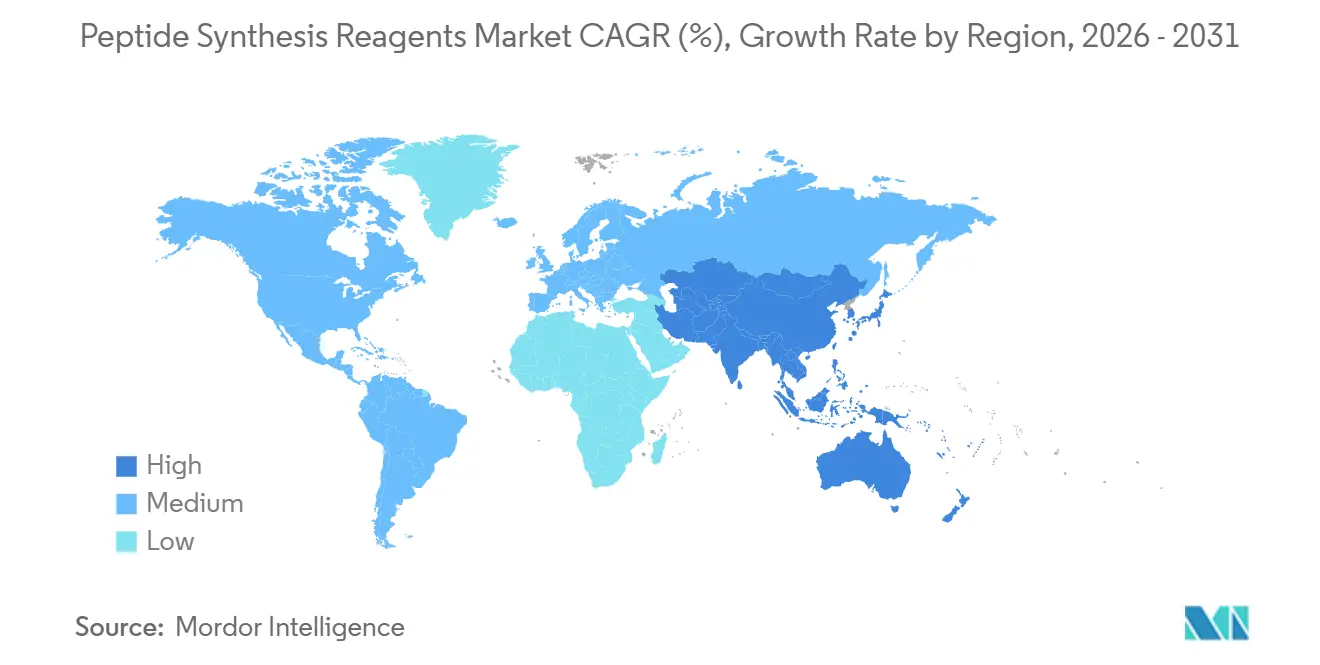
North America held 39.82% of the peptide synthesis reagents market share in 2025, making it the largest regional contributor. The region benefits from a dense concentration of pharmaceutical companies, biotechnology firms, and large peptide Contract Development and Manufacturing Organizations (CDMOs) across the United States. This concentration supports steady demand for GMP-grade amino acid derivatives, coupling systems, resins, and documentation-ready specialty inputs in the peptide synthesis reagents market. Commercial investment remains active, and Bachem's ongoing expansion in 2026 indicates that North America continues to attract peptide manufacturing capacity alongside its existing development base. Canada contributes a smaller but growing share through academic research activity and contract development work centered in established life sciences provinces.
APAC Peptide Synthesis Reagents Market
Asia-Pacific is forecast to expand at a 9.03% CAGR through 2031, making it the fastest-growing region in the peptide synthesis reagents market. China supports this pace through its broad reagent manufacturing base; GL Biochem operates 5 global manufacturing sites and has commercialized more than 10,000 peptide reagents and building blocks. The region is also benefiting from a broader peptide manufacturing build-out, as demonstrated by PharmaBlock's Zhejiang GMP plant, which adds liquid-phase, continuous-flow, and enzyme-assisted synthesis capabilities. Japan maintains a distinct position through its depth in specialty reagents, and a 2026 agreement between Crafton Biotechnology and FUJIFILM Wako on a novel phosphoramidite reagent highlights its relevance in adjacent high-purity synthesis fields. India and South Korea are also improving their standing as customers seek cost-competitive, technically capable production options within the peptide synthesis reagents market.
Europe and Middle East Peptide Synthesis Reagents Market
Europe remains an established regional base in the peptide synthesis reagents market, supported by pharmaceutical clusters in Germany, the United Kingdom, and France. CordenPharma's Muttenz facility project represents a significant regional infrastructure commitment in the current cycle, indicating that Europe continues to invest in future peptide capacity. Germany's specialty chemistry ecosystem supports regional demand by supplying amino acid derivatives, reagent kits, and research-use materials. The Rest of the World remains smaller and earlier in development, with demand concentrated in academic research and basic pharmaceutical manufacturing, although healthcare investment in parts of the Middle East is beginning to create new opportunities for GMP-oriented supply.

Competitive Landscape
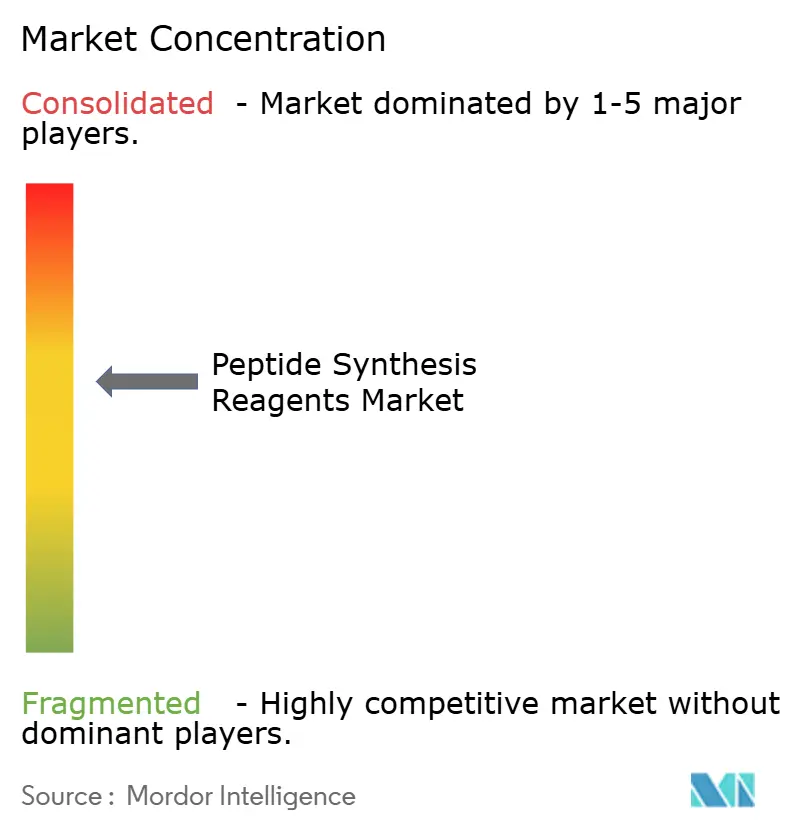
The peptide synthesis reagents market is moderately consolidated. A small group of companies, including Merck KGaA through MilliporeSigma, Thermo Fisher Scientific, Bachem, FUJIFILM Wako Pure Chemical, and GL Biochem, accounts for a large share of pharmaceutical-grade reagent revenue. At the same time, many smaller specialty suppliers remain active across unusual amino acid derivatives, isotope-labeled building blocks, and niche coupling systems, keeping the market open to technical differentiation rather than scale alone. This structure allows large customers to rely on global suppliers for core materials while sourcing specialized inputs from focused chemistry vendors. Price competition is also uneven, with greater pressure on catalog products and stronger margins on compliance-heavy or technically distinctive products.
A notable strategic shift in the market is the growing overlap between reagent supply and peptide Contract Development and Manufacturing Organization (CDMO) services. CordenPharma's Tag-Assisted Peptide Synthesis technology won the CPhI 2025 Pharma Award for API Development and Innovation, reflecting how proprietary synthesis platforms can reshape reagent preferences within customer programs. Bachem's Building K ramp in 2026 is one example, as new manufacturing capacity strengthens both its peptide production role and its influence over input demand patterns. CordenPharma's acquisition of AmbioPharm in May 2026 added US and China manufacturing nodes and broadened the company's reach across solid-phase, liquid-phase, and hybrid synthesis needs. These developments indicate that strategic advantage in the market is increasingly tied to process ownership, manufacturing scale, and customer integration.
Technology represents one of the clearest areas of competition in the peptide synthesis reagents market. Suppliers with dimethylformamide (DMF)-free, flow-compatible, and greener coupling portfolios are better positioned as customers prepare for regulatory and operational changes related to solvent use and impurity control. Research on digital twin systems for TIDES manufacturing also suggests that some suppliers will compete by pairing reagent lots with process data and modeling support, rather than by selling materials alone. Asian suppliers are also improving documentation and quality systems to compete more directly in regulated markets, which will keep the market active on both cost and compliance dimensions. Patent activity in sustainable coupling chemistry and flow-compatible protected amino acid synthesis further indicates that intellectual property will play a greater role in supplier positioning going forward.
Peptide Synthesis Reagents Industry Leaders
Thermo Fisher Scientific Inc.
Merck KGaA
Bachem Inc.
AAPPTec
Fluorochem Limited
- *Disclaimer: Major Players sorted in no particular order
Peptide Synthesis Reagents Market Companies Covered in this Report
- AAPPTec
- AnaSpec, Inc.
- Bachem Inc.
- Biosolve Chimie
- BLD Pharmatech Ltd.
- Canpeptide Inc.
- Carl Roth GmbH + Co. KG
- Chem-Impex International
- CordenPharma International
- CS Bio Co.
- Enamine Ltd.
- Fluorochem Limited
- FUJIFILM Wako Pure Chemical Corporation
- GL Biochem (Shanghai) Ltd.
- IRIS Biotech GmbH
- Luxembourg Bio Technologies Ltd.
- Merck KGaA
- Suzhou Highfine Biotech Co., Ltd.
- Thermo Fisher Scientific Inc.
- Tokyo Chemical Industry Co., Ltd.

Recent Industry Developments in Peptide Synthesis Reagents Market
- June 2026: PharmaBlock Sciences commissioned its first peptide GMP pilot-scale plant at its Zhejiang site. The facility integrates LPPS, continuous-flow LPPS, and enzyme-assisted peptide synthesis. This platform extends beyond conventional SPPS and reflects a shift in China's peptide manufacturing capabilities toward higher-complexity synthesis routes.
- May 2026: CordenPharma entered into an agreement to acquire AmbioPharm, a US-headquartered peptide API CDMO with manufacturing sites in South Carolina (USA) and Shanghai (China). The acquisition adds SPPS, LPPS, and hybrid synthesis capabilities to CordenPharma's existing network and provides US-based peptide API supply options for large-scale commercial projects. This move is directly linked to supply chain repositioning demands arising from the BIOSECURE Act.


Global Peptide Synthesis Reagents Market Report Scope
Peptide synthesis is the process of chemically constructing peptides in a laboratory by linking individual amino acids together via peptide bonds. It is used to create peptide-based drugs, vaccines, and biochemical tools, typically through a cyclic process of adding protected amino acids to a growing chain.
The peptide synthesis reagents market is segmented by product type, synthesis method, application, and geography. By product type, the market is segmented into protected amino acids, coupling reagents, peptide synthesis resins, protecting reagents, peptide synthesis additives, and solvents and auxiliary reagents. By synthesis method, the market is segmented into solid-phase peptide synthesis (SPPS), liquid-phase peptide synthesis (LPPS), and hybrid peptide synthesis. By application, the market is segmented into therapeutic peptide manufacturing, pharmaceutical API synthesis, drug discovery and development, academic and research, diagnostic peptides, vaccine development, cosmetic peptides, and other applications. The report also covers market size and forecasts for peptide synthesis reagents across 11 countries in major regions. The market sizes and forecasts are provided in terms of value (USD).
| Protected Amino Acids |
| Coupling Reagents |
| Peptide Synthesis Resins |
| Protecting Reagents |
| Peptide Synthesis Additives |
| Solvents and Auxiliary Reagents |
| Solid-Phase Peptide Synthesis (SPPS) |
| Liquid-Phase Peptide Synthesis (LPPS) |
| Hybrid Peptide Synthesis |
| Therapeutic Peptide Manufacturing |
| Pharmaceutical API Synthesis |
| Drug Discovery and Development |
| Academic and Research |
| Diagnostic Peptides |
| Vaccine Development |
| Cosmetic Peptides |
| Other Applications |
| Asia-Pacific | China |
| India | |
| Japan | |
| South Korea | |
| Rest of Asia-Pacific | |
| North America | United States |
| Canada | |
| Europe | Germany |
| United Kingdom | |
| France | |
| Italy | |
| Russia | |
| Rest of Europe | |
| Rest of the World | South America |
| Middle-East and Africa |
| By Product Type | Protected Amino Acids | |
| Coupling Reagents | ||
| Peptide Synthesis Resins | ||
| Protecting Reagents | ||
| Peptide Synthesis Additives | ||
| Solvents and Auxiliary Reagents | ||
| By Synthesis Method | Solid-Phase Peptide Synthesis (SPPS) | |
| Liquid-Phase Peptide Synthesis (LPPS) | ||
| Hybrid Peptide Synthesis | ||
| By Application | Therapeutic Peptide Manufacturing | |
| Pharmaceutical API Synthesis | ||
| Drug Discovery and Development | ||
| Academic and Research | ||
| Diagnostic Peptides | ||
| Vaccine Development | ||
| Cosmetic Peptides | ||
| Other Applications | ||
| By Geography | Asia-Pacific | China |
| India | ||
| Japan | ||
| South Korea | ||
| Rest of Asia-Pacific | ||
| North America | United States | |
| Canada | ||
| Europe | Germany | |
| United Kingdom | ||
| France | ||
| Italy | ||
| Russia | ||
| Rest of Europe | ||
| Rest of the World | South America | |
| Middle-East and Africa | ||


Key Questions Answered in the Report
What is current market size of Peptide Synthesis Reagents Market?
The Peptide Synthesis Reagents Market size is expected to grow from USD 2.65 billion in 2025 to USD 2.85 billion in 2026 and is forecast to reach USD 4.12 billion by 2031 at 7.65% CAGR over 2026-2031.
Which product group is currently driving revenue?
Protected amino acids led product demand with a 33.47% share in 2025 because they are required across nearly every peptide synthesis workflow.
Which synthesis approach is growing the fastest?
Hybrid peptide synthesis is projected to expand at a 9.27% CAGR through 2031 as manufacturers combine solid-phase and solution-phase steps to improve yield and flexibility.
Why is vaccine-related demand increasing for peptide inputs?
Vaccine development is projected to grow at an 8.54% CAGR through 2031, largely because neoantigen programs require rapid, high-purity synthesis of many patient-specific peptide sequences.
Page last updated on:





